How to Launch Your First Micro-SaaS in 2026: A Practical Playbook
A step-by-step playbook for shipping your first profitable micro-SaaS in 2026 — from validating an idea to picking a lean stack, pricing, and launching to your first paying customers.

Micro-SaaS is the most accessible way to start an internet business in 2026. You don't need a team, funding, or a grand vision — just a narrow problem, a small audience, and the discipline to ship. This playbook walks you through the entire path, from a vague idea to your first paying customers.
What is a micro-SaaS?
A micro-SaaS is a small, focused software product run by one person or a tiny team. It solves one problem well, has low operating costs, and is designed for profitability over hypergrowth.
Why micro-SaaS in 2026
Three shifts make this the best time yet to start small:
- AI lowers the build cost. Code generation, support automation, and content workflows mean one founder can do the work of a small team.
- Distribution is fragmented but reachable. Niche communities, newsletters, and creators let you reach a specific audience without a marketing budget.
- Infrastructure is effectively free to start. Modern hosting, auth, and databases have generous free tiers that scale only when you do.
Step 1: Pick a problem, not an idea
Beginners chase ideas ("an app that does X"). Founders chase problems people already pay to solve. Strong signals for a good micro-SaaS problem:
- People currently solve it with a messy spreadsheet or manual process.
- It lives in a niche you understand or can reach.
- It recurs — a one-time need rarely supports a subscription.
Avoid the vitamin trap
"Nice to have" products are hard to sell. Aim for a painkiller: something that saves money, saves meaningful time, or reduces risk.
Step 2: Validate before you build
The goal of validation is to get evidence — ideally money or a strong commitment — before writing production code.
- Write a one-sentence value proposition.
- Talk to 10 people who have the problem. Listen for the words they use.
- Put up a simple landing page describing the outcome, not the features.
- Drive a little traffic and measure intent (email signups, pre-orders, calls booked).
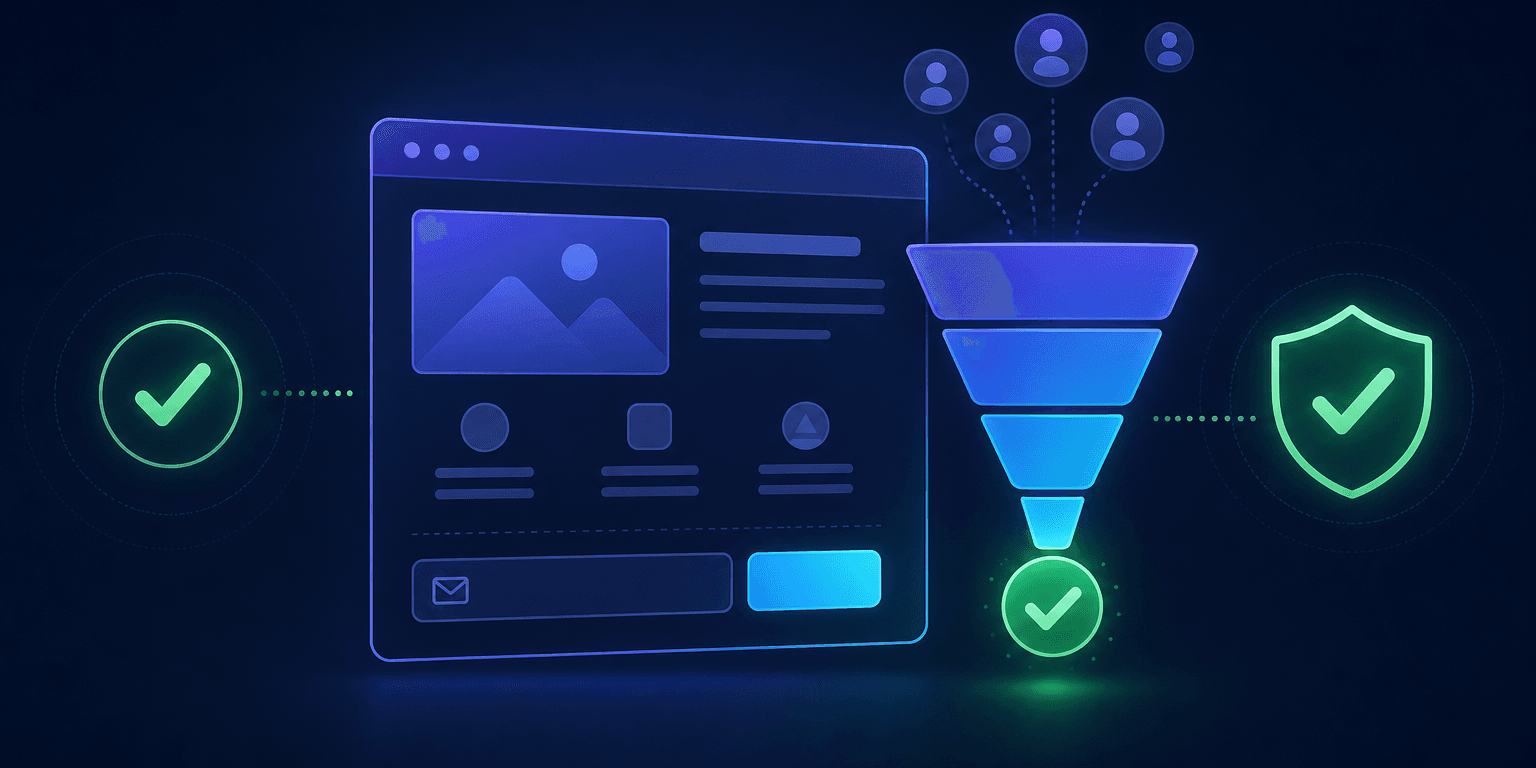
A realistic validation funnel looks like this:
If you can't get a handful of signups from people who match your target, fix the positioning or the problem before building.
Step 3: Choose a lean stack
Optimize for speed of iteration and low maintenance, not for theoretical scale. A dependable 2026 solo-founder stack:
| Layer | Recommended choice | Why |
|---|---|---|
| Framework | Next.js (App Router) | One codebase for UI, API, and SSR |
| Styling | Tailwind CSS | Fast, consistent UI without overhead |
| Auth | A hosted auth provider | Don't roll your own auth |
| Database | Managed Postgres | Reliable, well understood, cheap |
| Payments | Stripe | The default for SaaS billing |
| Hosting | A serverless platform | Scales to zero, deploys in minutes |
The principle: buy (or rent) everything that isn't your core differentiator.
Step 4: Build the smallest thing that delivers the outcome
Your MVP should do one job end to end. Resist adding settings, dashboards, and integrations until customers ask. A minimal billing check often looks like this:
export function hasActiveSubscription(
  user: { status: "active" | "trialing" | "canceled" }
): boolean {
  return user.status === "active" || user.status === "trialing";
}
Ship it to a few of your validation contacts first. Their feedback is worth more than any roadmap.
Step 5: Price for value
For a first micro-SaaS, keep pricing simple and slightly higher than feels comfortable:
- Start with one or two plans, billed monthly and yearly.
- Anchor on the value delivered (time or money saved), not your costs.
- Offer annual billing to improve cash flow and reduce churn.
Charge from day one
Free users give you flattering metrics and little signal. Paying customers tell you whether you have a real business.
Step 6: Launch to a specific audience
A "launch" is not one big day — it's a sequence of small, repeatable pushes:
- Warm list first. Email the people who signed up during validation.
- Communities. Share genuinely useful content where your audience already gathers.
- Build in public. Document the journey; it compounds into distribution.
- Content + SEO. Write the articles your buyers search for before they buy.
Step 7: Measure what matters
In the early days, track a handful of numbers and ignore vanity metrics:
- Activation rate (signups that reach the core value)
- Trial-to-paid conversion
- Monthly recurring revenue (MRR)
- Churn
If activation is low, your onboarding is broken. If conversion is low, your value or pricing is off. Let the metrics point you to the next fix.
Conclusion
Launching your first micro-SaaS in 2026 is less about clever ideas and more about disciplined execution: find a real, recurring problem, validate it with real intent, build the smallest useful version, charge for it, and launch repeatedly to a specific audience. Start narrow, stay close to your customers, and let revenue — not hype — guide what you build next.
Related posts
Validating a Micro-SaaS Idea Before You Build
How to validate a micro-SaaS idea with real evidence — conversations, landing pages, and signals of intent — before writing any production code.

Finding Micro-SaaS Ideas: Where Real Opportunities Hide
A practical guide to finding micro-SaaS ideas worth pursuing — by hunting for painful, recurring problems instead of waiting for inspiration.
Comments
Comments are not configured yet. Add your Giscus values in src/config/site.ts.