How to Build a Micro SaaS With AI in 2026 (Without Building Another Useless Wrapper)
A practical, no-hype walkthrough of building a profitable micro SaaS with AI in 2026: finding a real problem, validating it, shipping, pricing, and launching as a solo founder.
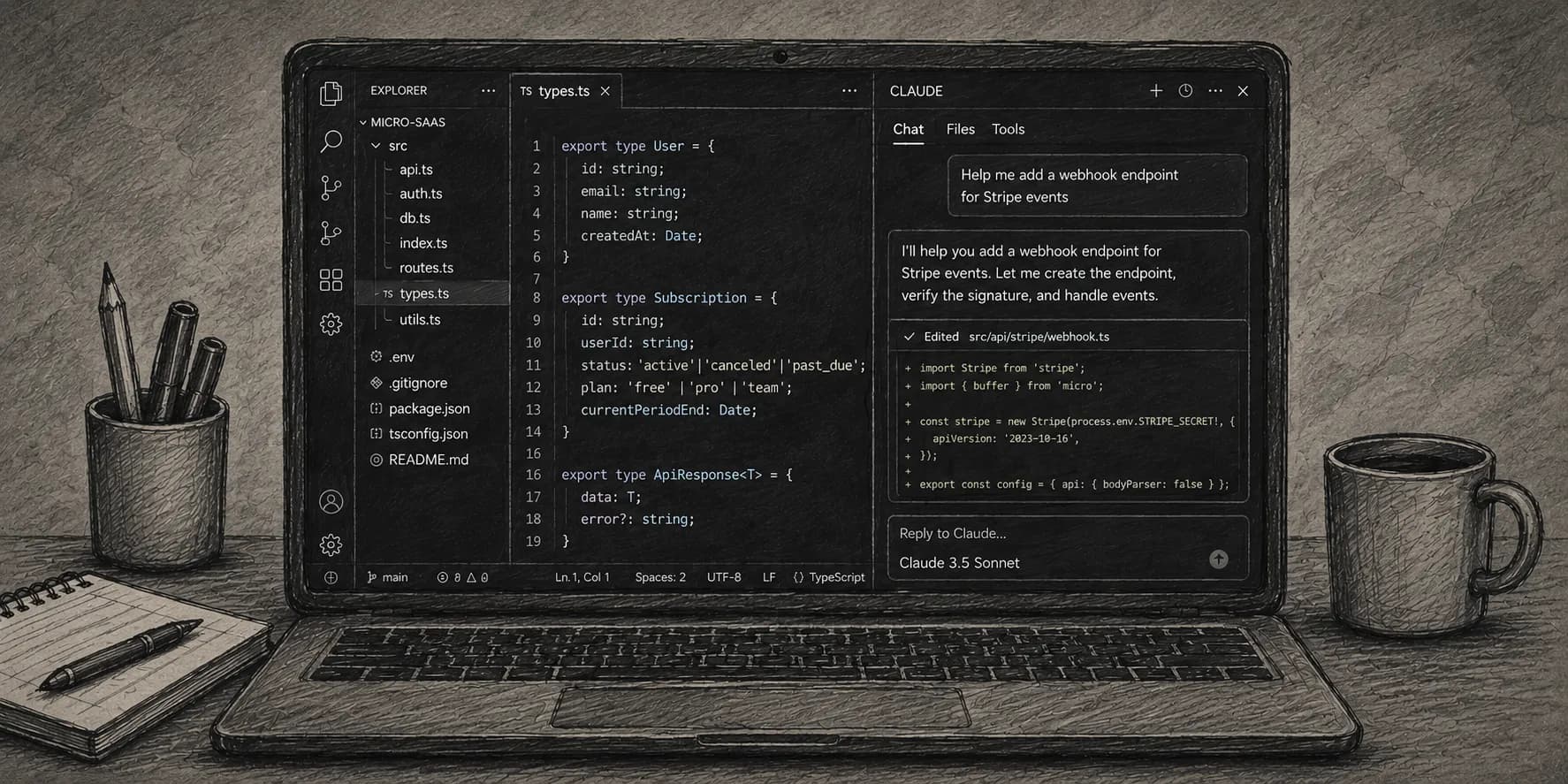
A few months back, a friend built a whole SaaS in a weekend. Real auth, Stripe checkout, a dashboard that actually looked good. He sent me a screenshot Sunday night, genuinely proud, and he had every right to be. The thing worked. Two weeks later I asked how it was going. Silence. No signups, no emails, not one person trying to pay him. The product was fine. The problem was that nobody had asked for it.
That's the state of building software in 2026, squeezed into a single weekend.
I've been writing code since 2012, and I've shipped more micro-SaaS products than I can cleanly remember. A couple paid my bills for years. Most went quietly nowhere. Several never got a single paying customer. The flops taught me far more than the wins, and there's one lesson AI has made louder instead of quieter: writing the code was never the hard part. Figuring out what to build, and getting a stranger to pay for it, that's the hard part.
So when someone asks me how to build a micro SaaS with AI, I want to answer a different question first. Not "how do I get the code written," because that's the easy slice now. The real question is how you use this ridiculous new speed without tricking yourself into shipping things nobody wants.
This is a long one, so here's the deal up front. I'm going to walk through the whole thing the way I'd actually do it today: finding a problem worth solving, checking that real people have it, picking a boring stack, letting AI do the heavy lifting where it's good and keeping it on a leash where it isn't, then pricing and launching without theatrics. I'll be specific about tools and numbers. Some of the numbers are made-up examples, and I'll say so when they are.
One belief colors everything below, so I'll put it on the table now. A boring SaaS making $2,000 a month beats a revolutionary one making nothing. AI doesn't change that. It just lets you find out which one you've got a lot faster.
Quick note on who this is for. If you're a developer who can already wrangle a frontend and a database, this is squarely aimed at you, because AI multiplies what you already know. If you're not technical yet, most of it still applies, you'll just lean on the AI more heavily for the building and need to be even more ruthless about validation, since you can't fall back on raw coding speed. Either way the order of operations is the same, and that order is the entire point.
AI made building easy. It didn't make it matter
Here's what actually changed in the last two years, and I want to be precise about it. The cost of turning an idea into working software fell off a cliff. What used to be three weeks of wiring up auth, forms, a database, and a payment flow is now an afternoon with Cursor and a clear head. That's real. I'm not one of those people who rolls his eyes at AI tooling. I use it every single day, and it's one of the best productivity tools I've ever touched.
But cheap construction has a side effect nobody likes to talk about. When building gets easy, building stops being a moat. If you can spin up your idea in a weekend, so can the next person, and the one after that. The barrier that used to protect you, the sheer annoyance of getting something to work, is mostly gone. What's left is the part AI can't do for you: knowing that the thing is worth making at all.
I'll say it plainly. AI can help you build faster. It can't tell you what people will pay for. Those are completely different skills, and the second one is the whole game.
Think about what a flooded market does to your odds. Picture the obvious AI idea everyone has right now, some "summarize your documents" tool. You can build it this weekend. So can ten thousand other developers, and a few of them are better marketers than you. The model underneath is the same one everybody else is renting. There's nothing in there that's actually yours.
This doesn't mean AI products are doomed. It means the value has to live somewhere other than "we called an API." Maybe it's a specific workflow for a specific kind of customer who'd never figure out the raw tools themselves. Maybe it's the data you accumulate over time, or the integrations, or just being the one small tool a niche actually trusts. The model is a commodity. Your judgment isn't.
So before I open my editor, I make myself sit with an uncomfortable question. If a competent developer could clone this in a weekend, what do I have that they don't? If the only honest answer is "I built it first," that's not a business. That's a head start measured in days, and days run out.
There's a reframe that stuck with me. Launch platforms and app stores are seeing more new products shipped every week than ever, and a huge share of them never reach a tenth customer. I don't bring that up to be grim. I bring it up because it changes the job description. In 2015, shipping something that worked was an achievement on its own. In 2026, shipping is the cover charge to even be in the room. The achievement is being the one product in that flood that a specific person actually needs and remembers. Hold that picture in your head every time the AI makes building feel effortless, because effortless is precisely when people stop asking whether they should build at all.
What a micro SaaS really is (and what it isn't)
Let me back up, because "micro SaaS" gets thrown around like everyone agrees on what it means, and they don't. To me, a micro SaaS is a small software product that solves one specific problem for one specific group of people, run by one person or a tiny team, priced as a recurring subscription. That's the whole definition. No funding round, no roadmap with forty features, no plan to own a category. One problem, one audience, money coming in every month.
What it isn't is a startup in miniature waiting to grow up. The smallness isn't a phase you escape. It's the actual strategy.
The one-problem rule
The discipline that makes a micro SaaS work is saying no. One problem, solved well, for people who feel that problem sharply. Say you build a tool that does exactly one thing: it watches a handful of competitor pricing pages and emails a small e-commerce shop when prices change. That's not a platform. It's barely even a feature. And it's a feature people will happily pay $29 a month for, because the alternative is checking by hand or missing it entirely.
The moment you start adding "and it could also," you're drifting away from the thing that made it buyable in the first place. Every extra feature is more to build, more to support, more ways for a new user to get confused about what your product even does. With a micro SaaS, the narrowness is the sales pitch. People understand instantly whether it's for them.
Why small is the point, not a limitation
There's a quiet snobbery in tech that treats "small" as a consolation prize, the thing you settle for when you couldn't build the big thing. I think that's backwards. Small is what lets one person run a profitable business without a team, without investors, without anyone's permission.
Do the math on it. Imagine 200 customers paying $29 a month. That's $5,800 in monthly recurring revenue, with maybe two hours a week of support and a hosting bill under $50. Nobody's writing a press release about that. It's also a real, durable income that one person controls completely. I'll take the boring version of that every time.
The trap is comparing your micro SaaS to a venture-backed company. Don't. They're playing a different sport, with different rules and a different definition of winning. Your win is freedom and margin. Theirs is a bigger fundraise. Keep your eyes on your own game.
If you want a feel for the shape of these things, picture the unglamorous middle of the market. A tool that turns one specific kind of spreadsheet into a clean PDF report. A scheduler built only for tattoo artists. A plugin that adds the one missing feature to a popular platform that the platform itself will never prioritize. None of these will ever land on a magazine cover. Each of them can quietly support a person, sometimes for years. That's the genre we're working in, and it's badly underrated precisely because it isn't loud.
Why building one in 2026 is actually different
People have built micro-SaaS products for fifteen years, so what's genuinely different now, and what's just hype with a 2026 sticker slapped on it? Both things are real at once, and they're worth separating.
What changed in the last couple of years
The build time collapsed, and the support burden shrank with it. A solo founder in 2026 has a stack that would have needed a small team a decade ago. AI coding assistants like Cursor and Claude handle the scaffolding. Supabase and Vercel handle the infrastructure you used to babysit. Stripe handles the billing you used to dread. Customer support can lean on AI for the first pass at common questions.
Put all that together and the practical result is wild. One person can realistically run two or three small products at once, each making a few thousand a month, without grinding themselves into dust. That wasn't possible in 2015. You'd have spent every waking hour just keeping the lights on.
The other shift is the speed of iteration. When changing a feature takes an hour instead of a day, you experiment more. You can afford to be wrong, notice it quickly, and fix it. That tightens the loop between an idea and real feedback, which is exactly where most of the learning actually happens.
The new trap that came with it
Here's the catch, and it's the thing I worry about for new builders. When building is cheap, the bottleneck moves entirely to demand. And demand is precisely the part AI doesn't help with.
So you get a strange new failure mode. People build beautifully, fast, and constantly, and they build the wrong things faster than ever. My friend's weekend SaaS is the perfect example. The code was never the problem. He skipped the slow, annoying, deeply human work of confirming that anyone wanted it, because the tools made it so easy to skip.
I've felt that pull myself. It's genuinely more fun to build than to go ask strangers whether they'd pay. AI makes building even more fun, and even faster, which makes it even easier to dodge the question that matters. So the discipline you need in 2026 isn't technical. It's the willpower to validate before you build, exactly when the building has never been more tempting.
I'll put a finer point on the opportunity, because I don't only want to wave warnings. The flip side of cheap building is that the math of a small portfolio finally works for one person. If a single product can reach, say, $2,000 a month, then three of them is a genuine income, and AI is what makes running three at once survivable instead of crushing. That wasn't a realistic plan for a solo founder a few years ago. It is now. The catch is that each of those three still has to clear the demand bar on its own. Cheap building lets you take more shots. It does not let you skip aiming.
Start with a problem, not a prompt
If one habit separates the micro-SaaS products that make money from the ones that die quietly, it's this. The winners start from a problem. The losers start from an idea, or worse, from a cool thing they wanted to build with a shiny new tool. I've been on both sides of that line plenty of times, and the problem-first ones are the only ones that ever paid me.
Where the good problems are hiding
Good problems are boring, specific, and a little tedious to think about. They don't sound exciting at a party. "I help bookkeepers reconcile one annoying kind of transaction faster" will never get a round of applause, and it might be a great business.
The richest source I know is work people already hate doing. Repetitive tasks. Copy-pasting between two tools that should obviously talk to each other. A spreadsheet that has quietly become load-bearing in someone's business. Go where people complain: niche subreddits, the Slack and Discord servers for a profession, the replies under a frustrated tweet, the support forums for popular software where people beg for a feature that's never coming. When you see the same gripe three times from three different people, you've found something.
Notice I haven't mentioned AI once here. That's on purpose. The problem comes first. AI is just how you'll build the answer later.
The search-volume trick I lean on
Here's a concrete one, and it's the same move I'd use to decide what to write or build. Take a guess at how someone would describe their problem in a search bar, then go check whether anyone actually searches for it. A tool like Ahrefs, or even the free Google Keyword Planner, will show you rough monthly volume and how competitive a term is.
What I'm hunting for isn't the biggest number. It's the overlooked one. A phrase with a few hundred searches a month and weak, low-effort results on the first page of Google is a gift. It means people are looking, and nobody good has bothered to answer them properly. That's a far better signal than a term with fifty thousand searches and ten funded companies already fighting over it.
Treat the volume numbers as rough directions, not gospel. They're estimates, and they drift between tools. But the pattern, real searches plus weak existing answers, is one of the cleanest demand signals you can get for free.
Scratch your own itch, but check it's not just yours
The classic indie advice is to build for yourself, and it's good advice with a sharp edge. Scratching your own itch is great, because you understand the problem deeply and you're customer number one. The danger is assuming your itch is universal when it might be yours alone.
I once spent three weeks building a tool I was certain every developer needed, because I needed it badly. Turns out I was the market. The whole market. It was a fantastic tool for exactly one person, and that person doesn't pay himself.
So use your own frustration as the starting gun, not the finish line. Once you've got the itch, go find five other people who have it too and haven't already solved it some other way. If you can't find them, that's not a reason to keep building and hope. It's information. Painful, useful, money-saving information.
One more filter I run before committing to anything. Not every real problem is a good business. I ask three quick things: do the people with this problem have money, can I reach them somewhere specific, and is the pain frequent enough that they'll keep paying month after month. A problem that only stings once a year is a brutal sell, no matter how genuine it is. A painful weekly problem, felt by a group that already spends money on tools, is the sweet spot. Plenty of honest frustrations fail that test, and it's far cheaper to fail them here, on a notepad, than after you've built the thing.
Validate before AI writes a single line
This is the section people skim, and it's the most important one in the whole piece. Validation is the unglamorous work that decides whether your next month is well spent or wasted. And in 2026, with building so cheap, the temptation to skip straight to code is stronger than it's ever been. Resist it. A week of validation can save you three months of building something that was dead on arrival.
The fake door that saves you three months
My favorite validation move costs almost nothing and takes an afternoon. Build a landing page for the product before the product exists. Describe what it does, who it's for, the problem it kills, and a price. Add a button that says "Get started" or "Start free trial." When someone clicks, capture their email and tell them it's launching soon.
That's it. You've built a fake door, and you're measuring how many people try to walk through it.
You can put this together in two hours with Carrd or a single Next.js page, no real backend required. Then send a little traffic at it, from the communities where you found the problem, a relevant subreddit, a small ad budget if you want data faster. Watch what happens. If people land and leave without a flicker of interest, you just learned something crucial for the price of an afternoon. If a chunk of them hand over their email to use a thing that doesn't even exist yet, that's a real signal, plus a warm list of first users waiting for you.
Five conversations beat a hundred guesses
Numbers tell you whether people click. Conversations tell you why. You need both, and most builders skip the second because it's uncomfortable. Talking to strangers about their problems feels like sales, and a lot of developers got into this partly to avoid sales. I understand. Do it anyway.
Find five people who have the problem and get them on a call, or even just a long chat thread. Don't pitch. Ask how they handle the thing today. Ask what they've already tried, what they hated about it, how much time or money it costs them right now. The magic question, the one that cuts through politeness, is some version of: "If a tool did this for you, what would make it worth paying for, and how much?"
Then listen for specifics. "Yeah, that sounds useful" is noise. People are nice, and they lie to be kind. "I currently pay a VA $200 a month to do this by hand" is gold, because it's a real number attached to real pain. Five honest conversations will reshape your product more than a hundred confident assumptions ever could.
What actually counts as a real signal
Here's where people fool themselves, so let me be blunt about what counts and what doesn't. Likes don't count. Retweets don't count. "Great idea, you should build it" doesn't count, especially from friends. Raw traffic doesn't count. These are vanity signals, and they feel like progress while telling you almost nothing.
What counts is money, or a credible promise of it. An email handed over to get early access counts a little. Someone joining a paid waitlist with a small deposit counts a lot. Someone saying "take my money, when can I start" and then actually replying to your follow-up counts most of all. Revenue is validation. Everything else is a guess wearing a nice outfit.
My rough bar, and it's a personal rule rather than a law, is this: I want clear evidence that a handful of strangers will pay real money before I let AI write a single line of the actual product. If I can't get even a tiny version of that, the problem usually isn't my pitch. It's that the demand was never really there. Far better to learn that now, for the cost of a week, than after a month of building.
Here's what passing this bar might actually look like, with made-up but realistic numbers. Say you send 300 visitors to the fake-door page from a couple of relevant subreddits and a tiny ad test. Forty of them click "Start free trial," and twenty-five hand over an email to join the waitlist. On your five calls, three people describe the problem with real heat, and two of them name a number they already spend on a workaround. That's not proof, but it's a strong yes, and you've got a warm list to launch into. Now compare it to the other common outcome: 300 visitors, four half-hearted clicks, and five "cool idea" replies with nobody willing to commit anything. Same effort, opposite signal. The second one just handed you back a month of your life, if you're honest enough to read it that way.
The stack I'd reach for
Once you've earned the right to build, the stack matters less than people pretend. Pick boring, proven tools you can move fast in, and spend your energy on the product instead of on architecture debates. Here's what I reach for, and more importantly, why.
TypeScript, Next.js, Supabase, Stripe, and why
My default for years now: TypeScript, Next.js, Supabase, and Stripe, with AI living in the editor. It's not the only good choice. It's the one that lets me ship a real, billable product in days instead of weeks, and early on that's the only metric I care about.
TypeScript, because the types catch dumb mistakes before they ship, and they make AI assistants dramatically more useful, since the model can see the shape of your data. Next.js, because it handles the frontend, the API routes, and the marketing pages in one project, deployed to Vercel with almost no ops work. Supabase, because it hands you a real Postgres database, authentication, and file storage out of the box, so you're not building login screens from scratch in 2026. Stripe, because getting paid is the entire point, and rolling your own billing is a special kind of self-harm.
The theme connecting all of it: don't build what you can rent. Here's how I think about the classic "should I build this myself" decision.
| Piece | Roll your own | What I do instead |
|---|---|---|
| Authentication | Weeks of edge cases and security risk | Supabase Auth |
| Billing and subscriptions | Months of webhook pain | Stripe |
| Database and hosting | Servers to patch and babysit | Supabase plus Vercel |
| The actual product | Nobody can do this for you | Build it yourself |
That last row is the whole strategy. Spend your scarce time on the one part that's genuinely yours, and let managed services handle the plumbing that every SaaS needs and nobody pays extra for.
Where AI actually fits in this stack
AI sits on top of all of it, in the editor. I live in Cursor, with Claude or GPT doing a lot of the typing. For this kind of stack, that pairing is close to magic, because the tools are popular and well-documented, which means the models know them cold. Ask for a Stripe webhook handler in a Next.js route and you'll get something 90% right on the first try.
But notice what the AI is actually doing here. It's accelerating work inside a stack I chose and understand. It isn't making the architectural calls. It's filling in the well-trodden patterns quickly, so I can spend my own thinking on the parts that are specific to my product.
One honest caveat. AI is great at the popular path and worse at the weird edges. The more obscure your tool choices, the less help you'll get, and the more confidently wrong the suggestions become. That's another quiet argument for a boring, mainstream stack. You're not just buying stability. You're buying a model that actually knows your tools.
One specific thing I set up early on Supabase is row-level security, so the database itself enforces that users only ever see their own rows. It's the kind of guardrail that turns a whole category of nasty auth bugs into a non-event, and it's worth understanding rather than letting AI bolt it on blindly. A policy as plain as this covers a lot of ground:
create policy "users read own rows"
on watches for select
using ( auth.uid() = user_id );
That's three lines that quietly prevent the exact disaster I keep warning about, one customer seeing another's data. I'd much rather spend ten minutes genuinely understanding that policy than ship a clever feature on top of a database that trusts everybody who asks.
How to build with AI without losing the plot
Now the fun part, and the part where people either get a real edge or quietly create a mess they'll regret. Building with AI well is a skill. It is not "type a prompt, paste the code, repeat." Done carelessly, you end up the proud owner of a codebase you don't understand, which is a miserable place to be when something breaks at 2am and a paying customer is annoyed.
Let it scaffold, don't let it architect
Here's the mental model that's served me well. AI is fantastic at scaffolding and filling in known patterns. It's unreliable at the big structural decisions that shape everything downstream. So I keep those two jobs apart.
I make the architectural calls myself. How the data is modeled. Where the boundaries between pieces sit. How money flows through the system. What happens when something fails. Those are decisions I want to own, because they're expensive to undo and they're exactly where understanding pays off. Then I hand the implementation to AI. "Given this schema, write the function that does X." "Here's the pattern I'm using for API routes, now write the one for this endpoint."
When you let AI make the structural decisions, you get something that runs today and fights you for months. It will happily invent three different ways to handle the same thing across your codebase, because it doesn't hold the whole picture in its head the way you do. You're the architect. Let the AI be the very fast, very tireless contractor.
To make that concrete, compare two prompts. The weak one is "build me a price monitoring feature," which hands the AI every structural decision and all but guarantees a tangle. The strong one sounds more like: "I have a watches table with a url and a user_id. Write a function that takes one watch row, fetches the page, extracts the price using this selector, and returns the new price or null. Don't touch the database, I'll handle persistence myself." The second prompt is doing the senior work, the boundaries, the inputs, the single responsibility, and leaving only the typing to the model. You'll feel the quality difference in the very first response.
The parts you still have to understand yourself
There are areas where "it works and I don't really know why" is a genuine liability, and you should refuse to ship code there until you understand it. My list is short but firm: anything touching authentication, anything touching money, and anything touching customer data.
Auth, because a subtle mistake means one user seeing another user's data, and that's the kind of bug that can end a small product's reputation overnight. Billing, because errors here either cost you revenue silently or charge customers wrong, and both are awful in their own way. Data handling, because privacy mistakes are legal and trust problems, not just technical ones.
AI will write plausible code for all three. Plausible isn't good enough here. I read every line in these areas, I make sure I understand the failure modes, and I test them on purpose, including the ugly cases. Everywhere else, I'll happily move fast and fix things later. In these three, slow and certain wins, because the cost of being wrong is so lopsided.
Reviewing AI code like it's an eager junior
The frame that keeps me sane: treat AI like a brilliant, fast, slightly overconfident junior developer. It produces a lot of good work quickly, and every so often it hands you something subtly wrong with total confidence. Your job is the senior review.
That means reading what it wrote before it goes in. Not skimming. Reading. Does this handle the empty case, the error case, the malicious-input case? Is it doing something clever that I'll curse in three months? Did it quietly pull in a dependency I don't need? I once let a "small" suggestion slip through that re-fetched data on every single render. The app was flawless in the demo and crawled the moment real usage hit it. The database was fast. The code wasn't.
The productivity win from AI is real, but it's a win on writing, not on understanding. You still have to own the understanding. If you can't explain what a piece of code does and why, it isn't ready to ship, no matter how confidently the model produced it. That habit costs you a little speed today and saves you from a codebase you're scared of later.
A realistic walkthrough of the build
Let me make this concrete with a hypothetical, so the advice isn't floating in the abstract. Say we validated that small e-commerce shops want a tool that monitors competitor prices and alerts them to changes. We've got a dozen emails on a waitlist and three people who said, on a call, that they'd pay $39 a month. Now we build. Here's roughly how the week goes.
The boring 80%: auth, billing, settings
Most of any SaaS is the same plumbing every other SaaS has, and this is exactly where AI and managed services earn their keep. Day one is the scaffolding nobody will ever praise you for.
Signup and login? Supabase Auth, wired up in about an hour with AI writing the glue code. Subscription billing? Stripe Checkout plus a webhook that flips a "subscribed" flag in the database, which I'll read carefully because, as I said, money. A settings page where someone enters the competitor URLs they want watched? A basic CRUD form, and AI produces the first version of that in minutes. Account management, password reset, a billing portal? Stripe and Supabase hand you most of it for free.
None of this is your product. None of it is interesting. All of it is necessary, and all of it is the well-lit path where AI is at its absolute best. Move through it fast, don't gold-plate it, and save your real attention for the next part.
The 20% that's actually your product
The thing customers are actually paying for, in our example, is the part that reliably checks those pages and notices genuine changes without crying wolf. That's the core, and it's where I slow right down and think for myself.
This is where the genuinely hard questions live. How often do we check a page without getting blocked? How do we tell a real price change from a layout shuffle or an A/B test? What does the alert say, so it's useful instead of annoying? AI will help me write the code once I've decided the approach, but the decisions here are mine, because they are the product. Get the plumbing wrong and it's embarrassing. Get this wrong and there's no reason for anyone to pay.
To make it less abstract: for the price monitor, the unglamorous heart of it is a scheduled job that runs every few hours, loops through the watched pages, fetches each one politely with backoff so we don't get blocked, and compares the extracted price against the last value we stored. When it finds a genuine change, it queues an email. That loop is maybe sixty lines of code, and it's the sixty lines I'll read three times before I trust them. Everything around it, the dashboard showing price history, the form to add a URL, the email template, the AI can draft in an afternoon. Those sixty lines are the company. The rest is packaging.
So I'll spend a disproportionate share of the week right here. Maybe auth and billing took a day combined. The detection logic, the thing that's actually mine, might take three. That ratio is correct, not a sign I'm slow. The boring 80% is 80% of the surface area and 20% of the value. Spend accordingly.
Knowing when to stop letting AI drive
There's a moment in every AI-assisted build where you should take the wheel back, and recognizing it is its own skill. It usually shows up as a smell. You're pasting in the fourth round of "that's not quite right, try again," and the code is getting more tangled, not less.
When that happens, the AI has lost the thread, and so have you if you keep going. The fix is to stop, close the chat, and actually think. Sketch the logic on paper, or in plain comments in the file. Decide what the function should do, step by step, in your own head. Then either write it yourself or give the AI a much tighter, smaller instruction. Almost every time, the mess came from me asking for too much at once, before I understood the shape of what I wanted.
The tell is simple. If you're accepting suggestions you don't fully understand just to make the red error go away, stop. You're not building anymore. You're gambling, and you'll pay it back later with interest, usually while a customer waits.
Pricing it without overthinking
Pricing paralyzes people, and it really shouldn't. You will not get it perfect, you can change it later, and early on your price is a hypothesis like everything else. The biggest pricing mistake I see in micro-SaaS isn't picking the wrong number. It's being too scared to charge at all.
Charge from day one
Free users are not customers. They're a research project that costs you money and tells you very little about whether you have a business. I've made the mistake of building a big free tier to "get traction," then watched thousands of happy free users generate exactly zero dollars and a real support load. Traffic isn't validation. Revenue is.
So charge money from the first day someone can use the thing. A free trial is fine, even good, because it lets people feel the value before they commit. But there should be a credit card at the end of that tunnel. The moment someone actually pays, everything sharpens. Their feedback gets better, because now they have skin in it. And you finally know the one thing that matters: that this is a business and not a hobby with users.
Yes, charging early means fewer signups. Good. You don't want the most signups. You want the most customers, and those are very different numbers.
Picking a number you won't regret
For the actual number, start higher than feels comfortable. New founders almost always underprice, usually out of fear, and it backfires twice. Low prices attract the neediest, most price-sensitive customers, and they leave you no margin to actually run the thing properly.
For a B2B micro SaaS solving a real, specific pain, I'd rarely start below $29 a month, and often I'd open at $49 or more. If your tool saves a business a few hours a week, or protects real revenue, then $49 is trivial to them and meaningful to you. Anchor to the value you create, not to what feels polite to ask for.
A simple way in: one plan, one clear price, maybe $39 a month. Don't agonize over three tiers and a pricing matrix before you have ten customers. You can add tiers later, once you understand how people actually use the product. Early on, a single honest price you can say out loud without wincing beats a clever structure nobody asked for.
Two small things that pay off later. Offer annual billing at a modest discount, something like two months free, once you've got a handful of monthly customers. It pulls cash forward, and more importantly it filters for people who actually intend to stick around. And when you eventually raise prices, which you will, grandfather your early customers at their old rate. It costs you a little revenue and buys you a lot of goodwill from the exact people who took a chance on you while the product was still rough. Those early believers are worth far more than the few dollars you'd squeeze out of them.
Launch isn't a day. It's a habit.
The fantasy launch goes like this: you post on a Tuesday, the internet notices, and you wake up to a wall of Stripe notifications. It almost never happens, and pinning your hopes on it is a great way to feel like a failure by Wednesday. Real launches for small products are quieter and more repetitive, and honestly that's good news, because it means you get many shots instead of one.
The math of launching
A single launch day is a spike. A launch habit is a slope. The slope is what pays your bills.
I think of launching as something you do continually, not once. Every new feature, every blog post, every helpful answer in a community is a tiny launch. The product doesn't "go live" and then sit there waiting. You keep showing up, keep telling the right people it exists, keep adding reasons to care. The compounding from that quietly beats any single big day.
The quiet launch nobody warns you about
Your first customers almost never come from a viral moment. They come from the warm list you built during validation, the people who handed over their email for a thing that didn't exist yet. Email them personally. Not a polished newsletter, an actual note: "You signed up to hear about this. It's ready, here's a link, I'd love your honest take."
Then the boring, effective channels. The communities where you found the problem in the first place are where your first twenty customers usually live. Not spamming a link, but genuinely helping, answering questions, and mentioning your tool when it's actually relevant. Product Hunt and a Show HN post can give you a useful bump and some sharp feedback, but treat them as one input, not the whole plan. The quiet, direct outreach is what reliably converts early on.
Showing up where your users already are
The longer game, the one that really compounds, is becoming a familiar, useful presence in the places your customers already gather. Remember how we picked this article's keyword by hunting for searches with weak answers? The same logic applies to your product. Write the genuinely useful article that answers the exact question your customers type into Google. Be the helpful regular in the niche community. Build in public if that fits you.
None of this is fast. That's the point, and it's the moat. Anyone can clone your features in a weekend now, but they can't clone two years of you being the trusted name in a small corner of the internet. In a world where building is cheap, distribution and trust become the expensive, defensible things. So treat your launch not as an event you survive, but as a habit you keep, long after the code is "done."
Where AI micro SaaS goes wrong
I've been broadly optimistic so far, so let me turn and look hard at the failure patterns, because they're specific and avoidable. AI gives solo founders a real edge, but plenty of AI products are temporary windows, not durable businesses. Knowing the difference up front saves you from building something with a built-in expiration date.
Thin wrappers and disappearing moats
The most common AI micro SaaS is a thin wrapper: a text box, a clever prompt, and somebody else's model doing the actual work. Sometimes that's a fine starting point. The trouble is when the wrapper is the entire product, because then you have no moat at all. Anyone can copy your prompt. The model is rented from a company that might launch your exact feature next quarter and turn it into a free checkbox.
I judge these products by one question: if you stripped the AI out, is there still something valuable left? If the answer is a specific workflow, accumulated data, deep integrations, or a hard-won audience, then you've got a real business that happens to use AI. If the honest answer is "no, the AI was the whole thing," you've got a feature renting out time until someone bigger notices. Build the former. The model should be an ingredient, not the meal.
Building on a model you don't control
The other quiet risk is the foundation. When your product sits on top of someone else's model and API, you're renting your core capability from a company whose interests aren't yours. They can change the pricing, the terms, the model's behavior, or its availability, and you'll usually find out when your costs spike or your output quietly shifts.
I'm not saying don't build on these APIs. I do, constantly. I'm saying go in clear-eyed and design for it. Keep your prompts and logic loosely coupled, so you can swap models if you have to. Watch your unit economics like a hawk, because an API price change can flip you from profitable to underwater overnight if your margins were thin to begin with. Don't let the entire value of your business live inside a dependency you have no say over. Treat the model like any other vendor: useful, replaceable, and never fully trusted with your survival.
The costs and liabilities people forget
There's a less dramatic way these go wrong, and it's just bad unit economics hiding behind a slick demo. AI calls cost real money per request, and it's easy to build something where a single power user quietly costs you more in API fees than they pay you in subscription. Run the numbers on your heaviest plausible user, not your average one, before you commit to a price. The other forgotten cost is being on the hook for what the model says. If your tool confidently hands a customer a wrong answer and they act on it, "the AI did it" is not a defense they'll accept. Decide early where a human, or at least a hard rule, needs to sit between the model and anything that genuinely matters, and treat that boundary as part of the product rather than an afterthought you bolt on after the first angry email.
What I'd do in my first 30 days
If you're staring at all this and wondering where to actually start, here's how I'd spend the first 30 days if I were beginning today, with no product and a normal amount of free time. It's deliberately weighted away from building, because that's the part people overdo.
- Week one, find the problem. Pick a niche you understand or genuinely care about. Lurk in their communities, read their complaints, and write down every recurring frustration. No building. Just listening and taking notes.
- Week two, validate it. Take your single best problem, build a one-page fake-door site with a price and an email capture, and get it in front of real people. In parallel, have five honest conversations. Look for money signals, not compliments.
- Week three, build the core. Only if validation held up. Set up the boring stack fast with AI, then spend most of your time on the one part that's actually your product. Get it working end to end, ugly but real.
- Week four, charge and launch quietly. Wire up Stripe, set a price that makes you slightly nervous, and email your waitlist personally. Get your first paying customer, then your second. Talk to every single one of them.
Notice that building gets one week out of four, and even that week only happens if the first two earned it. That ratio is the whole lesson, compressed. In 2026 the building is the easy, cheap, fast part. Your scarce resource isn't code. It's attention, and the discipline to point it at demand before you point it at your editor. Thirty days in, you won't have a polished company. You'll have something better for learning from: a real product, a few real customers, and an honest read on whether to double down or walk away.
And if that read says walk away, that's a win too, strange as it sounds. You spent a month and learned the truth, instead of spending a year learning the same thing the expensive way. Then you take everything you now know about that niche, the language, the communities, the real pains, and point it at the next problem. You'll validate that one far faster, because you're no longer starting cold.
A few honest answers to questions I get
"I'm not technical enough to build this." You're probably more capable than you think in 2026, but if you genuinely can't build yet, don't let AI fool you into shipping something you can't maintain. Either learn enough to understand what it writes for you, partner with someone who can, or pick a no-code path and accept its limits. What you should not do is launch a paid product on code you can't read, touching people's data and money. That tends to end badly, and usually at the worst possible moment.
"Should I build for a market I know nothing about?" You can, but you'll pay an expensive tuition in validation. Domains you already understand hand you a real head start: you know the language, the watering holes, the actual pains. If you wander somewhere foreign, spend much longer in the listening phase and lean harder on conversations, because your intuition will be wrong more often than you'd like to admit.
"How do I know if it's actually working?" Look at paying customers, and whether they stick around after the first month. Not signups, not traffic, not kind comments. If people pay and keep paying, you have something real. If they pay once and churn the next month, the problem wasn't as painful as they believed, and you've got more learning to do before you pour energy into growth.
One last thing before you open Cursor
So here's where I'll leave you, with the thing I wish someone had drilled into me earlier.
The tools have never been better. You can genuinely build a real, paid micro SaaS with AI faster than at any point in history, and that's not hype, it's just true. But that same gift is the trap. When building is this easy, the world fills up with well-made products nobody wants, and it's painfully easy to add yours to the pile. The constraint that used to protect you is gone. The only thing standing between you and that pile now is your own judgment about what's worth making.
That friend with the weekend SaaS? He's fine, by the way. He took the lesson, spent the next month actually talking to people, and built something smaller and far less impressive that a handful of customers happily pay for every month. It's boring. It also works. Which is the entire point.
So before you open Cursor and let it write you something beautiful in an afternoon, sit with the slower questions first. Whose problem is this? Have they told me, with their time or their money, that they want it solved? What do I have here that someone can't clone by Sunday? Answer those honestly, and AI becomes the biggest unfair advantage a solo founder has ever had. Skip them, and it just helps you fail faster, and prettier, than before.
None of this requires working harder than the next person. It just requires pointing the same effort at the right target. The builders I watch succeed aren't the ones with the cleverest prompts or the fanciest stack. They're the ones who refuse to write code until they know who it's for and why that person will pay. The tools got a hundred times faster. That principle didn't move an inch.
Build the boring thing people will pay for. Then go build another one. That's the whole game, and it's a good one.
Comments
Comments are not configured yet. Add your Giscus values in src/config/site.ts.