Your Competitor Spreadsheet Is a Procrastination Trap
How to do micro-SaaS competitor research that actually changes your validation decision: three competitors, the pages that matter, and a weekly habit that beats a stalled spreadsheet.
 By Max25 min read
Listen to this article
23:55AI-generated podcast-style overview of this article (not a word-for-word narration).
A friend opened a Google Sheet last month, pasted eleven competitor names into column A, and then stared at the screen for twenty minutes. He asked me what goes in column B. Feature list? Pricing? Traffic estimate? Market size? He wanted the "right" competitor research template, as if the spreadsheet itself would tell him whether to build.
It would not. The spreadsheet was the procrastination. He already knew three companies solved roughly the same problem. What he did not know (and what no matrix of checkmarks would give him) was whether anyone in that market was unhappy enough to switch, whether the incumbents were actually making money, or whether his angle was a real opening or a fantasy he invented because building felt more fun than asking strangers for money.
I have done the same thing. Color-coded feature grids. A five-dollar traffic report I did not need. A whole "research week" that was really a socially acceptable way to avoid validation. Micro-SaaS competitor research matters. It just matters differently than most founders treat it.
You are not writing a consulting deck. You are trying to answer three questions before you spend a month in Cursor. Does this market pay? Where are the incumbents weak? Is your version specific enough that someone would choose it?
The mistake is treating competitors as a verdict on your ego. "They already built it" feels like a door closing. Usually it is a door opening with a line outside. The question was never whether someone else had the idea. The question is whether the idea is served well enough that you should stay away, or badly enough that a narrow wedge can survive.
If you want interviews, fake doors, and pre-sales, that lives in the validate before you build post. This one sits upstream of that. Figure out whether the battlefield is worth entering at all.
What micro-SaaS competitor research is actually for
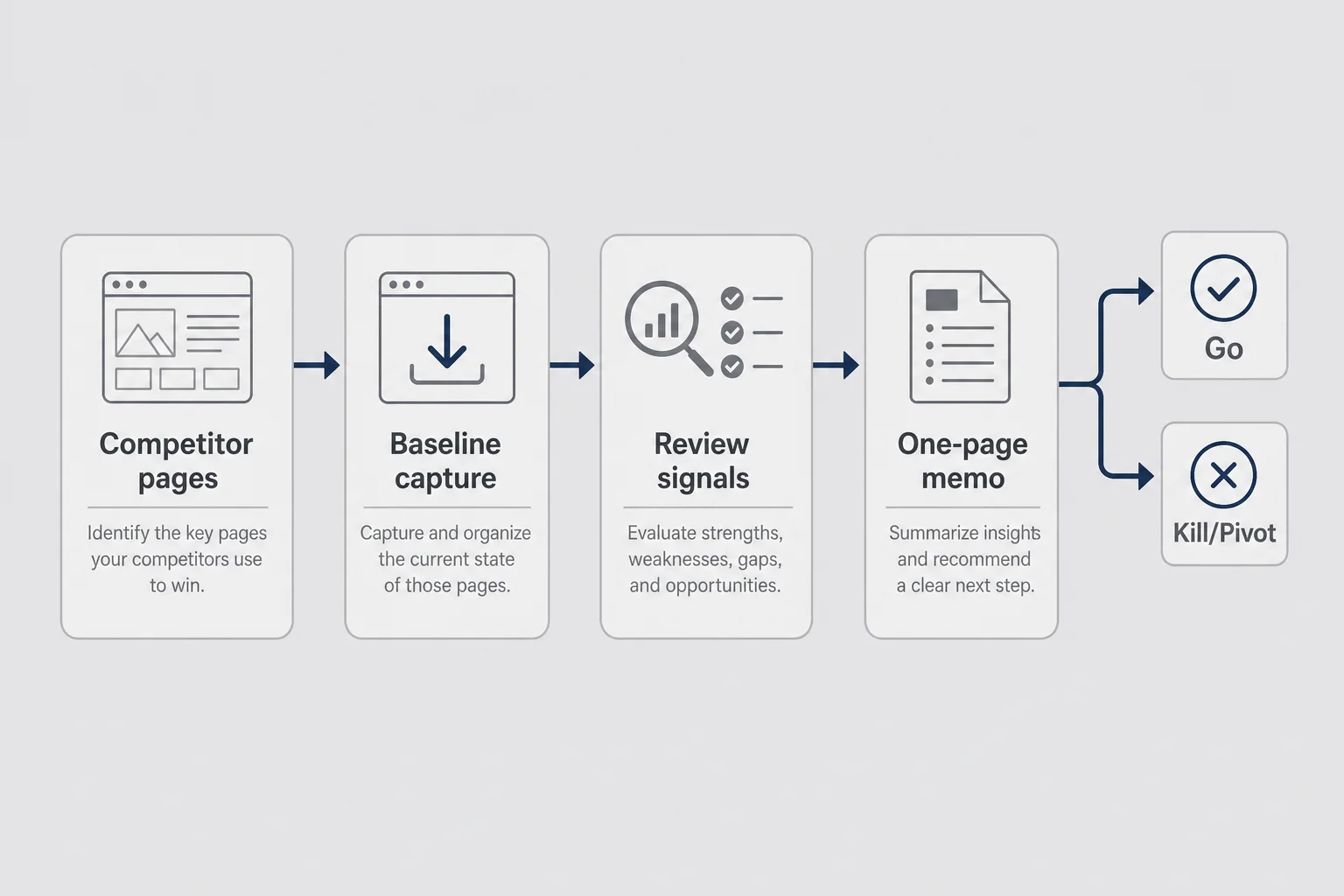
Most founders treat competitor research like a school assignment. List the players. Describe their features. Slap on a SWOT quadrant. File it away. Go build anyway. That produces a document. It rarely produces a decision.
Micro-SaaS competitor research has a narrower job. Before you write code or spend two weeks on a landing page, you need evidence for three claims.
People already pay for tools in this category, which means the problem is budgeted, not imaginary. The existing solutions leave a gap you could fill: a segment ignored, a workflow botched, a price that does not fit solo buyers, support that takes three days. And you are not walking into a knife fight with a giant who will copy your feature over a weekend and undercut you into oblivion, unless you have a specific reason to believe you can still win a slice.
Those claims are falsifiable. That is the point. "Competitors exist" is not scary. It is reassuring. Empty markets are usually empty for a reason. "Competitors are perfect" is rare. Read the one-star reviews. "I am uniquely positioned" needs specifics, not vibes. Your research should end with yes, no, or "not sure yet, and here is the one experiment that would settle it."
I think of the output as a filter, not a permission slip. Good competitor research can tell you to stop. That is a win. A month not spent building a clone of something users tolerate but do not love is a month you can spend on a sharper idea. Bad competitor research tells you what you want to hear. "The market is huge." "Their UI is ugly." "I could do this better." All without checking whether anyone switches tools for the reason you assume.
Keep the scope honest. You are a solo founder validating a micro-SaaS, not a VC associate sizing a TAM for a Series A deck. You do not need every competitor on earth. You do not need precise revenue unless something public suggests it. You need enough signal to pair with customer conversations and, ideally, a fake door or pre-sale from the main validation playbook. Research that never connects to "will someone pay me" is just expensive procrastination with better formatting.
Here is a concrete example with round numbers, not a real company. Say you want to build a tool that turns Stripe payout data into a clean CSV for bookkeepers who serve e-commerce shops. You find three competitors. The leader charges $79 a month and reviewers complain about clunky onboarding. The indie peer charges $29, ships slowly, and replies to support within hours. The adjacent option is "export from Stripe and fix it in Excel every month."
Your memo might say: market pays, leader leaves small shops behind on price, indie peer is beatable on setup speed, Excel is the real default competitor. That is enough to run five interviews with shop owners who mention bookkeeping pain. It is not enough to start coding for six weeks.
When competitor research before building helps (and when it's just fear)
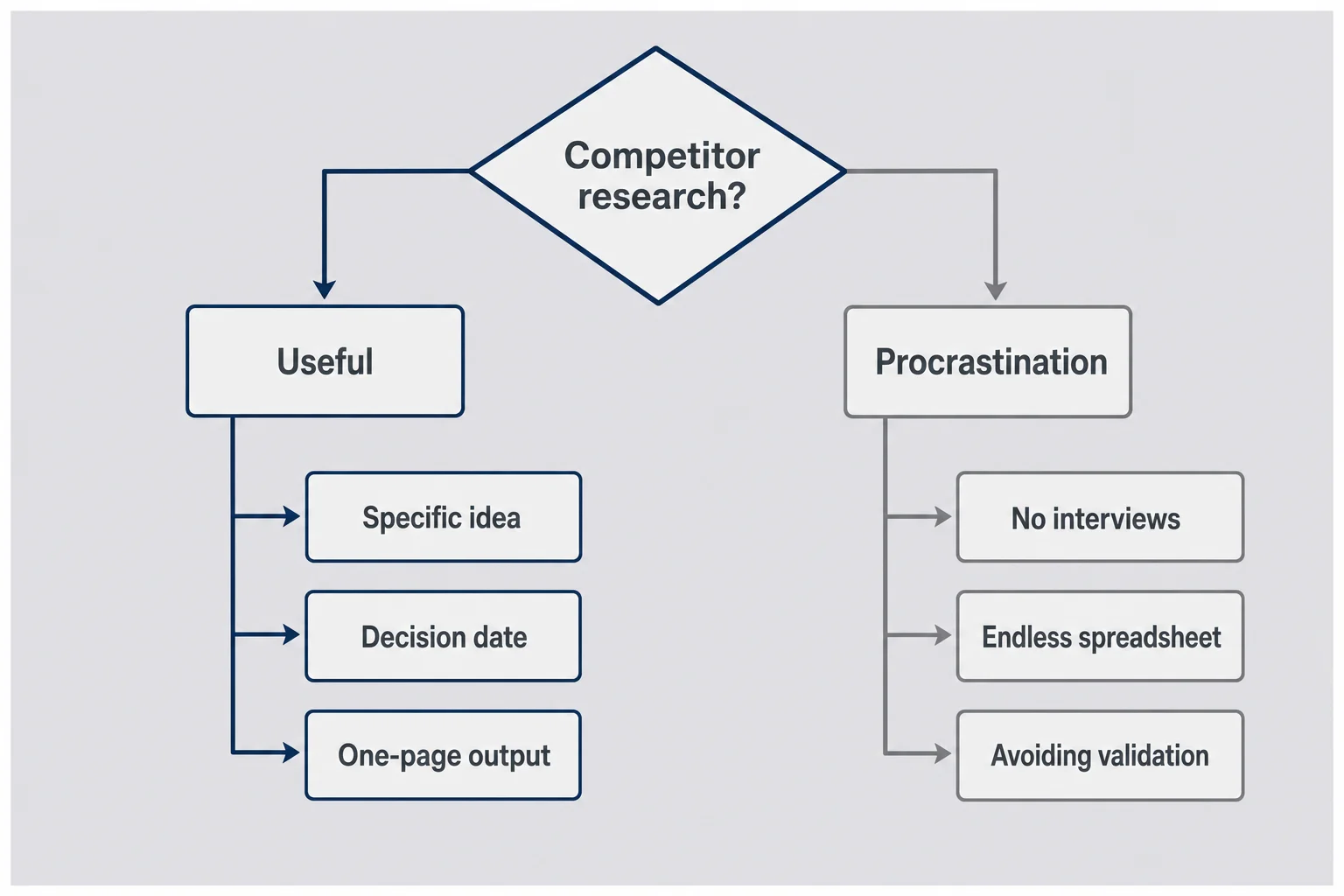
There is a version of competitor research that saves you months. There is also a version that eats a week while your subconscious celebrates, because you did not have to talk to a single customer. Telling them apart is mostly about whether you have a decision date and an output format.
Research helps when you have a specific idea and need to know if the market is real, crowded, or hostile. It helps when you are choosing between two angles (say, Stripe billing alerts for agencies versus the same thing for course creators) and you want to see who already owns each phrase, what they charge, and whether reviews mention the same pain for both. It helps when you are about to price your product and want to know what incumbents charge. Not so you can copy them. So you do not accidentally price yourself into a dead zone.
Research becomes procrastination when it replaces conversations. Five days on spreadsheets and zero minutes on calls with people who have the problem? You are avoiding the hard part. It also drifts when you keep adding competitors because the first three made you nervous. More names feel like safety. Usually they just delay the moment you admit you need a sharper wedge or a different idea.
I use a simple rule. Competitor research gets one calendar week for a first pass, with a defined deliverable: a one-page memo with a go, pivot, or kill recommendation. Not "ongoing market monitoring." Not a Notion database with forty tags. One page. Finish early? Spend the rest of the week on interviews. Hit day five and still feel fuzzy? You are probably not missing data. You are missing a hypothesis sharp enough to test.
Another tell: are you researching because you are excited or because you are scared? Excitement asks, "who else is winning here and how do I differentiate?" Fear asks, "maybe if I read one more G2 page I will discover nobody has thought of this yet." Spoiler: they have. The question is whether they serve your exact buyer well enough that you should stay away.
I also watch for research recursion. You finish the memo, feel uneasy about the kill call, and decide you need traffic data to be sure. Then keyword data. Then a LinkedIn scroll through the competitor CEO's posts. Each layer feels responsible. None of it changes the decision if the first pass already showed happy users and a strong incumbent at your exact price point. When recursion starts, set a timer. One hour for the extra question. Then back to the memo. If it still says kill, believe it.
Pick three competitors, not fifteen
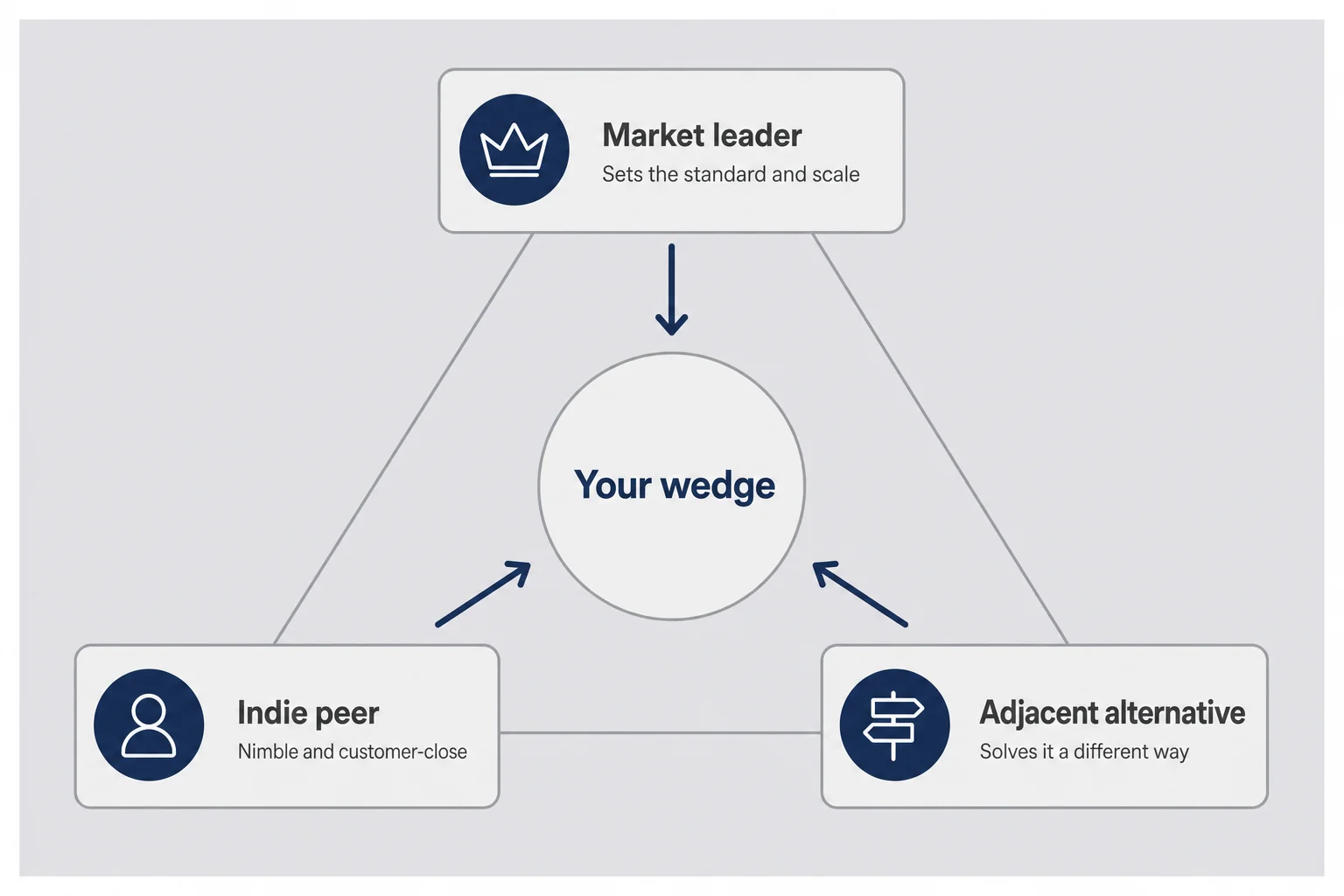
Fifteen competitors in a spreadsheet is a fantasy of completeness. Three is a decision tool. I pick one market leader, one scrappy indie in my weight class, and one adjacent alternative that solves part of the problem a different way.
The leader shows you what "good enough" looks like to buyers who search the obvious keywords. Read their homepage as if you are a customer with the problem. Not as a jealous builder. What outcome do they promise in the first screen? What proof do they show? What do they hide behind "Contact sales"? Leaders also show you where incumbents get lazy: support forums full of unanswered tickets, changelogs quiet for six months, pricing pages that require a sales call for anything useful.
The indie peer is the most important comparison for micro-SaaS. That is the company whose constraints look like yours. One or two founders. Maybe a part-time contractor. Shipping on Stripe. Replying to support from a personal inbox. If they are at $5K MRR and still grinding, the market pays but might not pay easily. If they shut down last year, dig into why before you assume you are smarter. Indie peers also show you realistic pricing. Not Salesforce pricing. Not "enterprise custom." What a solo buyer actually pays per month.
The adjacent alternative covers the "spreadsheet plus Zapier" option and the manual workflow your customer uses today. Sometimes your real competitor is Notion and a Friday afternoon, not another SaaS. Ignoring that is how you build a beautiful tool nobody switches to, because switching costs more than the pain.
Three names, one afternoon
If you cannot find three competitors in an hour of honest searching, that is data too. Either the category is brand new, or buyers do not think in tools yet. Both cases need interviews more than spreadsheets.
Direct vs indirect — and why both matter
Direct competitors sell the same outcome to the same buyer. Indirect competitors sell a different path to a similar outcome, or the same tool to a buyer one step removed. For a micro-SaaS that sends Stripe dunning emails, direct competitors are other dunning tools. Indirect competitors might be "finance person runs a report every Monday" or "founder ignores failed payments until someone complains."
You need at least one indirect entry, because that is often what your first ten customers use right before they pay you. If the indirect option is "hire a VA," your product competes with $400 a month and a human relationship. If the indirect option is "do nothing," your product competes with inertia. Inertia is harder than any SaaS competitor on a feature chart. I have lost deals to "we'll just keep doing it manually for now" more often than I have lost them to a named product. That is the competitor nobody puts in column A.
Why spreadsheets stall
Spreadsheets stall because column B has no natural end. Features are infinite. You can always find one more checkbox. Pricing can always be copied into another row. Traffic estimates become a rabbit hole of tools and guesswork.
When I feel the spreadsheet itch, I force the output format first. One page. Five sections: who I picked and why, what they charge, what users complain about repeatedly, what angle I think is open, and my go/pivot/kill call. The research serves the memo, not the other way around. If a data point does not change the memo, I skip it. That discipline sounds harsh. It is also the only reason research finishes instead of expanding forever.
Finding three names takes an hour, not a day. Search the obvious keyword your buyer would use. Ask ChatGPT or Claude for a list, then delete the ones that target enterprise or a different buyer. Check Product Hunt and G2. Post in one community thread: "What do you use for X?" The answers converge fast.
Where competitors actually show their strategy
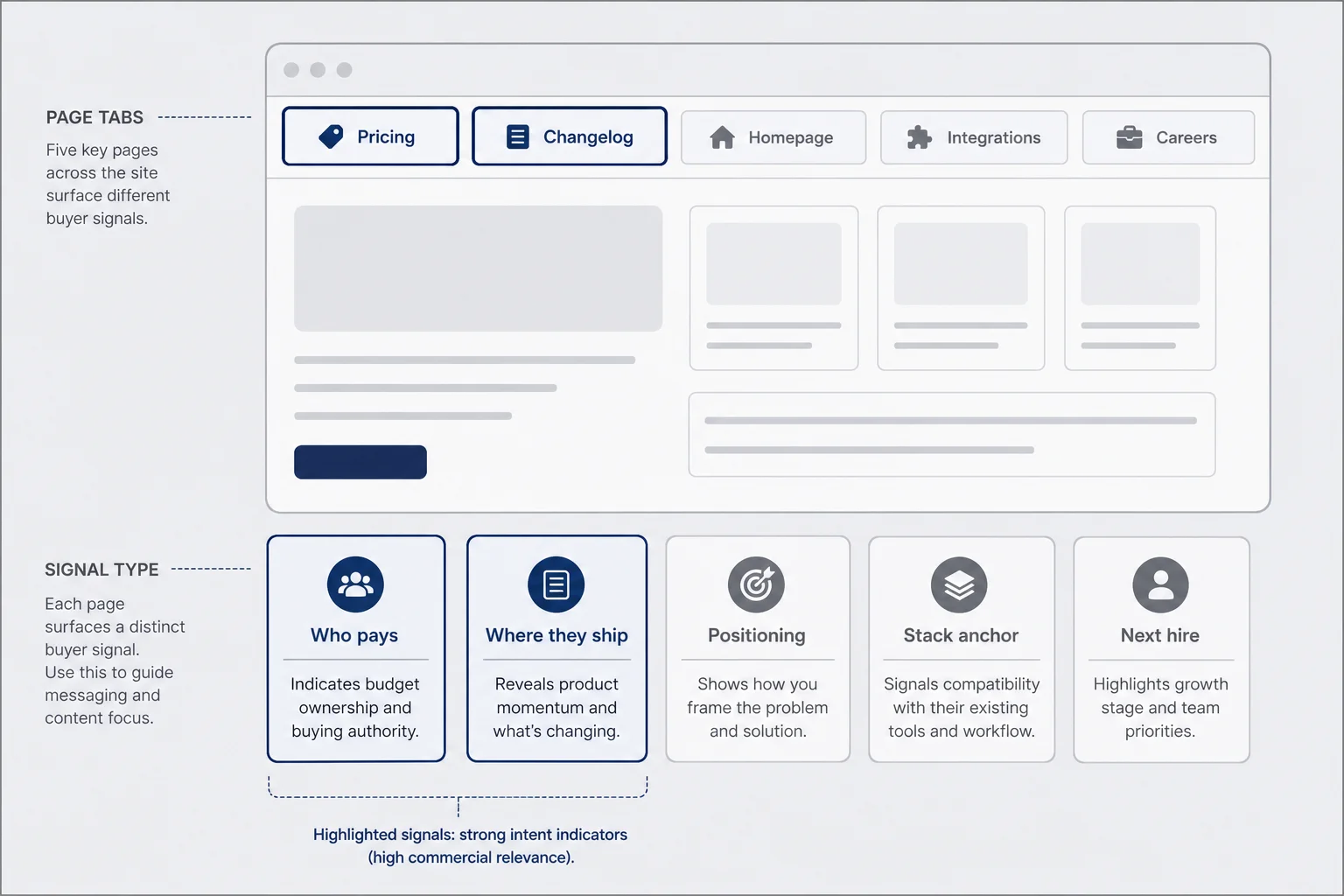
Founders read competitor homepages like marketing students critiquing ad copy. That is fine for ten minutes. Strategy lives on noisier, uglier pages.
Start with pricing. Not because you will copy the number. Because pricing is where companies tell the truth about who they want as a customer. A self-serve page with three tiers and a credit card form says one thing. "Contact us" on every plan says another. Watch for usage-based meters, seat minimums, annual-only discounts, and the feature gated behind the expensive tier. Those choices reveal who pays and what the vendor thinks is valuable.
Changelogs and release notes are underrated. A team shipping every two weeks is still searching for product-market fit or defending against churn. A team whose last update was nine months ago might be profitable and coasting. Or dying quietly. You cannot know which from the changelog alone. Combined with reviews and hiring, it narrows the picture.
I once watched a competitor rewrite their homepage hero twice in six weeks. First: "AI-powered workflow automation." Then: "Save four hours on client reporting." That second version told me more about their sales calls than any feature matrix ever would. Founders rewrite heroes when positioning shifts. Screenshot today's version so you notice when it happens.
Integrations pages show where incumbents anchor in a stack. If every competitor integrates deeply with HubSpot and you planned to ignore CRMs, that is a gap or a warning depending on your buyer. Careers pages show where they invest next. Sales hires mean they are pushing upmarket. Support hires might mean churn hurt.
Skip most of the blog unless it is clearly SEO content targeting your keywords. Post frequency is noise. A competitor publishing twice a week is not necessarily winning. They might be desperate for traffic. What you want is durable pages that change: pricing, product positioning, hiring, integrations, status pages if they sell reliability.
Status pages are a quiet tell for B2B-ish micro-SaaS. If a competitor publishes incident history and postmortems, reliability is part of the sale. If your wedge is "simple and good enough for solo shops," you might not need five-nines uptime. If your wedge is "we replace the tool that runs their Friday payroll export," downtime stories in reviews will matter, and their status page discipline sets the bar.
Documentation depth matters for complex tools. Shallow docs plus angry reviews about setup mean onboarding is a moat you can attack with concierge help for your first ten customers. Deep docs plus still-angry reviews mean the product might be fine and the market might be hard, or you are looking at the wrong buyer. Read docs only when reviews keep mentioning confusion. Otherwise you are studying their help center instead of their business.
Capture a baseline before you compare anything
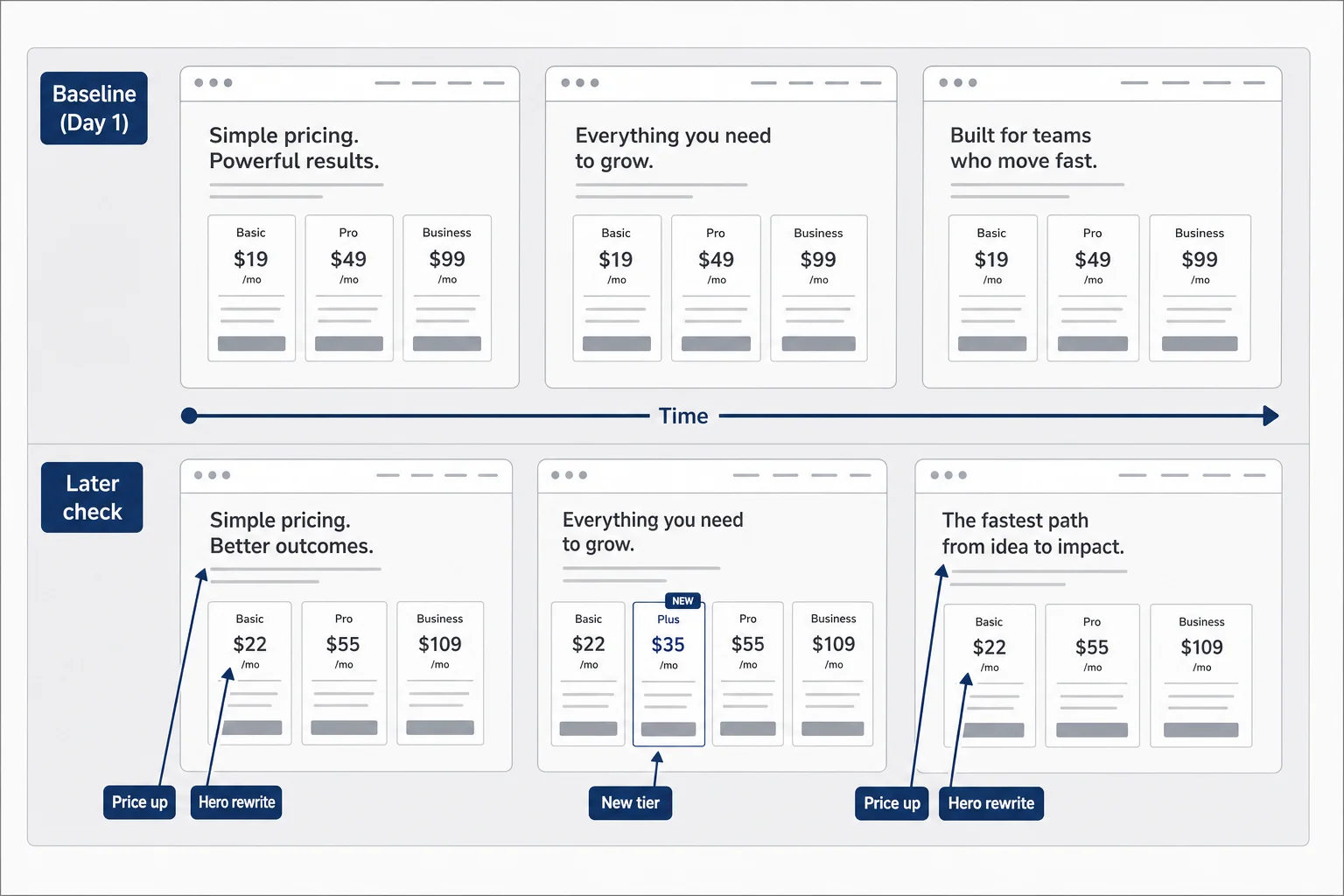
You cannot notice a change without a before. That sounds obvious. Almost everyone skips it.
On day one of research, before you form opinions, capture baselines for your three competitors. Screenshot the pricing page. Screenshot the homepage hero. Copy the tier names and dollar amounts into your memo. Save the changelog URL and note the date of the latest entry. If they have a public roadmap or status page, bookmark it.
I use a folder per competitor and dated files. competitor-a-pricing-2026-07-14.png. Ugly, but searchable. Some founders prefer the Wayback Machine for pricing archaeology later. Paste competitor.com/pricing into web.archive.org and look at snapshots from six and twelve months ago. Did they kill the free plan? Add an enterprise tier? Raise the starter price? Companies do not change pricing pages for fun. Something worked or failed.
Baselines also keep you honest about recency bias. You visit a site today, see a polished product, and assume they have always been that polished. A baseline from eighteen months ago might show a scrappier tool that grew into the thing you fear. Motivating or sobering, depending on your temperament. Either way, more useful than mythologizing the incumbent.
For solo founders, baseline capture should take an afternoon, not a week. Three competitors. Five pages each. Fifteen screenshots. One notes doc. Done. The payoff comes later, when you recheck in month two of building and notice the indie peer just launched the feature you planned as your wedge. That early warning is worth more than any traffic estimate.
Free signals: reviews, Reddit, and the complaints that repeat
Review sites and community threads are where customers say the quiet part out loud. Marketing pages say "streamline your workflow." Reviews say "streamline your workflow unless you need exports, then good luck."
G2, Capterra, and niche forums in your vertical are worth an hour each for your three competitors. Sort by lowest rating first. Read until you see repetition. One angry user complaining about missing dark mode is noise. Twelve users over two years complaining that onboarding takes a week and nobody replies to support is a pattern. Patterns are what you are hunting.
Reddit is messy and useful. Search site:reddit.com [competitor name] alternative and [problem category] tool recommendation. Threads where someone asks for advice and gets three suggestions tell you who owns mindshare. Threads where someone says "I tried X and switched to Y because..." tell you why people move. You are not looking for vindication that your idea is genius. You are looking for the sentence users repeat when they are frustrated.
Product Hunt launch history is another free signal. A tool that launched eighteen months ago with strong upvotes and then went quiet (no major updates, founder ghosting comments) might have peaked. A tool that launches smaller features every few months is still iterating. Neither case is a verdict alone. Combined with pricing changes and reviews, it helps you guess whether the market rewards new entrants or punishes them.
Review sites worth reading
On G2 and Capterra, filter reviews to your buyer size if you can. Enterprise reviewers complaining about SSO are irrelevant if you sell to freelancers. Look for "small business" or "mid-market" depending on your target. Pay attention to "what do you dislike most." Those fields are often more honest than star ratings.
App Store reviews matter if you are building mobile or comparing to mobile-first competitors. Same rule: sort low, read for repetition. Consumer apps get emotional reviews. Extract the underlying job. "This app ruined my vacation" might mean offline mode failed. That is engineering language hiding inside drama.
Community threads that matter
Indie Hackers, Hacker News Show HN threads, and vertical Slack groups sometimes surface founders discussing revenue honestly. Treat single comments as anecdotes, not data. But when a competitor founder posts "we are stuck at $2K MRR," that is more useful than a SimilarWeb guess.
Do not spend days here. Two hours of structured reading beats a week of doomscrolling competitor mentions. Capture paraphrased quotes in your memo under "repeated complaints." If you cannot fill half a page with repeated complaints, either the incumbents are good enough that differentiation will be hard, or you are looking at the wrong competitors.
I keep a simple repetition rule. Same complaint in three independent places (two reviews and one Reddit thread, or three reviews across two years) goes in the memo. See it once? It goes in a "maybe" bucket I ignore unless interviews confirm it. Founders love unique horror stories. Markets move on patterns. Your wedge should attach to a pattern, not a single angry outlier.
I learned that the hard way. Early on I built a whole "export to Google Sheets" feature because one reviewer on G2 went nuclear about CSV downloads. Turned out that person was the only one. Nobody else mentioned it in interviews. The feature shipped, sat unused, and taught me nothing except that volume of emotion is not the same as volume of demand.
For SaaS competitor analysis as a solo founder, bias toward sources where people paid money. Free users complain about everything. Paying users complain about what blocks renewal. That distinction saves you from building for tourists.
Reading a pricing page like a founder, not a shopper
Shoppers ask "can I afford this?" Founders ask "who are they trying to acquire, and what does that imply about willingness to pay in this niche?"
When I read a competitor pricing page during micro-SaaS market research, I write down four numbers and three flags. Cheapest self-serve tier. Most popular tier if they label one. Annual discount if shown. Any obvious usage cap. Then: is there a free tier, is a credit card required for trial, and does the expensive tier hide behind sales.
A $9 starter with heavy limits tells you solo buyers exist but might be unprofitable to serve. A $49 minimum with no monthly option tells you they do not want tiny customers. A free tier with generous limits might mean paid conversion is hard in this category, which affects your pricing strategy if you plan to undercut on price.
Compare pricing across your three competitors on one screen. If everyone clusters at $29–$49 a month for the useful tier, that band is probably market-tested. You can charge inside it with a sharper wedge. Or outside it only if you offer something clearly different. Not "better UI." Something that saves hours or replaces another tool.
Watch for pricing page changes over time using your baselines or the Wayback Machine. Adding an enterprise tier often means self-serve growth slowed and they want bigger contracts. Removing a free plan often means free users cost too much support. Raising prices on new customers while grandfathering old ones is a sign the product delivers enough value that churn did not explode.
Do not treat competitor price as your price. Treat it as evidence about the buyer's wallet and the vendor's confidence. Your costs, support burden, and positioning might justify charging more or less. But if every incumbent charges $19 and you need $99 to make the math work on low volume, you either have a positioning problem or a market mismatch worth knowing before you build.
Annual versus monthly presentation matters too. Heavy annual push with a big discount often means monthly churn hurt or cash flow got tight. Monthly-default pricing with no annual option sometimes means customers refuse to commit long. Neither is good or bad alone. It is context for how hard retention will be when you ship. Pair this with the MRR Calculator if you want to sanity-check what ten customers at their price band actually means for a solo founder's bills. Back-of-napkin math beats guessing.
When competitors hide pricing entirely, treat that as a segmentation signal, not a mystery to solve with spycraft. They might sell to mid-market only. Your micro-SaaS might target buyers they ignore on purpose. That can be an opening. It can also mean those buyers will not pay what you need. Note it in the memo and test with interviews. Do not spend another hour refreshing their pricing URL hoping a number appears.
What to copy, what to ignore, and what to run away from
Copying competitor features is the default move for anxious founders. It is usually the wrong move. Users rarely switch for parity. They switch for an outcome incumbents fail to deliver, or for a price and simplicity fit incumbents ignore.
What is worth copying is structural, not cosmetic. If every successful competitor offers a Stripe integration on day one, you probably need Stripe. If everyone publishes a public status page, reliability matters in this category. If every winner shows case studies with logos, social proof is part of the buying motion and your landing page should plan for it. Table stakes. Not differentiation.
What to ignore: feature count, blog volume, Twitter follower counts, award badges, and most "AI-powered" label changes on homepages. Marketing weather. They do not tell you whether a solo founder can win a slice.
What should make you run away: one incumbent owns the exact workflow with deep integrations, prices aggressively at a tier you cannot match without drowning in support, and reviews are mostly warm. Another stop sign is a market where every competitor is venture-backed and burning cash on outbound while you planned to grow organically. You might still enter. Just admit in your memo that you are choosing hard mode.
Your angle should be boring and specific. "Notion for X" is not specific. "Weekly PDF reports for Shopify stores under $500K GMV without a data analyst" is specific. Competitor research helps you test whether that specificity matches a gap (complaints about complexity, pricing out of reach, missing integration) or whether you invented a niche that does not exist.
I also watch for the dead competitor graveyard. Tools that shut down or pivoted leave clues. Read their last changelog and final pricing. Sometimes the market was too small. Sometimes support killed them. Sometimes they were feature-complete but could not acquire customers cheaply. Any of those lessons apply to you.
Turn a week of research into a one-page decision
All the screenshots and review reading should collapse into one page you can read in five minutes on a bad day. If it does not fit one page, you are still browsing, not deciding.
My memo template has five sections.
Competitors: three names, one sentence each on why they are in the set.
Money signals: what pricing and public hints suggest about paying customers. Not precise MRR. Just "self-serve tiers exist," "indie peer still blogging monthly," "leader requires sales call."
Repeated complaints: three to five bullets max, phrased in customer language.
Open angle: the specific wedge you believe is open, tied to those complaints.
Decision: go, pivot, or kill, plus the next validation step if go. Usually five customer interviews or a fake door from the main validation playbook.
A go means you still believe the market pays and your angle is sharp enough to test with people. A pivot means the market exists but your first idea collides with an incumbent strength, so change segment, outcome, or channel. A kill means the research showed a strong incumbent, happy users, or a market too small to feed a solo founder. Kills feel bad for an afternoon and cheap for a year.
Share the memo with one skeptical friend if you can. Not for approval. For a sanity check on whether your "open angle" is real or wishful. I have killed ideas in this step that felt brilliant while I was color-coding spreadsheets.
Connect the memo to action within forty-eight hours. Schedule interviews. Draft a landing page headline. Or archive the idea and pick the next gap. Research that sits in a folder for three weeks decays into guilt. Research that leads to a conversation tomorrow was worth the week.
The twenty-minute weekly habit that keeps working
After the first week, competitor research shrinks to maintenance. You are not rebuilding the matrix every Monday. You are checking whether the ground shifted while you shipped.
Block twenty minutes weekly. Same day. Same time. Calendar invite. No exceptions during active build phases. Open your three baseline folders. Scan pricing pages for visual diffs. Skim changelogs since last check. Glance at one review site sorted by most recent. If nothing moved, close the laptop and go write code. Most weeks nothing moved. That is fine.
When something does move, ask whether it affects your wedge. Competitor launches your planned feature? Narrow further, ship faster, or change the headline on your landing page. Competitor raises prices? That might open room for you, or signal the category can bear more. Competitor shuts down? Talk to their users if you can find them publicly. Migrating customers are the warmest leads on earth.
Automated trackers can help if you tend to skip manual checks. Tools that diff pricing pages and email you on change are useful for solo founders who forget. They are not required. A recurring calendar block and disciplined baselines beat a fancy stack you abandon by week three.
The habit exists to protect you from surprise, not to feed anxiety. If weekly checks make you slower without changing decisions, drop to monthly until you are closer to launch. Research serves shipping. Shipping does not serve research.
Store your weekly notes in the same doc as the original memo. Date each check. "2026-08-04: no pricing changes; Competitor B shipped Slack integration." Six months later, when you wonder why you narrowed to a Slack-first wedge, the log explains it. Memory lies. Dated one-liners do not.
If you are still validating whether to build at all, competitor research belongs in week one of a two-week validation sprint. Week two is conversations and a fake door. If you are already building, weekly competitor checks are guardrails, not the main work. The main work is still shipping something a specific person can pay for and watching whether they do.
Questions I get about competitor research
How do you do competitor research for a micro-SaaS idea?
Pick three direct competitors, not fifteen. Capture baselines of their pricing page, changelog, and homepage today. Read reviews and community threads for repeated complaints. Write a one-page memo answering whether the market pays, what angle is open, and whether you still want to build. Stop when you have a decision, not a deck.
How many competitors should a solo founder track?
Three is enough for validation. One clear leader, one scrappy indie in your weight class, and one adjacent tool that solves part of the problem differently. More names feel productive but rarely change your decision. Add a fourth only if a new entrant launches something that directly threatens your angle.
What pages should I watch on competitor websites?
Pricing, changelog or release notes, homepage hero copy, integrations page, and careers if they hire. Blog post cadence and social likes are mostly noise. Pricing changes and new tiers tell you what is working. Changelogs tell you where they are investing engineering time.
Is competitor research enough to validate a SaaS idea?
No. Competitor research tells you whether a market exists and where gaps might be. It does not tell you whether strangers will pay you. Pair it with customer interviews and a fake door or pre-sale attempt. A crowded market with unhappy users is interesting. Money from a real person is validation.
How long should micro-SaaS competitor research take?
One focused week for a first pass. Days one to three are for picking competitors and capturing baselines. Days four and five are for reviews, Reddit, and pricing archaeology. Day six is the one-page memo. After that, a twenty-minute weekly check is enough unless you are about to change pricing or positioning.
Should I build if competitors already exist?
Usually yes, if customers are paying and still complaining about the same gaps. No, if one incumbent owns the workflow, prices aggressively, and users seem genuinely happy. Competitors prove demand. Your job is to find an angle specific enough that someone switches or buys for the first time because of you.
Research clears the runway — it doesn't fly the plane
Competitor research told me not to build a Stripe dashboard clone three years ago. The incumbents were fine. Users were lukewarm but not angry. My angle was "cleaner UI," which is not a business. I pivoted to a narrower alert tool for a segment that complained about the same missing webhook in every review thread. That version got its first paying customer six weeks later. The research did not find the customer. It kept me from wasting the month that made finding the customer possible.
You do not need a perfect market map. You need three competitors, honest baselines, repeated complaints in plain language, and a one-page decision you act on before the motivation fades. Pair that with the unglamorous work from validation without coding or customer interviews if you code: talk to people, ask for money, read the signals without flinching.
Research is the filter at the airport. You still have to board the plane.
If your spreadsheet has eleven names and an empty column B, delete eight rows, pick your three, capture today's pricing screenshots, and write the memo by Friday. Everything else is noise dressed up as diligence.




Comments