Bolt Is Not a Validation Strategy
Fake doors, deposit tests, and customer calls — how I validate micro-SaaS ideas without code before Bolt or Hermes ship anything.

Listen to this article
26:52AI-generated podcast-style overview of this article (not a word-for-word narration).
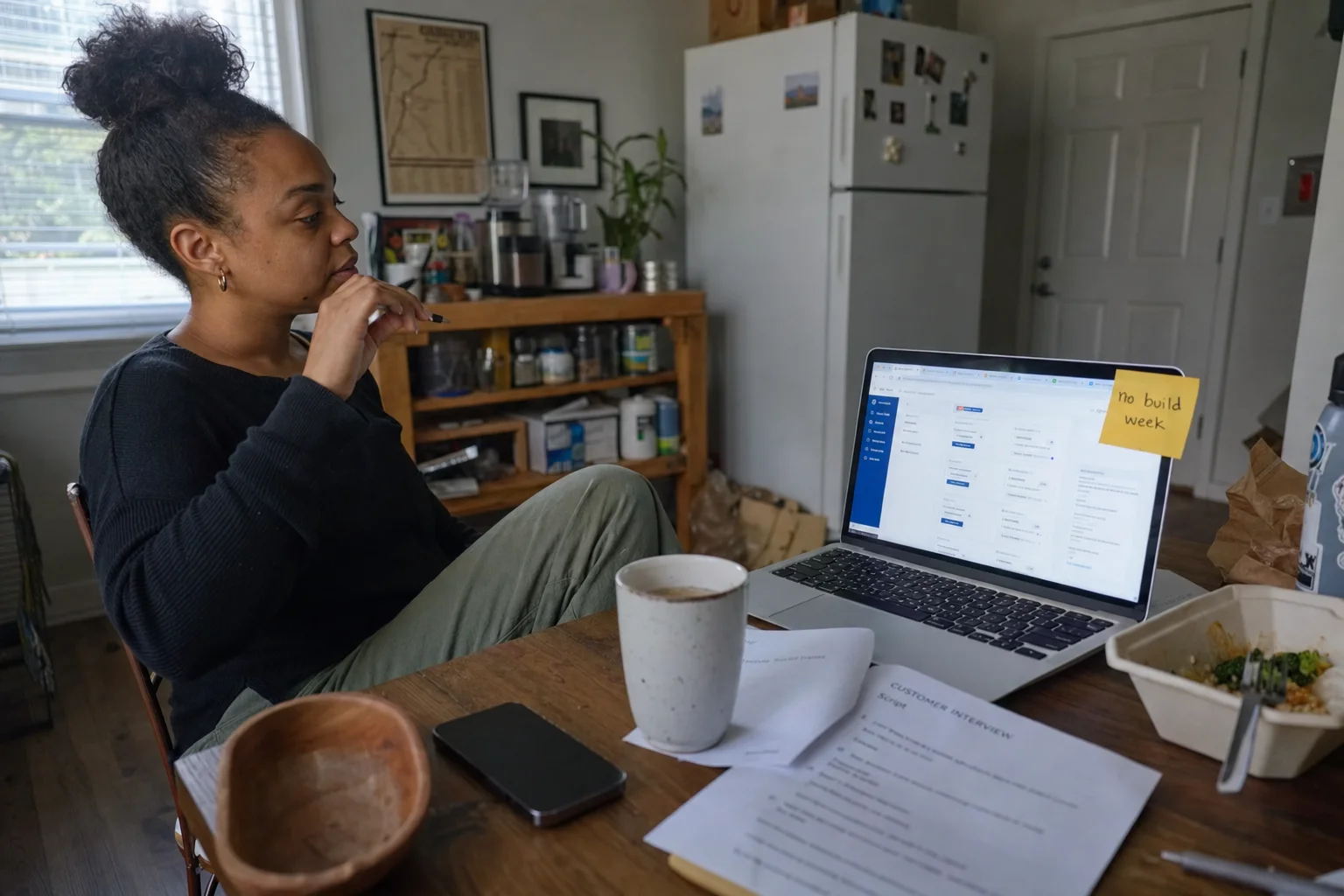
It was a Tuesday morning in Austin and I had Bolt open in one tab, a half-written customer interview script in another, and a sticky note on my laptop that said "no build week" in handwriting only I could read. I was supposed to email five Etsy sellers about a reminder tool idea. Instead I was three prompts deep into a dashboard mockup that nobody had asked for. The mockup looked great. That was the problem. When you do not code, AI builders feel like proof you are making progress. They are not proof anyone will pay.
If you are trying to figure out how to validate a micro-SaaS idea without coding, you are probably standing where I stood in late 2023: smart, motivated, slightly intimidated by GitHub, and tempted every hour to skip the boring part and let a tool ship something pretty. I am Imani. I am not a software developer. I build small products by directing AI tools and an always-on Hermes Agent setup, not by hand-writing production TypeScript. Before that I handled vendor emails and inventory spreadsheets at a small e-commerce brand. That job taught me what customers actually complain about, which turns out to be more useful for validation than knowing how to debug a webhook.
This post is the non-coder entry point to Micro-SaaS From Zero and the micro-SaaS path I wish I had before I burned eleven days in Bolt. Max wrote the developer-facing validation guide in Validate Before You Build. Read that for the full methodology. I am not repeating his sprint line for line. I am writing for people who will validate with Carrd and Stripe Payment Links, not with a repo and a local dev server. If you already shipped past validation, how to build a micro-SaaS without coding is the next step. Same bar: strangers and money. Different traps.
One belief sits under everything below, same as on my author page. The product does not care who wrote the code. It cares whether someone pays. A working prototype you built in a weekend because Bolt was fun is not validation. An ugly landing page with three deposits is. A fake door, if you have not met the term yet, is that one-page site with a price and no product behind it. If you want micro-SaaS validation without coding, that is the finish line.
Some numbers in this post are illustrative examples. I will say when I am guessing. Real outcomes from my own products are messier and smaller than Twitter would suggest.
How to validate a micro-SaaS idea without coding when building got free
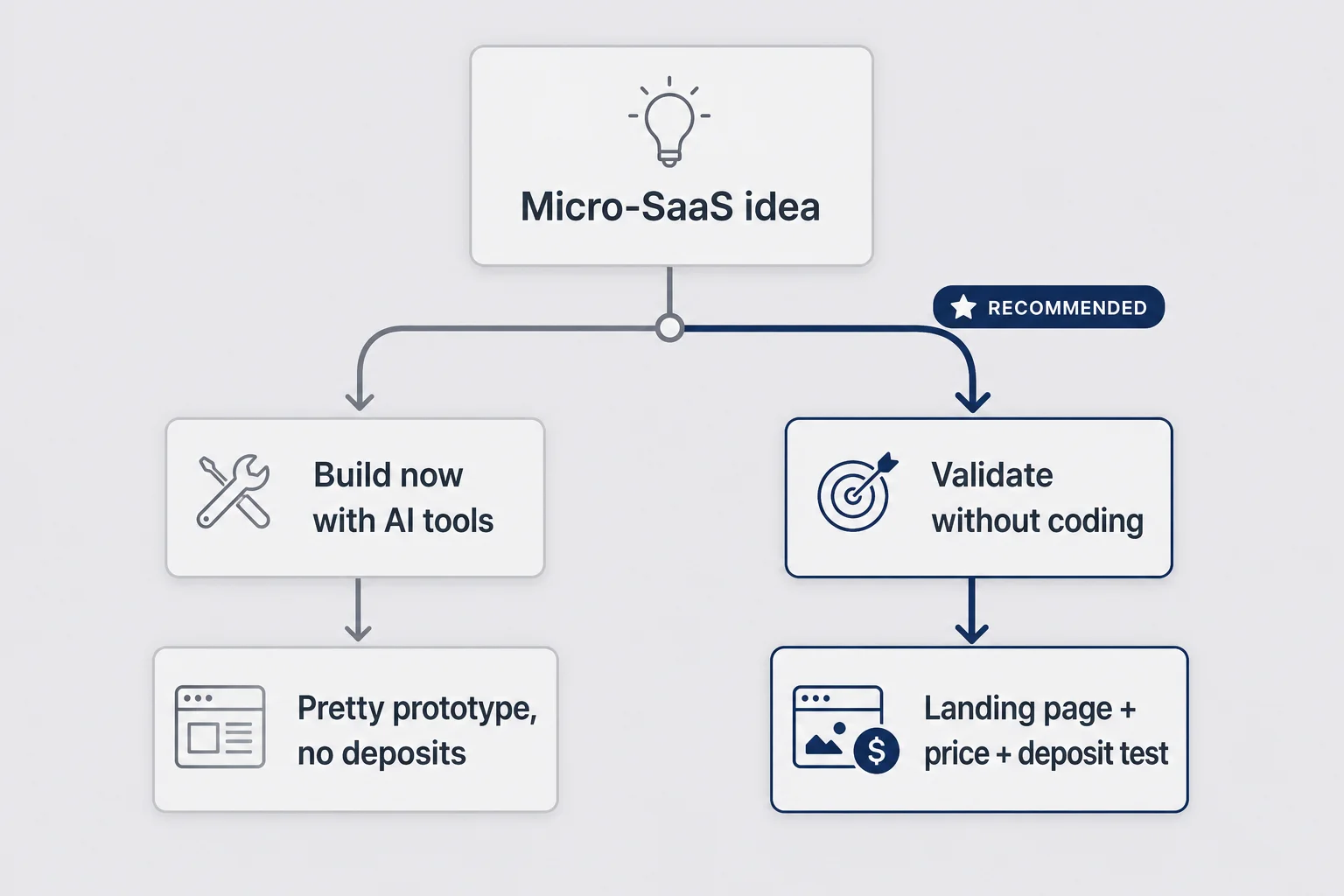
Here is what changed for people like us, and why validation got harder emotionally even as it got easier technically. Building used to be the gate. If you could not code, you had to validate because you had no other move. Now Bolt, v0, and agents will scaffold an app while your coffee is still hot. The gate moved. Judgment did not.
When I say how to validate a micro-SaaS idea without coding, I mean you can find out whether strangers will pay before you touch any of that. You do not need permission from a bootcamp. You do need the discipline to treat AI builders like construction equipment that stays in the garage until someone hands you a deposit.
Non-coders have a specific failure mode that developers share but experience differently. Developers skip validation because building is more fun than hearing no. Non-coders skip validation because building is the first time they feel like real founders. The dashboard loads. The button clicks. Hermes says deployment complete. Your brain files that under progress. It is cosplay progress. The market does not care that you felt technical for an afternoon.
I learned this on my second product, a reminder tool for Etsy sellers. I spent eleven days tuning prompts and colors. Hermes rewrote my onboarding copy and was right, which was rude. I shipped. Three people signed up for a free trial. Nobody converted. The product worked. I had built a solution to a problem I had not validated, which is the classic trap when AI makes building feel free.
The reframe that saved me on everything after: validation is cheaper than building, but building is more flattering. Choose cheap over flattering. Revenue is validation. A pretty prototype is research at best and self-deception at worst.
If you already know how to code, Max's path might feel faster. Fair. This post is for the person who will otherwise open Bolt tonight instead of emailing five strangers. That person was me. She still shows up sometimes. The sticky note helps.
There is another trap I see in non-coder communities: confusing research with building. Reading twenty Reddit threads is useful. Summarizing them with ChatGPT is useful. Designing a logo at midnight is not validation, even though it produces a file you can attach to a message. Files feel like assets. Deposits are assets. Keep the distinction sharp or you will spend a month producing artifacts that do not change what strangers do with their wallets.
Say you budget two weeks for a first validation pass. That is roughly twenty to thirty hours if you have a day job. Non-coders sometimes spend twenty-eight of those hours inside tools because tools reward attention with visible output. Interviews reward attention with awkward silence sometimes. Silence is still data. A stranger saying "hmm, I just use a spreadsheet" is more valuable than your agent generating a settings page nobody asked for.
I am not anti-tool. I pay for Bolt, Cursor, and Hermes every month. I love them on the right side of the money signal. Before that signal, they are entertainment with a subscription fee. Entertainment is fine on a Friday night. It is expensive on a Tuesday when you are avoiding DMs.
What validation actually means if you cannot read a repo
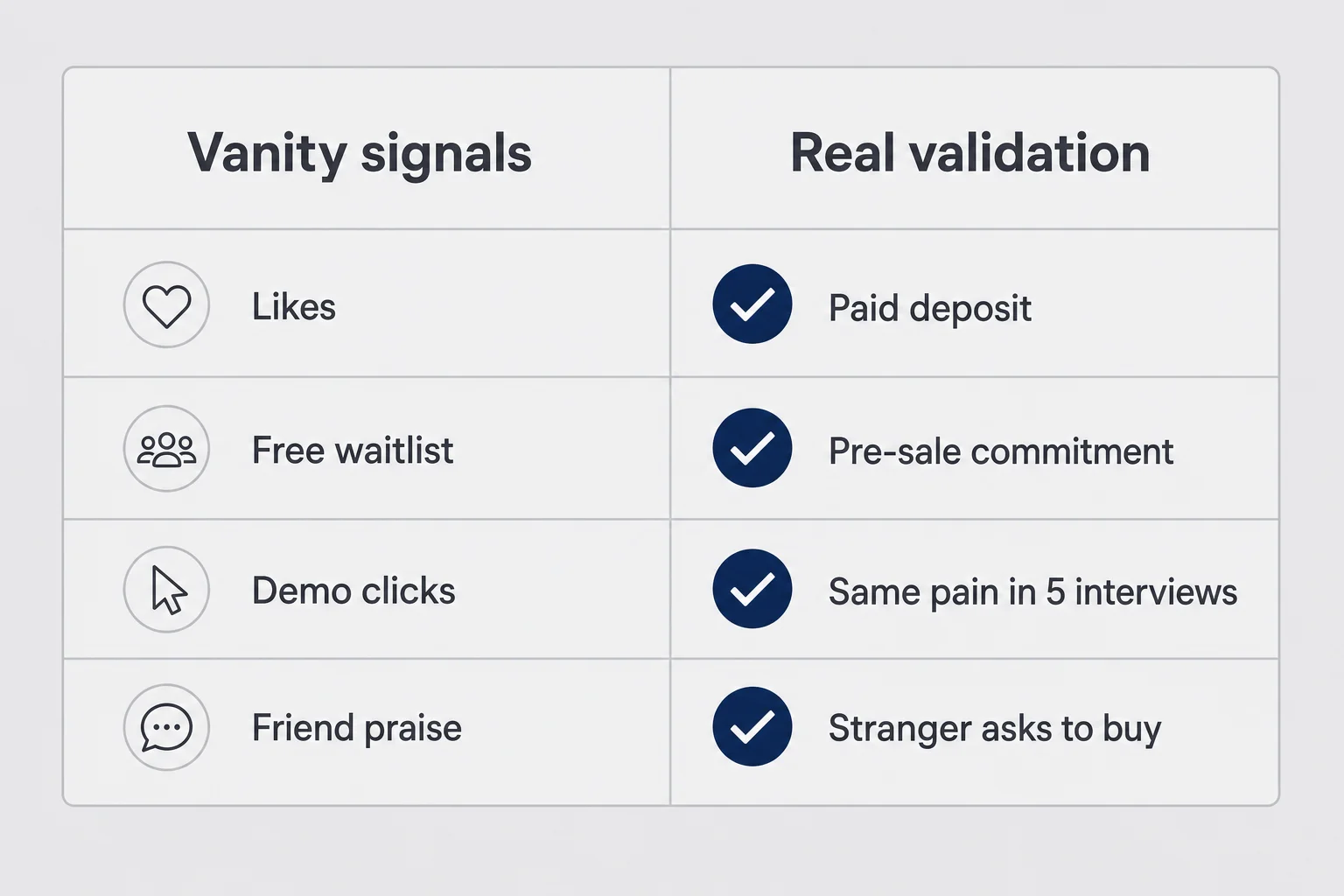
People use the word validation loosely. For a micro-SaaS aimed at solo founders and small businesses, I use it narrowly. Validation is evidence that a real person with a real problem will give you real money, or a binding commitment to money, for the outcome you propose. Everything else is noise dressed up as momentum.
You cannot read a repo. That does not exempt you from this bar. It might make you more vulnerable to substitutes that look like proof.
The vanity metrics that fool non-coders especially
Likes do not validate. "This is so cool" from a college friend does not validate. A free waitlist of two hundred emails does not validate if zero people will pay when you ask. I have seen non-coders treat a working AI prototype as validation because strangers could click through a demo. Clicking is not paying. Demos are theater unless money follows.
Here is a composite example. Say you post a screen recording of your Bolt-built MVP in a Facebook group and get eighty comments. Feels like demand. You spend three weeks polishing onboarding. At launch, four people sign up for free and one pays. That was not delayed validation. That was validation never happening, and the comments were cheerleading.
Traffic without a price on the page teaches you almost nothing. Traffic with a price teaches you something painful and useful.
What counts as real signal
A paid pre-order validates. A refundable five-dollar deposit validates. Someone saying "invoice me when it is ready" and replying to your follow-up validates. Five conversations where strangers describe the same pain in their own words, with workarounds they already pay for, validates the problem side even before money moves.
My personal bar before I let myself build: at least one money signal from someone who is not a friend, with the price visible and the product unfinished. That is a cautious yellow-green, not a parade. Three strangers paying or committing is the stronger green light I want before I spend eleven days in Bolt again. You can set a lower bar for a weekend throwaway experiment. Raise it if you are spending savings. Pick the finish line before you start so you cannot move the goalposts when weak signals arrive.
If you cannot explain what validated means in one sentence, you will accept substitutes. Write the sentence down. Tape it next to the sticky note.
Non-coders sometimes ask whether a concierge MVP counts as validation. Doing the job manually for three customers can teach you enormously about workflow. I still separate that from revenue validation. Manual work proves you can deliver value. It does not prove strangers will pay for software until you ask them to pay for software, with a price visible, before you automate. The manual phase is research. The deposit on a page is validation. Both matter. Do not skip the second because the first felt virtuous.
Another question I get: does competitor research count? Only partly. If ten tools exist and customers hate them all but keep paying because nothing else works, that is interesting. If ten tools exist and everyone is happy, you are in for a painful education. Competitor screenshots are not conversations. Open a review tab, yes. Then talk to the person who left the one-star review about what broke on their Tuesday.
Your ops and marketing background is a validation superpower
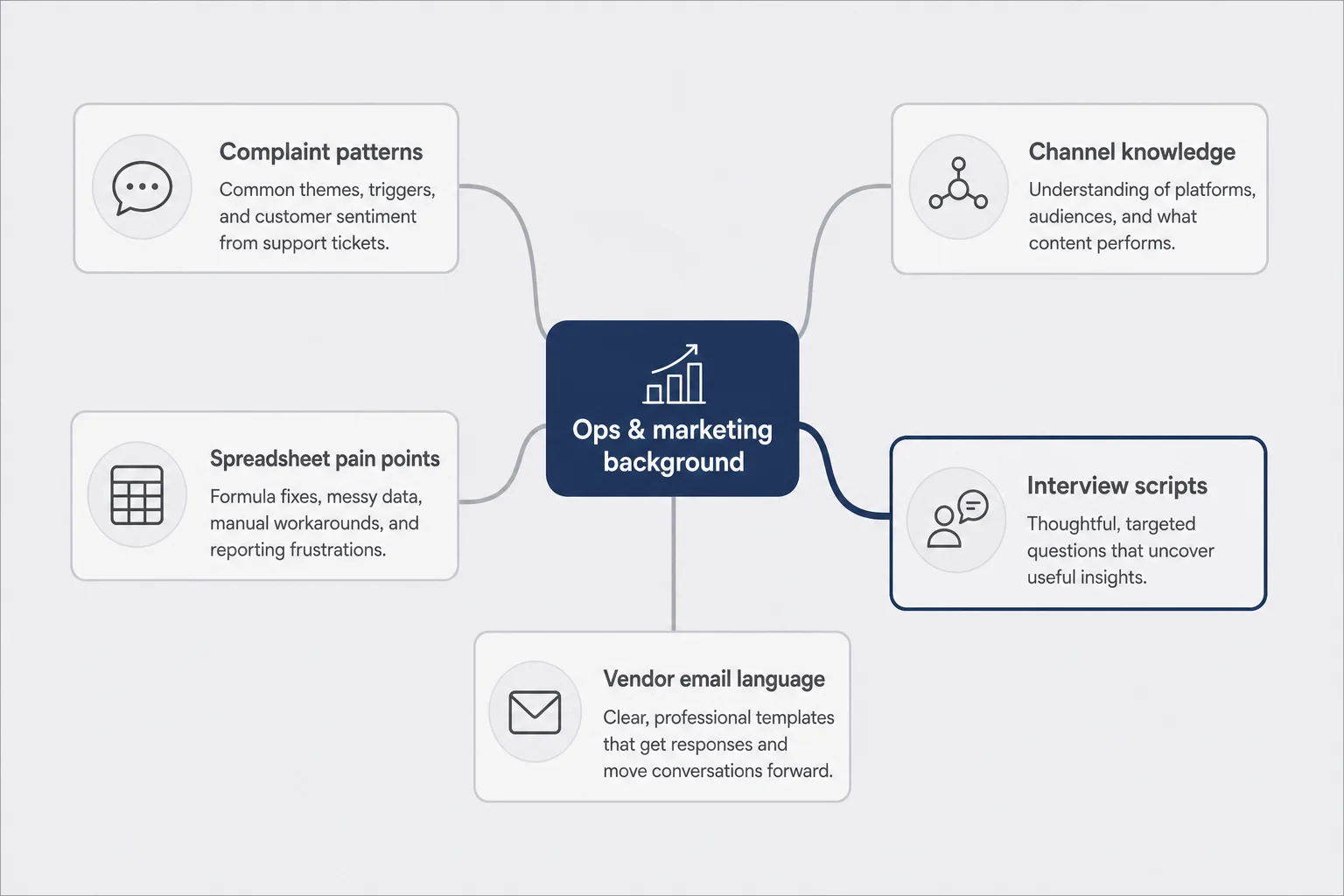
Developers sometimes validate like engineers: hypotheses, features, technical feasibility. That is fine. It is not the only way. If you come from ops, marketing, admin, teaching, or design, you already know how to read complaint patterns. You have seen which spreadsheet columns actually matter when a vendor email goes wrong. That is customer research wearing a boring outfit.
I did not learn validation from a startup book. I learned it from answering the same vendor question forty times and realizing the brand's software made simple things hard. The gap was obvious because I lived in the inbox. You might have lived in a classroom, a clinic schedule, a Shopify admin, or a Notion workspace nobody else could navigate. That proximity is an edge non-coders underestimate because they think validation requires code.
When I validate now, I start with language, not architecture. What exact phrase does someone use when they are frustrated? What workaround are they already paying for, even if it is ugly? Spreadsheets plus Stripe subscriptions to five different tools count. Manual labor counts. "My assistant does it" counts. Those are demand signals hiding in plain sight.
You also know which channels reach real people versus which channels reach other founders performing ambition. A developer might default to Hacker News. You might know that Etsy sellers actually answer DMs in a specific Facebook group, or that wedding planners live in a Slack you used at your old job. That knowledge is not cheating. It is distribution insight that should inform who you interview first.
The trap is assuming your background is too normal to build software around. Normal problems paid by normal people are the whole micro-SaaS game. You do not need a futuristic AI angle. You need a painful Tuesday task and someone who would pay twelve dollars a month to make it shorter.
Imposter syndrome will tell you that without code you are only playing founder. Revenue disagrees. Strangers do not ask for your GitHub when they hand you nineteen dollars.
When I worked ops, I could tell which vendor emails would explode into a week of back-and-forth from the subject line alone. That pattern recognition is validation prep. You are listening for the subject-line version of a software problem. What makes someone forward a message internally? What makes someone sigh audibly on a Zoom? What makes someone keep paying for a clunky tool because switching feels worse? Write those observations down like you used to write escalation notes. They become interview scripts later.
If your background is teaching, you know which questions students ask twice before they admit they are lost. If your background is design, you know which client feedback really means "I do not understand the deliverable." Translate that ear into customer calls. You are not behind the developers. You are holding a different flashlight.
The one-sentence problem test (before Carrd, before Bolt)
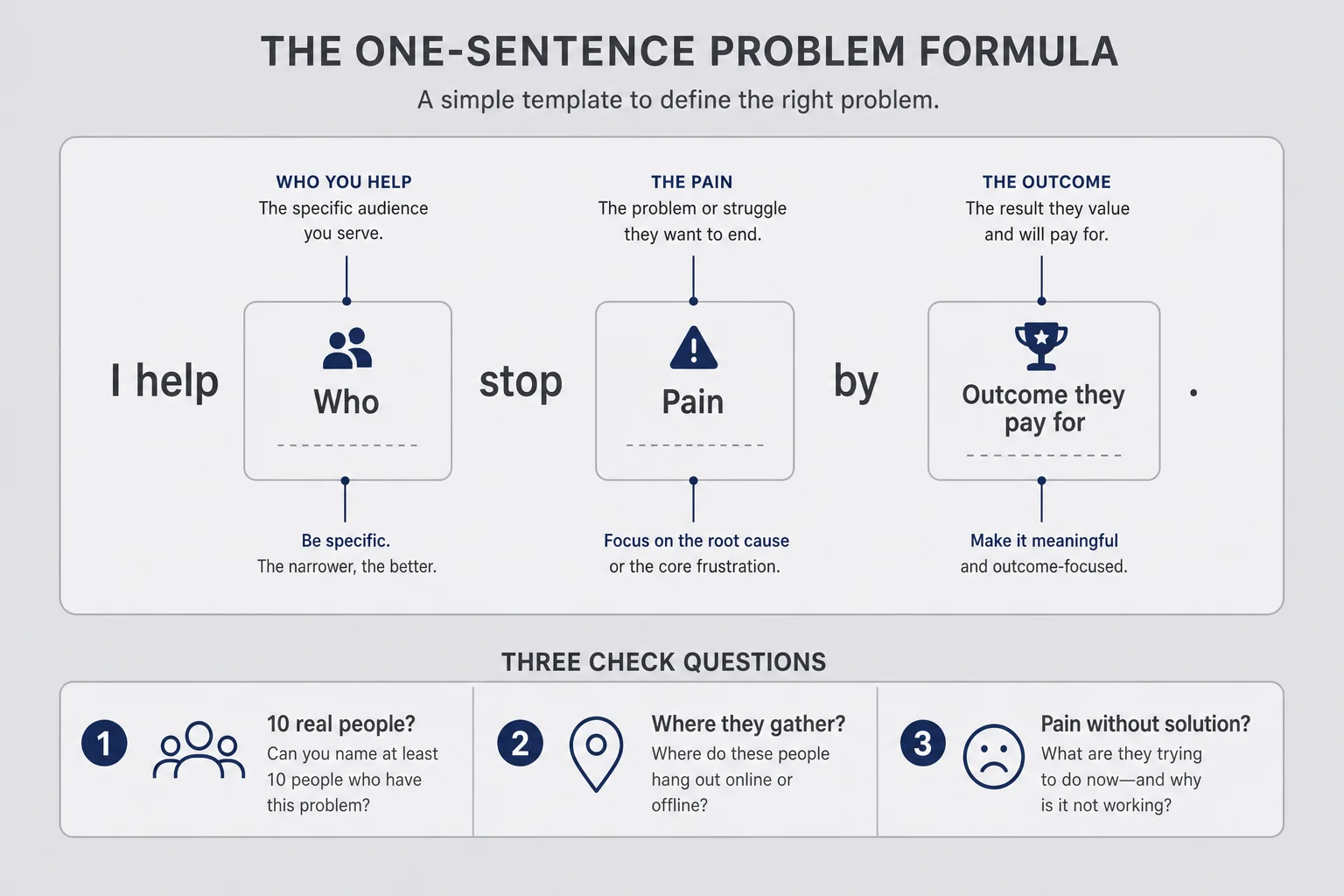
Before you open any tool, write one sentence. Not a pitch deck. One sentence.
I help [specific person] stop [specific pain] by [specific outcome they would pay for].
If you cannot write that sentence without fog words, you are not ready for a landing page. You are ready for more listening.
Fog words sound like: streamline, leverage, empower, next-gen, AI-powered solution. Specific words sound like: Etsy sellers, missed renewal dates, email me the night before a listing fee is due. The second version you can test. The first version you can only demo.
I keep a physical index card for this because screens lie. When I see the sentence on paper, I notice faster when the audience is too broad. "Small businesses" is not an audience. "Solo bookkeepers with ten to thirty clients who reconcile in QuickBooks every Friday" is an audience you can find.
Narrow hurts because it closes doors in your imagination. Narrow helps because it opens doors in the real world. You can email thirty bookkeepers. You cannot email small businesses.
Ask three brutal questions about the sentence. Can I name ten real people who match the who? Can I point to where they already gather online or offline? Can I describe the pain without mentioning my solution? If any answer is no, shrink the who or interview more before you build anything.
This step costs zero dollars and zero tabs. Non-coders skip it because tabs feel more productive than thinking. Resist. The index card is the cheapest tool in your stack.
When the sentence is sharp, read it to someone out loud. Watch their face. If they nod slowly and add a story unprompted, keep going. If they say "interesting" and change the subject, you have fog. Rewrite.
Keep a kill list next to the sentence. If you hear "I might use that someday," write it down. If you hear "I already pay for X but hate Y," write that down too. The second phrase is gold. The first is polite fog. Non-coders sometimes collect maybes because maybes feel kind. Kindness is not a business metric.
I rewrite the one-sentence card at least three times before any landing page goes live. First draft is always too broad. Second draft is still slightly embarrassed to say out loud. Third draft is specific enough that someone in the target audience would think you have been watching them. That embarrassment is a compass. Lean into it.
Fake door pages without an app: Carrd, Framer, and a visible price
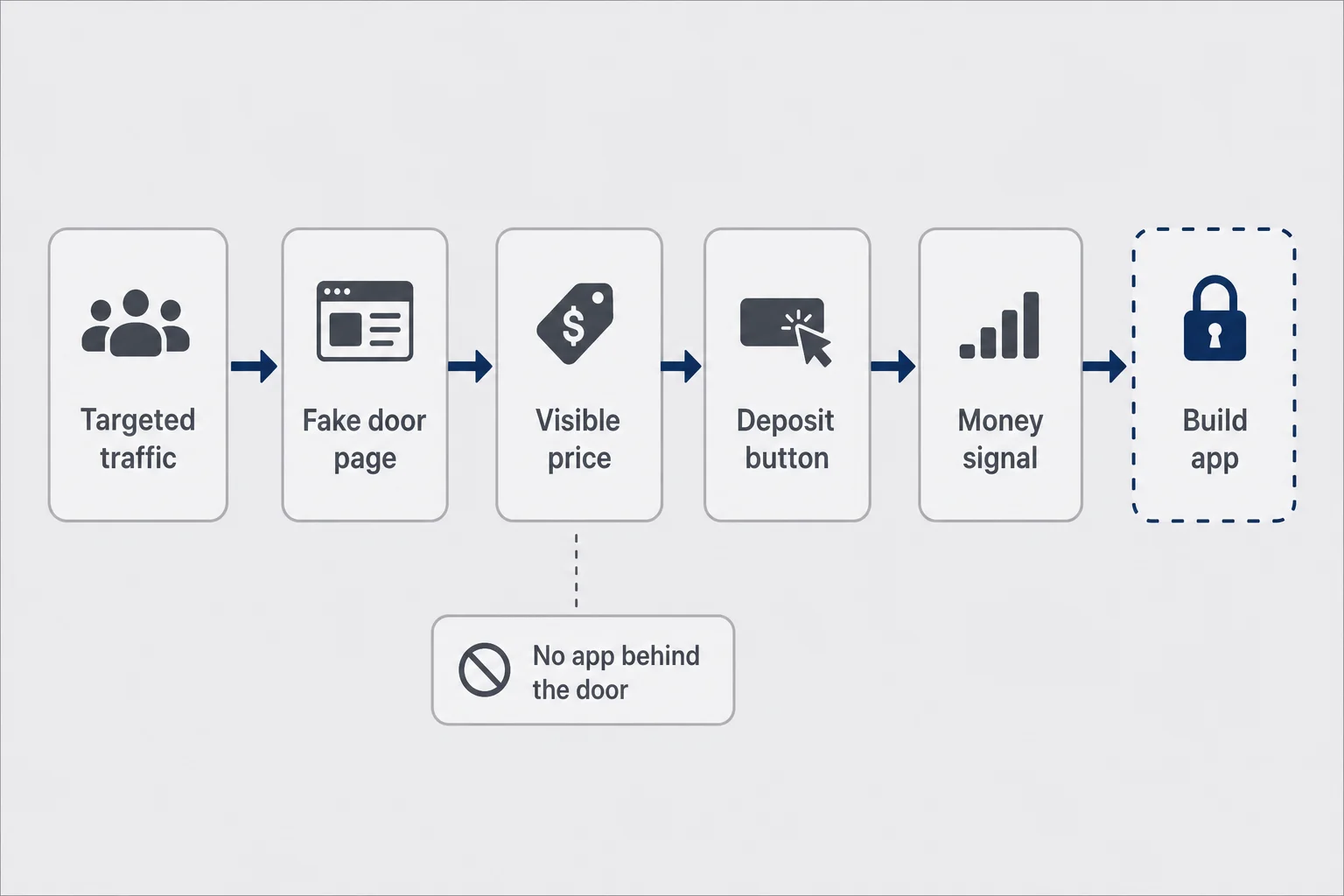
A fake door is a landing page for a product that does not exist yet. You describe the problem, the outcome, and a price. You measure whether targeted visitors commit. No app behind the door. No login. No database. No Bolt project eating your weekend.
For non-coders, this is the whole validation laboratory. Carrd is enough for many tests. Framer is enough if you want slightly more polish. My tools for non-developers post explains when I pick which and what I actually pay each month. Reese's guide to micro-SaaS landing pages for solo founders covers structure and headlines in depth. I will not repeat her eight-second test. I will add the non-coder constraint: if you are tempted to add a second page, you are already building.
The page does four jobs. State the problem in the audience's words, not yours. Describe the outcome in two or three sentences. Show the price prominently. Offer a way to commit: deposit button, paid waitlist, book a call to pre-order. Ugly and clear beats beautiful and vague.
Put Stripe Payment Links on the button if you can. In Stripe, create a Product, add a one-time Price for your deposit amount, click Payment link, copy the URL, paste it on the button. No code, no repo. Five to twenty-five dollars refundable founding-member deposit is enough. Typing a card number is a different mental act than typing an email. You are testing willingness to pay, not willingness to be polite.
Drive traffic manually at first. Thirty to fifty targeted people beats five thousand random visitors. Post in one community where you have been helpful, not spammy. Email people who match the who. DM carefully with context. Manual outreach feels slow. It is fast compared to building the wrong product for a month.
Track simple numbers: visits, deposit attempts, conversations booked, replies. A spreadsheet is fine. You do not need analytics software for the first pass.
If nobody clicks from a relevant audience, your headline or audience is wrong. If people click but nobody pays, your price or urgency is wrong. If people pay but you cannot find more of them, your channel is wrong. Each failure mode has a fix that does not require code.
I once ran a fake door for a tool idea in two hours on a Sunday. Carrd page, Stripe link, twelve DMs to shop owners I found in a forum. One deposit by Wednesday. That was enough to open Bolt the following week. Not because one person is a business. Because one stranger put money down for something that did not exist.
Pricing on the fake door should not require a finance degree. Pick a number you would notice if one person paid it monthly. Nineteen, twenty-nine, forty-nine for B2B-ish pain. Put annual math in small text if you want, but do not hide the monthly reality. You are testing whether the problem is worth money, not whether you can trick someone into clicking. Max goes deeper on pricing psychology in micro-SaaS pricing for solo founders. For validation week, one visible number is enough.
Your fake door headline should sound like a complaint, not a feature list. "Stop missing Etsy renewal fees" beats "AI-powered seller intelligence platform." You learned that phrasing from interviews, not from a branding exercise. If you do not have the phrasing yet, you are not ready for the page. Go back to calls.
The no-build week rule for non-coders
This is the rule I wish someone had taped to my monitor in 2023. During validation week, you do not build the product. No app. No dashboard. No "quick prototype" that becomes an eleven-day art project. Landing page yes. Carrd, Framer, a single HTML file if you must. Not the thing customers will log into.
AI makes this rule harder, not easier. Bolt and v0 want you to build. Hermes will happily scaffold features you described at midnight. Cursor will generate a repo you cannot fully read. All of that is construction. Construction starts after money or a credible promise of money.
You can use AI during validation week. Just point it at questions, not construction. Rewrite the headline for clarity, not hype. List objections someone might have at this price. Draft interview questions. Summarize notes from a customer call. Role-play a skeptical buyer. That is cheap and useful.
What you cannot do is let the agent ship because shipping feels like identity. I have woken up to Telegram messages from Hermes proudly describing files I did not ask for. The agent was helpful. I was off mission. Non-coders need a bright line because we cannot skim the diff and notice scope creep.
Tell a friend the rule if you need accountability. "If I show you a login screen before Friday, roast me." Sounds silly. Works.
Max's validation sprint allows learning with prototypes in some cases. Developers can throw away a weekend repo. You might not know what was thrown away. Your no-build week protects you from shipping opaque complexity you will have to support at 2 a.m. without understanding it.
Validation week ends when you hit your money signal bar or when two weeks of honest outreach says no. Then you open the builder. Not before. The sticky note comes off the laptop. The fun part is allowed. It is more fun when you are less scared.
Here is what I allow myself during no-build week without guilt. Carrd edits. Stripe link setup. Calendly. Interview notes. Headline rewrites in ChatGPT. Spreadsheet tracking. Community posts that ask questions instead of announcing products. Here is what I do not allow. Login screens. User dashboards. Database schemas I cannot explain. "Just checking if Bolt can do this" experiments that spawn a repo. Hermes tasks that touch production anything. The line is blunt on purpose. Blunt lines survive tired brains at 11 p.m.
If you break the rule once, you will break it again. I broke it on the Etsy reminder tool and lost eleven days. I did not break it on the idea after that where three shop owners used the words "renewal fee panic" in separate calls before I generated a single component. Different outcome. Same me. Different rule enforcement.
Customer conversations when you are not the technical founder
Talking to strangers is the part non-coders sometimes avoid because they fear sounding stupid about tech. Good news: customers do not want tech talk in validation. They want you to understand their Tuesday.
Your job in these calls is listening, not pitching. Fifteen to twenty minutes. Ask how they handle the problem today. Ask what breaks. Ask what they have tried. Ask what it costs them in time, money, or stress. Ask whether they have budget for tools in this category. Take notes in their words, not yours.
Do not open with "I am building an AI-powered platform." Open with "I am researching how bookkeepers handle Friday reconciliations. Can I ask how you do it today?" You are a researcher, not a founder performing on a podcast.
You need five to ten conversations with people who match your who and are not your friends. Friends lie kindly. Strangers lie less when they have no reason to encourage you.
Recruiting is manual work. Post in a community with a specific ask. Reply to public complaints you see on Reddit or in reviews. Email people who engaged with your fake door. Check the two places you named when you wrote your one-sentence problem: the subreddit, Facebook group, Slack, or forum where your who already gathers. If you cannot name two places, fix the who before you fix the headline. Offer nothing except listening and maybe early access later. No gift cards needed at this stage.
When someone describes your problem back to you unprompted, write that sentence down verbatim. That sentence is worth more than a week in Bolt. It becomes your headline, your onboarding copy, your support macros later.
If you finish ten conversations and hear three different problems, your who is too broad or your question is too vague. Tighten and run five more. Cheaper than code.
You will feel like an impostor. I still do sometimes. The customer does not care about your credentials. They care whether you listened. Listening is a skill you already have if you ever answered vendor emails for a living.
A simple script I still use: "Thanks for making time. I am not selling anything today. I am trying to understand how people handle [problem]. Could you walk me through the last time it came up?" Then I shut up. The hardest part is not filling silence with feature ideas. Silence is where people tell you the truth.
On Zoom, turn your camera on if they do. Dress like a human, not a keynote speaker. On audio only, stand up and pace if that helps you sound natural. Performative founder voice is a tell that you are nervous about credibility. Curious researcher voice is enough.
After each call, write three lines. Their words for the pain. What they pay today, even if the answer is "my time." Whether they asked when they could buy. That third line matters. Unprompted buy questions are rare and precious. If nobody asks across ten calls, your problem might be nice-to-have. That is useful to know before Bolt opens.
Pre-sell and deposit tests without touching a repo
Free signups are weak signals. Deposits are stronger. Pre-sales are stronger still. Non-coders can run both without a product backend.
Stripe Payment Links let you collect money for a founding-member spot without writing code. Lemon Squeezy works similarly if you prefer. Say the deposit is refundable until launch, or applies to the first three months. Put that in plain language on the page. Refundable lowers friction while still testing payment intent.
Imagine you price the product at nineteen dollars a month. A ten-dollar refundable deposit from five strangers is not retirement money. It is proof that five strangers typed card numbers for a problem you described on one page. That proof should change what you do next.
Pre-selling can also look like an invoice sent manually after a call. Low tech. Valid. Someone says "I would pay for that today if it existed." Reply: "I am building the first version for three founding customers at this price. Want me to send a Stripe invoice for the first month?" If they ghost, you learned something. If they pay, you learned something better.
Do not confuse pre-selling with pressuring friends. Do not ask your roommate to be customer number one unless your roommate actually has the problem. Strangers only for the signal that matters.
Track deposits in a spreadsheet: name, date, channel, exact wording they used about the pain. You are building a research asset that will later become marketing copy. Ops brain helps here. Developers sometimes skip the spreadsheet because the code feels like the real work. You know the spreadsheet is how businesses think.
If you cannot get a single deposit from fifty targeted visits and ten conversations, pause. Rewrite the offer, change the who, or pick a sharper pain. Do not open the AI builder to avoid the conclusion.
Refunds are part of the test, not a failure of it. If someone asks for a deposit back because you pivoted hard, refund quickly and thank them. You are buying honesty cheaply. Non-coders sometimes fear Stripe because money feels scary when you cannot read the code behind it. Payment Links are still worth the fear. They filter polite interest from payment intent better than any survey.
Say four people pay a ten-dollar deposit and you expected twenty. That is yellow, not green. Iterate the headline, tighten the who, or increase outreach volume before you build. Deposits give you permission to iterate with data instead of vibes.
How to read micro-SaaS validation signals without hope editing your spreadsheet
Hope is a talented editor. It will rename "zero deposits" to "early stage interest." Your job is to be boring and literal about what happened.
Use one tiered bar, not two competing ones. I score three questions before I open a builder: money signal from strangers, same pain repeated in interviews, and a reachable audience I can actually find. Three yes is green. Two yes gets one more week of targeted tests. One yes is a no.
Green lights: three or more strangers paid or committed to pay a specific price; or one deposit plus five interviews where the same pain shows up unprompted; people referring you to others without being asked; fake door conversion above roughly five to ten percent from a targeted audience when the offer is clear.
Yellow lights: lots of praise, no money; free waitlist growth with no deposit clicks; interviews that sound interested but nobody has budget; you keep widening the audience to find enthusiasm. Yellow means fix the offer or narrow the who before you build. Not forever. One more week of targeted tests.
Red lights: you cannot find ten people to talk to; conversations reveal the problem is rare or low urgency; people happily use a free alternative and would not pay; you personally would not pay if you were them. Red means kill or pivot hard. Killing fast is a skill. I have killed more ideas than I have kept. The kept ones hurt less because they were cheap to test.
When to kill the idea (and when one more week is justified)
Kill when red lights stack up and your three yes doc has one yes or zero. Do not kill because the work felt boring. Kill because strangers with the problem will not commit money or credible time after you made the offer clear and reached them where they already gather.
One more week is justified when you have yellow lights with a specific fix: the headline was feature-heavy, the price was hidden, the who was too broad, or you only talked to friends. That is not stubbornness. That is a controlled retest.
Stubbornness is ignoring red lights because Bolt is already open. I did that on the Etsy reminder tool. The interviews were polite, the deposits were zero, and I built anyway because the dashboard looked good. That is the expensive version. No-code founders feel it worse because we cannot read what we shipped.
Write your decision criteria before the sprint. If you decide after looking at the numbers, you will negotiate with yourself. Put the three yes questions at the top of the same spreadsheet where you track deposits, or walk through the Idea Validation Scorecard on day fourteen before you open Bolt.
Sunk cost will whisper that you already bought Bolt this month so you should build anyway. Subscription fees are smaller than opportunity cost. Kill the idea, keep the tool for the next test.
Compare yourself to founders with audiences you do not have. Irrelevant. Run your sprint against your own bar.
When you kill an idea, save the interview notes. I reuse pain-language research months later on a different angle. Nothing is wasted if you take notes like an operator.
A two-week validation sprint for people who do not code
Max lays out a two-week sprint in Validate Before You Build. Same spine here, non-coder tools only.
Days one and two: write the one-sentence problem. List twenty people or places where your who gathers. No Carrd yet. If you cannot list twenty, your who is still fog.
Days three and four: five outreach messages to book conversations. Start interviews. Take notes in their words. Still no app.
Days five and six: build the fake door on Carrd or Framer. Visible price. Deposit button. One page.
Days seven through ten: send thirty to fifty targeted visits via DMs, posts, emails. Book more calls from replies. Use AI for headline tweaks, not for building product.
Days eleven and twelve: push for deposits. Follow up with anyone who showed real pain. Manual invoices are allowed.
Days thirteen and fourteen: score green, yellow, or red. Decide build, iterate, or kill. If build, read how to build a micro-SaaS without coding next. If tools confuse you, my tools post lists what I actually pay for.
Two weeks is a first pass, not a lifetime. Some ideas need one more week after a sharp pivot. Set a cap. Validation can become procrastination if you never call the shot.
During the entire sprint, the no-build week rule applies to the product itself for all fourteen days. The name sounds like seven days; the point is simpler: no login screens and no app construction until the sprint ends or you get a money signal worth breaking glass for. The login screen can wait.
Hour-by-hour perfection is not the point. Direction is. If you work nights and weekends, block four two-hour chunks per week and protect them like meetings. Tell your partner or roommate you are in "research mode," not "founder mode," because founder mode right now means conversations and deposits, not repos.
At the end of day fourteen, write a half-page decision memo to yourself. What happened. What you learned. Build, iterate, or kill. Sign it like an operator closing a ticket. Future you at 2 a.m. with a broken webhook will thank present you for not skipping this memo.
When you get a green light, resist the urge to celebrate by immediately prompting a full product. Read the build guide next. Pick the smallest stack you can maintain. Your validation notes are now your product spec. The headline that got clicks becomes the hero. The phrases from calls become onboarding. Validation is not a separate phase you leave behind. It is the research department you carry forward.
Questions I get about validating without code
What is a fake door test for micro-SaaS validation?
A fake door is a one-page site for a product that does not exist yet. You describe the problem, the outcome, and a visible price, then measure whether targeted visitors leave an email, pay a deposit, or book a call. There is no app behind the page. For non-coders, Carrd or Framer plus a Stripe Payment Link is enough. Ugly and clear beats polished and vague.
How long should micro-SaaS validation take without coding?
Two weeks of focused evenings or weekends is enough for a first pass if you already have a niche in mind. Week one is conversations and sharpening the problem sentence. Week two is a fake door page and a deposit or pre-sale attempt. If you cannot get a single money signal from strangers after honest outreach in that window, change the audience or offer before you open an AI builder.
Can you validate a micro-SaaS without coding?
Yes. Validation is a business skill, not a developer skill. You need a narrow problem statement, five to ten conversations with strangers who have the problem, a landing page with a visible price, and ideally a deposit or pre-sale before you build the product. Carrd, Framer, and Stripe Payment Links are enough. You do not need an app, a database, or a repo to find out if anyone will pay.
What tools do non-coders use for fake door tests?
Carrd or Framer for a one-page site, Stripe Payment Links or Lemon Squeezy for a deposit button, Calendly or email for booking conversations, and ChatGPT or Claude for rewriting headlines. That is the whole stack for most first passes. You do not need Bolt, Supabase, or an agent until validation gives you a money signal.
Is a free waitlist enough validation?
Almost never. A free email signup tells you someone was curious for eight seconds. It does not tell you they will pay twelve dollars a month when the product exists. Put a price on the page. Ask for a small refundable deposit if you can. Validate willingness to pay, not willingness to join a list.
How many customer conversations do you need?
Five honest conversations with strangers who have the problem is a solid minimum. Ten is better if the niche is new to you. What matters is hearing the same pain unprompted, with real workarounds and real costs. If five people describe the problem in nearly the same words without you coaching them, you are onto something worth testing with money.
When should you stop validating and start building?
Two weeks of focused outreach is enough for a first pass. Stop when you have a money signal from strangers, not friends: a deposit, a pre-sale, or a written commitment to pay a specific price when you ship. One refundable deposit is enough to start building carefully if interviews also show a sharp, repeated pain. Three or more money commitments is a stronger green light. If you only have polite interest and free signups after that window, change the problem, audience, or offer before you open Bolt.
You do not need a repo to know if anyone cares
I still google basic terms sometimes. I still feel like an impostor in developer spaces. I still want to open Bolt when a conversation gets boring. The difference between my early projects and the ones that earned build time is not talent. It is the willingness to look for money signals before I look for mockups.
You do not need a repo to validate. You need a sharp sentence, strangers, a price on a page, and honesty about what the spreadsheet says. Code can come later, directed through tools you choose on purpose, after you know someone besides your mom cares.
If your sprint comes back red, that is not failure. That is two weeks you did not spend supporting a product nobody wanted. Go kill the idea with your head up. The index card stays. The sticky note goes back on the laptop for the next test.
The market is not grading your technical depth. It is grading whether you solved something painful for someone specific. You can learn that answer without writing a line of code. You probably should.



Comments