Signup Isn't When They Win
How solo founders onboard micro-SaaS customers without a CS team: define the magic moment, concierge early users, fix empty states, and measure activation.
 By Reese26 min read
Listen to this article
24:56AI-generated podcast-style overview of this article (not a word-for-word narration).
A founder Slack-messaged me on a Thursday with a screenshot I recognized immediately. Twelve new signups in a week. Three people had logged in twice. One had connected an integration. Nobody had done the thing the product was built for. He was ready to run more ads.
I asked what happened after someone clicked signup. His onboarding was a welcome email with a link to the docs and a twelve-minute Loom tour. Then silence until the trial ended. That is not onboarding. That is a polite way to lose people who already raised their hand. If the trial itself has no activation goal, fix micro-SaaS free trial for solo founders before you rewrite onboarding emails.
Micro-SaaS customer onboarding for solo founders is the work between "they created an account" and "they got value once." At a bigger company that is a team, a lifecycle email tool, and someone whose title includes customer success. At your scale it is you, probably at night, wondering why strangers ghost a product you spent months building.
I have been on the growth side of small B2B SaaS since 2014. I have written onboarding emails that sounded like a robot and ones that got replies from people who were about to cancel. I have watched founders celebrate signup spikes while activation flatlined. The pattern is always the same: distribution got easier, onboarding did not keep up. Building got cheap. Teaching someone to win inside your product did not.
This guide is for the solo founder who already has paying users or serious trials and is losing them in the first week. Not the person still picking a stack. Not the person with a waitlist and no product. You shipped. Someone signed up. Now you are customer success, support, and product feedback loop in one person.
This is Part 9 of Micro-SaaS From Zero. If you have not validated demand, start with how to validate a micro-SaaS idea. If you are still turning traffic into signups, read micro-SaaS landing page for solo founders and micro-SaaS cold email for first customers. When people start leaving after the trial, how to reduce churn in a micro-SaaS picks up where onboarding fails — and the churn impact calculator shows what that leak costs in MRR. Once they are past week one and emailing you, micro-SaaS customer support for solo founders is Part 10. For more on retention habits across the funnel, those two posts are the cluster. Max covers the build. Imani covers shipping without code. I cover what happens after someone says yes.
Micro-SaaS customer onboarding for solo founders when signup is not the finish line
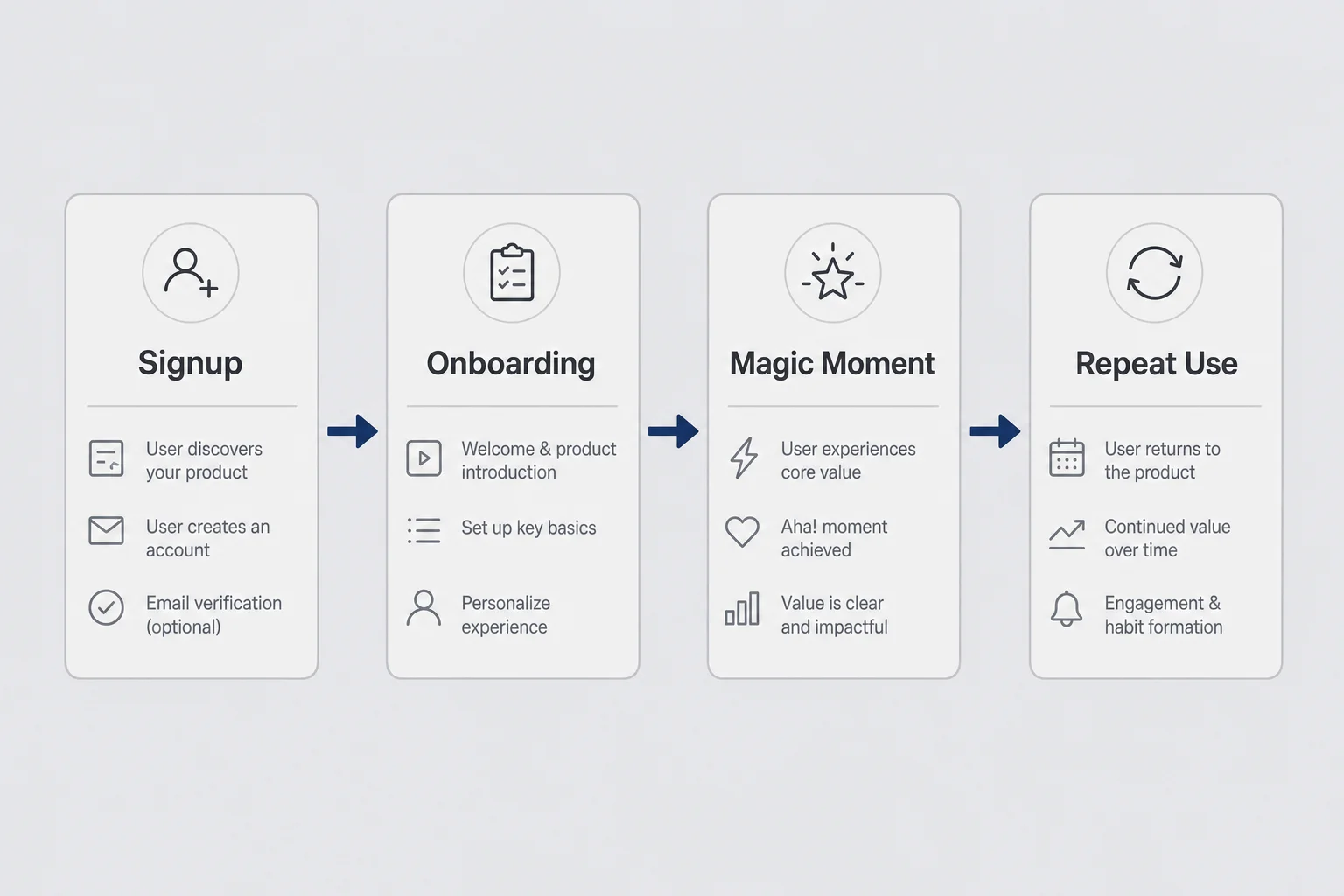
Marketing gets credit for signups. Onboarding earns retention. Solo founders often treat those as the same event because both show up in a dashboard as growth. They are not.
Signup means someone believed your promise enough to try. Activation means they experienced proof. For a micro-SaaS with one plan and no sales team, the gap between those two moments is where most revenue leaks. Not in month six. In week one.
I think about onboarding as translation. Your landing page translated attention into action. Onboarding translates action into habit. If the landing page spoke outcomes, the first session inside the product has to deliver one outcome fast enough that a busy person notices.
At fifteen-person SaaS companies I worked at, onboarding was someone's job. They ran experiments on empty states, argued about tooltip copy, and pulled cohort reports. You do not have that headcount. You have judgment, a few hours a week, and the ability to email a new user like a human. That is enough if you are deliberate.
The mistake I see most often is copying onboarding patterns from products with sales teams. Long tours. Mandatory profile fields. Seven-email drips written in brand voice. Those patterns assume someone will nag a prospect on a demo call if they stall. You are not doing that at micro-SaaS scale unless you choose to. Default self-serve has to carry more weight.
Another mistake is waiting until churn hurts. Founders treat onboarding as a nice-to-have until cancellation emails arrive. By then you are fixing a leak downstream of the real break. The real break is usually the first login. If you want a gut check on how expensive that leak already is, run your monthly churn through the churn impact calculator before you rewrite another email sequence.
Say you sell a tool that syncs form submissions to a spreadsheet. Signup is not success. Success is a row appearing in the sheet with the right columns while the user watches. Everything before that moment is onboarding. Everything after is retention. Confusing the two is how you end up optimizing email subject lines while the dashboard stays empty.
The diagram is boring on purpose. Founders want to skip the middle box and pour more traffic into signup. More traffic into a broken first session is how you learn nothing except that strangers do not stick.
I ran a small consulting project in 2021 for a founder selling invoice reminders to freelancers. His ads were fine. His landing page was fine. His onboarding was a blank project list and a link to YouTube. Trial users signed up Sunday night, opened the app Monday morning, saw nothing, and never came back. We did not touch the ads. We added a sample client, a pre-written reminder template, and a welcome email that said "click send on the sample reminder to see how your client gets notified." Activation doubled in three weeks. Same product. Different first five minutes.
That story is not unusual. It is the default if you build like a developer and market like a marketer without designing the bridge between them. Onboarding is the bridge.
What good onboarding decides (and what it does not)
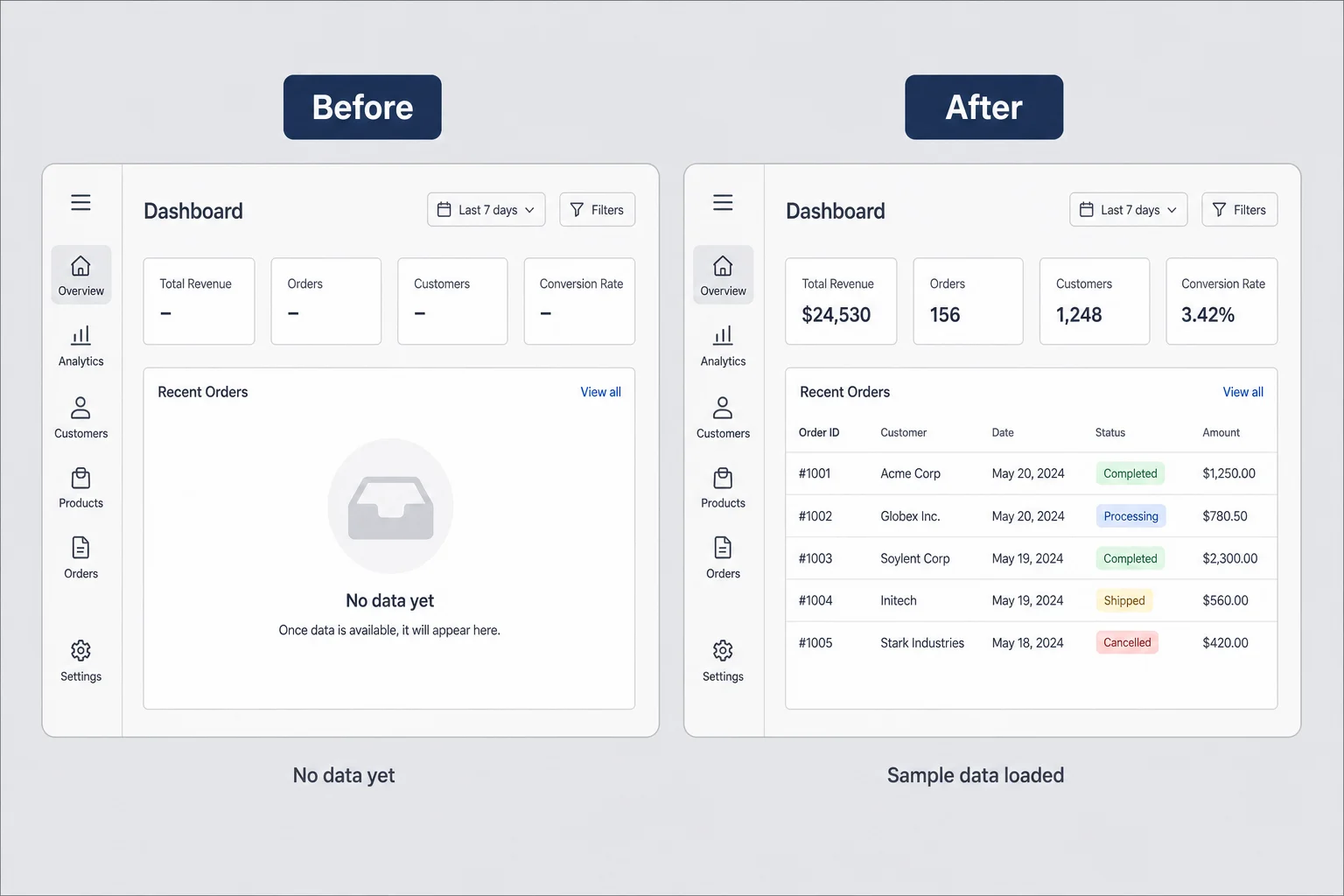
Onboarding is not a welcome modal. It is not a checklist widget unless that checklist points at real value. It is the set of decisions that determine whether a new user reaches your product's first win without you hand-holding forever.
Good onboarding decides three things. What must happen first. What can wait. What you will do when someone stalls. Bad onboarding decides none of those and hopes curiosity carries the day.
Signup is not activation
Activation is a verb inside the product, not a row in your auth table. I have seen founders celebrate two hundred signups while thirty people completed the one action that correlates with payment. The other one hundred seventy were tourists.
Pick one activation event and name it before you argue about tools. For a scheduling tool it might be "first booking link shared." For a PDF tool it might be "first document generated." If you cannot name it in one sentence, you are not ready to automate anything.
Track completion of that event within twenty-four hours and within seven days. At small volume the numbers will feel embarrassing. Good. Embarrassing numbers tell you where to look. Vanity signup charts tell you to buy more ads.
I once advised a founder who tracked eleven events because his analytics tool made it easy. He could not tell me which one meant success. We deleted eight events and kept three: account created, data connected, first report exported. Clarity improved immediately. Measurement should reduce confusion, not document everything that moves.
Onboarding starts before they click inside the product
The promise on your landing page is the first onboarding message. If the page says "export Shopify orders in one click" and the first screen asks them to configure webhooks, you already lied. Not maliciously. Accidentally. Still costly.
Your welcome email is the second onboarding message. It should bridge promise to first action in plain language. Not "welcome to the platform." Not a link to documentation with forty pages. One sentence about what to do next and why it matters this week.
Launch gets people in the door. Onboarding decides whether they stay long enough to become customers worth keeping. Treat every pre-product touchpoint as part of the same path.
Pricing page copy is onboarding too. If you promise unlimited exports on the pricing page but gate exports behind a three-step integration, you created an onboarding debt you will pay in support tickets. Alignment sounds boring. Misalignment shows up as "this is not what I expected" emails that no sequence can fix.
I keep a short list on my desk for every product I advise: what we said on the landing page, what happens in the first sixty seconds inside the app, what the welcome email tells them to do. If those three disagree, I fix copy before I fix code. Copy is cheaper and faster at solo-founder speed.
Define the magic moment before you write another email
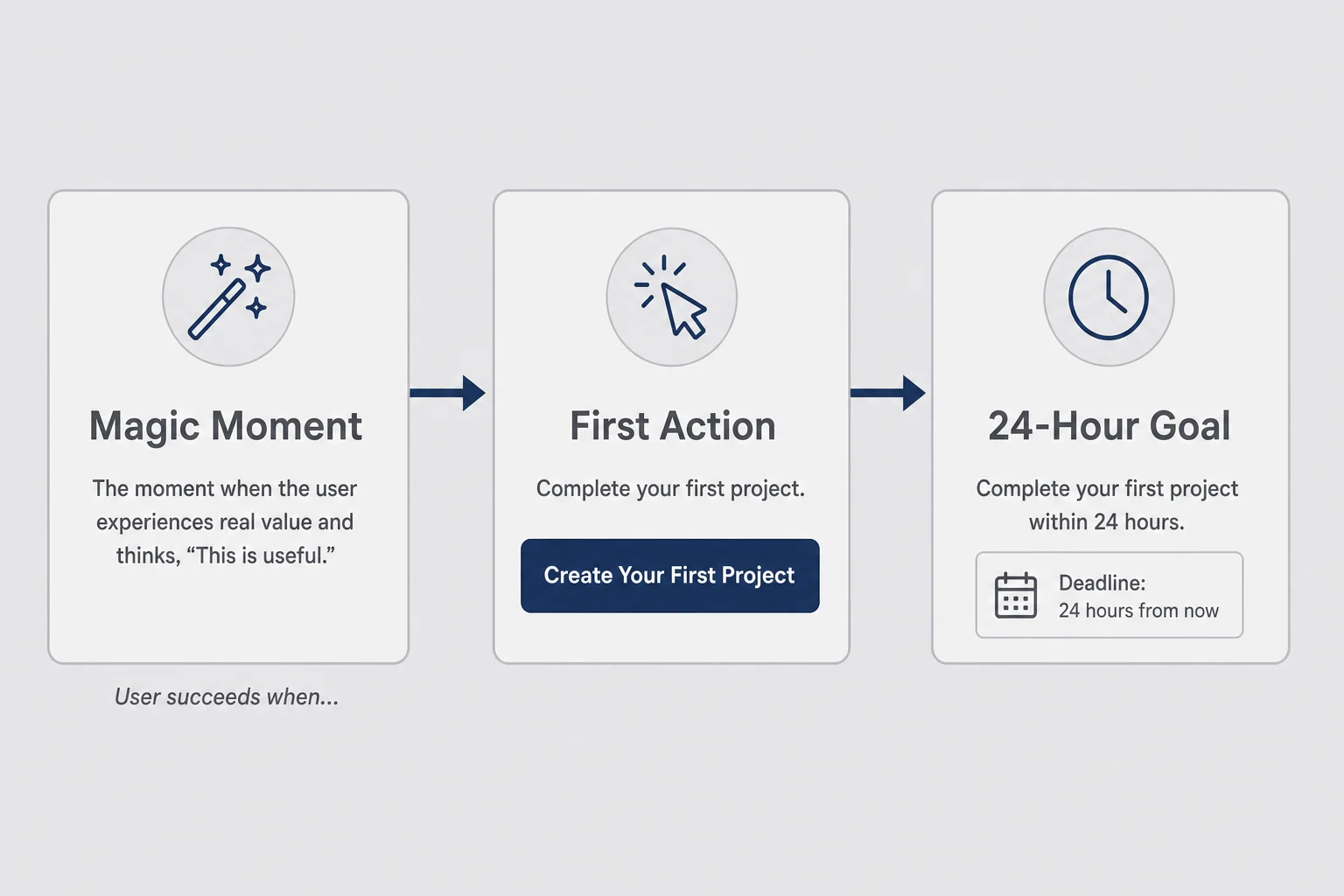
I will not let myself open an email tool until I can finish this sentence: "A new user has succeeded when they ___ within ___." Unfilled blanks mean you are decorating a product you do not understand yet.
The magic moment is not "logged in." It is not "connected Stripe." It is the first time your product's core promise becomes true in their hands. Everything in onboarding should pull toward that moment or get out of the way.
One sentence, one action, one deadline
Write the sentence on paper. Read it to someone who does not know your product. If they ask clarifying questions, the sentence is still too vague.
Then pick one deadline. Twenty-four hours is harsh and useful for B2B tools with obvious jobs. Seven days is more realistic when setup requires data import or integration. Longer than seven days without value and you are not onboarding. You are hoping.
I worked with a founder whose magic moment was "first client report sent from the app." His product had sixteen settings on the first screen. We hid fourteen behind an "advanced" link and put a big button that said "import last month's CSV." Time-to-first-report dropped from days to hours. No new features. Just clarity about what counted as winning.
Sample data beats a product tour every time
Empty dashboards are onboarding failures wearing a UI skin. A new user does not want to learn your information architecture. They want to see what success looks like.
Pre-populate realistic sample data when you can. Show a filled report, a fake project, a demo inbox with tagged threads. Label it as sample if you must, but show the shape of value. Let them delete it after they connect real data.
Product tours that click through twelve hotspots before any value appears are a confession that the product cannot speak for itself yet. Sometimes you need a sixty-second Loom for complex setup. That is fine. Lead with the outcome in the thumbnail title, not "platform overview."
Write the magic moment on a sticky note and put it where you see it when you open the product admin. You will be tempted to add steps that feel productive but do not move users toward that moment. The sticky note is a cheap guardrail against scope creep disguised as helpfulness.
The one-sentence test
If you cannot describe the magic moment without product jargon, interview three users who paid. Ask what they did the first time they thought the product was worth the money. Their verbs become your onboarding map.
Concierge onboarding for your first ten paying users
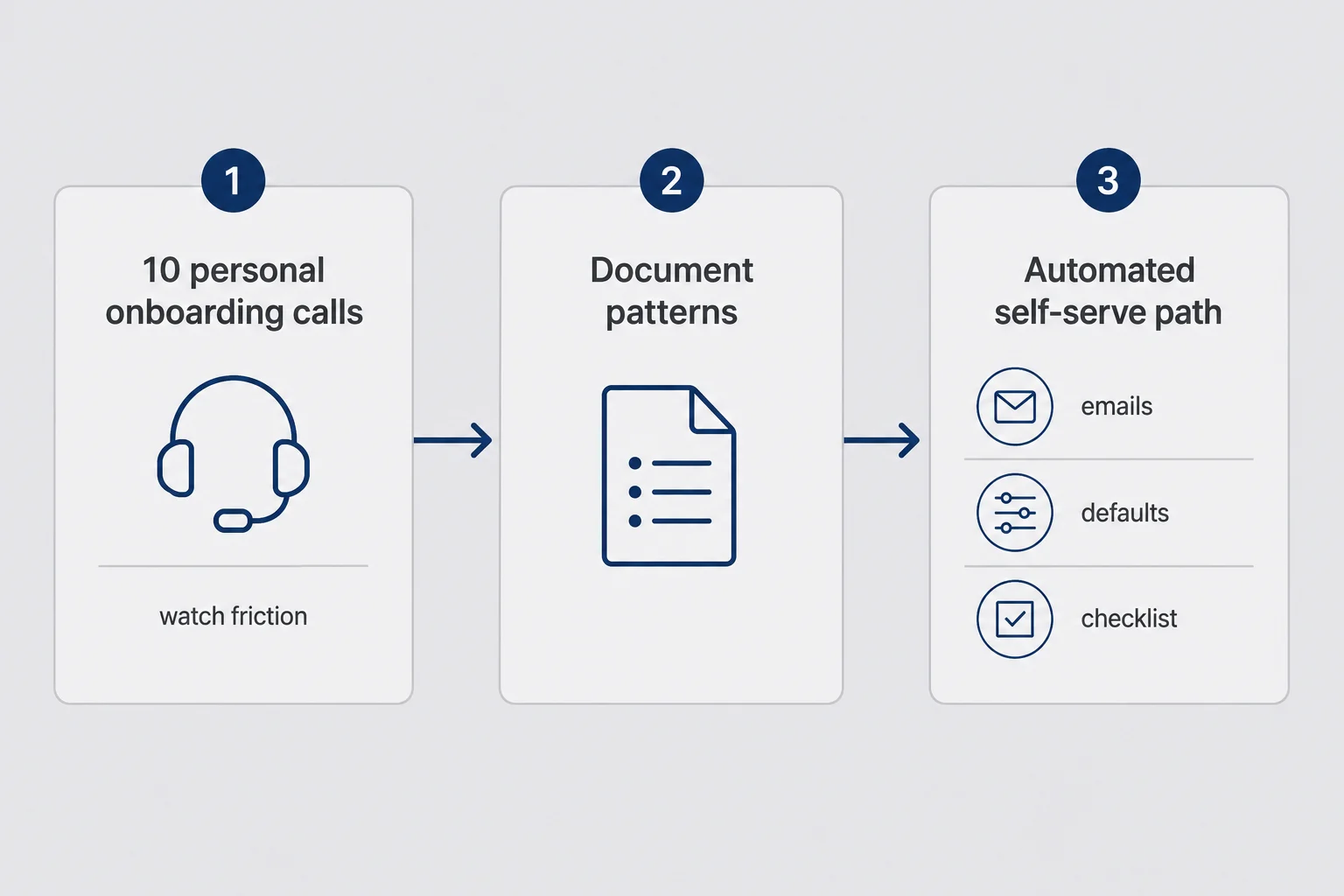
Automation is a reward for understanding, not a shortcut to it. Your first ten paying users deserve white-glove treatment even if your price is forty-nine dollars a month and you feel silly offering it.
Concierge onboarding means you show up. A short call. A personal Loom recorded for their account. An email that says "I noticed you signed up, want me to walk you through the first export?" Not a calendar link to a thirty-minute "demo" that feels like sales. A help offer from the person who built the thing.
I learned this freelancing for indie founders in 2020. The products that retained early customers almost always had a founder in the inbox for week one. The products that churned had beautiful docs and silence. Docs are for reference. Presence is for momentum.
On a concierge call you are not pitching. You are watching. Share screen if they share screen. Note where they hesitate. Note which words they use for their problem. Note the tab they never find. That hesitation list is a more honest roadmap than any feature request form.
Say you have seven trial users this month. Block two hours. Email each one personally within twenty-four hours of signup. Offer fifteen minutes. Expect three to accept. One will teach you more than fifty analytics sessions.
After ten to twenty conversations patterns appear. Everyone misses the same button. Everyone thinks "workspace" means something different. Everyone tries to import the wrong file format. Those patterns become emails, defaults, and checklist steps. That is when automation earns its keep.
Do not concierge forever. Concierge is research at small scale. The goal is to make the path obvious enough that user eleven does not need you. If user forty still needs a call to succeed, the product is too complex or the audience is wrong. But user three should absolutely get your attention.
Record the calls when people agree. Not for content marketing. For your own reference. I still replay clips where a user could not find the export button because I named it "generate artifact" like a fool. Renaming the button took ten minutes. Finding that problem in analytics would have taken weeks at low volume.
One more note on tone. Concierge does not mean performing expertise. It means being useful fast. "Walk me through what you were trying to do Tuesday" beats a scripted tour. Users will tell you the truth if you stop presenting.
Empty states, checklists, and the first screen they see
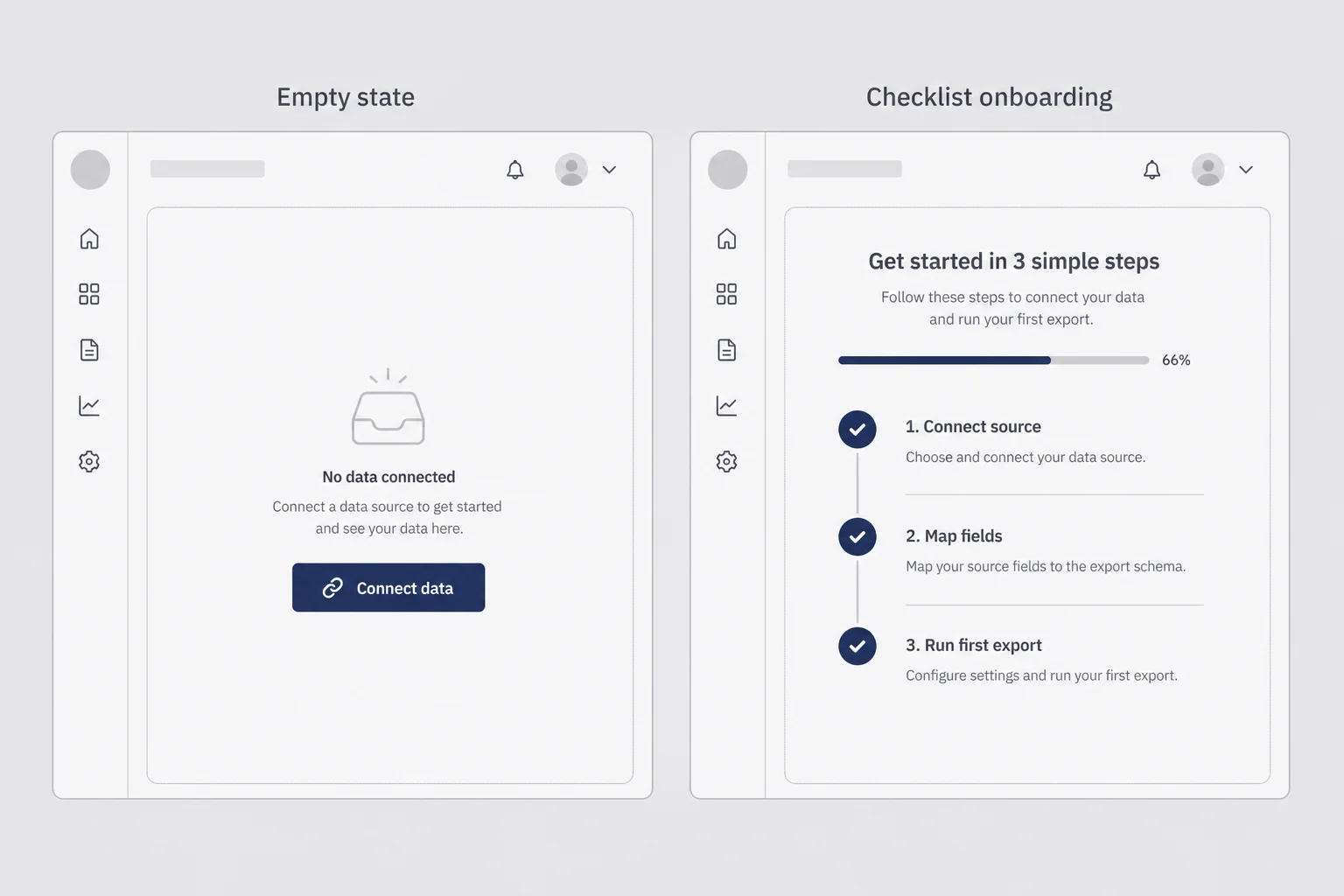
The first screen after login is the most expensive real estate in your product. Most solo founders waste it on a settings page or a blank grid.
An empty state should answer two questions without scrolling. What is this page for? What is the one action that makes it useful? A paragraph of encouragement is not an answer. A button with a verb is.
Checklists work when they are short and tied to the magic moment. Three to five steps, each completable in a few minutes. "Complete profile" is not a step unless profile completion correlates with payment. "Connect your Shopify store" is a step if connection unlocks the core workflow.
Progress indicators help because they exploit a harmless human quirk. People like closing loops. A checklist at sixty percent complete nudges someone to finish the last forty. A checklist with twelve vague items gets ignored.
I am skeptical of gamification badges for B2B micro-SaaS. Your buyer is not a teenager collecting stickers. They are a person trying to finish work before dinner. Respect that.
Default settings should favor the common case. If ninety percent of users need USD and weekly reports, do not force currency and cadence selection before they see a report. Smart defaults are onboarding. Configuration wizards are often procrastination disguised as thoroughness.
When something fails, show the error in words a human wrote. "Webhook validation failed: we could not reach your URL. Here is the test payload we sent." Not "Error 422." Errors are onboarding moments too. A cryptic failure on day one is a cancellation with extra steps.
Think about the first screen as a host greeting someone at the door. You would not hand a guest a binder of house rules before they sit down. You would show them where the coat goes and offer water. Your product's equivalent: where to click, what will happen, how long it takes. "This takes about two minutes" is onboarding copy. Silence is not.
Checklists should disappear when complete. A finished checklist that stays on screen forever is a reminder that the product needed training wheels. Celebrate completion quietly and get out of the way. Some products convert the checklist into a "what's next" panel with advanced features. That works when the magic moment already happened. It does not work as a substitute for one.
The welcome email sequence I actually send
Email is still the most useful onboarding channel for solo founders. It reaches people when they are not inside your product. It can carry tone that in-app modals cannot. It is also easy to overdo.
I keep early-stage sequences short. Three emails. Maybe four if setup is genuinely multi-day. Not twelve. Not "day fourteen thought leadership about our mission." When you want the fuller drip with branching, suppression, and trial conversion asks, use the dedicated micro saas onboarding email sequence.
Day zero: what to say without sounding like a brand
Send within an hour of signup when possible. Thank them briefly. Restate the outcome in their language, not yours. Give one link that starts the magic moment path. Offer a reply if they are stuck.
Bad day zero: "Welcome to Acme! We are thrilled to have you join our community of innovators." Good day zero: "You signed up to stop copying refunds into a spreadsheet. Start here to connect Shopify and see your first export. If anything looks off, reply to this email."
Notice the good version assumes why they came. That is only possible if your landing page and signup flow were honest. If you do not know why they came, your onboarding problem started before email.
Day two and day five: nudge toward value, not features
Day two goes to people who have not activated. Short. Specific. "I noticed you have not connected a data source yet. Here is a ninety-second walkthrough for the step most people miss." One link. No newsletter footer essay.
Day five is a check-in, not a guilt trip. "How is setup going? If you hit a wall, tell me what you were trying to do." You will get replies that save accounts. You will also get silence from people who already churned mentally. Both are data.
I use Loops or ConvertKit for this at small scale. The tool matters less than the copy and the trigger. Behavioral triggers beat calendar triggers when you have enough volume to measure them. At ten signups a month, calendar is fine.
Do not send onboarding emails from noreply@. You are one person. Act like one person.
Here is a day-zero template I have adapted for several founders. Adjust the verbs, keep the shape: "You signed up to [outcome]. The fastest way to see it work is [one action link]. Takes about [honest time]. If anything looks wrong, reply here — I read these." That is the whole email. No logo parade. No three secondary links. One job.
For products with a longer setup path, day three can acknowledge reality. "Most people stall on [specific step]. Here is the doc section that fixes it" works better than a generic "we noticed you have not finished setup" guilt message. Specificity signals you have seen other humans struggle in the same place. Generic guilt signals automation.
Unsubscribe compliance matters legally, but onboarding emails to active trial users are not newsletters. Keep them transactional in spirit even when they are helpful. You are guiding a purchase decision, not building an audience for a podcast.
In-app prompts without the modal avalanche
In-app messaging is useful when it is rare and contextual. It is harmful when it becomes a slideshow blocking the screen.
One modal on first login is tolerable if it points to one action. Three modals deep-linked to a tour are a product apology. Tooltips on every icon are worse. If you need twelve tooltips, your UI is not ready for strangers.
Use prompts when someone hits a known stall point. Imported a CSV but did not map columns. Created a project but did not invite a teammate if collaboration is the core value. Idle for forty-eight hours after connecting data. Context beats generic.
Banners beat modals for non-urgent nudges. Modals should mean "you cannot proceed sensibly without this choice." Everything else can wait for a quiet strip at the top.
I disable most in-app chat widgets until I can respond within a business day. A chat bubble that promises help and delivers a ticket black hole is worse than no chat. If you are the only responder, say so in the widget copy. "Email the founder" is honest and works at micro-SaaS scale.
Progressive disclosure is the fancy term for not showing everything at once. Show the three fields needed for the first export. Hide the webhook debugger until someone connects an integration. Advanced settings are for week two, not minute two. Founders fear that hiding features makes the product look small. Strangers fear that visible features make the product look like homework.
If you use tooltips, attach them to the one action you want next, not to every icon in the nav bar. Tooltip fatigue is real. People stop reading after the third bubble. Make the UI legible enough that most tooltips are unnecessary.
Measuring activation on a solo-founder analytics budget
You do not need an analytics team. You need one event tracked correctly and the discipline to look weekly.
PostHog, Plausible with custom events, or even a simple database query if you are technical enough. Pick one tool. Define activation. Watch the ratio of signups to activations by week. That ratio is your onboarding grade.
| Signal | What it tells you |
|---|---|
| Signups vs activations within 7 days | Whether onboarding delivers the first win |
| Time to first activation | Whether friction is front-loaded |
| Second login within 14 days | Whether value stuck enough to return |
| Support replies in week one | Where words in the UI failed |
At low volume, talk to users in addition to charts. Analytics will lie politely when N equals six. Interviews will not.
Segment by acquisition channel when you can. Users from cold email may already understand the outcome. Users from a vague tweet may not. One onboarding path might not fit both. That does not mean two products. It might mean two welcome emails.
Review onboarding metrics the same day you review revenue. For a solo founder those are nearly the same meeting.
If you are not technical enough to instrument events yourself, ask a developer friend for one afternoon or use a tool your stack already includes. Building without code does not excuse flying blind on activation. Imani covers the ship path; you still own whether anyone succeeds after signup.
A simple weekly note in your calendar beats a dashboard you never open. Write down: signups, activations, median time to activate, replies to onboarding emails. Four numbers. Trend over eight weeks. That is enough to know if your changes worked.
When activation improves but revenue does not, the magic moment might be wrong. You optimized toward an action that feels good but does not correlate with payment. Go back to paid users and ask what they did before they pulled out a credit card. Adjust the definition. Measure again.
When a new customer stalls and you are the support queue
Stall detection is onboarding for founders who do not have a customer success platform. You are the platform. When the inbox grows past stall saves, micro-SaaS customer support for solo founders is the system for everything that is not a day-one activation fix.
Define stall rules in plain language. Signed up three days ago, never connected data. Activated once, never returned. Trial ending in forty-eight hours without a second session. Those users get a personal email from you. Not an automation with {first_name}.
The email should be short enough to read on a phone between things. "Saw you signed up for the trial but have not imported a file yet. Common snag is column headers. Want me to look at a sample?" That tone works because it is specific and offers help without begging.
Some stalls are bad fit, not bad onboarding. If someone signed up for a Shopify tool but does not use Shopify, no email saves them. If someone needed enterprise SSO and you are a forty-nine dollar indie tool, let them go. Onboarding is not conversion therapy for mismatched leads.
For good-fit stalls, one personal note converts more than a twenty-percent discount. Discounts train people to wait for panic offers. Help trains people that you are paying attention. At micro-SaaS scale attention is still a competitive advantage.
Keep a simple stall list in a spreadsheet if you must. Email, signup date, activation yes or no, last login, notes from any call. Review every Monday. Fifteen minutes. You will catch accounts you would have lost while optimizing something irrelevant.
The best stall email I ever sent was three sentences because I was on my phone in a grocery line. A trial user had uploaded data but not run the report. I said I noticed, asked if the column mapping looked confusing, and offered to fix it async. She replied with a screenshot. I sent back a thirty-second Loom. She converted Friday. No discount. No calendar link. Just proof that someone was paying attention.
That does not scale to five hundred signups a month. It scales perfectly to five. Know which stage you are in.
Scaling past fifty signups without a customer success hire
Fifty signups a month is a different problem than five. You cannot call everyone. You can still learn from everyone.
Tier your involvement. Personal outreach for high-intent or high-price accounts. Automated path for self-serve trials that match your ideal profile. Office hours once a week for anyone who wants live help. A recorded walkthrough embedded where stalls cluster.
Document the answers you repeat. Not a wiki graveyard. Short articles or Looms titled the way users phrase the problem. "Why my CSV import failed" beats "Data ingestion FAQ."
Hire automation carefully. Triggered emails when activation events fail are good. Chatbots pretending to be humans are bad at solo-founder scale unless you maintain them like code.
The handoff from concierge to self-serve should feel continuous. Users who read your early emails should recognize the same voice in the product copy. Founders who sound corporate in email and casual on calls confuse people. Pick a register and keep it.
When you pass a hundred activations a month, revisit tooling. Not before. Premature optimization of onboarding infrastructure is how solo founders spend a week integrating Customer.io while three trials expire unnoticed.
Build a lightweight playbook document after your concierge phase. One page. Magic moment definition. Top five stall points. Email copy that worked. Screenshots of good first sessions. Future you will forget the details. Future you will also be tired.
Community can supplement onboarding at small scale if your buyers cluster somewhere. A private Slack for the first twenty customers sounds unscalable. It is. It also surfaces confusion faster than any NPS survey. You do not need a community for everyone. You need a feedback loop that does not require people to hunt for a support form buried in settings.
Onboarding mistakes I keep seeing on live products
Mandatory email verification before value is a classic. Security matters. Losing a motivated user in their first five minutes matters more at trial stage. Verify before payment if you must. Let them see sample value first when you can.
Profile completion gates are another. Nobody's job title changes whether your PDF tool works. Collect the minimum data required to deliver the magic moment. Ask for the rest after they win once.
Copying competitor onboarding flows without copying their audience is how you inherit complexity that does not fit. Their step three might be your step zero because your buyer is less technical.
Treating documentation as onboarding is lazy kindness. Docs are for reference after someone cares. Onboarding is the guided path to caring.
Celebrating signup spikes in public while activation is flat is morale poison. Fix the middle of the funnel before you brag about the top.
Finally, disappearing after launch week. Marketing brings people in. Onboarding is a weekly habit, not a launch task you check off next to Product Hunt.
Questions I get about micro-SaaS onboarding
When should I automate onboarding for a micro-SaaS?
After you have personally onboarded ten to twenty paying users and can describe exactly what they needed to succeed. Before that, automation guesses at friction you have not seen yet. Concierge onboarding is slower but teaches you what to automate.
What is a magic moment in SaaS onboarding?
The first in-product action that proves your product is valuable to a real user. Not signup. Not profile setup. The moment they think this is useful. For a reporting tool it might be seeing a correct chart. For an export tool it might be downloading a clean file. Define it in one sentence before you write emails or tours.
How many onboarding emails should a solo founder send?
Three is enough for most early products: welcome with one clear first step, a day-two nudge if they have not reached value, and a day-five check-in that offers help without guilt. Long drip sequences are for products with proven activation paths, not for founders still learning what confuses people.
What activation rate is realistic for a new micro-SaaS?
There is no universal number, but if fewer than thirty percent of new signups reach your magic moment within seven days, onboarding is probably broken before marketing is. At solo-founder scale, even ten signups a month gives you enough signal to spot a blank-dashboard problem fast.
Should I offer onboarding calls for every customer?
Yes for your first ten to twenty, especially if price is above twenty-nine dollars per month or setup is non-obvious. After that, offer calls to stuck users and high-value accounts, not to everyone by default. Calls do not scale; what you learn on them does.
How does onboarding connect to churn?
Most early cancellations are people who never reached value, not people who tried the product and rejected it. Fix the first session and the first week before you obsess over retention campaigns. Onboarding is where churn prevention actually starts for a solo founder.
A signup without a first win is just an expensive lead
I used to think onboarding was something you bolted on after the product was done. Ship features, then write emails. That order produced a lot of pretty products with quiet dashboards.
Now I think onboarding is the product for the first week. The emails, the empty states, the defaults, the reply when someone is stuck. That is what strangers actually experience. Your architecture diagram is not what they experience. Your roadmap is not what they experience. The first path to value is what they experience.
You do not need a customer success team. You need a clear magic moment, ten honest conversations with early users, and the discipline to measure whether new signups reach that moment before you pour more traffic in. Distribution is still a skill. So is teaching someone to win inside what you built.
Go define the sentence. Email user three. Fix the blank screen. The signup count will still be there tomorrow. The activation count is the one that pays rent.
If you do one thing this week, pick one trial user who went quiet. Send the three-sentence email. Watch what they say. That reply is worth more than another feature on the roadmap.




Comments