Day Three and They Still Haven't Logged In
A practical micro saas onboarding email sequence for solo founders: activation triggers, first-week drips, branching, and trial conversion emails that do not sound like a robot.
 By Reese29 min read
Listen to this article
19:17AI-generated podcast-style overview of this article (not a word-for-word narration).
I opened Loops on a Monday and saw what I already knew in my gut. Forty-one people had started a trial in the last two weeks. Nineteen never opened the product after signup day. Eight hit the activation event. Three paid. The welcome email had a 62% open rate. So the problem was not deliverability. The problem was that my micro saas onboarding email sequence was cheering people into an empty dashboard.
I rewrote the day-one email that afternoon. Not the subject line. The job. Old version linked to a feature tour. New version named one action, estimated ten minutes, and linked straight to that screen. By the end of the week, stuck users were replying with questions instead of ignoring me. That is the bar. Not clever copy. A sequence that moves someone toward value or asks what is blocking them.
This post is about that sequence. Not in-app customer onboarding (empty states, checklists, concierge calls). Not how to structure the trial itself. Those posts own product and pricing mechanics. Here we own the emails that show up when someone is not inside the product. If early cancellations are already eating you alive, pair this with how to reduce churn in a micro-SaaS after you fix week one.
I write as someone who has run lifecycle email for small B2B SaaS teams and for my own side projects. I have shipped drips nobody opened and ones that got "this is exactly what I needed" replies. The difference was almost never a prettier template. It was clarity about the one job each message had, and the discipline to stop emailing people who already finished that job.
One more framing before we get into templates. If you have twenty trial users a month, this sequence will not feel like "marketing automation." It will feel like a polite system that catches people you would have forgotten to nudge. That is the right scale to start. Fancy journey builders can wait until the boring version is making money.
Micro SaaS onboarding email sequence: what it is actually for
A micro saas onboarding email sequence is a short set of automated messages that run after signup with one purpose: get a new user to their first real outcome, then help the ones who got value decide to pay. That is it. It is not a newsletter. It is not a brand story. It is not seven feature announcements dressed up as education.
If you only remember one sentence from this whole post, make it this: every email either moves someone toward activation, removes a blocker, or asks for the sale. If a draft does none of those three, delete it.
Solo founders often copy enterprise lifecycle maps. Welcome. Product education. Social proof. Case study. Upsell. Soft cancel save. That stack assumes a sales team, a CS manager, and a product with ten jobs to be done. Your product probably has one job. Your sequence should act like it.
I once audited a founder's seven-email drip for a tool that did one thing well: turn form spam into a clean weekly digest. Email two explained "workspaces." Email three explained "roles and permissions." Email four linked a blog post about inbox zero. The product did not need workspaces for the first win. Those emails were borrowed from a Notion-shaped mental model of SaaS. The user needed one successful digest. Everything else was delay dressed up as education.
The sequence also has a finish line. Once someone activates, you stop asking them to activate. Once they convert, you stop the trial countdown emails. Onboarding email without exit conditions is just spam with better intentions.
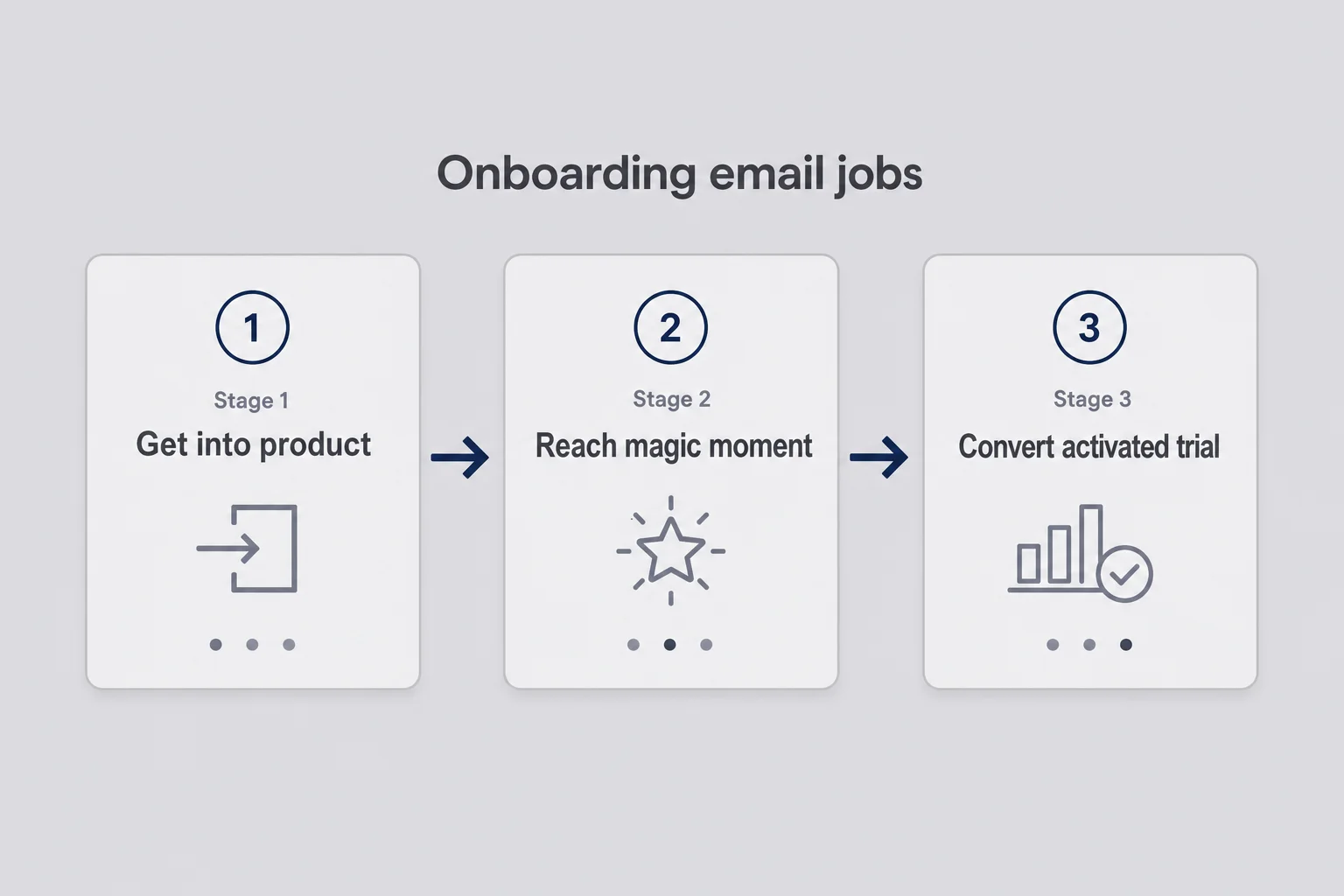
I treat the first fourteen days as three overlapping jobs:
- Get them into the product with a clear next step.
- Get them to the magic moment, or learn why they stalled.
- Convert activated trial users before the clock runs out.
Notice what is missing. No "here's our company story." No "meet the founder" video unless it directly unblocks setup. People did not sign up for your biography. They signed up because something in their week is broken and your landing page said you fix it.
When founders tell me their sequence "is not converting," I ask which job failed. Usually they have no idea. Opens look fine. Clicks are soft. Nobody reached the event that proves the product works. Email cannot fix a blank first screen, but it can stop pretending a tour link is the same as a win.
There is also a quieter failure mode: the sequence converts a few people who never activated, then those people cancel in week two. Your dashboard celebrates trial-to-paid. Your churn post will not. If paid users never reached value, you did not convert them. You postponed a refund conversation.
Your product onboarding and your email drip are not the same job
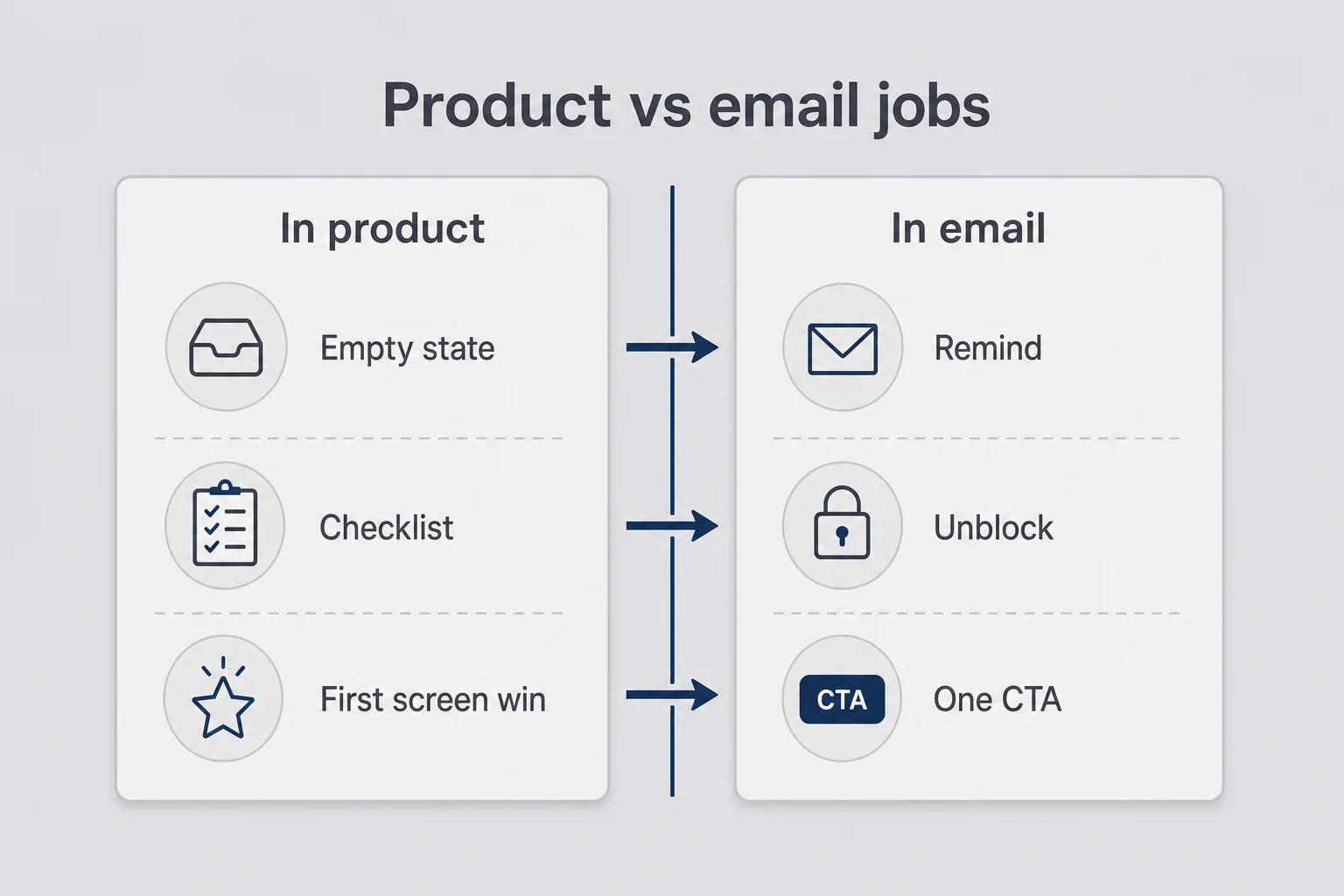
I keep seeing founders collapse these into one workstream. They write five emails, skip the empty state, and wonder why activation is dead. Or they polish the checklist UI and send one welcome note that says "check the docs." Both sides matter. They do different work.
Product onboarding is what happens when someone is already logged in. The empty state. The first checklist. The setup wizard that does not ask for seventeen fields. That is the territory of micro-SaaS customer onboarding for solo founders. If the first screen is confusing, your emails will just send people into a wall faster.
Email onboarding is what happens when they are not logged in. Most trial users live there. They signed up between meetings. They meant to come back. Life happened. Your email is the only channel that can interrupt that drift without waiting for them to remember your URL.
Use email to pull. Use product to deliver. The pull is specific: "Finish connecting Stripe so your first report can generate." The deliver is the screen that makes that connection obvious. If either side is vague, the other side cannot compensate forever.
A practical split I use:
- In product: remove friction for the activation action. Prefill. Show an example. Make the primary button the actual next step.
- In email: remind, reframe, and offer help. One CTA. One reason to click today. A reply path that hits your inbox, not a support void.
Think about where the user is physically when each channel fires. Product onboarding assumes a laptop, a tab already open, and five minutes of focus. Email often lands on a phone in a grocery line. That is why email copy that says "explore the platform" fails. Explore is a desktop verb. "Tap here and paste your webhook URL" is a phone-compatible verb. Match the channel to the kind of action you are asking for.
Concierge still wins for your first ten to twenty users. I will personally email early trials from my own address before I trust automation. Automation encodes what you learned by talking to stuck people. It should not invent the path.
If you are early enough that you can still name every trial user, do that for a week. Keep a note: where they stalled, what they replied, which sentence in your email got a click. Those notes become your sequence. Templates from a SaaS blog do not know that your users get stuck on OAuth consent screens. Your inbox does.
If you have not defined the magic moment yet, stop writing subject lines. Go define it. Email without an activation definition is just a calendar of hope.
Map the activation event before you write a single subject line
A SaaS activation email drip only works if you know what "activated" means in your product. Not in theory. In an event your database can see.
Signup is not activation. Profile complete is not activation. Watching a Loom is not activation. Activation is the first action that makes a user think, "okay, this is useful." For a reporting tool it might be viewing a correct chart with their data. For an export tool it might be downloading a clean file. For a scheduling tool it might be booking the first real meeting through the product.
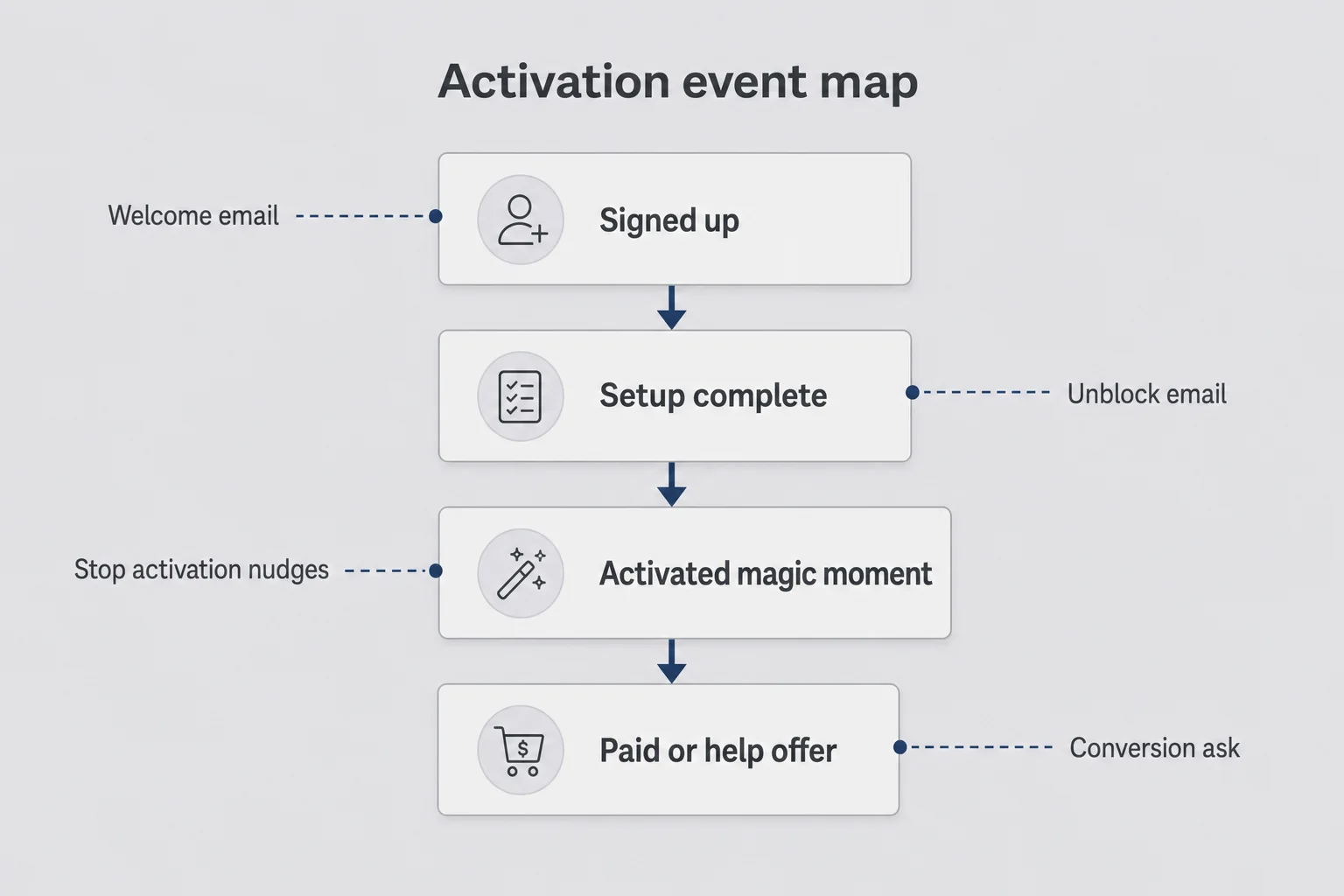
Write that moment as one sentence. Then turn it into an event name you can fire from the app: first_report_generated, first_export_downloaded, first_meeting_booked. If you cannot name the event, you cannot branch the sequence. You will send the same day-three nudge to people who already won and people who never logged in. That is how you train users to ignore you.
I also map two earlier events because they explain the stall:
- Setup complete: the required connection or configuration finished.
- First session return: they came back after signup day.
You do not need a warehouse. You need three honest signals and a way to tag users in Loops, Customer.io, or ConvertKit when those signals fire. At solo-founder scale, a webhook into your ESP is enough. Max can help you wire the event in the app. Your job is deciding which event is worth wiring.
If you are non-technical and the event work feels scary, start with a proxy you can see without engineering theater. Example: a row appears in your "accounts" table with integration_connected = true. Or Stripe Customer metadata you update when the first export succeeds. Ugly proxies beat elegant dashboards you never build. Imani's lane covers shipping without a CS degree; I just need a boolean I can branch on.
Time-to-value matters for cadence. If most successful users hit the magic moment in under an hour, your day-three "getting started" email is already late for the motivated cohort and still early for the distracted one. If real value takes three days of data syncing, do not guilt people on day one for not being done.
Say your product needs a CRM sync that takes overnight. Day-zero email should set that expectation. Day-one email should confirm the sync started, not yell about unused features. Day-three email should celebrate the first synced view or troubleshoot a failed connection. Same sequence skeleton. Different product physics.
Another example: a screenshot annotation tool where activation is "shared a link with a teammate." Day-zero should not ask them to invite five people. It should ask them to annotate one image and copy the share link. Day-two can ask whether anyone opened it. Day-four can offer a second workflow once sharing worked. Invite-heavy products die when onboarding emails pretend virality is the first win. First win is usually selfish. Sharing comes after.
I keep a one-page map before I write copy:
| Event | What it means | Email reaction |
|---|---|---|
| Signed up | Interest, not value | Welcome + one next step |
| Setup incomplete after 24h | Stuck on plumbing | Specific unblock email |
| Activated | Value proved | Stop activation nudges |
| Activated + trial day 10 | Ready for the ask | Conversion email |
| Never activated + trial day 12 | Probably not converting | Help offer or soft close |
That table is the sequence. The emails are just sentences attached to rows.
If you cannot fill the middle column in plain language, you are not ready to automate. "Engaged user" is not an event. "Created first project" might be, if creating the project already shows value. Be ruthless about whether the event is proof or paperwork.
The first-week trial onboarding emails I actually send (and what I skip)
Trial onboarding emails earn their keep in week one. That is when intent is highest and habit is lowest. I front-load messages there and keep week two thinner. A fourteen-day trial does not need fourteen emails. It needs a few well-timed ones with exits.
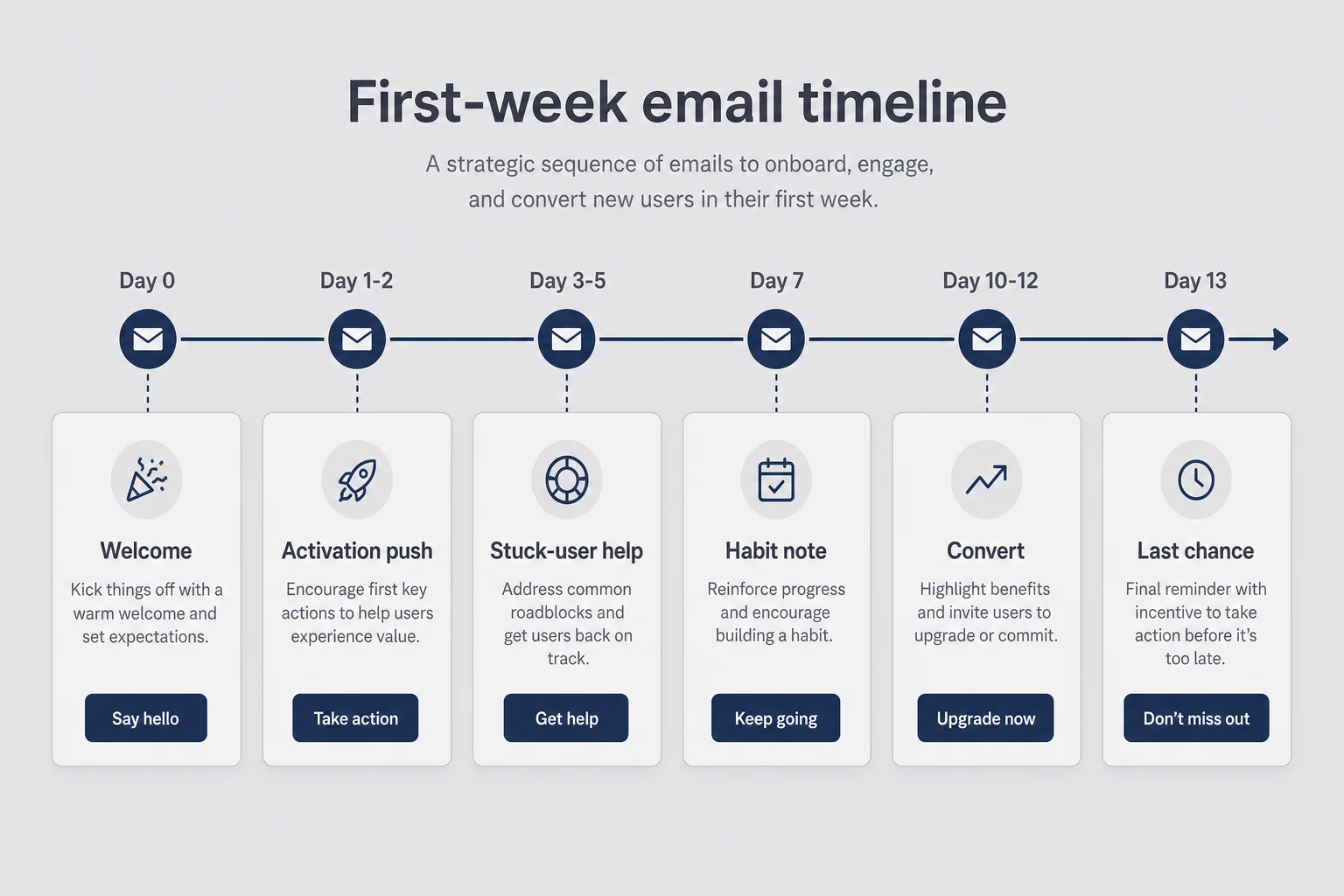
My default for a typical B2B micro-SaaS trial looks like this:
- Day 0: welcome with one next step
- Day 1 or 2: activation push (only if not activated)
- Day 3 to 5: stuck-user help (only if still not activated)
- Day 7: light habit or proof email for activated users only
- Day 10 to 12: conversion ask for activated users still on trial
- Optional day 13: last-chance note, still specific, still human
I skip feature tours as separate emails. I skip "customers like you" case studies before activation. Social proof helps conversion after someone has felt value. Before that, it is wallpaper.
I also skip the founder origin story unless the product is trust-heavy and the story removes a real objection ("I built this because I got burned by X, so we never store Y"). Most origin emails are the founder wanting to be liked. Save it for the about page.
Day 0: welcome with one next step
Send within five minutes. From your name, not noreply@. Subject line should sound like a person, not a brand launch.
The body does four things and stops:
- Confirms they are in the right place.
- Names the outcome they came for, in their words if you can.
- Gives one next step with a realistic time estimate.
- Invites a reply if they get stuck.
No footer menu with six links. No GIF of confetti. No "we're so excited you're here" paragraph that says nothing.
If you captured a use case on the signup form ("reporting," "client updates," "internal ops"), mirror that phrase in sentence two. People skim for evidence they are still in the right product. Generic enthusiasm does not do that. Their own words do.
Here is a welcome email micro saas template you can steal in plain text:
Subject: next step inside {product}

Hey {first_name},

You're in. The fastest way to see if {product} is useful is to {one action}.

Takes most people about ten minutes:
1. {setup step}
2. {activation step}

Start here: {deep link}

If something looks broken or confusing, reply to this email. I read them.

Reese
Deep link matters. Send them to the exact screen, not the marketing site, not the generic dashboard home if home is empty. If your auth wall forces a password reset dance before the deep link works, fix that first. A perfect welcome email that drops people on a login error is still a failed welcome email.
I also put the time estimate in because founders lie to themselves about setup length. If it takes twenty-five minutes, say twenty-five. People can schedule twenty-five minutes. They resent "two minutes" that becomes a half hour.
Day 1–2: get them to the magic moment
Only send this if they have not activated. If they already hit the event, suppress it. Full stop.
This email assumes they have seen the product once or bounced after signup. Your job is to restate the win in sharper terms and remove one common blocker.
Useful angles:
- "Most people get stuck on
{integration}. Here is the two-minute version." - "If you only do one thing this week, do
{activation action}." - "Here is what a finished setup looks like" with a screenshot or short Loom under two minutes.
I avoid stacking three CTAs. One link. Maybe a secondary "reply if you want me to look" line. That reply line has closed more stuck trials for me than another feature bullet ever did.
If your product needs data before it looks alive, say so. "Your dashboard will look empty until the first sync finishes overnight" prevents people from deciding the product is broken on hour one.
A pattern that works when the blocker is scary permissions: name the scary thing and why it is scoped. "We only ask for read access to the Reports folder, not your whole Drive." Silence around permissions reads like a trap. Clarity reads like respect.
If day-one clicks are high and activation among clickers is still low, stop rewriting the email. Sit with three users on the screen the link opens. The copy got them there. The product lost them after the click.
Day 3–5: help the stuck ones (and leave the active ones alone)
This is the email most founders either skip or turn into a guilt trip. Do neither.
By day three, non-activated users are in two buckets: busy but still interested, or quietly gone. You cannot know which from opens alone. So you write for the busy person and give them an easy out.
Tone: curious, specific, low pressure.
Ask one diagnostic question. "Was it the Salesforce connect, the field mapping, or something else?" Multiple choice in a sentence beats "let me know if you need anything."
Offer a fifteen-minute call only if you can actually take those calls. If you cannot, do not offer. Offer a Loom review of their account instead, or a reply-based debug. Empty promises train people that your email is theater.
Activated users should not get this message. They should get silence on the activation track, or a short "nice, you generated your first report" note that points to the second useful action. Celebration can be one sentence. Then get out of the way.
I sometimes send a day-five email that is almost rude in its brevity: "Still worth trying, or should I close your trial so I stop emailing?" Oddly, that gets honest replies. Busy people appreciate an exit. Ghosts stay ghosts. Either outcome is better than another soft "just checking in."
Branching beats a fixed calendar
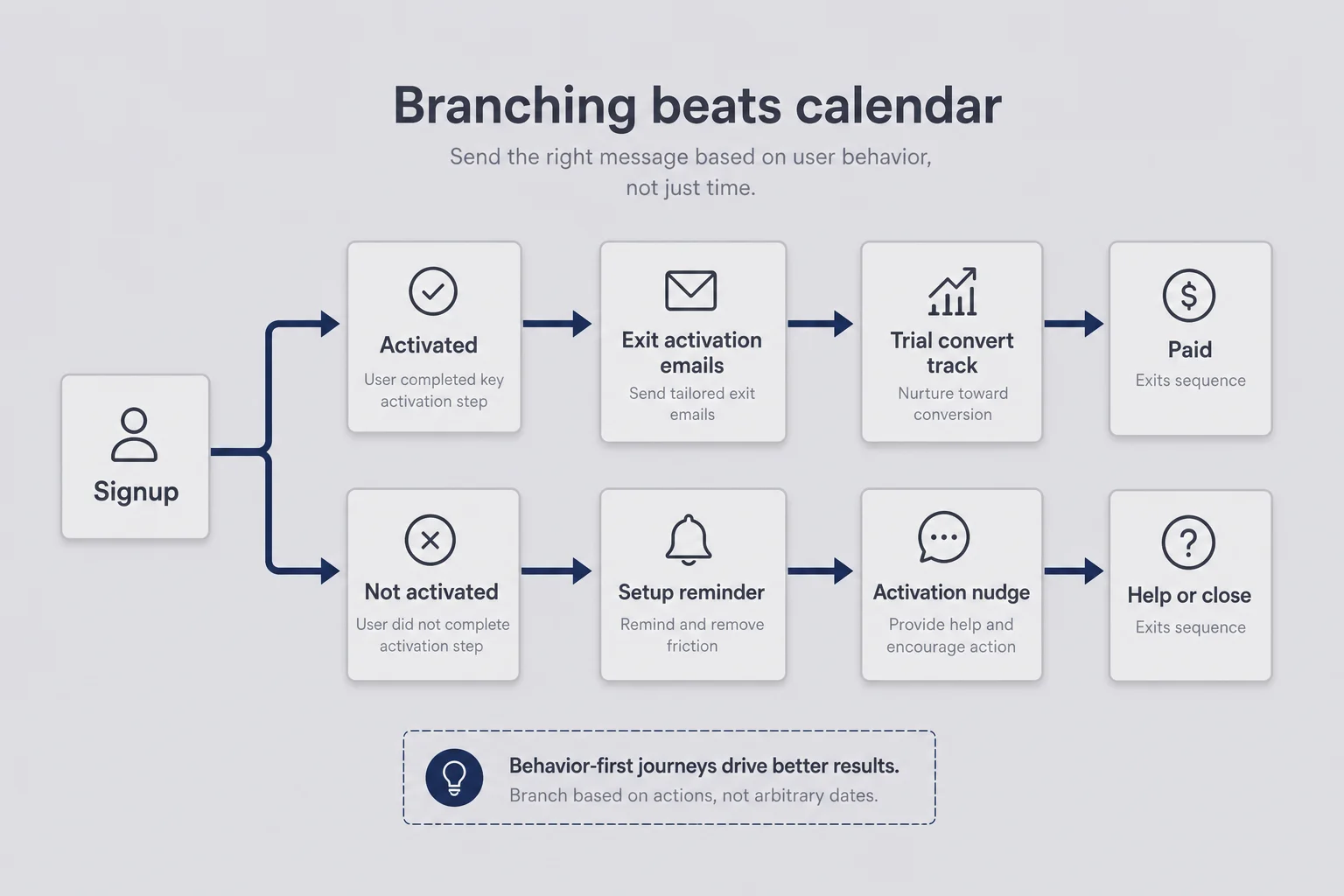
A calendar drip is easy to build and easy to regret. It sends email three on day three whether the user is a power user or a ghost. Branching is how a solo founder looks attentive without living in the inbox.
You do not need twenty journeys. You need a few gates:
- If activated → exit activation emails; enter light habit or conversion track.
- If setup incomplete after 24 hours → send the setup-specific unblock email; delay the generic activation push.
- If they reply → pause automation for that thread until you answer.
- If they convert → exit trial conversion emails immediately.
That is enough for most micro-SaaS products under a few hundred trials a month.
I have watched founders build beautiful day-by-day maps in Notion and then refuse to add a single if/then in Loops because "we'll complicate it later." Later never comes. The fixed calendar ships. Activated users keep getting "have you tried connecting your account?" and they unsubscribe. You lose the people who liked you.
Branching also forces product honesty. If you cannot detect activation, you cannot suppress. If you cannot suppress, your sequence will eventually train your best users to ignore you. Instrument first. Copy second.
A simple mental model: the calendar is the default path for people who do nothing. Behavior is the override. Defaults are for ghosts. Overrides are for humans making progress.
When your ESP is limited, fake branching with tags. Fire activated from the app, add the tag, and exclude that tag from activation campaigns. It is not elegant. It works.
Here is a concrete branch set I have used on a fourteen-day trial with one core integration:
- Signup → enroll in "Onboarding core."
- If
integration_connectedwithin 24 hours → skip setup reminder; wait for activation check. - If not connected at 24 hours → send setup reminder; delay activation email by 24 hours.
- If
first_value_eventanytime → exit "Onboarding core," addactivated, enroll in "Trial convert" starting day 10. - If still not activated on day 12 → send help-or-close; do not send the paid ask.
That is five rules, not a CRM PhD. Write them on a sticky note before you click around the ESP UI. The interface makes you feel productive. The sticky note keeps you honest.
Minimum viable branching
If you only build one branch this month, make it activation suppression. Stopping the wrong email beats writing a better version of it.
One more branch people forget: timezone and send windows. If most of your users are US agency owners, blasting at 3 a.m. their time is not a growth tactic. Pick a daytime window in their likely zone. Perfect personalization is unnecessary. Not waking them up is polite.
Subject lines and plain-text body that do not sound like a brand
Onboarding copy fails in two predictable ways. It sounds like a public company marketing site, or it sounds like a productivity influencer. Neither sounds like the person who will refund them if the product is bad.
Subject lines that tend to work at solo-founder scale are boring on purpose:
- "next step inside
{product}" - "stuck on the Salesforce connect?"
- "your trial ends Thursday"
- "quick question about your setup"
Subject lines I avoid:
- "🚀 You're in! Let's maximize your potential"
- "Everything you need to get started"
- "A special gift inside"
The emoji rocket does not increase activation. It increases the chance I look like every other SaaS in the inbox.
Body style: plain text, short paragraphs, one ask. Write like you would Slack a friendly peer. Contractions are fine. Fragments are fine. A single specific detail beats three vague benefits.
I still use AI for first drafts of variants. Then I cut the adjectives and put the deep link back in. AI defaults to "exciting journey" language. Your users are not on a journey. They are trying to finish a task before lunch.
A quick edit pass I run on every AI draft: delete the first sentence if it thanks them for signing up, delete any sentence that starts with "In today's," and replace every vague verb ("explore," "discover," "check out") with a concrete action verb ("connect," "generate," "export," "invite"). That pass alone removes most of the synthetic smell.
Personalization should be real. First name is table stakes. Better: the integration they picked, the use case from signup, the fact they generated zero reports. Fake personalization ("as a busy professional like you") is worse than none.
One CTA. If you need a second link, make it "reply to this email." That is not a second marketing CTA. That is an escape hatch into a human conversation.
Also: send from a monitored address. If your main inbox is full of noise, use a founder alias you actually check twice a day. Nothing kills trust like "reply anytime" going into a black hole.
Formatting tip: if you insist on light HTML, keep it looking like plain text. One link color. No hero image. No three-column footer. The second your email looks like a campaign, people read it like a campaign. Campaigns get skimmed. Skimmed onboarding emails do not activate.
Trial conversion email sequence without the guilt trip
A trial conversion email sequence should talk to people who already felt value. If they never activated, a "your trial ends in 48 hours" countdown is mostly pressure on someone who never saw the product work. Sometimes they convert anyway. Often they churn in week two and teach you the wrong lesson about pricing.
I separate the asks:
- Not activated near trial end: help offer or honest close. "Looks like you never got a first report live. Want me to jump on a quick setup, or should I leave you alone?"
- Activated near trial end: clear ask. Remind them what they already did. Name what happens to that work if they do not subscribe. Link to checkout.
Guilt is lazy conversion. "We will miss you" is not a reason to pay. "Your weekly report will stop sending to the team Slack on Friday" is a reason to decide.
Timing depends on trial length. On a seven-day trial, one conversion email on day five and a short final note on day six is plenty. On fourteen days, I like day ten and day twelve for activated users, with the last note only if they still have not paid.
Price objections show up here. If people activate and still bounce at checkout, the sequence is not your main problem. Revisit micro-SaaS pricing for solo founders and whether the trial proved the expensive outcome. Email can clarify value. It cannot invent willingness to pay.
For activated users, I like one proof line that is specific to their account when the ESP allows it. "You generated four reports last week" beats "you've been busy in the product." Specific proof makes the upcoming charge feel connected to work already done. Generic flattery does not.
Copy pattern that stays human:
Subject: your trial ends Thursday

Hey {first_name},

You already {activation proof in plain language}. That is the part most people never reach.

If you want that to keep running, you can switch to a paid plan here: {checkout link}

If something is missing for your workflow, reply and tell me. I would rather hear that than send another reminder.

Reese
Notice there is no fake urgency inventory countdown. Trial end dates are real urgency. Invented scarcity is not.
If someone replies with a feature request as the reason they will not pay, do not argue in the conversion email thread. Thank them, note the request, and decide later whether that feature is real demand or a polite no. Conversion week is a bad time to promise a roadmap. Promises made under sales pressure become support debt.
If you require a card upfront, conversion email jobs change. You are less "please buy" and more "use this so the charge feels fair." Card-upfront trials still need activation mail. They need less end-of-trial theater.
Annual plan nudges belong after someone trusts monthly value, not in email two of onboarding. Early annual pushes read like you need cash more than they need a discount. Earn the right to talk about yearly pricing after activation, preferably after the first successful week.
What to measure when open rates lie
Open rates are polluted. Apple Mail Privacy Protection alone made them a vanity comfort blanket. I glance at them for deliverability disasters. I do not manage the sequence by opens.
Track these instead, weekly, even on a messy spreadsheet:
- Signup → setup complete
- Signup → activated within 7 days
- Activated → paid
- Email click → activated (for the specific activation emails)
- Reply rate on stuck-user emails
- Unsubscribe rate on the onboarding stream
If signup → activated is weak and email clicks are strong, your product onboarding is the bottleneck. If clicks are weak and activation among clickers is fine, your email job or offer is weak. Do not "optimize the sequence" until you know which side failed.
Cohorts matter more than totals. Ten signups who all came from a Reddit thread may behave differently than ten from cold email. If one channel dumps low-intent signups into your trial, your onboarding metrics will look broken while the sequence is fine. That is a traffic quality problem. I have written about that tension in micro-SaaS cold email for first customers and Reddit marketing for micro-SaaS.
I also watch time-to-activation. If people who activate do it on day zero, your day-three email is mostly a safety net. If people activate on day four after a human reply, your automation is incomplete and your reply workflow is the real onboarding engine. Automate what repeats. Keep the weird cases manual.
A simple weekly review I actually do on Fridays:
- How many new trials this week?
- How many activated within seven days (rolling)?
- Which email got the most clicks into the activation screen?
- How many stuck-user replies did I answer?
- Did any activated user get an activation email by mistake?
That last one is a quality check. If the answer is yes, fix the branch before you write new copy. Wrong email to the right user trains them faster than a weak subject line ever will.
A harsh but useful rule: if you cannot say what last week's emails changed in activation or conversion, pause new copy experiments. Instrument. Then rewrite.
If you want the money version of this leak, plug your churn into the churn impact calculator after you have a month of post-trial data. Onboarding email is retention work wearing a marketing costume.
Tools I use when I am the whole marketing team
You do not need a CDP. You need an ESP that can send transactional-ish lifecycle mail, tag users, and branch without a four-week implementation.
What I reach for:
- Loops: clean UI, fine for early SaaS lifecycle, sane defaults for solo founders.
- Customer.io: more powerful branching when event volume justifies it.
- ConvertKit (Kit): workable if you already live there; keep broadcast newsletters separate from onboarding automations.
- PostHog or a simple server event: fire activation; do not guess from email clicks alone.
- Stripe Customer Portal / checkout links: conversion emails should deep-link to paying, not to a vague pricing essay.
I avoid stitching five tools together on day one. Every sync you add is a failure point you will discover when a paying customer gets the "you haven't activated" email by mistake.
For content inside emails, a two-minute Loom recorded once beats a twelve-page help center nobody reads. Record the common stuck path. Link it from the day-one or day-three email. Update it when the UI changes. That is documentation that behaves like support.
If your app cannot emit events yet, start uglier. Manual tags from a daily CSV export. Or a Zapier catch that fires when a row appears in your database. Perfect instrumentation is not the prerequisite for a useful sequence. A defined activation moment is.
Domain setup matters more than founders admit. Authenticate SPF, DKIM, and DMARC on the sending domain before you judge copy. I have seen people rewrite subject lines for two weeks while Gmail quietly filtered half the drip. If you are new to a domain, warm it with real one-to-one founder email first, then turn on automation. Cold domains plus bursty trial signups is how you earn the spam folder.
And please keep marketing site forms out of the onboarding list unless you intend to. Mixing "download the PDF" leads with trial users is how you accidentally send setup reminders to people who never signed up for the product.
Budget reality: at early volume, the ESP bill is not your constraint. Your constraint is maintenance time. Pick the tool you will actually open on a Tuesday when something breaks. Fancy features you never configure are just a higher invoice.
Common ways solo founders wreck the sequence
I keep a short list of failure modes because I have shipped most of them.
Writing the drip before the magic moment. You end up with eloquent emails pointed at nothing. Define the event first.
Sending the same email to activated and inactive users. Instant credibility loss. Suppress.
Turning day three into a feature dump. Features are not activation. One action is.
Using brand voice instead of human voice. "Our team is thrilled" from a one-person company reads false. Be the one person.
Measuring success by open rate. Opens do not pay for your Stripe bill. Activation and conversion do.
Offering calendar links you will resent. If you dread the calls, you will dodge them, and the offer becomes a lie. Offer replies or Loom reviews instead.
Building twelve emails for forty trial users a month. You will not maintain twelve. Build five you can keep honest.
Ignoring the product hole. If the first screen is empty and confusing, email is a megaphone for a bad first minute. Fix the screen. I have watched founders A/B test subject lines for weeks while the dashboard still said "No data yet" with no explanation. The subject line was never the problem.
Mixing newsletter and onboarding. Different jobs, different exit conditions, different tolerance for frequency. Separate them.
Asking for a review or referral before activation. People cannot recommend a product they have not felt. Referral asks belong after value, usually after paid. Early asks make you look hungry.
Changing the whole sequence every three days. You will never learn anything. Change one email, watch one metric for two weeks, then touch the next piece. Solo-founder patience is a growth skill.
When something feels off, I read the sequence out loud as if I were the user on a tired Thursday. If I would mute the sender, I rewrite.
A final smell test: would you send this email from your personal Gmail to a peer you respect? If not, your "lifecycle automation" is just embarrassment at scale.
Questions founders ask me about onboarding emails
How many emails should a micro-SaaS onboarding sequence include?
Five to seven is enough for most fourteen-day trials. Front-load the first week around activation, then send one or two conversion nudges near the end. More than eight usually means you are repeating yourself or covering product problems email cannot fix.
Should onboarding emails be plain text or designed HTML?
Start plain text or nearly plain, sent from your real name. Designed templates look like marketing the second someone opens them. Once activation and reply rates are stable, you can test a simple branded footer. The copy matters more than the layout.
When should I stop sending onboarding emails to a user?
Stop the activation nudge the moment they hit your magic moment. Keep a short habit or conversion track if they are still on trial, but do not keep asking them to do the thing they already did. Suppression is the difference between helpful and annoying.
What tool should a solo founder use for onboarding emails?
Loops, Customer.io, or ConvertKit work at early scale. Pick the one that can branch on a product event or a simple tag you update from your app. Fancy journey builders are optional. Reliable triggers and one clear CTA per email are not.
How is an onboarding sequence different from a newsletter?
Onboarding has a job with an exit condition. A newsletter assumes ongoing interest and no finish line. Mix them and you either spam new users with blog posts or bore subscribers with setup reminders. Separate lists and intents until you know what each message is for.
Do onboarding emails still matter if my in-app onboarding is good?
Yes, because most trial users will not open your app every day. Email is how you reach the ones who signed up on Tuesday and forgot by Thursday. Good in-app onboarding and a tight email sequence reinforce each other. Neither replaces the other.
The sequence is not the product
A good micro saas onboarding email sequence makes a simple promise and keeps it: we will not disappear after signup, and we will not nag you about work you already finished. That is a low bar. Plenty of products still clear it the wrong way, with silence or with noise.
If you ship only one improvement this week, ship activation suppression plus a day-one email that names a single next step. Then watch signup-to-activated for fourteen days. Not opens. Activated.
I know the temptation to keep polishing copy because copy is controllable. Events feel like engineering. Product empty states feel like design. Email feels like something you can finish tonight. Finish the useful version tonight. Then spend tomorrow on the screen that email opens.
Distribution got you the trial. The sequence is how you respect that attention. The product is still what has to win. Email can only carry someone to the door and knock twice. They still have to walk in and see that the room was worth entering.



Comments