Charge More Than Feels Comfortable
How to price a micro-SaaS as a solo founder: one plan, a floor that doesn't embarrass you, when to skip freemium, and the signals that tell you it's time to raise.
 By Max27 min read
Listen to this article
22:29AI-generated podcast-style overview of this article (not a word-for-word narration).
A friend launched his first SaaS last spring. Good product. Clean UI. He spent two weeks on the pricing page alone, three tiers, a comparison table, an enterprise "contact us" row he knew nobody would click. He landed on $9, $19, and $49. Then he sat there refreshing Stripe for a month wondering why the $9 tier got all the signups and none of them stuck.
When I asked why he picked $9, he said he didn't want to scare people away. Reasonable instinct. Wrong target. He wasn't selling to teenagers with allowance money. He was selling a workflow tool to small e-commerce shops. His customers were already paying $200 a month for Shopify apps that did less. He left four hundred dollars a month on the table because nine dollars felt safe in his head, not because nine dollars was right for the buyer.
I've underpriced my own products more times than I want to admit. I've also watched founders price themselves into a support nightmare: too cheap, too many users, no margin to hire help, burning out on tickets from people who paid less than a Netflix subscription. Pricing is where bootstrapping gets emotional. Revenue is validation, and your price is the first revenue decision that sticks.
This is Part 3 of Micro-SaaS From Zero. You validated the idea. You built the thing. Now you need a number on the page that turns strangers into customers without trapping you in bad math. The build guide touched pricing in one section; this post owns the whole decision. I'm going to walk through the micro-SaaS pricing strategy I'd actually use as a solo founder today: one plan, a floor I'd stand behind, models that don't explode your brain, free tiers that lie to you, and the moment you raise prices without burning the people who believed in you first. Some numbers below are round examples to show the logic. I'll say when they're hypothetical.
One belief under all of it, same as everything on Micro-SaaS Insider. A boring micro-SaaS at $49 a month with forty customers beats a revolutionary one at $5 a month with four hundred signups and no profit. Price is not greed. It's alignment between the value you deliver and the business you can sustain alone. Everything below is pricing for builders who ship alone, not pricing theory for a boardroom.
Micro-SaaS pricing for solo founders when every dollar feels personal
Pricing hits different when you're alone. There's no finance team to hide behind, no board to blame, no "market research" deck you can point at when someone says you're expensive. It's just you, a Stripe dashboard, and the creeping feeling that asking for money makes you a fraud.
I know that feeling. I still get a half-second of discomfort when I type a new price into a checkout page, and I've been doing this since 2012. The discomfort doesn't mean the price is wrong. It usually means you're pricing like an employee, not like a business. Employees worry about what feels fair to the buyer. Businesses worry about whether the exchange is sustainable on both sides.
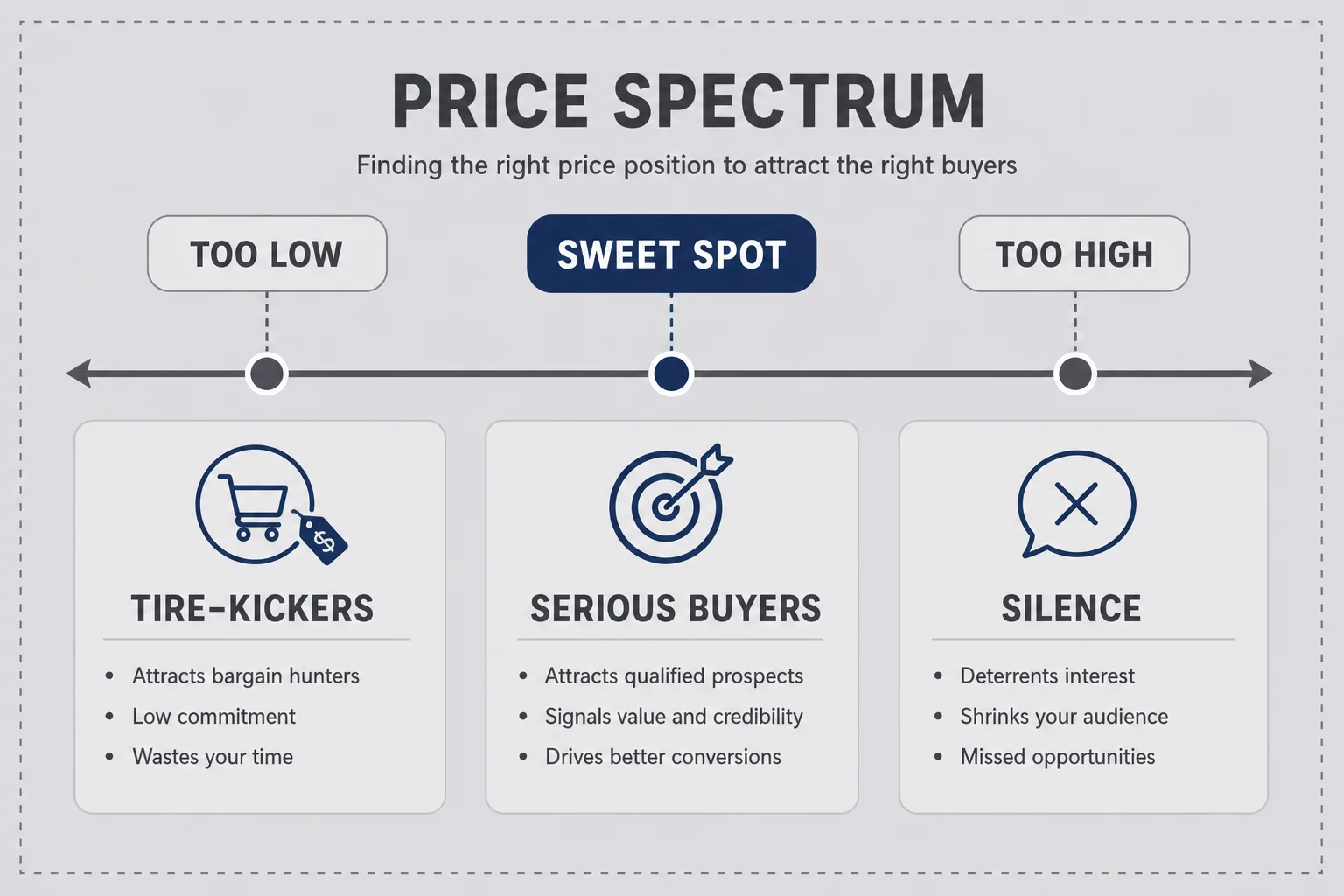
Here's the reframe that helped me. Your price is not a judgment of your worth as a person. It's a filter. It tells the right customers you're serious and tells the wrong ones to keep scrolling. A solo founder selling a $7-a-month tool to small businesses is not being generous. They're selecting for customers who will churn over a missing feature, flood support with "can you also…" requests, and never refer anyone because they're not invested enough to care.
When building got cheap, pricing got more important, not less. Anyone can ship a clone of your idea in a weekend now. What they can't clone is your relationship with a niche, your support quality, your willingness to fix edge cases at 10 p.m. on a Tuesday. You need margin for that work. Margin comes from price times customers, and as a solo founder you don't get to optimize for "most users." You optimize for "enough paying customers that I can keep doing this without getting a job."
So micro-SaaS pricing for solo founders is really three questions wearing a trench coat. What number makes the math work for one person running this? What number makes the buyer take the problem seriously? And what number can you say out loud in a sales call without apologizing? The rest of this article is how I answer those without a pricing consultant invoice.
What pricing actually decides (and what it doesn't)
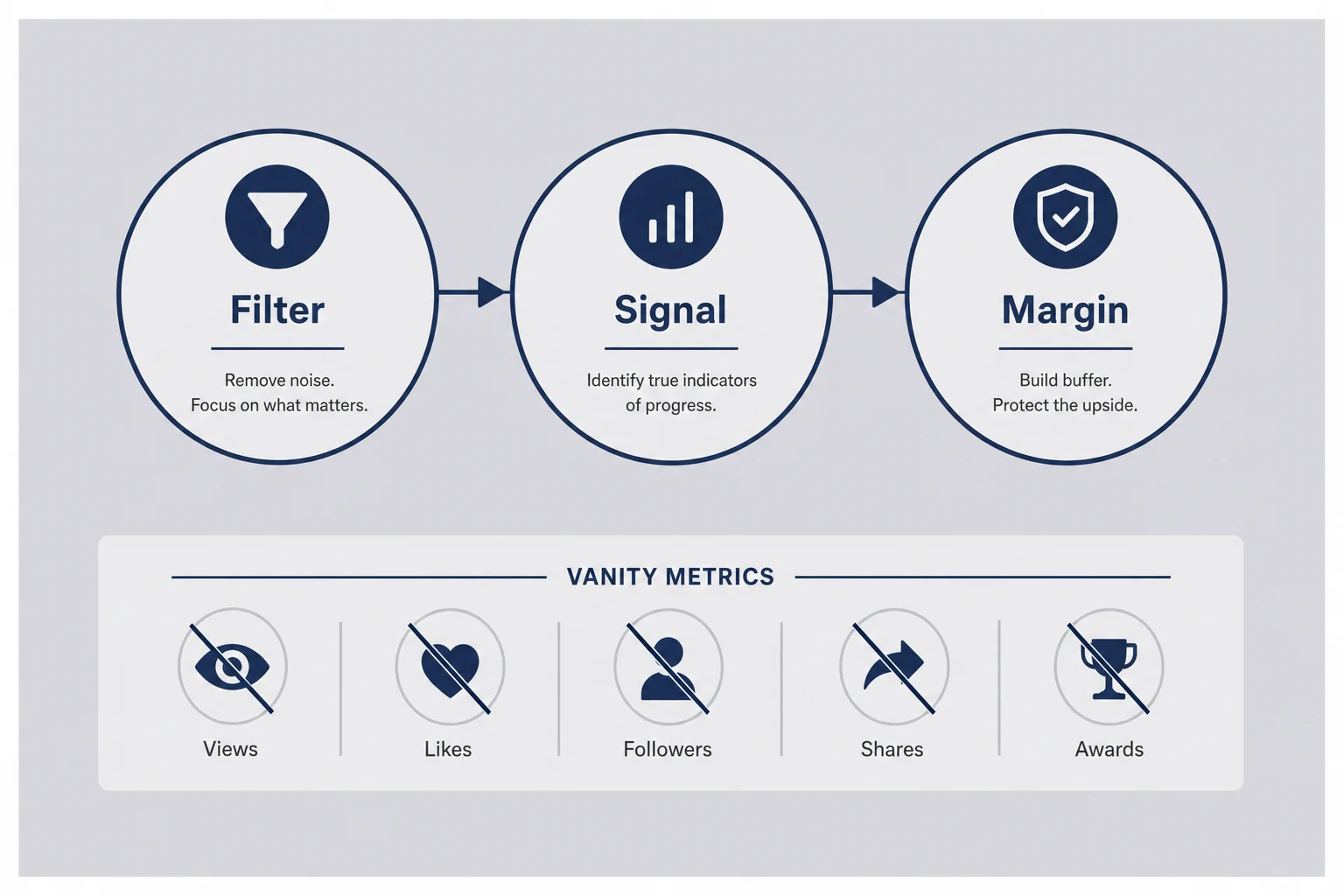
People treat pricing like it's astrology. They stare at competitor pages, pick something in the middle, and hope the universe cooperates. Pricing is simpler and harsher than that. It decides who buys, how seriously they take you, and whether you can afford to keep the lights on.
It does not decide whether your product is good. Plenty of excellent products die at wrong prices. Plenty of mediocre ones limp along at $99 a month because they solve an expensive problem for a specific buyer. Price is a lever, not a grade.
The three jobs your price has to do
First job: filter. A price that's too low relative to the problem attracts tire-kickers. A price that's too high for the audience you're reaching attracts silence. You want the band where someone reads the number, pauses, and thinks "that's reasonable if it actually works" rather than "sure, why not" or "I'll come back later."
Second job: signal seriousness. In B2B especially, price communicates maturity. I've talked to shop owners who wouldn't trust a $5-a-month inventory tool because it felt like a toy. Same feature set at $39 felt "real." That sounds irrational. It's just how humans buy things that affect their business.
Third job: fund the business. Stripe takes a cut. Your hosting costs scale with usage. Support emails take hours. Taxes exist. At $9 a month you need roughly six times as many customers as at $49 to hit the same revenue, and those customers often need more hand-holding per dollar. The math gets ugly fast when you're alone — plug your candidate price into a Stripe fee calculator before you fall in love with a round number that looks cheap on the landing page.
What your price cannot fix
If nobody has the problem, a lower price won't save you. If your onboarding loses everyone after signup, a discount won't fix it. If your validation was a pile of polite maybes, undercutting competitors just gets you more polite maybes who pay less.
I watched a founder drop from $39 to $12 thinking price was the objection. Conversion ticked up slightly. Churn ticked up more. The people who came for cheap left for cheaper. The ones who would have stayed at $39 never showed up because the product now looked budget-tier. He spent three months optimizing the wrong variable.
Pricing assumes demand exists. That's why this post sits after validation and build in the series. You should already have evidence that strangers will pay something. Pricing is the refinement of how much and how, not the substitute for demand.
Why solo founders underprice almost every time
Ask ten solo founders what they'd charge for a tool that saves a small business five hours a month. Eight will say something between $9 and $19. Ask those same founders what they'd pay for an equivalent tool in their own business. Six will pick a higher number. We are generous buyers in our heads and timid sellers on our pricing pages.
I'm not throwing stones. I launched a product at $12 a month because $29 felt arrogant for version 0.3. The customers I got were fine people who needed white-glove support for a product that wasn't ready for white-glove economics. I raised to $29 six months later, lost almost nobody, and gained customers who actually read the docs before emailing me.
Fear dressed up as strategy
The stories we tell ourselves sound strategic. "I'll start low and raise later." "I need traction first." "My competitor is cheaper." Sometimes those are true. Usually they're fear wearing a LinkedIn quote.
Starting low and raising later is harder than it sounds. Existing customers feel entitled to the old number. New customers wonder why Grandpa Jim pays half what they pay. Your public reviews anchor on the cheap era. I've raised prices successfully, but it's a communication project, not a checkbox. Launching closer to right the first time saves you a messy conversation later.
"Traction first" often means "free users first," and free users are not traction in the revenue sense. They don't tell you if the business works. They tell you if the signup form works.
Competitor pricing is a data point, not a destiny. Your competitor might be underpriced, VC-subsidized, or dying slowly. Copying their number without copying their cost structure and audience is how you inherit their mistakes without their runway.
The math nobody wants to do
Pull up a spreadsheet. Be honest.
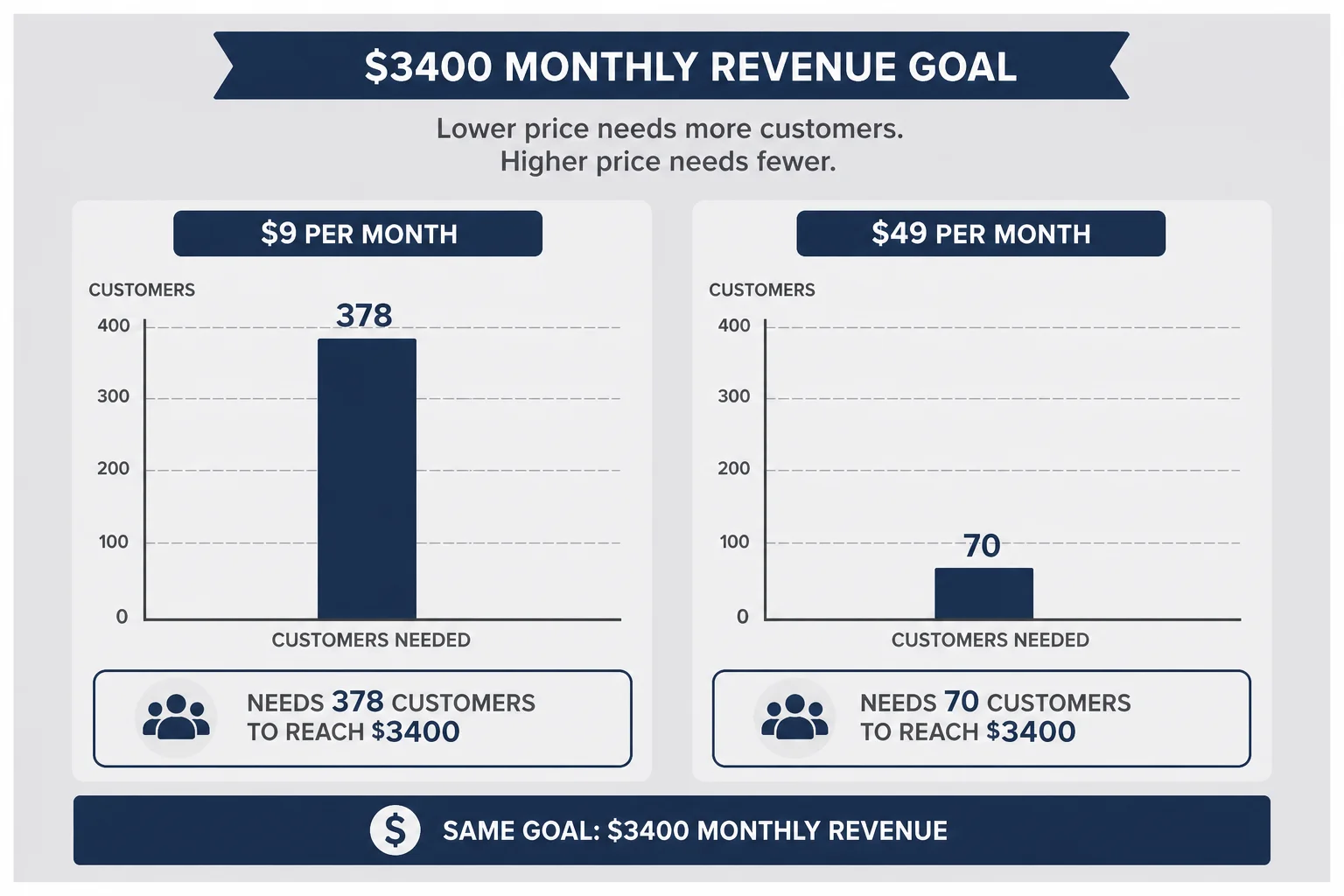
Say your all-in cost to run the product, hosting, APIs, email, your time for support, is $400 a month at current scale. You want $3,000 a month in profit because that's a real solo-founder salary in many places. You need $3,400 in revenue.
At $9 a month you need 378 paying customers. At $49 you need 70. Use the free MRR calculator to map your price to $1k, $5k, or $10k goals without rebuilding a spreadsheet — then check take-home with the Stripe fee calculator so list price does not fool you. Which sounds more achievable for a niche B2B tool you launch alone? Which support load can one person handle while also building features?
Now add churn. Cheap B2B tools often churn faster because the buyer wasn't that invested. If monthly churn is 8% at $9, you're on a treadmill. At $49 with 4% churn because buyers are more committed, the treadmill slows.
I'm not saying charge $49 because spreadsheet said so. I'm saying look at the spreadsheet before you let fear pick $9. The number that feels comfortable in your gut is often the number that makes the business impossible at solo scale.
The one-plan rule for your first ten customers
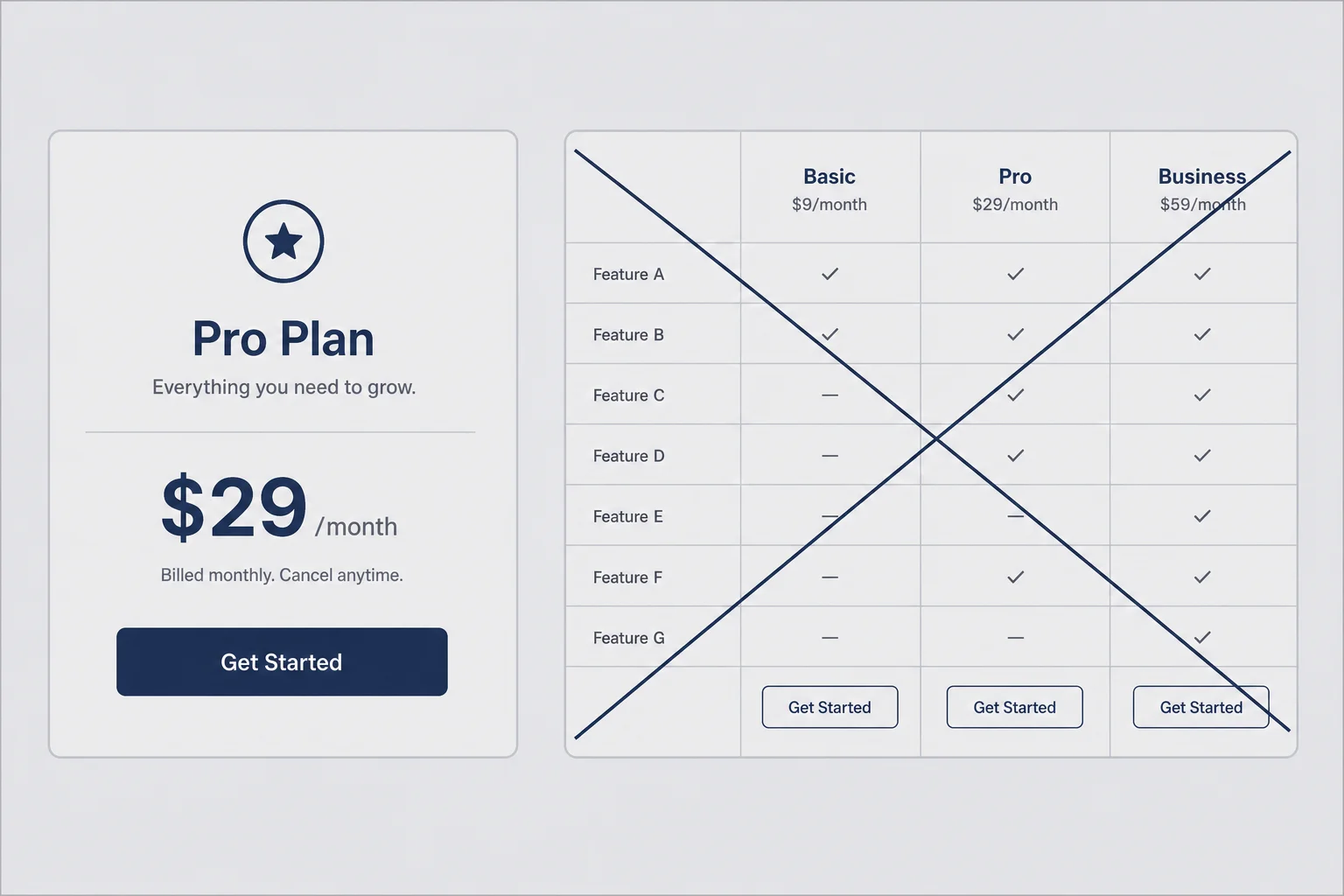
My rule for early micro-SaaS pricing: one plan, one price, one button, until you have at least ten paying customers who've stayed more than one billing cycle. Not ten signups. Ten people who renewed or stayed long enough that you'd call them customers.
This sounds limiting. It's liberating. Every hour you spend designing a "Pro" tier with ambiguously better limits is an hour you're not talking to users or fixing the core workflow.
Why three tiers is usually two tiers too many
Three-tier pricing pages are an enterprise SaaS habit bleeding down into products that don't need them. The good tier is almost always the middle one. The cheap tier exists to make the middle look reasonable. The expensive tier exists to anchor high. It's psychology, and it works when you have a sales team and a feature matrix the size of a poster.
You don't have that. You have one person who is also the support team, the marketer, and the person fixing a bug in the Stripe webhook at midnight.
Early tiers also split your focus. Customer A wants the export feature you put in Pro. Customer B on the cheap tier asks why exports aren't included. You start building plan-gating logic instead of the product. One plan means everyone gets the same thing. You learn what the product actually is before you learn what to withhold.
When do you add a second plan? When you hit roughly $3,000 MRR and you can point to a real segment asking for something specific. Maybe agencies want five client workspaces and solo users don't. That's a clean split. "Basic" versus "Pro" with a vague feature bullet difference is not.
What to put on the single plan page
Keep the page boring and clear. Headline that states the outcome, not the technology. Price. What's included in plain language. A trial or money-back period if you offer one. A buy button.
Skip the ten-row comparison table. Skip "Contact us for enterprise." If enterprise buyers find you, they'll email you whether or not you have a row for them. I've sold $200-a-month deals off a single-plan page because the buyer didn't want a matrix. They wanted a problem solved.
Show annual pricing if you're ready for it, but default the UI to monthly. Annual is a cash-flow tool, not the first thing you optimize before you know monthly retention.
One more thing: put the price on the page. Not "starting at," not "request a demo to see pricing." Visible price filters for seriousness. If you're ashamed of the number, fix the number or fix the offer. Hiding it rarely helps solo founders.
How to price a micro-SaaS without embarrassing yourself later
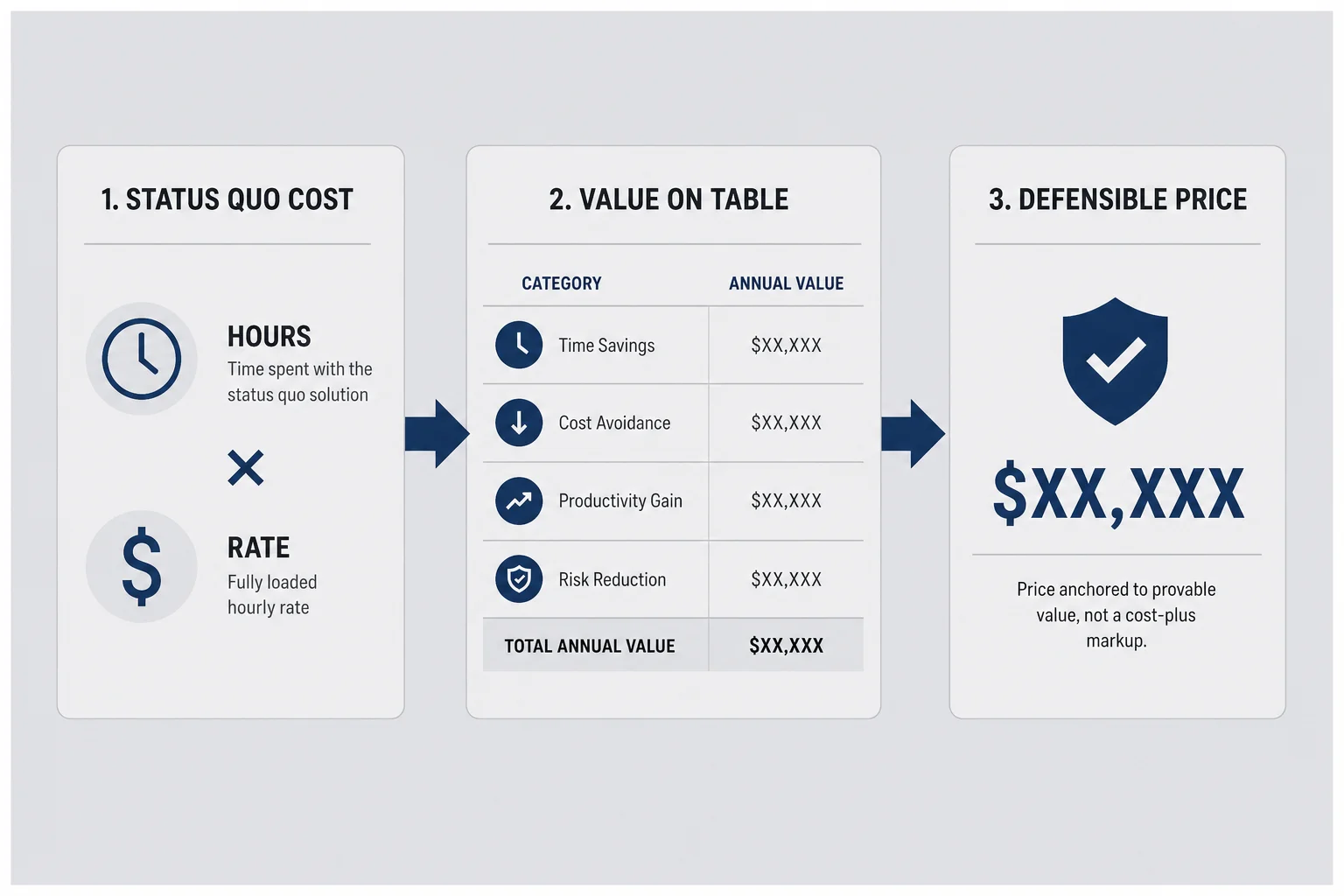
"Picking a number" sounds arbitrary. It shouldn't be. You're looking for a range where the buyer's ROI is obvious and your economics work. Not a perfect number. A defensible one.
Value anchoring without pretending you're McKinsey
Value-based pricing is a fancy term for a simple question: what is the problem costing them today?
Not what your software costs to run. What the status quo costs. Time, errors, missed sales, manual labor, agency fees, the spreadsheet nobody trusts.
Talk to five people in your niche before you lock a price. Not pitches. Conversations. Ask what they do now, what they pay, what breaks. If they hire a VA for fifteen hours a month at $25 an hour to do the thing your tool automates, $375 of value is on the table monthly. Charging $49 is not aggressive. It's a steal.
If they shrug and say "I just do it manually, takes an hour," the pain might not support $49. That's useful data. Either sharpen the problem you solve or find buyers where the hour is expensive.
Competitor prices help here as a ceiling, not a floor. If the janky incumbent charges $99 and everyone hates it, you have room. If three tools charge $15 and the market treats them as commodities, you need a sharper wedge than price.
The uncomfortable floor I'd use in 2026
For B2B micro-SaaS sold to businesses, not consumers, I'd rarely launch below $29 a month today. Often I'd start at $39 or $49 if the outcome is clearly tied to revenue or hours saved.
Below $29 you attract buyers who compare you to consumer apps, churn over small issues, and open support tickets that cost you more than their subscription. There are exceptions. Developer tools with viral free tiers. Products where volume at low ARPU works because support is self-serve and docs-driven. If that's not you, don't price like it is.
Consumer-facing micro-SaaS can work lower, but the support math still bites. I've seen $9-a-month products work when onboarding is entirely automated and the audience is huge. That's a different game with different odds.
Say you're building the competitor price monitor for small Shopify stores I mentioned in the build guide. It saves someone from checking five sites by hand every morning. Maybe prevents one underpricing mistake a quarter worth hundreds. $39 a month is an easy internal approval. $9 signals "toy" and attracts store owners who won't configure it properly, then blame you.
Pick a number you can defend in one sentence to a skeptical buyer. If you can't, you're not ready to publish the page.
Flat rate, usage-based, or per-seat: pick one and stop
Most pricing advice reads like a menu you're supposed to order everything from. Flat rate. Per seat. Usage-based. Hybrid. Good better best. For a solo founder at launch, the menu is a trap.
Default: flat monthly rate, all features included, maybe a generous fair-use cap you don't enforce until it hurts. That's it.
When flat rate wins
Flat rate wins when the product solves one job, usage per customer doesn't vary by orders of magnitude, and your costs are predictable enough that one bad power user won't bankrupt you.
Most micro-SaaS fits that description. The invoicing tool, the review aggregator, the webhook debugger, the compliance checklist for a niche industry. The buyer wants to know the bill. You want to know the revenue. Flat rate is honest on both sides.
Flat rate also makes marketing simple. One number in the ad, one number on the landing page, one number in the founder's mouth on a podcast. Complexity is a tax solo founders pay in confused prospects and billing bugs.
When usage or seats actually earn their complexity
Per-seat pricing makes sense when collaboration is the value. More teammates using the tool means more benefit. CRM-ish products, team inboxes, shared dashboards. The buyer intuitively gets "we pay per person."
Usage-based pricing makes sense when cost scales hard with consumption or value scales obviously with volume. API calls, messages sent, documents processed, storage gigabytes. The buyer can estimate usage. You won't get wiped out by one customer's cron job eating your margin.
Hybrid models, base fee plus usage, can work later. They're miserable to explain on a pricing page when you're unknown. "What's a credit?" is a support ticket you don't need in month one.
Real example of the complexity tax: a founder I know launched with "500 API calls included, then $0.002 per call." Sounded fair. Every prospect asked how many calls their use case needed. He didn't know. Support spent weeks helping people estimate usage instead of fixing bugs. He moved to flat $49 with a generous soft cap and never looked back. Conversion improved because the mental math disappeared.
Per-seat has a similar trap for products that aren't naturally team-shaped. If you charge per seat but one person does all the work in a small business, you're punishing the buyer for an org chart they don't have. Flat rate per account, sometimes called per-workspace, fits solo and tiny teams better. Save per-seat for when customers volunteer "I wish my colleague could see this too" without you prompting.
If you're unsure, flat rate. You can migrate to usage or seats when customers start asking "why am I paying the same as a team ten times my size?" That question is a luxury problem. It means you have customers.
Free trials, freemium, and the cost of free users
Free is the most expensive word in SaaS when you use it wrong. Once you've picked a price, micro-SaaS free trial for solo founders owns the filter between signup and payment.
There's a real difference between a trial and freemium. A trial says: you can feel the full product for a bounded time, then you pay or leave. Freemium says: you can use a gutted or capped version forever, and maybe you'll upgrade someday. If you are stuck between the two, the free trial vs freemium picker walks through the viral-loop and support-load checks in a few minutes.
For most solo-founded micro-SaaS, freemium is a slow bleed. Free users consume support, skew your product roadmap toward "make the free tier less annoying," and rarely convert at rates that justify the load.
Trials that filter versus trials that waste your week
I'm fine with trials. Seven to fourteen days of full access is reasonable. Long enough to complete one real workflow, short enough that procrastinators don't camp forever.
Credit card up front is a filter. Conversion drops. Quality rises. The people who enter their card intend to pay if the product works. If that feels too harsh for your market, no card required can work, but watch trial-to-paid carefully. Below 15% trial-to-paid for B2B often means onboarding or fit problems, not price.
Don't do unlimited free trials with fake accounts. You're training people to spin up new emails. Don't do "free forever for early adopters" unless you mean it literally forever, including when you're at $10k MRR and they're still paying zero.
Extended trials for serious evaluators are fine as a sales move. One prospect wants thirty days to run a parallel process. Give it to them personally. That's different from publishing "free forever" on the pricing page.
Why I skip freemium until the product earns it
Freemium works when free users advertise for you. Dropbox-style sync folders, Calendly links in signatures, "powered by" badges on embeds. The product spreads because the free tier is a distribution mechanism.
If your product is a dashboard only the buyer sees, free users don't bring leads. They bring costs. Every free account is a database row, an auth record, maybe a daily cron, and a question about why feature X is locked.
Some founders use a limited free tier as a validation crutch. "Look, 500 signups!" Look, 500 people who wouldn't pay $29. Validation is revenue, which we covered in the validation post. If you need free to get volume, question whether the pain is strong enough or whether you're reaching the wrong audience.
When might I add freemium later? When conversion data shows a clear path: free users invite teammates, hit a natural limit, and upgrade without sales calls. When support load per free user is near zero because docs and UI carry the weight. Until then, paid with a trial is the honest model for a business that needs to eat.
Annual billing and the cash-flow trick that isn't a trick
Monthly subscriptions are the default for a reason. They're easy to understand and easy to cancel. Annual billing is a tool you add once monthly retention isn't terrifying.
Offer annual at a modest discount. Two months free, roughly seventeen percent off, is the common range. Enough incentive to prepay, not so much you're effectively running a fire sale. Frame it as "pay for ten months, get twelve" rather than complex percentages on the page.
Annual improves cash flow. More importantly for solo founders, it improves commitment. Someone who paid for a year is less likely to churn over a rough week. They've mentally amortized the cost.
Don't push annual hard before you know people stay monthly. An annual customer who realizes in month two that your product doesn't fit is a refund request and a bad review waiting to happen. I'd want at least twenty-ish monthly customers with a couple of renewal cycles before I optimize for annual in marketing.
Technically, Stripe makes annual plans straightforward. Same product, second price ID, toggle on checkout. Don't overbuild portal logic on day one. A link that says "pay annually and save" is enough.
Watch refunds on annual plans. A spike means onboarding or positioning is broken, not that annual was wrong.
One nuance worth mentioning: annual plans change how you read churn. A customer who cancels after eleven months on a monthly plan is one thing. A customer who doesn't renew after year one is a bigger signal. Track both monthly and annual cohorts separately once you have enough volume. Early on you won't have volume, so don't let annual optimization distract from the harder problem of getting ten people to pay monthly at all.
If your product is seasonal, annual can still work, but be careful pushing prepay before you've seen a full cycle. A tool that peaks during tax season shouldn't assume January signups predict December retention. Monthly first, learn the curve, then invite annual when you understand when people actually use the thing.
When to raise prices (and how to not betray early customers)
You will raise prices. If the product gets better and the customer base grows, staying at launch price forever is a choice to subsidize new customers with your time.
The fear is backlash. The reality, if you've delivered value, is quieter than Twitter makes it seem. Most customers who rely on your tool won't leave over a reasonable increase communicated honestly.
Signals it's time: prospects say yes too fast. Support is drowning. You're profitable on paper but can't invest in the roadmap because margin per customer is thin. Competitors charge double for less. You haven't changed price in eighteen months and you've shipped major value.
Raise on new customers first. Test the number. Watch conversion for a month. If it holds, you've found the new floor.
Grandfathering without leaving money on the table forever
Existing customers stay at the old price for a defined period. Six months, twelve months, "legacy plan" forever if you're feeling generous. I lean toward grandfathering early believers for at least a year. They took risk on bugsy v1. That goodwill compounds into referrals and case studies worth more than the delta.
When you eventually move legacy customers, give notice. Email, in-app banner, sixty to ninety days. Explain what improved. Never apologize for running a business. "We've added X, Y, Z since you joined. New pricing reflects that. Your rate stays until DATE."
Some founders offer a "lock in old price if you switch to annual now" bridge. Works when you need cash and want to reduce churn.
Price increases are also a churn filter. Customers who leave over $10 were probably leaving anyway. Customers who stay are more aligned. I've seen net revenue rise after increases even when raw subscriber count dips slightly. Before you move the base, run expected cancels through the price raise impact calculator so you know whether remaining customers at the new sticker still beat everyone at the old one.
Micro-SaaS pricing mistakes that look smart until support explodes
The failure patterns repeat so often I can spot them from the outside now. Founder races to $9 because they want "more users" for social proof. They get users. They don't get a business. Or they match the cheapest competitor without asking whether that competitor is VC-subsidized and dying slowly. They can burn. You can't.
I've watched people launch three tiers before one plan works, stacking complexity before product-market fit. Lifetime deals on AppSumo show up as a cash injection and stay as a support obligation: thousands of users who paid $49 once and expect updates forever. One campaign, fine. A business model, no.
Hiding price to force a sales call sounds sophisticated until you realize that for micro-SaaS under $100 a month, calls don't scale. Visible price saves everyone time, including yours. Going annual-only at launch removes the monthly escape hatch cautious buyers want before they trust you. Never raising prices because it feels awkward is its own mistake: your costs drift up, the product improves, and the number stays frozen while you tell yourself you're being nice.
Grandfathering everyone forever out of guilt has the same shape. Kindness has a bill. Legacy plans are a thank-you, not a life sentence for your margins.
The one I see most, though, is treating pricing as a one-time decision made in fear and then never revisited. Founders will spend six months on a feature nobody asked for but won't spend twenty minutes raising a price that hasn't moved since the product had half the capability. Stripe fees climb. API usage climbs. Your opportunity cost definitely climbs. If the price is frozen while everything else moves, you're slowly making the business less viable.
Another subtle trap: discounting without a deadline. A "launch discount" that never ends trains everyone that the real price is fake. If you want early-adopter pricing, say so plainly and set a date when new signups move to the standard rate. Early believers get locked in. You get a clean story. Permanent sales mode makes later increases feel like betrayal even when they're overdue.
A pricing worksheet before you flip the Stripe switch
Before you publish, walk through a short checklist on paper. Not as a formula that spits out the answer. As a forcing function for honesty. Once the number is real, wire billing with Stripe for micro-SaaS before you chase strangers.
Start with the buyer. Not "small businesses." Name them. Shopify stores doing $500k a year with one ops person. Freelance designers billing $8k a month. Whatever your niche actually is. Then ask what the problem costs them today in money or time, and write a number even if it's a range. What do they pay for partial solutions now? Spreadsheets count as zero on the invoice but not on the labor bill.
Flip to your side. What's your monthly cost to serve one average customer once you include hosting, API calls, and the support minutes you keep pretending won't exist? How many paying customers do you need at $29, $39, and $49 to hit the income you'd actually keep doing this for? Try all three. The spread usually makes the right floor obvious.
The sentence that matters
Write one line before you ship: "We charge $___ per month because ___." If the because is empty, you're not ready for a pricing page. You're ready for more customer conversations.
Can you say the number aloud without wincing? If not, sit with why. Shame about money is common. It is not a pricing strategy. What happens if your first ten customers all arrive on a discount, can you still support them without resenting the product?
When those answers feel solid, publish one plan. Turn on Stripe test mode. Run five real people through checkout, not friends who'll lie to be nice. Fix friction. Go live.
The worksheet isn't one-and-done. Revisit it when you add a major feature, when support patterns shift, when a competitor moves, or when revenue plateaus while your hours climb. Pricing is a living guess informed by conversations and dashboards, not a sacred number from launch week.
If you're stuck between two numbers, pick the higher one for new customers and offer a short early-bird window at the lower one with a clear end date. You learn faster from "too expensive" objections than from silent signups who churn in thirty days. Objections give you language to fix the offer. Ghosts give you nothing. Stripe prices can be archived. Pages can be updated. Nothing here is permanent except the habit of revisiting the number.
Questions I get about pricing a micro-SaaS
How much should I charge for a micro-SaaS?
For a B2B micro-SaaS solving a real problem, start at $29 to $49 per month with one plan. That range is high enough to filter serious buyers and low enough that a small business can approve it without a procurement meeting. If your tool saves someone five hours a month or protects real revenue, $49 is often trivial to them and meaningful to you. Going below $19 attracts the highest-churn, highest-support customers and makes the math brutal for a solo founder.
Should I offer a free plan or a free trial?
Start with a paid plan and a short free trial, not a permanent free tier. A seven to fourteen day trial with full access lets people feel the value before they commit. Require a credit card at signup if you can stomach the lower conversion, because it filters for people who intend to pay. Freemium only makes sense when free users naturally bring you more users, like embedded widgets or shared outputs. Otherwise free users are a support load that tells you almost nothing about revenue.
When should I raise my SaaS prices?
Raise when more than thirty percent of prospects say yes on the first conversation without negotiating, when support volume is climbing faster than revenue, or when you have ten or more paying customers who renewed at least once. Test the new price on new customers first. Grandfather existing customers at their old rate for six to twelve months. Communicate the change as added value, not your rising costs.
What pricing model works best for solo founders?
Flat-rate monthly subscription with one plan at launch. Most solo founders I know who've crossed a thousand dollars MRR started with a single fixed price, and for good reason. Customers know what they pay, you know what you earn, and nobody needs a spreadsheet to understand the bill. Add usage-based or per-seat pricing only after you have clear data that usage or seats map directly to value or cost.
How do I price a B2B micro-SaaS?
Anchor to the business outcome, not your build time. Ask what the problem costs them today in hours, missed revenue, or manual workarounds. If your tool replaces ten hours of monthly spreadsheet wrangling at fifty dollars an hour, five hundred dollars of value is on the table and forty-nine dollars is an easy yes. Talk to five potential buyers about what they already pay for partial solutions. Price below that replacement cost but high enough that you can support them properly.
Is $29 per month too expensive for a new product?
No, if you are selling to businesses with a real problem. Twenty-nine dollars is less than one hour of a contractor's time. What kills new products is not the price tag but weak demand and unclear value. If nobody converts at twenty-nine dollars, dropping to nine dollars rarely fixes it. It usually means the problem is not painful enough, the audience is wrong, or the offer is unclear. Fix those before you race to the bottom.
The price is a hypothesis, not a tattoo
I still think about my friend and his $9 tier sometimes. He eventually raised prices, lost almost none of his real customers, and wondered why he waited. The product didn't change overnight. His story about what he was allowed to charge changed.
You'll get pricing wrong at first. Maybe not catastrophically wrong if you pick a defensible floor and one clear plan, but wrong enough to adjust. That's normal. What isn't normal, what the indie SaaS graveyard is full of, is treating price as something you set once out of fear and never revisit while you pour years into a product that can't pay you back.
Micro-SaaS pricing for solo founders isn't a science fair. You don't need perfect elasticity models. You need a number that makes the buyer and the builder both serious, a model simple enough to explain in one breath, and the willingness to look at Stripe and support queues and say "we're going up" when the evidence says you're leaving money and sanity on the table.
Charge more than feels comfortable. Not because greed is good, because sustainable businesses need margin, and margin is how you keep helping the people who depend on your tool without burning out or going back to client work.
Then ship the pricing page, get back to the product, and treat the number like any other early decision: real, revisable, and nowhere near as scary as building something nobody wanted in the first place.




Comments