Your Launch Price Was a Favor to Yourself
When and how to raise micro-SaaS prices as a solo founder: undercharge signals, new-customer tests, grandfathering, and the email that doesn't start a fire.
 By Max26 min read
Listen to this article
21:21AI-generated podcast-style overview of this article (not a word-for-word narration).
I stared at the pricing page for twenty minutes like it had insulted me. Same $29 I'd set the night before launch. Same one plan. Same little guilt that whispered I should leave early customers alone forever, as if the product hadn't changed and Stripe fees hadn't quietly climbed and my Tuesday support load hadn't doubled.
The product had changed. I had shipped the feature people actually asked for, killed two features nobody used, and written docs that finally answered the questions that used to land in my inbox at 11 p.m. The sticker had not moved. I was still charging launch-day charity rates for a product that no longer looked like launch-day charity.
Raising prices is the decision solo founders postpone the longest. Setting the first number is hard. Changing it feels like betrayal. I get it. I've delayed raises until the math was embarrassing. I've also raised too late and watched a year of margin evaporate into "I'll do it next quarter."
Here is the weird part. The same people who will spend a weekend rewriting onboarding copy will refuse to touch a price for eighteen months. They will A/B a button color. They will not A/B a dollar amount. Price feels moral. Button color feels safe. That is backwards. At indie scale, a quiet price mistake compounds every month you leave it alone.
This is not another pricing 101. I already wrote how to price a micro-SaaS as a solo founder: one plan, a floor that doesn't embarrass you, freemium traps, the whole launch sticker. This post owns the next problem. Raise micro-saas prices solo founder reality is simple: move the sticker without torching the people who paid you first, without guessing the jump size, and without turning your inbox into a complaint queue. Round numbers below are examples to show the logic. I'll say when they're hypothetical.
If you are still picking your first number, stop here and read the pricing guide first. If you already have paying customers and a sticker that feels stuck, keep going. The work below assumes you have something to raise from.
One belief under all of it. A boring micro-SaaS that updates its price when the product earns it beats a product that stays "nice" and broke. Price is not a personality test. It is a maintenance job.
Raise micro-saas prices solo founder: the decision nobody wants to make
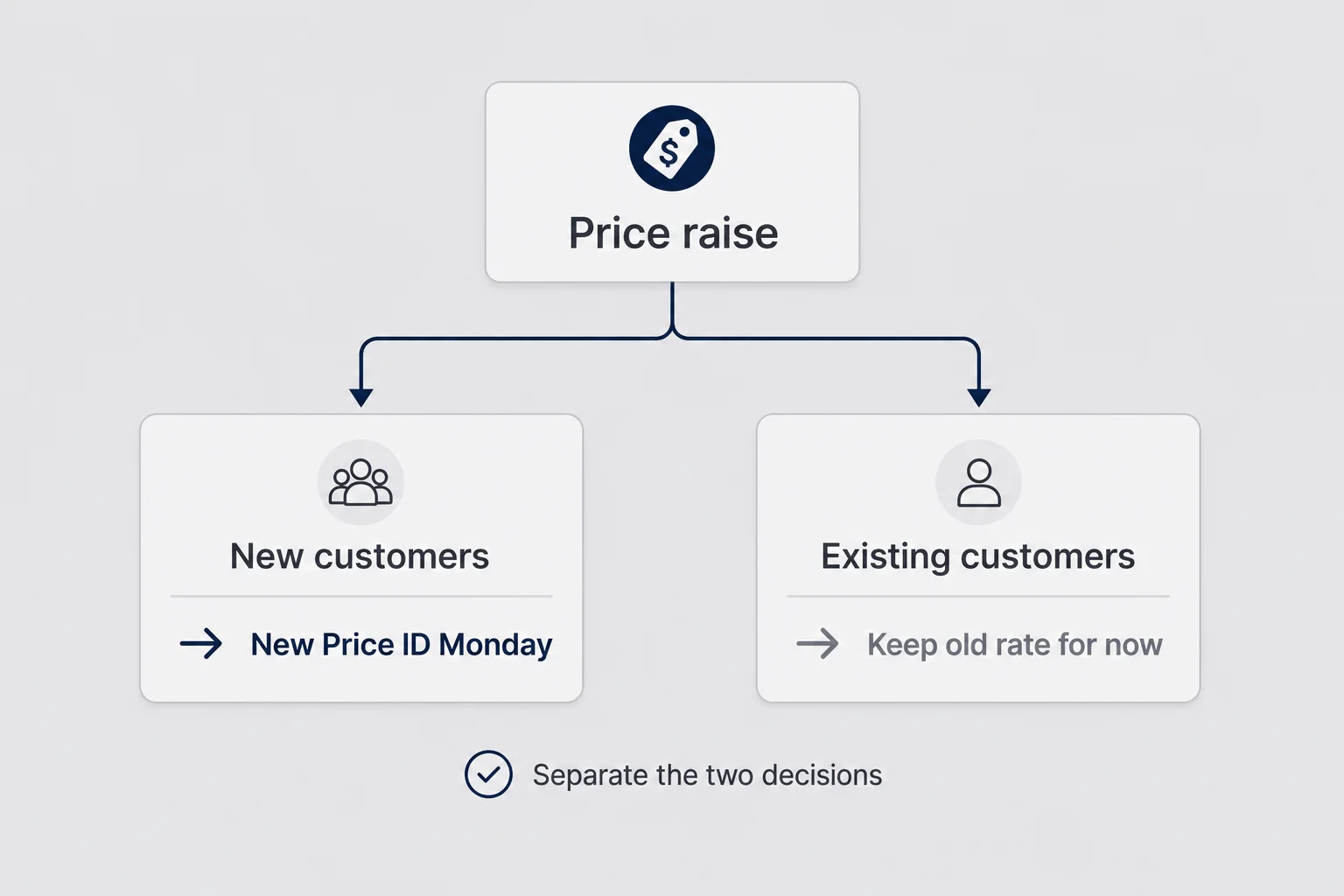
Most founders I talk to treat a raise like a courtroom drama. They imagine every customer opening the email at the same second, coordinating a boycott, and canceling before breakfast. That almost never happens at indie scale. What actually happens is quieter and worse: you keep the old price for eighteen months, your costs and scope creep up, and you resent the business that is supposed to buy your freedom.
I have sat in that resentment. It shows up as short replies in support. It shows up as "I'll ship that later" for features that would help the people already paying you. It shows up as envy of founders who charge more for less. None of that is a product problem. It is a price hygiene problem wearing a mood.
The raise decision nobody wants to make is usually two decisions glued together. Decision one: what do new customers pay starting Monday? Decision two: what do existing customers pay, and when? Confusing those two is how you either create unnecessary churn or leave money on the table for years.
Say you have forty paying customers at $29. That is about $1,160 MRR. You want to move to $39. If you raise everyone overnight without notice, you risk a loud week and a handful of cancellations you did not need. If you only raise new customers, the next ten signups pay $390 combined instead of $290. Existing customers keep sleeping. You learn whether $39 is real. That is the raise I want most solo founders to run first.
I take a clear position here. Your first raise should almost always change new customers only. Existing customers keep their rate. You measure for a month. Then you decide whether you ever touch the early cohort. That is not softness. That is risk management for a one-person company that cannot afford a support fire and a revenue dip in the same week.
The emotional part is real, though. Early customers believed you when the product was rough. Grandfathering them is how you repay that without pretending your business froze in amber. If you want the deep cut on why launch pricing tends to land low in the first place, go back to the pricing guide. Here we assume you already have a sticker and some people paying it.
One more framing that helps me. A raise is not a referendum on whether you are a good person. It is a check on whether the exchange still works for both sides. If the product got better and the price stayed frozen, only one side of the exchange moved.
Bootstrappers love to talk about freedom. Freedom has a cost structure. If your price cannot fund the support and reliability people expect, you are not free. You are trapped in a polite job you invented for yourself. Raising prices is sometimes the least dramatic way out.
Your launch price was a guess — treat it like one
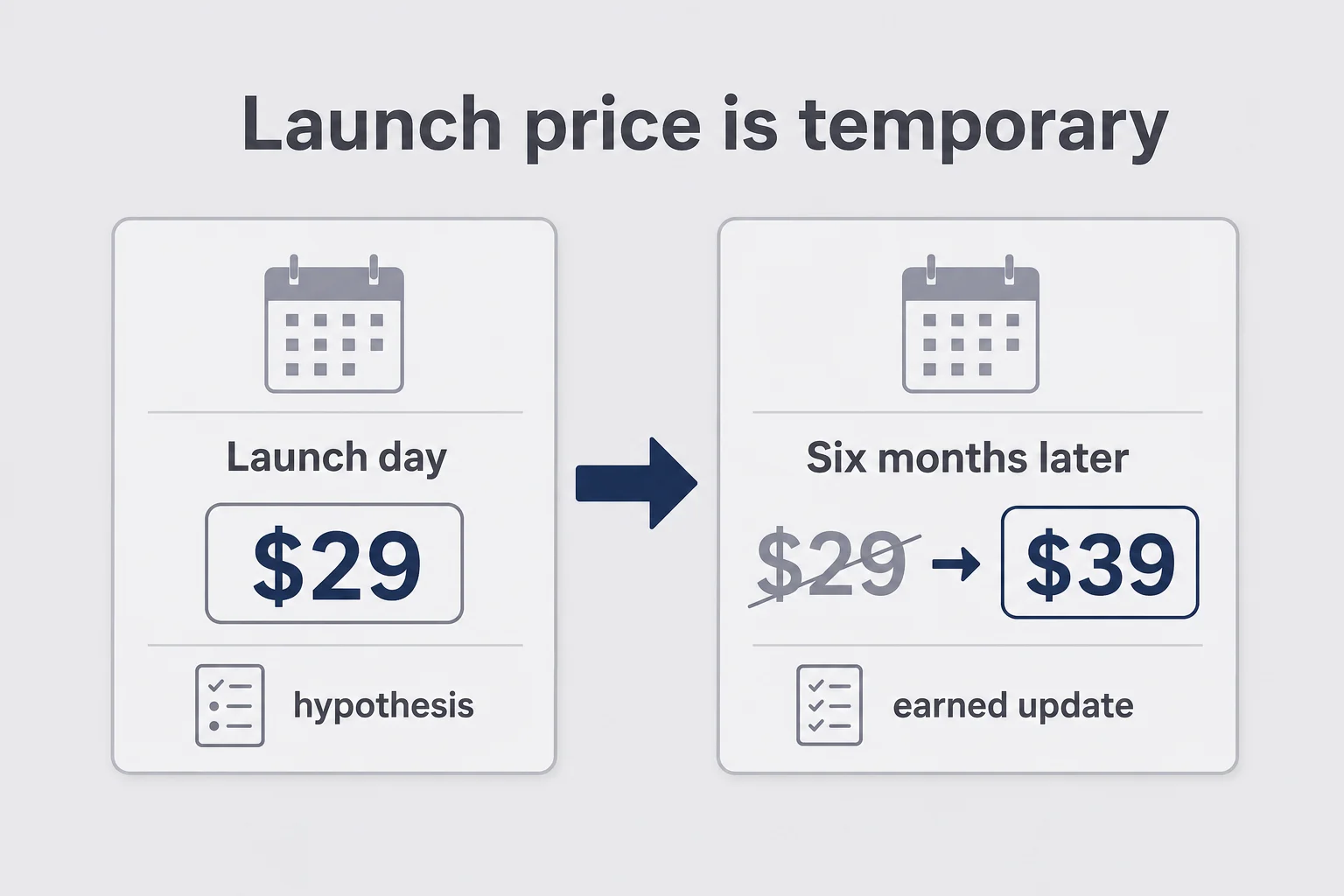
Your launch price was a hypothesis wearing a dollar sign. You picked something that felt chargeable. Maybe you copied a competitor. Maybe you split the difference between "I need rent" and "I don't want to scare anyone." Maybe you read a thread that said $29 is the indie default and stopped thinking.
None of that makes the number sacred.
I treat launch pricing the way I treat a first database schema. Good enough to ship. Expected to change. The founders who get stuck are the ones who confuse "this was fair on day one" with "this must remain fair forever." Fairness is a relationship across time. The product improved. Your reliability improved. The buyer's alternative options may have gotten worse or more expensive. Holding the sticker constant while everything else moves is not loyalty. It is accounting with your eyes closed.
Here is a simple scene. Say you launched an invoicing helper at $19 a month with twelve customers. Six months later you added reminders, PDF branding, and a Stripe sync that saved people an hour a week. You are still at $19. New buyers compare you to a $49 tool and wonder why you are cheaper. Existing buyers are happy. You are tired. That gap between product and price is where raises live.
Another scene I see often: a founder keeps $19 because "my early users are friends of friends." Friendship is not a billing plan. You can still grandfather friends. You do not have to keep advertising friendship pricing to strangers forever. Public price and private exceptions are different tools. Mixing them is how your pricing page becomes fiction.
Treat the original number as temporary. Put a calendar reminder six months after launch that says "price review," not "price raise." Review means you look at conversion, support load, and what you shipped. Raise is optional. Ignoring the review is how you wake up two years later charging hobby rates for a serious product.
What belongs in that review? Three questions on a sticky note are enough. Did we ship material value since the last sticker? Are buyers hesitating on price, or never mentioning it? Is support load rising faster than revenue? If you cannot answer those from your own inbox and Stripe dashboard, you are not ready for a raise. You are ready for better instrumentation. The analytics post is the companion if your numbers live in vibes.
The signals that say you're undercharging
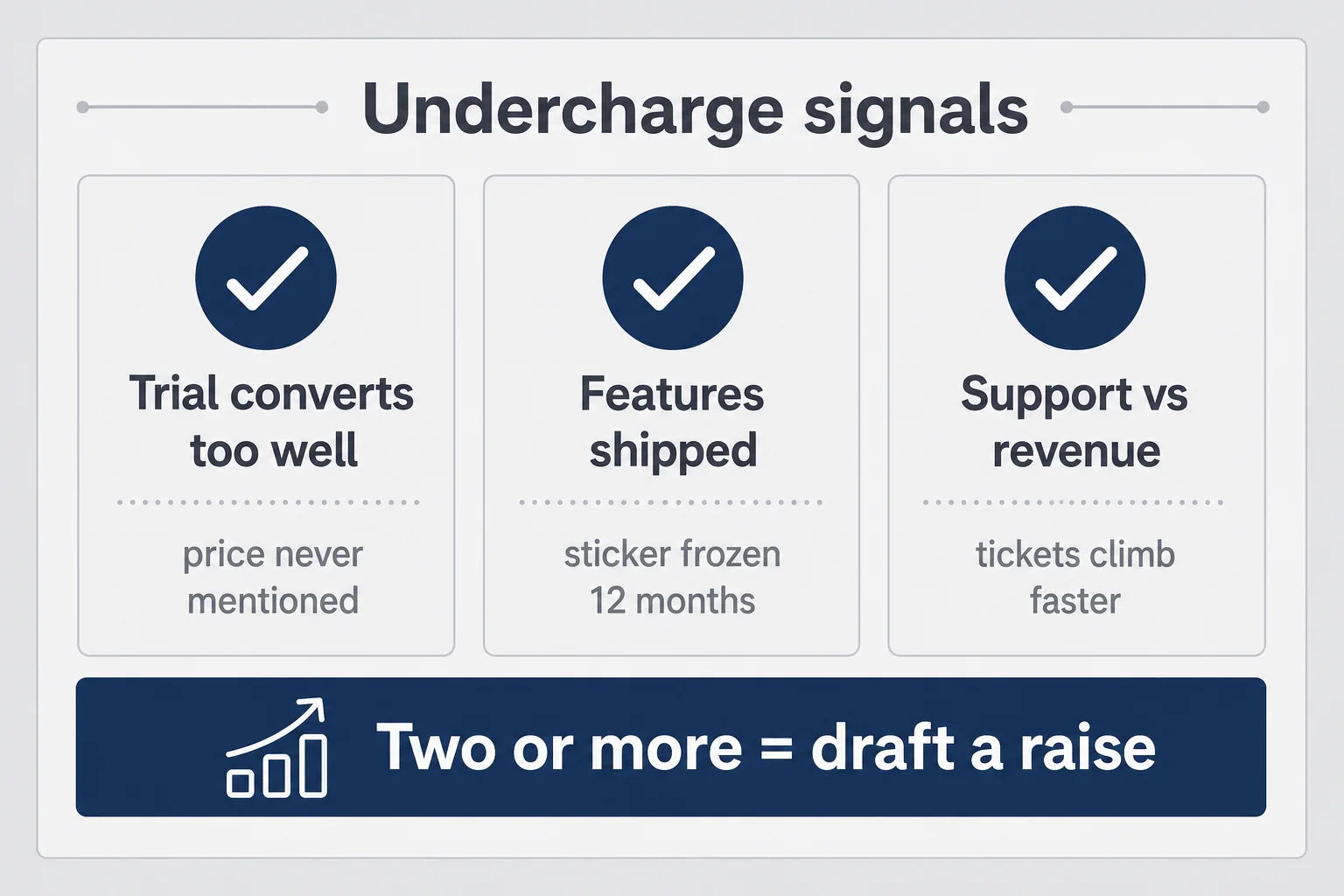
You do not raise because a Twitter thread told you to. You raise when the business is whispering that the sticker is wrong. I look for a handful of signals. Two or more at once is enough for me to draft a new price. One alone can be noise.
I also ignore vanity signals. "A competitor charges $99" is not a raise plan. "I feel underpaid" is not a raise plan either, though the feeling often shows up right before the real signals do. Feelings get you to open the spreadsheet. Signals decide whether you change the Price ID.
Trial-to-paid conversion that is "too good"
Healthy trial-to-paid for many B2B micro-SaaS tools sits somewhere in the messy middle. Exact benchmarks vary by niche and trial design. What I care about is the pattern where almost everyone who tries it pays, and nobody ever mentions price.
If your trial converts north of about thirty percent and your free trial is not a joke trial with half the product locked, take that seriously. High conversion is wonderful. It can also mean your price is below the pain. People are not negotiating because the number never hits a nerve.
Caveat: a tiny sample lies. Five trials and four conversions is not a strategy meeting. Wait until you have enough trials that a percentage means something. Then ask whether price ever appears in sales conversations or support tickets. Silence on price plus high conversion is a raise signal, not a victory lap.
Another related tell: refunds are rare, and cancellations cite "not using it" or "switching tools," almost never "too expensive." If price is invisible in cancellation reasons for months, your sticker is probably not the binding constraint. Usage and activation might be. Raise carefully, and fix activation in parallel.
Features shipping while the sticker stays frozen
If you have been on the same price for twelve months and you kept shipping meaningful work, you are running a silent discount. The buyer who signed up last winter bought a thinner product than the buyer who signs up tomorrow. Charging them the same forever is a choice. Sometimes it is the right choice for trust. Often it is inertia.
I do not mean every bugfix deserves a price bump. I mean material scope: workflows that used to require a workaround, integrations people asked for, reliability work that reduced downtime, docs that cut support in half. If the product is clearly more valuable and the sticker is identical, schedule the review.
A practical test I use: write a short changelog of the last six months as if you were pitching a stranger. If that pitch sounds like a different product than the one on your original landing page, your price probably deserves a second look. If the changelog is mostly polish and typos, wait.
Support cost per dollar of revenue
Low prices attract high-maintenance buyers more often than founders want to admit. Not always. Sometimes you just have a confusing UI. But when support volume climbs faster than MRR, and the loudest tickets come from the cheapest plans, your price is selecting the wrong room.
I once watched a founder answer the same onboarding question forty times in a month for customers paying less than a streaming subscription. He was not running a SaaS. He was running a charity help desk. Raising new-customer prices did not fix his docs. It did change who showed up. Higher-intent buyers asked better questions and churned less over missing polish.
If you are drowning in tickets relative to revenue, fix the product friction and raise the floor for new buyers. Doing only one of those leaves the wound open.
There is a fourth signal worth naming even if it is fuzzier: you apologize when you say the price out loud. If you catch yourself saying "it's only $29" in demos, you have already decided the number is soft. Soft numbers invite soft buyers. Soft buyers invite soft businesses.
New customers first: the raise that doesn't wake anyone up
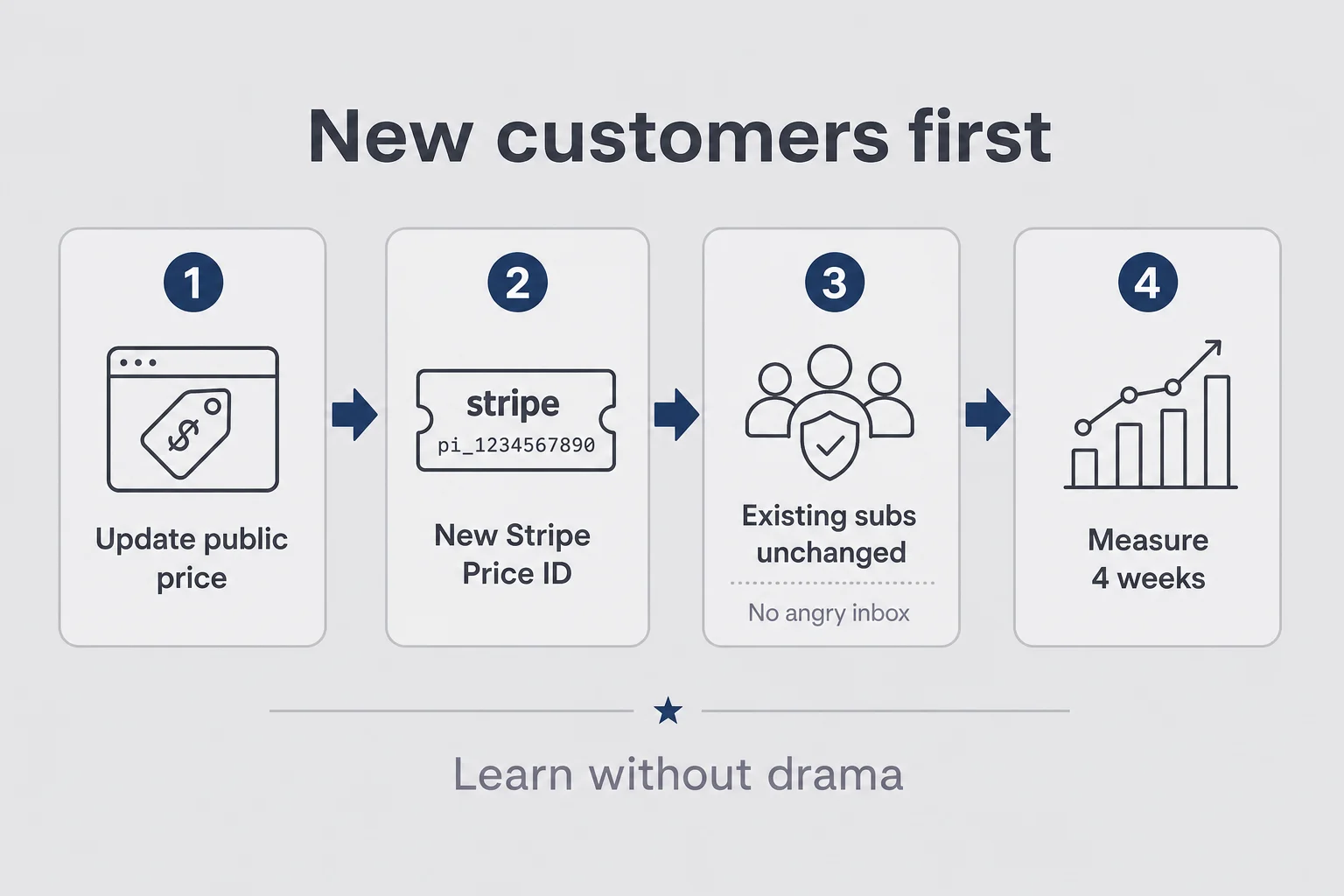
This is the cleanest raise. Update the public price. Point Checkout at a new Stripe Price. Leave every existing subscription alone. Nobody gets an angry email because nobody's invoice changed.
I like this path because it separates learning from drama. You find out whether the market accepts $39 the same way you found out whether it accepted $29: by putting it in front of strangers. Existing customers keep sleeping. Your reputation with them stays intact.
Operationally it is boring, which is the point. Create a new price. Swap the price ID in your app config. Deploy. Watch signup rate, trial-to-paid, and early churn for four weeks. Compare to the prior cohort. If revenue per visitor goes up even while raw signups dip a bit, you probably did the right thing.
People panic when signup count falls. Signup count is not the business. Say you were converting ten paying customers a month at $29. That is $290 in new MRR. After the raise you convert eight at $39. That is $312. You "lost" two logos and made more money. Solo founders optimize for logos when they should optimize for durable revenue and sane support.
Push the same math further. Imagine fifty customers at $29 ($1,450 MRR) and you raise only new customers to $39. Over the next quarter you add twenty new customers at the higher rate while five old ones churn for normal reasons. Your mix shifts. Blended ARPU climbs without a single angry grandfather email. That compounding is the whole point of new-customer-first raises.
The caveat is traffic quality. If you just launched a Product Hunt spike or a newsletter feature, wait until traffic looks normal again. Otherwise you will blame the price for a traffic mix change.
Another caveat: do not run a "secret" public price. If your landing page still says $29 while Checkout charges $39, you are not testing price. You are testing whether people notice bait and switch. Update every public surface the same day: pricing section, FAQ, comparison table, ads if you run them. Consistency is part of the experiment.
When to raise saas prices for people already paying
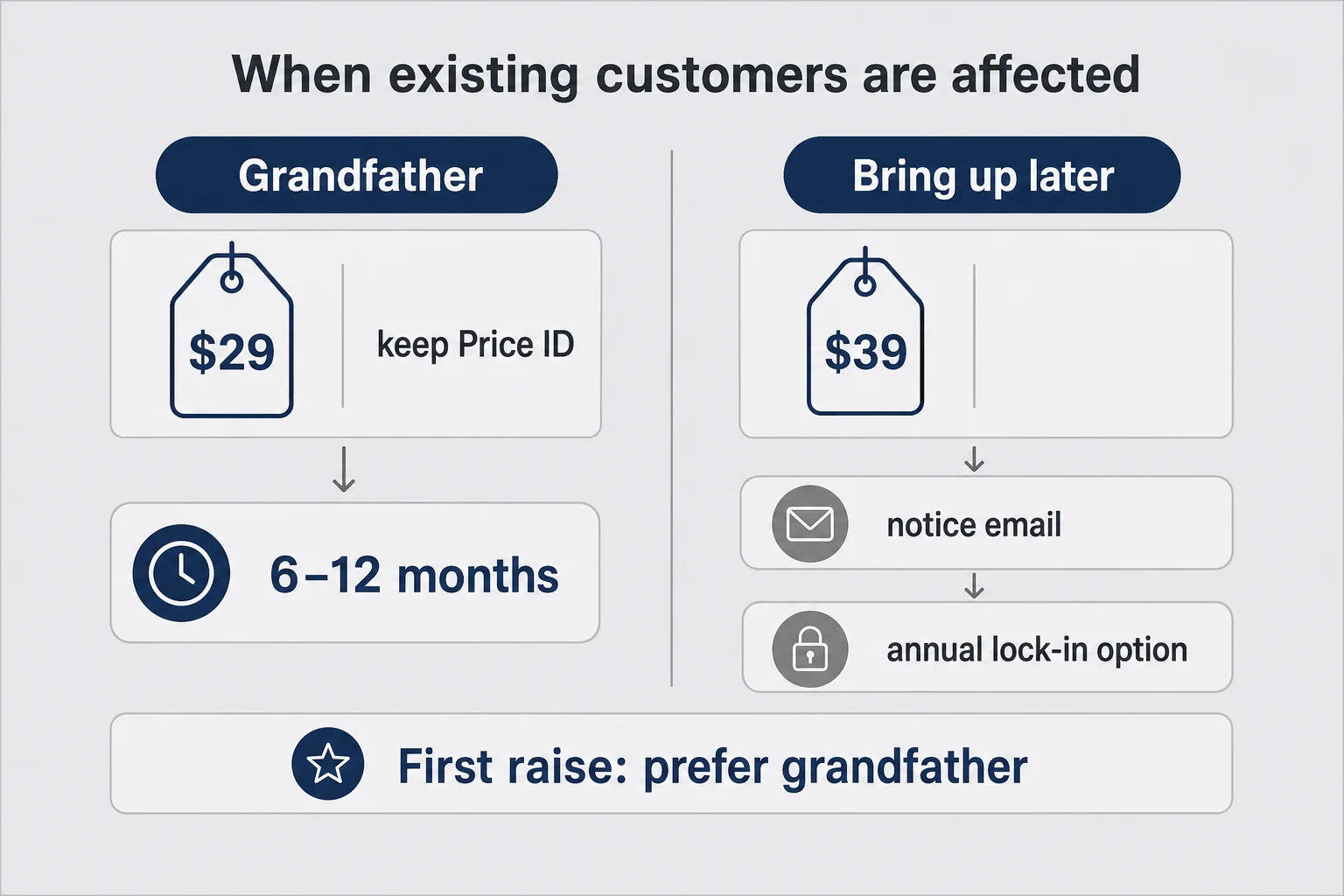
Eventually you may need to touch the people who already pay you. That is a different emotional and operational problem. Do it when new-customer pricing has been higher for a while, the product gap is obvious, and you can explain the change without sounding like you are plugging a cash hole.
I still default to patience. Grandfather longer than feels necessary on the first company-wide raise. Early believers are not an infinite liability. They are also not free marketing you get to squeeze whenever Stripe looks soft.
A rule of thumb I like: if new customers have been paying the higher rate for at least one full quarter, and the product kept improving, you have earned the conversation with the early cohort. If you raise everyone the same week you raise new customers, you skipped the learning and invited the drama.
Grandfather existing customers pricing (and when you stop)
Grandfather existing customers pricing means their subscription stays on the old Price ID. New checkouts use the new one. In plain language: they keep paying what they agreed to when they said yes.
For the first raise, I grandfather for at least six to twelve months. Sometimes longer if the early cohort is tiny and vocal. The goodwill is cheap at indie scale. Twenty customers at $29 versus $39 is a couple hundred dollars a month. Burning those twenty people for a couple hundred dollars is usually bad math once you count referrals, case studies, and your own sleep. When you do bring the base up, model remaining customers times new price versus everyone at the old sticker in the price raise impact calculator before you send the email.
When do you stop grandfathering? On a second or third raise, or when the old price has become a museum exhibit that confuses your positioning. Then you bring people up with notice. Always with notice. Always with a way to lock annual at the old rate for a window. Never with a surprise invoice.
Watch for the trap where grandfathering becomes permanent special pricing for people who no longer resemble your ICP. If your product moved upmarket and half the early cohort still wants hobbyist support at hobbyist rates, you may need a sunset plan. Sunset with dignity. Give time. Offer export help. Do not ghost them into a failed charge.
The annual lock-in offer before the change
If you must raise for existing customers, give them a bridge. Two to four weeks before the change, email them. Explain what improved. State the new monthly price. Offer annual billing at the current rate if they switch before the deadline.
That offer does three jobs. It rewards loyalty. It pulls cash forward. It turns a price fight into a choice. Some people will cancel anyway. Most will either stay monthly at the new rate or jump to annual because humans like closing a loop.
Do not bury the date. Do not soft-pedal the number. Ambiguity creates support tickets. Clarity creates decisions.
Make the mechanics stupidly clear. "On March 1, monthly plans renew at $39. If you switch to annual before February 28, you keep $29/month equivalent billed once as $348 for the year." Numbers beat adjectives. If someone has to forward your email to a bookkeeper, the bookkeeper should understand it on the first read.
How big a jump: under 30%, repositioning, or relaunch
Size matters more than founders admit. A ten percent bump and a doubling are different products of conversation.
Under about thirty percent is a routine price update. $29 to $39. $49 to $59. Buyers feel it as "they updated pricing," not "they reinvented the company." This is the band I use for annual hygiene raises when the product kept improving.
Thirty to fifty percent is repositioning. You need a story. New audience, clearer outcome, bigger scope, maybe a plan rename. Without that story, the jump reads as opportunistic.
Over fifty percent is usually a relaunch. New packaging, new promise, sometimes a new product name. Treat it like a launch, not a spreadsheet edit. If you are doubling price because you undercharged out of fear for two years, say that in private notes to yourself, then invent a public framing that is about value, not your regret.
I am biased toward smaller, earlier raises. The downside of a too-small raise is invisible. The downside of a too-big raise is loud. Solo founders systematically fear the loud problem and ignore the invisible one.
Concrete example. Moving $29 to $49 is about a seventy percent jump. That can be right if you added a second seat, a major workflow, or you are clearly selling to a different buyer than year one. It is wrong if nothing changed except your courage. Courage is not a product feature. Pair big jumps with big evidence.
If you are unsure, split the difference once. Raise new customers by twenty percent. Live with it for a quarter. Raise again if the signals still scream undercharge. Two modest moves beat one dramatic apology tour.
Run a new customer price test before you commit
Before you change the story for everyone, change the price for the next cohort only. Four to six weeks is enough if you get steady traffic. If you get three signups a month, you need a longer window or you are reading tea leaves.
Track three numbers against the prior cohort at the old price: signup rate to trial, trial-to-paid, and thirty-day retention or early churn. Revenue per visitor is the summary statistic I care about most. If that rises and retention does not fall off a cliff, keep the new price.
How you run the test depends on your setup. Simplest version: flip the public price and live with it. Slightly cleaner version if you have the engineering appetite: show the new price to new visitors while a control path stays old, then compare. Most solo founders should take the simple version. Fancy experiments are how you delay the raise another quarter.
Write down your kill criteria before you start. Example: if trial-to-paid drops by more than about a third and stays there for four weeks, roll back to a midpoint. Without a prewritten rule, you will either panic on day four or rationalize a bad price for six months.
Keep a tiny notebook entry the day you flip. Date. Old price. New price. Traffic notes. What else changed that week. Human memory is terrible at isolating variables. Two months later you will swear the raise killed signups when the real culprit was a broken OAuth callback you shipped the same Tuesday.
If you use ads, pause creative that hardcodes the old price. If you have affiliates, tell them before their screenshots become lawsuits in the group chat. Distribution partners hate learning about price changes from confused leads.
And write the hypothesis in one sentence before you flip: "I believe $39 will lower signups by less than twenty percent and raise revenue per visitor." When the month ends, grade the sentence true or false. Without that sentence, every outcome becomes a story you can massage.
The saas price increase email that doesn't sound like a ransom note
When existing customers are affected, the email is the product. Write it like a human who respects their time.
Open with the change in the first two sentences. New price. Effective date. Who it applies to. Then explain what is different in the product since they joined. Be specific. "We added automated reminders and cut average support response time" beats "we've been working hard on improvements."
Offer the annual lock-in if you have one. Link to a short FAQ or a reply-to address you actually monitor. Thank them without groveling. Do not apologize for charging money. Do not lecture them about inflation. Do not hide behind "industry standards."
Tone check: if the email would sound weird read aloud to a friend who pays for your tool, rewrite it. Corporate ransom notes create screenshots. Plain notes create shrugs.
Send it from you, not from "Billing Notifications." At indie scale, the founder voice is the brand. Schedule it for a Tuesday or Wednesday morning in your customers' main timezone if you know it. Avoid Friday afternoon bombs.
A structure that works for me looks like this in spirit, not as a template you paste blindly. Sentence one: what changes and when. Sentence two: who is affected. Paragraph two: what shipped since they joined, named concretely. Paragraph three: the annual lock-in option with exact dollars and a deadline. Close with how to reply if something looks wrong on their invoice.
Expect a few emotional replies. Answer them one by one the same day if you can. A fast human reply turns "they're greedy now" into "they still care." Slow silence turns a price change into a story about abandonment.
What you should not do: negotiate a unique price for every loud reply. That recreates the exception maze. Offer the published lock-in. Offer a short grace period if an invoice already went out wrong. Then hold the line. Consistency is kinder than endless custom deals you will forget in six months.
What to watch for four weeks after you flip the switch
Week one will lie to you. People delay decisions. A few angry replies arrive fast. A quiet majority does nothing. Do not reverse a raise because three people yelled on day two unless those three people are your entire business.
Through week four, watch cancellations tagged to pricing, reply sentiment, and whether new-customer conversion stabilized. If existing-customer churn spikes hard and stays high, you either jumped too far, explained too poorly, or raised into a weak product. Compare the real cancel rate to what you modeled in the price raise impact calculator before you panic-roll back. Fix the real cause. Rolling back without a diagnosis just trains everyone that complaints set prices.
Also watch your own behavior. Founders sometimes "make it up" to angry customers with custom discounts that recreate the old price one inbox at a time. That is how you end up with fifteen undocumented exceptions and a billing system you are afraid to touch. Prefer a clean public policy: grandfather rules, annual lock-in window, done.
If the raise was new customers only, your four-week review is mostly acquisition math. If it included existing customers, your four-week review is retention and reputation. Different dashboards. Same calendar discipline.
I put a calendar block labeled "price raise postmortem" thirty days out on the day I ship the change. Otherwise I forget and the experiment never closes. Closing matters. Either you keep the new price with confidence, or you adjust with data. Open-ended anxiety is how prices drift back to fear.
One last measurement tip. Tag cancellations in a crude way if your tool allows it: pricing, missing feature, unused, switched tools, other. You do not need a data warehouse. A spreadsheet column is enough. After a raise, "pricing" tags should rise a little. If they become the majority reason overnight, you overshot. If they barely move and "unused" still dominates, your price was not the main story. Activation was.
Stripe and the boring mechanics of a price change
Most raise disasters I have seen were not strategy failures. They were Price ID failures.
In Stripe, a Product is the thing. A Price is a specific amount and interval attached to that product. Active subscriptions point at a Price ID. If you edit the amount on a Price that live subscriptions already use, you can change invoices for people you meant to grandfather. Create a new Price instead. Point new Checkout sessions at the new Price. Leave old subscriptions on the old Price until you intentionally migrate them.
If you use Checkout, update the price ID in env vars or your pricing config and redeploy. If you use the Customer Portal, confirm customers cannot "self-serve" onto a weird legacy price you forgot about. If you have coupons or intro offers, re-test them against the new Price. Billing edge cases love price changes.
I wrote the deeper billing setup in Stripe billing for micro-SaaS. For a raise, the short version is: new Price for new buyers, old Price for grandfathered buyers, test with your own customer record before you announce anything. Boring. Correct.
One more operational note. Update the marketing site the same day the Checkout price changes. Nothing erodes trust like a landing page that says $29 while Checkout charges $39. If you need a staged rollout, use a feature flag or a scheduled deploy. Do not rely on "I'll remember to edit the page after lunch."
When you eventually migrate grandfathered customers, do it with Stripe's subscription update flows and clear proration rules you understand. Test on a throwaway customer. Read the upcoming invoice preview. If the preview surprises you, your customers will be surprised too, and surprise invoices are how indie Twitter threads get born.
If failed payments start rising after a raise that touched existing cards, that may be dunning rather than pricing philosophy. Pair this post with Stripe dunning for solo founders so you do not confuse "card declined" with "they hate me now."
Will this scare off the people who believed in me first?
Sometimes yes. A few early customers will leave when money gets real. That hurts. It is also information. If your earliest buyers only stayed because the product was cheap, you learned something about willingness to pay that validation interviews may have soft-pedaled.
Most early believers stay when you treat them like adults. Grandfather them. Tell the truth. Keep shipping. The ones who leave over a well-communicated, modest raise were often going to churn anyway when the novelty wore off.
I care more about the founder who never raises because they are terrified of disappointing people. That fear keeps the business fragile. Fragile businesses eventually disappoint everyone, including the founder who was trying to be nice.
There is a version of this fear that sounds noble: "I promised early users a fair deal." Fair deals can include time-bound discounts. They do not require permanent underpricing while you add months of work. If you made a literal promise in writing, honor it. If you made a soft vibe promise in your own head, update the vibe.
If you need a retention lens after a messy raise, read how to reduce churn in a micro-SaaS. Price is one lever. Onboarding and activation are usually bigger ones. Do not use a price cut as a substitute for fixing the first-run experience. A cheaper broken product still churns. A fairly priced useful product can survive a sticky conversation about money.
Common questions about raising prices
When should a solo founder raise micro-SaaS prices?
Raise when two or more undercharge signals show up together: trial-to-paid conversion above about thirty percent, twelve months on the same sticker while you kept shipping, support volume climbing faster than revenue, or buyers saying yes without flinching. Test the new price on new customers first. Do not wait for a cash crisis to force the decision.
Should I grandfather existing customers when I raise prices?
Yes on your first raise. Keep existing customers at their current rate for at least six to twelve months. It protects trust, keeps churn quiet, and turns early believers into advocates who brag about being locked in. On a second or third raise you can bring them up with notice and an annual lock-in option at the old rate.
How much should I raise SaaS prices by?
For a routine update, stay under about thirty percent. Moving from twenty-nine to thirty-nine dollars is the kind of jump most buyers absorb without drama. Thirty to fifty percent needs a clear value story. Over fifty percent usually means you are repositioning or relaunching, not quietly updating a price.
Do I have to email customers if only new signups pay more?
If existing customers keep their old price, you do not owe a panic announcement. Still update your public pricing page so you are not lying to the internet. If you later raise prices for people already paying, email them two to four weeks ahead with a plain explanation and a lock-in option.
What if signups drop after I raise prices?
Watch revenue per visitor, not signup count alone. A twenty-five percent price increase that costs you ten percent of signups is usually a win. Give it four weeks before you panic. If conversion collapses or early churn spikes, roll back to a midpoint and improve the value framing before you try again.
How do I change prices in Stripe without breaking subscriptions?
Create a new Price on the existing Product for new checkouts. Leave old subscription Price IDs alone for grandfathered customers. Do not edit the live price amount on an ID that active subscriptions already use unless you understand exactly which customers will be affected. Test with a small list before you flip production.
The price that feels fair six months later is the one you update
The founders who do well with pricing are not the ones who pick a perfect number on launch day. They are the ones who treat price like product: review it, ship a change, measure, repeat.
Your launch price was a favor to your nerves. Fine. You needed to ship. Months later, if the product is better and the sticker is identical, the favor has expired. Raise for new customers first. Grandfather the people who believed early. Write the email like a human. Keep the Stripe change boring.
You do not need permission from a pricing consultant. You need a calendar reminder, two signals that the old number is wrong, and the willingness to disappoint a hypothetical mob that mostly does not exist. Update the price when the product earns it. Then go back to building the thing people are paying for.
If this post did its job, your next move is not another tab of pricing theory. It is a thirty-minute review: conversion, support load, changelog since launch, and a draft new Price ID you are not afraid to put in front of strangers. Ship that change on a quiet Monday. Watch for four weeks. Decide with numbers instead of guilt. That is how a solo founder raises micro-saas prices without turning the business into a hostage negotiation with their own fear.




Comments