One Annual Signature Replaced Twenty Small Accounts.
Annual contract micro SaaS for solo founders: when teams choose yearly over monthly, minimum deal size for procurement, order forms and invoicing without ops, negotiation moves, and net-30 renewal traps.
 By Derek30 min read
Listen to this article
AI-generated podcast-style overview of this article (not a word-for-word narration).
The DocuSign email landed at 4:11 p.m. on a Friday. I was on a call with another founder who was still negotiating a pilot that had been "almost done" since March.
I opened the notification anyway. Habit.
$11,400. Annual. One signature. Twelve seats. Net-30. No custom MSA, just an order form with a security exhibit attached.
The founder who signed had spent eighteen months babysitting forty-two accounts between $29 and $79 a month. Support tickets at odd hours. Churn that felt personal. Revenue that looked healthy on a chart and fragile in his calendar. One annual contract did not make him enterprise. It bought him a quarter where he could ship instead of chase card failures.
That is the annual contract micro saas solo founder moment in one envelope. Not a logo hunt. Not a Series A story. A math problem about concentration, cash, and whether you are ready for paperwork that outlives the excitement of the demo.
I am Derek. I sold B2B SaaS at small companies long enough to watch procurement turn a $9k renewal into a six-week email chain. Since 2019 I have freelanced with bootstrapped founders who could configure Stripe subscriptions in an afternoon and panicked the first time someone said "send us your W-9 and a vendor form." This is post six in the upmarket sequence. If you have not read when to sell enterprise, enterprise sales demo, champion vs economic buyer, security questionnaire, or pilot proposal, start there. Annual contracts are what you sell after the room is mapped, the pilot scope is legible, and someone with authority is willing to put a number on paper.
A champion is not a buyer. Interest is not budget. A great demo is not a signed order form. Revenue is validation. Everything below assumes you are past the fantasy pipeline stage and into terms.
Max owns the annual billing discount math and the Stripe billing plumbing. I own the conversation where a director says "we need annual invoicing" and you have to decide whether that is a $4k team plan or a $14k contract worth six weeks of your life.
I am not a lawyer. I will tell you what founders typically prepare and when to pay a real attorney.
One signature replaced twenty accounts
The thesis motion on this page is a deal board, not a trophy case. On one side: twenty small accounts, lots of logos, lots of noise. On the other: one annual signature, fewer relationships, more concentration. Neither side is morally superior. They are different operating systems.
SMB annuals happen on a pricing page. Someone clicks yearly, saves two months, and you never meet them. Team annuals happen in email threads. Someone needs ten seats, finance wants one invoice, procurement wants a vendor record, and your champion wants you to look like a real company without becoming a fake enterprise.
I have seen founders treat those as the same product motion. They are not.
Twenty accounts at $49 a month is $980 MRR on paper. One account at $11,400 a year is $950 MRR with a different shape. Similar revenue. Different physics. The twenty accounts cancel one at a time on quiet Tuesdays. The annual account can churn as a cliff at renewal, or expand as a single conversation with a buyer who already knows your name. Support load drops when one admin calls you instead of twenty individuals who each think they are your only customer.
Concentration is risk. I am not romanticizing it. If your only annual customer is 40% of revenue and they leave in month ten, you feel it. The board is honest about that trade. Twenty small accounts diversify churn. One annual simplifies your week. Solo founders choose concentration when babysitting SMBs is eating the product roadmap, not when they want a press release.
Say you close a $10k annual team plan. That is one customer, not scale. It might still replace forty small accounts you were nursing because each one needed a custom answer in Intercom. The founder I mentioned above did not fire his SMB base overnight. He stopped optimizing for logo count and started protecting calendar. Annual contracts are a capacity strategy dressed up as pricing.
The internal sell changes too. A champion forwarding your Loom is different from a champion attaching an order form to a budget request. Paper forces clarity. Scope, seats, term, price, start date. Vague enthusiasm dies when someone has to type a line item. That is a feature, not a bug.
Cash timing is the obvious win. Annual prepay lands as a lump instead of twelve monthly charges that can fail on holidays. Net-30 annual still beats monthly card chaos for finance teams who close books monthly and hate micro-transactions. Even when cash arrives in thirty days, you are negotiating once per year instead of twelve times per customer.
Relationship depth is the underrated win. One annual buyer teaches you procurement, renewal, expansion, and the difference between the person who uses the product and the person who defends the budget line. Twenty SMBs teach you onboarding copy and cancellation reasons. You need both lessons eventually. You cannot learn renewal politics from a $39 plan that renews silently on Stripe.
Sales efficiency matters when you are the whole sales team. A five-figure annual conversation might take six to ten hours spread across five weeks. Twenty SMB conversions might take the same hours with less upside and more support debt. I am not saying ignore SMB. I am saying know which game you are playing in a given quarter.
If you chase annual because monthly churn embarrasses you, fix churn before you sell a year of denial. Max wrote the honest piece on annual billing discounts. Prepay can hide product problems until month four. Enterprise annuals magnify that mistake. A team that signs a year and never adopts is a renewal fight you earned.
If you chase annual because one loud customer asked for a quote, map the buyer first. Read champion vs economic buyer if you skipped it. A quote request from someone who cannot sign is homework, not revenue.
If you chase annual without surviving a security review on a smaller deal, read security questionnaire. Paper triggers questions. Have answers ready or have the courage to say not yet.
Before you celebrate a big annual, write two numbers: percent of MRR from the largest account, and hours per week you spend on accounts under $100 MRR. If the first number scares you and the second number steals shipping time, one annual signature is rational. If you have no base revenue and one annual is 80% of the business, you did not diversify. You bet the quarter.
I ask founders to name the work they want back. Sleep? Feature development? Fewer refund emails? The answer shapes whether you hunt annuals or optimize SMB self-serve. Reese can help you grow the long tail. I help you decide when the long tail is long enough.
Annual contracts are not graduation ceremonies. They are trades. You trade breadth for depth, noise for concentration, many small yeses for one big yes with strings attached. The strings are procurement, renewal language, and the chance that your champion leaves before month nine. Go in with eyes open.
Annual vs monthly when a team is buying
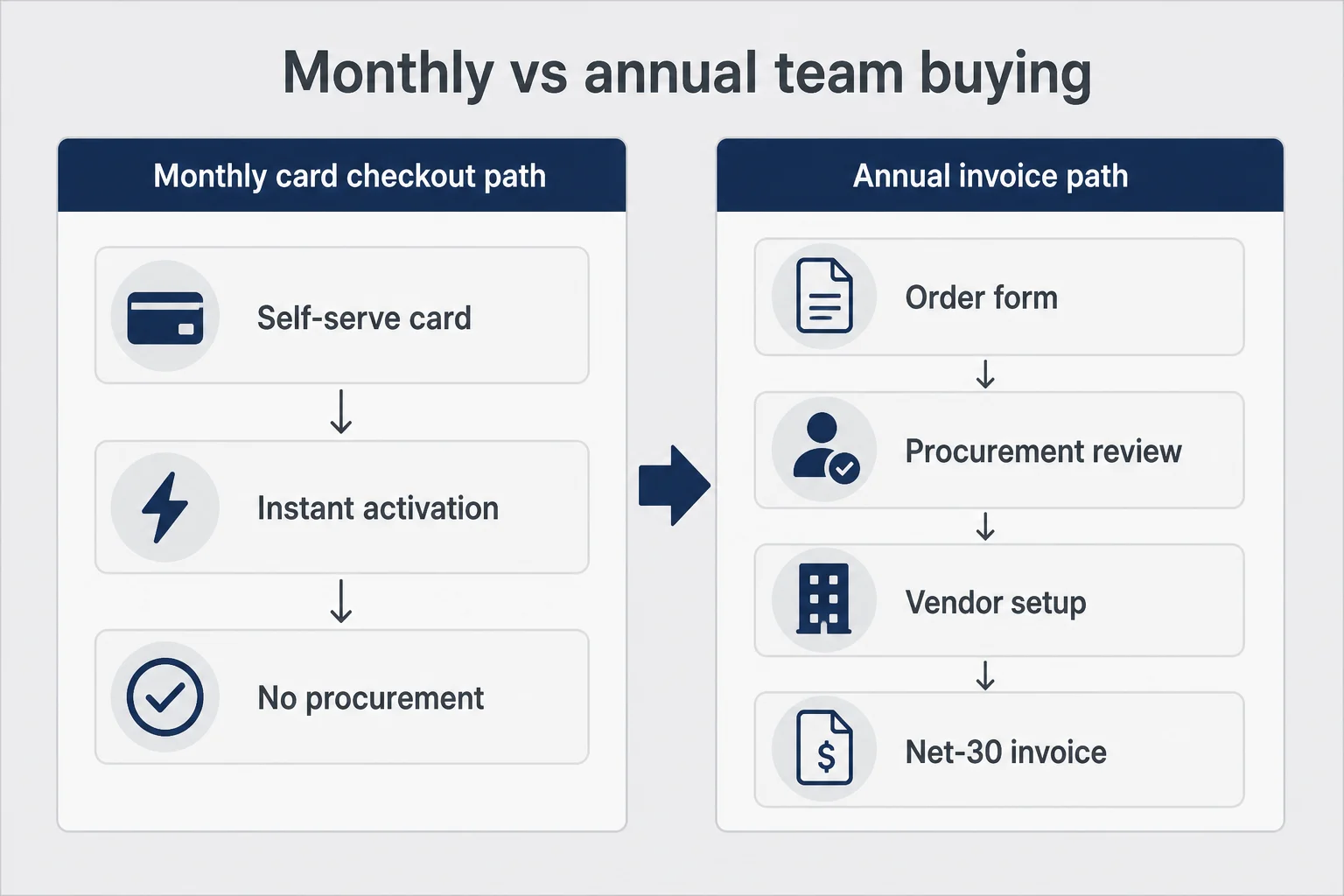
Monthly versus annual is not a math puzzle alone when a team is buying. It is a signal about who is in the deal and what machinery they plan to run you through.
Individual SMB buyers choose monthly because commitment feels risky and expense reports are easier one month at a time. Team buyers choose annual because finance hates twelve separate charges, budgets are often annual, and procurement wants a PO that matches a fiscal year. When your champion says "we prefer annual invoicing," they are telling you finance is awake. Good. Annoying. Good.
I default to monthly on the website for self-serve. I default to annual in conversations once multiple seats and an admin appear. Not because annual is always better for you. Because teams that pay annually behave like teams. They assign an owner. They plan rollout. They renew as a decision instead of a forgotten card.
The mistake is forcing annual on a team still piloting. Read pilot proposal if you have not scoped a paid pilot cleanly. Pilots should be short, bounded, and priced in a way that does not require a year of faith. Annual belongs after value is proven, not as a discount trap to close someone who is unsure.
Another mistake is offering monthly on a deal procurement will not allow. Some companies cannot put recurring SaaS on a corporate card at scale. You will learn this when accounting replies with "invoice only" and a vendor portal link. Fighting that preference to keep your Stripe flow simple wastes weeks. Give them annual invoice path when the buyer names it.
Champions think about usability and internal politics. Buyers think about budget lines and renewal risk. Finance thinks about payment method, accruals, and whether your company looks like it will exist next year. Procurement thinks about terms, insurance, and whether you have a W-9 that matches your legal name.
Monthly helps champions sneak you in under the radar sometimes. Annual forces the buyer to acknowledge you on the spreadsheet. That is scary and necessary. If you want upmarket revenue, you want to be on the spreadsheet before renewal season, not hidden in expensed card charges until someone audits subscriptions.
When a buyer asks for annual, ask why. Listen for real reasons. "We prefer annual budgets" is a green light. "Do you give a discount for annual?" is negotiable but fine. "We need annual because monthly is not in our system" is a process tell. "We want annual so we forget to cancel" is honesty you can work with.
When a buyer insists on monthly despite team size, probe. Sometimes they are testing flexibility. Sometimes they truly have a monthly OPEX line and you need a smaller initial commit. Sometimes they are not the buyer and do not know their own rules. Cadence questions surface authority.
Founders hear annual and think discount. Teams hear annual and think predictability. Lead with predictability. Discount is seasoning, not the meal.
Max's guidance on annual billing discount is the right technical frame: two months free reads clearer than seventeen percent. In sales conversations I add a buyer frame: annual locks your support priority, implementation window, and price for the term. You are not begging them to prepay. You are trading cash flow for stability on both sides.
If they push for a deeper cut, trade something back. Shorter payment terms. Case study rights after success. Minimum seat commit. Fewer custom terms. Discount without trade is how bootstrapped founders fund other people's procurement theater.
Monthly at list price versus annual with a modest cut often lands near parity on total dollars. Finance still prefers annual because work drops. Do not assume they only care about percentage off. Many care about hours.
Card annual is the bridge motion. Team lead has a limit, can charge $4,800 today, does not need legal review. You send a Stripe link or checkout session. Done in a week. Invoice annual is the procurement motion. PO, vendor setup, net-30, maybe a security exhibit. Done in a month if you are lucky.
Solo founders should love card annuals. They teach team dynamics without net-60 pain. Move to invoice annual when deal size or policy demands it. If you only have invoice machinery because you think it sounds enterprise, you will starve waiting for AP to prioritize a $3k vendor.
Stripe can do more than you think here. Max covers Stripe billing properly. You do not need custom code for every annual. You need a clear price, a term, and a record in your database that matches what someone signed.
Monthly wins for early team trials where adoption is uncertain. Monthly wins when your product is still moving weekly and a year lock-in would be unfair. Monthly wins when the buyer is a small business owner who thinks like a consumer. Monthly wins when you need more data points on churn before you sell annual to everyone.
Do not let LinkedIn shame you into annual-only positioning while your refund rate tells a different story. Cadence is a tool. Use the right one per deal.
I keep a simple rule on my whiteboard when advising founders: if one person can decide today with a card, offer monthly and annual as self-serve options. If two departments are in the thread, default the proposal to annual and invoice. If legal is already cc'd, annual is not optional. It is Tuesday.
Fiscal year alignment trips founders who only think in signup anniversaries. A buyer in October may want a contract that runs January through December because that is how budget resets. You might prorate two months or stub a short initial term. Either is fine if written clearly. What is not fine is assuming your Stripe anniversary logic matches their internal books. Ask when their budget year turns. Write dates that match.
Multi-year annuals appear sometimes on team deals. Three years with a defined uplift cap can be easier for a buyer than three separate renewals. Bootstrapped founders should be cautious. Multi-year is a bet on your own pricing power and product stability. If you are still changing core workflows monthly, one year is enough rope. If your product is mature and the buyer wants predictability, a two-year with modest escalator can work when the trade is explicit.
Minimum deal size worth the procurement hassle
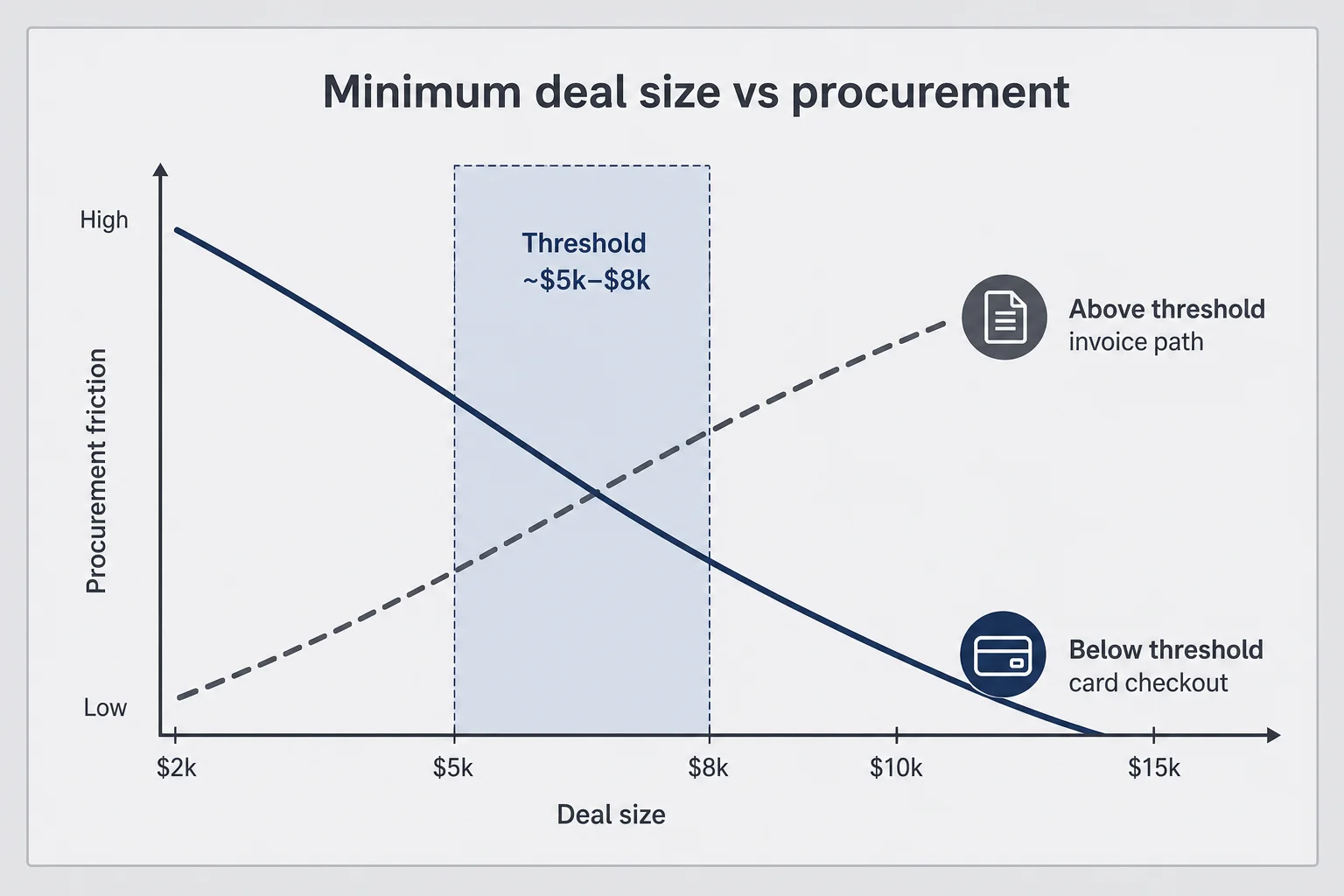
Procurement does not care that your product is AI-powered. They care whether you have insurance, a W-9, and terms their lawyer can live with. Your job is to decide when that attention is worth your calendar.
There is no universal floor. A $5k deal at a fifty-person company can close on a card annual in ten days. A $12k deal at a five-hundred-person company can die in vendor review because your SOC 2 answer was "in progress." Size sets expectations. Company type sets friction. Buyer access sets reality.
I use $6k to $8k ACV as the rough line where vendor setup, net-30, and a security exhibit start earning their keep for solo founders. Below that, I push hard for card annual, prepay, and a one-page order form without redlines. Above $10k, I assume procurement exists even if nobody used that word on the demo. Between $8k and $10k is where judgment matters and champions lie with good intentions.
Hours matter as much as dollars. A $7k deal that closes in two calls beats a $15k deal that eats six weeks if you only have one sales thread of capacity. Read when to sell enterprise on capacity. The minimum deal size is partly an hourly rate question disguised as ACV.
Vendor portal invitation before price is agreed. Request for certificate of insurance on a first quote. Legal cc'd on an email thread still in discovery. Questionnaire attached to a calendar invite. Finance asking for net-60 "standard terms" before scope is written. Each signal alone might be fine. Stack three and you are in procurement land.
Ask your champion directly: what approval threshold triggers vendor review? At one client it was $2,500. At another it was anything not on a corporate card. The threshold tells you more than your own pricing page.
If the threshold is low and the process is heavy, that is a company culture tell. Some orgs run enterprise process on team deals because risk aversion is the brand. You can still win. Price for the hassle or walk.
Walk when legal sends a fifty-page MSA for a $6k pilot. Walk when security review has no owner and no deadline. Walk when net-90 is non-negotiable and cash is tight. Walk when the champion cannot get a buyer on a call and procurement is already asking for references.
Walking is not failure. It is portfolio management. The solo founder who wins a $4k deal after forty hours of redlines celebrates margin they did not make. I have seen it. The founder was too proud to say no. His product shipped nothing that month.
Offer an alternative when you walk: card annual at a fair price, smaller scope, or pilot per saas pilot proposal. If they cannot accept any lighter path, they wanted process, not you.
Sometimes strategic logos teach you a vertical. Sometimes a design partner funds a feature. Sometimes concentration is fine because the account expands if you deliver. Accept below-floor hassle when the learning is priced in and the buyer is real.
Never accept it because pipeline looks thin and you panic. Thin pipeline plus heavy process equals burnout. Fix pipeline with Reese motions or tighten ICP before you become free legal review for strangers.
If you know a deal will run through vendor review, price the tax in. Not as a line item. In the number. Ten to twenty percent mental markup for solo founder time is reasonable on first deals. You are not gouging. You are accounting for reality.
Repeat customers get smoother. First vendor setup is the expensive one. If procurement loves you at renewal, the tax drops. Renewals are where annual contracts shine if you did not sign trap language year one.
Compute founder hours per dollar before you celebrate ACV. Six months of weekly calls on an eight-thousand-dollar deal is a bad wage. One signature with ninety-day implementation and quiet support is a good one. Minimum deal size is a filter protecting the solo founder's calendar. Use it.
Order forms and invoicing without an ops team
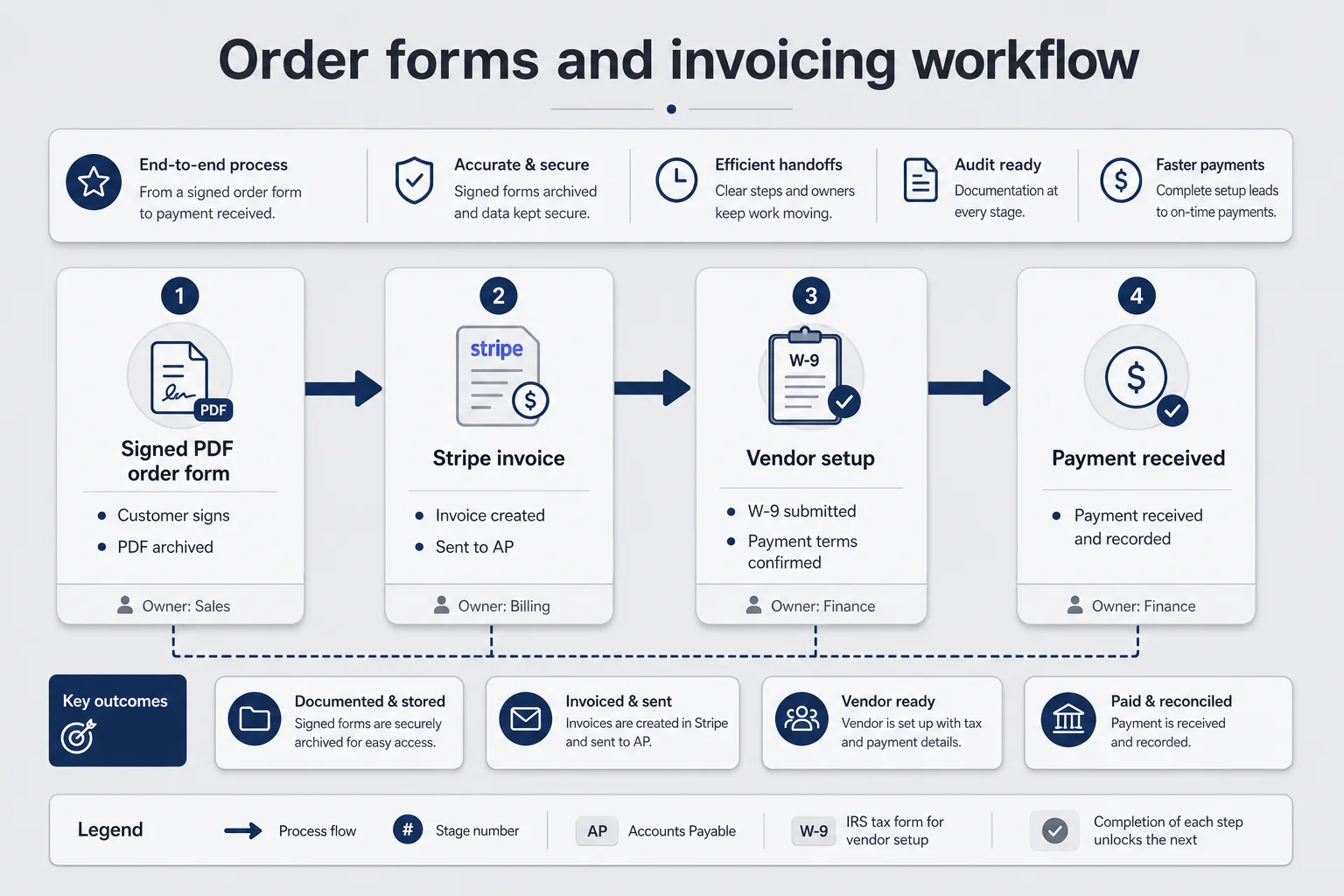
You do not need an ops team. You need a repeatable document, a billing tool, and the discipline to match what you sold with what you bill.
Order form beats MSA for most solo-founder team annuals. One to three pages. Parties, product description, seat count or usage definition, term, price, payment terms, renewal snippet, signature blocks. Attach security FAQ or DPA as exhibit if needed. Keep the main body readable by a human who is not a lawyer.
I like PandaDoc or DocuSign for signatures. Google Docs with a clear PDF export works if you are broke and organized. The tool matters less than version control. order-form-v3-final-FINAL folders have killed deals when numbers disagree.
Template once, reuse until someone redlines. Pay a lawyer to review the template, not every deal. When redlines arrive, decide if they are material. Cap liability fights on a $8k contract are often theater. Data processing addenda are not theater. Know the difference or ask someone who does.
Identify the customer legal entity correctly. Sounds obvious. I have seen invoices rejected because the buyer typed a parent company name and finance expected a subsidiary. Ask accounts payable which name they need before you send anything.
Scope in plain English. "Twelve seats of Product Pro with admin reporting" beats jargon. Link to a security page if required. State implementation expectations if you promised onboarding hours. Ambiguity becomes free work after signature.
Term and start date. Annual from signature date versus annual aligned to their fiscal year matters to finance. If they need a stub period, write it. Do not wing proration in email.
Price and payment terms. Total contract value, invoice schedule, net-30 or prepay, currency, tax handling if relevant. If you quoted $9,600 and invoice $9,600.01, someone will pause your payment for a week.
Renewal and cancellation pointer. Not the whole treatise. One paragraph with the behavior stated clearly. Details live in terms of service, but the order form should not surprise anyone at month eleven.
Signature blocks with titles. Encourage actual buyers to sign. Champions who sign without authority create rework.
Match the PO. If procurement issued PO-4421 for $9,600, your invoice references PO-4421 for $9,600. Creative invoicing is how you meet AP robots and lose.
Send invoices to the email accounts payable gives you, not the champion's personal inbox unless they confirm forwarding. Champions are not AP. Love them anyway.
Stripe Invoicing works for many founders. QuickBooks works if you already live there. The system is less important than a checklist: signed order form stored, invoice sent, due date calendared, follow-up on day thirty-one if net-30, mark paid in CRM when money lands.
Max can wire Stripe billing so entitlements update from webhooks. Even on invoice deals, your app should not guess. Someone paid you; flip the access bit. Manual provisioning on annual deals is how founders get burned on weekends.
W-9 ready. Insurance certificate if they ask. Bank details for ACH. Business address that matches your state registration. Description of services under ten words. Founders laugh until they lose a week because their DBA did not match their W-9.
Questionnaires overlap with security reviews. Reuse answers from security questionnaire work. Build a doc library: security FAQ, subprocessors, data retention, incident contact. Copy paste with care, not laziness.
Portal fatigue is real. Some portals take ninety minutes the first time. Batch them. Do not start vendor setup before verbal yes on scope or you donate labor.
I watched a founder complete a vendor portal for a $5,500 annual before the buyer confirmed seat count. Procurement approved vendor status. Finance rejected the PO because the number did not match the internal requisition. He had to redo the portal fields and explain to his champion why the "easy" part took two weeks. Vendor setup is not closed until money moves. Treat it that way.
Keep a folder called vendor-packet with PDFs ready: W-9, certificate of insurance, short company overview, security FAQ link, sample order form. When the portal asks for the same upload for the tenth time, you will thank yourself. Champions lose momentum when you say you will "get the insurance cert tomorrow." Tomorrow is where deals go to nap.
Send a draft order form with blanks highlighted, not a verbal quote in Slack. Slack quotes do not survive buyer changes. Paper forces the buyer to appear.
If they resist paper before scope is firm, send a pilot SOW instead per pilot proposal. Pilots are the on-ramp. Annual is the highway. Do not merge lanes.
Do not start work without signed order form or deposit. Verbal yes is not revenue. Founders eager for logos start implementation early. Then legal stalls six weeks and you built custom reports for free.
Founders feel awkward chasing money. Awkward is cheaper than unpaid annual. Order forms are how solo founders look like vendors worth taking seriously. One page of commercial clarity beats a hundred-slide deck.
Negotiation moves that work for bootstrapped founders
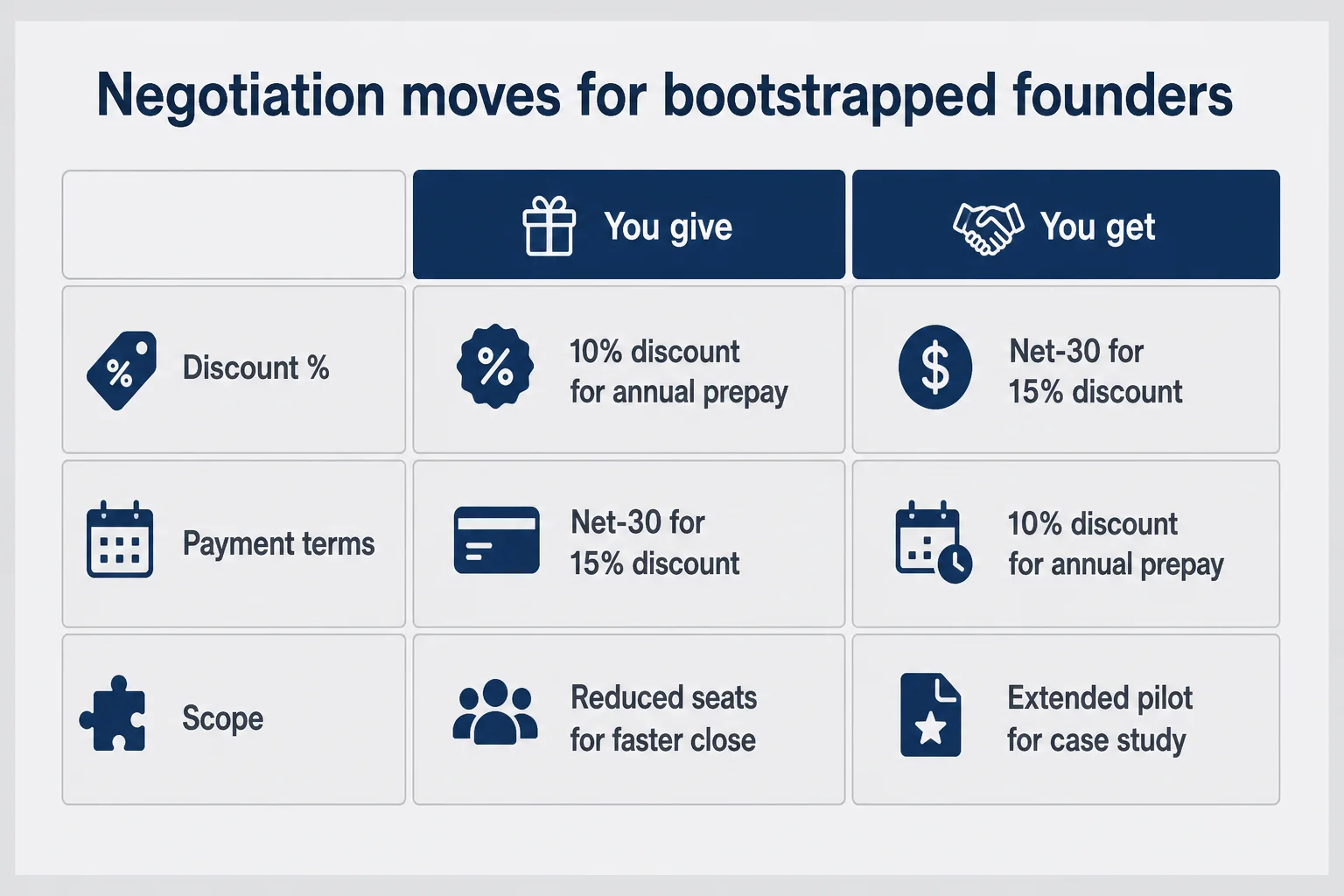
Negotiation on annual contracts is not a personality contest. It is structured trading. You have constraints: time, cash, margin, and sanity. They have constraints: budget, risk, internal politics, and procurement scorecards. Founders who treat negotiation as begging lose money and respect. Founders who treat it as war lose deals over pride.
You are bootstrapped. Act like it honestly. "I do not have a fifty-person legal team" is not weakness if followed by "here is our standard order form that has worked for similar teams." Adults prefer fast truth to fake enterprise theater.
Prepare three numbers before you enter negotiation: walk-away price, target price, and anchor price. Anchor is what you hope they accept. Target is what you expect after trades. Walk-away is where you politely decline. Without walk-away, every procurement tactic feels like an emergency.
They want a deeper annual discount. You offer prepay instead of net-30, or cap support hours, or limit custom integrations, or shorten pilot overlap. Never give discount for free because they asked nicely.
They want net-60. You offer net-30 with a small discount removed, or higher total commit, or multi-year with defined uplift cap. Net terms are loans. Price them.
They want more seats than budget allows. Phase seats with a written expansion trigger instead of discounting seats day one. Land with dignity, expand with milestones.
They want a feature on the roadmap. Put it in an appendix with target quarter, not in the binding scope unless you will ship it. Roadmap promises in contracts are product hostages.
They want logo rights. Trade for case study participation after success metrics, not before rollout. Case studies on failed rollouts help nobody.
Summarize agreements in email after calls. "As discussed, $9,600 annual, twelve seats, net-30, start March 1, standard order form." Creates a paper trail champions can forward.
Name the decision maker who must say yes to close. Not aggressive. Practical. "Who besides you signs off so we can aim for your Q2 budget window?"
Offer two good options instead of one take-it-or-leave-it. Annual prepay at X or annual net-30 at Y slightly higher. Buyers like choosing between acceptable outcomes.
Use silence after you state price. Founders narrate nervousness into discounts. State the number. Stop talking.
Set expiration dates on quotes that are real. Not fake urgency. If their quarter ends in three weeks, say quotes for that budget cycle expire with the quarter. Procurement understands fiscal clocks.
Procurement will ask for most-favored-customer pricing or a most-favored-nation clause. On a first team annual, resist if you can. You have other customers at other price points because stage and scope differ. Explain that your public pricing is transparent and custom quotes reflect seat count and term. If they insist, narrow the clause to same product tier and similar seat band, not your entire customer base.
When legal sends redlines, categorize: acceptable, negotiable, walk-away. Insurance and liability caps are often negotiable within bands. Unlimited liability is walk-away for bootstrapped SaaS. If you do not know, spend an hour with a lawyer once instead of guessing on every deal.
Respond to redlines in a table. Their ask, your response, rationale one sentence. Lawyers respect clarity. Walls of prose signal fear.
Pick battles proportional to deal size. Fighting indemnification language for three days on a $7k contract is how founders lose the war. Escalate battles proportional to ARR impact.
Good champions negotiate internally for you. Great champions tell you what finance will accept before you propose. Ask what similar vendors charged. Ask what got rejected last time. Ask whether multi-year is easier than single-year for their budget mechanics.
Bad champions say "just be flexible" without specifics. Flexibility without bounds is a discount request wearing a scarf.
If internal politics turn ugly, offer to join a fifteen-minute call with finance or procurement. Sometimes a founder voice de-risks the unknown vendor. Sometimes you hear the real blocker live. Both beat email ping-pong.
I use Claude for first drafts of objection responses and redline summaries. It does not know your runway. You still decide whether net-60 is survivable. AI speeds typing on negotiation emails. It does not replace knowing your walk-away.
Founders with one big deal in pipeline negotiate worst. Diversify before you need to. Bootstrapped does not mean soft. It means clear limits because you have no backup AE.
Net-30, renewal language, and cancellation traps
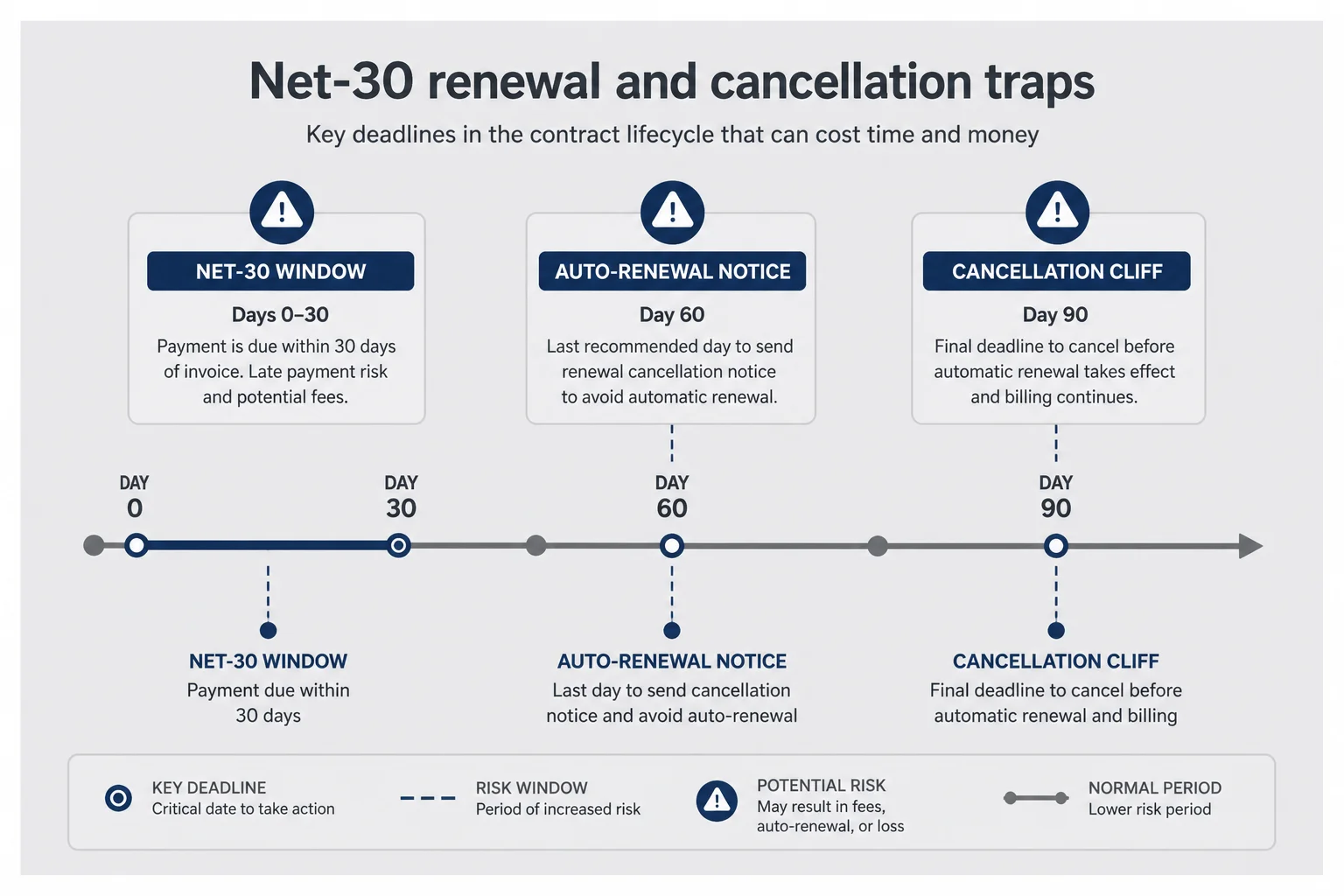
Payment terms and renewal clauses are where annual contracts pay you or haunt you. Net-30 sounds standard until you are payroll Friday with cash still in accounts payable. Auto-renew sounds efficient until a customer disputes a price increase you buried in section 9. Cancellation traps cut both directions. Read them before signature, not at renewal when everyone is tense.
Net-30 means they owe you thirty days after invoice date or receipt depending on language. Know which. Means you float a month of their usage. Bootstrapped founders forget that float until it stacks across three accounts.
Default to prepay or net-15 on first deals if cash is tight. Offer net-30 when you can afford it and it unlocks a buyer who cannot prepay by policy. Offer net-60 only when deal size compensates and you have tracked AP behavior on similar accounts.
Follow up on overdue invoices on day thirty-one, not day sixty. Polite, specific, with invoice PDF attached. Champions are not collections agents. CC AP if needed. Founders who fear being annoying get paid late habitually.
State term length clearly. Twelve months from start date, or aligned to fiscal year with stub spelled out. "Annual" is not a term. Dates are terms.
Auto-renew versus manual renew is a choice with trade-offs. Auto-renew helps predictable revenue. Manual renew helps relationships and price adjustments. If you auto-renew, specify notice window in plain language on the order form: "Renews for successive twelve-month terms unless either party gives thirty days written notice before term end."
Price increase language belongs in writing. "Renewal at then-current list price" is common. Understand what it means when you raise prices next year. If you want cap, say cap. Buyers remember surprise increases more than modest ones they were warned about.
Seat true-up language matters for team products. If they can add seats mid-term without reporting, you discover usage at renewal and look like a cop. Define how seat changes work: billed quarterly, billed at renewal, or self-serve with proration via Stripe.
Expansion is renewal's cheerful sibling. Write how add-ons price mid-term. Ambiguity creates awkward QBRs.
Evergreen contracts without clear exit are traps for founders. Some buyer paper auto-renews with ninety-day notice while sounding "standard." Read notice periods. Ninety days notice on a twelve-month term is a hostage clause if you need to change strategy.
Convenience cancellation fees on annual deals rarely favor vendors at solo scale. If legal inserts them, negotiate proportionality or remove.
Data export and deletion timelines belong near cancellation. Enterprise buyers care. SMB buyers care when they leave angry. Clarity prevents support fires.
Refund language on annual prepay should match what you can stomach. "No refunds pro-rata" is common. Be honest on the order form. Surprises here become chargebacks and LinkedIn posts you do not want.
Buyers fear price shocks, shelfware embarrassment, and vendor indifference after signature. Founders fear churn cliffs and re-procurement theater. Renewal is where both fears meet.
Start renewal conversations sixty to ninety days before term end for accounts that matter. Not spam. A check-in with usage summary, wins, and a draft renewal order form. Champions need ammunition before finance asks if they still need you.
If usage is weak, renewal is a rescue mission, not a billing event. Honest conversation beats auto-invoice shock. Sometimes downsell saves the logo. Sometimes you learn they never adopted and you fix onboarding for the next account.
Track renewal dates in CRM or a spreadsheet. Stripe alone will not remind you to relationship-manage a net-30 annual that never auto-charged again.
Founders confuse payment terms with contract term. Net-30 is how they pay an invoice. Twelve months is how long the license runs. You can have annual contract with net-30 on the sole invoice, or quarterly invoices on a twelve-month commit, or prepay for the year. Mix deliberately. Do not let procurement default you into quarterly net-45 on a small deal because nobody read the draft.
Some buyers only have MSA paper. For smaller annuals, ask if order form can control on conflict. For larger, pick battles on liability, insurance, and data processing. MSA review is where solo founders bleed time. Tie effort to deal size. A $20k annual might justify hours. A $6k annual might justify a lighter exhibit or walking.
Sixty days before term end, send something your champion can forward without editing every line. Short usage win, reminder of term end date, proposed renewal with same scope and any price change stated plainly, ask for a fifteen-minute call if they want to adjust seats. Attach draft order form. Good renewal emails talk about value delivered and what happens next by default if nobody replies.
If they ghost renewal until week fifty-two, that is data about adoption or internal politics, not a reason to panic-discount on day three hundred sixty-four. Founders who slash price at the last minute teach buyers to ignore you until the cliff.
Watch for unlimited liability for data breach when you are a twelve-person vendor. Indemnity for their misuse of your API. Termination for convenience with no refund clarity on unused months. Most-favored-nation pricing if you sell cheaper to anyone. Assignment clauses that let them sell your contract without consent. IP assignment for configurations they built in your product.
You are not signing bank-grade risk for five-figure deals. Cap liability at fees paid in the twelve months prior. Carve out gross negligence if their lawyer insists. Ask your attorney once, reuse language.
I am not giving legal advice. I am saying read the traps founders step on repeatedly and fix your template once. Annual contracts reward founders who think about day three hundred sixty on day one.
Questions founders ask about annual contracts
When should a solo founder push annual instead of monthly?
Push annual when a team is buying, procurement or finance is involved, or your champion asks for an invoice and a PO. Monthly still wins for solo users testing the product and for early SMB where one person swipes a card. Annual is a buying motion signal, not just a pricing toggle. If nobody has asked for consolidated billing yet, you are selling annual too early.
What is the minimum deal size worth procurement hassle?
For most bootstrapped founders I like $6k to $8k ACV as the floor where vendor setup, net-30, and light legal review earn their calendar cost. Below $4k, push for card annual or a simple order form with prepay. Above $10k, assume procurement, a questionnaire, and three to eight weeks unless your champion has unusual authority. Size is not the only variable, but it sets the tone.
Do I need a lawyer for every annual contract?
Not for every deal. A one-page order form with your standard terms, clear scope, and renewal language handles many team annuals under $15k. Lawyers earn their fee when redlines start on liability caps, indemnification, or data processing addenda you do not understand. Have a template reviewed once. Reuse it until someone sends back a fifty-page MSA for a pilot.
How do I invoice without an ops team?
Stripe Invoicing or your billing stack plus a PDF order form is enough for most solo founders. Send the invoice after signature, match line items to what procurement approved, and put net-30 in writing only if you can float the cash. Many team deals close on annual prepay with a card or ACH. Invoicing is paperwork choreography, not a department.
What net terms should a bootstrapped SaaS offer?
Default to prepay or net-15 for first team customers if cash is tight. Net-30 is common in mid-market procurement and reasonable once you have runway. Net-60 and net-90 are concessions, not defaults. Trade longer terms for larger commits, not for politeness. Every day you wait is working capital you are lending for free.
What renewal language trips up solo founders?
Auto-renew with short notice windows, ambiguous seat counts, and price increase clauses buried on page four. Buyers remember surprises at renewal. State term length, renewal behavior, price change rules, and cancellation notice in plain English on the order form. If legal sends evergreen language, ask what happens at year two before you sign.
One signature is a trade, not a trophy
Twenty small accounts taught you strangers would pay. One annual contract teaches you whether you can sell to an organization without losing the product in the process. Both lessons matter. They are not interchangeable.
I still take calls with founders who want the big number on the homepage more than the clean order form in PandaDoc. I get it. The number feels like safety. Safety is knowing who signs, what you traded for net-30, and what renewal looks like when the champion who loved you moves teams.
If you are earlier in the sequence, go read when to sell enterprise and fix the room before you fix the term length. If demos go well and paper stalls, read enterprise sales demo and champion economic buyer. If security and scope are the blockers, read security questionnaire and pilot proposal. Annual is the layer where those threads knot into one signature.
Max will keep your Stripe billing honest and your annual discount math from becoming a refund trap. I will keep telling you that procurement does not care about your roadmap slide. They care whether your W-9 matches and your renewal language is readable.
Before you send the next quote, write the walk-away number. Before you accept net-60, check payroll. Before you sign auto-renew, read section nine out loud to another human.
A signed annual with one real buyer beats twenty "probably renewing" SMBs rattling in a dashboard. Make sure the signature belongs to someone who had authority, not someone who hoped authority would appear later.
The deal board is not asking you to abandon small customers. It is asking whether your next quarter needs depth more than breadth. Answer honestly. Then send the order form.




Comments