She Loved the Product. She Could Not Sign Anything.
Champion vs economic buyer for solo micro-SaaS founders: map the buying committee, discovery questions that surface who signs, real champions vs polite fans, and when to pause single-threaded deals.
 By Derek26 min read
Listen to this article
AI-generated podcast-style overview of this article (not a word-for-word narration).
The Slack message arrived on a Wednesday afternoon. Heart emoji. Screenshot of her team using the product. "Everyone is obsessed. I am pushing this up the chain."
I asked one question: who signs the purchase order when your director says yes?
Typing dots. Then: "I am not totally sure. Finance is weird here."
She loved the product. She could not sign anything. The deal was not dead. It was mislabeled. Pipeline said "hot." Reality said "single-threaded with no budget map."
That is the champion economic buyer micro saas gap in one thread. Founders celebrate enthusiasm because enthusiasm is rare and validating. Enthusiasm from someone without signing authority is not revenue. It is a prerequisite at best.
I am Derek. I spent years as an AE at small B2B SaaS companies where the CEO still joined demos when the deal was big enough. Then I freelanced with bootstrapped founders who had champions quoting their product in Slack and terror in their eyes about asking who controlled the budget. Since 2023 I have advised solo founders on first team plans and enterprise pilots. The ones who won mapped the room before they mapped the feature roadmap.
This post is for founders who already have SMB traction and are in conversations that feel real but stall before signature. If you are not sure whether you should be upmarket yet, read when to sell enterprise first. If your demos keep going well while nobody with budget attends, read enterprise sales demo next. This article is the connective tissue between readiness and the call itself: who has to say yes, and how you find out before month three.
A champion is not a buyer. Interest is not budget. A great demo is not a signed order form. My job here is to help you tell the difference early enough to save your quarter.
I use HubSpot or Pipedrive with embarrassingly simple stages. Champion identified. Buyer named. Buyer engaged. That is enough CRM for one person. Fancy scoring models are for teams with SDRs. You have a notebook and judgment.
The thesis motion on this page is a buying committee map, not a org chart fantasy. Three roles matter on most small B2B deals: champion, economic buyer, blockers. Blockers come later. Most stalled deals die because the middle column stayed empty.
A champion is not a buyer
A champion is the person inside the account who wants you to win. They use the product. They feel the pain. They will spend political capital to get you a meeting, forward your Loom, argue in a team channel that the old tool is worse.
A buyer is the person who can commit budget or get a signature from someone who can. Different job. Different incentives. Different risk profile.
Champions risk embarrassment if they push a bad vendor. Buyers risk budget, headcount optics, and procurement headaches. Your champion might love you because you saved them four hours a week. Their director might love a different vendor because it came with a bundle discount from a parent company relationship you will never see.
Founders conflate the two because champions are accessible. They reply to email. They join calls. They send the nice messages. Buyers are busy, skeptical, and trained to say "send me something" instead of "let's meet Thursday."
I have watched founders build mutual action plans with champions who had zero authority to commit anything. Beautiful docs. Dates and owners. The buyer's name appeared as "TBD" for six weeks. TBD is not a stakeholder. It is a warning label.
On a $49/month self-serve plan, the champion and buyer are often the same human with a credit card. Congratulations. That motion is not what this article is about. The moment invoice, PO, or security review enters the chat, assume the roles split.
Champions can be individual contributors, ops leads, team managers, senior analysts. Buyers are often directors, VPs, finance partners, or founders at smaller companies buying tools for their own team. Titles lie. A "Head of Operations" at a twelve-person startup might sign. A "Head of Operations" at a four-hundred-person company might only recommend.
The test I use is simple: if this person said yes today, could an order form go out without someone else getting involved? If no, they are not the buyer. They might become your champion. Treat them accordingly.
I once advised a founder whose champion was a senior designer at a marketing agency. Incredible advocate. Sent three referrals. Joined every call. When we finally asked who approved software spend, she said "honestly, that is Marcus, but he only meets vendors once legal is done." Marcus was the buyer. We had spent eight weeks in the wrong sequence. The fix was not firing the champion. It was asking for Marcus for a fifteen-minute scope call before another feature sprint.
Another founder had the opposite problem. His contact was the CEO of a twenty-person company. Champion and buyer in one. Deal closed in three weeks with a standard order form. No procurement. That is the team tier sweet spot. Do not overcomplicate it with enterprise playbooks when one signature solves it.
Why champions volunteer
Champions volunteer because your product makes them look competent. They found a tool that works. Their team stops complaining. Recommending you is a career micro-win. Buyers volunteer because the problem is expensive enough to fund. Different motivation. Your discovery job is to learn which motivation you are serving.
Why buyers stall
Buyers stall when priority is low, budget is uncertain, or risk feels high. Your champion's enthusiasm does not automatically change buyer math. A buyer might like your champion and still say not this quarter. That is why buyer access matters. You need to hear no or yes from the source, not through translation layers that soften bad news.
Why founders avoid the distinction
Asking "who signs" feels pushy when you are a developer who hates sales. You do not want to sound like a caricature AE. So you stay in product mode. You answer feature questions. You send recordings. You interpret silence as "they are busy" instead of "nobody with budget is in the loop."
Politeness is expensive. A champion who cannot introduce the buyer is not being mean. They might not know the path. They might be scared of bothering their boss. They might know the boss will say no and do not want to deliver bad news. Your job is to help them sell internally, not to pretend the org chart does not exist.
Interest is not budget
"We are evaluating several options" is interest. "We have budget allocated for Q3 rollout" is budget. "Leadership is excited" is interest wearing a suit. "I need a quote for finance by the fifteenth" is motion.
Track motion, not adjectives.
Say you are at $9k MRR and one team lead at a forty-person company keeps asking for features. You ship two of them. She is thrilled. Your pipeline row says $14k ACV opportunity. Then you learn the tool budget for her department is owned by a VP who standardizes on a competitor for anything over $3k. Your champion was real. Your map was incomplete. You built product for a deal that needed a buyer conversation first.
That story is common. It is not failure. It is tuition. The fix is not "never trust champions." The fix is map earlier and price the internal sell, not just the product work.
What changes when you name the buyer
Pipeline stages get honest. Forecasting stops being astrology. You know whether to spend Tuesday on a security form or on a cold LinkedIn search for the director your champion will not introduce.
You also stop resenting champions who are doing their job correctly. An ops lead who loves you and cannot sign is not leading you on. They are a piece of the puzzle. Your frustration should aim at the missing buyer conversation, not at the person who showed up.
The three roles on a small B2B deal
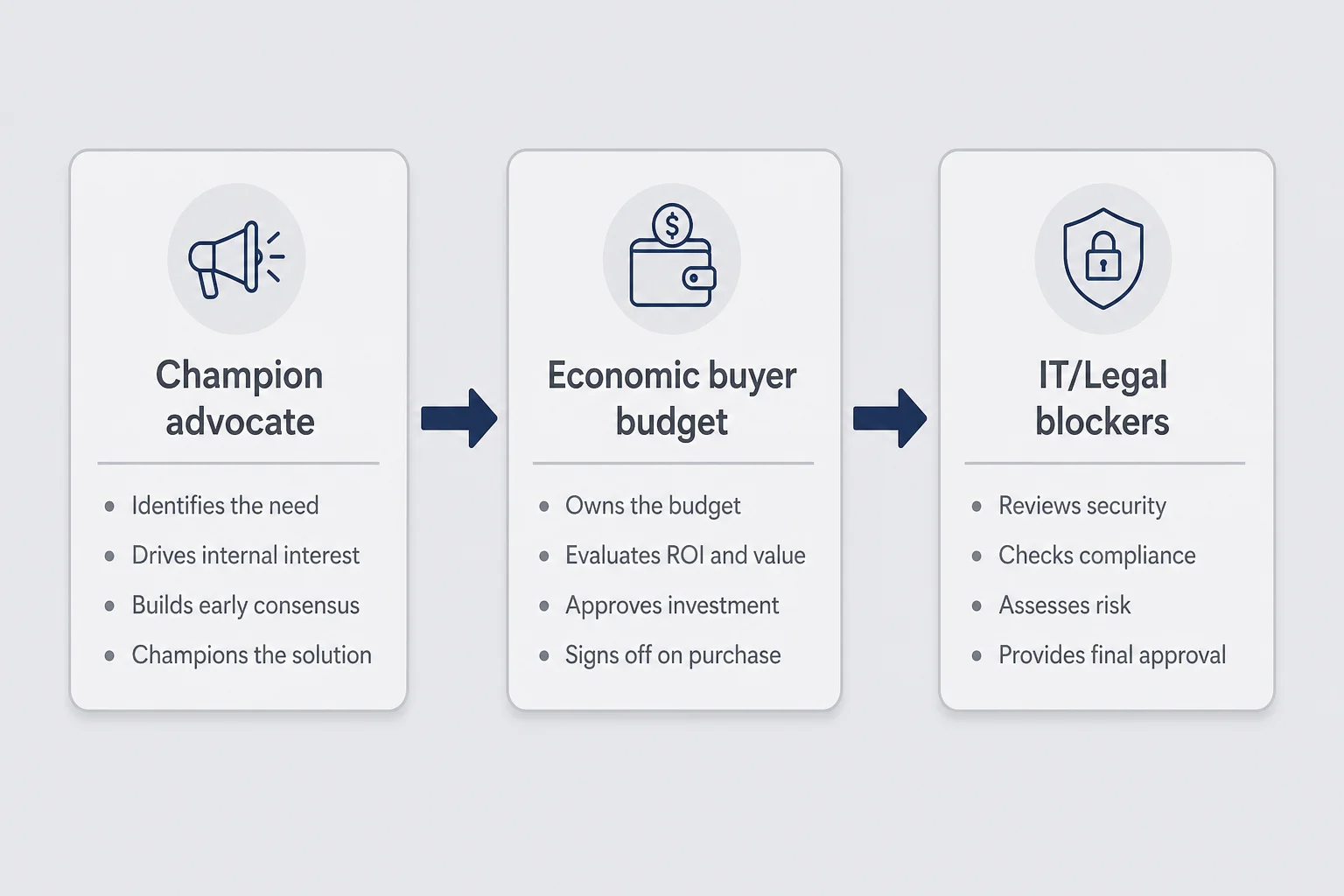
You do not need a fifty-person buying committee map for a $12k annual pilot. You need three roles understood.
The champion is your internal advocate. They want the problem solved. They will run interference, share internal context, and tell you when procurement is being weird. They cannot carry the deal alone past a certain size. Respect them. Do not treat them as the buyer unless they actually are.
The economic buyer holds budget or signing authority for this purchase. They might delegate evaluation to your champion. They still exist. On small team deals, this is sometimes the same person as the champion with a higher title. On larger deals, they are the human who says "approved" and means money moves.
The blockers are IT, security, legal, procurement. They rarely kill deals out of malice. They kill deals when risk is unclear or the buyer never showed up to prioritize the exception. Blockers matter. They come after the buyer path is real, not before.
Think of it as a sequence, not a democracy. Champion opens the door. Buyer decides whether to walk through. Blockers check your shoelaces on the way in.
On a fifteen-seat team plan at $4k annual, you might only meet champion and buyer in one person. Procurement might never appear. On a $15k pilot at a mid-size company, expect blockers to show up after the buyer says this is worth the paperwork.
Founders over-index on blockers too early. They panic about SOC 2 before they know who would sign if SOC 2 were not an issue. Map buyer first. Blockers are solvable problems attached to real intent. Blockers without a buyer are paperwork theater.
The champion's actual job
Your champion's job is not to buy. It is to sell you internally when you are not in the room. That means they need ammunition: a one-pager with ROI in their language, a clear price, answers to "why not the incumbent," and a short path to pilot.
If you dump a forty-slide deck on them, they will not forward it. If you give them three bullets they can paste into their manager's Slack, you are helping them do their real job.
The buyer's actual job
The buyer's job is to allocate scarce budget and absorb organizational risk. They care about outcomes, not your roadmap slide. They care whether this makes them look smart or reckless. They care about rollout friction, not your keyboard shortcuts.
When you finally get fifteen minutes with a buyer, do not replay the demo. Confirm the problem, confirm the champion's read, confirm the decision process and timeline. Then ask what would make this an easy yes.
Blockers are not villains
IT asks about SSO because they get blamed when tools leak data. Legal redlines because they get blamed when contracts go wrong. Procurement asks for three bids because policy says so. Annoying? Often. Personal? Rarely.
Your champion cannot override blockers indefinitely. The buyer can prioritize exceptions. Another reason buyer access matters.
Composite example: $11k pilot at a sixty-person agency
Champion: account manager who uses the product daily. Buyer: operations director who approves software spend over $5k. Blockers: part-time IT consultant who reviews vendor forms, plus the owner's quick glance at anything annual.
The champion got the demo. The buyer joined call two for twelve minutes. That was enough. IT sent a forty-question form. The buyer told IT to prioritize it because the account team was losing hours weekly. Deal closed in seven weeks.
Same product, different map: champion only, no buyer intro, IT form arrives anyway because someone in finance forwarded your website to compliance. Stall. Six months of "still in review."
The product did not change. The map did.
Questions that surface who actually signs
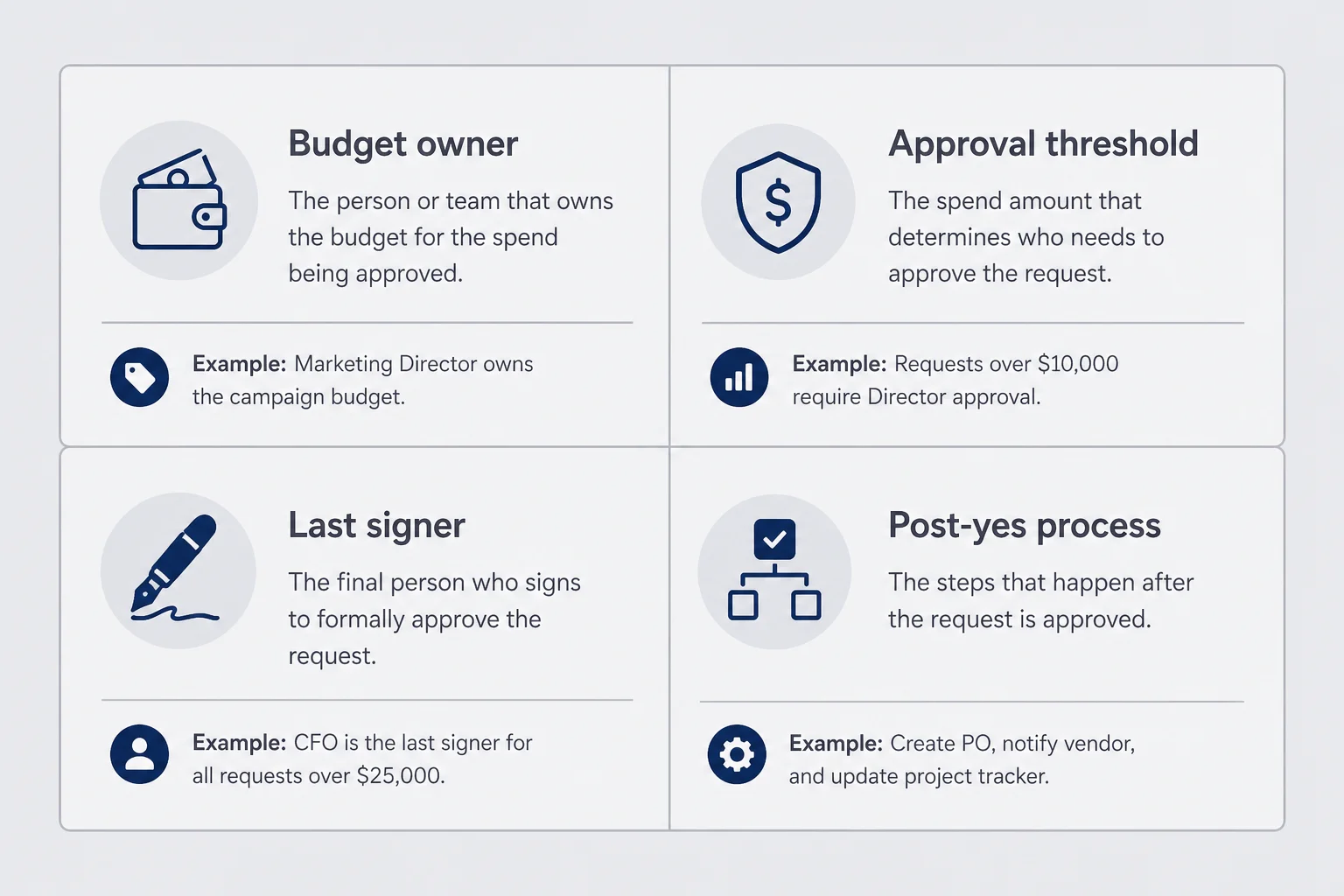
Discovery is not interrogation. It is cartography. You are drawing a map of who matters before you spend forty minutes on screen share.
These questions work on a first or second call. Ask them plainly. Founders apologize for budget questions like they are rude. They are not rude. They are how adults buy software.
Who owns the budget for tools in this category? Not "are you the decision maker." That phrase makes everyone say yes incorrectly. Ownership language is clearer.
What is the approval threshold before finance or procurement gets involved? You will learn whether your $8k deal can close at team lead level or needs director sign-off.
Who signed the last vendor contract like this? Past behavior predicts process. If IT signed the last one, IT will appear again.
What happens internally after you recommend a vendor? Listen for names, meetings, and timelines. "I tell my boss" is thinner than "I send a one-pager to Sarah and she brings it to weekly ops review."
If we are a fit, what would you need to see to feel comfortable advocating internally? This turns your champion into a collaborator. They will tell you what proof they lack.
Is there anyone who could veto this even if you and your manager love it? Surfaces blockers early. Better now than in week eight.
I keep these in a Google Doc template. Copy, paste, adapt. I use Claude sometimes to phrase follow-ups. It does not know their org chart. I still have to listen.
Questions that sound safe but fail
"Are you the decision maker?" Everyone says yes. "What's your timeline?" Everyone says soon. "Any concerns?" Everyone says not really, then procurement appears.
Better: "What would prevent this from moving forward in the next thirty days?" That invites real blockers.
When the champion deflects
If they say "I will handle that internally" every time you ask about the buyer, offer help. "Happy to join a fifteen-minute call with your director so we do not waste their time." If they refuse twice with no alternative, downgrade the deal in your pipeline. You are not being aggressive. You are being accurate.
Document the map
After every call, write three names or "unknown": champion, buyer, next blocker. Unknown buyer after call two is a red flag, not a scheduling problem.
Role-play the procurement call you have not had yet
Before demo two, ask yourself: if procurement emailed tomorrow, who at the account would care whether this deal lives or dies? If the answer is only your champion, you are not ready for procurement. You are ready for a buyer conversation.
Founders treat procurement like weather. Sometimes it is. Often it is the buyer's way of making risk someone else's job. The buyer still has to want the outcome. Map them first.
Budget line language matters
Champions say "we need budget." Buyers say "this comes out of ops tooling" or "professional services" or "client delivery stack." The line tells you who competes with you internally and who else must sign off. Ask which budget line. Write it down. Use their words in your one-pager.
Real champion vs polite fan
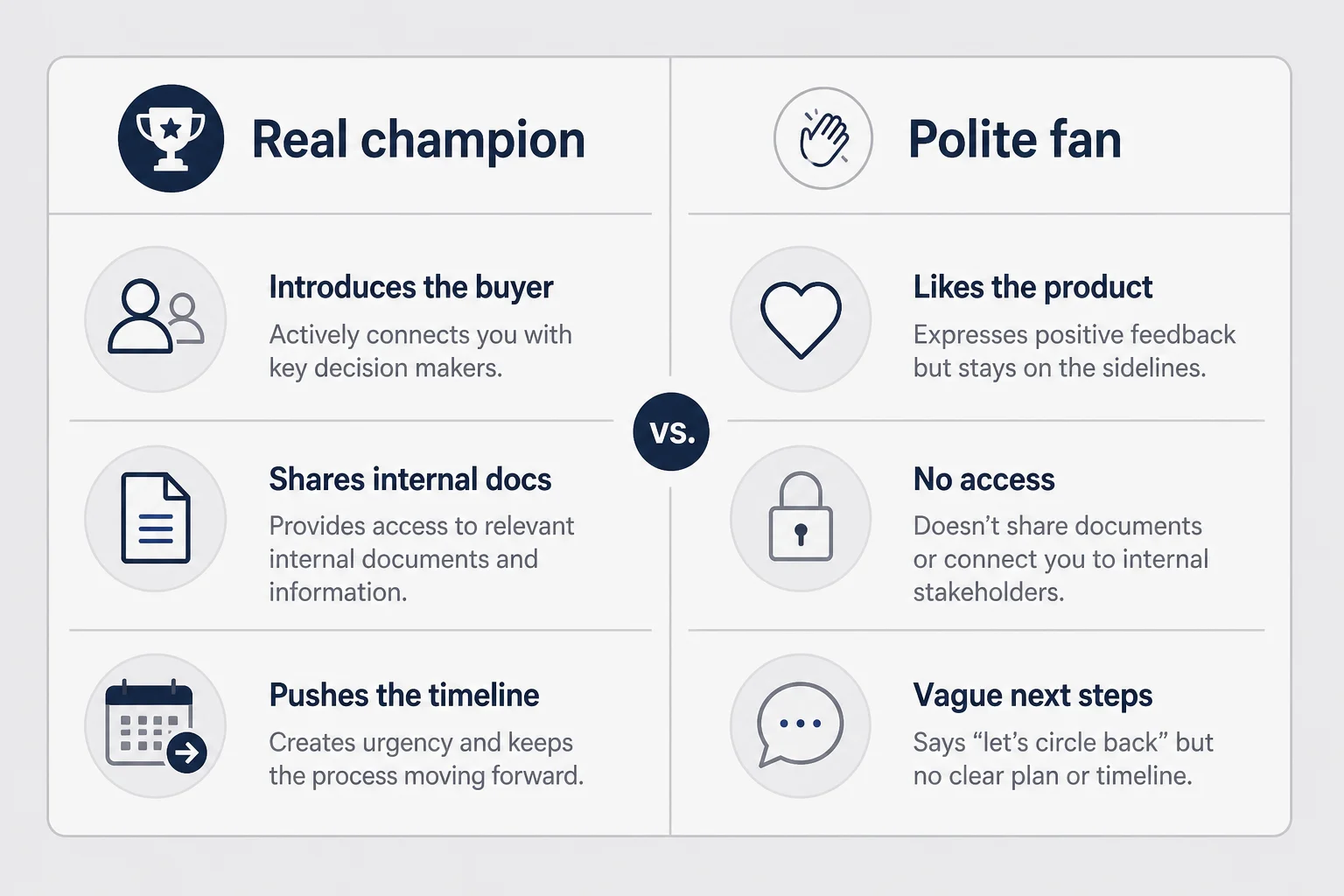
Every founder wants a champion. Not every enthusiastic user is one.
A real champion introduces you to someone upstream, shares how decisions actually get made, gives you candid feedback on internal politics, and pushes for a dated next step. They might still lose. Politics happen. But they play offense for you.
A polite fan replies quickly, loves the product in chat, attends demos, and never escalates. They say "leadership is looking at it" without a meeting. They forward your email to a black hole. They feel bad ghosting you, so they send hope instead of clarity.
Fans are not malicious. They are often junior, kind, and optimistic. They want you to win. They cannot make you win. Treating them as a champion burns your calendar.
Signals of a real champion: they ask what your buyer needs to see, they warn you about internal competitors, they propose a specific intro date, they follow up when legal stalls, they tell you when the deal is dead instead of stringing you along.
Signals of a polite fan: every next step is on them alone, they change the subject when you ask about budget, they celebrate small product wins instead of moving process, they have been "pushing internally" for two months with zero new names.
I am not saying abandon fans. Fans become champions when the timing is right or when you coach them with usable internal assets. I am saying do not build pipeline forecasts on fan energy.
The Slack emoji trap
Heart reactions are not pipeline. I have seen founders screenshot enthusiastic Slack threads as proof of enterprise traction. Screenshots are marketing. Signed order forms are revenue.
Coaching a fan toward champion behavior
Give them a forwardable blurb. Two paragraphs. Problem, outcome, price range, ask. Make it easy to paste. Ask them to cc you on the forward so you know it happened. If they will not forward, you have your answer.
When the fan is still valuable
Fans can give product feedback. They can be early users on a team plan they pay for themselves. They are not the path to a five-figure contract until they escalate or you find another thread.
The "director was on the call" illusion
Sometimes a director joins for five minutes, says "looks great," and leaves. Founders mark buyer engaged. That is not buyer engagement. That is polite air cover.
Buyer engagement sounds like: "Send me the pilot terms." "What is the annual price?" "Who on your side owns implementation?" "I need this live before Q4 planning."
If you only got head nods, your champion still owes you a real buyer conversation.
Champions age out
People change jobs. Champions get promoted or leave. A deal single-threaded on one person dies when they move. Multi-threading is insurance. Even a brief intro to finance or IT creates continuity.
I lost a deal once when a champion went on parental leave and nobody picked up the thread. Painful. Now I ask who else should be copied on updates by week three.
The internal sell you cannot make for them
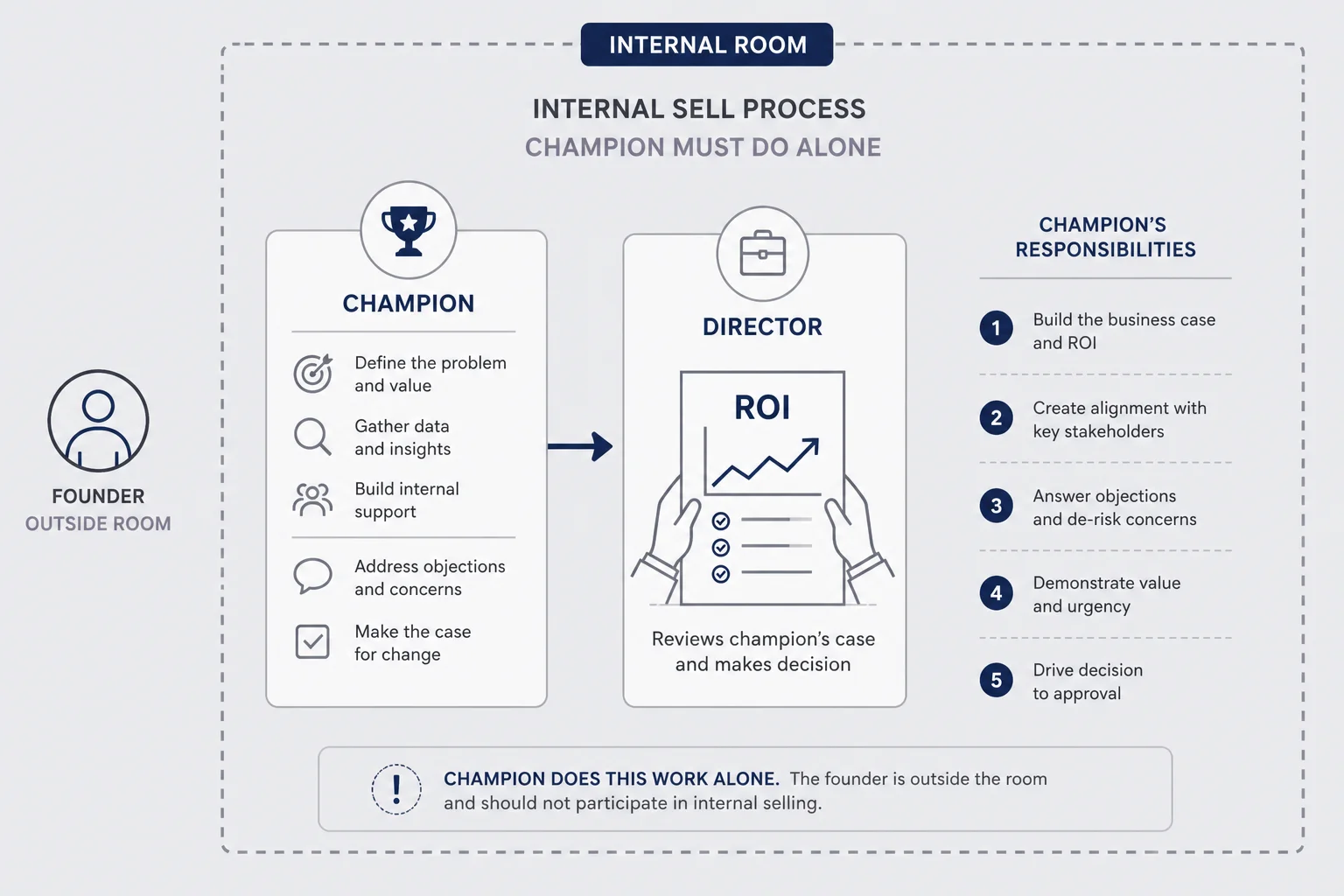
Here is the hard part. You are not in the room when the decision happens. Your champion is. You cannot jump through the screen and close for them.
What you can do is arm them. A one-page business case in their words, not yours. A pilot proposal with clear scope, price, and success metrics. A comparison that respects the incumbent instead of insulting it. A short Loom they can forward if live meetings are hard to schedule.
What you cannot do is want it more than they do. If your champion will not schedule the buyer meeting, no deck color fixes that. If they will not stake reputation on a recommendation, the product is not painful enough or they are not the right champion.
I call this the internal sell. Enterprise deals are two sales: you to the champion, champion to everyone else. Most solo founders ace the first and ignore the second.
Build internal collateral like you build onboarding. What does the buyer need on one screen? Typical list: problem statement in their industry language, expected outcome, implementation time, price, risk mitigation, why now. No jargon. No twelve-feature grid.
Offer to join the internal meeting. Not a second demo. A fifteen-minute Q&A for the buyer. Champions often welcome that because it reduces their burden. If they refuse and the deal is big enough to matter, notice.
The one-pager that actually gets forwarded
Header: their company name and the problem. Not your logo parade. Three bullets: current pain, proposed outcome, why your approach. One number: price or pilot range. One ask: fifteen-minute buyer call or approved pilot start date. Footer: your contact and a link to security FAQ if relevant.
Founders send twelve-page PDFs nobody reads. Champions forward short things.
When to walk away from a champion who will not sell
If you have provided collateral twice, offered buyer access twice, and heard "still working on it" with no new names for thirty days, downgrade or exit politely. "Sounds like timing might not be right. Happy to reconnect when budget opens." Preserves the relationship. Frees your calendar.
Walking away sometimes revives deals. Buyers smell desperation. Calm clarity reads as confidence.
Mutual action plans with real owners
A mutual action plan only works when the buyer side has names, not "champion to confirm." If every row owner is your champion, you have a task list, not a committee map. Push for buyer-owned rows: budget approval, legal review start, security submission.
Founders think MAPs are corporate theater. At solo scale, a one-page Google Doc with dates is enough. Theater is a fifty-field Salesforce plugin nobody updates. Simplicity wins.
Loom for the buying committee
When the committee cannot align on a live slot, a five-minute Loom tailored to the buyer's stated concern beats a generic recording. "You mentioned rollout risk on our last call. Here is how similar teams onboard in week one." Champion forwards. Buyer watches on their schedule. You still need the buyer identified. Loom does not replace the map.
Single-threaded deals and when to pause
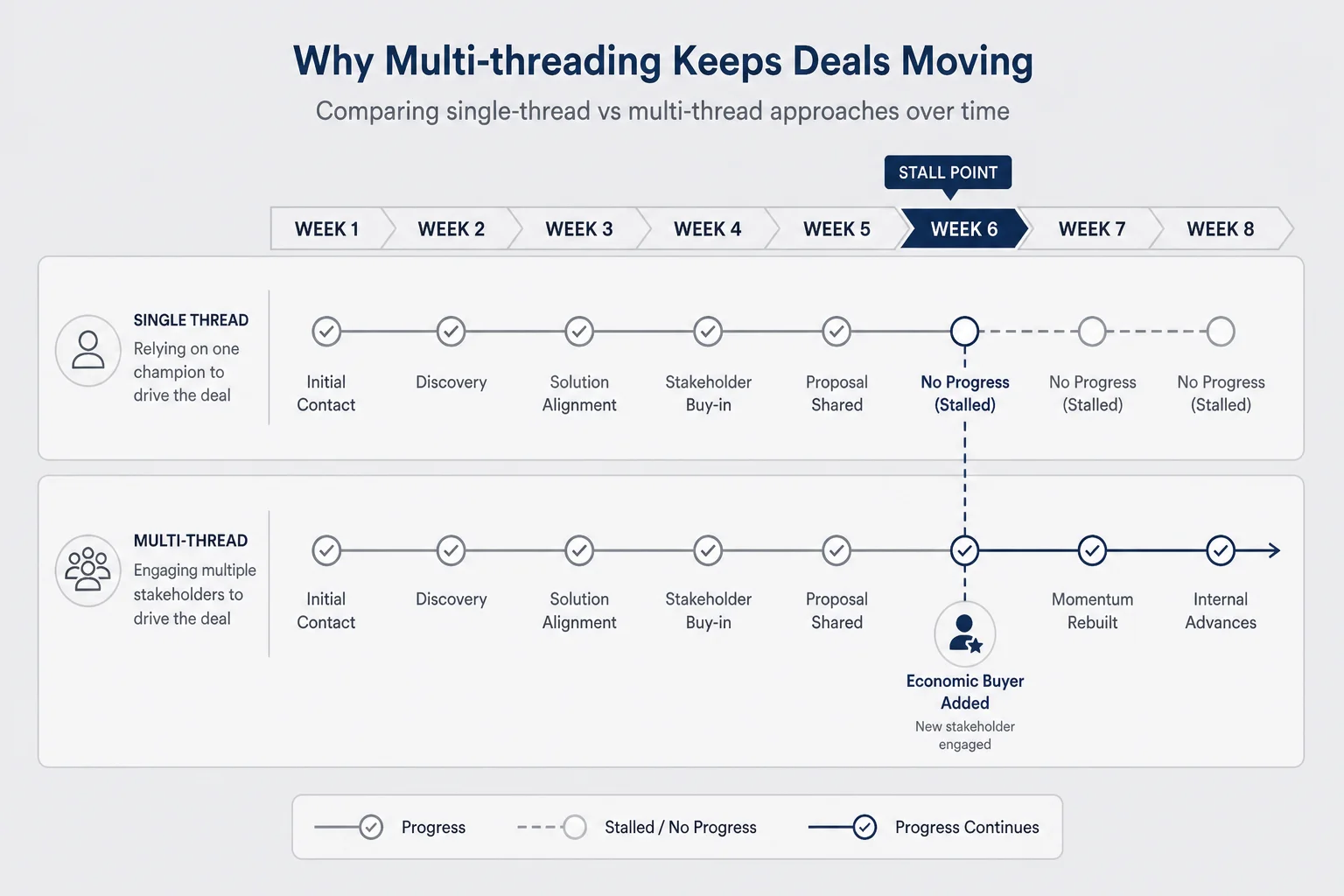
Single-threaded means one person is your entire relationship at the account. That is normal at the start. It is dangerous at week six.
Single-threading is fine when: the contact is clearly moving you toward the buyer, meetings are getting more senior, paperwork has started, or the deal size is small enough that one signer is realistic.
Pause or downgrade when: one person remains your only line for six weeks, promised intros never happen, every answer is "soon," legal or security appears but the buyer still has not, or you are doing free consulting for someone who cannot buy.
Pausing is not quitting. It is pipeline honesty. I mark deals "nurture" and spend the hours on accounts where the map is growing.
Multi-threading means more than one relationship at the account. Champion plus buyer. Champion plus procurement contact. Buyer plus IT for technical validation. You do not need ten friends. You need two real threads so one vacation does not zero your deal.
How to multi-thread without being creepy: ask naturally. "Who else should weigh in so we do not miss a requirement?" "Happy to do a short security call if that speeds review." "Should we loop in finance now or after scope is locked?"
If the champion blocks every attempt to expand the map, believe them. They might be protecting turf. They might know the answer is no. Either way, you are single-threaded on purpose now. Plan accordingly.
The six-week rule
Not scientific. Useful. If buyer access has not improved in six weeks of active conversation, assume the deal is not priority. You can keep the door open. Stop betting the quarter on it.
Parallel deals and capacity
Solo founders can run one serious mapped deal and one team deal. Maybe two if one is in legal wait. Single-threaded fantasy pipeline of five enterprise logos will eat your product roadmap. Capacity is part of strategy.
When pausing saves the relationship
A polite pause beats resentful chasing. "I am going to focus elsewhere until you have a buyer intro. Still here when timing aligns." Champions respect honesty. Fans disappear quietly. Both outcomes clarify reality.
HubSpot stages I actually use
Champion confirmed. Buyer named. Buyer met. Paper started. Closed won or nurture. Five stages. If a deal sits in "buyer named" for three weeks without a meeting, I move it to nurture or send one direct ask. CRM hygiene is boring. So is rebuilding a quarter around a ghost.
Team plans as champion training wheels
If you have never closed multi-seat annual, start there. Team deals teach champion dynamics with lower blocker risk. Your champion might be the buyer at $3k. You learn internal sell collateral on a deal that does not need SOC 2. Then you climb.
That is why the upmarket sequence matters. Champion-buyer mapping on a $4k team annual is the same skill as a $14k pilot with less calendar risk.
The calendar cost of mislabeled champions
Every week you treat a fan as a champion is a week you are not talking to someone who can sign. Solo founders have maybe ten serious sales hours a week if the product still needs them. Mislabeled pipeline is not harmless optimism. It is misallocated time with compound interest.
I ask founders to label every active deal: champion confirmed yes or no, buyer named yes or no, buyer met yes or no. Three checkboxes. Most "hot" rows fail checkbox two. That is useful pain.
When the buyer is hostile
Sometimes you meet the buyer and they are skeptical or prefer the incumbent. Good. That is a real conversation. You can address objections. Hostile buyers who engage beat friendly champions who hide them.
Ask what would need to be true to earn a pilot. If the answer is "nothing, we are locked in for two years," believe them and move on. You bought clarity cheap.
The finance partner hiding in the org chart
Champions talk to their manager. Managers talk to finance. Finance talks to procurement. You are not on those emails.
The finance partner is the human who asks whether this purchase fits the budget line and whether three bids are required. They rarely join demo one. They appear as a comment on an internal form: "need ROI" or "over threshold."
Your champion might not know the finance partner's name. Ask anyway. "When purchases like this go forward, does finance review before or after your director approves?" Past process predicts future process.
If the answer is "finance reviews everything over five thousand," your $8k pilot needs finance collateral even if your champion is enthusiastic. Give them a one-pager with a number, a budget line suggestion, and a sentence on why waiting costs more than buying.
Finance partners care about duplicate spend. "We already pay for Asana and Notion and a custom spreadsheet" is their nightmare. Your champion's internal sell should name what you replace or what you do not overlap with. Honest overlap beats surprise in week six.
I lost a deal when finance killed a $12k annual because the company had a parent-vendor bundle that included a mediocre tool in the same category. Champion never knew. Buyer knew. Finance knew. I found out on a polite rejection email with no call offered.
When finance requests a three-bid comparison, you are not always dead. Ask your champion what the other two slots usually look like. Sometimes one is incumbent and one is a strawman. Your job is to make your champion's recommendation the path of least internal pain.
Offer finance-friendly artifacts. Annual price, monthly equivalent, implementation hours, cancellation terms, no auto-renew surprise. Founders hide pricing until late. Finance hates late pricing. Early ranges help champions more than you think.
When your champion becomes the bottleneck
Sometimes the blocker is not IT or legal. It is your champion who will not schedule the buyer meeting because they are embarrassed the product is not ready, or they fear their boss will ask questions they cannot answer, or they enjoy being the person who "discovered" you and do not want to share credit.
Signs: every delay is "I am still prepping leadership." Every ask for intro is "they are swamped." Product feedback keeps flowing. Process does not.
Coaching helps once. Offer to join a short call. Offer to write the internal blurb. Offer a pilot scoped so small the risk feels safe. If the pattern continues, name it calmly. "Feels like we might be stuck on your side without air cover. Should we pause until you can loop in Sarah?"
Champions who are bottlenecks are not villains. They are humans with career risk. Your job is to reduce their risk with crisp collateral and short buyer meetings. If they still block, believe the block.
Do not confuse bottleneck with blocker. A blocker says no for policy reasons. A bottleneck says maybe forever because moving forward costs them something personal.
When you identify a bottleneck, adjust forecast to zero until the map changes. Keep the relationship warm with product updates if useful. Stop spending Tuesday afternoons on security forms for a deal with no buyer path.
Multi-threading can bypass a champion bottleneck if another contact exists. Ask who else felt the pain originally. Ask whether IT already sent a form without the champion knowing. Careful, not creepy. One additional thread from finance or IT can restart motion when your champion stalled.
The hardest version is champion-as-bottleneck at a deal size where they should be the buyer. A team lead with a corporate card who keeps requesting features instead of clicking upgrade. That is not enterprise mapping. That is a power user on a solo plan. Sell them team billing or accept they are not a five-figure opportunity yet.
Questions founders ask about champions and buyers
What is the difference between a champion and an economic buyer?
A champion loves your product and will advocate internally. An economic buyer controls budget or can get a signature from someone who does. Champions recommend. Buyers commit money. You need both for a real deal. A champion without a buyer is a fan with good intentions. A buyer without a champion is a cold spreadsheet comparison.
How do I find the economic buyer on a small B2B deal?
Ask your champion directly: who approves spend at this level, who signs the order form, and what budget line this would come from. Request a fifteen-minute intro before demo two. If they cannot name a person and a path, you are early. On team deals under $5k, the champion sometimes is the buyer. Know which case you are in.
What questions surface who actually signs?
Who owns the budget for tools like this? What is the approval threshold before legal or procurement gets involved? Who signed your last vendor contract in this category? What happens after you say yes internally? Those four questions tell you more than forty minutes of product demo.
When is a champion actually just a polite fan?
When they love the product but will not introduce you upstream, cannot answer budget questions, or keep saying leadership is excited without a meeting attached. Fans reply fast and forward nothing. Champions risk a little internal capital to get you in front of someone who can say yes with money.
Should I keep working a deal with only one contact?
Single-threaded deals are fine early if that contact is moving you toward the buyer. Pause when one person is your only line for six weeks, nobody new joins a call, and every next step is vague. Polite persistence has a shelf life. Your calendar is the scarcest resource.
Can I close a team deal without meeting the economic buyer?
Sometimes yes on smaller team plans where your champion has a corporate card or delegated authority under a few thousand dollars. Above that, assume you need buyer visibility or explicit written delegation. If the deal size justifies procurement, you need the buyer path before you celebrate.
Map the room before you map the roadmap
She loved the product. That mattered. It was not enough.
Champions open doors. Buyers walk through them. Blockers check the hinges. Solo founders who learn that sequence stop confusing great demos with great deals.
Before your next call, write three names: champion, buyer, blocker. If buyer is still blank after demo two, your next email is not a feature update. It is a request for a fifteen-minute intro.
Read when to sell enterprise if you are still deciding whether these conversations belong in your motion. Read enterprise sales demo if the right people still are not showing up when you share screen.
The internal sell is their job with your tools. You cannot want it more than they do. You can make wanting it easier.
A signed pilot with one real stakeholder beats a hundred "looks promising" pipeline entries. Make sure the stakeholder you have can actually get you to one who signs.
If the form arrives before you have met the buyer, pause on the paperwork and fix the map first. Filling two hundred questions for a champion who cannot escalate is how solo founders burn weekends on deals that were never real.
The best time to build your answer library is after your first team annual closes. The second best time is when the Excel attachment lands tonight. Open it. Save a copy. Start page one. Page four is waiting. You can finish it.




Comments