Page Four of the Vendor Form Is Where Solo Founders Quit.
Security questionnaire survival for solo micro-SaaS founders: what procurement actually asks, honest answers that buy time, filling forms without a compliance team, SOC 2 without a letter, and when to hire help.
 By Derek26 min read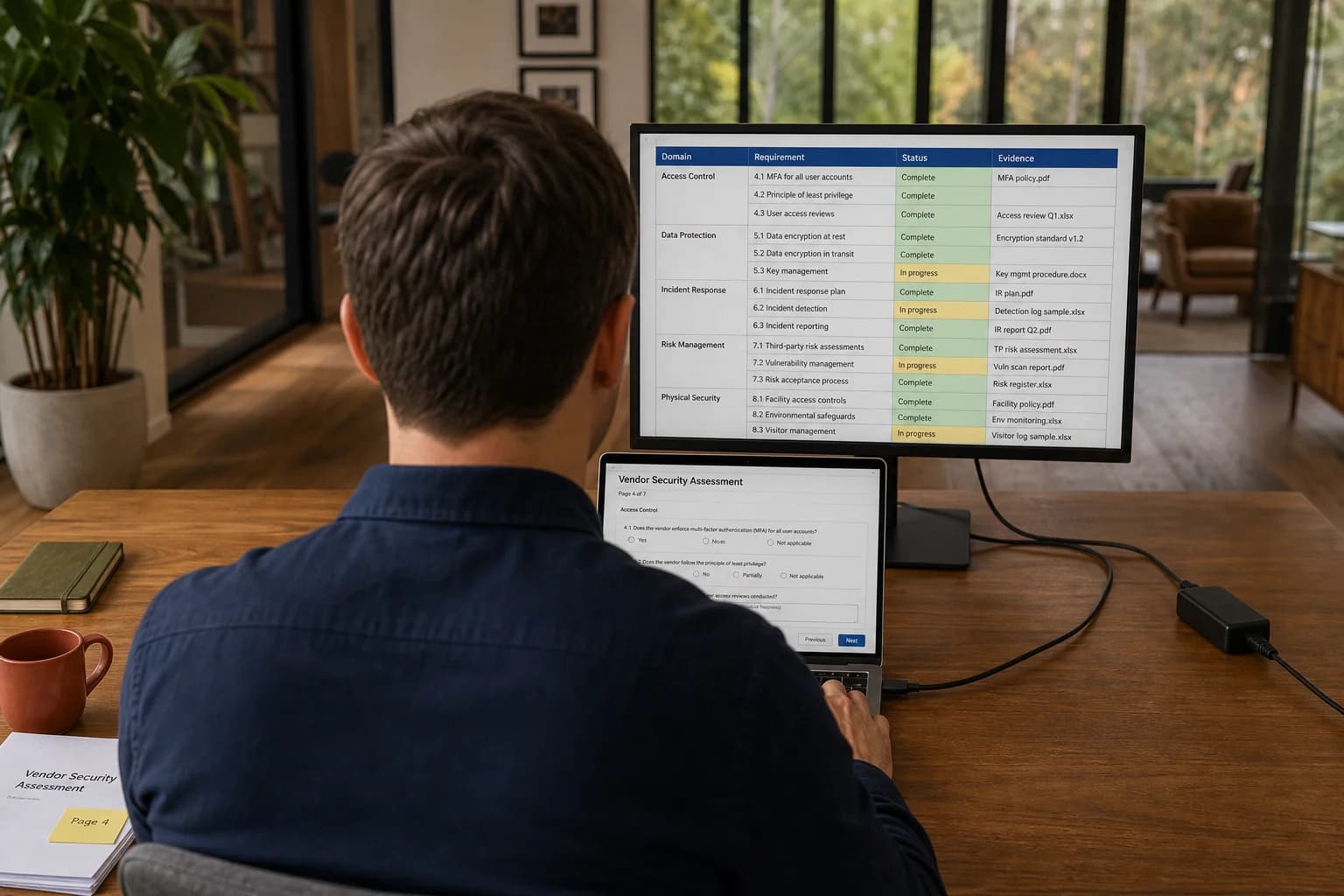
Listen to this article
AI-generated podcast-style overview of this article (not a word-for-word narration).
The email subject line was polite. "Vendor Security Assessment — action required."
Attachment: Excel file. Four tabs. Two hundred and fourteen questions. Due date: ten business days.
The founder forwarded it to me at 11 p.m. with one sentence: "I opened it. I closed it. I think we are not enterprise."
Page four is where solo founders quit. Not because they are careless. Because the form stops asking what they know and starts asking what they never wrote down.
I am Derek. I have sat through enough procurement limbo to know the pattern. Pages one through three are company name, hosting provider, encryption at rest. You can answer those from your architecture notes. Page four asks about incident response timelines, employee security training, and whether you have a formal change management policy. Solo founders with twelve customers and a Supabase project freeze. They assume the deal is dead. Often it is not. Often procurement needs a completed form, not perfection.
This post is for founders who already have a buyer path or a serious team deal and just received the vendor portal link. If you are not sure you should be upmarket yet, start with when to sell enterprise. If your champion loves you but nobody signs, read champion vs economic buyer. If demos go well but procurement ghosts you, enterprise sales demo covers the room before the form arrives.
Your legal and privacy foundation should not be fiction. Max can help you implement controls. For the words on your site and in your policies, see terms of service and privacy templates. Security questionnaires test whether your story matches your stack.
A confusing pricing page kills deals. Missing SSO blocks procurement. A security questionnaire you cannot answer in plain English is a product problem dressed up as paperwork. My job here is to help you finish the form without inventing a compliance department.
I keep answers in Notion. Subprocessors list. Data flow paragraph. Encryption blurb. Incident response one-pager. First form took me twelve hours with a founder who thought he needed to shut down the enterprise tier. Fourth form took three hours because eighty percent was copy-paste-verify.
Procurement does not care that your product is "AI-powered." They care who holds the data and whether you have a SOC 2 letter. Answer the second part honestly.
The first time I filled a vendor form with a founder, we did it on a Zoom call share-screen style. He read question forty-two out loud. "Do you maintain a formal vulnerability management program?" Long silence. I said, "Do you update dependencies and monitor CVEs?" He said yes. I said, "That is your answer, in grown-up words." We wrote three sentences. Procurement accepted it. The program was not fancy. It was true.
Forms are intimidating because the language is intimidating. Translation is a skill. You are not becoming a CISO overnight. You are describing what you already do in the dialect procurement expects.
Page four is where solo founders quit
The form always starts friendly. Legal entity name. Primary contact. Number of employees. Cloud provider. You type AWS or Supabase or Vercel. Confidence returns.
Then page four. Incident response plan. Business continuity. Penetration test cadence. Security awareness training for all personnel. Background checks for employees with data access.
Founders stare at the screen and hear a voice: "We are not a real company."
You are a real company. You are a small one. The form was written for vendors with a GRC team and a folder called "Audit Evidence 2024." That is not an insult. It is a mismatch you solve with honesty and documentation, not with quitting.
Page four is where the questionnaire stops being a survey and becomes an audit wishlist. Founders quit because they treat every blank as a failure instead of a question. Procurement often accepts "in progress" or "planned Q4" with a short explanation if the rest is credible. They reject vendors who claim yes everywhere and crumble on the IT follow-up call.
I have seen founders abandon a $9k annual deal because question 87 asked for a PDF policy they could have drafted in an afternoon. I have seen others lie yes on SOC 2 and get blacklisted when IT asked for the report number. Quitting early wastes less reputation than lying. Finishing honestly beats both.
The emotional arc matters. Day one: optimism. Day three: dread. Day seven: shame spiral. Day nine: frantic Google search for "incident response template SaaS startup." You are not alone. The form is designed for scale. You are designed for shipping. Meet in the middle with a reuse library and realistic timelines.
I have a folder in my advising practice literally labeled "page four saves." Incident response template. Business continuity blurb. Security awareness paragraph for solo teams. Founders copy, customize, submit. Same emotional arc every time. The ones who finish learn that page four was never about being Salesforce. It was about writing down what they already did badly in a Google Doc instead of not at all.
What page four usually contains
Incident response: how you detect, contain, and notify if something goes wrong. Business continuity: what happens if your hosting region has an outage. Policy questions: change management, access reviews, password standards. Training: whether everyone with production access knows phishing basics.
None of this requires fifty employees. It requires you to think for an hour and write it down.
Founders ask whether templates from the internet are safe to use. Safe for structure, not for copy-paste truth. Download a SOC 2 incident response outline. Rewrite every line for your stack. Generic policy language that does not match your hosting setup is almost as bad as a blank field. IT has read a thousand fake policies. Specificity signals you actually thought about it.
The quit is often premature
Before you close the laptop, ask your champion: is this form required for a pilot or for full production rollout? Pilots often have lighter paths. Production does not. Know which stage you are in. A founder who quits at page four on a pilot form might have only needed honest partial answers plus a call with IT.
The ten-day clock is real
Due dates are not suggestions on enterprise forms. Missing the date signals immaturity. If you need an extension, ask on day two, not day nine. "Received your assessment. We are compiling answers from our infrastructure review. Requesting three additional business days to ensure accuracy." Professional. Common. Better than silence.
Founders who confuse the form with the deal
The form is a gate, not the destination. You can pass the gate and still lose in legal. You can stumble on page four and still win if you recover with IT on a call. Do not tie your self-worth to Excel tabs. Tie your process to a reuse library and honest answers.
What procurement is actually asking
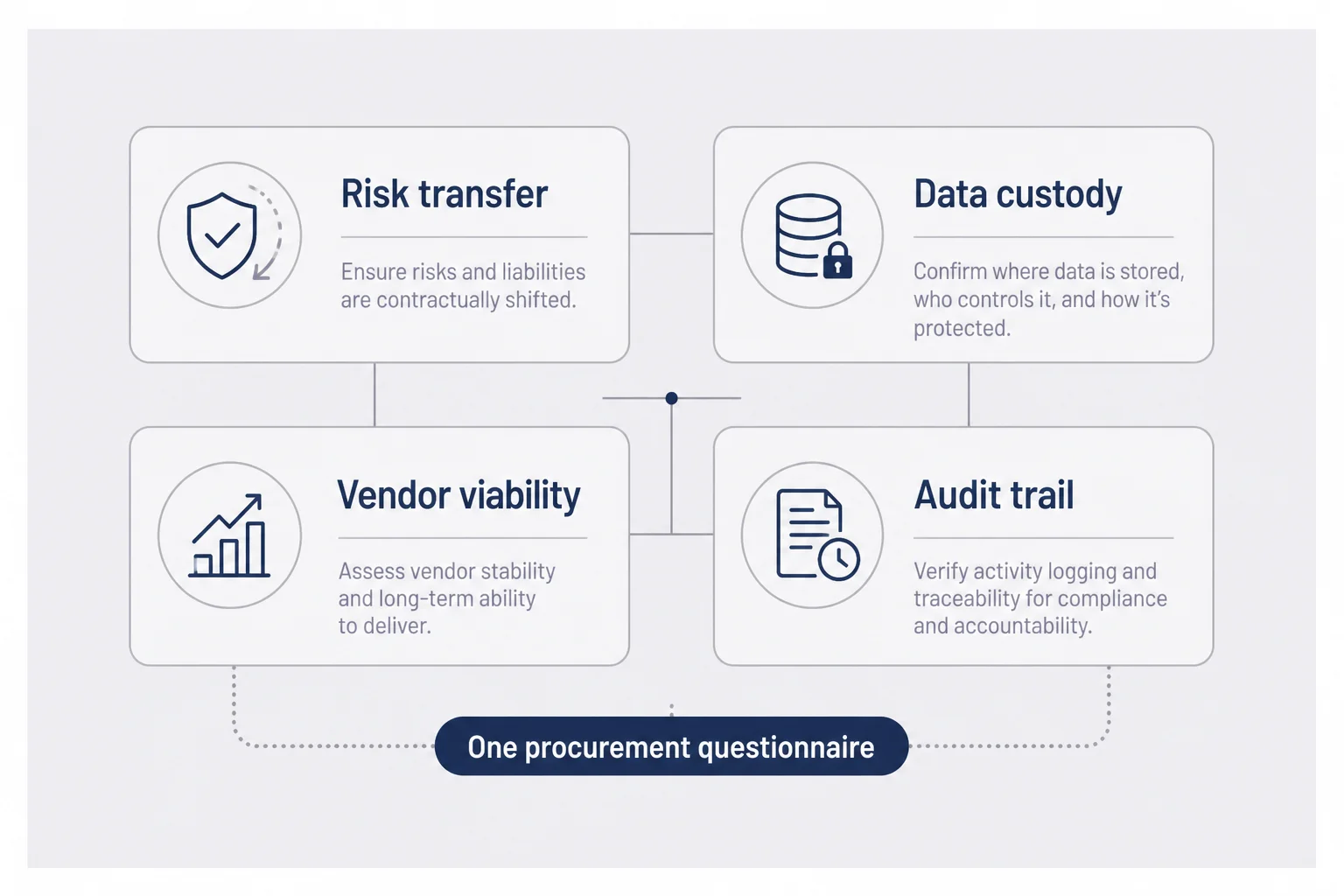
Procurement is not trying to humiliate you. They are trying to not get fired if your app leaks customer data or vanishes next month.
Every section maps to risk they pass upstairs. Data handling: where does customer data live, who can see it, how long do you keep it. Access control: who on your team touches production, how do you revoke access when someone leaves. Vendor viability: will you exist in twelve months, do you have backups, what is your support path. Compliance posture: SOC 2, ISO, GDPR, whatever their template was cloned from five years ago. Incident readiness: if something breaks, how fast do they hear about it.
They are not asking whether your UI is pretty. They are asking whether adding you to the stack creates a story they can defend in a meeting nobody invited you to.
Small deals get big forms because enterprises buy one vendor platform and send everyone the same Excel file. A $6k pilot and a $600k platform deal might share question 142 about penetration testing. Annoying? Yes. Personal? No.
Your champion often cannot explain why each question exists. IT or vendor management owns the template. Treat the form as a translation exercise: their risk language to your actual practices.
When I debrief founders after their first submission, the surprise is never "they asked hard questions." The surprise is "half the questions did not apply and we could say N/A with a sentence." Questionnaires are bloated by design. Your job is triage, not literary perfection on row 203 about physical data center access when you are serverless.
Reading the form like procurement does
They scan for red flags first. False certifications. Contradictions. Blank critical fields. Then they spot-check detail on data handling and access. Write for the scan. Lead with clear yes/no where honest. Put nuance in the comment cell, not the checkbox.
When you answer, think about the reader. A bored analyst checking boxes. They want consistency, not marketing. Short sentences. Same subprocessor list every time. Same data residency paragraph. If question 34 and question 178 both ask about encryption, the answers should match.
Subprocessors and data flow
They will ask for a list: hosting, email, analytics, error tracking, payment processor, AI API if you use one. Maintain one canonical list. Update when you add PostHog or swap Stripe for Paddle. Inconsistency triggers follow-up calls.
Know your data flow in one paragraph. User signs up. Data stored in Postgres on X. Files in S3 region Y. Backups daily. Deletes on request within Z days. If you do not know Z, decide before you answer.
I keep a subprocessors table with columns: vendor, purpose, data touched, region, link to their security page. Update quarterly or when you add a tool. Questionnaires love tables. Give them one.
Insurance and cyber liability
Page six often asks about insurance limits. Solo founders sometimes have none. Answer truthfully. Ask if pilot can proceed with current coverage or if named cyber policy is production-only. Sometimes the answer unlocks a smaller initial contract that funds the rider later.
The IT call after the form
Budget thirty minutes with IT if they request it. They will ask about things not on the form: session timeout, password policy, API keys, admin access. Have your engineering notes handy or loop in Max for fifteen minutes prep. Unprepared IT calls undo good forms.
The viability question
"Describe your business continuity plan" sounds enterprise. For a solo founder it might mean: codebase in GitHub, infrastructure as code, backups tested quarterly, documented runbook if primary founder is unavailable. Be specific without pretending you have a NOC team.
Answers that kill deals vs answers that buy time
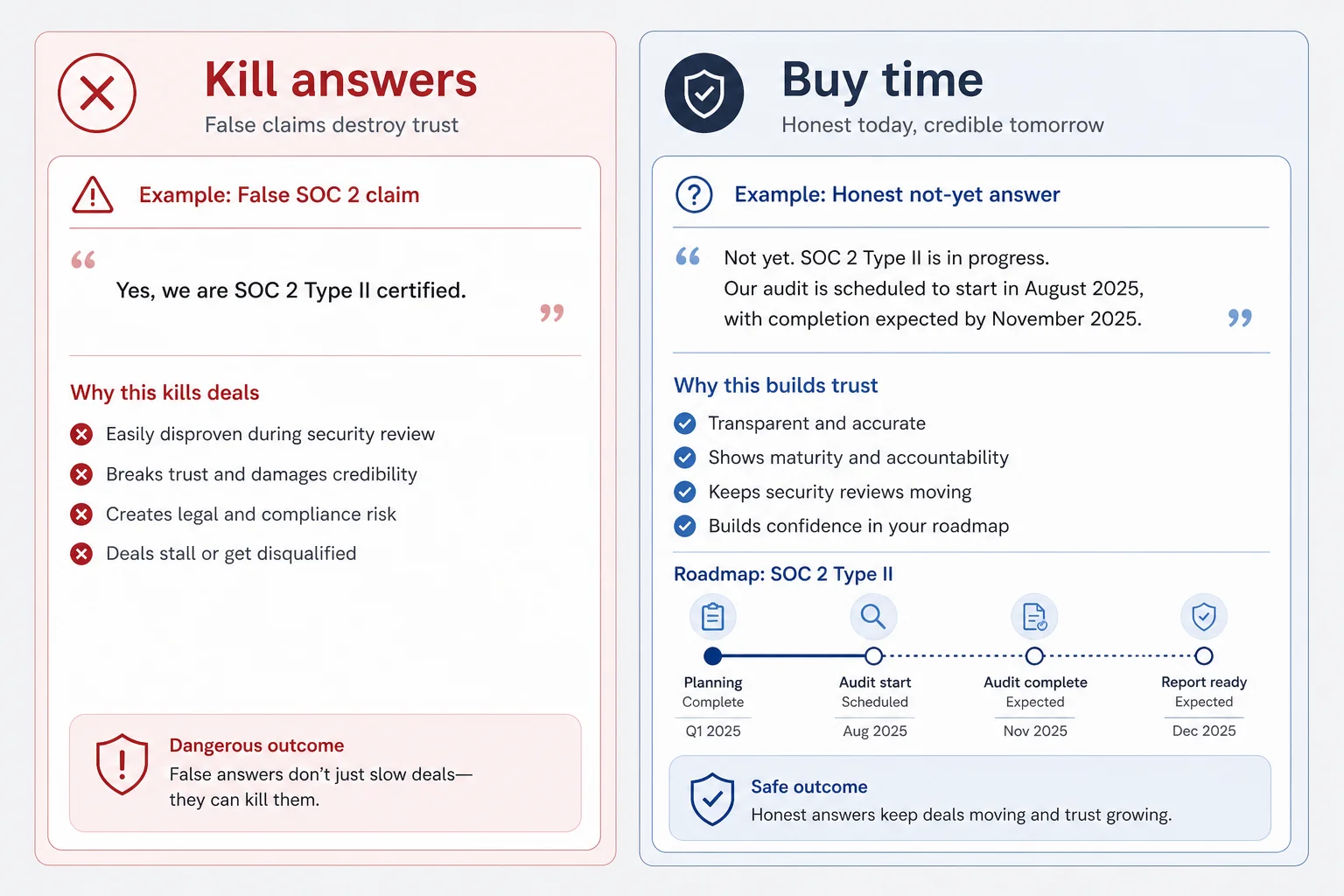
Answers that kill deals: claiming SOC 2 Type II when you are not audited. Saying all data is encrypted without specifying at rest and in transit. Listing subprocessors you forgot about. Denying you use customer data for model training when your privacy policy says otherwise. "N/A" on forty questions without explanation. Copy-pasting another company's answers from a blog post.
Answers that buy time: "We do not have a formal SOC 2 report today. We maintain a security FAQ, completed vendor assessments for similar customers, and can share our DPA. SOC 2 Type I is on our roadmap for [realistic quarter] if production rollout requires it." "Incident response policy is documented internally. We can share summary on request." "Penetration test: not conducted in last twelve months. We rely on managed hosting security, dependency scanning, and planned third-party test in [quarter]."
Adults respect direct. Bluffers get found out on the IT call when someone asks for your SOC 2 bridge letter and you pause.
"We do not do that yet" is an answer. Add what you do instead. "We do not have SSO today. We support Google OAuth and magic links. SAML is on the roadmap for Q1 with estimated delivery after two team annual customers request it." Procurement might accept that for a pilot. IT might not for full rollout. Know the difference.
Buying time is not stalling forever. It is pairing honesty with a next step. Offer a fifteen-minute call with IT. Offer your DPA. Offer a trimmed data processing summary. Momentum beats a perfect PDF that ships in three weeks after the buyer moved on.
Founders sometimes ask if partial completion is allowed. Often yes for pilots if you flag gaps and schedule the IT call. Rarely yes for production without remediation plan. Ask your champion how their org treats incomplete assessments. Better to know before you submit half empty than after procurement rejects the whole packet.
The follow-up call is the real test
Forms filter. Calls verify. If you lied on the form, the call is where it ends. Prepare by reading your own answers the morning before. Sound like the same person who wrote them.
Red flags procurement watches for
Mismatch between your website privacy policy and your answers. Subprocessor list missing your obvious vendors. Claiming 24/7 security operations when your about page shows one founder. Inconsistency is worse than weakness.
Examples that survived review
"We use Supabase for Postgres hosting in us-east-1. Encryption at rest is provided by the platform. TLS for data in transit. Customer data is not used to train third-party models." Clear. Verifiable.
"We do not conduct annual penetration tests. We use dependency scanning in CI, managed hosting security controls, and plan third-party penetration test before first production enterprise deployment above $25k ACV." Honest scope.
"We have a one-page incident response procedure: detect via monitoring alerts, contain via access revocation and rollback, notify affected customers within 72 hours per our DPA." Specific beats vague policy names.
Examples that failed
"Enterprise-grade security across the stack." Meaningless.
"Yes" to every checkbox. IT call exposes gaps in minutes.
Copy-paste from a competitor's public trust center. Humiliating when caught.
When procurement sends follow-up questions, respond within twenty-four hours if possible. Speed signals operational maturity. Slow responses after a fast demo confuse buyers. They wonder if you are too small to trust. You are small. You can still be responsive.
Filling the form without a compliance team
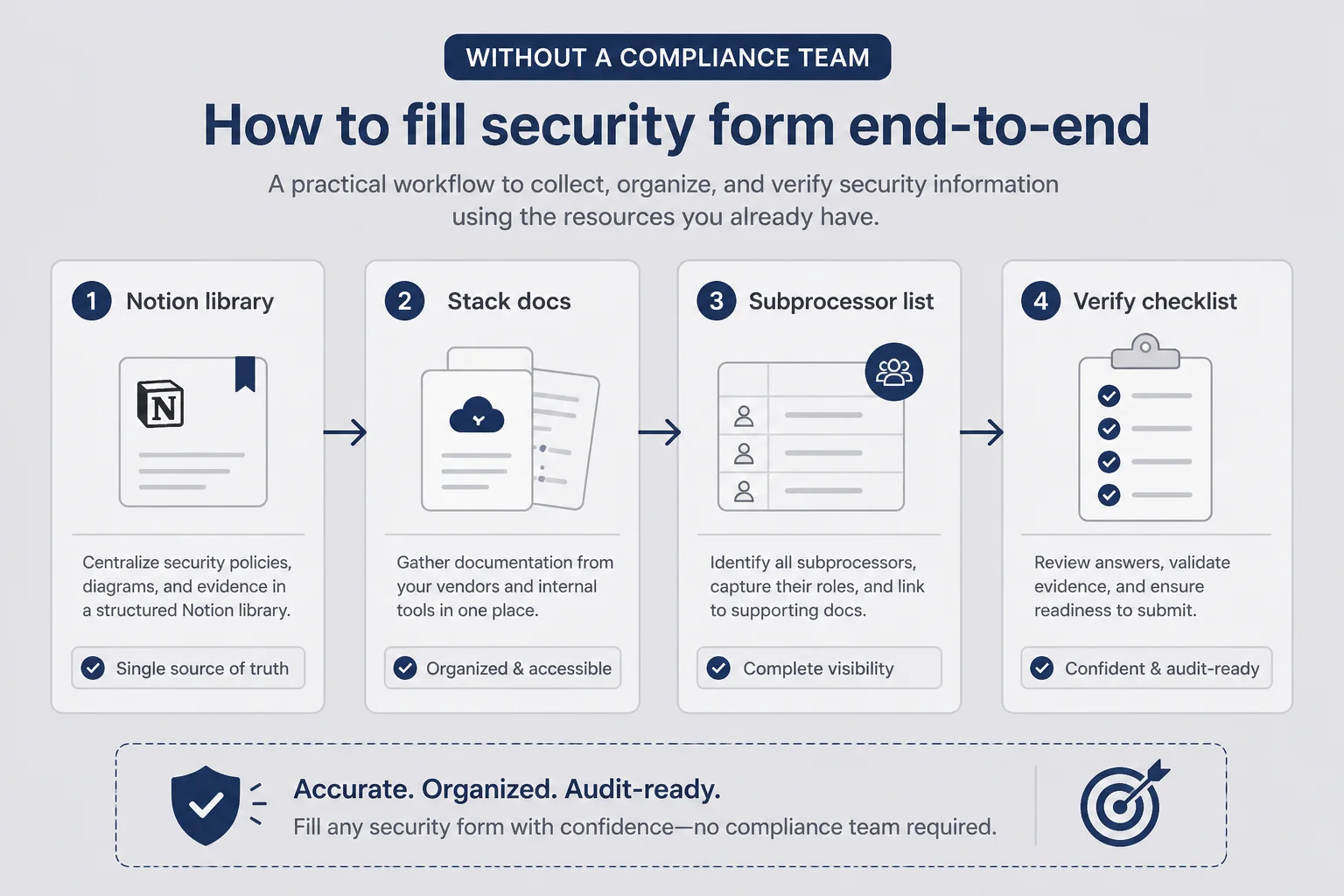
You do not need a compliance team. You need a system one person can run.
Step zero: create a folder. Notion, Google Docs, whatever you already use. Sections: company facts, infrastructure, data handling, access control, subprocessors, incident response, policies, known gaps.
First pass: answer everything you know without researching. Thirty to forty percent will be done.
Second pass: open your hosting dashboard, Stripe settings, auth config, error tracker. Document reality.
Third pass: draft the policies you lack in plain English. One page each. Incident response. Access control. Change management can be "changes via GitHub PR review, production deploys through CI."
Fourth pass: mark gaps honestly. Planned. Not applicable with reason. In progress.
Fifth pass: have someone technical sanity-check if you are not technical. Have someone read for contradictions.
Use AI for drafting paragraphs from bullet notes. Never submit without verifying against production. Claude does not know you still have a debug endpoint open.
Reuse is everything. Your second questionnaire should be faster. Your fifth should feel boring. Boring is good.
I advise founders to timebox the first pass. Two hours, no perfection. Get answers on paper. Sleep. Second session is polish and contradiction hunt. Splitting the work beats one heroic night that produces sloppy yes answers you regret.
Template your opening email to procurement when you submit. "Attached completed assessment. Available for clarification call with your IT team. Typical response within one business day." Sets expectation. Shows maturity. Costs five minutes.
Block four hours for the first serious form. Tell your champion you received it and will return by the due date. Do not disappear for nine days and submit hour fifty-nine. Procurement tracks responsiveness as vendor maturity.
Building your first incident response one-pager
Page four quits happen because founders think IR means a SOC team and pagers. For solo scale, one page is enough. Sections: how you learn something broke (monitoring, customer report, error tracker). Who responds (you, contractor, on-call rotation if you have one). Containment steps (revoke keys, rollback deploy, disable feature flag). Customer notification (within X hours per DPA). Post-incident (short writeup, fix ticket). Save as PDF. Attach when the form asks. You just passed page four.
Access control without HR theater
They ask about background checks and security training. Solo founder reality: you are the only employee with production access. Answer accurately. "All personnel with production access" might be one person. MFA enabled. Keys rotated on contractor offboarding. Annual self-review of access list. Truth beats inventing an HR department.
Questionnaire types you will see
Excel attachments. Vendor portals with save-and-resume. SIG Lite or CAIQ variants if you move upmarket. Same content, different packaging. Your answer library travels with you.
When to push back
If the form asks for on-prem deployment and you are cloud-only, say so. If they require insurance limits you do not carry, quote the cost to add a rider or ask if pilot can proceed without it. Pushback is professional when paired with alternatives.
Aligning with your public legal docs
If your terms and privacy pages say one retention period and your form says another, fix the mismatch before submit. Procurement compares. App founders learn this on App Privacy labels. B2B founders learn it on question ninety-one.
Saving partial progress
Portals time out. Excel corrupts. Save every twenty answers. Export PDF of submitted version for your records. Next questionnaire, you are not reconstructing from memory.
Champion visibility during the form
Send your champion a one-line update when you submit. "Vendor assessment returned today. IT review typically takes one to two weeks on your side?" Keeps them warm. Surfaces if internal owner is missing. Forms feel like black holes. Light communication prevents champion panic.
SOC 2 when you do not have a letter yet
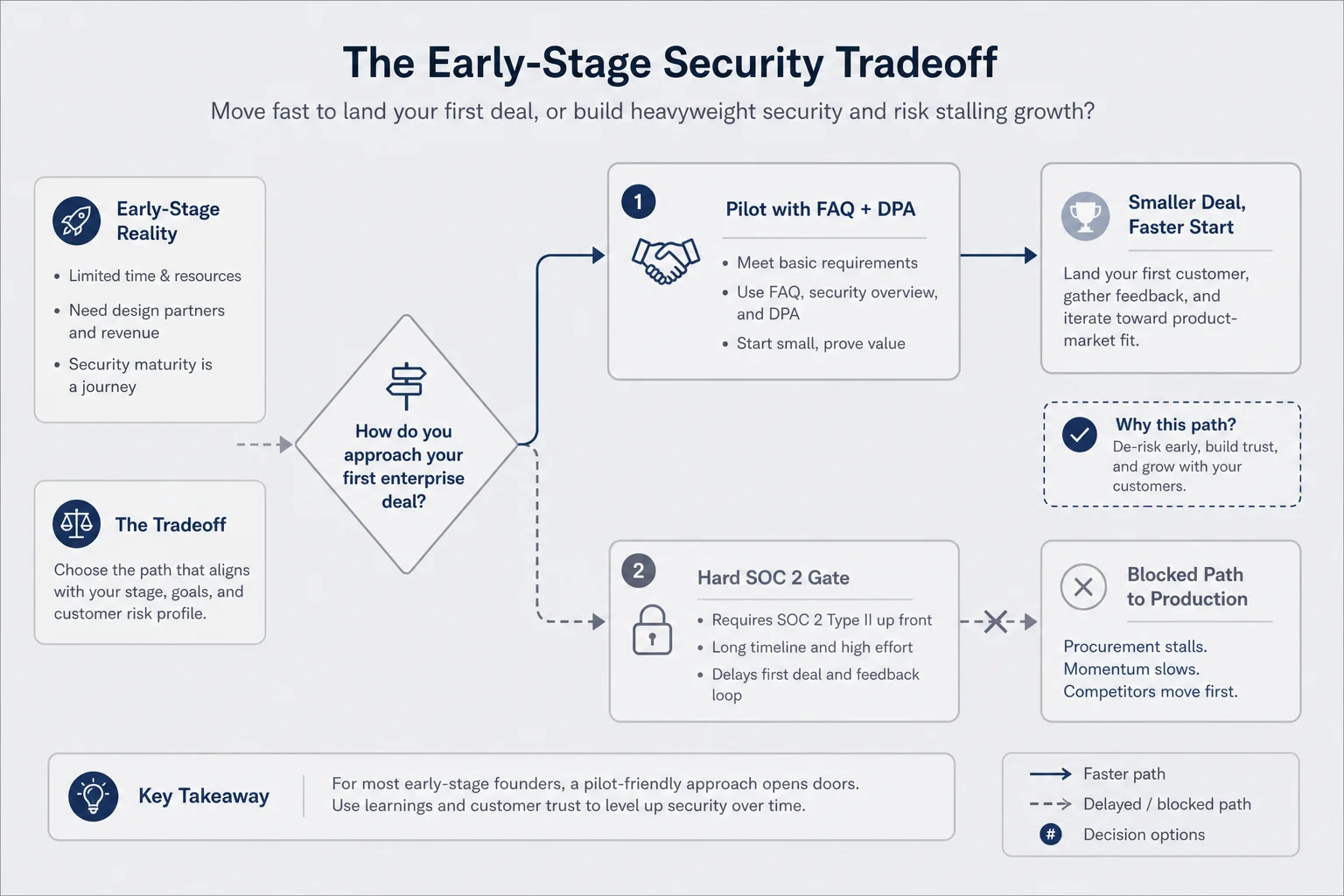
SOC 2 is the boogeyman. The questionnaire will ask. Checkbox. Upload report. Founders panic.
Many first deals do not need SOC 2 for a pilot. They need credible answers and a path if the relationship grows. Type I says you designed controls. Type II says you ran them over time. Both cost money and calendar months.
If you do not have a letter, say so in the first sentence of that section. Attach what you do have: security FAQ, architecture overview, list of controls you implement (encryption, backups, access logging, MFA on admin accounts). Offer a pilot under their standard vendor review.
Ask procurement: "Is SOC 2 required for pilot or for production?" Pilots often have exceptions. Production often does not. Sell the pilot. Earn the right to discuss SOC 2 with revenue attached.
If multiple deals stall on the same SOC 2 checkbox, the market is telling you something. Budget Vanta or Drata or a consultant when team revenue supports it. Do not start nine months of audit for one logo that might ghost in month two.
Treat SOC 2 questions like any other control gap. Name current state. Name target state. Name trigger for investment. "We begin SOC 2 readiness when annual contract value from upmarket accounts exceeds $40k" is a business rule, not a dodge. Buyers respect founders who know their numbers.
I am not a lawyer or auditor. Founders should talk to professionals when contract value justifies it. I am saying do not fake the letter and do not abandon ship at the checkbox if a pilot path exists.
Say you are closing a $11k pilot. Procurement checks SOC 2. You answer honestly. Buyer says we can pilot if you commit to Type I in nine months. You have $14k MRR and two team annuals. That might be worth funding Vanta and a consultant. Same checkbox on a $5k deal with one champion and no buyer met? Different math. SOC 2 follows pull and revenue, not anxiety.
Controls you can describe today without SOC 2
MFA on production access. Encrypted data at rest via your cloud provider. HTTPS everywhere. Role-based access in your app. Regular dependency updates. Backups with tested restore. Logging on admin actions. These are real. Name them specifically.
Roadmap language that works
"We plan to pursue SOC 2 Type I in [quarter] contingent on closing our first two production enterprise accounts above $X." Specific beats vague. Contingent beats promise. Do not commit to audit dates you cannot fund.
Vanta Drata and the middle path
Compliance automation tools help when you have revenue to fund them and repeated questionnaire pull. They do not replace knowing your stack. They organize evidence. Sequence: team annuals, questionnaire library, then SOC 2 readiness when the third deal stalls on the same control. Not SOC 2 because you are anxious.
When the buyer offers a bridge
Sometimes a buyer will sign a pilot contingent on SOC 2 timeline. Get it in writing. Six months to Type I with deposit or paid pilot is real. Handshake maybe is not. I am not a lawyer. Get terms reviewed when money is material.
GDPR HIPAA and the questions that feel personal
Even US-focused B2B SaaS hits international data questions. "Do you process EU personal data?" "Can data be stored in EU region?" "Are you a business associate under HIPAA?"
Answer from facts, not fear. If your customers are US agencies with no EU users, say so. If one EU customer exists, your story changes. Know before the form asks.
GDPR language on forms is often template noise. They ask for a DPA, subprocessors, breach notification timelines, data subject request process. You might not need a fifty-page GDPR program for a $7k pilot. You need accurate answers and a DPA that matches your privacy story.
HIPAA is a different beast. If the form asks about PHI, pause and ask your champion whether this deployment actually touches health data. Sometimes champions click HIPAA because the company is in healthcare, even when your tool only handles project management metadata. Clarify scope before you claim compliance you do not need or cannot support.
"We are not HIPAA compliant today" is valid if true. "We do not store PHI; we store workflow metadata only" is better if true. Misclassifying your product to win a deal invites audit pain later.
Data residency questions spike when IT reads the form. "Can you host in eu-west-1 only?" If your stack is US-only today, say US-only. Offer timeline only if you can fund EU infra. Fake region flexibility dies on the IT call.
Founders panic about GDPR and hire lawyers for hour one. Sometimes hour one is a thirty-minute read of what your app actually stores. Max can map the stack. You translate to form language. Lawyer when contract value justifies, not when question twelve scares you.
Children's data, biometric data, payment card storage: forms ask about all of it. Stripe handles cards? Say Stripe handles cards. You do not store PAN. Be precise. PCI scope questions follow. "SAQ A via Stripe" might be your real answer. Look it up once, reuse forever.
What happens after you hit submit
Submit feels like finish line. It is more like passing the first toll booth.
Day one to three: automated acknowledgment. Maybe a ticket number. Champion says "thanks, IT will review."
Week one: follow-up questions on five rows where your answer was vague. Respond same day. Short clarifications. Attach the one-pager you should have attached the first time.
Week two: IT call invite. Thirty minutes. They test whether the human matches the spreadsheet. Morning of the call, reread your answers out loud.
Week three to six: either approval, remediation list, or silence. Remediation list is good. It names gaps with deadlines. "Enable MFA on all admin accounts by next review" is a ticket you can close. Silence without ticket number is weaker signal.
Some portals show status: submitted, under review, approved, approved with conditions. Ask your champion what each status means internally. Approved with conditions might be enough to start a pilot while you close MFA gap.
Founders celebrate IT approval and forget legal still has the MSA. Security approval is not signature. Keep champion warm through legal week. "IT cleared us. What does legal need for the order form?"
If procurement rejects the packet, ask for specific rows, not vibes. Fix rows, resubmit, note version two in email. Rejection with detail is progress. Ghosting after submit is different.
Build a post-submit checklist in your library: confirmation email sent, champion notified, IT call scheduled, remediation tickets filed, legal contact requested, mutual action plan updated with review dates.
The second questionnaire from the same customer is easier unless they send a new template with different wording. Copy answers, scan for new questions, submit faster. Enterprise accounts sometimes questionnaire you annually. Your library is recurring revenue protection.
When approval finally lands, save the approval email PDF. Next year's renewal, someone will ask "did we ever approve this vendor?" Your champion might not remember. You having the file makes renewal friction lower. Small kindness that speeds re-ups.
When to hire help vs write it yourself
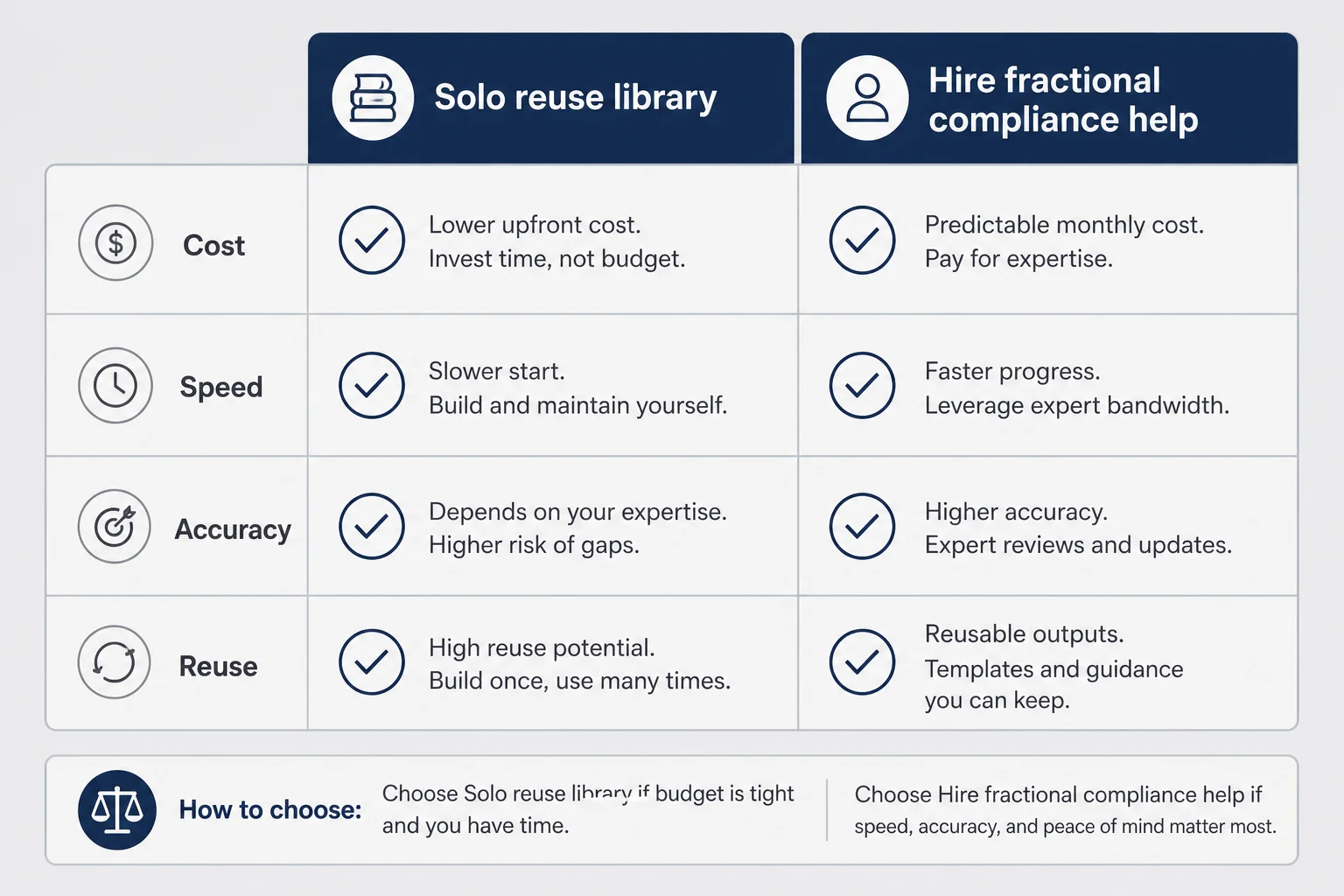
Write it yourself when: deal is under $15k, first or second questionnaire, questions are mostly factual, you have time to build a reuse library, IT is willing to jump on a clarifying call.
Hire help when: deal is large enough to fund $3k to $10k in compliance consulting, legal indemnity language in the form scares you, the same gap blocks three qualified opportunities, you need SOC 2 on a real timeline, or the buyer's legal team sends a fifty-page MSA attached to the security packet.
Fractional compliance consultants exist for bootstrapped SaaS. Lawyers for an hour on indemnity clauses. Not Big Four on day one. Match spend to deal size.
A $7k pilot? You plus a good template plus honest answers. A $40k annual with mandatory SOC 2 before production? Budget the consultant.
I watched a founder spend $18k on SOC 2 prep before he had a buyer on a call. Audit started. Champion left company. Deal died. Brutal tuition. Reverse the order when you can: buyer intent, then compliance spend.
Another founder ignored questionnaires until three team deals stalled on the same access-log question. He shipped audit logs in two weeks, updated the answer library, closed two of three. Product fix, not compliance theater.
Founders overspend on SOC 2 too early and underspend on a lawyer hour for the MSA. Sequence matters. Close team plans. Bank revenue. Fund help when the pipeline repeats the same blocker.
DPA and order form alignment
The security form is not the only document. Legal sends the MSA. Finance sends the PO template. Your terms and DPA must agree with what you claimed on page four. Data retention, subprocessors, breach notification. One story everywhere. Legal week gets shorter when the story is consistent.
Max owns implementation depth. If the questionnaire exposes a real gap like missing audit logs or SSO, that is a product ticket with revenue attached. I own the words you put on the form and the conversation with procurement. Know the handoff.
What you get from a good consultant
Answer library tuned to your stack. Policy templates that survive IT review. SOC 2 readiness gap assessment. Sometimes they join the IT call. Worth it when ACV justifies it.
What still stays on you
Truth. You sign the form. You know whether backups actually run. Consultants draft. You verify. Never outsource honesty.
The first form as product research
Every question you struggle to answer is a product or ops ticket. Missing audit logs. No admin MFA. Unclear data deletion. Thank the form for the roadmap. Founders who treat questionnaires as pure annoyance miss free enterprise discovery.
Connecting back to the series
When to sell enterprise asked whether you are ready. Enterprise demo asked who was in the room. Champion vs buyer asked who signs. This post asks whether you can survive the paperwork after they say yes. Same motion. Different week.
Questions founders ask about security questionnaires
Do I need SOC 2 to complete a security questionnaire?
Not always. Many first pilots under $15k close with honest answers about current controls and a roadmap, not a Type II letter. SOC 2 matters when procurement names it as a hard gate and will not pilot without a timeline. Until then, document what you have, answer plainly, and do not claim certification you lack.
How long does a security questionnaire take a solo founder?
First one from scratch: eight to twenty hours if you have to research your own stack. With a reuse library in Notion or Google Docs, two to six hours for a standard two-hundred-question form. Budget a full day for your first enterprise account. It gets faster when answers repeat.
What should I never lie about on a vendor form?
Encryption, data residency, breach history, subprocessors, access controls, and whether you have SOC 2 or ISO certifications. Procurement verifies. Vendors get caught on calls with IT. One lie kills the deal and your reputation. Not yet is a valid answer with a plan beats yes that is fiction.
Can I use AI to fill out security questionnaires?
AI helps draft answers from your notes. It does not know your infrastructure. Use Claude or ChatGPT to rephrase, not to invent controls. You verify every line against your actual stack. Wrong answers on encryption or logging end deals faster than slow answers.
When should I hire help for security questionnaires?
Hire a fractional compliance consultant or lawyer when deal size justifies it, the same question blocks three deals, or legal language in the form exceeds your comfort. For a first $8k pilot, a reuse library and honest answers often suffice. For $50k ACV with mandatory SOC 2, budget real help.
What is page four and why do founders quit there?
Page four is usually where forms shift from company facts to incident response, business continuity, formal policies, and audit evidence. Founders know their product. They often have never written an IR plan. That gap feels like a stop sign. It is a documentation problem, not a reason to abandon the deal.
Finish the form. Then fix the gaps.
Page four is not a stop sign. It is where amateurs quit and professionals open a Google Doc.
Procurement wants a completed form they can file, not a vendor who disappeared because incident response sounded scary. Write the one-pager. Answer honestly. Reuse everything next time.
If you are still mapping who signs before the form matters, read champion vs economic buyer. If you are deciding whether this motion fits your stage, read when to sell enterprise. Align your terms and privacy story with what the form claims.
The security questionnaire is not separate from the product. It is the product described in risk language. Ship the truth. Upgrade the controls when deals repeat the same question.
I still take calls with founders who closed the Excel file on page four and declared themselves "not enterprise." Sometimes they were right to walk from the deal. More often they were one afternoon of documentation away from a pilot that paid for the next quarter.
Open the file again. Page one is easy. Page four is learnable. Page six is negotiable on a small pilot if you earned a buyer who wants you to win.
Your champion cannot fill the form for you. Procurement will not skip it because your demo was good. Finish it, tell the truth, and build the library so page four never feels like a cliff again.
The next time the vendor portal email lands, you will still flinch. That is human. The difference is whether you have a Notion page called "Security Answers" and whether you already know who signs on the other side. Champion mapping and demo discipline get you to the form. This article gets you through it.
Revenue is validation. A completed questionnaire with honest gaps is validation too. It means someone with budget thought you were worth the paperwork. Do not quit on page four. Document for an afternoon. Submit. Then go ship the feature IT asked about on the call.
You will fill this form more than once if upmarket works. The second time is faster. The fifth time you will wonder why you ever closed the laptop. Build the library now. Future you is busy on a demo with an actual buyer in the room.




Comments