Meta Ads Will Not Fix an App That Embarrasses You on First Open
How a solo founder runs Facebook and Instagram ads for a consumer iOS app: prerequisites, campaign structure, creative, metrics, App Store landing, and when to pause before you burn the budget.
 By Iryna24 min read
Listen to this article
AI-generated podcast-style overview of this article (not a word-for-word narration).
I opened Meta Ads Manager on a Sunday afternoon with forty dollars in the account and a stomachache. Finish Him Replies was live in one country. Organic downloads trickled in. A founder friend texted that Instagram ads were printing installs for her habit tracker. I thought maybe I could buy my way past the awkward middle where nobody knows you exist.
Three days later I had cheap installs and almost no one who opened the app twice. The creative promised witty replies. The first screenshot on the store still looked like a generic chat app. People tapped install, opened once, hit a permission screen that felt nosy, and left. Meta did its job. My funnel did not.
That is the whole meta ads ios app solo founder lesson compressed into one expensive weekend. Facebook and Instagram ads can put your consumer iOS app in front of people who already live on their phones. They cannot fix an onboarding flow that confuses strangers, a paywall that appears before trust exists, or an App Store listing that oversells. Paid social is gasoline. You still need an engine that runs without you in the room.
This piece is for solo founders who have something real in the App Store, or almost real, and wonder whether Meta should be the next lever after soft launch. Not for teams with attribution engineers. Not for venture-backed consumer apps with creative studios. You, a budget that hurts a little, and a phone app that solves one embarrassing problem if people stick around long enough to believe you.
Meta ads for iOS apps solo founder: amplification, not alchemy
The fantasy version of Meta ads for apps goes like this. You upload a screen recording, pick App Installs, set a daily budget, and watch the line go up. Strangers appear. Subscriptions follow. You tell yourself you cracked distribution.
The operator version is quieter. You run paid social to learn whether strangers who do not know your name will stop scrolling, understand the promise in two seconds, install, complete your core loop, and survive to the paywall with enough trust to consider paying. Each step is a gate. Ads only control the first one. Everything after that is product, listing, pricing, and timing.
I think of Meta as a microscope, not a megaphone. It lets you see creative hooks and audience pockets quickly. It also magnifies every mistake you were tolerating in organic traffic. If organic users bounce at permissions, paid users bounce louder and faster because they owe you nothing. They did not follow your build-in-public thread. They saw a thumb-stopper between their cousin's wedding photos and a skincare ad.
That framing matters because consumer iOS economics are brutal at small scale. Say your subscription is $4.99 a month. Meta might charge you $1.50 to $4.00 per install depending on category, country, and creative quality. Install is not customer. Trial is not customer. Even paid subscriber is not profitable until month two or three after Apple's cut and occasional refunds. Meta ads ios app solo founder math only works when retention and conversion are already legible on a small organic sample. Otherwise you are paying to discover problems you could have found in TestFlight for free.
There is also an emotional trap. Ads feel like doing something when product work is slow. Tweaking audiences is easier than rewriting permission copy. I have refreshed ad sets to avoid opening Figma. Honest admission. The work still had to happen. The ads just billed me for the delay.
Operator definition of winning
A winning test is not the lowest cost per install. It is proof that paid strangers complete your first loop at a rate you can eventually afford against subscription pricing you are willing to keep.
Why Instagram and Facebook still show up in indie iOS threads
Despite attribution headaches and Apple's privacy changes, Meta placements remain relevant for consumer apps because your users already scroll there. Dating anxiety apps, photo tools, journaling, fitness micro-habits, reply helpers. The feed is where the problem moment happens. A good ad meets the user in the shame scroll, names the feeling, shows the relief, and offers a one-tap escape to the store.
TikTok ads belong in a cousin article. Apple Search Ads belong in another. This one is Meta because founders ask about Facebook and Instagram first, usually right after they exhaust friends-and-family downloads. The playbook overlaps, but Meta's creative norms and campaign UI are their own animal. Learn one channel before you pretend to be omnichannel.
What Meta ads actually buy you on a phone screen
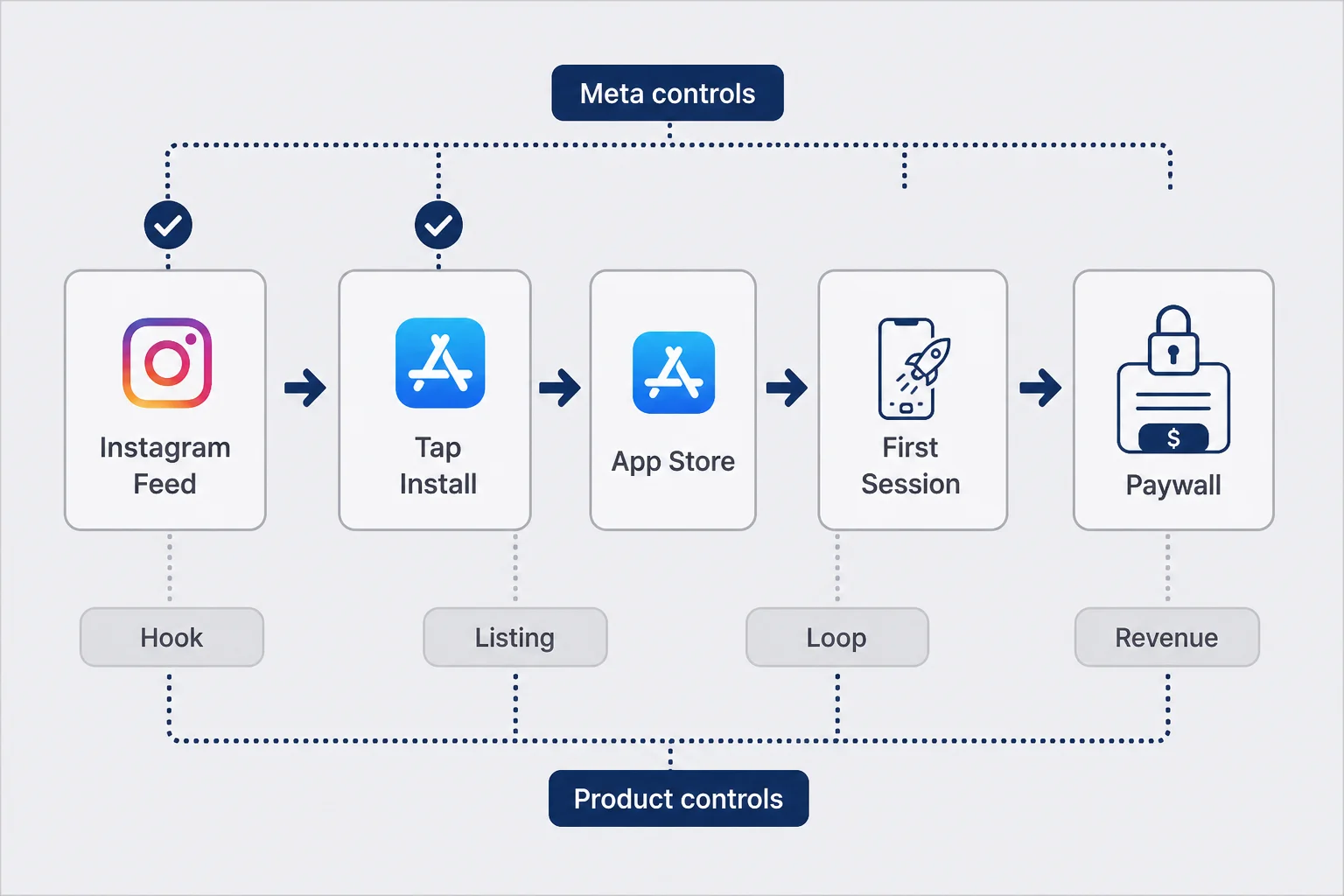
Meta ads buy attention between posts from people you will never meet organically. That is it. They do not buy App Review approval. They do not buy five-star ratings. They do not buy a completed StoreKit purchase on the first night.
In practice you are renting a slot in the feed with three assets: the hook, the proof, and the CTA. Hook is the first frame or headline. Proof is the screen recording, testimonial line, or before-after that makes the promise believable. CTA is usually Install Now or Learn More that deep-links toward the App Store. Everything after the tap is yours.
Consumer iOS campaigns on Meta typically run as App promotion objectives with mobile app install optimization. You connect your app in Events Manager, verify the SDK or partner integration, and let Meta chase people statistically likely to install apps like yours. You choose placements. Many solo founders start with Advantage+ placements or Instagram-heavy mixes because Reels and Stories match vertical screen recordings. Facebook feed still works for older demographics and certain niches. Do not get religious about placement until creative works.
Events Manager setup is unglamorous and mandatory. App ID, bundle ID, SKAdNetwork identifiers, test device installs before you spend. I once ran ads while events were still in test mode and wondered why nothing reconciled. The interface happily took money anyway. Verify the install event fires on a real phone with the production build you are advertising.
Audiences at solo scale are simpler than growth Twitter makes them sound. Broad with light interest stacking, or broad with no interests at all if creative is specific enough. Lookalikes need seed users you do not have yet. Detailed targeting on "people interested in mobile apps" is not a strategy. It is a way to feel sophisticated while burning twenty dollars a day.
Geography should match where your app is live and where your listing is honest. Running US ads while your app is only available in New Zealand teaches you little except that Meta will happily spend your money. Align ad countries with App Store availability the same way you align support hours. If you are soft-launched in one country, run ads there first. Learn in a pond.
Budget mechanics are boring and important. Account spending limits, campaign budgets, ad set budgets. I use one campaign, two to three ad sets max at first, each ad set holding two to three creative variants. Daily budget low enough that a bad day cannot ruin the month. Meta's learning phase is real. Panic-editing every six hours resets the lesson you were trying to buy.
The attention contract you sign with a thumb-stop
When someone stops scrolling, you owe them clarity fast. Personal apps fail here when the ad shows abstract gradients and the app is about a specific pain. Finish Him's early mistake was showing chat bubbles without saying screenshot in, replies out. People thought it was another messaging app. They were gone before the store page loaded.
You are not selling features in the feed. You are selling recognition. The user should think that is me within one second. The second second shows the outcome. The third offers the install. If your app needs a paragraph to explain, the ad is not the place. The App Store subtitle might be. The ad is the feeling.
Sound-off design is non-negotiable. Captions on video. Large text on statics. Do not rely on voiceover unless you enjoy paying for muted views.
Before you spend a dollar: the funnel you are amplifying
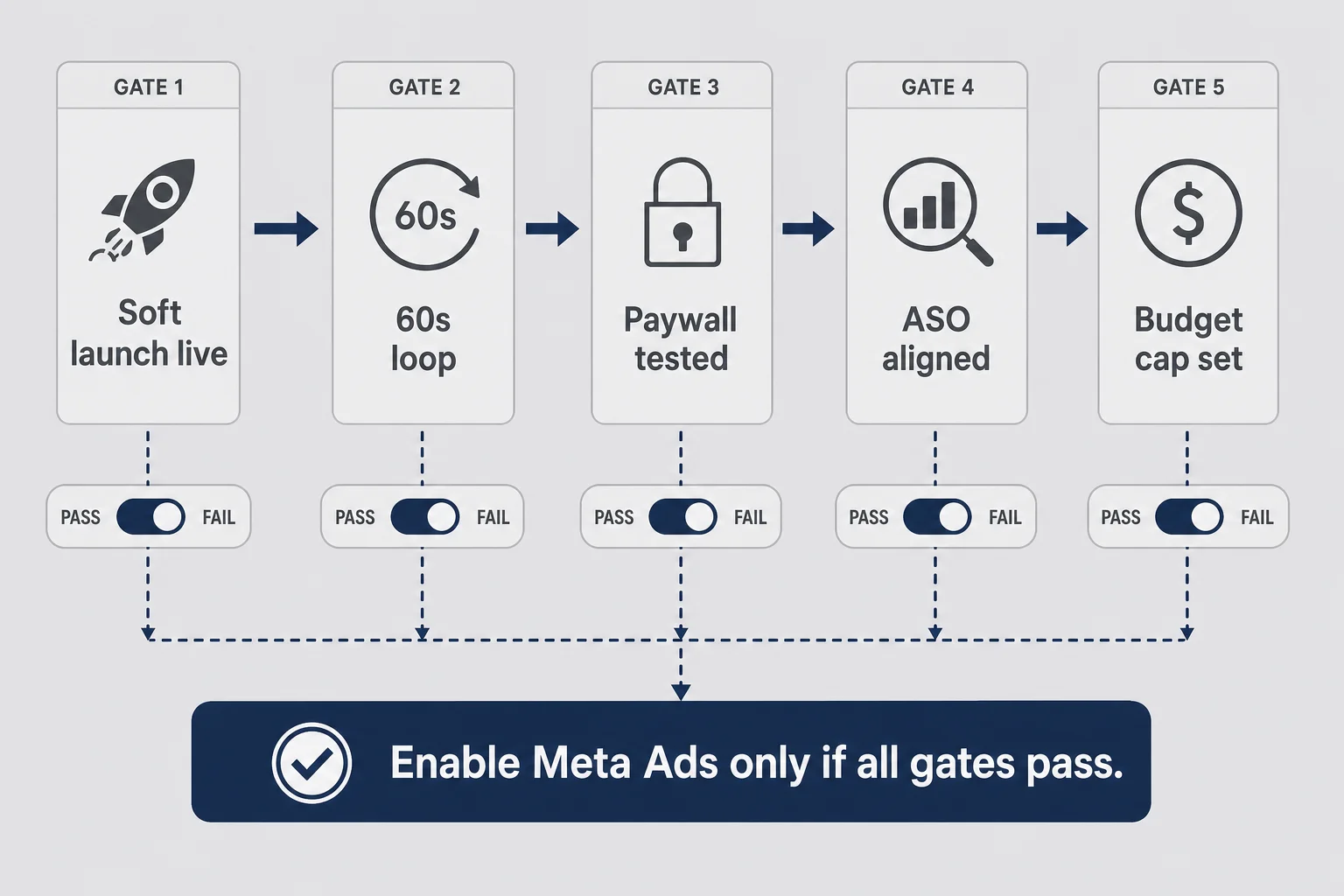
Paid acquisition before prerequisites is how solo founders fund Meta's payroll while avoiding their own product. I did it. Do not copy me.
Gate one is distribution reality. The app is on the App Store in the countries you will advertise, on a build you are not ashamed to support. Crashes are rare enough that you are not fixing showstoppers nightly. If TestFlight strangers still find broken flows, stay in beta. Ads will not respect your TODO list.
Gate two is the sixty-second loop. Cold install to completed core job in about a minute. For me that meant screenshot, three replies, copy one. For a meditation app it might be one session. For a photo tool, one edit export. If you cannot describe the loop in one sentence, ads will not discover it for you. They will dump users into confusion.
Gate three is monetization plumbing. Production StoreKit, restore purchases visible, paywall timing chosen on purpose, trial language honest. Paid users hitting a broken purchase flow is worse than organic users hitting it because you literally paid for their anger.
Gate four is listing alignment. Screenshots, subtitle, and first lines of description match the ad promise. App Store optimization is not a post-launch hobby if you are about to buy traffic. Misaligned listings produce installs that bounce before analytics update. You blame creative when the store page lied.
Gate five is a number you can afford to learn with. Not rent money. A defined test cap with a calendar end. Two weeks, five hundred dollars, whatever lets you say this experiment ended instead of this leak might fix itself if I raise budget.
I also gate on emotional readiness, which sounds soft until you have refreshed Ads Manager at 1 a.m. while onboarding was still broken. If you are using ads to avoid shipping a fix, you are not ready. If you are using ads to answer a specific question, like whether problem-first hooks beat outcome-first hooks in Canada, you are ready. Specific questions get specific budgets.
I write these gates on paper because Ads Manager loves urgency. Red badges. Recommendations. The interface wants you to believe spending more is responsible. Your gates are the adult in the room.
Organic proof you should have first
Before Meta, I wanted at least fifty to a hundred organic or soft-launch installs with some repeat opens. Not friends lying to be nice. Strangers from one country or TestFlight external. Enough to see where people stall. If organic retention is zero, paid retention is not magically higher. It is organic retention with a bill attached.
Talk to three users if you can. Not a survey. One question: what almost made you delete it? Feed that into onboarding before you feed it into ad copy. Otherwise you amplify the wrong story beautifully.
Campaign structure for one person and a five-hundred-dollar test
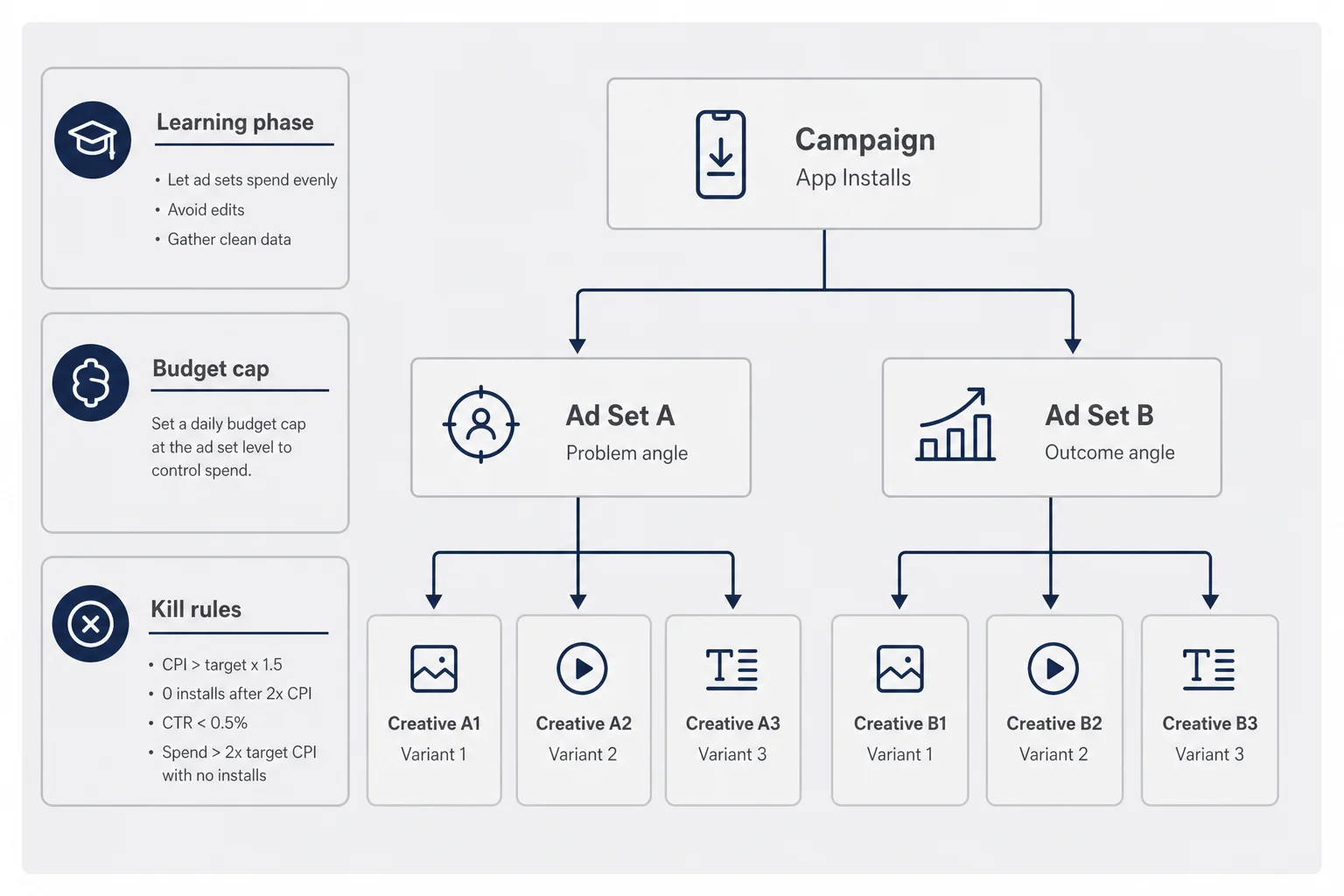
Complexity is a luxury for teams with analysts. Solo founders need a structure they can hold in working memory while also being customer support.
My default skeleton: one campaign optimized for app installs, two ad sets, each ad set a different angle or audience slice, each ad set two or three creatives that share the angle but vary hook or first frame. That is already six to twelve ads. Enough for learning without pretending to be a creative agency.
Ad set one might be problem-forward: the anxious moment before you reply. Ad set two might be outcome-forward: three replies ready in ten seconds. Same app. Different emotional entry. Meta tells you which entry cheaply produces installs. Your analytics tell you which produces loops.
Do not launch ten ad sets because a podcast said scale creative testing. You will not check them daily. Neglected ad sets leak money quietly. Two ad sets you actually read beats ten you forget.
Naming conventions save your future self. Campaign name includes app, country, month. Ad set names include angle. Ad names include hook shorthand. Boring. When you are tired on a Wednesday you will still know what was what.
Schedule matters less than kill rules. I set calendar reminders on day three, day seven, and day fourteen. Day three: any creative with spend but zero installs gets paused. Day seven: any ad set with installs but terrible downstream behavior in my analytics gets paused even if CPI looks fine. Day fourteen: write a half-page memo. Keep, kill, or redesign creative. No memo means you are gambling.
Advantage campaign budget versus ad set budget is a religious war I will not join. Pick one interface mode and stay consistent for the test. Switching mid-flight confuses you more than Meta.
What I ignore in Ads Manager at first
Delivery recommendations to broaden audiences. Instant forms. Traffic campaigns when you wanted installs. The green checkmarks that suggest you are missing out. You are missing out on spending faster. Ignore until you have a baseline.
Also ignore cost per install envy from Twitter screenshots. CPI without context is a vanity metric. A $0.80 install that never opens is infinitely expensive. A $3.20 install that trials and converts might be fine depending on your price and retention. Context is the product funnel, not the Ads Manager column alone.
Creative that stops the scroll without lying about your app
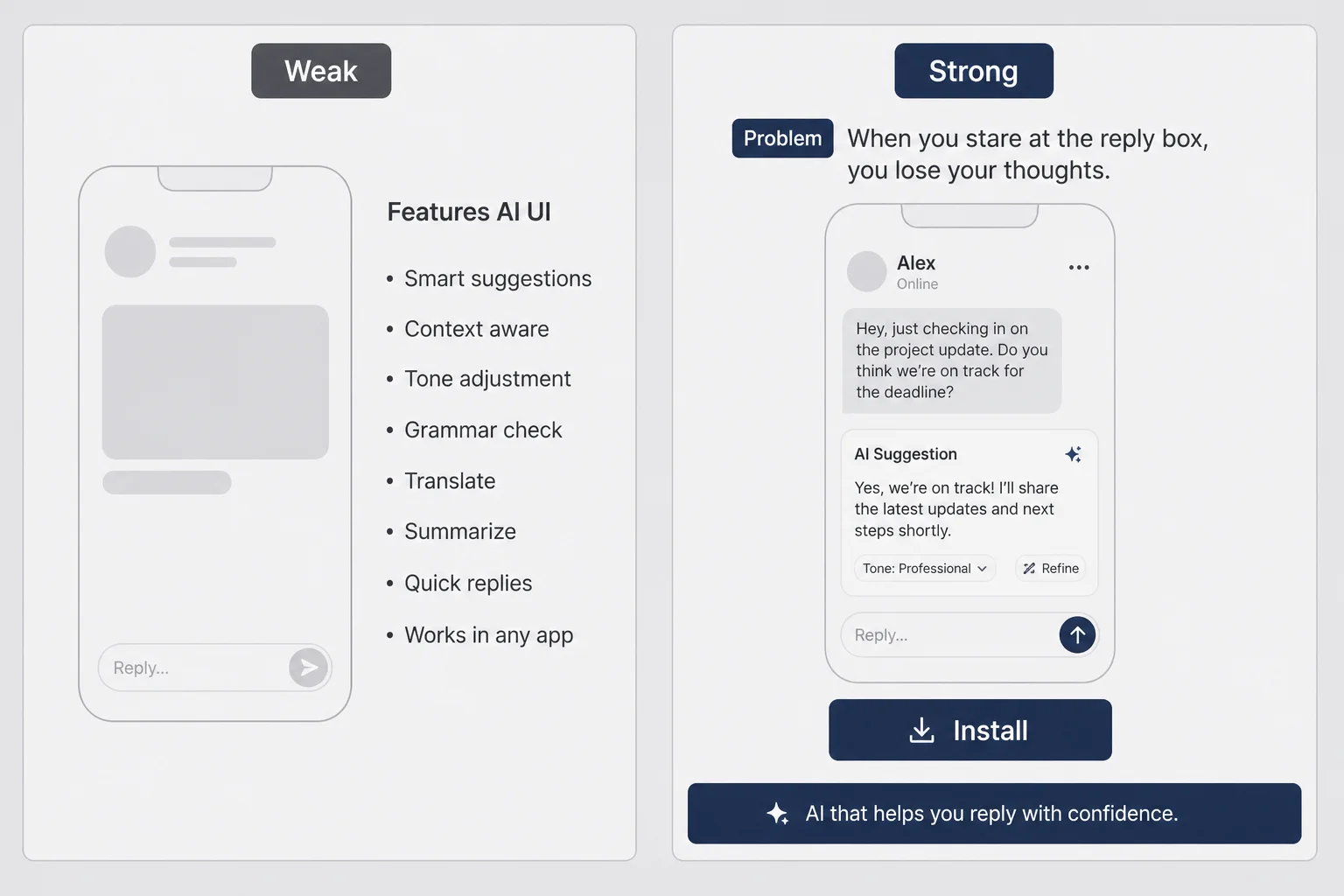
Creative is where solo founders win or lose before math enters the chat. You do not have brand recognition. You have three seconds and honesty.
Weak creative lists features. AI-powered, smart suggestions, beautiful UI. Strong creative shows a recognizable moment and a specific relief. The screenshot inbox. The blank reply field. The three tone options appearing. Caption: when you stare at the text box too long. No one needs to know your tech stack.
Formats that work at small scale: screen recording with thumb-friendly UI, static carousel where slide one is the problem and slide two is the result, founder face-to-camera only if you already post on video and your face is part of the brand. UGC-style lo-fi often beats polished corporate motion graphics because personal apps are intimate. Over-produced ads signal scam to anyone burned by subscription traps.
Hook testing is underrated. Same body, three openings: the anxious pause, the notification badge, the blank text field cursor blinking. Meta will tell you which opening earns the stop. Your job is to not fall in love with the opening you filmed first because it felt clever at midnight. I still like my first hook best. Data disagreed twice.
Use real in-app UI. Blur names if needed. Do not mock up fantasy interfaces you have not shipped. App Review and user trust both punish gaps between ad and app.
Refresh creative on a schedule even if metrics look fine. Fatigue is real in consumer categories. I plan one new hook a week during active tests. Not a full rebrand. A new opening frame, new caption line, new problem angle.
Legal and platform policy basics: no before-after bodies for weight loss unless your app is actually that and you enjoy compliance paperwork. No fake system dialogs. No implying Apple endorses you. Subscription apps need clear enough pricing cues that users are not surprised. You do not need the full price table in the ad. You do need honesty.
Testimonials help when tiny and real. A sentence from a beta tester with permission beats a invented five-star wall. Solo scale is an excuse for human-scale proof, not fake social proof.
The App Store handoff your creative promises
Every ad is a contract. If the ad shows instant replies from a screenshot, the store screenshots better show the same within two swipes. If the ad promises privacy, the store privacy section and in-app copy better agree. Break the contract and CPI is a tax on disappointment.
Custom product pages in App Store Connect let you align a specific page with a specific ad angle when you are ready. Optional for first tests. Valuable when one angle wins and you want the store to continue the story. Link from Meta using the CPP URL if you go that deep. Otherwise default page must still not contradict the ad.
Reading numbers when you do not have a growth team
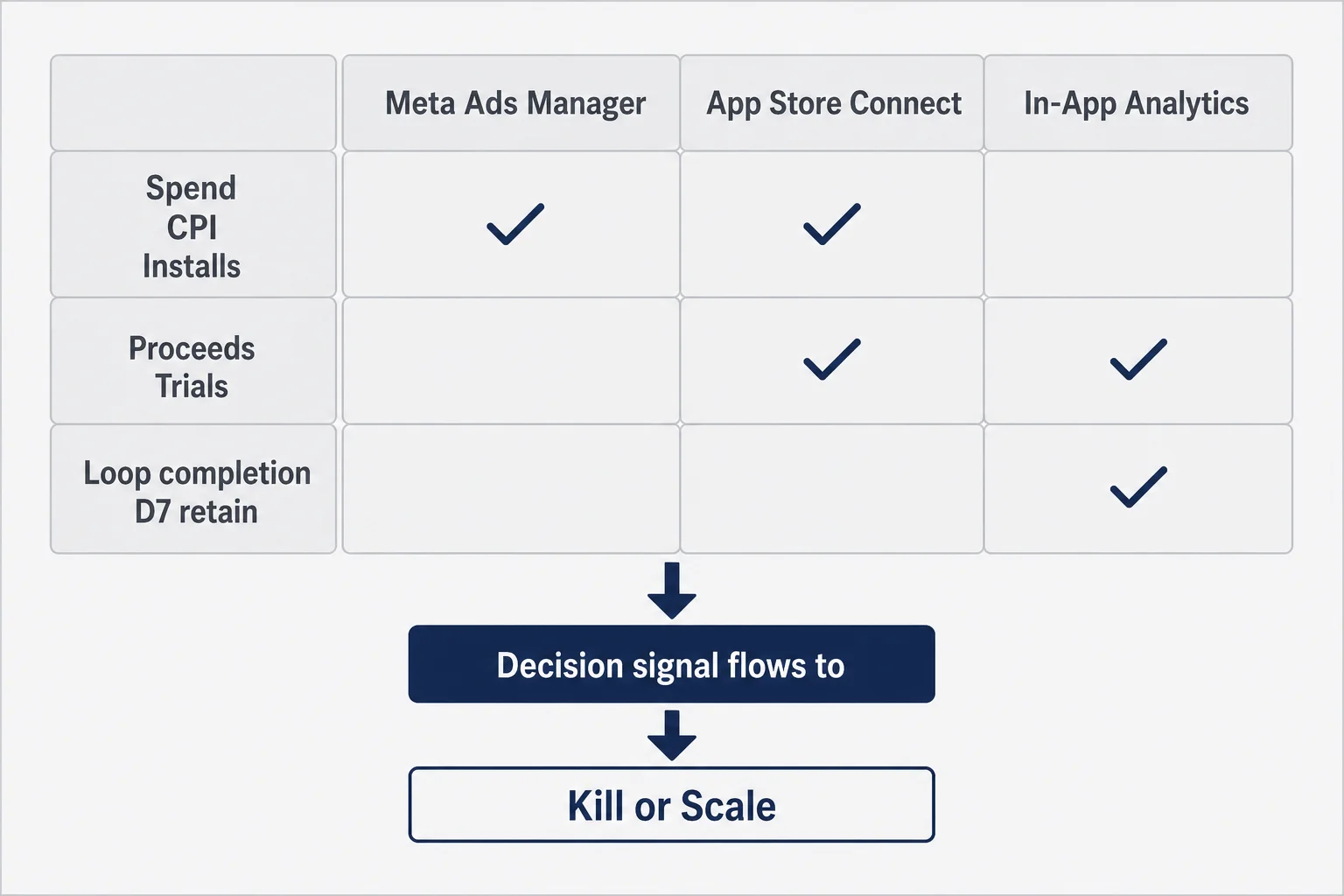
Ads Manager will hypnotize you with columns. Install volume. Cost per install. Impressions. Frequency. Useful. Incomplete.
I look at a simple stack. Meta: spend, impressions, installs, cost per install, thumbstop or video watch if available. App Store Connect: units, proceeds, trial starts if visible, geography match. In-app analytics: first open, loop complete, paywall view, trial start, day-one and day-seven return. RevenueCat or similar if you use it. One spreadsheet row per ad set per day. Low tech on purpose.
Cost per install is a door metric. It tells you whether creative and audience are efficient enough to get a knock. It does not tell you whether anyone stays for dinner. Loop completion rate on paid users is the next gate. If you tag campaigns in your analytics, compare paid cohorts to organic. Paid should not be dramatically worse. Some drop is normal. Cliff is a product problem.
Trial start rate matters for subscription apps. Paywall view without trial means timing or trust issues. Trial without conversion after seven or fourteen days means pricing or value gap. Fix those before you scale spend. Scaling a leaky paywall is how you discover Apple refund emails come in batches.
Return on ad spend at solo scale is often unknowable precisely because of SKAdNetwork delay and Apple's cut. Use directional ROAS. If you spend five hundred and see a plausible path to two hundred in year-one subscriber value with sane churn assumptions, you might continue testing. If you spend five hundred and cannot find completed loops, you do not have a ROAS problem. You have a product problem wearing a ROAS costume.
Frequency creeping up with falling installs means creative fatigue. New hooks before bid changes. Country-level CPI shifts sometimes mean you exhausted a small geo. Widen only if gates pass, not because you are bored.
Write kill rules before you launch. Example: pause ad set if spend exceeds seventy dollars with fewer than twenty installs. Pause if install-to-open rate under fifty percent two days running. Pause if zero paywall views after a hundred installs. Numbers are examples. Yours depend on category and price. The point is deciding while calm, not while watching spend tick at midnight.
The spreadsheet row I actually maintain
Date, ad set name, spend, installs, CPI, opens from analytics, loops completed, paywall views, trials, notes. One row per day per ad set. Colors are optional. Shame is not. When the row is empty for three days because you got busy, you are not running ads. You are donating.
Compare weeks, not hours. Meta fluctuates daily. Consumer apps are noisy at low volume. A bad Tuesday is not a trend. Two bad Tuesdays might be.
Where the click lands: App Store listing and deep links
The store is part of the ad. Not a separate planet.
First screenshot is the second hook. Subtitle is the clarifier. First review stars visible near the top matter more when traffic is cold. You do not need thousands of reviews. You need enough that the listing does not look abandoned. Ratings and reviews strategy pairs with paid traffic. A burst of installs with no reviews yet is a awkward phase. Plan timing so a few happy organic users left stars before you push spend.
Subtitle and first paragraph should echo ad language without keyword stuffing. If your ad said replies from a screenshot, your subtitle should not talk about productivity AI for modern communicators. Say the plain thing.
Preview video on the store helps when it shows the same loop as the ad, faster. Autoplay silent. First frame matters. I treat store preview and ad video as siblings, not strangers.
Deep linking and deferred deep links are nice when they work. At solo scale, perfect deep link into onboarding step three is less important than not crashing on cold install. Get the default path solid first.
Localization: if you only advertise in English, your listing in that geo should be English-clean. Running ads in a language you do not support in email is a support trap.
SKAdNetwork, attribution, and the fog you learn to live in
I am not Max. I will not pretend to enjoy attribution plumbing. I will tell you what a designer-founder needs to know so you do not lie to yourself.
Apple's privacy changes mean you will not see perfect user-level paths from ad click to purchase in every dashboard. SKAdNetwork sends delayed postbacks. Meta models conversions. Your numbers will not match on day one. They might not match on day seven. Welcome to consumer iOS growth in the 2020s.
Practical setup: Meta SDK or approved partner, app events configured, install tracking verified in Events Manager test events before you spend real money. App Store Connect analytics for units. Your product analytics for behavior. Accept that reconciliation is directional.
Do not optimize your entire business on modeled ROAS inside Ads Manager when you have two hundred installs. Use modeled data to compare ad sets to each other, not to declare victory. The truth still lives in whether people use the app and whether subscriptions stick enough to cover blended cost over time.
UTMs on custom product pages help attribute which angle drove which store behavior when Apple gives you enough granularity. Not always perfect. Still better than guessing.
If attribution fog paralyzes you, return to gates. Can paid users complete the loop? Do they trial at similar rates to organic? Do they come back day two? Those questions survive SKAN. Vanity CPI does not.
When to trust Meta versus trust your product analytics
Trust Meta for relative creative performance within a test. Trust your analytics for absolute product health. If Meta says ad set A beats B on installs but analytics says B users complete loops twice as often, B wins even if CPI is higher. You are building a business, not a install leaderboard.
One more SKAN reality check: delayed postbacks mean you cannot tune bids hourly based on purchase data the way a ecommerce store might. Plan weekly decisions. Daily monitoring is for catching broken delivery or runaway spend, not for declaring creative winners on modeled conversions alone.
Budget pacing, kill rules, and when to pause
Ads reward patience poorly and punish neglect quickly. Check daily during active tests, but change weekly unless something is on fire. The check is five minutes: spend pacing, any ad set past kill threshold, any creative with zero delivery.
Pacing example: five hundred dollar test over fourteen days is about thirty-five dollars a day if you spend evenly. Some days Meta underspends. Resist doubling budget because yesterday underspent unless metrics justify it. Inconsistent spend confuses your own bookkeeping.
When to pause entirely: loop completion cliff, purchase flow broken in production, major onboarding bug discovered, App Review rejection pending, you emotionally cannot look at metrics without panic-spending. Pause is free. Ego is expensive.
When to scale cautiously: one ad set with acceptable CPI, loop completion within shouting distance of organic, trial starts appearing, day-seven retention not embarrassing, creative not fatigued after at least a week. Scale means ten to twenty percent budget increases, not 5x because TikTok said hog mode.
Seasonality hits consumer apps. January fitness spikes. Summer dating apps. Your category has rhythms. A dead week might be calendar, not creative. Note holidays in your spreadsheet notes.
Remember Apple's thirty percent cut and occasional refunds in mental math. A subscriber is not full price to you. LTV estimates should be humble. Churn on month two hurts more when you paid for the install.
There is also a cash-flow timing gap. Meta bills weekly or on spend thresholds. Apple pays on a delay. Your bank account can feel tight even when cohort math looks okay on paper. Keep the test budget small enough that the timing mismatch does not become a panic spiral. Paid acquisition is a cash management skill disguised as marketing.
If you use annual plans, remember trials convert into revenue lumps that smooth later but not immediately. Do not scale spend the day a trial starts. Wait for the renewal cliff you chose to design around.
Mistakes I keep seeing from solo founders running Instagram ads
Mistake one: skipping soft launch and buying worldwide installs. You learn nothing except that Meta will take worldwide money. Mistake two: optimizing for purchases with no volume, starving the campaign while you refresh dashboards. Mistake three: changing onboarding, paywall, and creative in the same week. You will not know what moved anything.
Mistake four: feature-first creative because you are proud of the engineering. Users scroll past pride. Mistake five: treating App Store listing as static wallpaper while rotating ads weekly. The ad and store must be one story. Mistake six: ignoring permission prompts. Personal apps die at photo access. Fix pre-prompt copy before you buy traffic that triggers it.
Mistake seven: no kill rules. Spend drifts until the card notification hurts. Mistake eight: comparing yourself to venture-backed case studies with creative teams and incrementality tests. You are one person. Your test is smaller and still valid.
Mistake nine: scaling into countries you do not support. Mistake ten: assuming ads replace product community. They do not. They find people who might care if the app delivers.
I made at least six of these. Possibly all ten on a generous grading scale. The fix was always boring. Return to the loop. Return to the listing. Return to the paywall. Make one change. Measure again.
What I would do differently starting over
I would not run ads until one country soft launch showed strangers completing the loop. I would write kill rules in Sharpie before opening Ads Manager. I would match store screenshots to ad frames pixel-closer. I would schedule creative refresh instead of bid tinkering when bored. Less heroics. More gates.
Questions solo founders ask about Meta ads for iOS
How much should a solo founder spend on Meta ads for an iOS app?
Start with a test budget you can lose without resentment, often three hundred to eight hundred dollars over two to three weeks, not a monthly salary. You are buying signal about creative, listing alignment, and whether strangers complete your first loop, not buying a business yet. Scale only when trial-to-paid and day-seven retention look stable on paid traffic, not when cost per install looks cheap in isolation.
Should I optimize Meta ads for app installs or purchases?
At solo-founder scale with a subscription app, optimize for the deepest event Meta can reliably count, usually app installs or a trial start if you have the SDK event wired and enough volume. Purchase optimization sounds mature but often starves learning phase when you have fifty events a week. Match the optimization event to what you can actually measure and what happens inside the first session, then judge success with App Store Connect and your analytics, not Ads Manager alone.
Do Facebook and Instagram ads work for consumer iOS apps?
They work when the app already converts organic strangers in a small geography and your creative shows the moment of relief, not a feature laundry list. They fail when you use paid social to skip soft launch, fix a confusing paywall, or compensate for a listing that promises something the app does not deliver. Meta is an amplifier. If the funnel squeals, ads turn up the volume.
When should I start running Meta ads for my iOS app?
After TestFlight or a one-country soft launch proves strangers finish your core loop, production StoreKit works, and your App Store screenshots match what the ad shows. If you are still fixing crashes daily or debating paywall copy, ads are an expensive distraction. Paid acquisition belongs in the grow stage, not the I hope this build compiles stage.
How do I track Meta ads results for iOS with SKAdNetwork?
Expect fog. SKAdNetwork gives delayed, aggregated conversion data. Use Meta for creative and cohort direction, App Store Connect for installs and proceeds, and your in-app analytics for loop completion and trial conversion. UTM parameters on App Store custom product pages help when you have them. Do not pretend you have pixel-perfect ROAS on day three. You have enough signal to kill bad ad sets and keep good hooks.
What creative format works best for Instagram ads to App Store?
Short vertical video or static frames that show the problem moment and the paid outcome in under three seconds, with captions because sound is often off. Screen recordings of the real app beat polished motion graphics that look like every other AI wrapper. One clear CTA to the App Store. Refresh creative before you tweak bids for the fifth time. Creative fatigue hits consumer apps faster than B2B landing pages.
Paid social is the last honest mirror
Meta ads did not save my first consumer app week. They held up a mirror and charged admission. Strangers scrolled, installed, and left when the product story cracked. That was painful and useful. Cheaper than pretending the problem was distribution while the paywall sat behind a permission wall nobody understood.
If your app already survives soft launch with modest organic signal, a disciplined Meta test can teach you hooks and geographies faster than waiting for the App Store algorithm to notice you exist. If it does not survive that, ads will not rescue you. They will fund your education.
Fix the loop. Align the listing. Price like you mean it. Then rent attention with creative that tells the truth in three seconds. The rest is spreadsheet discipline and the willingness to pause when the numbers say pause, even if the interface nudges you to spend tomorrow too.
If you are still choosing between soft launch geographies or staring at paywall copy, do that work first. Ads will still be here when the product stops embarrassing you in private. They work better when you can honestly answer what happens in the first sixty seconds after install, because that is the question Meta cannot answer for you no matter how clever the audience targeting looks.




Comments