Twelve Thousand Views and Zero Installs Taught Me Something
Instagram Reels and Stories can promote a consumer app when you film the embarrassing moment, fix your bio link, and measure App Store taps—not vanity views.
 By Iryna26 min read
Listen to this article
AI-generated podcast-style overview of this article (not a word-for-word narration).
I posted a fourteen-second Reel on a Wednesday night. Screen recording. Cheerful voiceover. Every tab in Finish Him Replies, in order. The caption said something clever about AI and dating. By Friday it had twelve thousand views. My App Store Connect graph looked like I had imagined the whole app.
That is when instagram reels app promotion solo founder work stopped being a fantasy about going viral and became a math problem I was failing. Views are cheap. Installs cost trust. The Reel that worked later was uglier: me staring at my phone, no logo, three seconds of silence, text on screen that said "when you rewrite the same text for the fifth time." Forty-one people tapped my bio link that week. Nine of them installed. I am not proud of the ratio. I am proud that the ratio existed.
If you are reading this because TikTok feels chaotic, LinkedIn feels like a job fair, and you still open Instagram every day anyway, you are my people. This is not a course on becoming an influencer. I do not have a ring light budget or a UGC agency. I have one consumer app, a personal account I was embarrassed to post on, and a growing folder of clips I almost deleted. This guide is how Instagram Reels and Stories fit a solo founder promoting a mobile app: what to film, what to fix before you film, how Stories differ from Reels, how to post without hating yourself, and how to measure something real.
I came to Instagram late as a distribution channel because I assumed my buyers would find me in the App Store. Some do. Search is slow when nobody knows your name yet. Social is messy when you are not a natural performer. Between those truths is a lane for founders who already understand the problem their app solves and can show it in fifteen seconds without a studio. That lane is not exclusive to dating apps or screenshot tools. It is any consumer product where the first emotion is recognizable on camera.
For the store listing those installs land on, read App Store optimization. For the product underneath, read how to build your first consumer iOS app. For what happens after they open the app, read iOS paywall UX. Bring your phone. The tripod is optional.
Instagram reels app promotion solo founder: what this actually means
When I say instagram reels app promotion solo founder, I mean using your personal Instagram account to show the problem your app solves in public, turning that attention into profile visits, and sending one clear link to the App Store or a tiny landing page. Reels are the discovery engine. Stories are the follow-up proof that you are still alive and still shipping. Neither is a replacement for a good product or a listing that explains the relief moment in the first screenshot.
The founders who get installs from Instagram rarely look like ad agencies. They look like someone who happened to film a relatable Tuesday. That distinction matters. The feed is full of polished app tours set to trending audio. It is also full of people who save clips because someone voiced the exact thought they had in the bathroom. Saves and shares are closer to pipeline than likes. Likes are applause from scrollers who will never tap your bio.
Not ads, not influencer deals, not a brand page strategy
Instagram ads exist. Meta will happily take your money to show a screen recording to people who watched one dating meme. I have tried boosting a Reel with twenty dollars out of curiosity. I got more views and the same zero installs because the bio and the hook were still wrong. Ads amplify a message. They do not invent one. Fix organic first.
Influencer deals are the other trap. Paying someone with a hundred thousand followers to say your app is amazing sounds like distribution. For a solo founder with a narrow personal app, it is usually an expensive way to learn that their audience is not your buyer. Micro-creators in your exact niche can work later. On day thirty, you are the micro-creator.
Brand pages are the third trap. Founders make @YourAppName, post three Reels, get forty views from friends, and conclude Instagram does not work. Personal accounts get suggested. Founders get DMs. The app account gets ignored unless the app is already famous. Post as yourself. Put the app in the bio.
The channel that works when your buyer already scrolls here
Instagram fits consumer apps where the problem is visual, emotional, or daily: fitness, style, dating, productivity for normal humans, creative tools, journaling, screenshot workflows. It fits when your ideal user is eighteen to forty-five and already watches Reels about the mess your app tidies. It does not fit when your buyer is an IT director who does not have the app installed. Reese can tell you about LinkedIn. I am telling you about the pocket scroll.
There is also a product fit test. If you cannot show the problem in three seconds without a paragraph, Reels will hurt. If the problem is embarrassing or private, you can still win, but you film the feeling, not the data. Finish Him Replies works in content because staring at a text box is universal. A B2B invoice tool does not belong here. Be honest about that before you buy a tripod.
I once watched a founder post weekly UI tours for two months. His audience was other founders. His downloads came from Product Hunt, not Instagram. The channel was active. The buyer was absent. Same mistake as posting on LinkedIn when your user is sixteen. Fit beats effort.
There is a version of this work that looks like discipline and is actually avoidance. You schedule Reels, obsess over hashtags, buy a second phone for content, and never fix the onboarding drop after install. Distribution without product readiness is loud waiting. I have been there. It is easier to film than to read session recordings. Film anyway, but fix the first session in parallel. Instagram sends curiosity. Your app must answer it.
Think of Instagram less like a billboard and more like a bus stop where your user already waits. You can show up with a useful story. You cannot make a different crowd appear by posting more feature tabs.
Fix your profile before you film anything
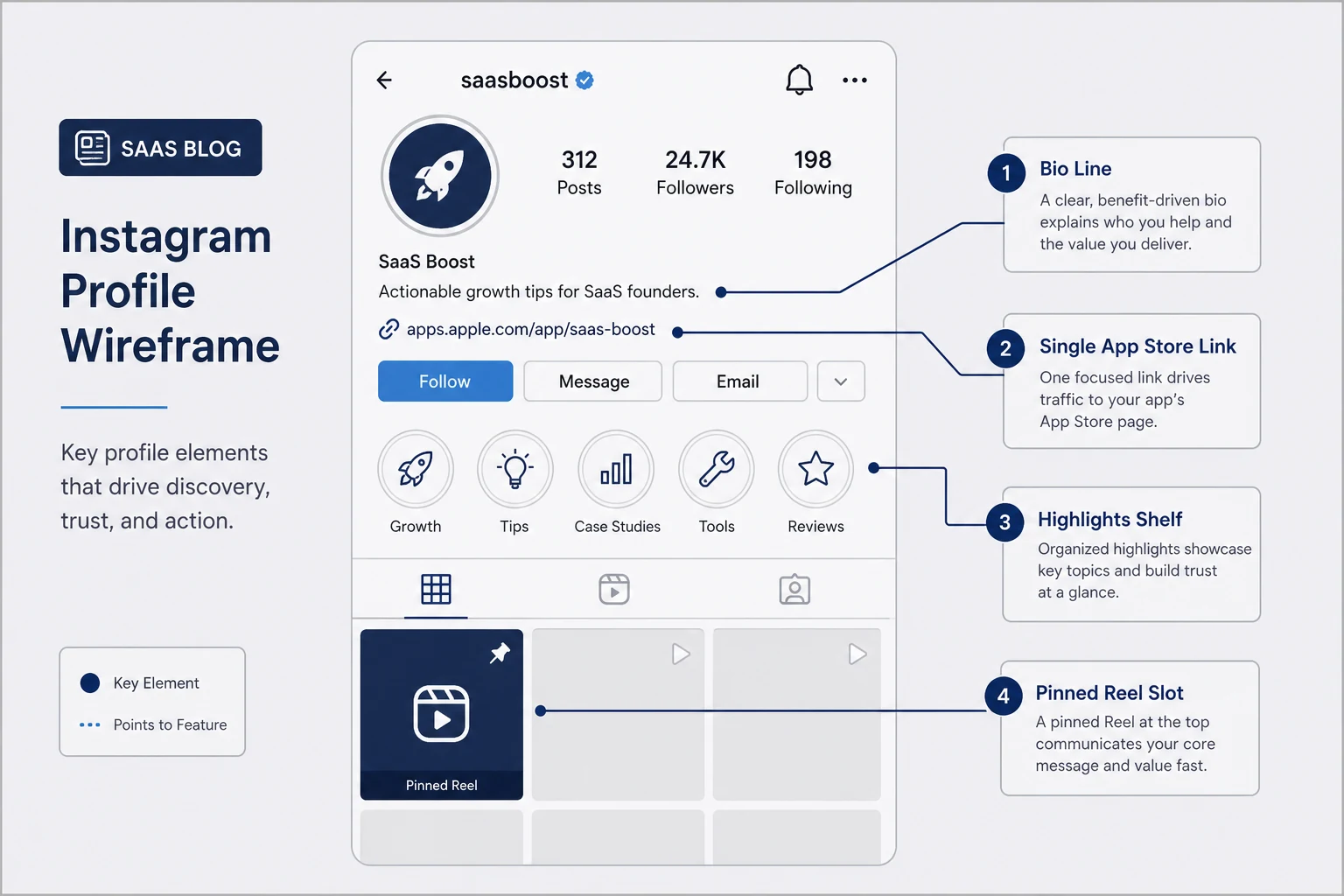
Most founders film first because filming feels like progress. Then someone watches a decent Reel, taps the profile, sees "Founder | building cool stuff ✨" and a Linktree with six dead links. You just paid for attention and burned it at the door.
Your profile is the landing page between a Reel and the App Store. It has one job: confirm that you understand the problem and point to one next step. Three seconds on mobile. No poetry.
I audit my own profile the way I audit onboarding. Would a stranger know what changes after they install? If not, the Reel is sending traffic to a blank wall. App Store optimization matters downstream, but the bio is upstream. Fix upstream first.
Bio line, link, and pinned Reel
Write the bio as an outcome, not a resume. "Screenshot → three reply styles" beats "AI-powered messaging assistant." You can name the app if it helps. The pain comes first.
One link in bio. App Store if your listing is ready. A single-page site if you need one sentence and privacy policy. Not a menu. Every extra tap loses people who were ready thirty seconds ago.
Pin one Reel that best shows the problem moment. Not your most viewed clip. Not your first upload. The one that makes a stranger nod. Update the pin when you learn a better hook. I change mine when a new Reel gets more saves, not more likes.
Highlights are optional shelves for trust: how it works, privacy, changelog, FAQ. Three max when you start. Empty highlights are fine. Random story dumps from 2023 are not.
Profile photo does not need to be a professional headshot. Clear face or clear logo if you are staying faceless. Banner is optional for app founders. I use a plain color because I am not a designer on weekends too.
Name field can include a short descriptor if your handle is cryptic. @mkr.app might need "reply helper" in the name line. Do not stuff keywords like it is 2014 SEO. One clarifying phrase is enough.
If you already have a personal account with college photos and wedding tags, you do not need a fresh account. Authenticity beats sterile brand.new energy. Archive what you want. Do not pretend you were born when SwiftUI shipped.
Consider switching to a professional account for insights. You do not have to become a business influencer. You need numbers on profile visits. Creator mode is fine. You can hide like counts on posts if that helps your nervous system. I hid them for a month. Then I turned them back on when I trusted the spreadsheet more than my mood.
The profile tap test
Post a Reel. Wait forty-eight hours. Open insights. If views are high and profile visits are low, the hook failed. If profile visits are high and link taps are low, the bio failed. If link taps are high and installs are low, the store listing or the product failed. This sounds obvious. Most founders blame the algorithm instead of running the test.
I keep a notes row on my phone: Reel topic, views, profile visits, link taps, installs that week. Patterns appear fast. "Feature tour" rows look pretty and go nowhere. "Text box panic" rows are ugly and move numbers.
Pin the comment
On every Reel that mentions the app, leave a pinned comment with the same link as your bio. Some people read comments before they tap profiles. Meet them where they scroll.
Reels that show the moment, not the product tour
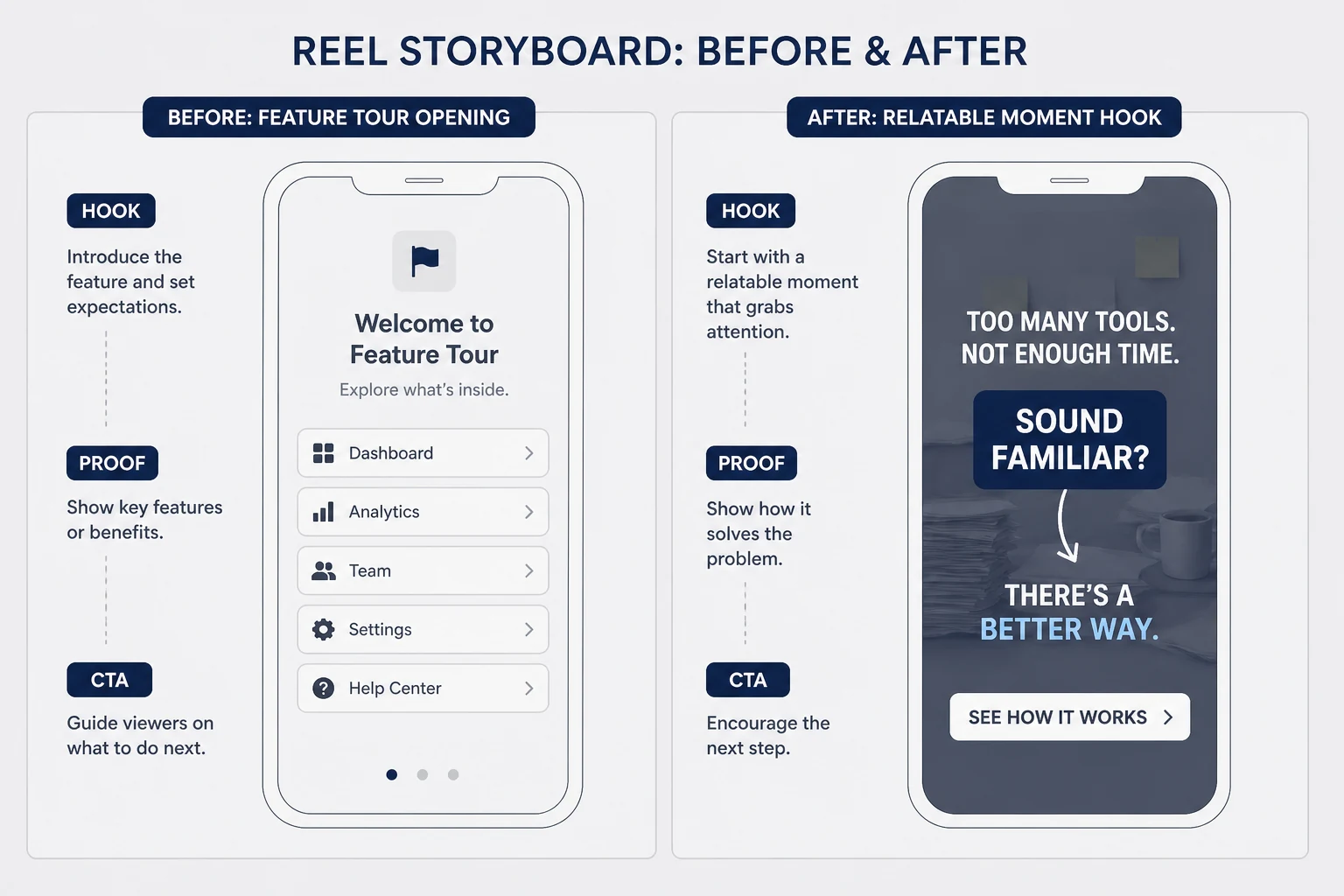
The Reel that got twelve thousand views was a product tour. The one that got nine installs was a moment. I wish I had learned that order reversed.
A moment Reel opens on the feeling your app addresses: the hesitation, the rewrite, the screenshot folder, the calendar dread. You can show your face or just the phone. You hold tension for three to five seconds. Then you show the smallest possible proof that your app helps: one action, one outcome. Not every setting. Not every tab. The demo is the punchline, not the whole joke.
Feature tours feel responsible. They show you are serious. They also train viewers to treat you like a free commercial they can skip. Moment Reels train viewers to think you see them. That is closer to trust.
Hook, proof, call to action without sounding like an ad
The hook is one sentence on screen or spoken in the first two seconds. "POV: you have rewritten this text five times." Not "Introducing the future of communication."
Proof is one screen recording or one live demo under ten seconds. Upload screenshot, see three options, pick one. Stop. Do not narrate the settings menu. The viewer's brain fills the rest if the hook was true.
Call to action is soft. "Link in bio if you do this every week." Not "DOWNLOAD NOW BEST APP 2026." Consumer apps die when they sound like infomercials in a place people come to relax.
Audio matters less than you think. Trending sounds can help distribution. Clear voiceover helps comprehension. I have had average audio with a true hook outperform perfect editing with a vague one. If you are choosing between color grading and rewriting the first line, rewrite the first line.
What to show for a consumer iOS app
Show the phone in context. Hand holding it. Messy couch. Real lighting. Not a mockup floating in space. Personal apps are judged on whether you feel like a real human.
Blur or fake sensitive content. If your app handles chats or health data, stage a generic thread. Viewers understand staging when the emotion is honest. They do not forgive creepy voyeur vibes.
End on the outcome, not the logo splash. The last frame should be the relieved send, the saved routine, the completed habit. Logo for a half second if you must. The App Store preview already has your icon.
I study Reels I save, not ones I like. Saved means "I might need this later." That is your buyer. Likes mean "huh, neat." That is other founders.
Length is a second debate. Instagram rewards watch time, which tempts people into sixty-second essays. For app promotion, shorter often wins. Fifteen to twenty-five seconds with one idea. If you need forty seconds, earn each segment. The drop-off graph in insights will tell you where you lost them. I lost people at second four when I showed settings. I lost almost nobody when I stayed on the text box.
Captions matter for search and for sound-off viewers. Write the hook again in the caption. Add three plain hashtags that describe the problem, not #entrepreneur. I use a mix of broad and specific: one category tag, one feeling tag, one app-adjacent tag. Hashtags are not magic. They are labels on a shelf. The hook still does the work.
Collaborations can wait. Duets and stitches are powerful when you have a peer in the same niche. Early on, your job is to find your own hook voice. Copy structure, not scripts. The first line should sound like something you would text a friend, not a press release.
Stories as your daily proof-of-life channel
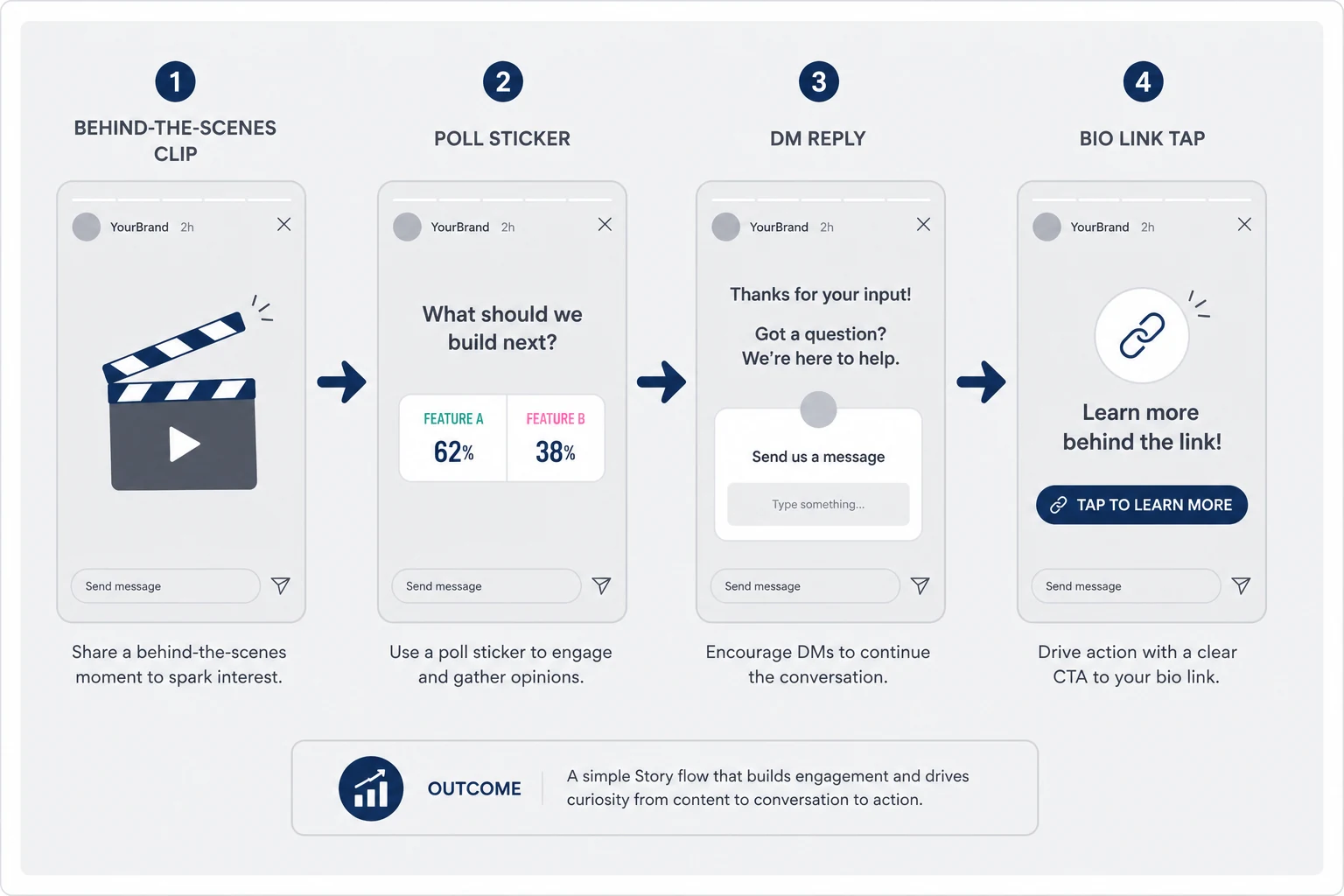
Reels find strangers. Stories keep the people who already follow you warm. I treated Stories as an afterthought for months. Then I noticed installs spiked on weeks when I posted build updates in Stories even if my Reels were average.
Stories are where you answer the trust questions Reels skip. How often do you ship fixes? Do you read DMs? Are you a real person who will not sell their data? A fifteen-second Story of you fixing a bug is boring and valuable. It is proof of life.
Behind the scenes without oversharing
Show the work, not your whole life. Screen recording of TestFlight feedback. A sticky note with the one copy change you made. A poll: "which reply tone do you use most?" That is content and research.
Do not post your revenue dashboard unless that fits your brand. Do not trauma-dump for engagement. Consumer apps already ask for intimacy. Stories should make you feel safer, not exposed.
Use polls and question stickers when you are stuck on copy. Followers will tell you which line they recognize. That is free positioning research. I changed onboarding header copy after a Story poll. Three people influenced a screen thousands would see.
When to push the App Store link in Stories
Not every Story. Maybe one in five. The rest build familiarity. When you do share the link sticker, pair it with a specific reason: "weekly subscription is live," "new privacy mode shipped," "this is the screen that took me six tries."
Link stickers work best after a Reel brought new followers. They check Stories first. Give them a shelf. Highlight "Start here" if you want a permanent path.
Stories disappear, which lowers the stakes. Film a rough take. Post it. Delete if it is embarrassing. The perfectionism that kills Reels is slightly weaker here.
I use a simple Story arc across the week. Monday might be a build note. Wednesday a user question with a poll. Friday a win, even a small one: "first stranger subscribed." That rhythm signals you are still in the game without turning every Story into a pitch. People mute accounts that sell in every frame. They tolerate founders who sell occasionally because the rest was useful.
Reply to Story responses in DMs when they are real questions. "How is this different from ChatGPT?" deserves an answer, not a heart reaction. Those DMs are pre-sales calls without a calendar link. Answer plainly. Mention privacy if your app competes on trust. Link only if they ask.
If you are shy about going live, you do not have to. Live video can work for Q&A when you have a few hundred engaged followers. At forty followers, it is you talking to your cousin. Stories and Reels scale down better for early accounts. Use that.
What to film when you hate being on camera
I delayed posting for six weeks because I did not want coworkers to see me talk to my phone. Reasonable fear. Also a convenient excuse. The app needed distribution. My face was not the product.
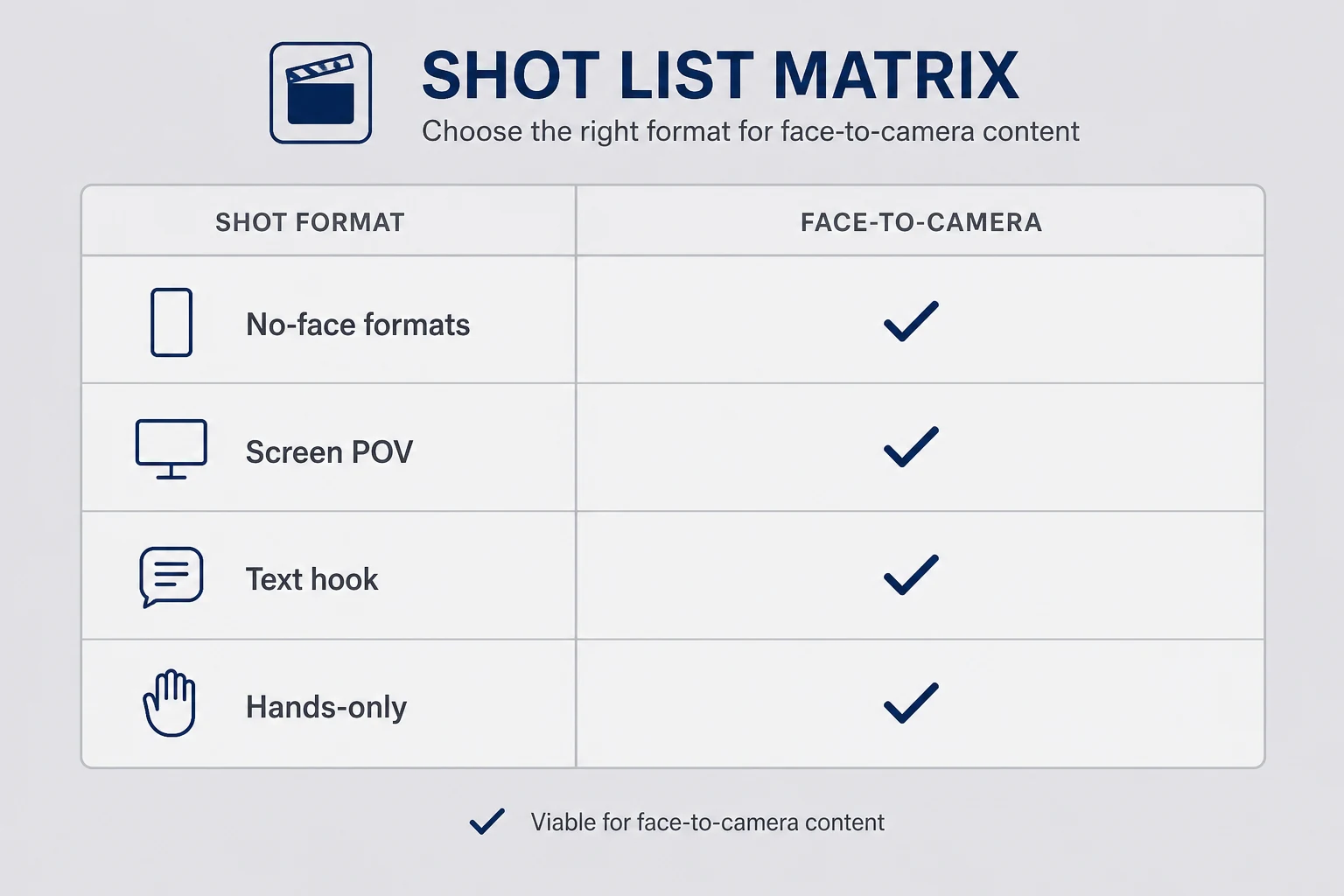
You can run a useful Instagram channel with zero face time. Screen POV. Text hooks on black. Voiceover. Hands only. Staged actors if you have a friend willing. The constraint is clarity, not charisma.
Formats that work without a talking-head
Screen POV: film over your shoulder at the phone. Show the lock screen, the notification, the problem app, then yours. Viewers feel like they are holding the device.
Text-on-screen: write the hook in large plain type. Read it in voiceover or use silence plus caption. Add one sound effect when the solution appears. Minimal. Effective.
Before and after: two clips stitched. Messy notes app, then clean output from your app. No face. The contrast does the work.
UGC-style testimonial: ask a beta user to film five seconds. Most will not. One might. That clip is gold. Get permission in writing. Blur usernames.
Batching clips on a Sunday afternoon
I batch when I am emotionally ready, not on a corporate calendar. One afternoon I film ten short clips of the same moment with different hooks. One afternoon I record voiceovers in my closet for sound dampening. Not glamorous. Neither is checking Connect at midnight.
Keep a list of hooks in Notes. Real things you or testers said. "I always forget to..." "Why is there no..." "I hate when..." Each line is a Reel seed.
Use CapCut or whatever editor you already tolerate. Templates are fine. Over-editing is a trap. If you spend four hours on transitions, you will quit by Thursday.
When you are ready for face, introduce it slowly. Start with three seconds at the end. Work up. Or never. Channels without faces exist. Consistency matters more than cheeks on camera.
Lighting does not need a ring light. Face a window. Film in the morning if your terrace or desk gets soft light. Bad shadows are fixable with position, not gear. Audio is harder than light. A quiet room beats a beautiful room with echo. I record voiceover under a blanket fort once. Desperate and effective.
If you show your app on screen, increase text size in the app for recording. Real UI is often too small for Reels. Temporarily bump dynamic type or use a demo account with large content. Viewers should read the outcome line without squinting.
Accessibility is not optional for you as a designer-founder. Add captions. Instagram auto-captions are imperfect. Skim them before publish. A wrong word in a dating-adjacent hook can change the meaning. I caught "ducking" more than once.
Measuring installs without lying to yourself
Vanity metrics are soothing. I loved watching twelve thousand views tick up. It felt like the app was growing. It was not. Growth is installs that stick, or at least installs that happen.
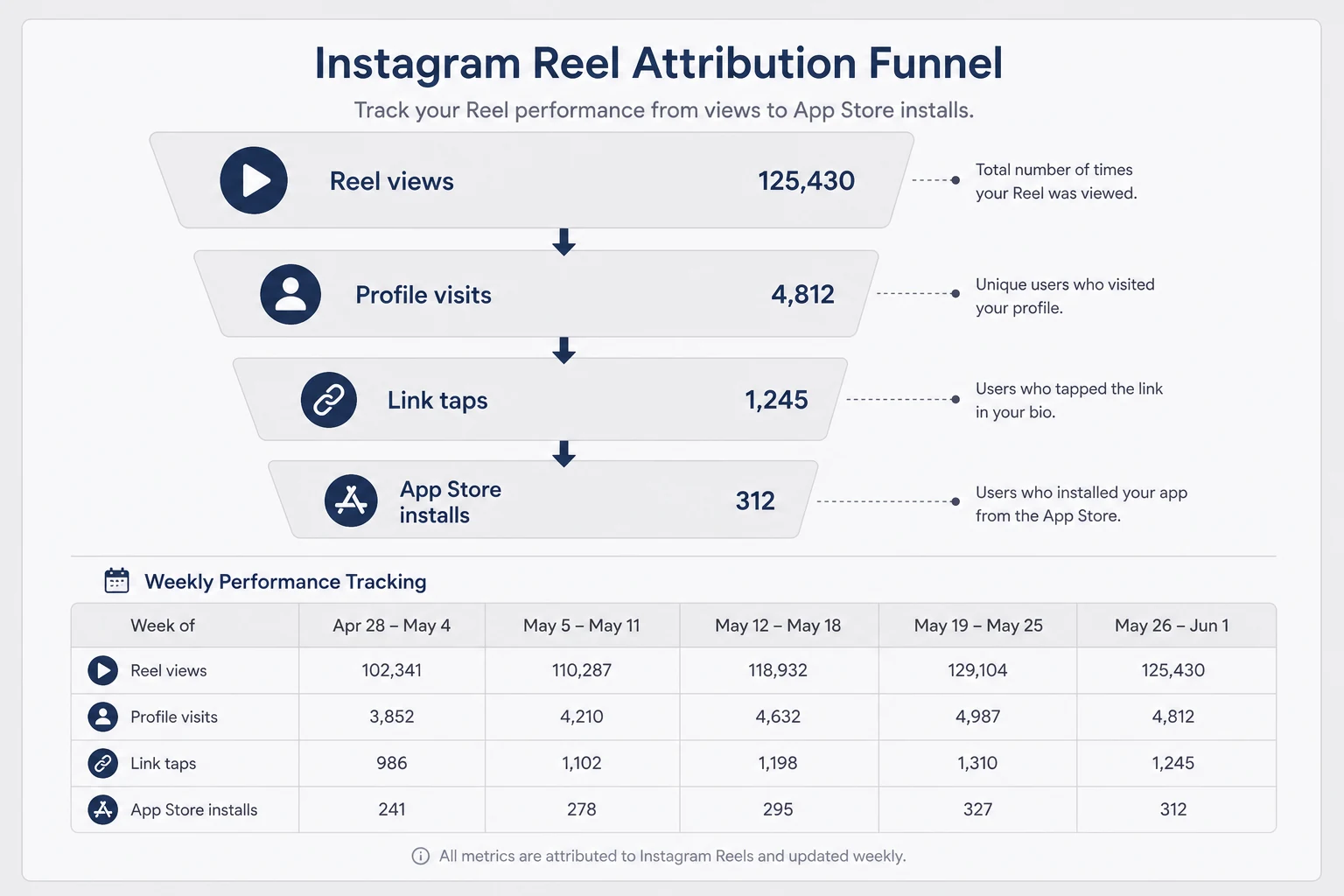
Pick one weekly number that matters: App Store units attributed to Instagram, or link taps times a rough conversion rate you learn over time. Write it down. Compare week to week, not day to day. Social spikes are noisy.
What Instagram insights actually tell you
Views and reach tell you if the hook traveled. Saves and shares tell you if the idea resonated. Profile visits tell you if curiosity survived the swipe. Link taps tell you if the bio did its job. None of those are installs. They are steps. Treat them like a funnel, not a scoreboard.
Accounts under professional mode show link taps if you use the link sticker or bio link tracking. Check on Mondays. Do not refresh hourly. You will mood-manage with noise.
Comments that ask "what app is this" are leads. Reply within an hour if you can. Pin a friendly answer. DM if they asked privately. This is support and sales at once. I still answer DMs myself. It scales poorly until it does not.
Connecting Reels to App Store Connect
Perfect attribution is hard. Apple does not hand you a Reels column. Practical workarounds: unique landing page with UTM parameters, a short domain that redirects to the App Store, or noting spikes in units when a Reel pops. Imperfect data beats no data.
If you run a landing page, keep it one screen. Outcome, screenshot, App Store badge. Reese writes about landing pages for web products. Consumer apps can be simpler. The store is the landing page if your listing is strong.
Watch retention, not just installs. A Reel that brings fifty installs and zero day-two opens is a warning about positioning or onboarding, not a win. Consumer app retention is where Instagram traffic proves itself. A spike without return is marketing theater.
I keep a spreadsheet with four columns: Reel title, profile visits, link taps, installs that week. After eight weeks you will know which topics earn taps. Film more of those. Not more of what merely looks impressive.
Apple Search Ads and organic search will muddy the water once you run them. Note in your sheet when you turn on other channels. Otherwise you will credit Instagram for a spike that was actually a keyword test. I made that mistake mentally before I wrote dates down.
If a Reel flops, resist deleting it immediately unless something embarrassing is on screen. Flops teach hook discipline. Archive mentally, remake the opening, repost a week later if the idea is still true. The algorithm is not your therapist. Your spreadsheet is colder and more useful.
Views are not distribution
A viral Reel that attracts founders, marketers, and random scrollers is a party, not a pipeline. Measure profile visits from your target user and store movement. Otherwise you are entertaining strangers.
The posting rhythm that will not burn you out
Cadence is where solo founders lie to themselves. "I will post daily." You will not. You will post daily for nine days, miss a week, feel guilty, and post a sloppy tour that hurts more than silence.
I aim for two Reels per week and three to five Stories. That is sustainable with a day job and bug fixes. Some weeks I hit one Reel. I do not punish myself with a feature dump to catch up.
Pick two posting days and protect them. Tuesday and Friday work for me. Batch film on Sunday when I can. Scheduling apps exist. I often post manually because I am still tweaking captions at the last second. Choose your flavor of discipline.
Reels versus Stories versus feed posts
Reels are for discovery. Prioritize hooks and saves. Post when your audience is awake, which Instagram insights will guess for you. Test one time slot for a month before you chase mythic "best times."
Stories are for warmth. Post when you have something true, even small. Broken build fixed. Question from a user. Coffee and a note about copy you rewrote.
Feed carousels can teach, but Reels get the reach for new accounts. I do one carousel a month if I have a before-and-after worth swiping. Not required early.
When to repost and when to remake
If a Reel underperforms, I do not delete it immediately. I remake the hook with the same footage. Half my "new" content is a second first line. The algorithm is opaque. Your hook is not.
If a Reel overperforms, pin it, make a follow-up that goes deeper on the same pain, and put the link in Stories for three days. Strike while curiosity is warm. Do not remix success into a twelve-part course nobody asked for.
Rest weeks are allowed. If you are fixing a crash, say so in Stories and skip Reels. Users forgive absence more than they forgive a broken app promoted loudly.
Seasonality is real for consumer apps. January fitness spikes. Summer travel shifts. Dating content behaves differently around holidays. You do not need a corporate calendar. Notice when your own life produces hooks and stockpile clips in calmer weeks.
Accountability without shame helps. I tell one friend when I post. Not for engagement pods. For the mild embarrassment of admitting I skipped two weeks. Solo does not have to mean invisible.
If you hire nobody, you are the strategist, filmmaker, editor, and community manager. That is five jobs. Two Reels a week is not laziness. It is capacity planning. Founders who post daily often have help or burnout coming. Plan for the long middle where nothing viral happens and you still show up.
Mistakes I keep seeing from solo app founders
I made most of these. I still make one of them when I am tired. The pattern is usually the same: founders optimize for content that impresses other builders instead of content that makes a shy stranger tap install.
Opening with the logo is the classic one. Nobody knows you yet. Your icon is not famous. Lead with the problem they already have at 11 p.m. on a Tuesday. The logo can appear when they already care.
Tiny text is the silent killer. You designed your app UI for a phone held at reading distance. A Reel is a phone held at arm's length while someone is half watching TV. Large captions. Short words. Assume sound off even when you record voiceover.
The Linktree maze is another. Every extra link is a small exit door. One offer. One store page or one landing page. If you need privacy policy and support, put them in the store listing or footer, not as equal choices above the install button.
Ignoring comments feels efficient and costs trust. A person who asked "does this work on iPad?" is warmer than a random viewer. Answer. Thank them. Note the FAQ gap. That is product research wearing a notification badge.
Posting only on release days trains your audience to think of you as a changelog. Feelings happen more often than version bumps. You can talk about the pain weekly and ship features monthly. Those are not contradictory schedules.
Buying followers or pods poisons your insights. You will see spikes that do not correlate with DMs or installs. Worse, you start believing your own theater. Organic is slower and honest. Honest is usable.
Cross-posting TikTok to Reels without rewriting the hook ignores context. Same video can work. Often it needs a new first line, different caption, and sometimes a crop. Native beats lazy. Lazy is still better than silent, but rewrite when you can.
Sending traffic to a paywall you have not watched a stranger hit is a special pain. Film all you want. If the first session confuses people, Instagram becomes a expensive funnel to a one-star review. Fix onboarding and paywall timing in parallel with content.
Assuming virality will rescue weak App Store optimization is the enterprise fantasy in indie clothing. Content finds people. Screenshots and the first line of your description convert them. A beautiful Reel plus vague store copy is a leaky bucket.
Comparing your month two to someone's year five is unfair and tempting. They have archives, social proof, and hooks you did not see them test. Your job is to run your own spreadsheet. Compete with last week's you, not a creator with an editor.
When Instagram is the wrong channel for your app
Honesty saves months. Instagram is weak for enterprise tools, niche B2B workflows, products aimed at people who deleted the app, and ideas that need a long explanation before the value is visible.
It is weak when your user is not on Instagram. Ask ten real users. If fewer than half scroll Reels weekly, believe them.
It is weak when your app requires heavy setup before any payoff. Content can promise relief. The first session must deliver fast. If onboarding is a project, fix that before you film.
Geography matters too. If you soft-launched in one country, say so in content or you will attract installs you cannot support. iOS soft launch and Instagram can work together if your captions match who can actually download.
If your category is regulated or sensitive, consult rules before you film. Health claims get flagged. Dating content gets shadowed. Learn the boundaries. I stay vague on real chat content and loud on the emotion.
Competitors can inspire format, not scripts. Save Reels whose pacing you admire. Do not plagiarize hooks word for word. The audience smells imitation. Your lived detail is the moat. "I deleted four drafts" beats a generic pain point because it sounds like a person.
When Instagram is wrong, that is fine. Reese has other channels. Your job is fit, not fame on every platform. A quarter of honest effort on the wrong channel is still a quarter you did not spend fixing onboarding.
Questions I get about Reels for app installs
Do Instagram Reels actually drive app installs for solo founders?
Sometimes, when your buyer already lives on Instagram and your content shows a relatable problem moment instead of a feature tour. Reels are top-of-funnel curiosity. They work when your profile bio has one clear App Store link, your listing already converts, and you measure profile visits and store taps—not likes. They fail when you post UI walkthroughs to other founders and call twelve thousand views distribution.
How often should I post Reels to promote my app?
Two to three Reels per week is enough for most solo founders if each one is specific. Daily posting burns you out and trains the algorithm on content you cannot sustain. Pair Reels with three to five Stories per week that show build progress, user questions, or small wins. Consistency over eight weeks beats a frantic two-week sprint that ends when you hate your own face on camera.
Should I use a personal account or a brand account for my app?
Personal, almost always. Consumer apps are trust products. People download from a human who looks like they understand the awkward moment the app solves. A logo account with three posts reads like an ad farm. You can mention the app name in your bio and still be yourself. Save the polished brand page for later when you have creative budget or a co-founder who loves posting.
What should I put in my Instagram bio link for an iOS app?
One link. App Store URL if you are optimizing for installs, or a simple landing page if you need one sentence of context first. The bio line itself should say who you help and what changes—not a list of features. Pin a comment on Reels with the same link. Do not link a Linktree with twelve options unless you enjoy watching people bounce.
Can I promote my app on Instagram without showing my face?
Yes. Screen recordings of the problem moment, text-on-screen hooks, hands holding a phone, or voiceover over b-roll of the situation all work. Face helps for trust in personal categories like dating or mental health, but it is not mandatory. What is mandatory is showing the feeling before the app appears. A faceless Reel that opens on a blank text box panic beats a smiling founder pointing at a logo.
How do I track whether Instagram Reels are working?
Use App Store Connect analytics for app units by source if available, UTM parameters on a landing page, or a dedicated short link in bio you check weekly. Track profile link taps in Instagram insights, saves and shares on Reels, and DMs that mention the problem. Likes and views alone lie. You want a line on a spreadsheet that connects a Reel topic to store taps within forty-eight hours.
The install is the beginning, not the trophy
I still think about that twelve-thousand-view Reel sometimes. It taught me that attention without trust is just noise with better graphics. Instagram rewards honesty about awkward moments more than polish about features. Stories reward showing up. Neither replaces a product that feels safe in the first thirty seconds.
If you film one thing this week, film the second before someone opens your app. Fix your bio before you post it. Measure link taps like they matter, because they do. The rest is iteration nobody sees.
Your first viral Reel might still get zero installs. That is data, not destiny. Change the hook. Change the pin. Keep the clip that made nine strangers trust you enough to tap. That is instagram reels app promotion solo founder work in the real world: not a stage, a bus stop conversation that ends with someone holding your app in their hand. Go make one ugly Reel before you talk yourself out of it again.


Comments