Pretty Ads Are a Trap — Test the Hook First
How to run UGC-style Meta ads for a consumer iOS app as a solo founder: cheap hook tests, DIY creatives, campaign structure, and when to scale spend.
 By Iryna27 min read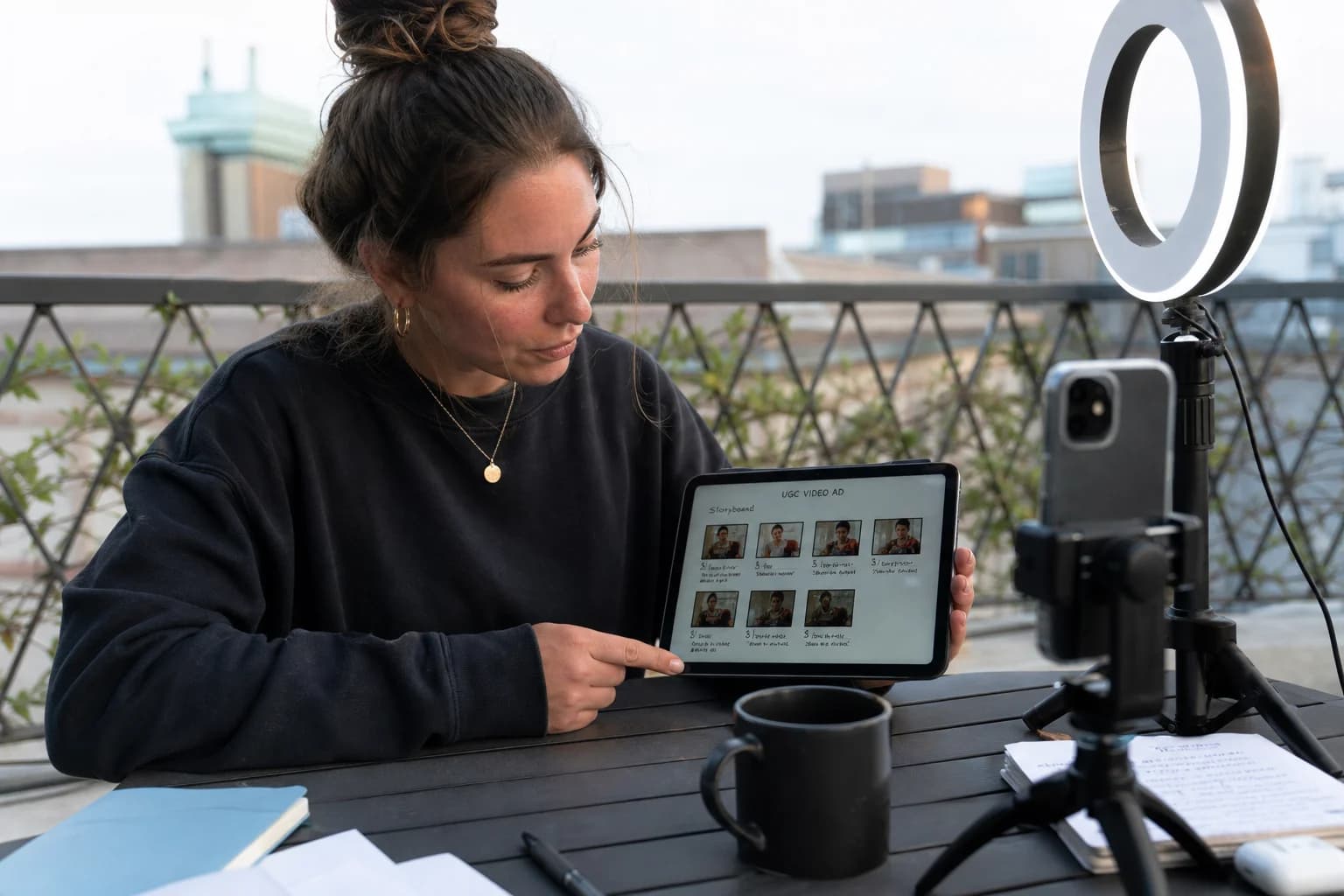
Listen to this article
AI-generated podcast-style overview of this article (not a word-for-word narration).
I spent forty-seven dollars on a UGC ad before I had written the first sentence out loud. The video looked great. Soft light. Ring light reflection in my eyes like every TikTok tutorial promised. Caption font on brand. I hit publish in Ads Manager feeling like a real founder. Three days later I had twelve installs, nine of them bounced before the screenshot upload screen, and a cost per install that would make my $4.99 monthly plan laugh at me.
The problem was not the lighting. It was that I never tested whether anyone cared about the hook. I assumed the hook because I lived inside the app. Strangers do not live inside your app. They live inside a feed that murders attention in under two seconds. Ugc ads consumer app solo founder work starts there: not with cinematic UGC, but with five cheap opening lines and the discipline to kill four of them before you scale.
This piece is the board I wish I had taped above my monitor. How to test UGC-style hooks on Meta before you treat ad spend like a launch event. How to make those creatives without a creator budget. How to structure campaigns so you learn instead of panic-optimize. And when to actually raise budget, which is later than your nervous system wants. If your app is not live in a controlled geography yet, read iOS soft launch for solo founders first. If your paywall appears before strangers get value, fix paywall UX before you pay Meta to send people into a wall.
UGC ads consumer app solo founder: why polish is the wrong first move
The indie ad advice ecosystem loves polish. Hire a creator. Test three hooks in one video. Add captions. Add trending audio. Sync your brand colors. All of that can matter eventually. None of it matters if the opening line does not stop the right person.
Consumer apps sell relief from a small embarrassing moment. Reply anxiety. Meal logging shame. Closet chaos. Photo retouch panic. The hook is the name of that moment in plain language, spoken like a human, in the first three seconds. Everything after is proof. Solo founders invert the order because proof is what we built. We spent months on the app. Of course the demo should lead. Strangers do not know your demo deserves their time until you earn it with a sentence they feel in their chest.
Polish-first ad strategy is a vanity trap. One video. One hook you guessed. Twenty or fifty dollars a day because spending feels like momentum. You optimize CTR because Ads Manager makes it easy to stare at. You do not optimize day-one loop completion because that requires opening App Store Connect and your analytics tool and admitting the ad worked but the product did not. Hook-first strategy is uglier and cheaper. Five videos. Five opening lines. Five dollars a day. Kill anything that cannot buy an install under your rough ceiling. Scale the one that still makes sense after strangers use the app without you.
I am not anti-UGC aesthetics. I am anti-spending aesthetic tax before message tax. Message tax is paid in small increments with your face on camera and your dignity slightly bruised. Aesthetic tax is paid to freelancers before you know if anyone cares about "stop rewriting texts for twenty minutes."
There is also a platform reality. Meta's algorithm needs creative variety to learn, but your learning needs hook variety more than filter variety. Same demo, different confession. Same screen recording, different shame. That is the game at solo-founder scale.
I learned this from a friend who sells a meal-logging app. She spent two weeks arguing about font in captions while her hooks all said "track macros easily." None of them mentioned the shame of opening MyFitnessPal at a restaurant. When she finally recorded "I pretend I will remember this meal later," installs got cheaper overnight. Same app. Same paywall. Different first sentence. That is the whole thesis of this article in one story.
Another trap: confusing UGC format with UGC honesty. You can shoot vertical video with a ring light and still sound like a press release. "Revolutionizing nutrition tracking" is not UGC because your face is in frame. If you would not say it to a friend in your kitchen, do not say it to a stranger in Reels.
The two budgets you are actually running
Every ad test spends two budgets: cash and attention. Cash is visible in Ads Manager. Attention is invisible until it is gone. When you run one polished ad, you spend both on a single guess. When you run five ugly hook tests, you spend cash in thin slices across five guesses and you preserve attention for the winner.
I write my cash budget on a sticky note: max dollars per hook per week. I write my attention budget in the Notes app: max hours I will spend tweaking campaigns before I record new hooks. If I am color-correcting before I have a winner, I am procrastinating in Adobe.
Operator rule
Do not raise daily budget on a hook until it wins against at least two alternatives on install CPA, not just CTR. Pretty CTR with trash retention is a trap dressed as success.
What UGC-style Meta ads actually look like for consumer apps
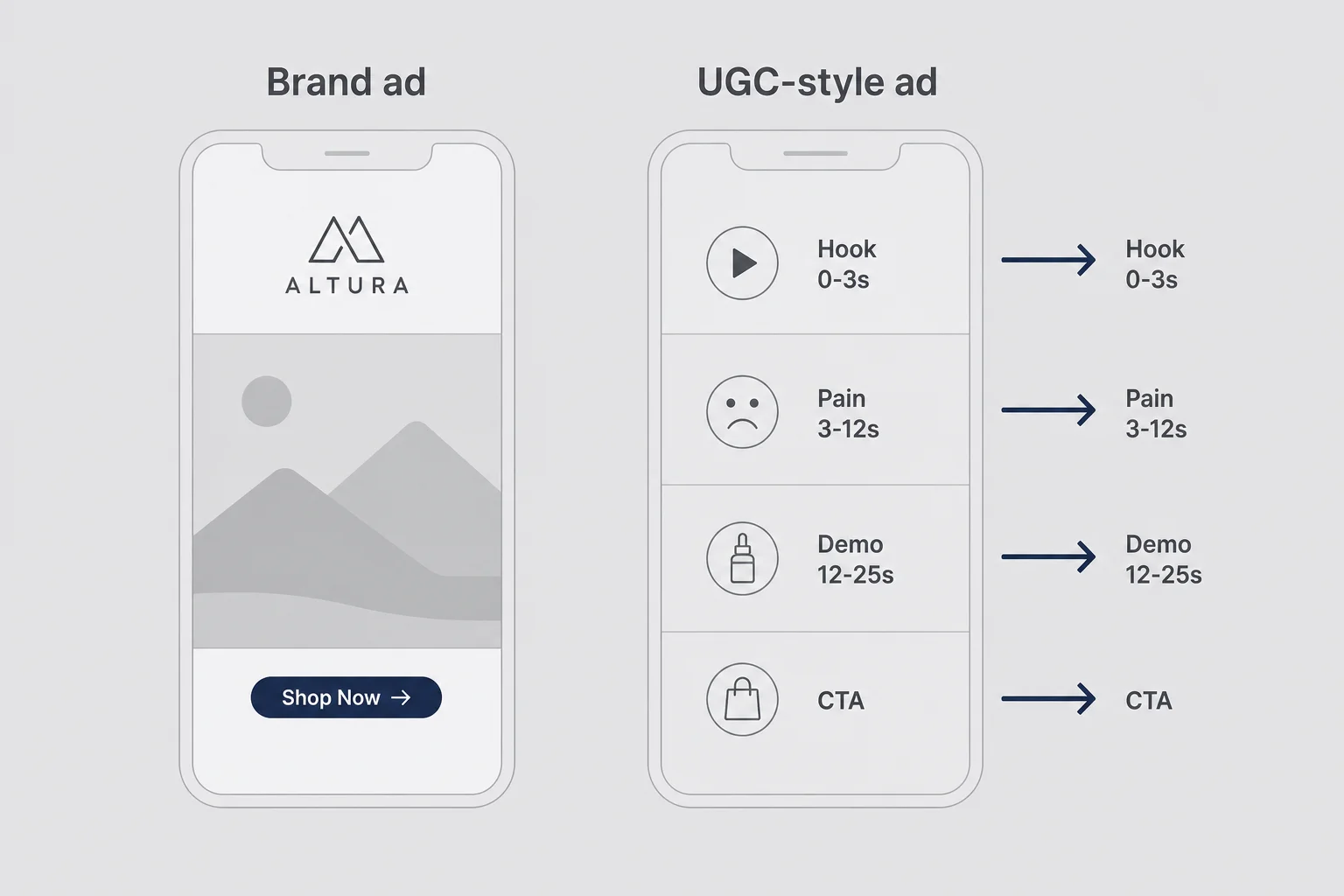
UGC-style does not mean "user generated" in the legal sense. It means the ad borrows the visual language of someone recording themselves on a phone: vertical frame, face or voice in the first beat, imperfect lighting, captions burned in, app demo as screen recording or picture-in-picture. It should feel like content that could almost be organic, without lying about sponsorship if your jurisdiction requires disclosure.
For consumer iOS apps, the anatomy is predictable. Seconds zero to three: hook, spoken or text-on-screen. Seconds three to twelve: agitate the moment or show the pain quickly. Seconds twelve to twenty-five: screen recording of the app solving it once, cleanly, no developer menus visible. Final beats: outcome plus call to action. Install now. Link in bio style line. Do not get clever with "learn more" if you mean install.
Brand ads lead with logo and mood. UGC-style ads lead with confession. "I was about to send something I would regret." "I take forty photos and delete thirty-nine." "My closet is lying to me." You are not describing features. You are describing the feeling your feature interrupts.
Audio matters but not the way Spotify-minded founders think. Trending sounds can help distribution on organic TikTok. On paid Meta placements, clarity beats trendiness. Voiceover or direct-to-camera speech with captions is enough for hook testing. Add music later when you are refreshing a winner, not when you are discovering whether the hook exists.
Length: aim for twenty to thirty-five seconds for first tests. Shorter often wins because consumer apps do not need a saga. You are not selling enterprise workflow. You are selling relief. Long ads can work for story-heavy categories but they cost more to produce and more to learn from. Solo founders should default short.
Placements: for early hook tests, Advantage+ placements or broad automatic placements are fine if you are geo-limited to your soft launch country. Do not micro-manage Stories versus Reels on day one. You do not have enough data to care. You are testing hooks, not placement arbitrage.
What UGC is not
UGC-style is not an excuse for misleading claims. If your app does not delete screenshots from servers, do not imply it with jump cuts. App Review and ad policy are cousins. They both hate surprises.
It is also not permission to never show the product. Hook-first does not mean face-only rambling for forty seconds with a logo sting at the end. Strangers need to see the app work once, fast, without narration that sounds like a webinar.
Finally, it is not only for dating apps and skincare. Any consumer app with a visceral first-session moment can use confession-style hooks. Budgeting apps use shame about checking bank accounts. Habit apps use the couch at 11 p.m. Fit apps use mirror avoidance. Find your version of embarrassment without turning it into cruelty. You are naming tension, not bullying the viewer.
If you are unsure whether your category has a hook, open the App Store reviews of competitors. One-star and five-star reviews both contain raw language about the moment of need. "Finally stopped doom-scrolling recipes I never cook" is a hook hiding in plain sight. Reviews are free voice-of-customer research. Ad libraries are free structure research. Combine them before you hire anyone.
Format checklist before you record
Vertical nine by sixteen. Face or voice in the first frame. Captions on. Demo under thirty seconds. CTA that matches your actual onboarding path. No fake UI states. No competitor logos in your screen recording. Disclosure if your market requires it. That is the whole production spec for round one. Everything else is round two vanity.
The hook test board I run before real budget
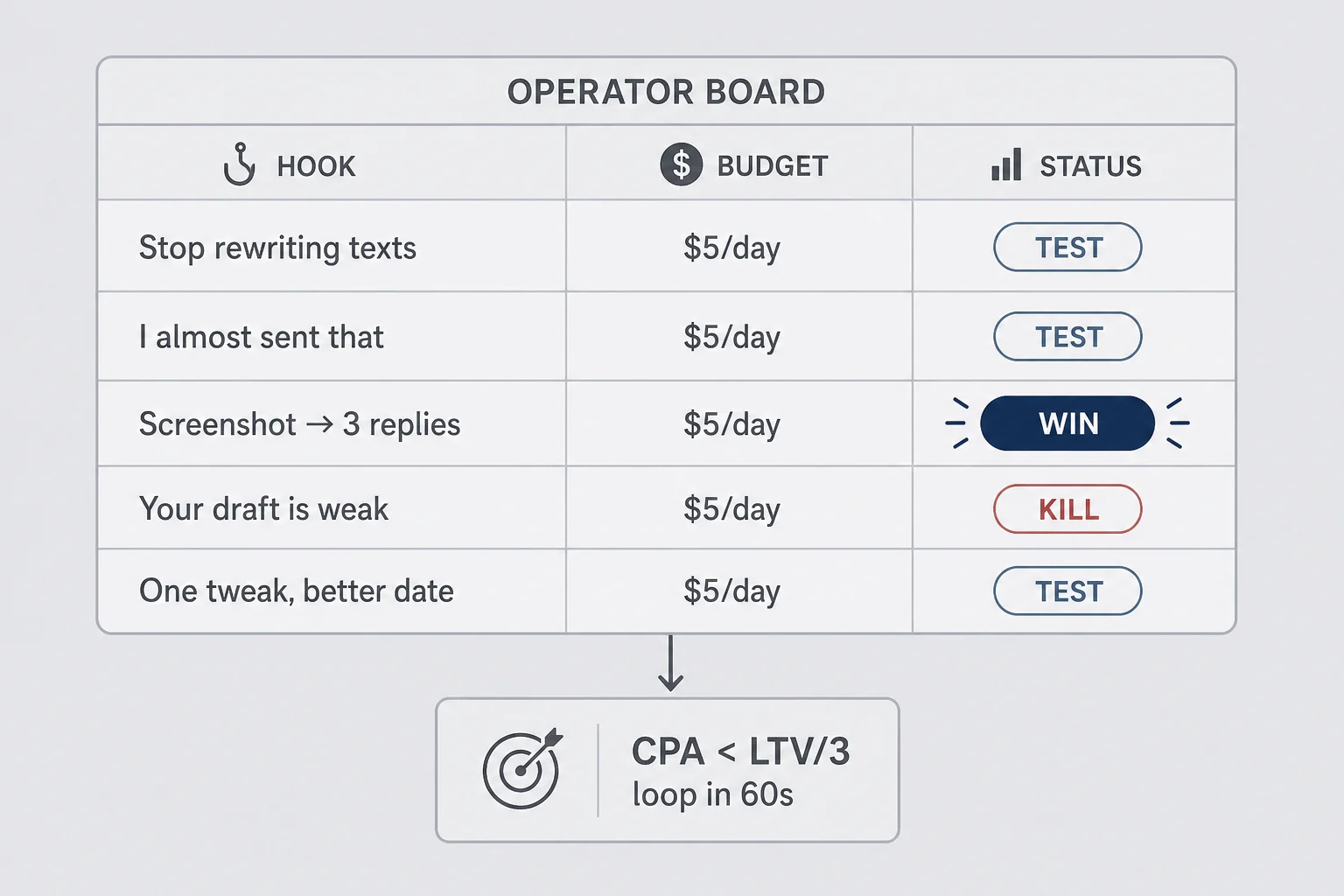
Here is the board. Five hooks. Same app demo stitched under each. Five dollars per day per hook in one ad set or five ad sets with identical targeting, depending on how cleanly you want to compare. Three to five days. Kill losers. Promote one hook to a second test at ten dollars per day. Only then talk about scaling.
Hook one is always the obvious sentence you already say to friends. For Finish Him Replies it was some version of "I rewrite texts too long." Hook two is the near-miss emotional beat: "I almost sent that." Hook three is mechanism-forward: "screenshot in, three replies out." Hook four is social proof shaped like UGC: "my friend uses this when she is stuck." Hook five is POV: "POV: you have been typing for twenty minutes." You will invent better ones for your category. Write ten, record five, test five.
Each hook gets its own video file. Do not cram five openings into one ad and call it a test. Meta will distribute unevenly and you will learn nothing except that you enjoy editing. One hook per ad. Same body. Same demo path. Same CTA. Change only the opening.
Naming convention saves sanity. hook-01-rewrite-text.mp4, hook-02-almost-sent.mp4. In Ads Manager, name campaigns and ad sets with the hook slug too. Future you at midnight will not remember which creative was which.
Kill rules are pre-written before spend starts. Mine: if CPA is more than double my target after three days and at least three hundred impressions, pause. If install-to-loop-completion is under forty percent in my analytics, pause even if CPA looks okay. CTR below half a percent after five hundred impressions, pause. These thresholds are not universal laws. Write yours based on price and funnel. The point is to decide kill criteria while calm, not while watching money tick.
Scale rules are also pre-written. Winner must beat the second-place hook on CPA by at least twenty percent or beat my absolute CPA ceiling, whichever is stricter. Winner must survive one full day of installs without a crash spike. Winner must show paywall view rate that matches organic soft launch, not a cliff. Then and only then duplicate the ad set at higher budget or broaden geo one country at a time.
Where the board lives physically
I use a whiteboard. Five rows. Columns: hook line, spend cap, status, notes. Status is test, win, or kill in marker colors because I am not above drama. Digital works too. Notion table, paper notebook, sticky notes on the monitor bezel. The tool does not matter. The pre-commitment matters.
Review the board every morning before you touch bids. Ads Manager is designed to make you react. The board is designed to make you compare. Reaction optimizes panic. Comparison optimizes learning.
Say your five hooks cost twenty-five dollars a day total. That is one hundred seventy-five a week. Painful if you think of it as marketing spend. Cheap if you think of it as buying five answers to "will a stranger stop scrolling for this sentence." A single fifty-dollar-a-day polished ad buys one guess. The board buys five. Math is on the side of embarrassment.
When a hook survives the first kill round, duplicate it before you change anything else. Same hook, same demo, slightly different caption placement or thumbnail frame. Sometimes the hook is right and the first three frames are wrong. One variable at a time still applies. Do not change hook and music and CTA in the same iteration. You will not know what worked.
Pairing hooks with App Store copy
Your ad hook and your App Store first screenshot should feel like the same conversation. If the ad promises "three replies without overthinking," screenshot two should not lead with "powered by advanced AI." Users notice the tone shift. They bounce before you get credit for the hook that worked.
Subtitle and promotional text are underrated ad extensions. You do not need to stuff keywords. You need to continue the emotional promise. Soft launch is the right time to align these pieces because traffic is small enough to iterate without a mob watching.
Mining hooks from the embarrassing moment your app fixes
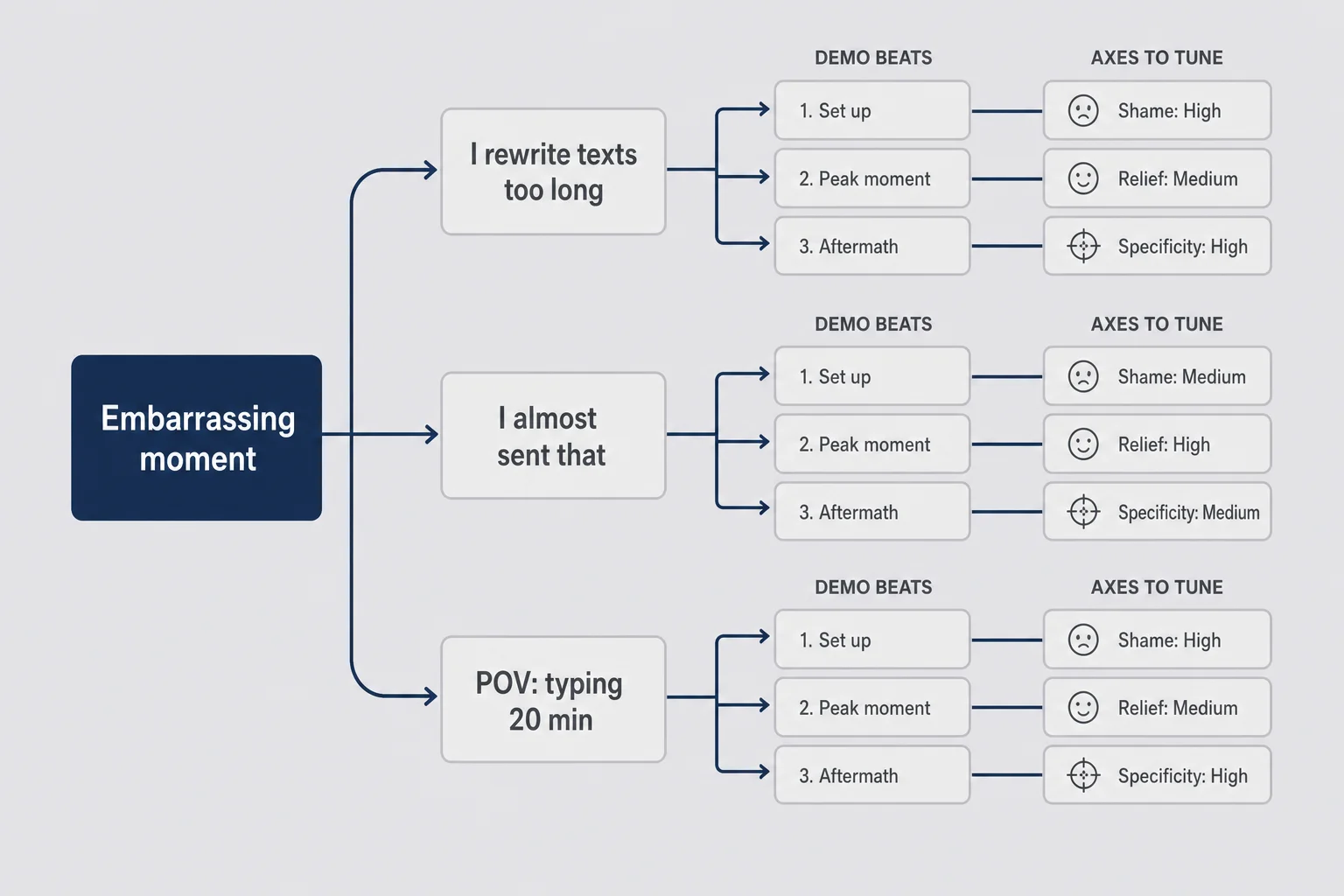
Hooks are not marketing copy. They are the internal monologue your user has right before they open the App Store search bar. Mining them means listening for that monologue everywhere except inside your own head.
Start with support email and TestFlight notes if you have them. Real sentences beat brainstormed ones. "I stared at the reply box for an hour" beats "AI-powered messaging assistant." If you do not have users yet, use your own diary entry from before you built the app. You are the first user persona until proven otherwise.
Interview yourself with annoying literalism. What were you doing? Where? What did it feel like in your body? What did you almost do wrong? What would have happened if you did? The hook usually lives in the almost.
Map hooks on three axes: shame, relief, and specificity. High shame hooks work for personal categories if you stay kind. High relief hooks work when the pain is tiring rather than embarrassing. Specificity beats cleverness every time. "Three reply options from one screenshot" beats "communication supercharged."
Write hooks as spoken lines, not taglines. Read them out loud. If you stumble, strangers will scroll. If you feel cringe, notice whether it is because the line is too honest or because you are imagining your ex seeing the ad. Too honest often converts. Ex-fear is not a business metric.
Keep a hook backlog in the same doc as your App Store subtitle experiments. They should rhyme. If your subtitle says one thing and your ad says another, you pay for confusion.
I keep a running doc called "things I almost did." Almost sent the text. Almost bought the dress. Almost logged the meal. Almost deleted the photo. Those almost lines are hook gold because they are true and specific. When I cannot think of a fifth hook, I read that doc for five minutes and record whatever makes my stomach tighten.
Steal structure, not sentences
Competitor ads in the Meta Ad Library are fair game for structure study. Note how fast they show the product. Note whether they lead with face or screen. Do not copy lines word for word. Copy the beat map: confession, demo, result.
Organic TikTok search in your category is another mine. Sort by relevance, not likes. Likes reward entertainment. You want recognition grunts. Videos where comments say "this is me" are hook textbooks.
Making UGC-style video without a creator budget
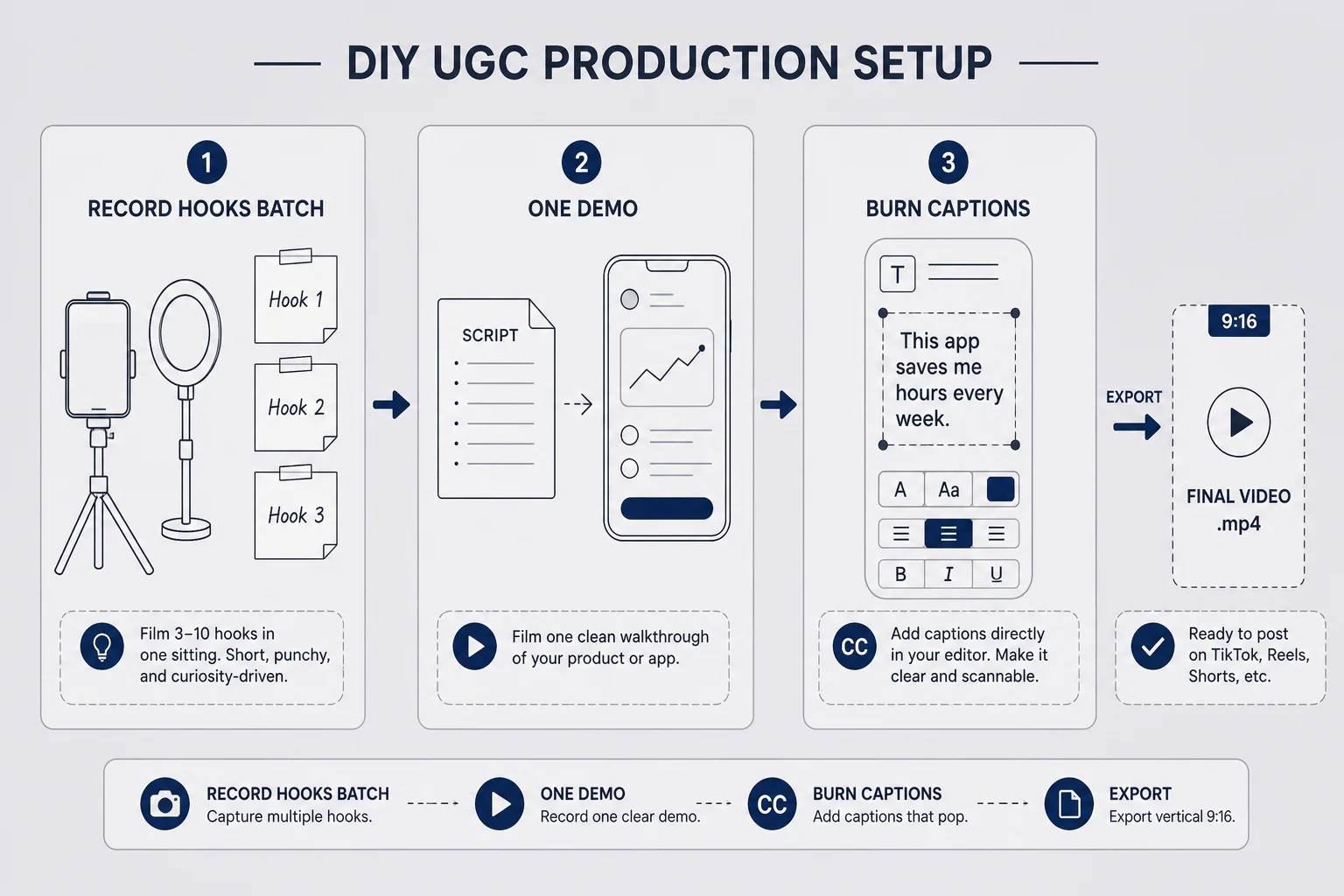
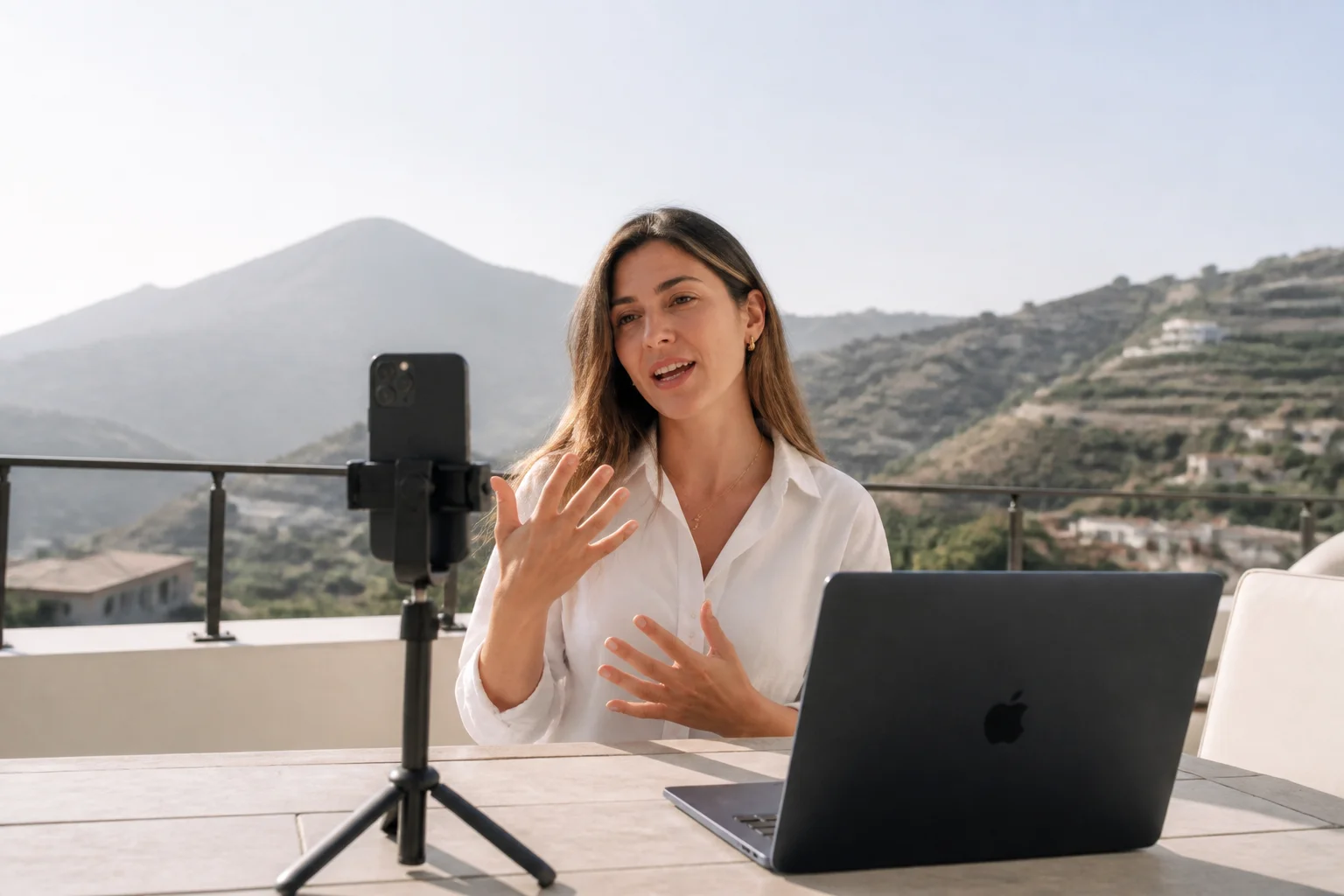
You need a phone, a quiet corner, and enough shame tolerance to talk to the lens twice. That is the solo-founder UGC studio. Everything else is optional until you have a winning hook worth beautifying.
Record hooks in batches. Ten openings in twenty minutes. Change shirt between hooks if you care about continuity later. Do not stop to edit between takes. Momentum beats perfection. Screen-record the app demo once on a clean test account with notifications disabled. Use the same demo for all hooks so comparison stays fair.
Lighting: face a window or use a twenty-dollar ring light. Meta compression will punish darkness. Audio: quiet room, phone mic close enough. Captions: non-negotiable. Most people watch muted. Burn in captions with large readable type. Tools like CapCut are fine. iMovie is fine. FFmpeg if you are Max. I use CapCut because I am not Max.
Keep the app demo tight. Tap only what matters. No settings tour. No account creation unless account creation is the product story. For subscription apps, show free value first, then where premium would appear without faking a purchase. Do not screen-record your sandbox receipt flow and pretend it is production.
Export vertical nine by sixteen. Meta will crop and place across Reels and Stories. Upload the highest quality you can without sending files through five compressors. One export per hook.
If your face on camera is not right for the category, use voiceover on b-roll of hands and phone. Still UGC-adjacent. Still hook-first. Do not hide behind motion graphics because you are shy. Shyness is cheaper than a creator invoice, but voiceover plus hands is a middle path.
When to hire a creator
Hire when you have a hook that wins small and you need fresh faces for fatigue reasons, or when your category demands higher production trust, like health or finance. Hand the creator a brief with the winning hook script, the demo beats, and forbidden claims. Pay for usage rights in writing. Cheap UGC marketplaces exist. Quality varies. For hook discovery, your face is free and available tonight.
Meta campaign setup for solo founder hook tests
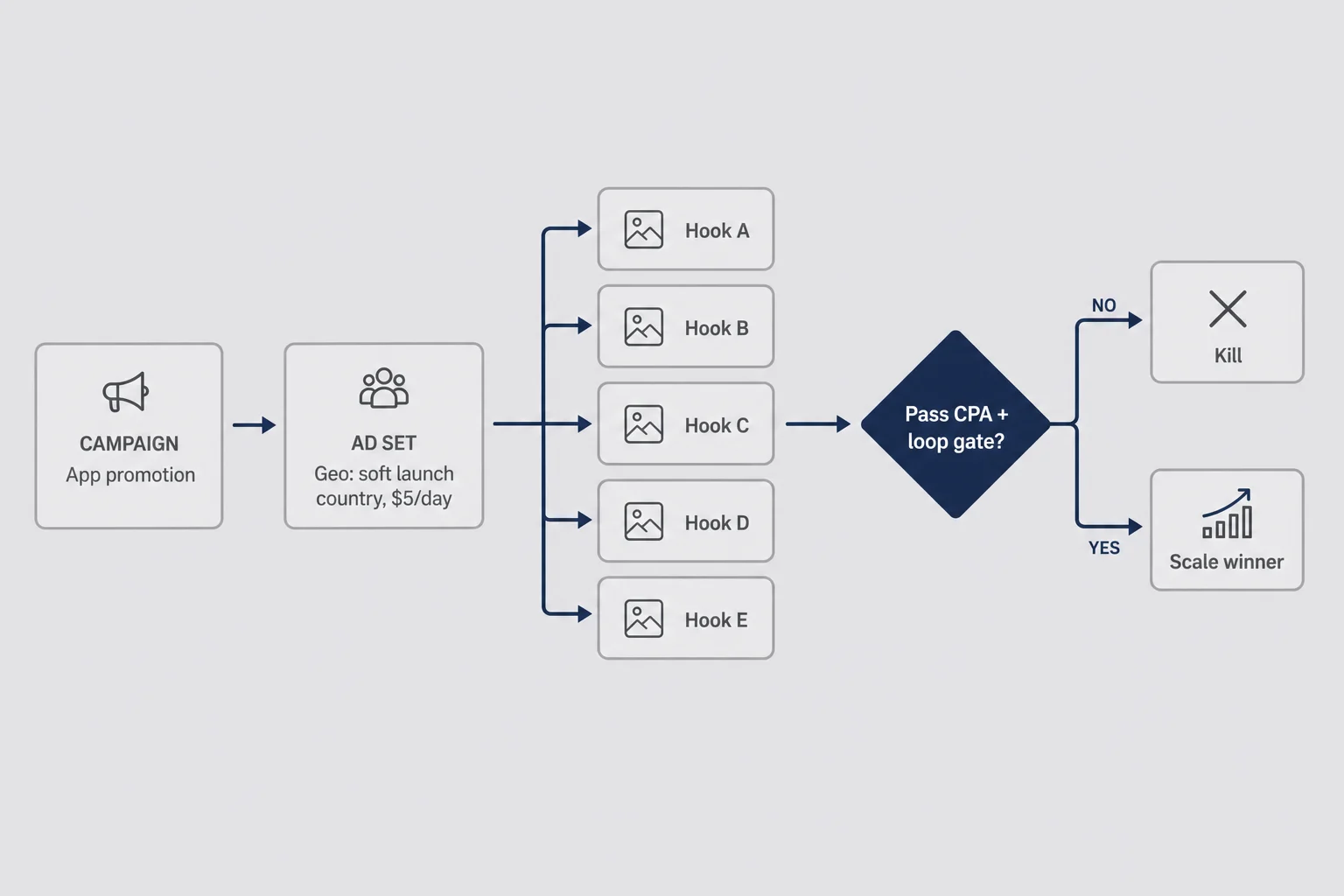
Campaign objective: App promotion or Sales with app events, depending on what your pixel and MMP setup supports. Many solo iOS founders start with App promotion pointing at the App Store URL for simplicity. If you have SKAN and an MMP configured, you can get fancier later. Hook testing does not require a perfect attribution stack. It requires consistent comparison.
Geo: match your soft launch country. If you are live in New Zealand only, run ads in New Zealand only. Mixing geos before you understand unit economics is noise. If you are worldwide live already, pick one English market you can support and stick to it for the first board.
Audience: broad is fine for consumer apps with emotional hooks. Advantage+ audience on a small budget often outperforms hyper-targeted interest stacks built from guesses. You are not selling forklift software to procurement managers. You are selling relief to anyone with the problem. Let the hook select.
Structure option A: one campaign, one ad set, five ads. Simplest. Meta will favor one ad early. Watch distribution. If one ad hogs spend before others get impressions, duplicate into five ad sets with one ad each and equal budgets. Structure option B: five ad sets, one dollar each if minimums allow, or five dollars each. Cleaner comparison, more clicking in Ads Manager, worth it if you are serious.
Daily budget per hook at five dollars is not statistically perfect. It is solo-founder realistic. You are not running a growth team. You are buying directional signal. Increase to ten only after you trust your kill rules.
Turn off automatic enhancements that rewrite your creative if you are comparing hooks literally. You do not want Meta swapping your opening line because it thinks it can do better before you learn.
For broader Meta campaign structure beyond hook testing, see Meta ads for iOS apps as a solo founder. That piece covers unit economics and campaign architecture. This piece is the creative layer underneath: which sentence earns the right to spend.
Track UTMs or use Apple's campaign parameters in your App Store URL if you want cleaner source reporting in App Store Connect. Not mandatory for hook one versus hook two, but helpful when you promote a winner.
The Ads Manager trap door
Ads Manager will suggest raising budget when CTR spikes on day one. Ignore it unless your board says scale. Early CTR is often curiosity, not intent. Wait for install volume and behavior. The platform optimizes for its revenue. You optimize for yours.
Check frequency. If the same tiny audience sees your face twelve times in three days, your hooks will fatigue together. Broaden slightly or accept that small geo tests get noisy.
What to measure before you raise ad spend
Ads Manager metrics are the appetizer. Product metrics are the meal. Solo founders stop at appetizer because the numbers update faster and arguing with Meta feels like work.
Track at minimum: impressions, CTR, CPC, installs, CPA. Then immediately leave Ads Manager and check: percent of new users who complete your core loop in the first session, paywall view rate, trial start or purchase rate if applicable, day-one retention, crash rate on new installs. A hook that buys cheap installs that never upload a screenshot is not a winner. It is a museum of bounced intent.
Define your core loop event in analytics before spend. One event. Not twelve. For a reply app it might be "generated first reply." For a photo app it might be "exported edited image." For a journal app it might be "saved first entry." Hook tests exist to move that number on cold traffic.
Compare ad users to organic soft launch users on the same events. If organic users hit the paywall after value and ad users bounce before, your ad promise and onboarding first screen disagree. Fix copy alignment before scaling.
Retention day one does not need to be beautiful yet. It needs to not be a cliff unique to paid users. If paid users retain half as well as organic, your hook might be attracting the wrong people or your onboarding might be lying about what the app does.
Refund and support volume matter too. A hook that overpromises "instant perfect results" will spike refunds and angry email. Read the first ten support messages from ad installs word for word. They are free creative briefs for hook two.
A simple scorecard
I keep a spreadsheet with one row per hook. Columns for spend, installs, CPA, loop completion percent, paywall view percent, purchase or trial percent, day-one retention, notes. Color the row green only if CPA and loop completion both pass. Yellow if one passes. Red if neither. Scale only greens. This sounds obvious. Obvious is easy to skip when you are tired.
If you use RevenueCat or similar, compare trial conversion on ad cohorts versus organic. A hook that attracts bargain hunters who start trials and cancel day one is worse than a hook with higher CPA but better trial retention. LTV thinking is hard on day three of testing. Directional LTV thinking still beats CTR thinking.
Watch install time to first open. If people install from an ad and open the app hours later, your hook might be fine but your CTA urgency is off. If they never open, you might have accidental clicks or a misleading frame. Both are fixable without raising budget.
Connecting ads to paywall experiments
Ad traffic is the harshest paywall QA you can buy. People who saw "three free replies" in your hook will riot internally if the paywall appears before reply three. Match your free tier limit to ad language. If you change limits, pause ads until copy aligns.
Run one week of hook tests before you A/B test paywall headlines. Otherwise you are optimizing the lock on a door people never reach. Sequence matters. Funnel order is product design, not just growth trivia.
When a hook wins — and what you do next
A winning hook is not a license to 10x budget overnight. It is permission to run a second experiment with slightly more money and slightly more geography. Promote the winner to ten dollars per day for five days in the same country. If metrics hold, duplicate the ad set to a second country with similar support characteristics. If metrics hold again, consider creative refresh: new face, tighter edit, same hook line.
Creative fatigue is real. Winners die. When CPA creeps up twenty percent week over week on stable budget, record three hook variants on the same beat before you raise bids. Sometimes the line needs a refresh, not more cash.
Build a landing rhythm. Hook tests weekly or biweekly while you are learning. Batch record Sundays. Launch Mondays. Review Fridays. Do not live in Ads Manager daily. That is how you optimize thumbnails instead of product.
When a hook wins, document why you think it won in one sentence. "Specific shame beat plus immediate demo." Future hooks should rhyme with that sentence, not random new angles.
Pair winning hooks with App Store product page experiments if you have enough volume. Ad hook and screenshot story should match. Mismatch taxes you twice.
Eventually you might hand the winning script to a creator, add B-roll, add music, add localized versions. That is scaling creative, not testing hooks. Different phase. Different budget. Same board rules.
Document your losing hooks too. "Revolutionize your texting" lost. "I almost sent that" won. Losers teach you what language your audience rejects. Keep them in the backlog doc with a red X so you do not romanticize them later because you liked how they sounded in the shower.
When you broaden geography, re-run the board lightly. A hook that wins in New Zealand might fatigue or misfire in the United States. Same product, different cultural bluntness. I am not saying start over. I am saying watch CPA for the first seventy-two hours after geo expansion like you watched the first test.
Knowing when to stop ads entirely
Sometimes no hook passes gates. That is data. It might mean the problem is not visceral enough for paid social. It might mean your demo is slow. It might mean your price or paywall timing is wrong. It might mean Meta is not your channel. Before you triple budget out of spite, walk the funnel on a fresh phone install from ad click. Feel where it breaks. Ads are amplifiers, not inventors.
Ads only work if the app behind them holds
Paid traffic is a fire hose pointed at your onboarding tub. If the tub has holes, more water is not the answer. Hook testing assumes the product behind the click is ready for strangers.
That means soft launch discipline. Crash-free sessions acceptable. Core loop completable without a tutorial voiceover from you. Paywall after value, not before, for most consumer apps. Privacy copy that matches what the ad implied. Production StoreKit, not sandbox cosplay.
Read iOS soft launch for solo founders as the prerequisite hallway. Ads in one country while live in one country keeps support sane. Ads worldwide while your build is flaky is how you fund public one-stars.
Paywall UX is the other door. A winning hook that promises "three replies in ten seconds" dies when the paywall appears before the first reply generates. Paywall UX for solo founders is not a separate marketing topic. It is the back half of your ad promise.
Onboarding copy should echo the hook without parroting it awkwardly. If the ad said "stop rewriting texts," the first screen should not talk about "advanced NLP pipelines." Translation matters. You are continuing a conversation that started in the feed.
If your app requires permissions, the ad should not pretend otherwise. Show the permission moment in the demo if it is essential. Surprise permission dialogs kill trust faster than ugly lighting.
Retention fixes beat bid tweaks. If day-seven retention is weak, ads will not fix that. They will import more people to leave. Fix the loop, then return to the hook board.
Amplifier rule
Never scale ad spend to fix a product problem. Scale when the product holds and the hook selects the right strangers cheaply.
How I burned pocket money on pretty ads nobody finished watching
Confession time, since we are in the UGC genre. My first ad had a hook buried at second eight because I wanted a cinematic look-up from my coffee cup first. Beautiful cup. Austin morning light. Zero installs that completed a reply. I moved the hook to second zero on the next batch and cut CPA in half without touching targeting.
Second mistake: one ad set, three hooks in one video with chapter markers. Meta spent eighty percent on the first hook because the algorithm is not your science teacher. I split them. Learning resumed.
Third mistake: scaling because CTR was high. Turns out people clicked to see if the app was real, then bounced at account creation I thought was "minor." It was not minor. It was a wall. I removed optional signup for the first session. Retention improved. CPA meaning improved.
Fourth mistake: ignoring caption size. I used thin stylish captions. Silent viewers scrolled. Thick captions are not ugly. They are accessible.
Fifth mistake: running ads before my soft launch country had production billing tested on a stranger's phone. I got one purchase that failed to restore and a support thread that ruined my evening. Fix billing paths first. Then hooks.
These are not morality tales. They are cheap tuition if you stop early. The board exists so tuition stays pocket-sized.
What I would do differently starting over
Record hooks before I touch Ads Manager. Set kill rules in writing. Match geo to soft launch. Compare five hooks minimum. Check loop completion before I tell anyone on Twitter I am "running ads now." Keep creative ugly until one hook survives a ten-dollar-a-day promotion. Hand that winner to a creator if I need fresh faces. Never confuse spend with progress.
Questions founders ask about UGC ads for consumer apps
What are UGC ads for a consumer app?
UGC-style ads look like a real person talking to their phone camera about a problem your app solves, not a polished brand commercial. For consumer iOS apps on Meta, they usually mean vertical video with a confession-style hook in the first three seconds, a quick demo of the app, and a clear next step. The format matters less than whether the opening line names an embarrassing moment your reader recognizes.
How much should a solo founder spend testing UGC hooks?
Enough to get statistically noisy but directionally useful signal, not enough to fund Meta's yacht. A practical starting point is five hooks at five dollars per day each for three to five days, so roughly seventy-five to one hundred twenty-five dollars per test round. You are buying hook comparisons, not scale. If none of the five hooks can buy an install under your rough CPA ceiling, fix the hook or the landing experience before raising budget.
Can I make UGC ads without hiring creators?
Yes, and for early hook testing you probably should. Record yourself or a willing friend with a phone and a cheap ring light. Read different opening lines into the camera, then screen-record the app demo. UGC at this stage is about voice and hook, not production value. Hire creators later when you have a winning hook to hand them, not before you know which sentence makes strangers stop scrolling.
When should I scale spend on a winning UGC hook?
When the hook beats your CPA gate on small budget and day-one behavior looks sane. That means installs complete your core loop without you narrating, paywall or trial flow works on cold traffic, and support email is not exploding. Scaling a hook that only wins on thumb-stop rate but loses everyone after install is how solo founders fund Meta's margin with nothing to show in App Store Connect.
Should I run UGC ads before or after App Store soft launch?
After you have a stable build in at least one live country with production StoreKit and acceptable crash rates. Paid traffic amplifies whatever is broken. Soft launch in a small geography first, fix onboarding and paywall timing, then send cheap hook tests to that same market so support load stays containable. Running ads worldwide before soft launch is paying strangers to find bugs you could have caught in New Zealand.
What is the difference between a hook test and a creative refresh?
A hook test compares opening lines and angles on the same core demo with pocket-change budget. A creative refresh is what you do after you have a winner: new faces, tighter editing, seasonal copy, or platform-specific crops. Solo founders skip straight to refresh because polished ads feel productive. Hook testing feels cheap and embarrassing. Embarrassing is cheaper than a thousand-dollar learning that your app demo never mattered because nobody got past second three.
Test the hook, then argue about cinematography
I still want pretty ads. I still notice ring lights on other founders' launches. The difference is sequence. Hook first. Polish second. Scale last. The ugc ads consumer app solo founder playbook is not about pretending you have a growth team. It is about running a small honest experiment that respects how little attention you are buying in a feed full of people who did not ask to meet your app.
Tonight, write five opening lines that sound like thoughts your user has in a bad moment. Record them tomorrow with the same demo underneath. Run them at pocket change. Kill the losers without mourning. Keep the winner only if strangers finish the job your app promises. Fix the product when they do not. Then, and only then, make it pretty enough to scale.
Your first ad does not need to win awards. It needs to win a comparison.


Comments