Your App Store Listing Is Not Where Strangers Find You
How to use TikTok organic and paid as a solo founder with a consumer app: hook posts, profile-to-App Store ramp, Spark Ads on winners, and what to measure before you burn weekends on content.
 By Iryna26 min read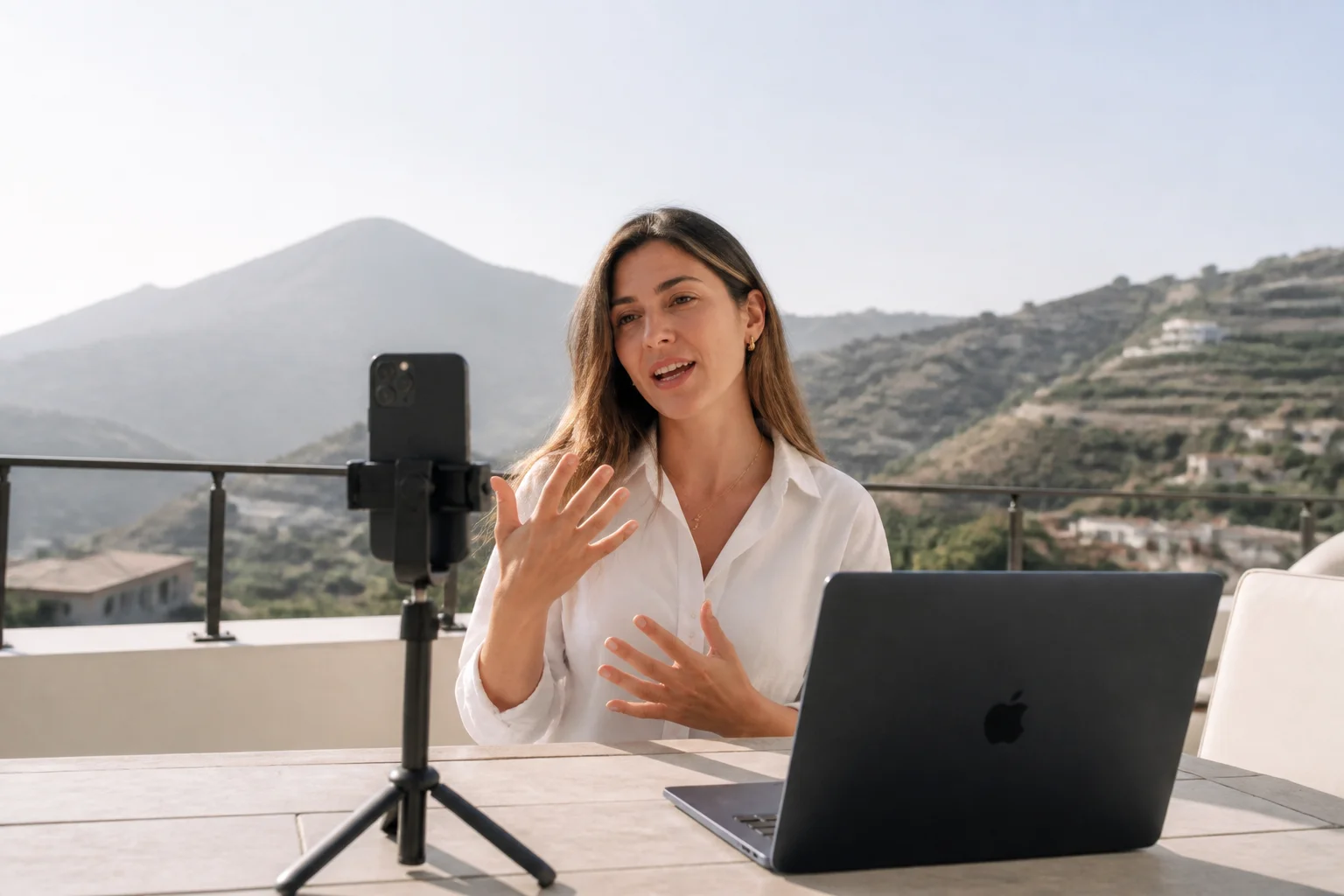
Listen to this article
AI-generated podcast-style overview of this article (not a word-for-word narration).
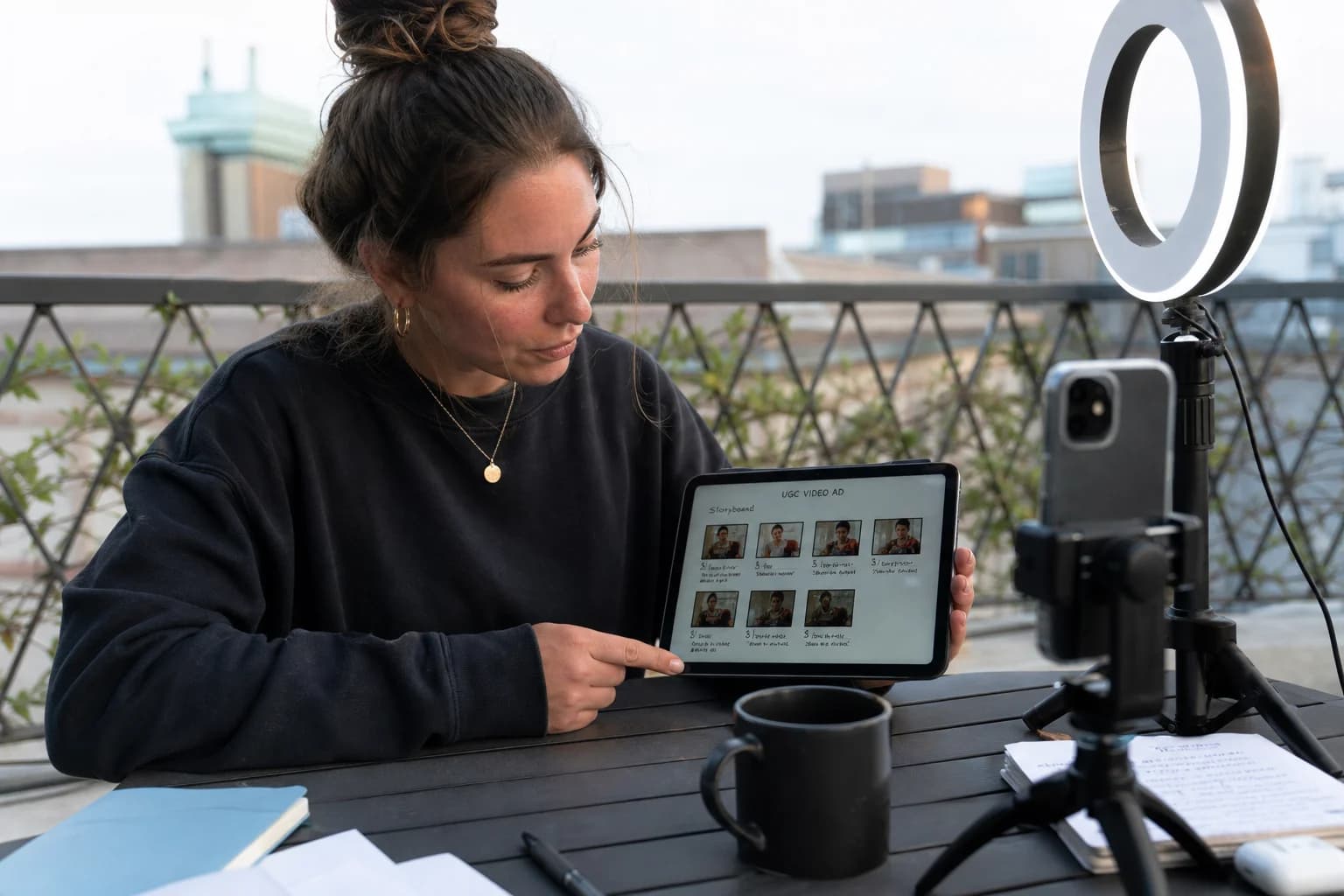
I filmed my forty-seventh TikTok for Finish Him Replies on a Tuesday that was too hot to sit inside. Ring light on a wobbly tripod. Phone propped on a stack of design books. Me, reading a fake dating-app message out loud, then cutting to the app spitting out three replies while I pretended to pick one. The video got eleven thousand views. My App Store Connect downloads chart did not move. Not one blip.
I refreshed Connect so many times that afternoon I felt like a weather app addict. Views were up. Profile visits were almost flat. I had made entertainment, not discovery. That hurt more than a flop with two hundred views would have, because eleven thousand looks like success on a screenshot you send friends. It is not success if nobody taps your bio.
That is when tiktok marketing consumer app solo founder work stopped being "maybe I should post" and became a funnel I had to understand or stop wasting evenings. TikTok is not magic distribution. It is a discovery ramp: hook post, profile tap, App Store listing, first session that proves the hook was honest. Organic proves which hooks pull strangers toward your app. Paid amplifies the winners. Everything in between is product work dressed up as marketing.
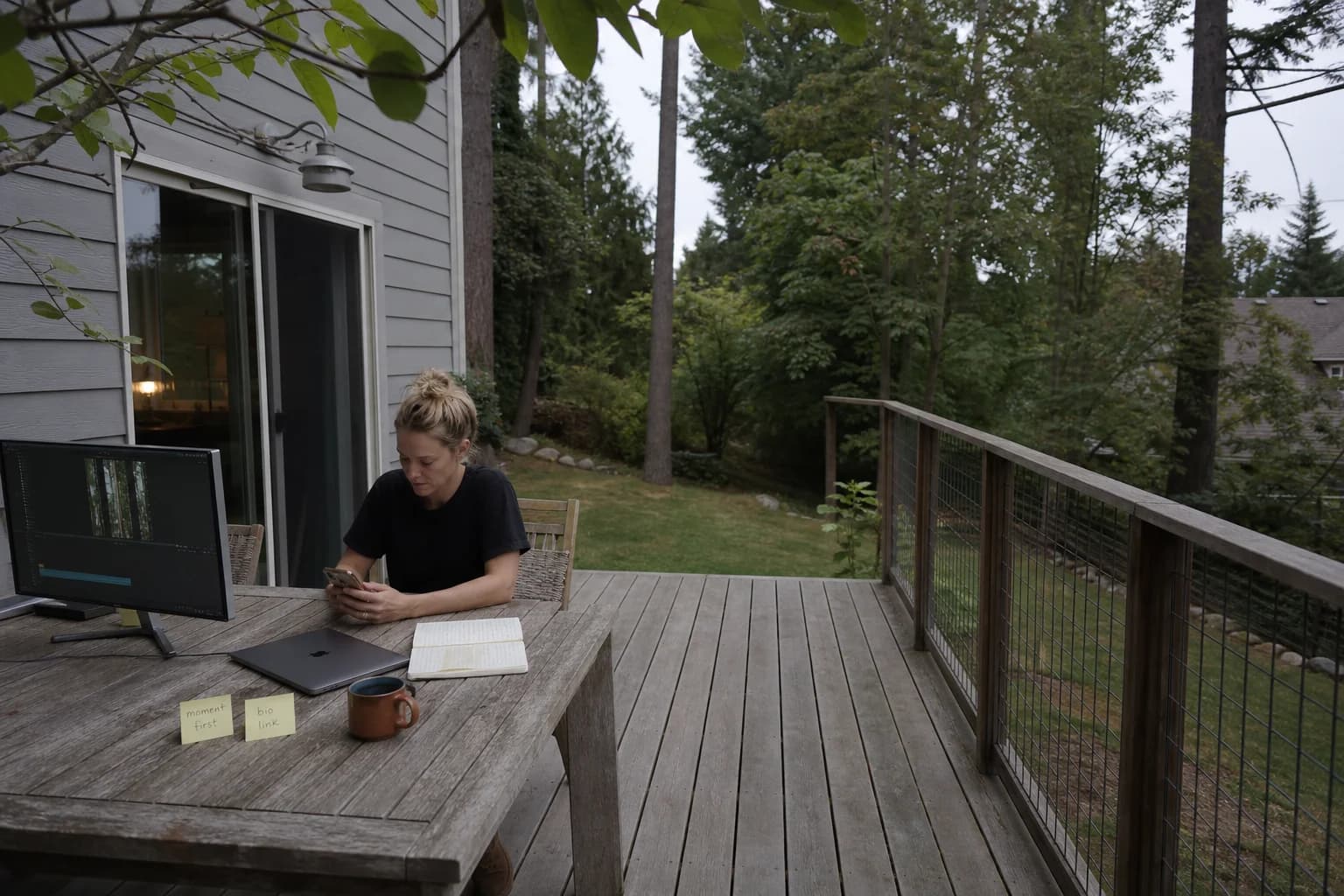
I am not a creator with an agency. I am a designer who ships one consumer app and films on a terrace when the light cooperates. If you are looking for B2B LinkedIn playbooks, Reese has those. If you want App Store mechanics without the video part, you already have posts on App Store optimization and iOS soft launch. This piece is what happens when short-form video meets a personal app in your pocket and you are the entire marketing department.
TikTok marketing consumer app solo founder: the App Store is not where discovery starts
The fantasy I carried for months went like this. Polish the listing. Pick the right keywords. Soft launch in one country. Wait for search to do its quiet job. Maybe post on Instagram. Downloads arrive while I sleep.
Search matters. App Store optimization is real homework. But for a first consumer app with no brand and no reviews, the store is a library shelf in a building nobody visits yet. Strangers do not search for an app they have never heard of. They scroll past a face or a screen recording that names an embarrassment they already have, tap the profile, and only then decide whether your icon deserves a download.
That is the mental flip. TikTok is upstream of the App Store for many B2C apps, especially ones tied to dating, appearance, money guilt, productivity shame, or any problem people already meme about. Your listing is the closing argument. TikTok is how some people first learn the argument exists.
Why consumer apps fit TikTok better than B2B tools
B2B founders sell outcomes to buyers who read case studies on LinkedIn. Consumer apps sell relief to people who are bored on the toilet at 11 p.m. TikTok meets them there. The format rewards a problem on screen in second one, a payoff by second fifteen, and a reason to tap the profile before the loop restarts.
Finish Him Replies is an obvious fit: screenshot, panic, three replies, exhale. A habit tracker is a fit if you film the guilt of breaking a streak, not the chart UI. A budget app is a fit if you open with "why did I spend forty dollars on delivery again," not pie graphs. If your entire value prop is a spreadsheet for accountants, you are reading the wrong article.
The discovery ramp, not the viral lottery
I chased virality early because virality feels like validation. Views are loud. Installs are quiet. The ramp I use now is boring on purpose.
Stage one: a hook post that shows the problem your app touches, with your face or your phone screen in frame so it feels human. Stage two: profile tap driven by curiosity ("what app is that?"). Stage three: App Store product page that matches the promise in the video. Stage four: first session where the stranger completes the core loop without you in the comments explaining steps.
Each stage has a gate. No gate passed, no paid spend. I treat TikTok like soft launch geography: widen only when the last step holds.
Views without profile taps
A video that gets fifty thousand views and zero profile visits taught you the hook was entertaining, not commercial. Do not boost it. Write a new hook.
Where TikTok sits in your grow stack
You are not abandoning ASO, TestFlight, or email. TikTok is one acquisition lane. For solo founders with emotional consumer apps, it is often the cheapest way to put real strangers in front of your value prop before you spend on Apple Search Ads or Meta install campaigns. It is also the easiest place to lie to yourself with vanity metrics if you are not tracking profile taps and store visits alongside views.
Think of TikTok as top-of-funnel creative testing that happens in public. Every post is a micro experiment on which embarrassment converts to curiosity. The App Store is where curiosity converts to install, if your screenshots and first line match the video. Consumer app retention is where install converts to revenue, if the first session delivers what the hook promised.
The numbers I actually watch
Say your best post hits eight thousand views, two hundred forty profile visits, and eighteen link clicks in forty-eight hours. That is a three percent profile tap rate and a seven point five percent link click rate from profile. Good enough to film five variations. If the same post gets eight thousand views and eleven profile visits, the hook was a party trick. Do not Spark Ad it. Do not remake it with a new filter. Write a new opening line.
Installs will lag and attribution will stay fuzzy. That is normal for organic. You are still allowed to notice that Tuesday's spike in App Store product page views followed Tuesday's post about screenshot panic. Round numbers in a notes app beat a perfect dashboard you never open.
When TikTok is the wrong channel
If your app needs a fifteen-minute setup before value, TikTok will disappoint you. If your buyer is a procurement team, go read Reese. If your core value is invisible (background VPN, enterprise SSO), there is nothing to film in three seconds. If you are pre-TestFlight with a crashing build, fix the build. TikTok sends strangers who will not forgive you for wasting their thumb tap.
What TikTok actually does for a consumer app
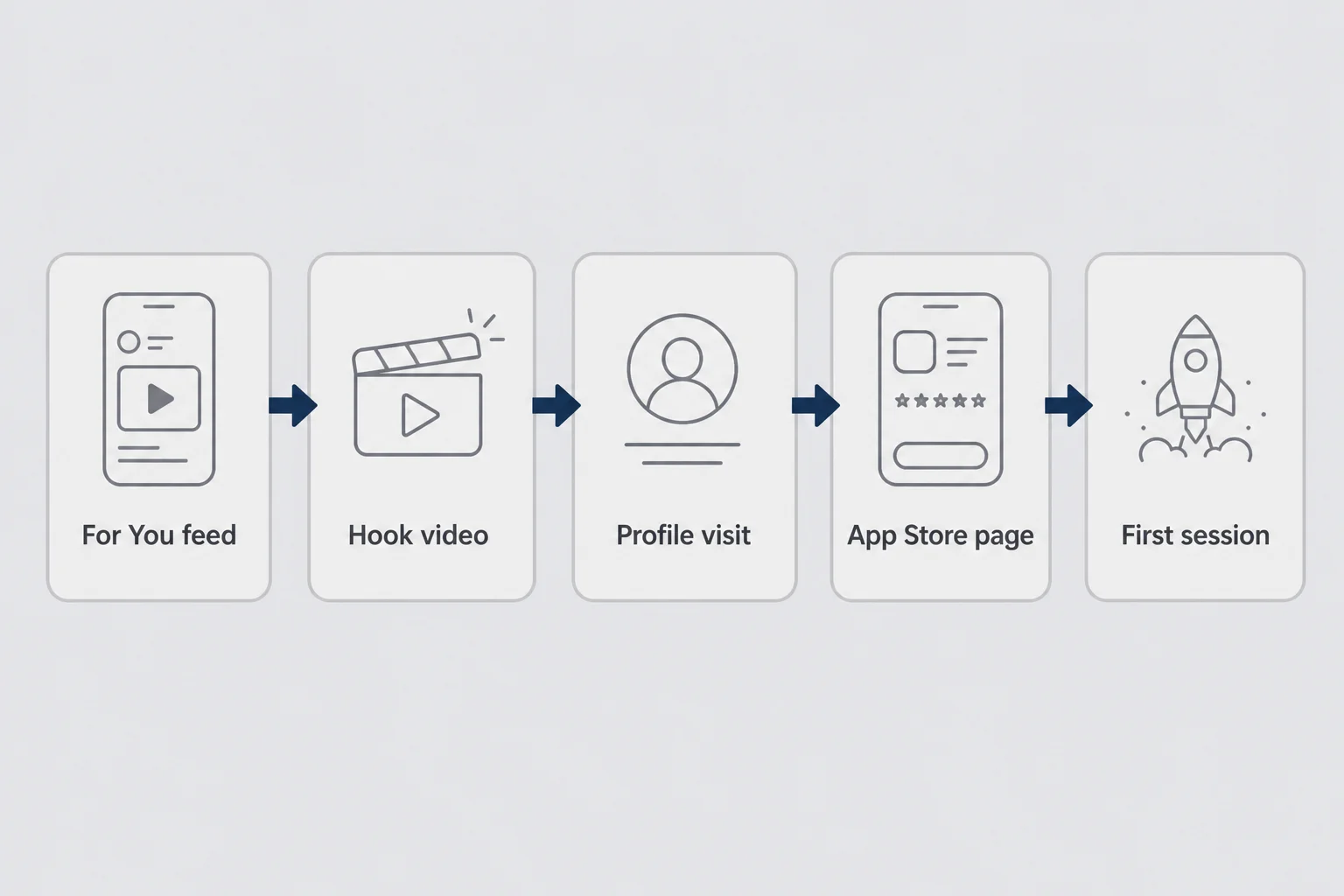
TikTok is not brand awareness in the billboard sense. It is interruptive discovery. A stranger who never would have typed your app name into search sees a seven-second story that mirrors something they did last night. The algorithm is the matchmaker. Your job is to be legible in one glance.
For consumer apps, TikTok does three jobs when you are honest about measurement.
First, it tests hooks faster than any landing page split test you could build alone. You learn which opening line makes people stop scrolling. Second, it builds a proof library. Comments that say "I needed this" are qualitative validation you can screenshot for App Store screenshots or future ad creative. Third, it feeds paid. Spark Ads work best when they amplify a post that already earned engagement organically, not when they introduce a brand-new story cold.
Organic vs paid on TikTok for apps
Organic is your R&D lab. Post often enough to learn, rarely enough that you burn out filming. Paid is your amplifier, not your substitute. I see founders skip straight to app install campaigns with polished ads that never lived on the feed. Those ads look like ads. They cost more. They teach you less.
The split I use: three to four organic posts a week until one consistently drives profile taps. Then put ten to twenty dollars a day behind that post as a Spark Ad and watch cost per install. If organic never produces a winner, paid will not save a weak hook. Fix the opening three seconds.
TikTok vs Instagram Reels for app discovery
Reels overlap in format but differ in culture and link behavior. TikTok's For You feed is more aggressive about showing strangers your post. Instagram still leans on existing followers for many accounts. For a zero-audience founder, TikTok is often the faster place to test cold attention. Reels can work as a repost lane once you have a hook that wins on TikTok. I do not film twice. I post on TikTok first, remove the watermark, repost to Reels the next day if the hook performed.
Do not spread yourself across six platforms before one channel shows profile taps. That is the same mistake as launching worldwide on day one. One ramp. One metric that matters this month.
How TikTok differs from Reddit or Twitter for apps
Reddit rewards long, specific help in threads where self-promotion is policed. Twitter rewards replies under other people's audiences if you are patient. TikTok rewards pattern interrupt in the feed. For visual, emotional consumer problems, TikTok compresses the story fastest. I still post on Reddit for feedback and on Twitter for founder friends. Neither replaced TikTok for cold discovery of Finish Him Replies. They are different rooms. Pick the room where your stranger already feels the problem without reading three paragraphs.
The discovery ramp: organic hooks before you spend a dollar
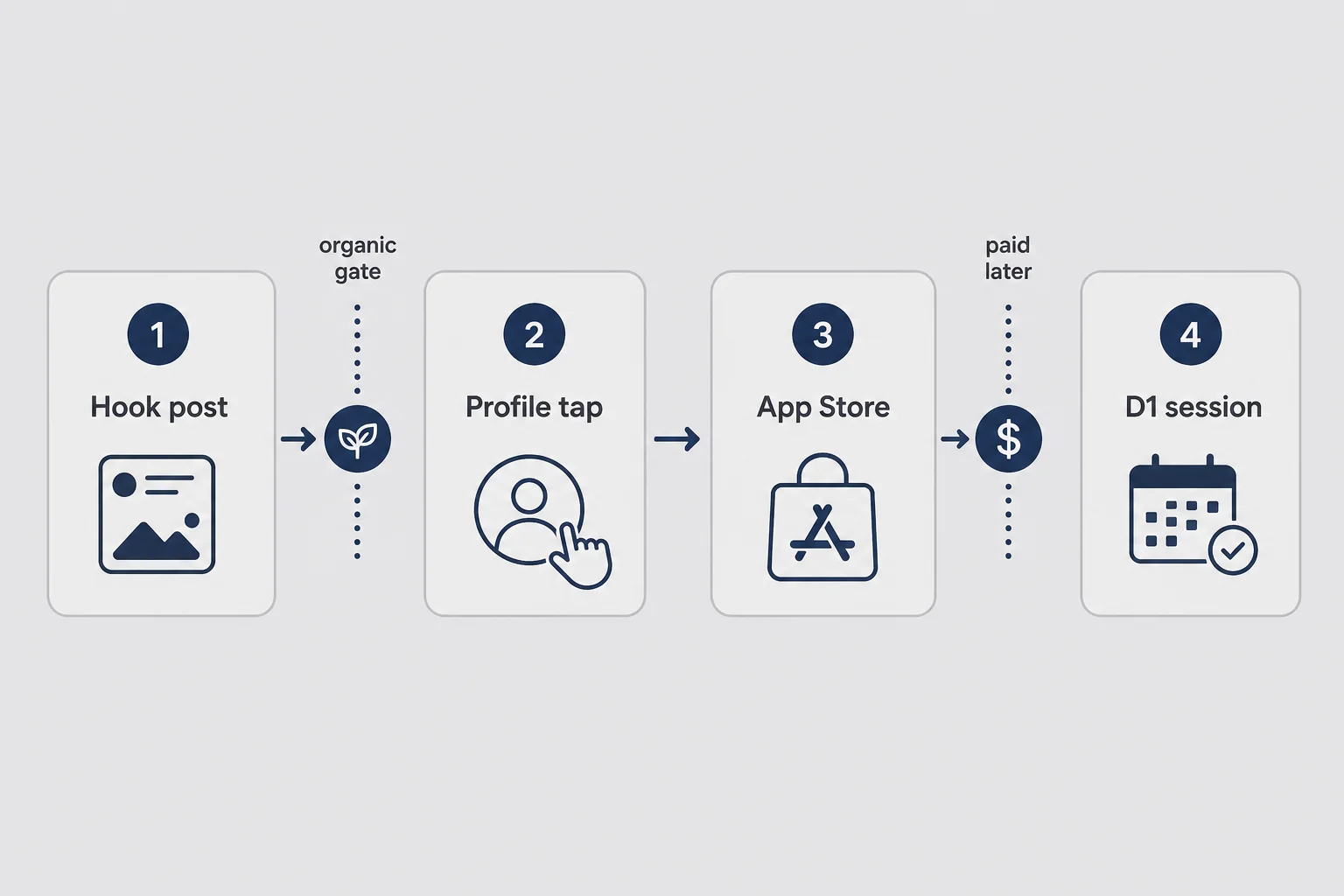
Here is the ramp I wish I had taped next to the ring light. Stage one: fifteen to twenty organic posts that each open on the problem, not the app icon. Stage two: profile bio with one link and a pinned post that explains the app in one sentence. Stage three: App Store listing aligned with your best hook. Stage four: measure first-session completion for people who arrived this week. Gates between stages. No skipping because you are impatient.
Stage one gate: at least one post in twenty hits three percent profile tap rate or generates a visible bump in App Store product page views on the day it posts. Stage two gate: link clicks, not just taps. Stage three gate: installs with day-one retention above your baseline. If retention collapses, TikTok did its job and your onboarding failed. Do not blame the algorithm.
Imagine you are on post fourteen. Two hooks cleared the profile tap gate. One mentioned "three replies from one screenshot." One mentioned "stop typing paragraphs at 1 a.m." Same app, different embarrassment. You film three variants of the winner, not three variants of the loser. That is how a ramp compounds without turning you into a full-time creator. You are a founder running creative tests, not a personality brand. The app stays the star. Your face is just proof a human built it.
How often to post as a solo founder
Three to four times a week is enough if each post is a new hook angle, not the same script with a different shirt. Daily posting sounds impressive until you are filming garbage on a Wednesday night because you promised the internet consistency. Consistency of quality beats consistency of calendar.
Batch film when you have energy. I record four hooks in one session, change one variable per clip (opening line, setting, which fake message appears on screen), and schedule them across the week. Scheduling is built into TikTok. Use it. Your future tired self should not be improvising on camera at midnight.
Reading TikTok analytics like an operator
Views are the weather report. Profile visits are foot traffic. Link clicks are people reaching for the door handle. In TikTok analytics, watch average watch time on videos over eight seconds. If people bail at second two, your opening is wrong. Watch follower conversion per video. Spiky follower growth on one post means that hook resonated. Go make variations.
Cross-check App Store Connect product page views on posting days. Imperfect attribution is fine. If your best TikTok day lines up with a product page spike, you have a working hook. Screenshot that post and write five cousins of it.
A simple weekly review ritual
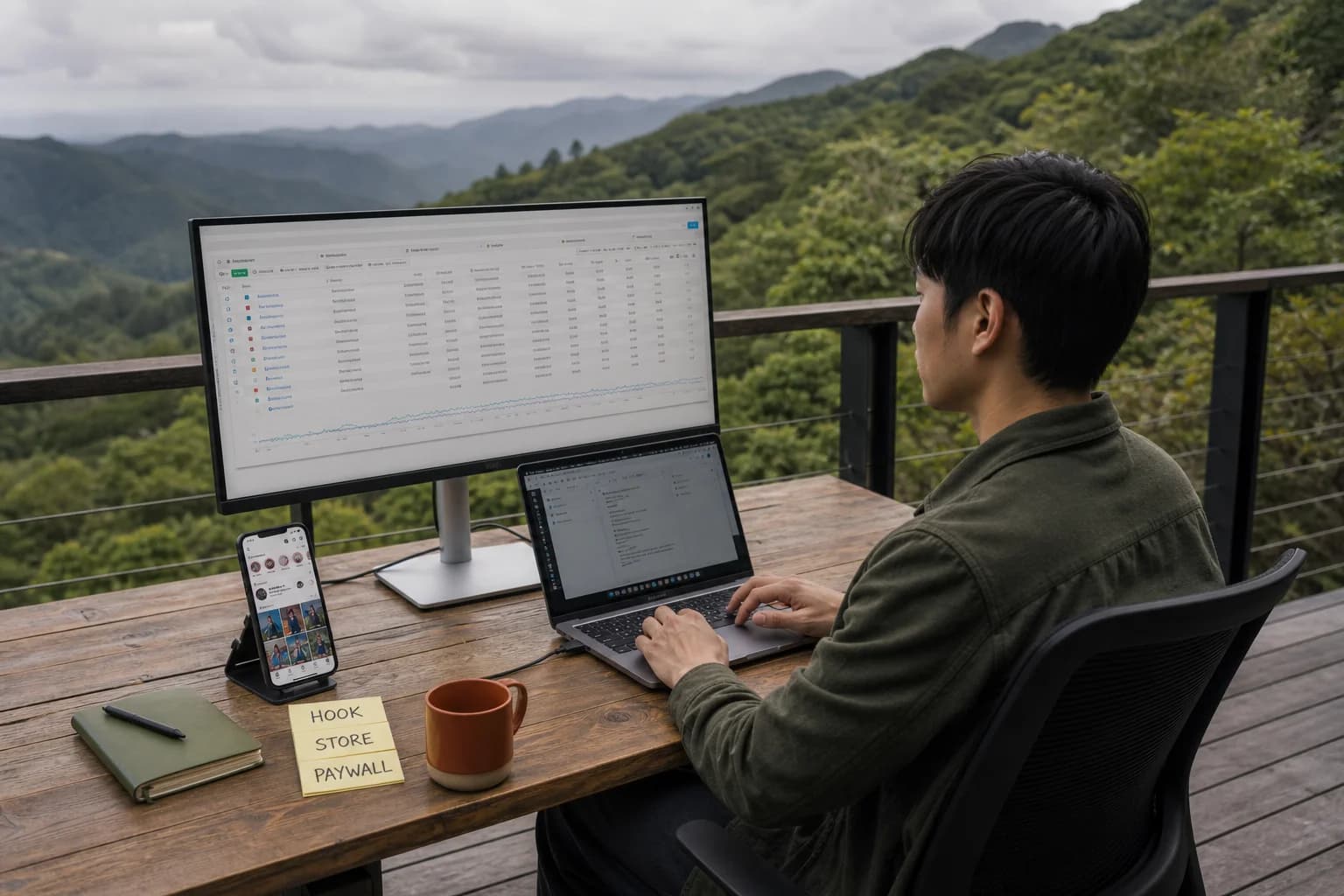
Every Sunday I open four tabs: TikTok analytics for the week, App Store Connect product page views by day, my onboarding funnel if I have one, and the notes file where I paste post links. I ask one question: which hook moved profile taps? Not which hook flattered me. I delete one idea that repeated without learning. I schedule three new hooks for the coming week. The whole ritual takes twenty-five minutes if I am honest and forty if I am procrastinating on filming.
Pinned post and bio hygiene
Your bio should say what the app does in one line, not your founder story. Link goes to the App Store or a one-screen bridge page. Pin the video that explains the product fastest, usually a tighter version of your best hook. When you find a new winner, update the pin. Leaving a pinned post from two months ago that references an old UI is how you burn trust at the profile step.
Writing TikTok scripts that show the problem, not the feature list
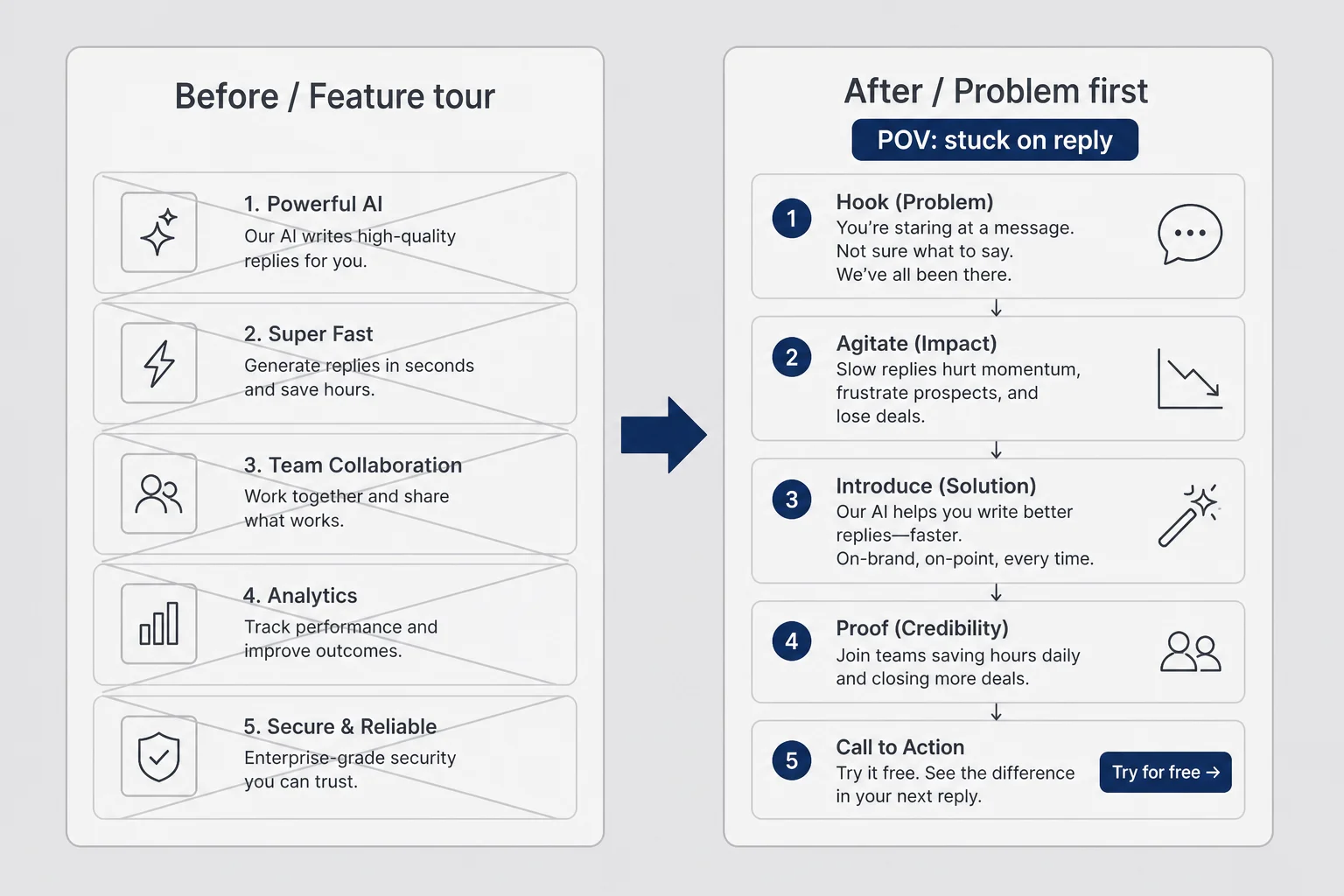
My worst-performing videos all started the same way. "Hey guys, I built an app that..." Instant scroll. The best ones start mid-crisis. A message on screen. A face that says I have been here. No introduction. No request to follow. The app appears as the fix, not the subject.
Script formula I use: second zero to three, name the pain in the viewer's language. Second three to twelve, show the moment your app intervenes. Second twelve to twenty, show the outcome (three replies, calmer face, saved photo, whatever relief looks like). Last three seconds, text overlay with what the app is called and "link in bio" without sounding like a infomercial.
Hook angles that work for personal apps
Problem confession: "POV: you have been staring at this text for twenty minutes." Demo without tutorial voice: screen recording of the actual flow at human speed, not sped up to look flashy. Stitch or duet format: react to someone else's dating or productivity video and show how your app handles that scenario. Before and after emotional state: anxiety face, then exhale after the app does its job. Myth bust: "Stop typing paragraphs. Do this instead."
Each angle is a hypothesis. Track which one moves profile taps. Double down. Kill the losers without mourning them.
On-screen text and captions
Most people watch muted. Assume silent viewing. Put the hook in text on screen in the first frame. Captions for anything you say out loud. Keep text high contrast and clear for three seconds minimum. I use large sans-serif captions burned in TikTok's editor, not tiny auto-captions lost at the bottom.
Do not paste your full App Store description. One emotional line. "Three replies from one screenshot" beats "AI-powered conversation assistant with multiple tone options."
What to never say in a consumer app TikTok
Do not open with "I am a solo founder." They do not care yet. Do not list subscription prices in the hook. Price belongs in the App Store or a comment reply when someone asks. Do not trash competitors by name. Do not promise outcomes you cannot deliver in the first session. Do not ask for follows before showing value. Earn the tap, then earn the follow.
Steal structure, not scripts
I keep a private list of hooks from other consumer apps in adjacent spaces. Not to copy words, but to copy shape. POV open. Tension in the middle. Relief at the end. Text on screen in frame one. I never paste their script. I paste their skeleton and fill in my embarrassment. Ethical stealing in public content means honoring the shape while telling your truth.
Length and pacing
Fifteen to twenty-five seconds is my sweet spot for Finish Him Replies. Long enough to show the reply flow, short enough to survive a second watch. If your demo needs forty seconds, cut onboarding inside the app before you cut the hook. App Store preview videos can be longer. TikTok hooks cannot.
Film the embarrassment
If you would not text the hook to a friend, it is probably too corporate. Consumer apps win on moments people are slightly ashamed to admit. Name those moments kindly.
Filming TikTok as a solo founder without a studio
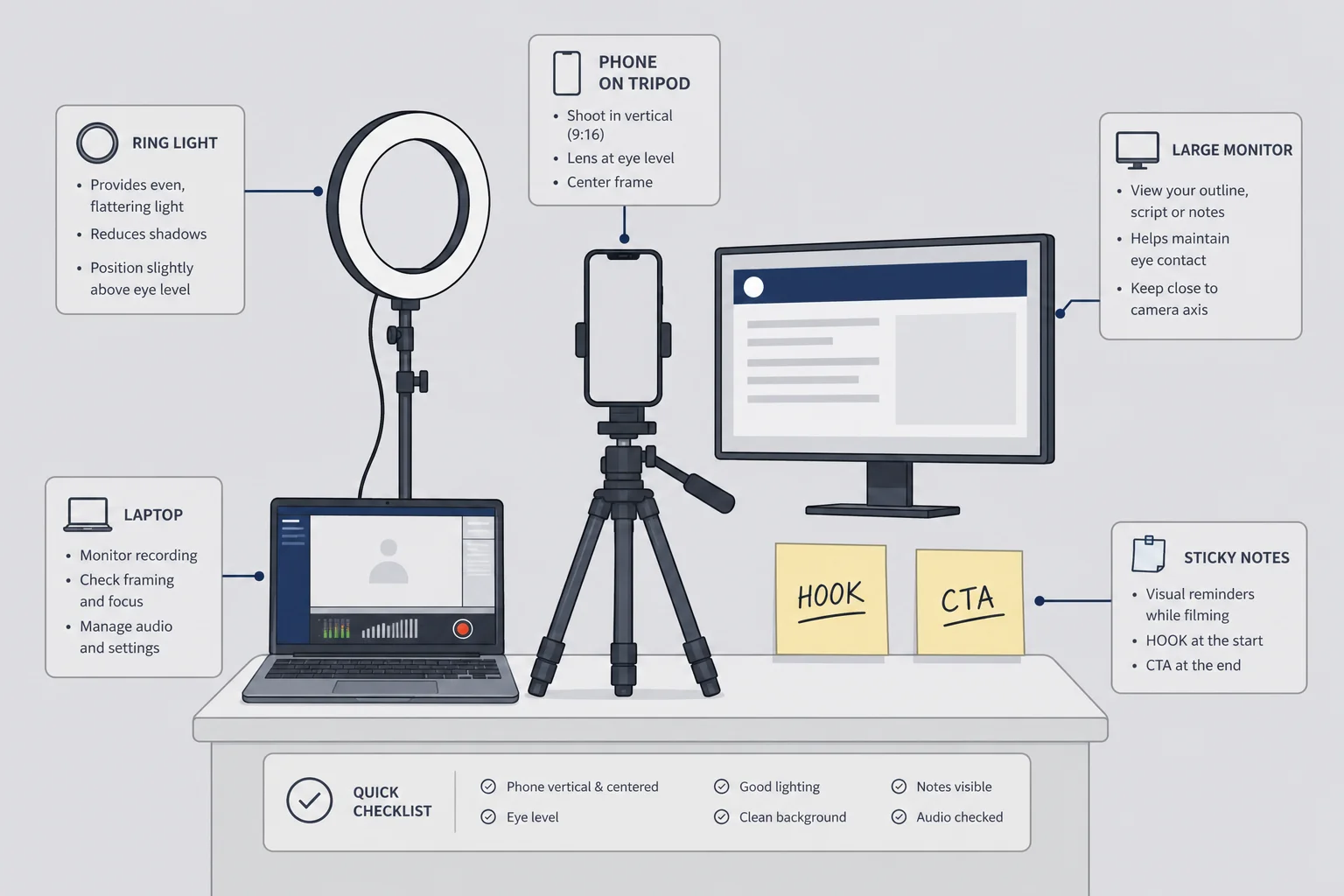
You do not need a production team. You need one clean vertical frame, decent light on your face or screen, and audio clear enough that captions are optional backup, not the only path. My entire setup fits in a tote bag: phone tripod, clip-on ring light, a printed fake chat on paper for physical props when screen glare misbehaves.
Film vertical nine by sixteen. Clean your front camera lens. Lock exposure on your face or the phone screen so the image does not pulse when you move. Record in a quiet room or embrace terrace wind and add captions. Both work. Inconsistency of audio is worse than inconsistency of background.
Screen recording plus face
The hybrid format that works for apps: picture-in-picture face in the corner while the phone screen shows the flow. Humans trust faces for emotional products. Screens prove the app is real. Record the screen with iOS screen recording, then film yourself reacting to the playback, or use TikTok's native tools to combine clips.
Show real UI, not Figma mockups. Real UI includes loading half a second. That is fine. Hyper-polished fake UI triggers scam alarms in comments.
Batch day workflow
Pick one afternoon. Write five hooks on sticky notes. Film all opening lines in one shirt. Change props or fake messages between clips. Edit inside TikTok: trim dead air, add text, pick a trending sound only if it does not fight your voiceover. Trending audio can help distribution and hurt clarity. If the sound does not match the problem, skip it.
Keep raw clips in an album labeled by hook type so you can re-cut a loser with a stronger opening without re-filming the demo.
Privacy on camera
Consumer apps touch sensitive data. If your app processes screenshots, say in comments how long data lives on servers. Show the permission prompt calmly in video when relevant. Do not film real people's messages without consent. Use fake chats with obviously fictional names. Trust on TikTok is fragile. One creepy comment thread can poison installs.
Accessibility basics that help everyone
High contrast text. Captions for spoken lines. Do not rely on red-green color alone to show good vs bad outcomes. These choices help viewers and help the algorithm understand your content. They also keep your app from looking like a scam in the three seconds people decide whether to tap.
Comments are part of the funnel
Reply to early comments fast. "Is this on Android?" gets an honest answer. "Is this safe with screenshots?" gets your privacy line. Pin the comment that restates the value prop. Delete spam. Do not argue with trolls. Every reply is micro-copy testing for your App Store description.
Paid Spark Ads and app install campaigns without burning cash
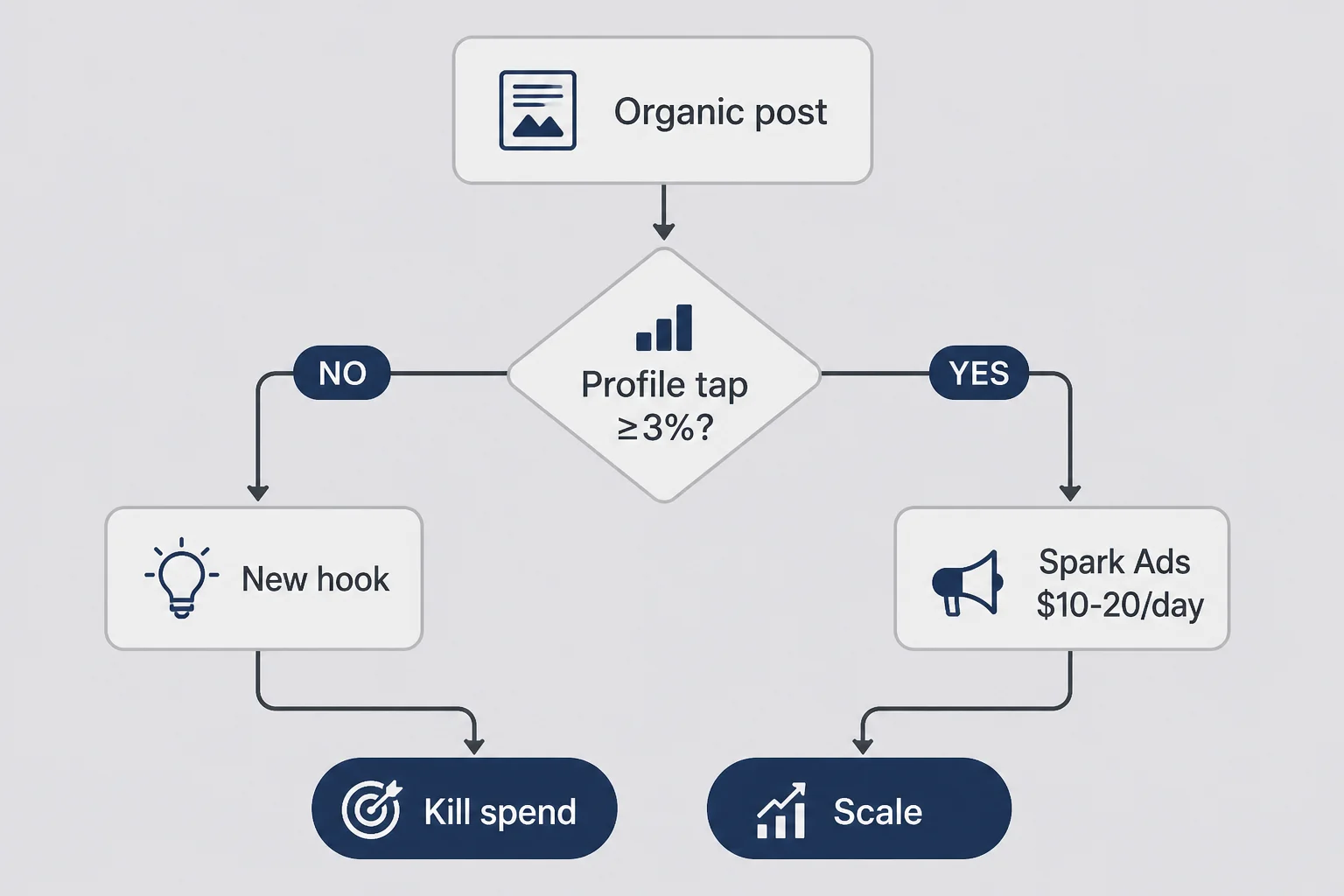
Paid TikTok for consumer apps should feel boring. You are not launching a Super Bowl spot. You are putting gas on a post that already proved strangers cared. Spark Ads boost your organic post with your account attached, which keeps social proof (comments, profile) visible. That matters for trust products.
My rule: no Spark spend until a post has at least three percent profile tap rate or clear store view lift, and your onboarding can handle a cold install. Boosting broken onboarding is paying to accelerate one-star reviews.
Spark Ads vs standard app install campaigns
Spark Ads start from an existing post. Install campaigns use separate creative in TikTok Ads Manager. As a solo founder, Spark is simpler and keeps the social proof. Install campaigns give more targeting knobs but require creative that often performs worse than the organic parent.
Start Spark with a small daily budget on one video. Geographic target your soft launch countries if you are still limited on the store. Expand when retention holds.
Budget and kill criteria
Ten to twenty dollars a day for seven days is enough to learn whether paid install economics are in the same zip code as reality. Track cost per install against your expected LTV from a monthly subscription. If CPI is forty dollars and your month-one revenue per user is three dollars, you do not have a ads problem. You have pricing, paywall, or hook alignment problem.
Kill an ad set if CPI doubles after three days with no improvement. Rotate back to organic hook tests. Paid is not punishment for impatience.
What I learned from a failed Spark week
I once put fifty dollars a day behind a post that had great watch time and weak profile taps. Installs rose. Day-one retention cratered. The hook attracted curious viewers, not people with the problem. Paid amplified the wrong story. Now I read profile tap rate before watch time when choosing Spark candidates. Entertainment metrics lie kindly. Intent metrics lie rarely.
App Store custom product pages
If you are running paid at scale, Apple's custom product pages let you match screenshots to the hook you boosted. Solo founders on small budgets can still align the default listing with the winning hook. Change screenshot one before you change the ad creative. The store page is part of the ad.
Creative rules for paid that still look organic
Do not reshoot a glossy ad with stock music. Boost the slightly messy post that already has comments. If you must create net-new paid creative, film it in the same kitchen or terrace as your organic posts so the feed does not feel like two brands. Match the App Store custom product page to the boosted hook if Apple gives you that option.
Measuring TikTok through to App Store first session
Metrics without a chain are vanity. My weekly check is one row in a notes app: date, post link, views, profile visits, link clicks, App Store product page views that day, installs that day, day-one retention for that cohort if sample size allows. Sample size is often tiny. Write it down anyway.
What good enough attribution looks like
Perfect source tracking from TikTok to install is rare for organic. Directional truth is enough. If three posts in a row spike store views on posting day, you have a channel. If views climb and store views stay flat, hooks are entertainment. Change the opening, not the budget.
For paid, use TikTok's campaign reporting plus App Store Connect's sources where available. Tag bio links with campaign parameters when the tool allows. Compare weeks, not hours.
Cohort notes in a spreadsheet
You do not need a data team. A spreadsheet with week number, posts shipped, best profile tap rate, product page views, installs, and day-one retention estimate is enough. After eight weeks you will see patterns: which hooks, which posting times, which countries respond if you geo-target. Patterns beat vibes. Vibes are how you justify filming another feature tour.
Pairing TikTok with email and TestFlight
TikTok is not replacing a beta list. If you are pre-launch, send warm testers to TestFlight and keep TikTok off until the core loop survives cold install. If you are live, occasional posts that mention "new in the latest version" can work when the hook is still problem-first. Version numbers in hooks are boring. Relief after an update is not.
Gates before you scale spend or posting frequency
Gate one: hook generates profile taps. Gate two: taps generate installs above baseline. Gate three: installs complete core loop in session one. Gate four: day-seven retention for TikTok cohort is within shouting distance of organic search users. Missing gate three means fix onboarding or screenshot upload friction before you film ten more hooks.
When to pair TikTok with soft launch geography
If you are still soft launched in one country, target Spark Ads to that country only. There is no point paying for installs you cannot accept. TikTok comments are global. Clarify availability in pinned comments if needed.
When traffic lands but nobody sticks
TikTok can do its job and you can still fail. High installs with brutal day-one retention means the hook was honest but the first session was not. Common causes I have seen in my own work and in other founders' apps: paywall before value, confusing permission prompts, onboarding that explains features instead of completing one win, App Store screenshots that promise a different app than the video showed.
Fix order: align store screenshots and subtitle with your best hook. Shorten onboarding to one outcome. Delay paywall until after the user gets value once. Add a lightweight "how did you hear about us" survey in settings for qualitative tags.
ASO mismatch kills TikTok momentum
Someone taps because the video showed three reply tones from a screenshot. Your first screenshot shows a settings menu. They bounce. They might leave a angry review. App Store optimization is not separate from TikTok. It is the landing page after the swipe-up.
Rewrite screenshot captions in the language your hooks use. "Stuck on what to say?" beats "Advanced NLP-powered response engine."
Retention is the real growth metric
Downloads from TikTok are top of funnel. Consumer app retention is where you learn if discovery was worth it. Track day-one and day-seven for TikTok weeks separately when you can. If retention is worse than other sources, your hooks might be attracting the wrong people or your first session is too slow for impulse installs.
The support inbox tells the truth
When TikTok works, support email shifts from "how does this work?" to "can I use this on iPad?" or "does yearly save money?" When TikTok sends the wrong people, you get refunds and confused one-stars within hours. Read those emails before filming more hooks. They are cheaper than ad spend at teaching you what the store page failed to say.
Fixing onboarding without a redesign
Sometimes the fix is one screen, not a rebuild. Add a single example screenshot in onboarding so users mimic the demo they saw on TikTok. Pre-fill the first action. Remove a login wall if you added one because a blog said you should. TikTok users arrive hot and impatient. Meet them at the door with the outcome, not the account creation form.
TikTok mistakes solo founders repeat
Posting two videos, declaring TikTok dead, and going back to polishing icon corners. Filming feature tours because showing settings feels safer than showing loneliness. Boosting a viral post that never drove profile taps. Putting a link tree in bio with newsletter, Twitter, and merch. Ignoring comments that are free copy research. Chasing trends that have nothing to do with your app. Filming only when you feel inspired instead of batching. Comparing your day three to a creator's year three.
The emotional mistake is shame. Consumer apps are personal. Filming yourself admitting you overthink texts feels cringe until it works. Cringe is not a metric. Profile taps are.
Chasing trends that do not fit
If the trend is a dance and your app is grief journaling, skip it. Forced trend participation reads desperate. Borrow trend audio only when the vibe matches the problem. Dating apps can use chaotic audio. Finance apps should not piggyback on joke formats that undermine trust.
Treating TikTok like Instagram
Polished grids, brand palettes, and caption essays belong elsewhere. TikTok rewards roughness that feels true. Your tenth video will look more natural than your first. Ship the first anyway.
Legal and platform hygiene
Use TikTok's commercial music library when you add sound. Do not show real dating profiles or DMs that look like you leaked someone's privacy. Follow Apple's rules about promising features in ads that are not in the build. TikTok can drive attention; App Review still owns what you ship. If a hook promises a feature still in TestFlight, you are buying angry comments.
Building a hook backlog
When something works, open Notes and write ten variants before you celebrate. When something fails, write one sentence about why before you delete the draft. A backlog turns TikTok from emotional roulette into a queue of experiments. Solo founders survive on queues, not on motivation.
Questions founders ask about TikTok for apps
Should a solo founder use TikTok to market a consumer app?
Yes, if your app solves a problem people already joke about on TikTok. Dating anxiety, screenshot replies, budget tracking, habit guilt, outfit panic. Those emotions film in three seconds. If your app is a quiet B2B utility with no visual hook, TikTok is probably the wrong room. Match the channel to the embarrassment or delight your product touches.
How many TikTok posts before I know if organic works?
Give yourself fifteen to twenty posts with real hooks, not feature tours, posted three to four times a week for about a month. You are looking for profile tap rate and App Store visits, not viral views. If nothing moves after twenty honest attempts, the hook angle is wrong or the audience is elsewhere. Do not judge the channel on two posts and a dance trend.
What should my TikTok bio link be for an iOS app?
A direct App Store link or a one-screen bridge page with one headline that matches your best hook video and a single download button. No newsletter signup in between. No link tree with six options. The bio is a storefront, not a resume. If your best video promises three reply options from a screenshot, the landing moment after the tap should say exactly that.
When should I turn on TikTok paid ads for my app?
After organic posts prove profile taps and at least a trickle of installs you can attribute. Use Spark Ads to boost videos that already earned engagement, not ads with brand-new creative you never tested. Start with ten to twenty dollars a day on one winning post. If cost per install makes no sense against your subscription price, fix onboarding or ASO before raising budget.
How do I track TikTok traffic to App Store installs?
Use App Store Connect analytics for product page views and downloads by source where available, plus a custom product page URL or campaign link in bio when you run paid. TikTok's own analytics show profile visits and link clicks. Connect the dots weekly: which video, which day, which spike in store views. Perfect attribution is rare for organic. Directional truth is enough to kill bad hooks.
What is the biggest TikTok mistake consumer app founders make?
Filming feature lists instead of the problem moment. Nobody downloads because you showed settings screens. They download because they felt seen in the first three seconds. The second mistake is boosting posts that got views but no profile taps. Views without intent is vanity theater. Fix the hook, then pay to amplify.
Whether TikTok is actually your channel
TikTok is not mandatory. It is a fit when your app touches a feeling people already perform online and you can show that feeling in three seconds without lying. If you sell calm, trust, and relief, short video can carry strangers to your App Store page cheaper than almost any other top-of-funnel test at solo-founder scale. If you sell complexity, compliance, or quiet utility, invest your weekends elsewhere.
I still film on hot Tuesdays when the hook is clear and the onboarding has caught up to the promise. The forty-seventh video taught me views are applause. Profile taps are intent. Installs are a contract. Retention is whether you deserved any of it.
Pick one hook this week. Film it before you perfect the icon. Post it. Check the store views the next morning. That is tiktok marketing consumer app solo founder work at its least glamorous and most useful. The ramp is not viral luck. It is hook, profile, store, session, then maybe paid. Everything else is noise with good lighting.
If you take one thing from this piece, make it the gate before Spark Ads: profile taps, not views. The rest is detail you will learn by posting badly in public until one video makes a stranger tap your bio and install something you built on a hot Tuesday. That is the whole game for a solo founder with a consumer app and no growth team. Film the problem. Match the store. Fix the first session. Then pay to turn up the volume on the hook that already worked for free.

Comments