The Global Launch Button Is How You Learn on Strangers' Dime
How to run an iOS soft launch as a solo founder: TestFlight first, country-by-country rollout, phased App Store release, and when to widen before you hit worldwide.
 By Iryna28 min read
Listen to this article
AI-generated podcast-style overview of this article (not a word-for-word narration).
I had the App Store Connect map open on a Thursday night. Every country checkbox looked the same shade of tempting. One tap and Finish Him Replies would be live in a hundred and seventy-five places I had never visited, for strangers I could not help if something broke at 2 a.m. my time. My finger hovered. Then I unchecked all but one.
That is the moment ios soft launch solo founder work actually starts. Not when Xcode finally archives. Not when your mom says the build is cute. When you decide that learning on ten thousand people's phones is a privilege you have not earned yet. A soft launch is a ramp: TestFlight strangers, then a small country on the store, then a few more, then worldwide when the product stops embarrassing you in private. If you have not run a beta yet, read TestFlight beta for solo founders first. If you are still nervous about review, App Store review is the other door on the same hallway. This piece is what happens between "it runs on my phone" and "Release to all countries."
I am not going to pretend I had a growth team spreadsheet. I had sticky notes with country codes, a crash-free percentage I refreshed too often, and a rule I wrote in Sharpie: widen only when the last stage passes the gate. Soft launch is not hiding. It is paying tuition in smaller classrooms before you lecture the whole App Store.
iOS soft launch solo founder: why the global launch button is not a plan
The global launch fantasy sounds like freedom. One button. One spike. Maybe Product Hunt the same day. Maybe a friend tweets. Downloads go up. You feel like a founder.
What actually happens on a worldwide day-one release for a first consumer app is messier. Someone in a country you forgot exists hits a paywall bug on an older iOS version. Someone else denies photo permission because your pre-prompt was vague. A third person subscribes, restores on a new phone, and loses premium because you never tested that path in production. All of that is public. Reviews are public. Refund requests are real. Support email arrives in a language you cannot read.
An ios soft launch solo founder plan trades that fireworks show for a sequence. You still ship. You still charge if you plan to charge. You just shrink the blast radius until you have evidence that the first session is safe, the core loop completes without you narrating, and StoreKit behaves on production receipts. Think of it as opening one theater row at a time instead of filling the stadium while the understudies are still learning lines.
I learned this the hard way by almost doing the opposite. My first instinct was to launch everywhere because restricting countries felt like admitting my app was small. It is small. That is the point. Small is how you keep one person's attention span across crashes, copy fixes, and a paywall tweak without drowning.
The blast radius problem
Blast radius is a phrase Max would use for servers. It applies to App Store launches too. Worldwide release maximizes blast radius: maximum downloads, maximum unknown devices, maximum one-stars you cannot reproduce, maximum support load when you are also the engineer, the designer, and the person answering "how do I cancel."
Country soft launch minimizes blast radius on purpose. You are not avoiding users. You are choosing users you can still learn from when something fails. A hundred installs in New Zealand with five detailed emails beats four thousand installs worldwide with silence and a 2.1 average rating you cannot attribute to anything specific.
There is an emotional version of blast radius too. When the app is live in one country, a bad day feels contained. You fix the build, upload, wait for review, breathe. When the app is live everywhere, every Connect notification feels like a referendum on your worth. I am not being dramatic. I checked the review count more than I checked whether the permission copy actually explained why I needed a screenshot. Soft launch protects your judgment, not just your star rating.
What you are buying with a ramp
You are buying time-shaped data. TestFlight buys distribution and cold-install behavior without public reviews. One live country buys production StoreKit, real subscriptions, and App Store search in a pond before the ocean. Three to five countries buy regional variety without every time zone on earth. Worldwide buys scale when the product has stopped surprising you in embarrassing ways.
You are also buying the right to be boring in public. Soft launch weeks are for fixing onboarding, tightening privacy copy, and adjusting price presentation. Launch day theater is for when those things are no longer guessing games. If you need a calendar date for motivation, fine. Pair it with a geography limit so the date does not override judgment.
There is a financial angle too easy to skip. Every bad review in a large market is a marketing debt. Every refund from a broken paywall is money you explain to yourself at midnight. Soft launch keeps those costs small while you still have the energy to care about the fix. I am not saying you will get rich in New Zealand. I am saying you might learn that your weekly subscription looks predatory next to the annual plan before ten thousand Americans agree in the reviews section.
Finally, you are buying alignment between your App Store listing and what the app actually does. Soft launch traffic is small enough that you can still change screenshots when you realize the first image sells a feature you cut. Worldwide traffic freezes the story faster. App Store optimization is not a post-launch hobby if your soft launch country shows impressions without installs. Fix the listing while the audience is tiny.
Vanity launch
Releasing in all countries because it looks more "real" is a vanity metric. Real is strangers completing your loop and paying without a hand-holding call. Geography is a tool. Use it.
What soft launch actually means for a consumer iOS app
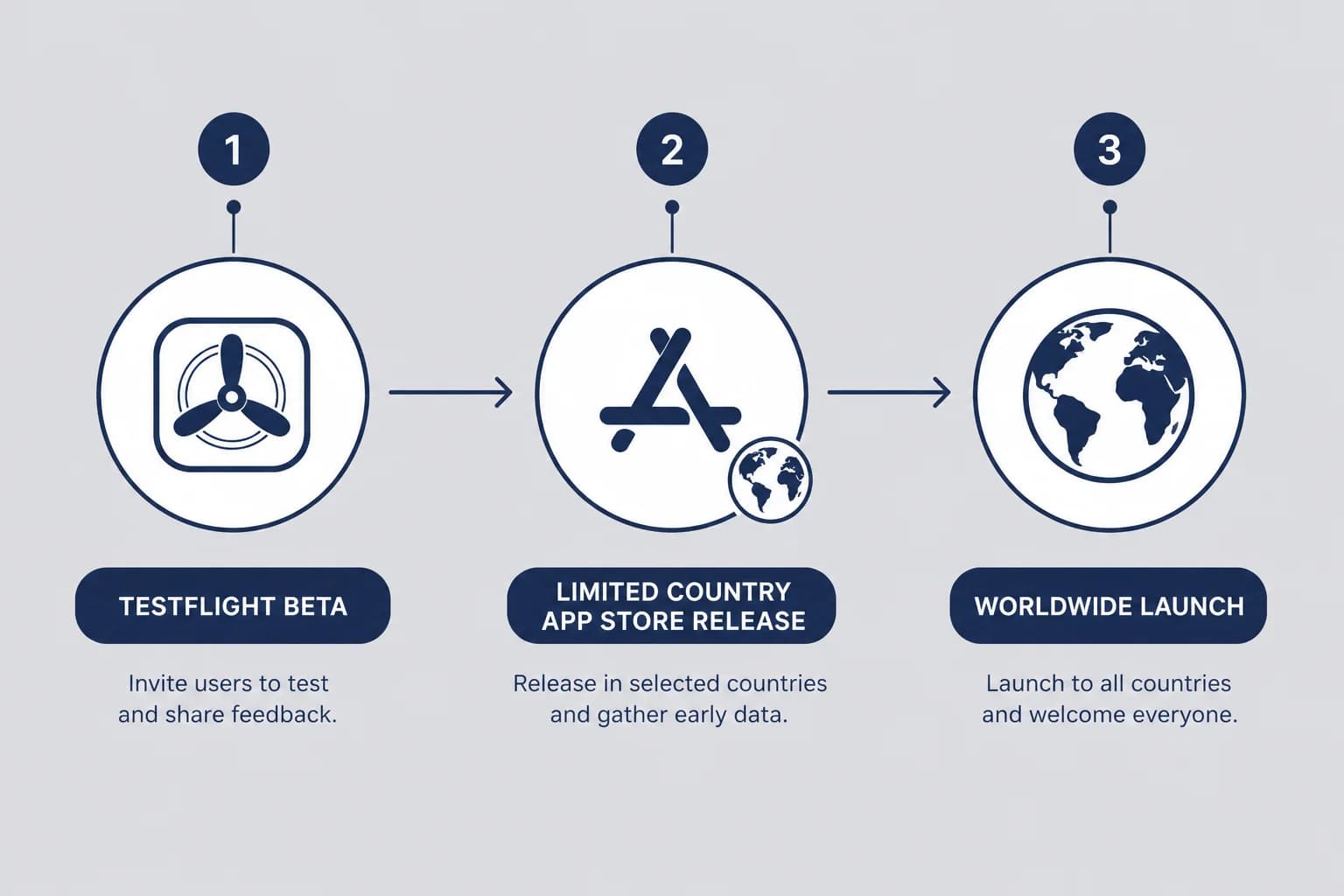
Soft launch on iOS is not one official Apple mode you toggle. It is a set of practices: beta distribution through TestFlight, limited availability on the App Store by country or region, and phased widening over days or weeks. Apple gives you the levers in App Store Connect. You supply the discipline.
For a consumer app, soft launch usually answers three questions before you scale spend or ego. Can a stranger cold-install and get value without you on FaceTime? Does production billing work for the people who should pay? Does the App Store listing describe that value honestly enough that the right person downloads and the wrong person self-selects out? If any answer is shaky, worldwide release turns every shaky answer into a public review.
Soft launch is also not permanent beta. TestFlight builds expire. Betas do not earn you production revenue in the way the store does. At some point you cross from "learning" to "operating." The ramp is how you know which side you are on.
Soft launch vs staying in TestFlight forever
Founders hide in TestFlight for the same reason I almost released everywhere: fear dressed up as prudence. Perpetual beta feels safer than a star rating. It is safer. It is also a stall if you already know the core loop works and you are polishing shadows on the paywall font.
The honest split: stay in TestFlight while distribution, permissions, or sandbox purchases are still unknowns. Move to App Store soft launch when you are ready to test production receipts, search, and review velocity in a small market. If you are on build twelve and only changing corner radii, you are not soft launching. You are avoiding the store.
Soft launch vs full marketing launch
Full marketing launch is a different layer. Paid ads, press, influencers, big social posts. That is Reese territory for web funnels. On iOS, you can soft launch with almost no marketing: a few posts, a short list, organic search in one country. Save the loud launch for when metrics from the soft stage say the product holds attention past day one.
I did not run ads for Finish Him Replies during early live countries. I watched whether people who found it organically came back. That was enough signal for a solo founder with no ad budget and a healthy fear of paying to amplify a broken first session.
Another distinction worth naming: soft launch is not the same as unlisted or secret. Your app can be fully public in New Zealand, searchable, reviewable, and still invisible to your Twitter followers if you never post. That is fine. You are testing systems, not performing success. Perform later when the hallway ends.
Who soft launch is wrong for
Soft launch is not mandatory for every iOS app. If you are shipping a tiny utility with almost no permissions, no accounts, and no payments, TestFlight plus a careful single-country release might be the whole story. If you are building enterprise B2B with MDM distribution, the App Store consumer playbook barely applies. If you already have ten thousand waitlist emails in one country and support staff, you might compress stages.
Where soft launch pays off is the uncomfortable middle I live in: consumer apps with personal data, subscriptions, emotional first sessions, and one founder staring at Connect. If that is you, the ramp is not bureaucracy. It is how you keep the first week from defining the first year.
The ramp: TestFlight, then countries, then everyone
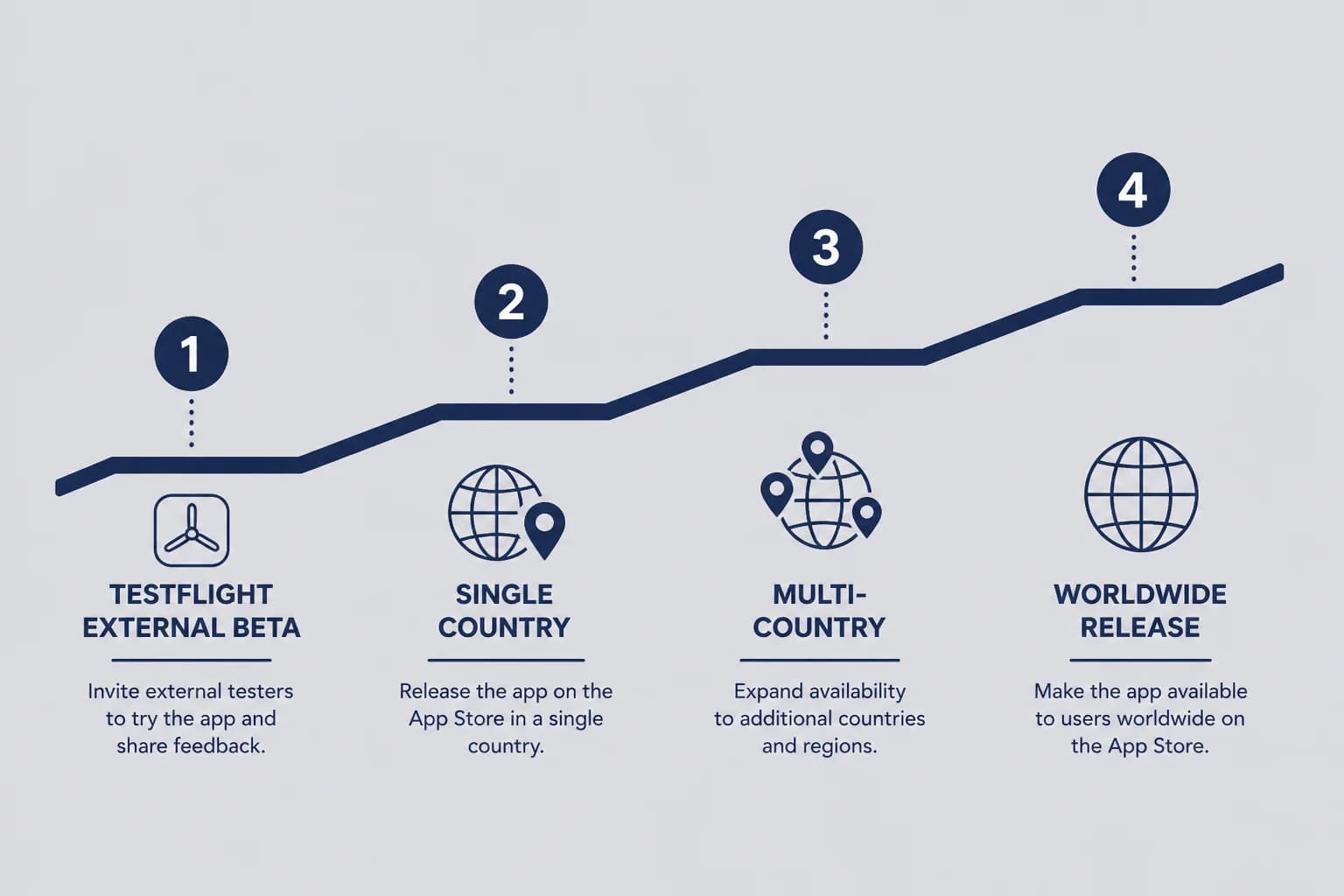
Here is the ramp I wish someone had taped to my monitor. Stage one: TestFlight external after internal smoke tests. Stage two: one App Store country. Stage three: three to five countries with similar support load. Stage four: worldwide or your real target markets. Each stage has a gate. No gate, no widen.
Stage one is TestFlight with a single question. Mine was whether a stranger could get from install to a useful reply in under sixty seconds without me explaining anything. Yours might be different. Write it down. Upload a distribution build, pass Beta App Review for external testers, invite people who are not your family chat. Collect notes about stalls, not compliments.
Stage two is production in one country. Submit for App Review with that country's availability selected. Turn on the version when approved. Tell a handful of people it exists. Watch crash analytics, support email, and whether anyone subscribes. This is the first time money and public reviews enter the picture. Keep the country small enough that you can read every review that week.
Stage three adds countries with intent, not vanity. Maybe Canada and Australia after New Zealand. Maybe you add the United States only when support templates and refund policy are written. Same binary. Wider geography. Same gates.
Stage four is worldwide or your defined end state. Not every app needs every country. If you only support English and USD pricing, releasing in markets you will never support creates refunds and confusion. Soft launch is also how you discover which markets matter before you pretend to serve them all.
Gates that actually matter
Pick gates you can measure without a data team. Crash-free sessions above roughly ninety-eight percent for three days. At least ten cold installs completing your core loop. Paywall working if you charge: view, purchase, restore, relaunch. No unresolved privacy mismatch between App Privacy labels and behavior. No showstopper in Notes for Review that you already know is broken.
If a gate fails, you do not widen. You fix or you hold. Holding feels like failure. It is professionalism. Shipping the same bug to forty more countries is the real failure.
How long each stage should last
TestFlight: five to ten days of real tester activity, not five to ten days on the calendar while nobody installs. One country live: seven to fourteen days unless you have almost no traffic, in which case ask whether the country was too small or the listing is invisible. Multi-country: another one to two weeks. These are ranges, not laws. The law is: do not widen on hope.
I once held New Zealand an extra week because restore purchases failed on a second device. That week saved me a public thread of angry reviews in bigger markets. Boring weeks are underrated.
Building your ramp on paper before Connect
Before you touch checkboxes, write the ramp on paper. One line per stage: audience, geography, gate, maximum duration. Example: "TestFlight external, ten strangers, gate = three cold loops under sixty seconds, max seven days active testing." Example: "NZ only, gate = crash-free ninety-eight percent for seventy-two hours and two production purchases with clean restore, max fourteen days."
Paper sounds quaint. It beats discovering you widened because Tuesday felt hopeful. I keep the paper note next to the sticky country codes. When my brain wants to skip a gate, the note is the adult in the room.
If you are juggling a day job, shorten calendar duration but not gate quality. Better to hold an extra week in one country than to spend a month cleaning up reviews in five. Time pressure is real. Blast radius math is realer.
Country soft launch strategy when you are one person
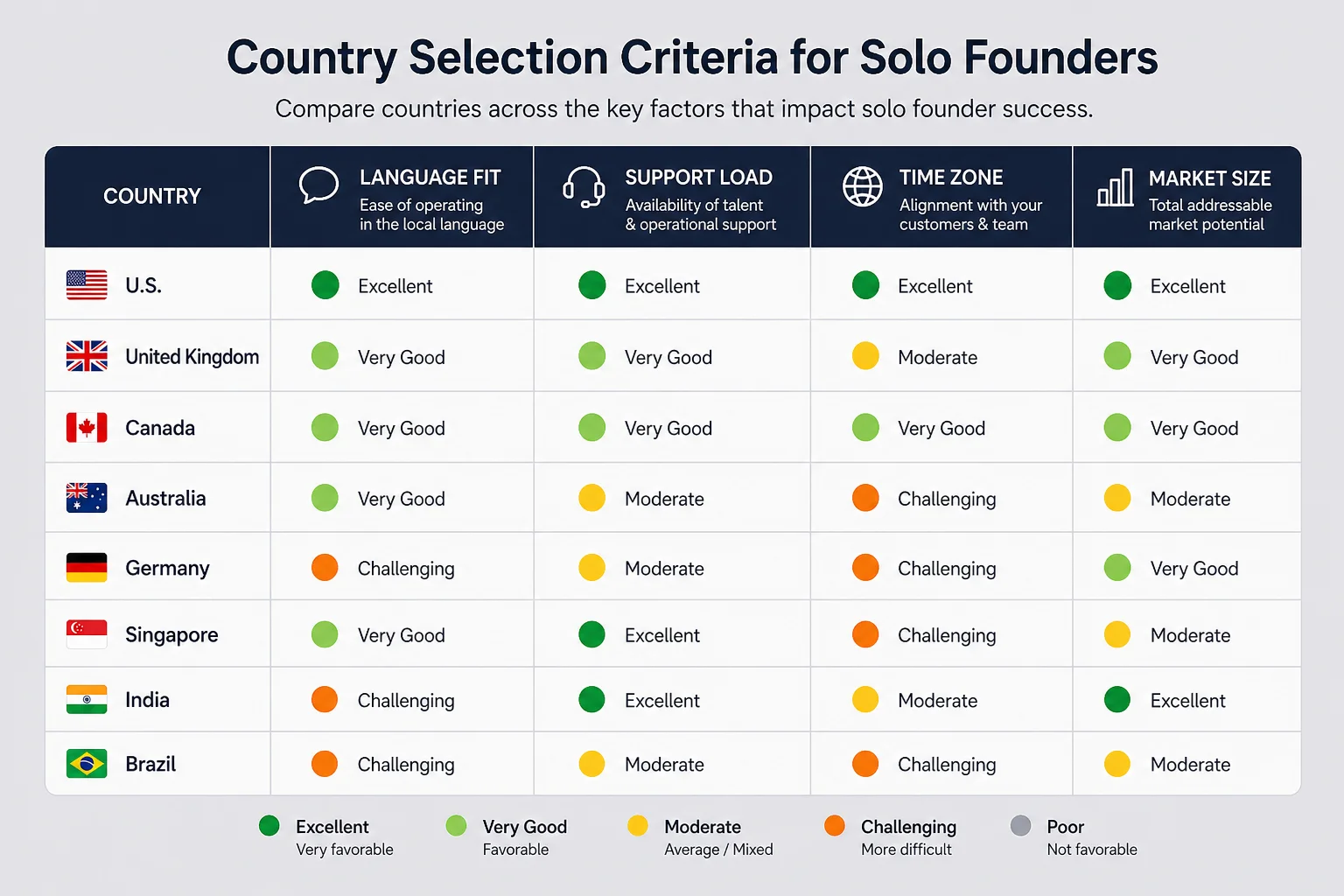
Country choice is where solo founders either get clever or get crushed. You do not have twenty-four-hour support staff. You do not have localized screenshots for six languages. You have you, your inbox, and whatever English you can type before coffee.
Start with countries where you can read support mail, understand refund culture at a basic level, and price sanely. New Zealand and the Philippines show up often in soft launch advice because volume is moderate and English is common. Canada and Australia are reasonable second steps for US-adjacent founders. None of these are magic. They are manageable classrooms.
Avoid launching first in a market whose primary language you do not speak unless you have real localization. A confused user in Tokyo is not a soft launch learning event. It is a one-star with a screenshot you cannot parse. Same for countries where your subscription price converts to something absurd without you noticing.
Time zone matters more than people admit. If every crash report arrives while you are asleep, you wake up to three bad reviews and a fog of guilt. Pick at least one early country where your evening overlaps someone's daytime if you want human rhythm on support.
Small pond vs representative sample
A country soft launch is a small pond, not a statistically perfect sample. You are not running academia. You are looking for repeatable failure modes. If onboarding breaks for five of twenty installs in NZ, it will probably break in the US too. If nobody can find the app because your keywords are wrong, soft launch also tells you to fix App Store optimization before you widen.
Do not pick a country solely because competitors did. Pick because you can operate there alone for two weeks. Operation beats folklore.
Pricing and storefront during country soft launch
Your price is part of soft launch even if you never change the number. A weekly plan that feels normal in USD might look silly when someone in another country sees the converted amount on the store. Walk through App Store Connect price tiers for each country you add. You are not optimizing for perfection. You are avoiding surprise anger.
If you offer a free trial, soft launch is when you learn whether people understand when billing starts. Confusion shows up as support mail before it shows up as chargebacks. Pair pricing tests with screenshot copy on the paywall, not just the number in Connect.
Local laws you cannot hand-wave
Even a one-person app touches rules: privacy disclosures, subscription cancellation paths, age ratings, data collection labels. Soft launch in one country lets you verify that your privacy nutrition label matches behavior before a regulator-minded reviewer in another region asks sharper questions. I am not a lawyer. Neither are most solo founders. Honest labels and clear in-app disclosure are the baseline. Fix mismatches in small markets first.
When to add the United States
The US is loud. High volume, high review velocity, high expectation. Many solo founders add the US only after one smaller English market looks stable. Others launch US first because their audience is explicitly American and NZ would be lying about demand. Both can work. The mistake is adding the US because it feels official while you still crash on launch.
If your app is about a culturally specific behavior, align geography with reality. Dating texting anxiety in American English is my lane. I did not need Germany on day one. You might.
Document what is live
Write down which countries are on. Connect UI changes. Notes get stale. A friend asking "is it live here?" should not require archaeology. I keep a sticky note in my project folder: countries live, date, build number. Boring documentation saves embarrassing DMs.
TestFlight vs App Store tactics (different rooms, different rules)
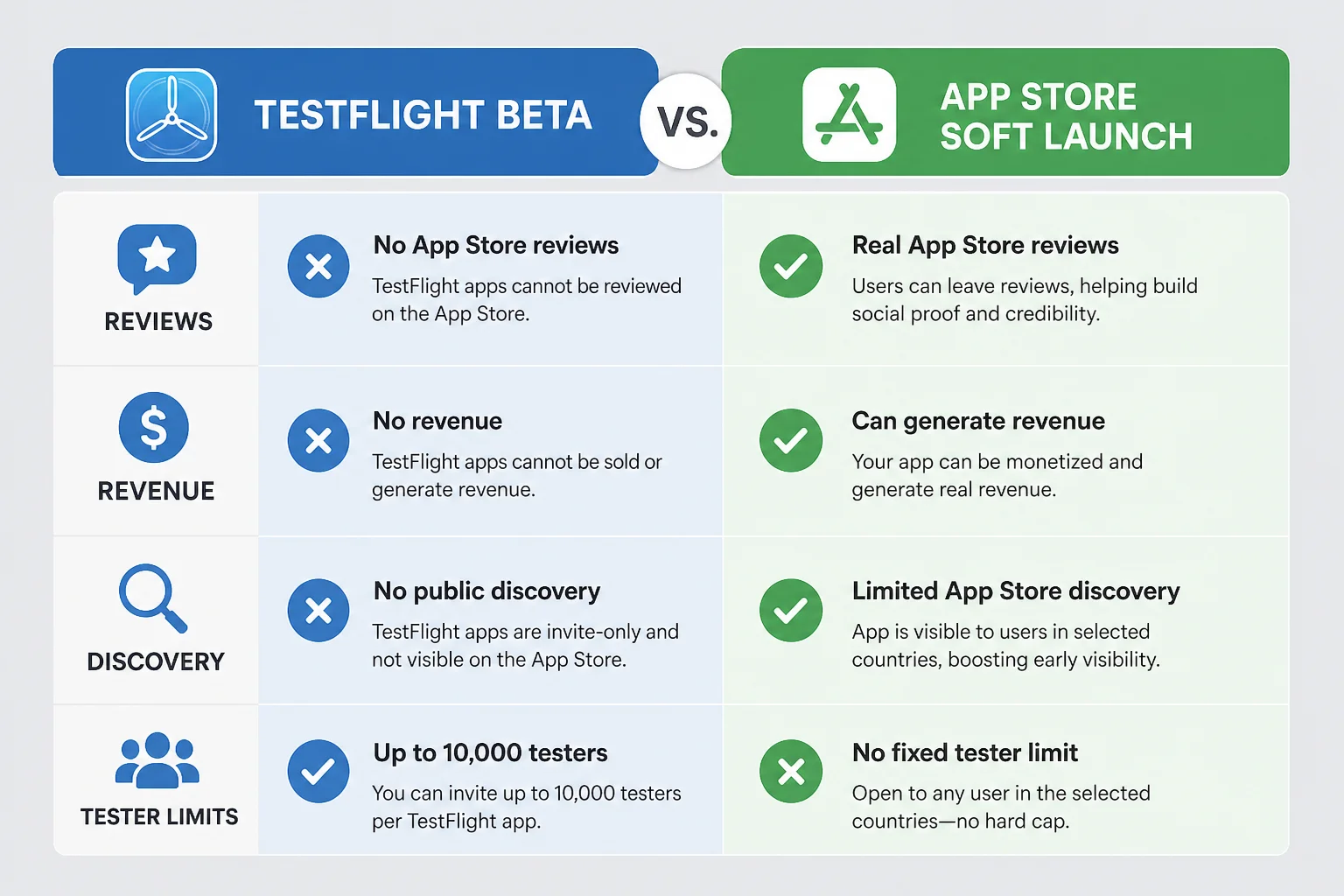
TestFlight and the App Store are adjacent doors, not the same room. Solo founders mix them up because both involve installs and Apple portals. The tactics differ.
TestFlight is for distribution proof and qualitative loops. External testers need Beta App Review once per version. Builds expire in ninety days. Purchases are sandbox. Reviews are not public. You can iterate quickly without SEO or star rating damage. Tactics: one sharp question, small external cohort, short feedback form, crash logs prioritized over feature requests.
App Store soft launch is for production proof and commercial reality. Review is full App Review. Purchases are real. Ratings are public. Search and browse can send strangers you did not invite. Tactics: tight country list, honest listing, monitored reviews, support macro emails ready, paywall and restore tested on production.
Use TestFlight to answer "does the app survive stranger phones?" Use App Store soft launch to answer "does the business survive stranger wallets and public opinion in a pond?" Skipping TestFlight and going straight to one country can work if your risk is low. Skipping both and going worldwide is how you fund Apple's thirty percent with tuition labeled "mistakes."
Public link vs unlisted store presence
TestFlight public links are useful for volume with light friction. They are still beta. People expect rough edges. App Store soft launch can be quiet: no big announcement, organic only. You can also use pre-order or manual release timing in Connect to control the hour you go live. None of this replaces product clarity. It controls noise.
Reviews and feedback channels
In TestFlight, feedback is email, TestFlight screenshots, and crash reports. On the store, feedback is stars, reviews, and support tickets. During soft launch, reply to reviews that describe real bugs. Ignore "did not work" with no detail unless you can reproduce. Thank people who describe the fix. Public professionalism matters even when you are small.
I still remember my first one-star that said the upload flow felt creepy. They were right. I fixed the copy before widening countries. That review was cheaper than a marketing agency telling me the same thing six months later.
When to run TestFlight and store overlap
You do not always need a hard handoff. Some founders keep a small TestFlight cohort running while one country is live on the store. That can work if you label builds clearly and do not confuse testers about which binary is "real." I prefer a clean line: external beta ends when production goes live in country one, except for trusted friends on crash patrol. Too many parallel channels split feedback and your attention.
If you do overlap, never test experimental features only in TestFlight while production users pay for a different experience without knowing. Ethically muddy. Also a fast way to lose trust when a tester tweets a feature paying users do not have yet.
Phased rollout in App Store Connect
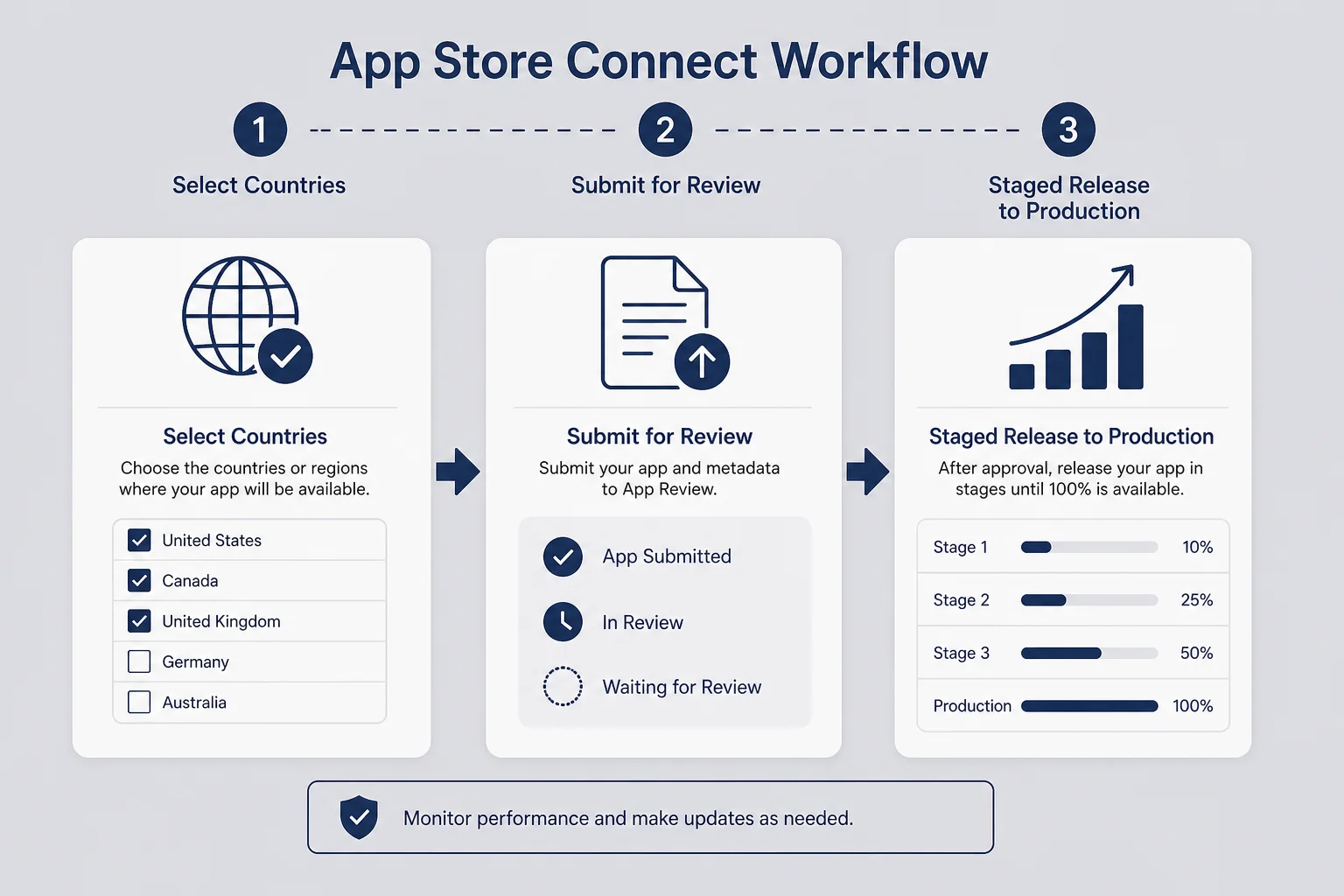
Phased rollout in practice means chaining Apple's tools with your own gates. Connect lets you choose pricing and availability by country, submit a version for review, and release manually or automatically when approved. You choose countries per version. You can expand later.
Workflow that has worked for solo founders I talk to: create the app record, complete privacy and age rating honestly, attach subscriptions before review if you charge, upload the build, select one country in availability, submit. After approval, release to that country. Monitor. Upload a new build if needed; review again. When gates pass, edit availability to add countries or submit an update that expands reach depending on current Connect flows.
Manual release is your friend during soft launch. Automatic release at approval sounds efficient until you are not at your desk when the app goes live in a new timezone. I prefer clicking release when I am awake and sober enough to watch crash graphs for an hour.
Versioning discipline during soft launch
Do not change five things per build. One meaningful fix per submission when possible. Review latency is real. If you bundle onboarding, paywall, and notification permission changes, you will not know which fix moved retention. Soft launch rewards boring changelogs.
Keep a release notes doc for yourself: build number, countries live, what changed, what you are watching. Future you will forget. Future you is still you, just tired.
Phased release day-one percentage (optional)
Apple has offered phased release for App Store updates where a percentage of users receive the new version first. That is a different knob from country availability. Country soft launch limits who can install at all. Phased release limits who gets an update among people who already have the app. For version 1.0 first release, country selection is your main phased tool. For version 1.1 fixes, consider phased rollout if you are terrified of a regression. Solo founders often skip it because volume is low anyway. Know it exists. Use it when a bug fix could affect thousands of existing users, not when you have twelve.
Communication without a marketing team
You do not need a press release for soft launch. You do need three sentences you can paste: what the app does in plain language, where it is live, how to send feedback. Send that to ten people who match your user. Post once where those people hang out. Then stop shouting and start watching metrics. Silence after a soft launch post is normal. Learn from installs and retention, not from likes.
App Review notes during phased release
Notes for Review should match the smallest live geography. If only New Zealand is on, say so. Give a test account if login is required. Describe the screenshot permission if you use photos. Reviewers are strangers too. Help them without writing a novel. If you already studied rejection patterns, App Store review for solo founders covers the common traps.
Metrics that matter during soft launch (not vanity)
Downloads are the metric your nervous system wants. They are the least useful signal during soft launch. You can buy downloads with ads. You cannot buy completed loops with dignity intact.
Watch crash-free rate first. If the app crashes on launch for five percent of sessions, nothing else matters. Fix that before widening. Watch funnel completion on cold install: opened, permission granted if needed, core action done, result delivered. For a subscription app, track paywall views, trials started, purchases, restores, and refunds at a basic level.
Retention beats spikes. Day-one and day-seven return rates tell you if the app is a novelty or a habit. Soft launch with a hundred users can show retention. Worldwide with ten thousand users and no retention read is just noise with a bigger electric bill for analytics tools.
Review velocity and theme matter. One star complaining about crashes is a P0 bug. Three stars saying "nice idea but confusing" is onboarding debt. Five stars from friends you begged do not count as signal. Strangers who choose to praise without knowing you are the real prize.
Support email themes are underrated metrics. If four people ask how to cancel, your settings screen is hidden. If six people ask whether screenshots are stored, your privacy copy failed. Inbox clustering is free qual research.
What to ignore for now
Ignore competitor download estimates from third-party tools. Ignore social media likes. Ignore your friend's cousin who said they would post and did not. Ignore absolute revenue in week one unless you are already covering costs. Soft launch is diagnostic, not a victory lap.
Set a simple dashboard or even a spreadsheet: date, country, installs, crash-free, loop completions, purchases, reviews, top support theme. Update it twice a week. That is enough for one human.
Qualitative notes beat perfect analytics
You might not have fancy funnel tools on day one. You can still take notes after every support email: where they stalled, what they feared, what word they used for your core action. Five qualitative notes in soft launch often beat a dashboard you do not understand. I tagged emails "permission," "paywall," "restore," "creepy," "love" for two weeks. The tag counts told me what to fix before the US.
Comparing stages fairly
Do not compare TestFlight completion rates to App Store completion rates as if they are the same population. TestFlight users opt into helping you. Store users opt into solving a problem. Store numbers are usually harsher. That is good. Harsh truth in a pond saves you from drowning in the ocean.
Paywalls, privacy labels, and subscription testing on a small stage
Consumer apps live or die on trust. Soft launch is where trust meets money in production. Sandbox TestFlight purchases are necessary. They are not sufficient. Production StoreKit with real receipts, real renewals, and real refund requests is a different animal.
Test restore on a second device during country soft launch. Test cancel and resubscribe. Test what happens when someone denies payment and retries. Test whether premium features lock correctly when a subscription lapses. These flows are where solo founders lose weeks of revenue to silent failures.
Privacy labels and in-app copy must match behavior. If you process screenshots on a server ephemerally, say so clearly before upload. If you do not store chats, do not imply cloud backup. Mismatch is a rejection risk and a review risk. Worse, it is a trust risk when someone feels duped in a personal moment.
Price presentation belongs in soft launch too. You can change price tiers in Connect, but you cannot unsend the feeling someone had when your weekly plan looked like a trap. Watch whether people who reach the paywall bounce or buy. Small sample, yes. Still directional.
Production receipt check
After first real purchase in soft launch, verify the transaction in App Store Connect payments, confirm entitlement in the app after force quit, and walk through restore on a clean install. One afternoon beats a month of "I paid but it locked me out" reviews.
Push notifications and email during soft launch
If you use push or email, soft launch is when you discover whether your messages feel helpful or stalker-ish. One poorly timed "come back" push after a sensitive session can end a relationship with a user forever. Keep notification asks behind value. Ask after they succeed once, not on first open. I delayed push permission on Finish Him Replies until after the first useful output because asking before value felt like a dating app red flag.
Email capture is similar. If you collect email for support, say why. If you do not need email for core value, do not gate the app on it during soft launch. Every extra field is friction you measure in drop-off, not opinions.
When to widen the rollout (and when to stop touching the app)
Widen when your gates pass, not when you are bored. Boredom ships bugs. If crash-free is stable, loop completion is repeatable, paywall works, privacy is honest, and support themes are cosmetic not structural, add countries or go worldwide per your plan.
Hold when crashes spike, when a new build is in review anyway, when you are mid-fix on a trust issue, or when you do not understand a metric move. Holding is not shame. It is scope control.
Stop touching the app when you are editing copy for anxiety, not evidence. There is a difference between fixing a permission string that confused ten people and redesigning onboarding because you cannot sit still. Soft launch needs a freeze window of a few days per build to learn. Constant uploads reset learning to zero.
If a country is clearly wrong (no installs, wrong language fit), remove it in Connect on the next submission instead of letting it generate confused one-stars. Geography is a dial.
Worldwide is a stage, not a default
Worldwide release makes sense when your support model, language, and pricing work at scale, or when you accept that many countries will be best-effort. Some apps never need every territory. Releasing worldwide to feel legitimate while only supporting English email is a recipe for refunds.
When you do go wide, schedule a calm day. Tell your small list. Update the listing if learnings from soft launch changed your headline or screenshots. Then watch the same metrics again. The numbers get bigger. The questions stay the same.
Common soft launch mistakes I see solo founders make
Releasing worldwide because Connect defaults to all countries checked. I did almost that. Uncheck on purpose.
Skipping strangers in TestFlight and counting family praise as beta. Your mom is not a cohort.
Choosing huge countries first because they feel "real." The US before you can handle volume is a stress test you pay for in stars.
Widening on download spikes without retention. Spikes lie. Retention whispers truth.
Ignoring App Store optimization while wondering why nobody installs in your soft launch country. Fix keywords and screenshots. SEO for the store is still launch work.
Treating soft launch as permission to never charge. At some point production revenue is part of the test. Charge when the value is real and the flows work.
Hiding in beta to avoid one-stars. Reviews come eventually. Earn them when the app is ready, not when your fear peaks.
Changing too many things between builds. You will not know what helped.
Forgetting to tell anyone the app is live in a soft launch country. Quiet is fine. Zero awareness and zero installs teaches you nothing about listing or product. Tell ten relevant people anyway.
The emotional calendar trap
Solo founders love picking "launch Friday" before they know if the build passes gates. Dates motivate. Dates also bully. If Friday arrives and crash-free is ninety-one percent, the calendar is wrong, not the gate. I have moved a widen date twice without feeling heroic. I felt relieved. Your users in the next country will not thank you for shipping a crash they could have avoided. They will never know you waited. That is the point.
What to do the night before you widen
Read every open review in the current countries. Scan support tags. Confirm the build live in Connect matches the build you tested. Write two reply templates: one for bugs you fixed in the next build, one for confusion you are addressing with copy. Sleep. Widen in the morning when you can watch graphs for a few hours. Night launches are for teams with on-call rotation. You are the on-call rotation.
Questions about iOS soft launch
What is an iOS soft launch for a solo founder?
A soft launch is a controlled release where your app goes live in a small audience first instead of worldwide on day one. For most consumer iOS apps that means TestFlight with strangers, then one or a few countries on the App Store, then widening when crash rates, onboarding, and paywall behavior look stable. You are buying learning cheaply before the whole internet can leave a public one-star review.
Which countries are best for an App Store soft launch?
Pick countries where you can read support email, where your pricing makes sense, and where you are not pretending to localize. New Zealand, the Philippines, Canada, and Australia are common first picks for English-first consumer apps because volume is manageable and time zones are workable for a solo founder. Choose based on support load and signal quality, not because a blog post said NZ is magic.
Should I use TestFlight or go straight to the App Store?
Run TestFlight external beta first unless you have almost no risk in the core loop. TestFlight catches distribution builds, permission flows, and sandbox purchases without public reviews. App Store soft launch adds real search, real subscriptions, and real ratings. They are different rooms. Use TestFlight for plumbing and trust on stranger phones, then App Store for money and discoverability in a small geography.
How long should an iOS soft launch last?
Long enough to see repeat opens and paywall behavior, not long enough to hide from shipping. A useful range is one to three weeks per stage: a TestFlight week, one to two weeks in a single country, then widen or hold based on metrics. If you are still fixing crashes daily after two weeks in one country, widening is not the problem. The build is.
Can I change countries after my app is live?
Yes. In App Store Connect you can add or remove countries and regions when you submit a new version or adjust availability on an existing release, subject to Apple's current interface. Treat geography as a dial you turn during soft launch, not a permanent tattoo. Document which countries are live so your support inbox and analytics filters match reality.
What metrics should I watch during soft launch?
Crash-free sessions, completion of your core loop on cold install, day-one and day-seven retention, paywall view to purchase if you charge, and support themes in email. Downloads alone are vanity during soft launch. You want proof that strangers finish the job your app promises and that premium unlocks work on production StoreKit, not just sandbox.
Soft launch is a hallway, not a hiding place
I still want the worldwide checkbox sometimes. Who would not? It is the fantasy that you are done. You are not done on soft launch day. You are earlier in the building, with the door cracked open instead of thrown wide.
The ramp is not pessimism. It is how a solo founder keeps one app, one inbox, and one nervous system aligned long enough to learn something true. TestFlight strangers, one country, a few more, then the world if the world still needs you. Widen when the gates pass. Hold when they fail. Fix the creepy upload screen before a thousand people decide you are untrustworthy in public.
Your first app does not need a stadium on opening night. It needs a row of seats, a clear play, and the courage to watch one performance without hiding behind the curtain. Soft launch is that row. Walk the hallway. Then open the next door.




Comments