I Froze the Roadmap for Thirty Days. Revenue Finally Moved.
A solo founder marketing focus sprint for when building feels safer than talking to strangers — how to pause features, run a 30-day grow board, and measure conversations instead of commits.
 By Reese26 min read
Listen to this article
AI-generated podcast-style overview of this article (not a word-for-word narration).
Tuesday night I merged a pull request for a settings page redesign nobody had asked for. The commit message was confident. The diff was clean. My Stripe dashboard looked exactly like it had looked the Tuesday before, which is the polite way of saying nothing had changed except my GitHub contribution graph.
I had told myself I would "do marketing next week" for eleven weeks. Next week is where solo founders bury distribution. It is soft soil. Features have tickets and green checkmarks. Outreach has silence and the vague feeling that you are bothering someone who did not invite you to their inbox.
That is the solo founder marketing focus not building trap in one comfortable loop. Building feels like progress because the tool moves. Marketing feels like exposure because strangers might say no. If you are a developer, the IDE is home. If you are a non-coder with AI tools, shipping features is the part that finally made you feel legitimate. I get it. I am not a developer either. I still fall into the same pattern when I am tired: polish something safe instead of sending something risky.
This article is the habit I use when I catch myself in that loop. Not "never build again." Not hustle culture cosplay. A 30-day marketing focus sprint: freeze the feature backlog on purpose, run a simple sprint board, spend two hours a day on distribution, and measure conversations instead of commits. If you need the wider marketing map first, read my micro-SaaS marketing for solo founders guide. If you have not launched at all, start with how to launch a micro-SaaS before you sprint. If your landing page still explains features to cold traffic, pair this with landing page notes for solo founders. This post is the operator move between "it works" and "strangers know it exists."
I am not going to pretend a marketing sprint fixed every product I touched. It did not. One side project still died because the problem was not painful enough. Another found three paying customers in the first sprint because I finally sent emails I had been drafting in my head since March. The sprint did not invent demand. It stopped me from hiding behind the repo.
A founder I coached last year had a clean export tool and a guilty conscience. She knew she should market. She also knew exactly how to add CSV column mapping, which felt more virtuous. We picked a start date two Thursdays out. She wrote the allowlist on a sticky note: checkout bug, broken password reset, nothing else. Thirty days later she had eleven replies, two trials, and one customer who was not her college roommate. The product did not change much. Her calendar did. That is the whole thesis of solo founder marketing focus not building work: you already built enough to learn something. You have not talked to enough strangers to earn the right to build more.
Solo founder marketing focus not building: the trap that feels like work
Solo founder marketing focus not building is not a character flaw. It is a scheduling failure with good intentions. You wake up with a clear plan to send ten emails. By 10 a.m. you noticed a bug in the export flow. By noon you are refactoring something that three users might notice. By 4 p.m. you tell yourself outreach can happen tomorrow because you "actually shipped." You did ship. You shipped to an empty room.
I see this constantly with founders who come to me after a quiet launch. The product is fine. The landing page is fine-ish. The problem is upstream and emotional: they treated distribution like a reward for finishing the product instead of part of finishing the product. Max writes well about launch as a sequence, not a day. I agree. What he does not have to live with is the marketer's version of the same guilt: you can always find one more copy tweak, one more channel to research, one more spreadsheet to justify waiting.
The build trap has three faces. Comfort face: coding or prompting AI has clear done states. A merged PR is done. A sent cold email is not done until someone replies, which might be never. Identity face: builders call themselves builders. Marketing can feel like asking permission to exist. Delay face: "one more feature" is a socially acceptable excuse. Nobody at a dinner party judges you for shipping dark mode. They might judge you for cold email, which is unfair, but your nervous system keeps score anyway.
None of those faces mean you should stop improving the product forever. They mean you need a container when the ratio gets stupid. If your last thirty days had fourteen commits and zero outreach, you do not have a product problem. You have a focus problem. The fix is not shame. The fix is a dated sprint with rules written while you are calm.
Say you run a $39/month tool for freelance designers who hate invoicing. You have four paying users, all friends or former coworkers. You spent March on a client portal nobody requested. April on Stripe receipt formatting. May on a keyboard shortcut. Each piece was defensible in isolation. None of it answered the question a stranger would ask: "Why should I switch from the spreadsheet I already tolerate?" A marketing sprint does not replace product judgment. It forces the question you keep postponing.
I also want to name who this is not for. If onboarding is broken, if checkout throws a 500, if your trial does not deliver the core job, do not sprint past that. Fix the blocker, then sprint. Marketing amplifies what exists. It does not resurrect a product that fails the first session.
Building is a hiding place
Hiding is too strong a word for some readers, so I will soften it and then unsoften it. When I say hiding, I mean choosing work that keeps you away from rejection. Rejection is information. A ignored email teaches you about subject lines or ICP. A merged PR teaches you that you enjoy typing.
The hiding place is especially comfy when AI made building fast. You can add a dashboard widget before lunch. You cannot add a customer before lunch unless you talk to humans, which is slower and messier. The speed mismatch tricks you into thinking the product is behind when the pipeline is behind.
I keep a note on my monitor that says "commits are not customers." It is cheesy. It works on Tuesdays.
There is a subtler version of the trap that looks responsible. You tell yourself you are "finishing the MVP" before you market. MVP never finishes. There is always one more edge case, one more integration, one more screen that will make you feel ready. Ready is a mood, not a milestone. If someone can pay and get the core job done today, you are past ready for conversations. Not perfect. Ready enough.
Developers sometimes argue that marketing before product-market fit is waste. Sometimes they are right. Often they use PMF as a shield when they mean "I do not want to send email." PMF is not a certificate you receive in the mail. It is a pile of evidence. A sprint produces evidence faster than a feature backlog does.
What a 30-day marketing focus sprint actually is
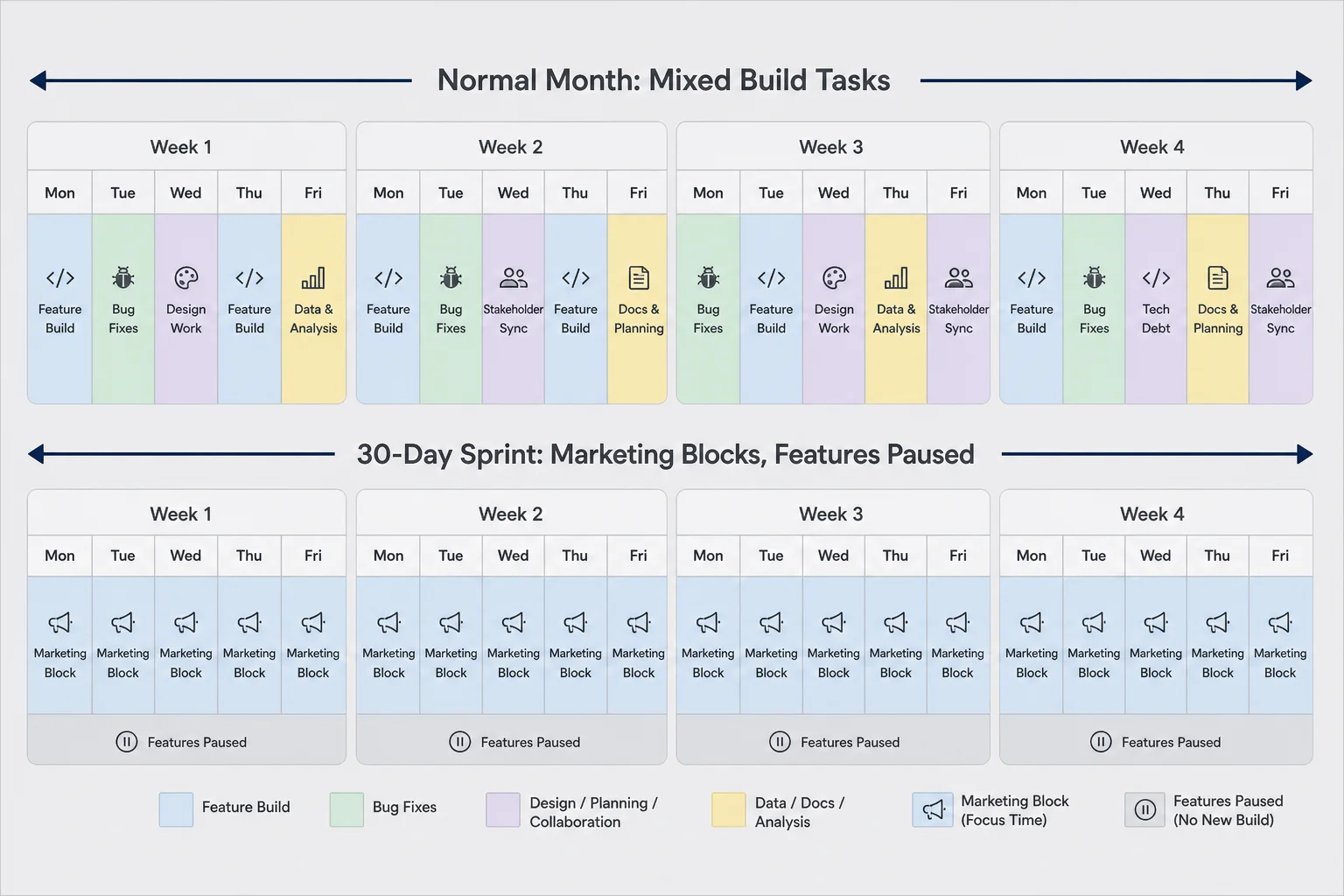
A marketing focus sprint is a fixed window where distribution work is the main job and feature work is on pause except for a short allowlist. Thirty days. Calendar block. Written rules. Not "I will try to post more." Not a vague commitment to be braver. A sprint has a start date, an end date, and a board you look at every morning.
It is not a vacation from the product. You still answer support. You still fix checkout if it breaks. You still show up for calls with people who reply. You are not abandoning users. You are abandoning the fiction that another feature will magically create demand.
It is also not an excuse to spam. A sprint without positioning is just louder noise. If you do not know who buys, spend the first three days sharpening that sentence before you blast a list. I would rather you send thirty targeted emails than three hundred scraped ones. The sprint is focus, not volume cosplay.
Think of two modes. Default mode: whatever feels urgent wins, and urgent usually means the IDE. Sprint mode: marketing tasks get first claim on your best two hours, and the backlog waits behind a gate. The gate is the whole trick. Willpower loses to a kanban column every time.
My sprint board has three columns: Market, Allowlist, and Signal. Market is outreach, content, landing page fixes, community replies, launch prep. Allowlist is the tiny set of build tasks that are truly blocking revenue. Signal is what came back: replies, demos, trials, tagged signups. Every evening I move one card and write one number. That is the ritual.
Week one is usually messy. You rewrite the hero, you clean your prospect list, you send the first emails that feel awkward. Week two is where replies either show up or they do not, which is scary and useful. Week three you double down on what got signal and stop doing what did not. Week four you finish strong and prep the day-thirty review. You do not add a new integration in week four because you are bored. Boredom is not a strategy.
What the sprint is not
It is not "delete the roadmap." It is "freeze the roadmap." There is a difference. Frozen means you can see the ideas. You cannot sneak them into production without admitting you broke the sprint.
It is not a public performance. You do not need to tweet a manifesto about your thirty-day challenge. Some founders announce and create accountability. Others cringe and quit. Pick your personality. The board is for you.
It is not a replacement for a bad offer. If nobody wants the thing, thirty days of outreach confirms that faster. That is still a win. It hurts, but it is cheaper than a year of features for an empty market.
Length matters psychologically. Twenty-one days is tempting because it sounds lighter. In practice you spend week one getting brave and week three quitting right before follow-ups compound. Forty-five days sounds serious until life happens and you drift without a hard review. Thirty is arbitrary and useful the way a sprint in agile is arbitrary and useful. The number creates a finish line your brain can see.
Some founders alternate: thirty days marketing, thirty days build, repeat. That rhythm works when you have real signal and a backlog of validated requests. It fails when the build month is just hiding again. Honesty check on day thirty: did marketing produce conversations? If yes, you earned a build cycle tied to what you heard. If no, another build month is denial with better GitHub stats.
The signals that told me to pause features
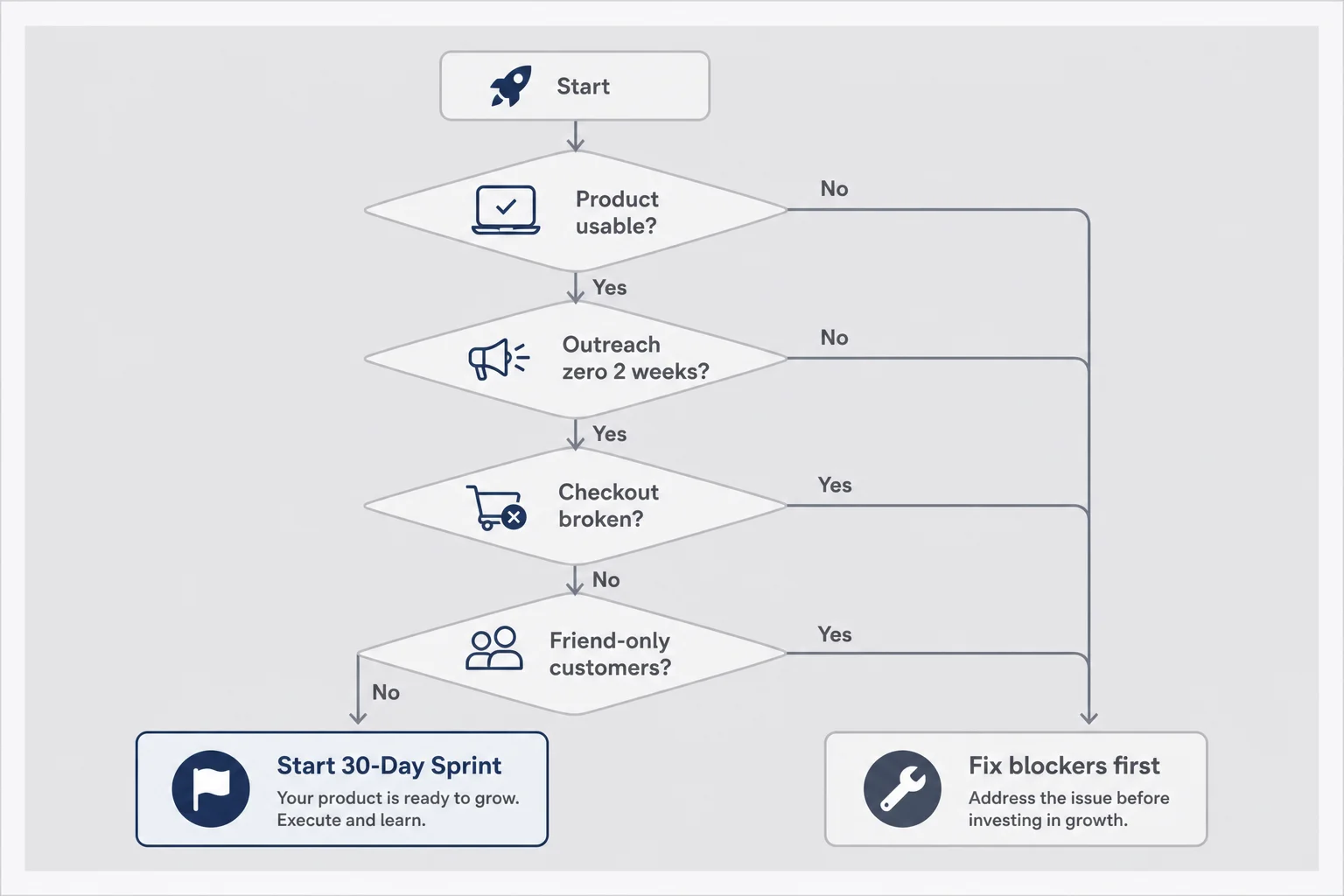
I start a marketing sprint when I see a pattern, not when I feel inspired. Inspiration is unreliable. Patterns are rude and honest.
Signal one: usable product, invisible pipeline. Strangers can complete core jobs without you hand-holding, but new signups are not showing up unless you personally nudge someone. That is a distribution gap, not a feature gap.
Signal two: the backlog is comfort food. When I read my todo list and everything is "nice to have," I am avoiding the market. Nice-to-haves are where founders hide.
Signal three: outreach is zero for two weeks. Not low. Zero. No emails, no community replies, no content aimed at buyers. If you track time and marketing hours are under five percent of work while build hours are ninety-five, you are not in balance. You are in denial.
Signal four: friend-shaped revenue. All customers know you personally. That is fine at the start. It is a warning when month four still looks that way. Friends buy your effort. Strangers buy your offer.
Signal five: you keep researching instead of sending. Competitive analysis can eat a week. Keyword research can eat a week. At some point research becomes a shield. If you have read ten articles about cold email and sent zero, you are not preparing. You are postponing.
Signal six: launch debt. You skipped warm launch work and told yourself you would "do marketing after." After arrived. The sprint is how you pay the debt without pretending launch day will save you.
When any two of those show up, I pick a start date within seven days. Not Monday of some mythical free month. Next Monday is fine. So is Thursday. The date matters more than the drama.
Counter-signals matter too. If refunds are spiking, sprinting past churn is foolish. If the core job fails in the first session, fix onboarding first. If you have no way to take money, fix billing first. Marketing sprint assumes the table exists. You are inviting guests, not building the dining room.
I also watch for false urgency from competitors. A rival shipped a feature and your brain screams that you must match it this week. Competitor panic is how backlogs swell while outreach sits at zero. Unless their feature blocks deals you are already in, it can wait thirty days. Your sprint is a bet that distribution matters more than parity on a settings screen.
Another signal I take seriously: you have not talked to a non-friend customer in thirty days. Not a survey. A conversation. If the answer is no, your sprint should include five calls, even if they are awkward, even if you must offer a free month for twenty minutes. Calls are marketing too. They are also product research without a Jira ticket.
I once coached a founder who wanted a sprint while onboarding still dropped eighty percent of trials at step two. We spent ten days fixing step two, then ran a twenty-day sprint. That was the right order. Sequence is not weakness.
The conversation I have with myself
Before day one I write a short note: "Why sprint now?" If the answer is "because I am scared of email," I still sprint, but I know the real blocker. If the answer is "because the API integration will unlock enterprise," I am probably lying. Enterprise is not coming from a solo founder's side project because of a webhook. Send the emails.
How I run a marketing sprint board week by week
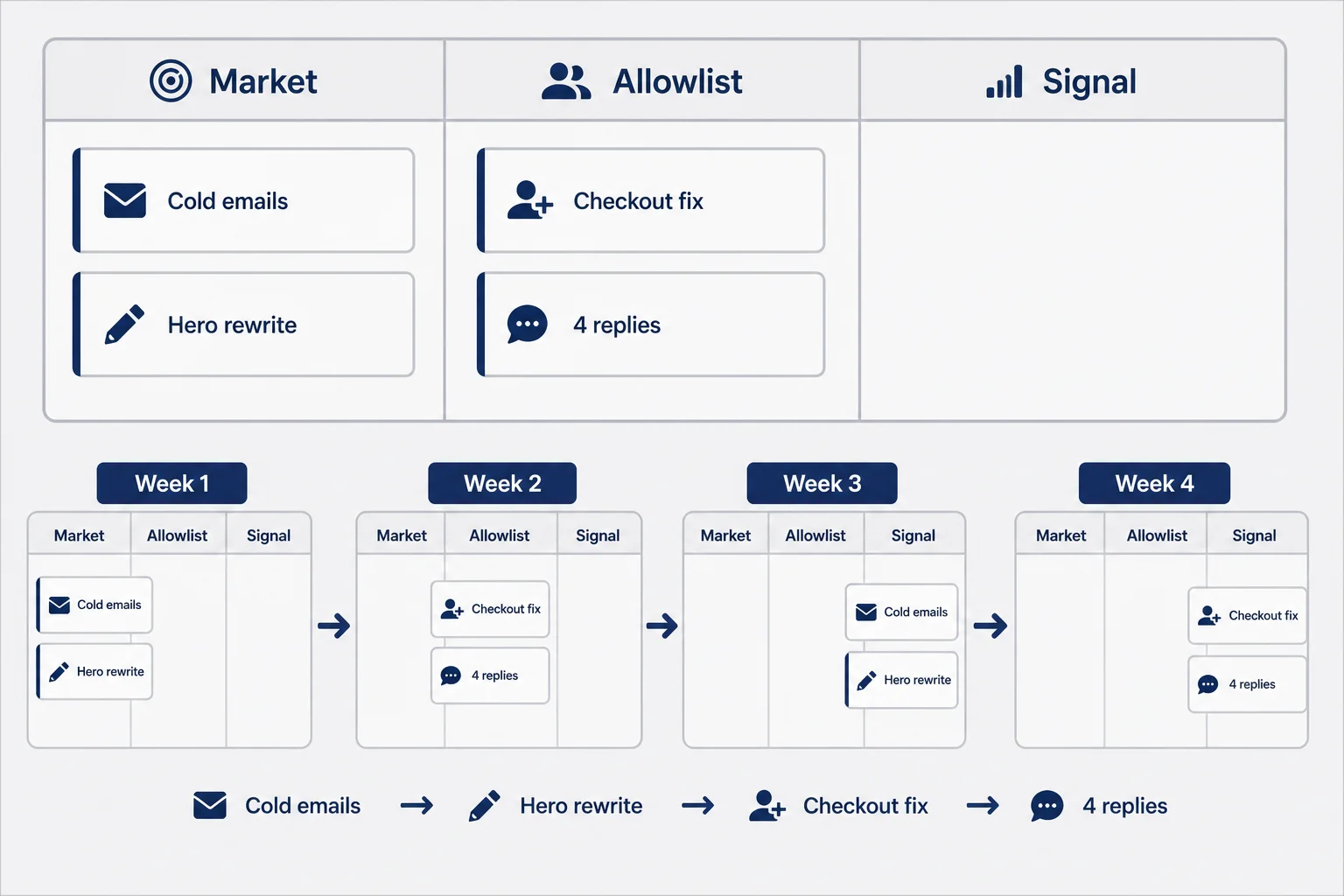
The board is the spine. Without it, a sprint becomes vibes. I use a simple tool: Notion, Trello, a wall sticky note if that is what you will actually open. Fancy does not matter. Visible matters.
Week one: aim and ammunition. Days one to three are setup without using setup as procrastination. Rewrite the hero headline if cold traffic is the bet. Clean the prospect list to fifty names you could defend. Draft three email variants, not thirty. Pick one channel for the sprint. Just one. Write the allowlist: usually three to five bugs max. Everything else goes in a "after day thirty" parking lot.
Week two: send and show up. This is the uncomfortable week. Ten to fifteen emails or DMs per day if B2B. Daily community replies if that is your channel. One piece of content that helps a buyer, not applause from founders. Track replies in Signal column. If nothing moves by day twelve, change the message before you change the channel.
Week three: double down. By now you have data, even if the data is "silence." Silence on message A and one reply on message B is a clue. Do more B. Fix the landing section people bounce from if analytics show it. Book calls with anyone who replied. This week is where sprints work or die. Most founders quit here because embarrassment peaks around day fifteen.
Week four: close and document. Finish outstanding threads. Send polite follow-ups to non-responders once, not four times. Publish one summary post if that fits your channel. Prep the day-thirty review: what sent, what replied, what signed up, what you learned. Do not sneak a feature in because you are nervous about the review. Nervous reviews are the point.
Daily rhythm: open the board before email, move one Market card, do the two-hour block, log one Signal number. Weekly rhythm: Friday thirty-minute retro. What shipped, what replied, what to cut next week.
I template my Market column cards so I do not invent tasks daily. Outreach batch (send fifteen), follow-up batch (touch non-responders once), landing slice (rewrite one section), community hour (ten helpful replies, zero pitches), content ship (one post or email to list), call block (book or run two calls). Pick one primary card per day. Secondary work waits.
On day seven I write a one-paragraph sprint hypothesis: "Freelance bookkeepers who complain about CSV exports will reply to a short email with a Loom showing the fix." That sentence guides week two. If week two proves me wrong, I edit the hypothesis, not the product. Founders skip this step and wonder why tasks feel random. Random tasks burn willpower.
Parking lot hygiene
The parking lot is where feature ideas go to wait without dying. During the sprint, every "great idea" becomes a card in parking lot with one line of context. After day thirty, you sort the lot: build, kill, or research. Most ideas age poorly. That is good news. It means you did not waste March on them.
Pairing with launch work
A sprint pairs well with warm launch habits. If you have a short list of people who said they were interested, week one is not cold prospecting. It is finally emailing them like you meant it. Max's launch writing and my sprint are complementary. Launch teaches sequence. Sprint teaches sustained focus after you failed to sequence the first time. No judgment. Most of us fail the first time.
What still ships during a grow sprint
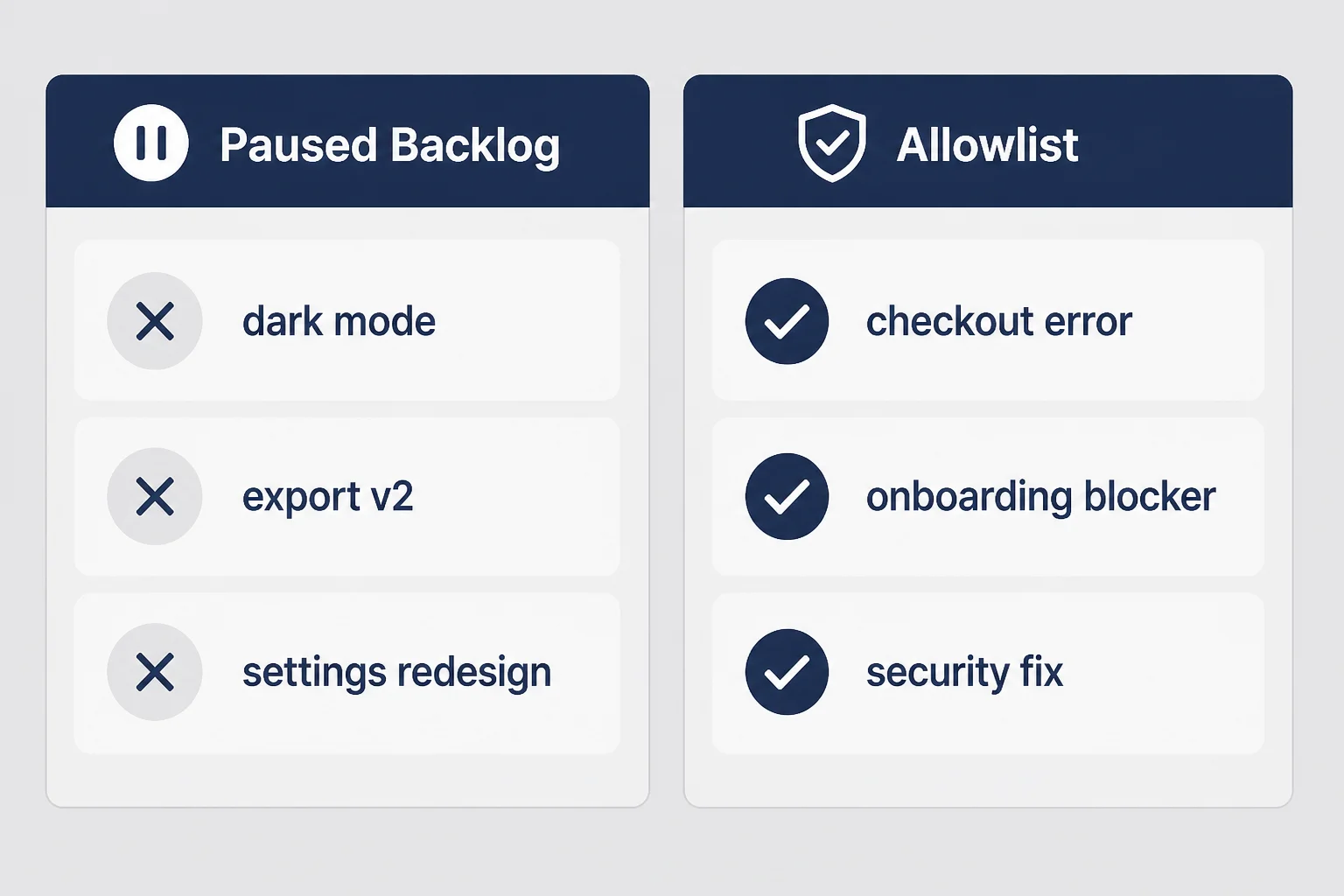
Pause does not mean neglect. Users paid you. Support still gets answers. The allowlist exists so you do not gaslight yourself into a three-day refactor.
My default allowlist categories: money blocked (checkout, billing, trial access), trust blocked (data loss, security, privacy promises broken), job blocked (core workflow fails for a paying user). Everything else waits.
Examples that wait: dark mode, new integrations, performance tweaks that help nobody sign up, admin dashboards only you use, refactoring because the code "feels messy." Those are real tasks. They are not sprint tasks.
Write the allowlist on day zero. When a shiny idea appears on day nine, you do not debate. You point at the paper. If it is not on the list, it goes to parking lot. If it is truly an emergency, add it and remove something else from the allowlist. Tradeoffs keep you honest.
Support tickets are triage, not product roadmap. "Can you add PDF export?" goes to parking lot with a kind reply. "I cannot log in" goes to allowlist. The discipline is separating pain from preference.
Some founders schedule one half-day for allowlist work each week. Friday afternoon works. That prevents marketing hours from bleeding into "just a quick fix" every morning. Quick fixes are how sprints die.
When I break my own rules
I break the sprint when a paying customer is stuck and the fix is small. That is not breaking. That is business. I break the sprint when I pretend a large feature is small. That is the sin. If the fix takes more than four hours, it waits unless revenue is actively on fire.
Tell one person you are sprinting if accountability helps: a cofounder, a friend, a community DM buddy. You do not need an audience. You need someone who will ask on day eighteen, "How many replies?"
The two-hour daily marketing block I actually keep
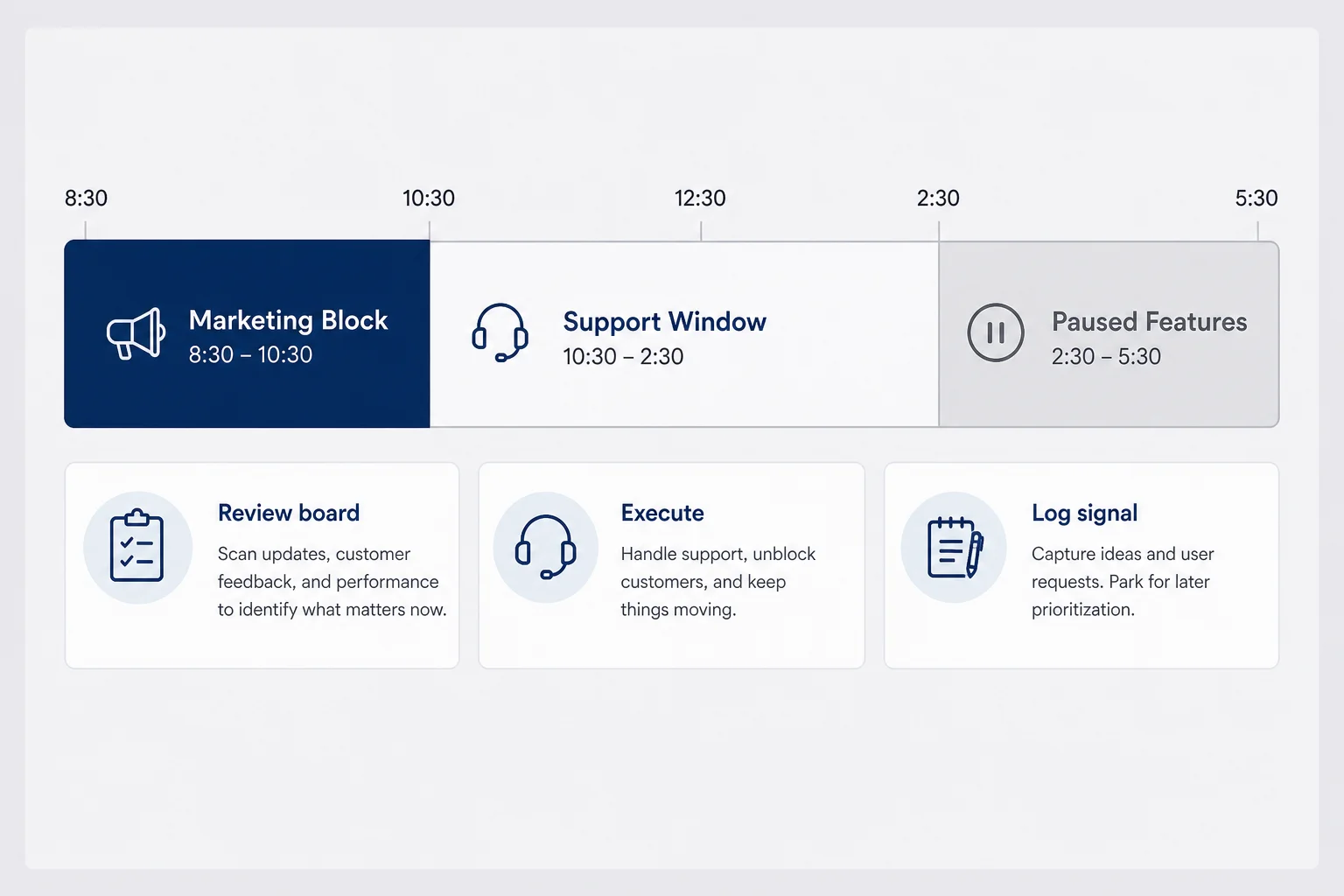
Two hours is enough if they are the first two hours of your workday, phone in another room, Slack closed, inbox closed until the block ends. Not two hours scattered between commits. Not "marketing while watching TV." A block.
Mine runs 8:30 to 10:30. Yours might be different. Protect the start time like a flight. The block has three beats: ten minutes review board and pick one primary task, eighty minutes execute that task without switching, thirty minutes log signal and queue tomorrow. One primary task. Not six half tasks.
Monday might be list cleaning and first sends. Tuesday follow-ups and community replies. Wednesday landing page section rewrite. Thursday content or Loom if that fits your channel. Friday retro and allowlist fixes. Repeat with variations, not reinventions.
If you have a day job, the block might be before work or one protected evening. Consistency beats duration. Five two-hour blocks in a week beats one ten-hour guilt binge on Sunday.
What belongs inside the block: emails, DMs, posting, landing edits, call prep, writing buyer-focused content. What stays outside: refactoring, feature design, reading Hacker News, "research" without output. If you finish early, send one more email. Do not reward yourself with code.
I use a stupid paper checkbox for the block. Physical checkmarks scratch an itch GitHub will not. Do what works. The block is sacred boring.
Energy management
Marketing hours are emotionally expensive. Build hours give you artifacts. Marketing hours give you silence sometimes. Plan a small reward that is not opening the IDE. Walk, coffee, a show. You are training a nervous system, not just a calendar.
If you miss a day, do not double the next day unless you enjoy burnout. Resume tomorrow. Sprints fail on shame spirals more than missed days.
Batch similar tasks inside the block. Writing fifteen emails in one sitting beats switching between email and landing page edits every twenty minutes. Context switching is where solo founders lose hours. The block works because it removes switching, not because two hours is magic.
I also protect post-block time for support and allowlist fixes. Marketing block ends at 10:30. Support inbox opens at 10:35. Build allowlist opens Friday afternoon only. Without those fences, support becomes an all-day excuse and the block shrinks to forty-five minutes of real work.
Measuring a grow sprint without fooling yourself
Vanity metrics are how founders lie during sprints. Impressions, follower count, page views without source, "engagement rate" on posts that never mention the product. I track a small scorecard on paper.
Outreach sent: count every real attempt, not drafts. Replies: any human response, even no. Positive replies: someone curious about the problem or product. Calls or demos: conversations that could lead to money. Trials or signups tagged: use UTM parameters or a simple "how did you hear" field. Revenue events: new paid customers if the cycle is short enough.
I do not track commits during a sprint. I do not track lines of code. I do not track number of tools integrated. Those are build metrics wearing a marketing hat.
A good sprint might look like: forty-five emails sent, nine replies, three calls, two trials, one paid customer. That is not scale. That is proof the message can land somewhere. A bad sprint with the same effort but zero replies is proof you need a new message or audience. Both outcomes beat another month of silent shipping.
Compare weeks, not days. Week one reply rate versus week three tells you if iteration works. If week three is worse, you are not iterating. You are panicking.
Tag links in outreach with simple UTM strings or a /sprint path you remember. You do not need perfection. You need to know whether Tuesday's email drove Thursday's trial. Without tagging, you will credit luck and repeat the wrong message.
I also keep a rejections log. Polite no's, angry no's, silence after a demo. Patterns show up fast. Three people say "too expensive" and you have a pricing conversation, not a feature conversation. Three people say "we use Excel" and you have a positioning gap. The log is marketing research that does not feel like research because it stings.
Plausible or your analytics tool is fine. You do not need a data warehouse. You need five numbers you trust.
The day-thirty review
On day thirty-one, answer four questions in writing. What channel got the most real conversations? What message got replies? What landing change moved signups, if any? What will I do for the next thirty days: another sprint, return to build, or pivot offer?
If you got signal, you might blend modes: four hours marketing, four hours build, with rules. If you got silence, resist the urge to build your feelings away. Change positioning or ICP first. I have seen founders run three sprints with three angles before the fourth clicked. That is still cheaper than a year of features.
Where to point the sprint: landing, launch, and warm paths
Not every sprint task is cold email. Pick the highest-leverage surface for your stage.
If cold traffic is the bet, spend week one on the landing page: hero, proof, CTA, risk reducers. Traffic without clarity is waste. Clarity without traffic is also waste. Sprint gives you both jobs in order.
If you have warm names from validation or a quiet launch, week one is finally working that list. Max's launch sequence is the playbook. Your sprint is the accountability to execute it.
If you have some content but no distribution, pair sprint with one channel depth from the marketing overview. One channel for thirty days. Not four.
Match sprint intensity to stage. Pre-revenue with zero list: heavier outreach. Post-launch with traffic but no conversion: heavier landing and call booking. Post-launch with no traffic: heavier channel presence and one SEO article aimed at a buying query.
If you are torn between channels, pick the one where you already have a toehold. A dead Twitter account is not a toehold. A Slack community where you answered five questions last month is. Sprint energy should deepen an existing thread, not start from zero in four places.
Content during a sprint should be buyer-facing, not founder-facing. A post about "lessons from my sprint" gets applause from other builders. A post that teaches your ICP how to solve a slice of their problem gets trials. Both can exist. Only one pays rent early.
Common ways founders bail on week two
Week two is when the sprint dies. Week one has novelty. Week three has hope if week two produced a reply. Week two is silence and self-loathing.
Bail pattern one: "Just one small feature" that takes four days. You know who you are.
Bail pattern two: switching channels because Reddit felt scary so you opened Twitter, then LinkedIn, then a newsletter you will abandon.
Bail pattern three: rewriting the same email without sending it. Drafts are not outreach.
Bail pattern four: consuming growth content as a substitute for doing growth. Reading my article does not count. Sending email counts.
Bail pattern five: announcing the sprint publicly then ghosting your own thread because embarrassment scales with audience.
The antidote is boring: same block, same channel, same board, one metric logged daily. Variety is not your friend in week two. Persistence is.
If you truly cannot send another email, switch task type inside the same channel: write a helpful reply in a community thread instead of cold outreach. Still marketing. Still counts. Do not open the IDE.
Week two is also when impostor syndrome shows up loudest. You will read a launch thread from someone with more followers and feel behind. Comparison is not signal. Your scorecard is signal. Close the tab. Send the email.
Some founders ask whether AI can run the sprint for them. AI can draft emails, subject lines, landing copy variants, and retro summaries. It cannot send the emails, book the calls, or hear the pause when a prospect says "we tried something like this before." Use AI inside the block. Do not use AI to skip the block.
If you are a developer-founder, tell your brain the sprint is an experiment with an end date. Developers respect experiments. "Marketing forever" feels fuzzy. "Thirty days, then we review commits versus replies" feels like engineering. Use the framing that works. The board does not care what you call it.
Questions founders ask when they cannot stop building
When should a solo founder stop building and focus on marketing?
When the product works for early users but strangers still cannot find you, when your backlog is full of nice-to-haves while outreach sits at zero, or when you have shipped three features in a month and had zero new conversations. If checkout is broken or onboarding loses everyone, fix that first. If the product is usable and invisible, pause features for a focused marketing sprint.
How long should a marketing focus sprint last?
Thirty days is the default I recommend. It is long enough to send real outreach, rewrite a landing page, and post consistently in one channel. It is short enough that you will not forget how to code. Two weeks often ends right when momentum starts. Sixty days without shipping anything new can make you stale. Pick thirty, put the end date on the calendar, and review on day thirty-one.
Can I still fix bugs during a marketing sprint?
Yes. Keep an allowlist: checkout failures, data loss, security issues, and onboarding blockers that stop a willing buyer from paying. Everything else waits. Dark mode, export v2, and settings redesigns are not emergencies. Write the allowlist on paper before day one so you cannot negotiate with yourself at midnight.
What should I measure during a grow sprint?
Count conversations, not commits. Track outreach sent, replies received, demos booked, trials started, and signups tagged from the work you did that week. Ignore follower growth and raw impressions unless they correlate with someone asking a buying question. One reply from your ICP beats fifty likes from other founders.
What if marketing still does not work after thirty days?
You learned something cheaper than six more months of building. Either the message is wrong, the channel is wrong, or the offer does not match the pain. Rewrite positioning, change the audience, or pick a different channel before you open the feature backlog again. A failed sprint is data. A failed year of silent shipping is just expensive denial.
The sprint ends. The product does not
Thirty days is a chapter, not a religion. On day thirty-one you choose with data, not with guilt. Some founders go back to build mode refreshed because they finally know what the market said. Some run another sprint because the first angle was weak but not hopeless. Some kill ideas that deserved killing months ago.
What I want you to take is simpler than a framework. Building is not moral. Marketing is not gross. They are two jobs, and solo founders cheat the second one because the first one gives faster feedback. A sprint is how you rebalance without pretending you will "get to it later." Later is where products go to be admired by the person who built them.
I still merge PRs I should not. I still need the board. The difference is I catch the loop faster now. Fourteen commits and zero outreach is a weather report. You can ignore weather. You cannot ignore it forever and expect revenue.
Pick a start date. Write the allowlist. Freeze the backlog. Two hours tomorrow morning, before the comfortable work seduces you. Thirty days later, count replies, not checkmarks. That is the whole game.
The uncomfortable truth is that distribution rewards repetition more than brilliance. Your first email will be mediocre. Your tenth might be fine. You do not get to the tenth if you retreat to the repo after the first silence. A sprint is a container for repetition until the market answers.
I do not think you need to become a marketer. You need to become someone who finishes conversations, not just features. The board helps. The date helps. The allowlist helps. None of them replace the send button. Press it tomorrow. Then press it again Thursday. That is how solo founders stop building in circles and start learning in public.




Comments