They Said Pilot. They Meant a Free Year.
How solo founders write a paid SaaS pilot proposal: scope, pricing, success criteria, one-page template, timeline caps, and when to walk away from free POC theater.
 By Derek28 min read
Listen to this article
AI-generated podcast-style overview of this article (not a word-for-word narration).
A founder forwarded me an email thread on a Wednesday. Subject line: "Pilot terms."
The prospect wanted twelve months of full access. Every feature. Twenty seats. Weekly check-ins. A custom integration they had not mentioned on the demo. Price: zero, "while we evaluate."
The founder asked if this was normal. I asked what success would look like at month twelve. Silence. I asked who would sign if the pilot went well. "Probably finance, eventually."
That is not a pilot. That is a free year with a LinkedIn logo promise attached.
I am Derek. I have sat through enough procurement calls to know the word pilot means seventeen different things depending on who typed it. For solo founders selling their first team or enterprise deal, the saas pilot proposal solo founder moment is where revenue either gets real or gets donated.
This post is for founders who already ran discovery, survived a demo, maybe even cleared a security questionnaire, and now have a champion who says "let's start with a pilot." If you have not mapped when to sell enterprise, read that first. If your demos keep missing the buyer, fix the room map before you write scope. If your champion cannot get budget adjacent humans on a call, read champion vs buyer. If legal already sent a vendor form, you are past the security questionnaire gate.
A signed pilot with one real stakeholder beats a hundred "looks promising" pipeline entries. A paid pilot with written success criteria beats both.
Interest is not budget. A free pilot is not a strategy. It is you funding their procurement process while they compare you to two other vendors on extended trials.
I use PandaDoc or a clean Google Doc for one-pagers. DocuSign for signature. Stripe invoicing when they pay by card. None of that matters if the scope is wrong.
This is post five in the upmarket launch series. By the time pilot language shows up in your inbox, you should already know whether you are ready to climb (readiness), whether the right people were in the demo room (enterprise demo), whether your champion can reach budget (champion vs buyer), and whether you can survive the vendor form (security questionnaire). The pilot proposal is where those threads either knot into revenue or unravel into a free year.
My one-line rule for this stage: if they will not pay something and will not name how success converts to annual, you are not writing a pilot proposal. You are negotiating how much free work you will do. That can be a valid choice once. It is a terrible default.
They said pilot. They meant free.
Buyers say pilot because it sounds lower risk than "annual contract." Champions say pilot because it is an easier internal sell than "new vendor, five figures." Procurement says pilot because it kicks the decision down the road without rejecting you outright.
None of those definitions require you to work for free.
The free-year pilot request usually arrives after a good demo. Your champion is sincere. They want the tool. They also want to avoid a budget conversation they are not sure they can win. So they ask for time. Lots of time. Your time.
I have seen the pattern dozens of times. Month one: enthusiastic onboarding. Month three: "can you add this edge case?" Month six: champion changes roles. Month nine: new person asks why they are paying for something nobody uses. Month twelve: "we need to revisit budget next fiscal year."
You spent a year being unpaid customer success for a account that never committed.
Free pilots also attract the wrong internal behavior. Without money attached, every stakeholder treats your product as optional. Meetings get canceled. IT deprioritizes SSO. Data never gets loaded. Then they say the pilot failed. It did not fail. It was never resourced.
Paid pilots change the physics. Three thousand dollars is not about the revenue. It is about skin in the game. Someone had to approve a line item. Someone will show up to the readout because they spent money. Finance remembers.
That does not mean gouge a startup champion who truly has no budget. It means negotiate honestly. A smaller paid pilot. Fewer seats. Shorter window. Credit toward annual if they convert on time. What you cannot do is absorb a year of enterprise support because the word pilot felt softer than invoice.
POC language is even worse. Proof of concept sounds technical, so founders think engineering hours are the product. Buyers use POC when they want your API in a sandbox forever. Clarify: are we proving the technology works, or proving your team will adopt the workflow? Technology proofs can be two weeks. Workflow pilots need users, data, and a decision date.
Founders confuse generosity with speed. They think free pilot closes faster. Sometimes it does sign faster. It does not convert faster. The signature you want is annual with a PO, not a perpetual evaluation.
I ask four questions when "pilot" hits the thread:
Who approves spend if this works? Not eventually. By name or role.
What three numbers change if we succeed? Time saved, errors reduced, revenue protected. Vague wins die in readouts.
What is the decision date? Calendar day. Meeting booked.
What happens if we hit the metrics? Annual order form ready, or another excuse machine?
If they cannot answer, you are not writing a proposal yet. You are still in discovery.
Champions sometimes push back: "We never pay for pilots." Fine. Ask what they did with the last vendor who gave a free year. Usually laughter, then a story about shelfware. Use that.
Enterprise theater loves the word pilot on slide decks. You are not deckware. You are a founder with twelve open support tickets and a roadmap argument on Slack. Scope protects you.
The thesis motion on this page is a scope board. Left side: what they asked for. Right side: what you actually send. Free year versus paid, capped, measured. If the left side looks familiar, stop typing and start negotiating.
Some deals genuinely need a small unpaid trial. Self-serve products with credit cards are different. I am talking about team and enterprise paths where someone already asked for SSO, a security review, and a call with legal. That buyer can afford a pilot fee. They are choosing not to because you let them.
Your champion is not the enemy. They are stuck between loving your product and fearing their boss. Help them with a proposal their boss can approve. "Free" is not a proposal. It is a favor. Favors do not survive reorgs.
Procurement sometimes sends a "standard pilot agreement" that assumes twelve months and zero dollars because that template was written for a different category of software. You are allowed to redline it. Replace duration with your cap. Add a fee line. Add success criteria as an exhibit. If they refuse all three, you have learned what kind of buyer this is before you provision accounts.
I also watch for the "pilot as production" move. They want every department on the tool, real customer data, full integrations, and a handshake that commercial terms come later. That is not a pilot. That is rollout without a contract. Name it when you see it. Rollout gets annual pricing or a paid pilot with scope that matches production load.
When a prospect says "pilot," repeat back: "So we are agreeing to a time-boxed evaluation with success criteria and a decision meeting. Not open-ended production access." Watch their face. That tells you whether you are in a real deal or a free tier audition.
I lost a deal once by agreeing to a free ninety-day pilot without a decision date. The product worked. They ghosted at day eighty-nine because budget was never real. I would have lost faster with a paid pilot and a walk-away clause. Faster loss is cheaper.
Another founder I advised took a different path. Same free-pilot ask. She replied with a one-page paid scope at $4,500, thirty seats max, sixty days, three metrics they had already named on the demo. The champion came back in forty-eight hours. Finance approved $3,800. Not her full number, but real money with a PO number. The pilot converted to a $16k annual in week eleven because the readout was scheduled before kickoff and the buyer was on that call. Same product. Different paper.
Free pilots also teach the wrong lesson inside your own company. You start staffing support like they are a paying customer without the revenue to justify it. Your roadmap bends toward one logo's requests. Your SMB customers wait longer for bug fixes because the "pilot" screams louder. That is not upmarket strategy. That is misallocated attention with extra steps.
Read enterprise demos if you are still letting users without budget run your forty-minute screen share. Pilots are downstream of a room that includes someone who can say yes with money.
What a paid pilot should cost at solo-founder scale
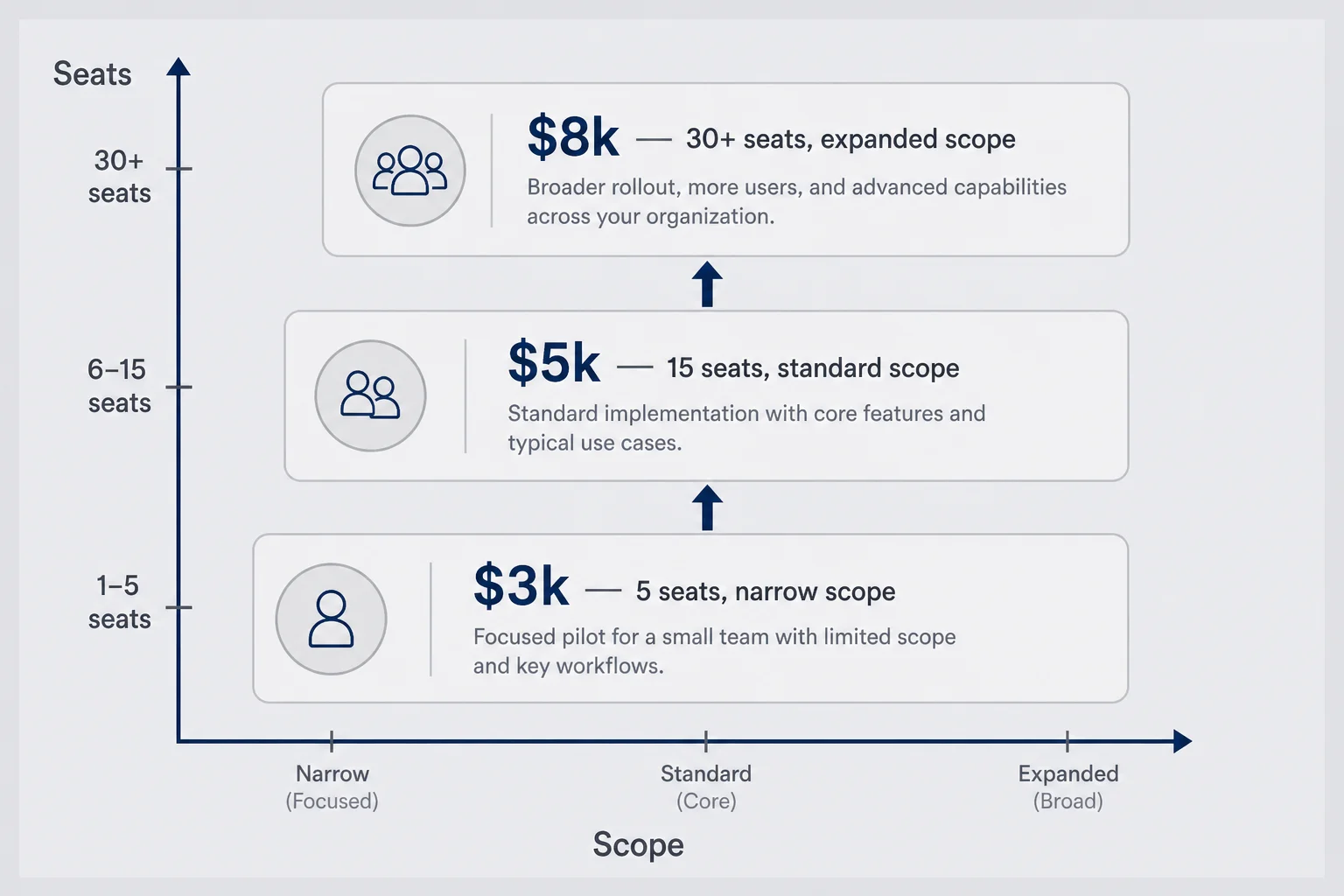
Pilot pricing is not list price. It is a filter plus a down payment on annual.
At solo-founder scale I think in bands, not formulas. $3k to $5k for a focused pilot: up to ten named users, one workflow, sixty days, standard support. $5k to $8k when security review already happened, integrations are involved, or the buyer is mid-market with real procurement. Above $8k you are often better off selling a discounted annual with an opt-out clause than calling it a pilot.
Below $3k, finance rounds weird and champions cannot explain why they paid "so little" for something strategic. Above $8k without annual path, you are doing project work dressed as SaaS.
The pilot fee should be painful enough to prioritize, cheap enough versus annual that conversion feels rational. Say annual is $14k. A $5k pilot with full credit toward year one if they sign within thirty days of readout is a clean story. They risk five, not fourteen. You risk two months, not a year.
Do not price pilots as a percentage of annual by reflex. Ten percent of ACV sounds enterprise. It also produces $1,200 pilots on $12k deals that nobody takes seriously. Use round numbers champions can repeat in hallways.
Credit policy matters as much as the fee. Full credit toward annual if they convert on time builds trust. Partial credit is fine if scope was heavy. No credit teaches buyers pilots are disposable. I default to full credit within sixty days of successful readout.
Some founders ask whether to invoice upfront or split 50/50. Upfront for pilots under $6k. Split only when procurement demands it and the buyer is real. You are not a bank.
Compare to your SMB math. Twenty accounts at $49 is $980 MRR. A $5k pilot is five months of that gross, collected once, with one relationship to manage. If the pilot converts to $12k annual, you replaced a dozen small accounts with one signature. That is the trade you are making when you go upmarket.
Pilot price also signals implementation depth. Too cheap and they expect white-glove custom work. Too expensive and they delay to next quarter. Ask your champion: "What pilot fee could you approve without a full RFP?" That number is your ceiling for speed.
Founders underprice because they fear losing the logo. I fear losing the year. Price the pilot so walking away hurts them a little too.
Payment mechanics: Stripe invoice for card-friendly buyers. PDF invoice with wire instructions for PO shops. DocuSign order form attached. Keep it boring. Surprises in payment method kill momentum after legal already cleared you.
Discounting the pilot to zero "just this once" trains the account. Next renewal they remember you fold. Hold the line with scope reductions instead. Fewer seats. Shorter time. Fewer integrations. Not free.
If they compare your pilot to a competitor's free trial, name the difference. Trials are self-serve. Pilots include onboarding, success criteria, and a readout with their buyer. You are selling an evaluation program, not login credentials.
Tax and rev rec are above my pay grade. Talk to an accountant once you run more than a few pilots. For now, know that pilot revenue is still revenue, and credit toward annual is a commercial term, not a refund, if you write it clearly.
Regional notes from calls: UK and EU buyers often expect VAT lines on pilot invoices. US mid-market sometimes needs a W-9 before first pay. Have those ready in a folder so you do not stall after verbal yes.
Founders ask whether to match a competitor's pilot terms. You rarely know what the competitor actually agreed to. You know your calendar and your annual target. Price to your floor, cap to your capacity, credit to your conversion path. Matching imaginary terms is how solo founders race to the bottom alone.
When finance pushes back on pilot line items, help your champion reframe. This is not "new software spend" only. It is risk reduction on a larger rollout decision. A failed $5k pilot that ends in thirty days is cheaper than a failed $18k annual that nobody uses. Finance understands that math when someone explains it plainly.
When a champion says budget is capped at $2k, consider a paid proof instead of a pilot: two weeks, three users, one metric. Smaller box. Still paid. Still a decision date.
Founders sometimes ask whether to quote pilot as a percentage of expected annual. Ten to twenty-five percent is a useful sanity check, not a law. A $20k annual target might support a $4k to $5k pilot. A $10k annual might land at $2,500. The percentage keeps you from pricing a pilot that feels trivial next to the contract you want, or so high that finance routes you to an RFP you cannot survive alone.
If they want the pilot fee waived in exchange for a case study, decline unless the case study is worth more than the fee in real distribution. Case studies from pilots that never converted are not assets. They are reminders.
The goal is not to maximize pilot dollars. It is to maximize decision quality. A paid pilot with a clear readout tells you if annual is real. A free year tells you if your product is nice.
Success criteria before you write scope
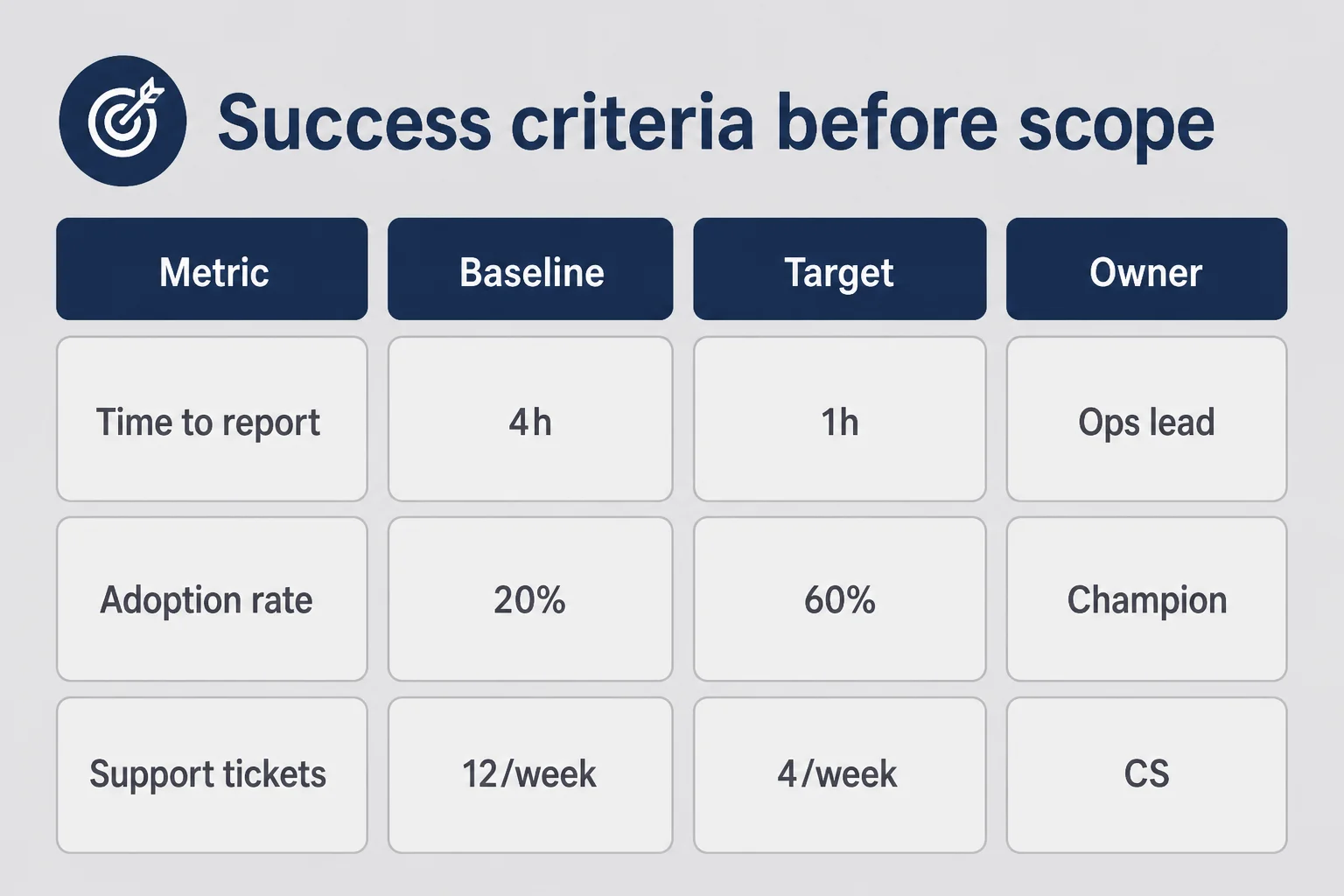
Scope without success criteria is a shopping list. Success criteria without baselines is fiction.
Before you write what you will do, write how you will know it worked. Three metrics. Not twelve. Three.
Metric one should be outcome tied to why they took the call. Hours saved per week. Error rate down. Reports shipped on time. Use their words from discovery.
Metric two should be adoption inside the capped cohort. Percentage of named users active weekly. Workflows completed. Something that proves it is not shelfware.
Metric three should be business enough for a buyer to care. Dollars, risk reduced, or capacity unlocked. Champions love feature metrics. Buyers love money or risk.
Each metric needs a baseline, a target, and an owner on their side who will pull the number. If they cannot name who measures, you will measure alone and argue in the readout.
Write these before seat counts and integrations. Otherwise you scope to please the loudest user in the room, not the buyer's problem.
I use a simple table in the proposal doc:
| Metric | Baseline today | Pilot target | Owner |
|---|
Fill it together on a call. Email alone lets everyone agree vaguely. A live call surfaces "we do not track that" early.
Success criteria also define failure. What happens if you miss? Extension is not automatic. Options: narrow scope and retry two weeks, pause, or part ways. Parting ways should be acceptable. Pilots that can only succeed create hostage deals.
Avoid vanity metrics. Logins are not success. "Engagement" without definition is poetry. Procurement does not buy poetry.
Security and IT sometimes add criteria: SSO working, data residency confirmed, audit log exported. Fine as supporting goals, not as the only three. IT success without user adoption is still shelfware.
Champions will ask to add "user satisfaction survey." Okay if short. NPS alone will not close finance. Pair with a hard operational metric.
When buyers want "flexibility to adjust metrics mid-pilot," allow one revision at day thirty with written sign-off. More than one revision is moving goalposts.
Your security questionnaire answers should align with what you measure. If you claim encryption and uptime, do not promise metrics you cannot observe.
Founders skip this step because it feels corporate. Corporate is what stops free years. A one-page table is not bureaucracy. It is the difference between readout and rerun.
Document data access needed to measure. If their admin will not export baseline numbers, the pilot starts late. Start late on paper, not in your head.
AI can draft metric ideas from call notes. You still validate them with the buyer. "Reduce reconciliation time from four hours to ninety minutes" beats "improve efficiency."
If success criteria sound impossible, say so before signature. Renegotiate target or scope. Impossible criteria become unpaid blame at day eighty-nine.
Success criteria are the spine of your champion's internal sell. Give them sentences they can paste into Slack. "If we hit X, Y, Z by week twelve, we ask finance for the annual."
Without that spine, your champion forwards a login and hopes. Hope is not a motion.
Say a marketing ops team wants your tool to cut campaign reporting time. Success criterion: produce weekly cross-channel report in under thirty minutes without manual spreadsheet merge. Scope follows: connect three named ad platforms, train up to six users, run four weekly reporting cycles during pilot. Out of scope: custom BI connectors, SSO, historical data backfill beyond ninety days. Every scope line defends itself because it ties to a metric.
Champions sometimes resist measurable criteria because fuzzy outcomes are politically safer internally. Empathize, then hold the line. "We want everyone to feel good" is not a success criterion. "Director of ops confirms reporting workflow is acceptable for team rollout" is. Fuzzy criteria become fuzzy losses when annual comes due.
If your product is early, you can hold private learning goals in your notebook. Customer-facing criteria stay about their pain. Your internal note might say "validate whether permission model survives six real users." Fine. Do not put that on the proposal unless they care.
The one-page pilot proposal I actually send
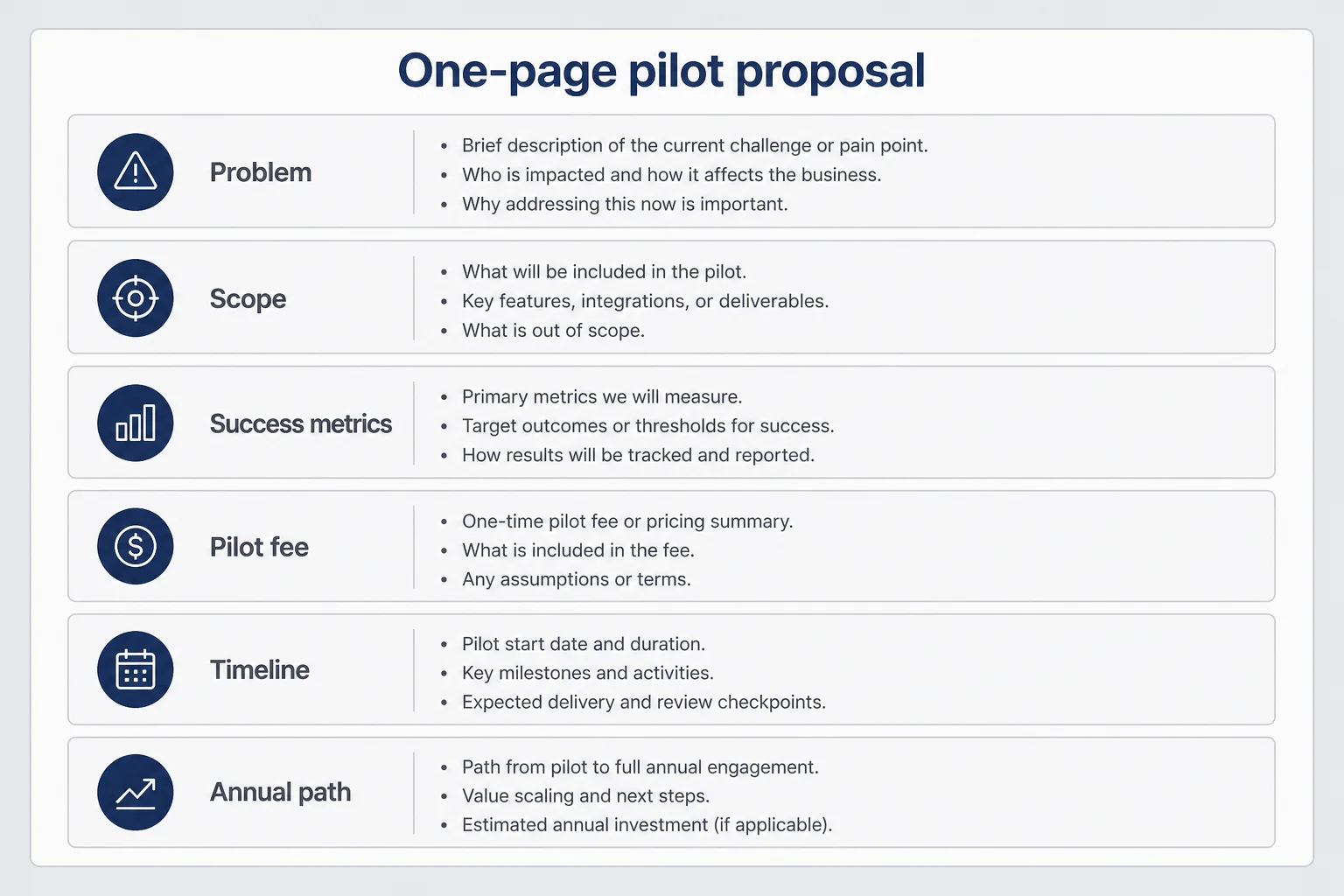
If it does not fit one page, you are overbuilding or underthinking.
My one-pager has eight blocks. No logo parade. No twelve-page MSA attached. Those come after yes.
1. Context (three sentences). Their pain in their words. Why now. Who is involved.
2. Pilot objective (one sentence). What decision this pilot supports.
3. Success criteria (the table). Three metrics with baselines and targets.
4. Scope. Named users. Environments. Features in. Features out. Integrations named with who owns each side.
5. Timeline. Start date. Readout date. Decision meeting date already on calendar.
6. Commercials. Pilot fee. Credit toward annual. Payment terms. What annual looks like in dollars if criteria are met.
7. Support boundaries. Office hours you will hold. Response times you will not promise. Escalation path.
8. Signatures. Champion and buyer or delegated approver. Date.
That is the saas pilot proposal solo founder artifact. Everything else is appendix material legal requests later.
Scope section is where founders leak margin. "Light custom work" becomes a quarter of engineering. Write excluded items explicitly. Custom reports not listed are out. New integrations not listed are a change order.
Change orders during pilots are fine. Charge or trade time for scope. Do not absorb silently. Silent absorption teaches enterprise buyers you are free consulting.
Attach a mutual action plan as page two only if they require it. Page one still stands alone.
Use plain English. Procurement parses buzzwords for risk. "We will migrate up to 500 records from CSV provided by Customer by week two" beats "comprehensive onboarding."
Pricing on the one-pager should mirror what you said on the demo call. Surprises here reopen trust you earned live.
I send PDF exported from Google Docs. PandaDoc if they want e-sign audit trail. Same content.
Champion forwarding is the moment of truth. Include a forwardable blurb at the top they can copy. "Recommend approving $5k pilot to test X against metrics Y. Decision on annual by DATE."
Legal may ask to attach their paper. Fine after commercial yes. Do not lead with MSA for a pilot. Order form plus short pilot terms beats fifty-page redlines for a $5k start.
Pilot terms I reuse: confidentiality both ways, limited liability cap tied to fees paid, data processing pointer to your DPA, termination for convenience with thirty days notice, no SLA beyond best effort unless you mean it.
Founders ask if they need a lawyer for every pilot doc. Not for the first few if you reuse sane templates. Get a lawyer to review your template once. Then reuse.
Compare your one-pager to the upmarket readiness gate. If you are promising enterprise SLA on a pilot fee, you are mismatched.
When buyers push for unlimited users, counter with named seats and a price per additional seat over cap. Numbers on paper stop scope creep.
Version control matters. Date the doc. "Pilot proposal v1.2" prevents arguing about which email thread was real.
If they want a deck, send five slides max. Slide one pain. Slide two success criteria. Slide three scope and timeline. Slide four money. Slide five next step. Deck supports the one-pager. Does not replace it.
Readout agenda belongs in the proposal footnote. Thirty-minute meeting. You present metrics. They confirm or dispute. Next step is order form or written reasons for no.
A one-page pilot proposal is respect for everyone's calendar. Including yours.
Here is the paid pilot proposal template shape I reuse. Not legalese. A working doc.
PILOT PROPOSAL - [Customer] / [Vendor]

1. Purpose (2-3 sentences in their words)
2. Success criteria (table: metric | baseline | target | owner)
3. Scope IN (seats, env, features, onboarding sessions)
4. Scope OUT (SSO, custom dev, integrations not listed)
5. Timeline (start | readout | decision meeting booked)
6. Fee + credit toward annual if signed within [N] days
7. Support boundaries (channels, hours, what is not included)
8. Signatures (champion + buyer or delegate)
Fill brackets per deal. Export PDF. Attach to email with a forwardable blurb for your champion. Total drafting time should be under an hour once you have done two or three.
Include a mutual action plan as page two only when the account is complex enough to need task owners. Kickoff scheduled. Questionnaire submitted by IT. Midpoint check. Final readout. Annual order form draft shared in week three. Two pages beats twenty. Founders who only email PDFs and wait often wait through three internal meetings they were not invited to.
If the champion wants to "run it by legal" before sharing internally, offer a fifteen-minute walkthrough of the one-pager on a call. Legal questions surface early. Surprises surface early.
Timeline caps that do not bleed six months
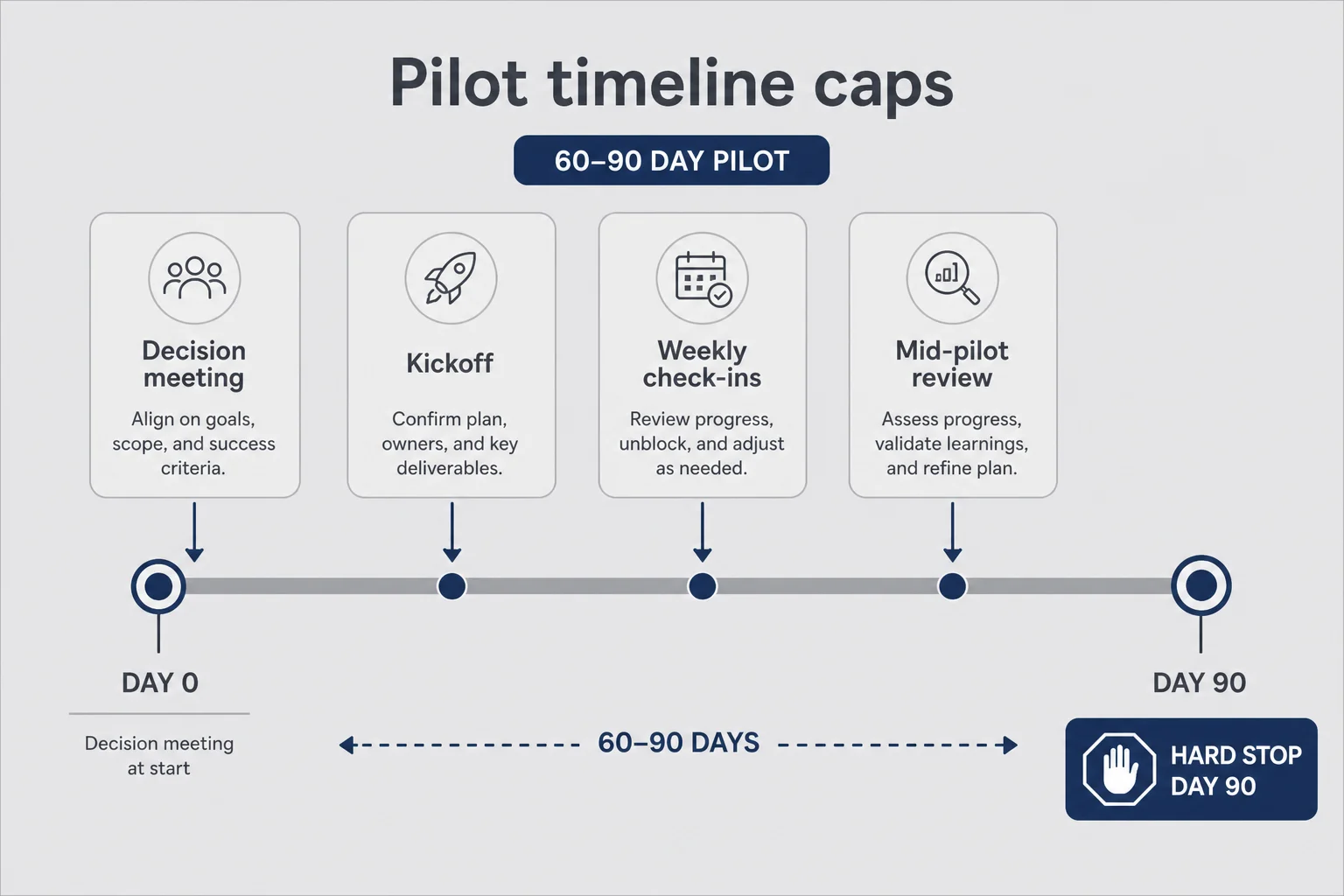
Six-month pilots are free tiers with quarterly check-ins.
Cap at sixty days when the workflow is narrow and data is ready. Ninety days when procurement slow-walked start or integrations need IT. Beyond ninety, require written extension with fee or partial annual commit.
Book the decision meeting before the pilot starts. Week ten for a sixty-day pilot. Week twelve for ninety. Invites sent at signature. Calendars fill. Empty calendar at day eighty means no decision.
Milestones inside the window keep champions honest:
Week zero: kickoff, confirm baselines, assign owners.
Week two: data loaded or integration smoke test.
Week four: midpoint check. Adjust one metric if needed with sign-off.
Week eight: dry run of readout numbers.
Final week: readout and commercial conversation.
If week two slips because their IT did not provision SSO, pause the clock in writing. Do not absorb silently. Paused clock needs new end date.
Extensions without new money are gifts. One free two-week extension per pilot max. Second extension converts to paid monthly or ends.
Founders bleed time on "almost ready" accounts. Timeline caps are how you exit without ghosting. End-of-pilot email: "Per our agreement, pilot concludes Friday. Here are results. Here is annual order form. If timing shifted, tell me by DATE or we will close access Monday."
Hard stops feel scary. They produce decisions. Soft stops produce another quarter of maybe.
Align timeline with demo follow-up discipline. Same pipeline honesty. If readout happens and buyer no-shows twice, downgrade the deal.
Holiday and fiscal year mess with caps. Ask about blackouts in kickoff. Q4 at enterprise can be dead for decisions even when users love you.
Your support load should be in the timeline. Weekly office hour is fine. Daily custom calls are not unless priced.
Document timezone and response windows. "Business hours US Central, email within one business day" sets bounds.
Parallel procurement during pilot is normal. Legal can review annual paper while users test. Do not let legal delay pilot start unless required. Start user work while paper moves when possible.
When champions ask to "keep access while finance reviews," sell a bridge month at discounted monthly until annual signs. Not free continuation.
Timer visibility helps. Shared doc with dates. Slack reminder at midpoint. Founders forget to nag. Nagging with dates is account management.
If product immaturity cannot hit ninety-day value, shorten scope, not timeline. A thirty-day proof with one metric beats ninety days of apology.
Timeline caps protect your roadmap. Every week in pilot limbo is a week not shipping for paying SMBs who fund the company.
Beware pilots that start "when IT finishes SSO." SSO might be annual scope. If SSO is not required for success criteria, start without it. If SSO is required, price and time-box implementation or the pilot clock never starts.
Holidays eat pilots. A thirty-day pilot over December is a fifteen-day pilot with extra email. Plan start dates with their calendar, not only yours.
Founders sometimes accept "rolling pilot" language. Rolling means no end. Cross it out. Replace with fixed end date and written conversion path.
Parallel track legal early if annual is likely. Do not wait until day fifty-eight to send MSA draft. Light legal prep in week two saves week twelve. You are not rushing them. You are respecting both calendars.
Cap the pilot. Book the decision. Enforce the end. Generosity without dates is how solo founders lose summers.
Mid-pilot check-ins are risk management, not optional kindness. Week two: are users assigned? Week four: are criteria on track? If usage is flat at week three, you have time to fix champion behavior or exit before you pour another month in.
Founders treat pilots like product trials. Enterprise buyers sometimes treat pilots like vendor bake-offs you do not know you are in. Ask on week one whether you are the only vendor in evaluation. Awkward question. Cheaper than learning at day fifty-nine you were column fodder.
Document every timeline slip they request. Two slips is a pattern. Patterns inform walk decisions.
Pilot to annual — and when to walk away
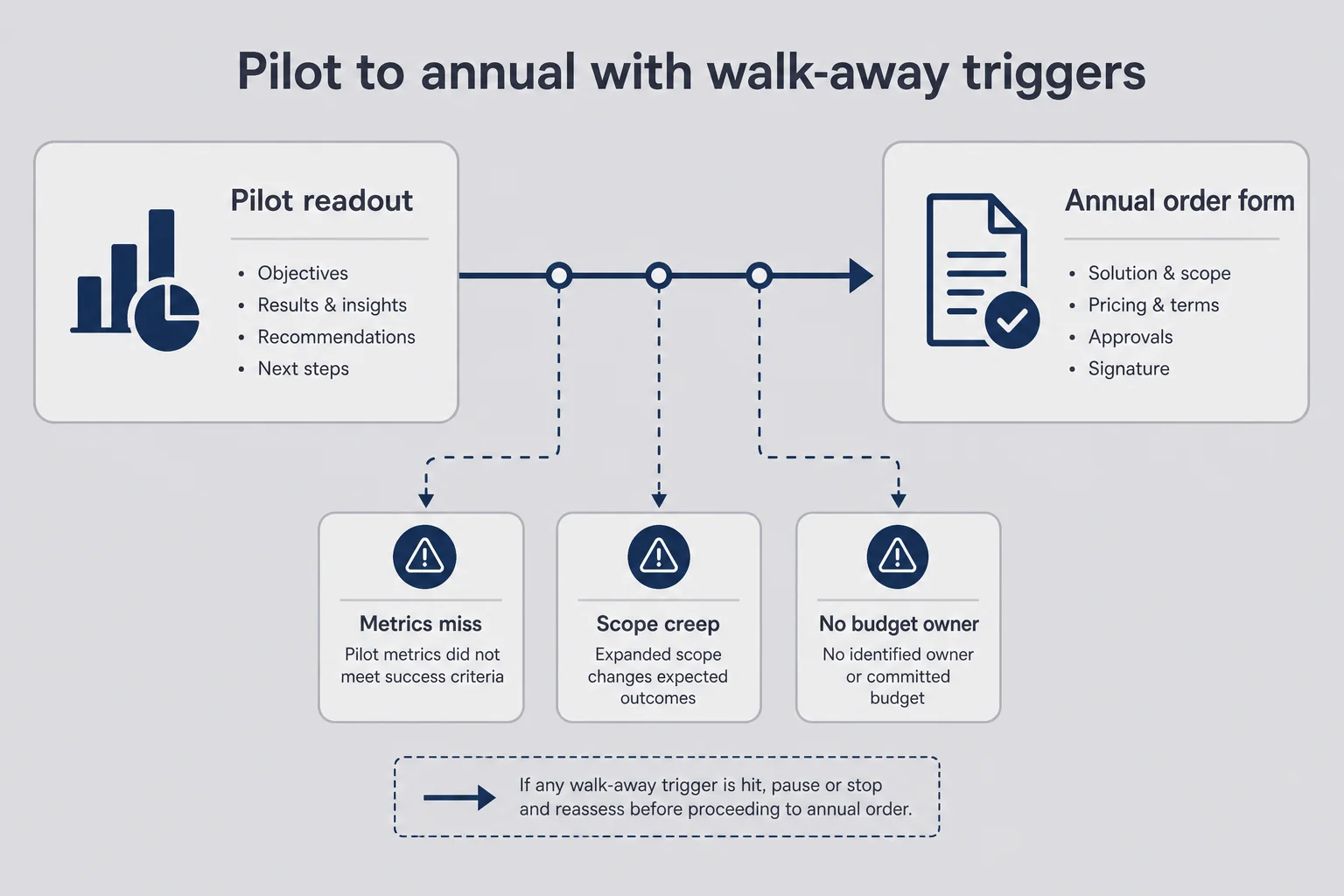
The pilot exists to make annual obvious, not to postpone it.
Readout is a sales meeting with numbers, not a celebration lunch. Open with the three metrics. Show pass/fail honestly. Partial wins count if written upfront. Then ask: "Based on this, are we proceeding to annual as outlined on page one?"
Have the order form ready in the room. PDF open. DocuSign link loaded. Buyers who want annual should sign within days, not weeks. Delay means new objections, not new love.
Annual terms on the order form: seat count, price, term, payment terms, renewal language. Name the annual range you already put on the pilot proposal. Do not introduce a new number at readout unless scope changed in writing.
Credit pilot fee on the order form line items. Visible credit. Finance likes visible math.
If metrics hit and they stall, name the stall. "Is this budget, priority, or product gap?" Three different responses. Budget needs buyer in room. Priority needs executive sponsor. Product gap needs scoped fix with new timeline, not free extension.
Walk away when:
They refuse annual path after agreed success. They want another free ninety days. Buyer never attended readout. Champion lost authority and will not intro replacement. Legal demands unlimited liability for pilot fee size. Scope exploded without change orders and they blame you.
Walking is polite. "Sounds like timing is not right for annual. We will export your data by Friday and close access per terms. Door open if priorities change."
Do not keep free access hoping. Hope burns quarters.
Failed pilots with honest metrics are still wins. You learned fit fast. SMB focus returns.
Failed pilots because they never resourced are lessons in qualification. Next deal, enforce kickoff checklist before access.
Some accounts convert to monthly team instead of annual. Fine if price and seat floor protect you. Better than free. Stepping stone to annual if written.
Champion promotion mid-pilot happens. Re-anchor with new stakeholder immediately. Same metrics, same dates, intro to buyer repeated.
Pilot to annual is also product work. If every pilot asks for the same missing feature, ship it or disqualify that ICP.
Reference customers often born from clean pilots. Ask permission at readout when numbers are strong.
When annual is not the right end state, say so in proposal. Some tools land on multi-year monthly team. Rare at enterprise. Know your end game.
I compare pilot conversion rate to SMB churn in my notebook. If pilots rarely convert but demos keep coming, your ICP or pricing is wrong. Fix upstream.
The readout meeting is where pilot to annual contract conversion actually happens. Not in the celebratory Slack thread from your champion. Not in the "finance is reviewing" email with no attachment. In a calendar slot with metrics on screen and an order form ready.
Open with the three criteria. Grade honestly. Invite disagreement on data, not on whether data matters. If they dispute a number, schedule a forty-eight-hour verification path, not another free month.
If criteria partially pass, negotiate from the written deal. "We hit adoption and outcome. Security criterion slips because IT was late. Options: two-week extension on that criterion only for $1,500, or annual with security milestone in first ninety days." Options beat ambiguity.
Buyers respect founders who can run a readout without spinning. Spinning once costs you the second deal at that account.
Walk away earlier if they would not pay pilot. Walking after readout with clear metrics is professional. Walking after a free year is resentment.
Partial conversion paths exist. Maybe annual is too big for this quarter but a six-month paid bridge at half seats is real. That is still revenue with an end date. Better than another free extension because the champion is embarrassed to say no.
When annual closes, note what the pilot taught you about implementation time. Underestimating onboarding in the proposal creates angry annual customers. If pilot onboarding took ten hours, annual rollout estimate should not pretend two.
Keep a win folder and a loss folder. Win: proposal PDF, criteria, timeline, what closed annual. Loss: where it stalled, what language they used, whether buyer ever appeared. Your third proposal should take half the time of your first because you stopped reinventing structure.
Your next deal deserves a capped pilot, not PTSD from the last one.
Questions founders ask about pilot proposals
Should a solo founder offer a free pilot to land an enterprise deal?
Usually no. A free pilot attracts tourists, not buyers. Serious accounts will pay something to prove internal priority. A paid pilot in the $2k to $8k range filters for champions who can move budget and gives you a paper trail procurement respects. Free POC theater eats six months and trains the customer to expect a year on the house.
How much should a SaaS pilot cost for a solo founder?
Rough band: ten to twenty-five percent of expected first-year contract value, with a floor around $2k and a ceiling around $10k for most micro-SaaS pilots. A $24k annual deal might justify a $4k to $6k pilot. Below $2k, procurement treats it like a credit card swipe and you get no seriousness filter. Above $10k without a named buyer, you are funding their evaluation.
What belongs in a one-page pilot proposal?
Scope in plain English, timeline with hard end date, success criteria both sides agree to measure, price and payment terms, what happens if criteria are met, what is explicitly out of scope, and named stakeholders. One page forces clarity. Fifteen pages of legalese before a $5k pilot is a signal the deal is wrong-sized.
How long should a B2B SaaS pilot run?
Thirty to sixty days for most solo-founder products. Ninety days max if implementation is real. Anything beyond ninety days without a signed path to annual is a free tier with a handshake. Cap extensions in writing. One renewal, one price, one deadline.
What are good pilot success criteria?
Measurable outcomes tied to their stated pain, not your feature checklist. Bad: they logged in ten times. Good: they processed fifty real records with under two hours of your support. Write criteria before scope so neither side moves the goalposts when the calendar runs out.
When should I walk away from a pilot negotiation?
Walk when they refuse any payment, will not name a buyer, want unlimited scope for ninety days, treat the pilot as production with no annual path, or legal sends a fifty-page MSA for a $4k evaluation. Your calendar is inventory. A polite no beats a free year of maybe.
They will call it a pilot. You name the price and the date.
Free years disguised as pilots eat solo founders alive. Paid, capped, measured pilots with a decision on the calendar separate tourists from buyers.
Write success criteria before scope. Send one page. Credit toward annual when they convert on time. Walk when they want your product without their money or their buyer.
The champion who fought for a $5k pilot is the champion who can fight for $14k annual. The champion who fought for free will ask for free again at renewal.
I still take calls with founders holding a free-pilot thread they are afraid to decline. I get it. The logo feels close. Close is not cash. Cash is cash.
Read the series in order if you are building the motion: upmarket readiness, demos, champion vs buyer, security forms. Then run a pilot that ends on a date, not a prayer.
Next time someone says "let's pilot," ask what success costs them. If the answer is nothing, you already know what kind of year you are signing up for.
A paid pilot that ends on time teaches you more about the account than a free year that never does. Send the one-pager. Cap the calendar. Let the tourists self-select.



Comments