Your SMB Customers Love You. That Is Not an Enterprise Motion Yet.
When to sell enterprise as a solo micro-SaaS founder: readiness signals, team plan vs enterprise tier, legal and procurement reality, revenue thresholds, and when to walk away from SOC 2 theater.
 By Derek26 min read
Listen to this article
20:50AI-generated podcast-style overview of this article (not a word-for-word narration).
A founder sent me a Slack message on a Tuesday. Screenshot attached. NPS scores. Glowing support tickets. A quote from a customer who called the product "a lifesaver."
Then one line: "We should go enterprise. When do we add SSO?"
I asked how much MRR was on the card today. Four thousand two hundred. I asked who had asked for SSO. One person on a fifteen-seat team who was not the person who paid the invoice. I asked whether anyone with signing authority had been on a call yet. Crickets emoji. Fair enough.
That is the when to sell enterprise micro saas solo founder moment in one thread. SMB love is real. It is also not a buying committee. It is not procurement. It is not a security review that starts with "please complete our vendor portal." Founders hear "enterprise" and picture logos and annual contracts. I picture calendar weeks, questionnaires, and the quiet gap between a great demo and someone who can actually sign.
I am Derek. I spent six years as an AE at small B2B SaaS shops, then freelanced with bootstrapped founders who had happy customers at $29 a month and terror in their eyes about a forty-five-minute call with a director. Since 2023 I have advised a handful of solo founders on their first team plans and enterprise pilots. A few replaced twenty small accounts with one annual contract. More stalled in legal review because nobody mapped who signs before the demo.
This post is for founders who already have paying SMB customers and are wondering whether upmarket is the next move or a distraction dressed as ambition. If pricing still feels fuzzy, fix pricing for solo founders before you add an "Enterprise" column. If strangers cannot explain what you do in one sentence, read positioning first. Upmarket multiplies clarity. It does not create it.
A signed pilot with one real stakeholder beats a hundred "looks promising" pipeline entries. That is the whole game. Everything below is how I decide whether you are ready to take the first step upmarket, which step to take, and when to close the laptop on a deal that will eat your year.
I am not going to tell you enterprise is evil or that every founder should stay SMB forever. Some products belong upmarket. Some founders want fewer, larger accounts because support load is killing them. That is a legitimate strategy. It still has to be earned with motion, not declared on a pricing page.
Reese will teach you how to get the first strangers to pay without a call. Max will tell you what SSO actually costs to implement. I am the guy who helps you figure out whether the person who loves your product can get you in front of someone who signs checks, and what to do when legal sends a PDF the size of a novella.
What upmarket actually means when you are the whole sales team
Upmarket is not a vibe. It is not a pricing page badge. It is not copying the Salesforce integration section from a competitor who raised Series B.
When you are the whole sales team, upmarket means you can run a multi-week conversation with more than one human at the account, survive a security questionnaire without inventing policies, and still ship bug fixes on Thursday night. It means annual contracts, stakeholder mapping, and the patience to hear "we need to run this by legal" without assuming the deal is dead or alive. Usually it is just slow.
SMB motion: someone finds you, swipes a card, maybe emails support once. You might never talk to them live. That is a gift at early scale. Team motion: someone needs three to twenty seats, wants an invoice, maybe wants a quick call to confirm you are not a phishing site. Enterprise motion: procurement exists, IT has opinions, legal redlines your order form, and the person who loved your demo is not the person who signs.
I use three words with founders because "enterprise" gets abused. SMB is self-serve or light-touch, under a few hundred a month. Team is multi-seat, often annual, champion-led, light legal. Enterprise is procurement path, security review, custom terms, buyer in the room or explicitly delegated.
Most solo founders should live in SMB until the product is boring-reliable, then open the team gate, then think about enterprise when the blockers are named and funded. Not when TechCrunch makes you feel small.
The thesis motion on this page is a go/no-go board, not a trophy case. SMB love is a pass state for where you are. Team plan is the first gate worth testing. Enterprise stays closed until you can name what opens it: SSO, SOC 2, insurance, a DPA, a human buyer, runway for a ninety-day cycle.
Founders confuse interest with motion. Interest is a DM, a feature request, a "we'd pay more if…" email. Motion is a recurring meeting, a shared doc, a named project with a quarter attached. I have seen founders add SAML because one cool startup employee asked, then wonder why no Fortune 500 knocks. Wrong tier. Wrong signal.
You also are not "going enterprise" because you raised your highest plan to $499. Price is a filter, not a motion. Motion is how the customer buys, not how you wish they would.
When I say you are the whole sales team, I mean you schedule the demo, take the demo, send the follow-up, answer the security form, negotiate the redlines, and update the pipeline row at midnight. There is no SDR to book meetings and no SE to run the technical deep dive while you sip coffee. That is fine. It also means you cannot run five enterprise cycles at once without something else starving. Capacity is part of the definition.
If that sounds unglamorous, good. Enterprise theater is built for people with headcount. You have judgment and a calendar. Use both.
The mistake I see every quarter
A founder with $3k MRR rewrites the homepage for "teams and enterprises," builds a forty-slide deck, and spends a month on a logo wall with two real customers and eight aspirational gray boxes. The product still has no team billing. Support is still one person answering tickets at 11 p.m. The motion did not change. The story did.
Upmarket starts with a motion change, not a rebrand.
I once watched a founder spend two weeks on a "VP Sales" title for himself on LinkedIn before he had closed a single multi-seat deal. The title did not change who answered the security form. He did.
Your CRM, if you use one, should reflect the motion. HubSpot or Pipedrive with three stages is enough. SMB, team conversation, enterprise review. If every row says "enterprise" because it sounds impressive, your pipeline is fiction. I have cleaned pipelines that were ninety percent champions with no buyer and one real team deal hiding in the noise.
Capacity planning is boring and saves marriages. Assume each active enterprise thread costs you three to five hours a week between calls, email, and document wrangling. How many threads can you run while still shipping? For most solo founders the honest answer is one, maybe two if one is in legal wait mode.
Signals you are ready — and signals you are still early
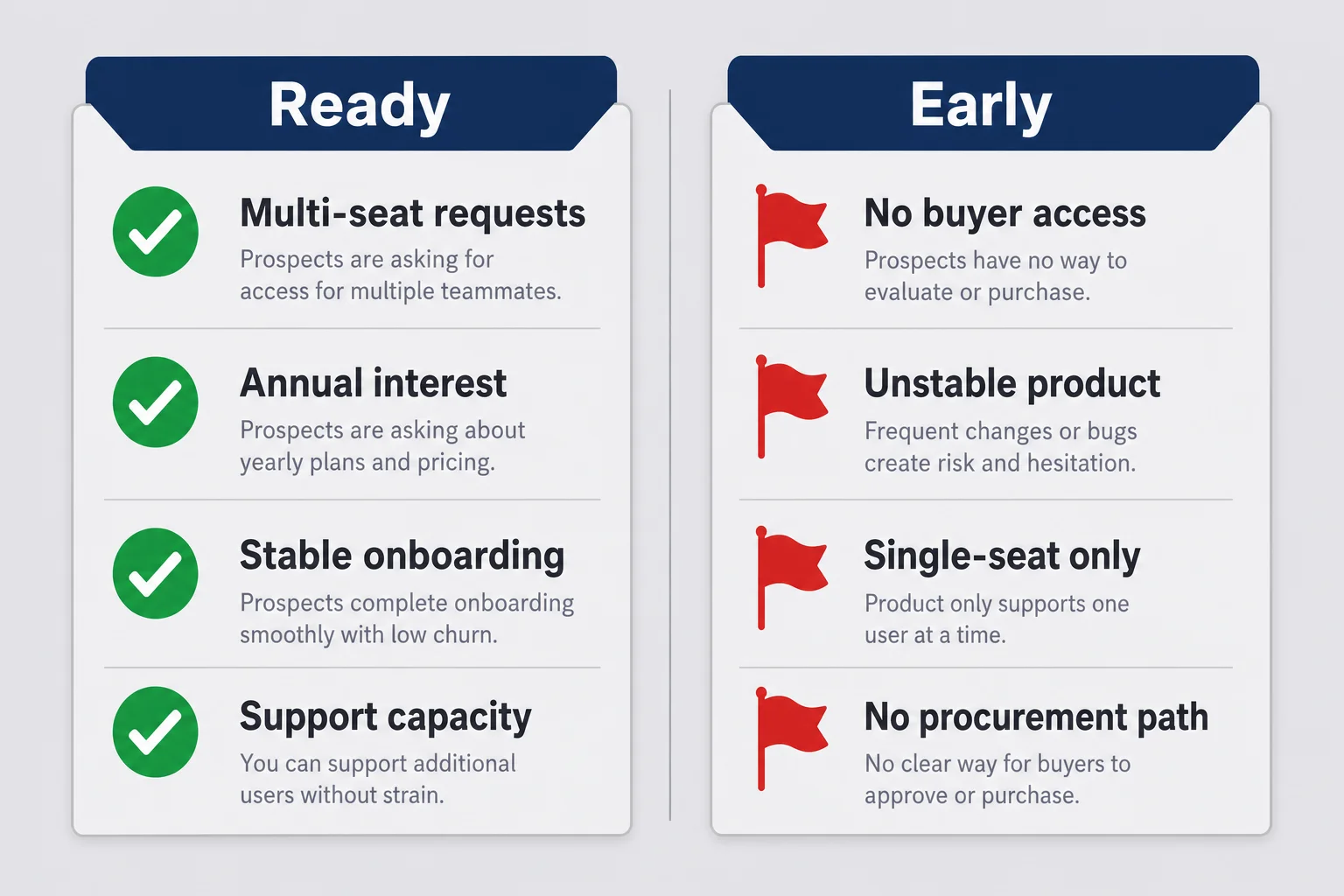
Readiness is lumpy. You will not get a certified letter from the market. You get patterns.
Signals you are ready for the next step up (usually team, not full enterprise): multiple customers hit seat limits or ask for consolidated billing. Someone forwards you to a manager without you begging. Annual prepay requests show up in support. Your churn is boring. You can survive two weeks of sales calls without stopping shipping. You know which feature gaps block expansion and which are noise. A real human with budget-adjacent title took a call and asked about onboarding their group, not about a single login.
Signals you are still early: you are hunting your first twenty paying customers. One loud user wants SSO for free. You cannot describe your ideal team customer in one sentence. Refunds spike when anyone uses the product seriously. You want enterprise because SMB feels slow, not because buyers are pulling you. Nobody will introduce you upstream. Legal has not appeared but you are pre-building an enterprise tier to feel legitimate.
I treat readiness like a physical before a road race. Not moral judgment. Can your knees handle it?
A founder I worked with had $11k MRR, mostly $39 plans. Two agencies asked for ten seats each in the same month. That is a pull signal. We shipped a team plan in two weeks, not SAML. Both converted to annual within forty-five days. That was upmarket for his stage.
Another founder had one enterprise logo in mind. He cold-pitched a director who ghosted. His SMB base was $2k MRR and flaky. He was not ready. He needed more SMB proof and a team offer, not a security whitepaper.
Pull beats push. If you are pushing enterprise because SMB feels embarrassing, fix the story or the product. If teams keep outgrowing your solo plan, listen.
The champion trap
Your champion loves you. They quote your tweets. They cannot get their boss on a call. That is not readiness. That is a fan with good intentions.
Readiness includes a path to someone who can say yes with money attached. Not eventually. A named next step. "I'll intro you to Sarah who owns the budget" beats "leadership is really excited."
Product signals nobody wants to hear
If your core workflow breaks when three people use it at once, enterprise is a retention disaster waiting for a contract signature. Fix the multi-user pain in SMB first. Teams will tell you what breaks cheaper than procurement will.
Watch your support queue for expansion language. "Can my teammate see this?" "Do you invoice?" "We need a shared workspace." Those are team signals. "Please fill out our vendor assessment portal" is an enterprise signal. Different animals.
Timing matters. End of fiscal year can accelerate team deals because budget must be spent. Beginning of year can stall enterprise because new priorities shuffle. You cannot control their calendar. You can notice patterns and not panic when August goes quiet.
I keep a simple note in every deal folder: why now? If the champion cannot answer, you are early. If they say "we are consolidating tools in Q3 and your name came up in the meeting," you are in motion.
False positives that feel like readiness
A big logo visiting your pricing page is not readiness. A podcast host mentioning enterprise customers is not readiness. Your uncle who works at a bank saying "you should sell to banks" is especially not readiness.
Readiness sounds like specific humans with specific problems and a specific quarter attached.
Team plan vs enterprise tier: pick the right first step
If I could tattoo one decision on every solo founder's forearm: team plan first.
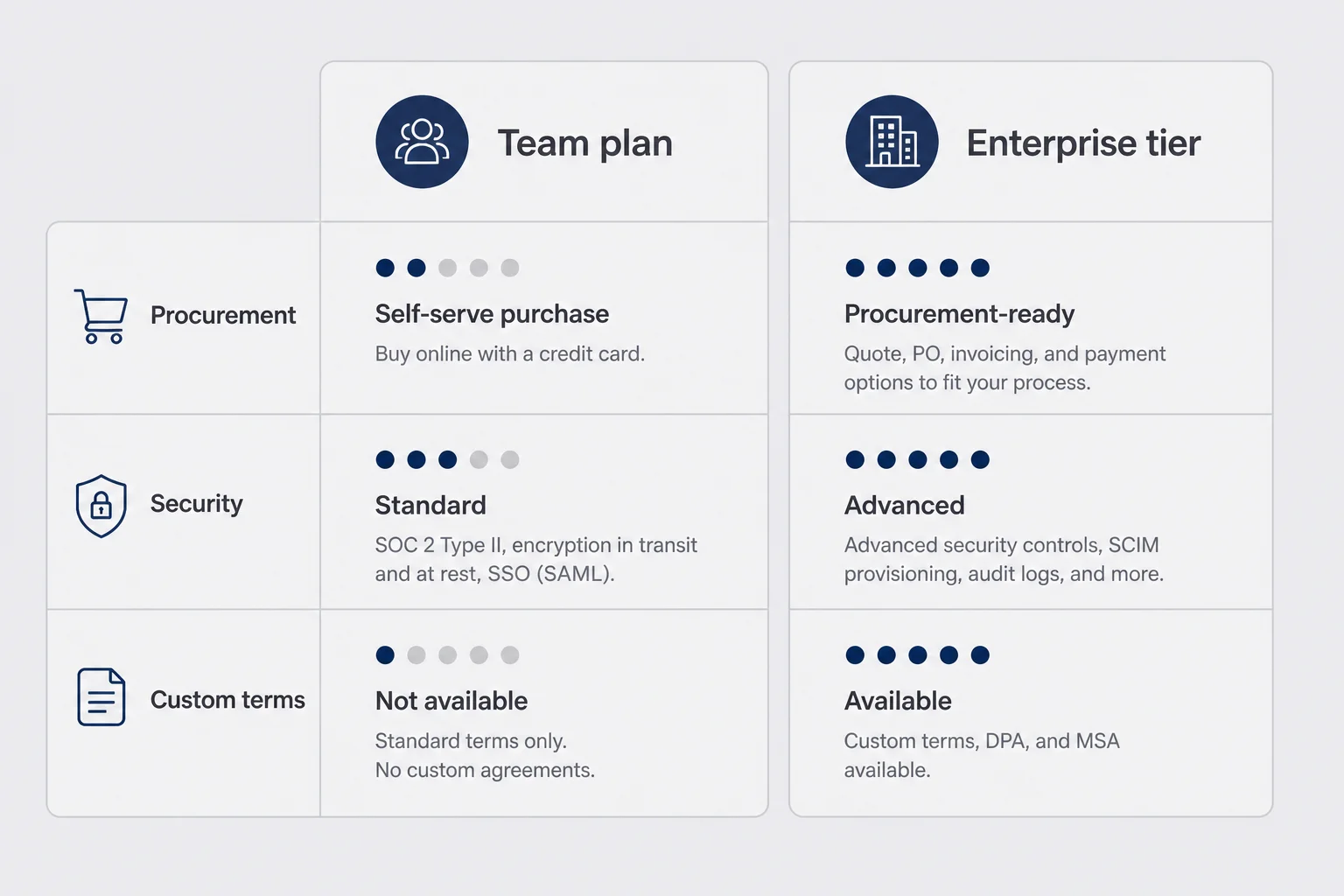
A team plan is multi-seat billing, maybe simple roles, annual invoice option, priority support if you can afford it. It is sold to a champion who needs their people on the same account. Legal might glance. Procurement might not exist. Cycle time is weeks, not quarters.
An enterprise tier is a procurement motion. Custom MSA. Security questionnaire. SSO. Audit logs. Maybe a dedicated success call. Cycle time is months. You need artifacts.
Jumping to enterprise tier without team revenue is like skipping the second stair. You can do it. You will hit your shin.
Pricing architecture matters. Put team between solo and enterprise. Make the upgrade obvious when seat count grows. Annual discount clear. If your pricing page hides team behind "contact us" with no anchor, champions cannot sell internally. Give them a number.
Enterprise tier should mean something specific in your product, not just "call us." Maybe SSO and SAML. Maybe SCIM. Maybe a 99.9% SLA you can actually honor. Maybe a DPA template. If enterprise is the same app with a handshake, you will drown in custom work.
I like a simple rule: team is self-serve plus invoice. Enterprise is questionnaire plus call.
Founders ask whether to gate features. Gate what procurement actually asks for, not what sounds impressive. IT asks for SSO when they standardize tools. Finance asks for invoicing and PO numbers. Legal asks for liability caps and data processing terms. Build toward named requests you are already hearing.
When enterprise tier first is rational
Rare cases: regulated industries where SSO is table stakes before any team lands. Or your SMB wedge is a foot in the door at huge accounts and every deal will hit security fast. Even then, price the pilot small and time-box it. Do not promise enterprise support on a $5k pilot unless you mean it.
Naming matters less than motion
Call it Business, Team, Pro Plus. Customers care whether they can pay by invoice and get their people onboarded, not whether you used the E-word.
Packaging team well also trains you for enterprise conversations later. You learn how champions sell internally. You learn which objections repeat. You learn whether your onboarding survives ten seats or collapses. That learning is worth more than a logo slide.
Annual team contracts in the $2k to $6k range are my favorite solo-founder upmarket win. Big enough to matter. Small enough that legal often waves them through on standard terms. One founder I advised replaced forty $39 accounts with four team annuals at $3,600 each. Support load dropped. Revenue went up. Nobody asked for SOC 2.
When you do add enterprise, make the upgrade path legible. Champions forward pricing pages to bosses. Bosses want numbers, not poetry. If enterprise is "contact sales" with zero anchor, you force every conversation to start from zero. A starting price or "pilots from $X" saves everyone time.
The invoice test
Can you send a PDF invoice with a PO number field and not break your billing flow? Team motion often ends here. Stripe invoicing, Paddle, manual wire for your first few. Pick one and test it before the call, not during.
What changes the week legal shows up
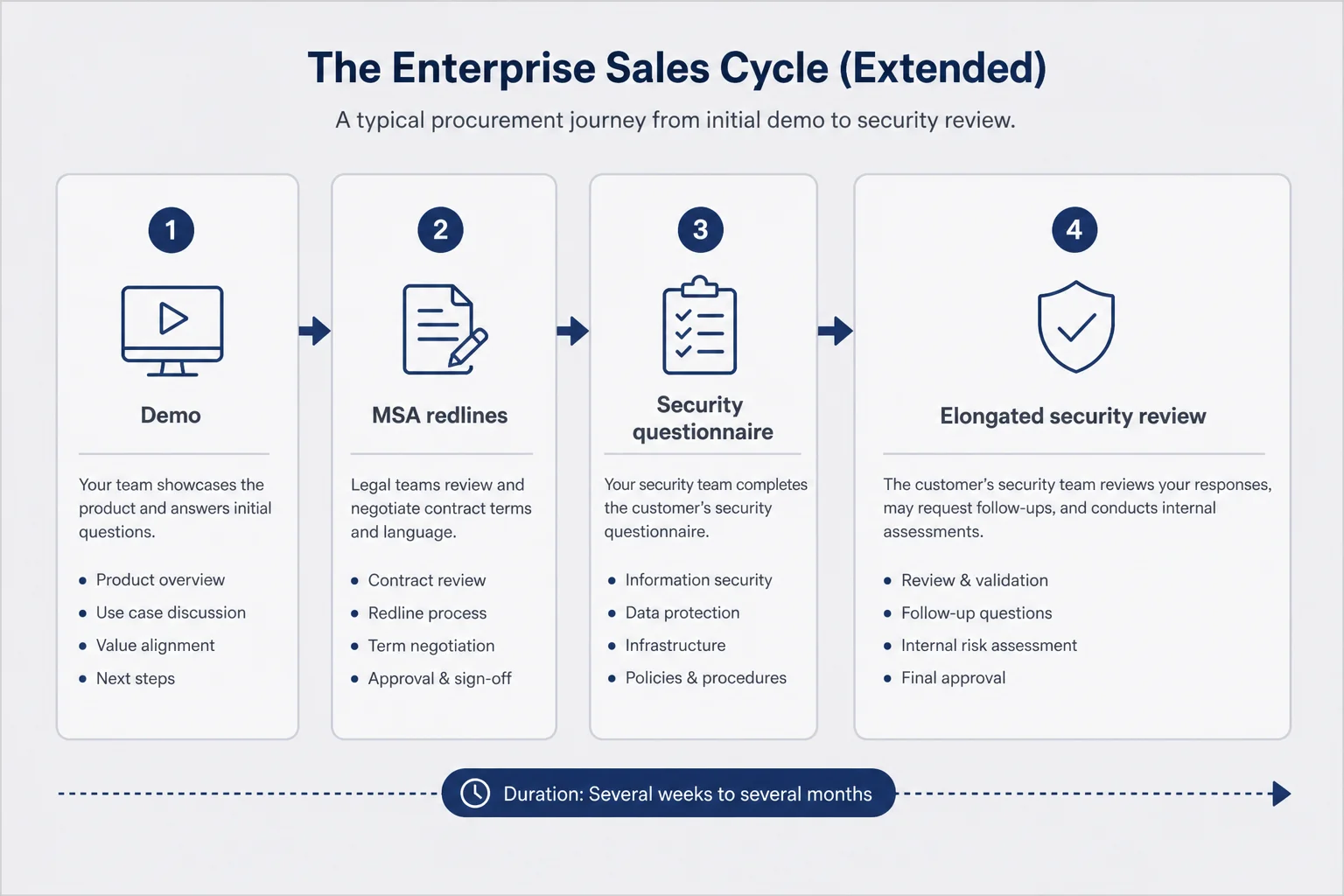
The week legal shows up, your calendar stops belonging to you.
Before legal, you are talking to humans about pain and workflow. After legal, you are talking to documents about liability, data residency, indemnification, and termination clauses neither side understands without Ctrl+F.
Expect these shifts:
Velocity dies in a useful way. The deal is real enough that someone spent legal time. Real also means slow. A Thursday email might get a response the following Thursday. Plan for it.
Your template order form stops working. Their paper arrives. Fifteen pages. Mutual NDA was just the appetizer. You will redline or you will walk. Budget founder time or budget a lawyer for the first few.
Security sends a spreadsheet. Hundreds of questions. Half do not apply to your stack. Answer honestly. "We do not do that yet" is an answer. Lie and you lose the deal later.
Your champion loses visibility. They still care. They do not know what paragraph 14 means either. Keep them warm with progress updates, not panic.
Product gaps become deal breakers. Missing SSO when IT said SSO is non-negotiable. No audit log when compliance asked. These are product decisions with revenue attached.
I keep a mutual action plan in a Google Doc for anything that touches legal. Dates, owners, next steps. Founders think that is corporate theater until they lose a deal because everyone assumed someone else was chasing the signature.
First-time founders underestimate insurance. Some MSAs ask for cyber liability coverage you do not have. Getting a rider can take days. Find out early.
Also: payment terms. Net 30 sounds fine until you are solo and groceries are due. Enterprise customers expect terms. Float matters. This is not moral failure. It is cash planning.
What you can prepare before legal
A standard order form. A short security FAQ. A DPA template written by an actual attorney once, reused forever. A list of subprocessors. Know where data lives. If you cannot answer "who hosts the database" in one sentence, fix that before the questionnaire.
I am not a lawyer. Neither are you, probably. Know when to spend $500 for an hour of real advice instead of guessing on indemnity caps.
The emotional shift is real. Legal week feels like progress because documents move. Documents are not signatures. Celebrate redlines returning, then get back to mapping the buyer.
Founders sometimes ask if they should use the customer's paper or theirs. First few deals, you will sign theirs more often. That is fine. Mark up what you cannot live with. Unlimited liability, broad indemnity, absurd SLA penalties. Push back on three things, not thirty. Lawyers respect focused founders.
Keep your champion in the loop with plain English updates. "Legal is reviewing data processing language, we expect to send comments by Friday." They can forward that internally. Silence makes champions nervous and nervous champions go find another vendor who feels easier.
If legal asks for something product cannot do, say so early. "We cannot host on-prem. Here is our cloud architecture." Dead ends early beat dead ends in month four.
The revenue threshold I use before chasing $10k deals
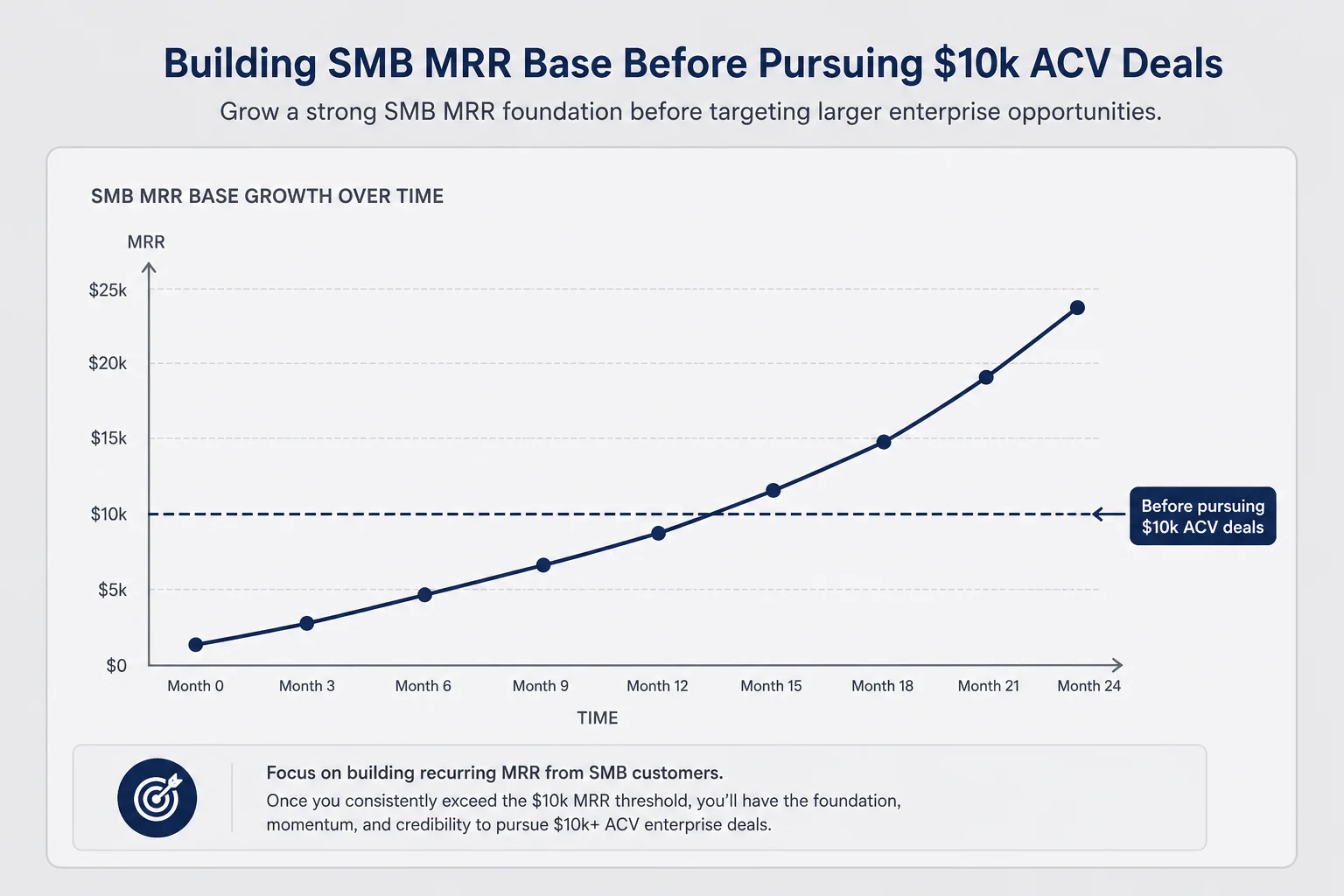
Nobody gets a universal number. I still use one because founders need a guardrail.
$8k to $15k MRR from SMB is my band before I treat a $10k annual contract as a growth strategy instead of a side bet.
Below $8k, one stalled deal is emotionally and financially loud. You will over-invest because the logo would feel like validation. You will under-ship because procurement wanted another security call. The base is too thin to absorb a miss.
In the band, one five-figure win can move the year without replacing the whole business. You can run one serious enterprise thread while SMB keeps feeding you. You can also afford a lawyer hour and a week of focus without skipping payroll.
Above $15k MRR, you have options. Maybe you hire part-time help for questionnaires. Maybe you run two cycles. The threshold rises with burn and falls with savings.
This is not "ignore big fish until magic MRR." If a $12k deal lands in your inbox with a buyer on the call, take it. Thresholds are about where you hunt, not what you catch.
Also watch concentration. One $10k deal on $4k MRR makes you a single-customer company with a logo. Dangerous. One $10k deal on $14k MRR is diversification.
ACV vs MRR framing
Founders mix these and panic. $10k ACV annual is one customer. $10k MRR is a different planet. Be precise in your notebook.
Time cost math
A $10k deal that eats six months is not $10k. It is opportunity cost. What SMB features did you not ship? What team plans did you not close? Divide contract value by founder hours spent. If you are below minimum wage, the deal is marketing, not revenue.
I also watch pipeline weight. If your only enterprise opportunity is one deal and SMB growth stalled because you are obsessed with the logo, you crossed from strategy into fantasy. Hunt team plans until the base is thick enough to absorb a miss.
Say you are at $12k MRR and a $15k annual pilot appears. Take it seriously. Also ask what happens if it slips to next quarter. Can you still pay yourself? If yes, play. If no, negotiate harder on timeline or deposit, or accept you are betting the quarter on one relationship.
Deposits and paid pilots are underrated. $2k paid pilot with credit toward annual is a filter. Serious buyers pay. Tourists vanish.
Revenue quality beats revenue theater
$10k from one customer who needs weekly calls is different from $10k from a team that barely pings support. Factor support load into your threshold. Upmarket should reduce chaos per dollar, not increase it.
I had a founder at $13k MRR who chased a $18k annual because the logo would look great on the homepage. The account needed custom onboarding calls twice a week. SMB churn was rising because he stopped shipping for six weeks. He closed the deal. MRR went up. His calendar became a hostage situation. Upmarket without support math is vanity.
Ask yourself a blunt question before you treat a five-figure contract as strategy: if this customer emails at 4 p.m. on a Friday with a vague complaint, who answers? If the answer is always you, one large account can feel like five small ones with better stationery.
The ninety-day calendar nobody plans for
Enterprise motion has a shape. Week one is discovery and demo. Week two is recap, internal forward, maybe a second call. Week three through six is security questionnaire, IT follow-up, champion check-ins. Week seven through twelve is legal redlines, procurement nudges, and the slow part where everyone is waiting on everyone else.
Solo founders plan for the demo. They do not plan for the twelve weeks after the demo when nothing visible happens and they wonder if they should have stayed SMB.
I tell founders to block a recurring ninety-minute slot on their calendar labeled "deal motion" for the length of any active enterprise thread. Not heroics every night. A protected window where questionnaires get answered, follow-ups go out, and redlines get reviewed. Without that block, enterprise deals lose to feature work every single week because features feel productive and procurement silence feels like failure.
The ninety-day calendar also needs a kill date. Pick it on day one. "If we do not have a signed pilot or clear buyer-owned next step by [date], I downgrade this deal and stop treating it as forecast." Kill dates sound harsh. They prevent the six-month maybe that eats your product roadmap.
Buyers respect founders who know their own calendar limits. "I want to get your team live before your Q3 planning cycle. That means we need security back by the 20th and legal comments by month end." You are not pressuring. You are aligning with their calendar while protecting yours.
Support load tells you whether upmarket is relief or a trap
SMB customers who love you can still generate support volume. Twenty accounts at $39 each might mean twenty different "how do I export" tickets. Four team accounts at $3,600 annual might mean four onboarding threads and one security form. The revenue per support hour is the number that matters.
Before you open the enterprise gate, look at your last thirty days of support. Count tickets per paying account. Note which accounts need hand-holding. If your happiest SMB customers are also your highest-touch customers, upmarket might multiply touch unless the product gets more self-serve at scale.
Team plans teach you this cheaply. Ship multi-seat billing. Watch what breaks when ten people share a workspace. Fix the chaos before procurement asks how you handle role-based access for two hundred seats you cannot support.
I worked with a founder whose product was beloved by power users who configured everything manually. SMB NPS was stellar. First team deal required white-glove setup for every seat. He was not ready for enterprise. He was ready to simplify onboarding for teams, which eventually made enterprise plausible.
Support load also affects champion behavior. A champion who spends three hours per week babysitting your product for their team will burn out before they escalate you to the buyer. Champions advocate for tools that make them look competent, not tools that create a second job.
If upmarket is your strategy to escape support hell, fix the product paths that create hell first. Annual contracts do not magically make users read documentation.
The competitor on your pricing page is not your real competitor
Founders obsess over feature parity with funded rivals. Enterprise buyers often compare you to spreadsheets, email threads, and the incumbent bundle deal their company already pays for. Your readiness gate is not "do we match Competitor X SSO." It is "can we beat the status quo enough that a champion will fight internally."
Status quo wins when your product saves time but internal switching cost feels higher than the pain. Champions measure political cost, not just ROI. A team plan with clear migration help beats an enterprise tier with SAML if the buyer fears rollout chaos.
Ask on discovery: "If you did nothing, what would you use next month?" Listen for Excel, manual exports, a shared inbox, a consultant. That answer is who you are really selling against on the first upmarket climb.
When your pricing page lists enterprise features you do not sell yet, you invite comparison on dimensions you cannot win. Team tier first. Name what is real. Champions forward honesty more easily than aspiration.
I have seen founders delay team billing because they wanted enterprise to be the first upmarket step. Meanwhile five accounts paid for extra solo seats on separate cards because there was no team SKU. That is revenue leaking sideways while you draft SOC 2 roadmap slides for a buyer who does not exist.
When to walk away from a SOC 2 conversation
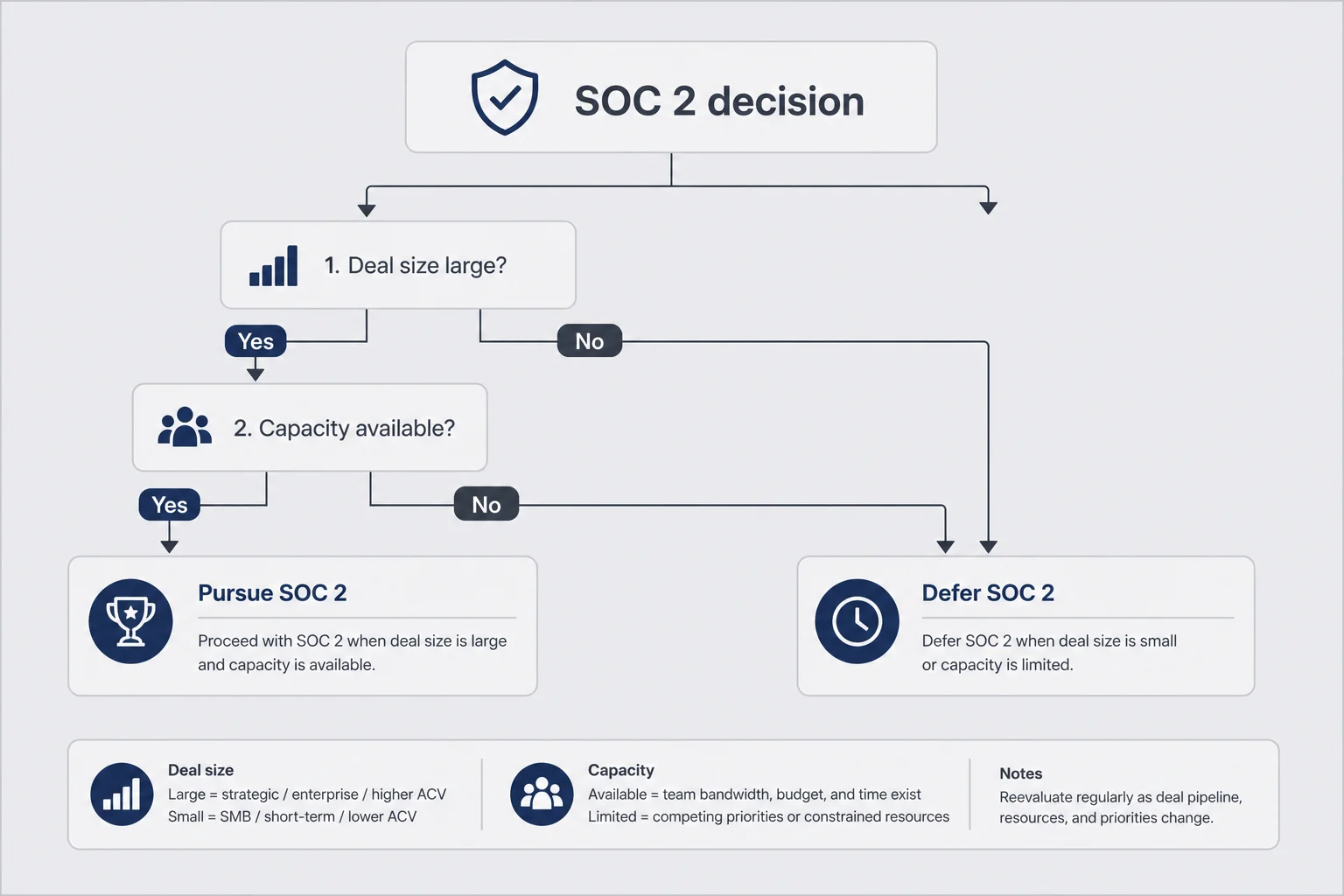
SOC 2 is the boogeyman of solo-founder enterprise dreams.
Procurement mentions it. Founders hear "you are not real." They picture a year of audits and $40k gone. Sometimes that is true. Sometimes it is a default checkbox nobody enforces for a pilot.
Walk away or defer SOC 2 when: the deal size does not justify certification cost in the next twelve months; procurement will not name a path without SOC 2 and will not pay enough to fund it; you have no enterprise pipeline beyond one logo chase; the champion cannot get a written exception for a pilot; you are using SOC 2 to procrastinate on sales.
Take SOC 2 seriously when: multiple deals stall on the same control gap; your ICP is mid-market and up where questionnaires always ask; you have team revenue funding the project; a buyer will sign contingent on a timeline you can hit with a consultant.
For many first pilots under $15k, a completed security questionnaire and honest policies are enough. Type I can be a milestone. Type II is a commitment.
I have seen founders spend nine months on compliance for a deal that died in month two because the buyer left the company. Brutal. SOC 2 should follow pull, not anxiety.
How to talk about it without bluffing
"We are not SOC 2 certified today. Here is our security FAQ, our DPA, and our roadmap. We can support a pilot under your standard vendor review with these controls in place." Direct. Adults respect it. Bluffers get found out on call three.
If they need SOC 2 before pilot, ask what minimum contract value makes the vendor risk worthwhile for them. Sometimes the answer exposes the deal was never real.
The middle path
Vanta, Drata, and friends exist. Budget exists. Sequence matters. Close team plans. Bank revenue. Start readiness when the third questionnaire asks the same question.
Questionnaires repeat. If three prospects ask how you handle encryption at rest and you keep typing the same paragraph in Google Docs, formalize it. That is free SOC 2 prep without the audit invoice.
Walking away from SOC 2 is not walking away from security. It is walking away from a timing mismatch. You can be a responsible vendor without a letter from an auditor. You cannot be a responsible vendor while lying on question 47.
When a prospect says "SOC 2 required," ask "for pilot or for production rollout?" Those are different gates. Pilots often have exceptions. Production does not. Know which stage you are selling.
I have seen founders lose deals by promising SOC 2 in ninety days when they had no budget and no engineer time. Better to lose early than fail audit and burn reputation.
AI for questionnaires
I use Claude for first drafts of security answers. It does not know your stack. You still verify every line. It saves typing, not thinking. Wrong answers on a security form end deals faster than slow answers.
Questions founders ask about going upmarket
When is a solo founder ready to sell enterprise?
When you have repeatable SMB revenue, at least one customer asking for multiple seats or annual billing, and enough margin to survive a six-to-twelve-week sales cycle without panic. Enterprise is not a mood. It is a motion that costs calendar weeks. If you are still chasing your first fifty self-serve customers, you are not ready. If three teams already outgrew your solo plan and you have not shipped a team tier, you are late.
Should I jump straight to an enterprise tier?
Usually no. A team plan with annual billing and light admin controls is the right first upmarket step for most micro-SaaS products. Enterprise tier implies procurement, security review, custom terms, and stakeholders you cannot see on a $49 credit card charge. Walk before you run. Team annual contracts teach you champion-building without a six-month legal review on day one.
How much MRR do I need before chasing $10k deals?
There is no magic number, but I like $8k to $15k MRR from SMB before you treat a single five-figure contract as a growth strategy instead of a lottery ticket. Below that, one stalled deal can eat your quarter. Above that, you have enough base revenue to run one enterprise conversation in parallel without betting the company on procurement saying yes.
Do I need SOC 2 before my first enterprise pilot?
Not always. Many first pilots under $15k close with a security questionnaire and honest answers, not a Type II report. SOC 2 becomes real when procurement names it on page two and will not move without it. Until then, document what you have, answer questionnaires in plain English, and do not promise a certification timeline you cannot fund.
What is the difference between a champion and a buyer?
A champion loves the product and will fight for it internally. A buyer controls budget or can get a signature from someone who does. You need both for a real enterprise deal. A champion without a buyer is a fan with a Slack emoji. A buyer without a champion is a cold spreadsheet comparison. Map both before you celebrate a great demo.
When should I walk away from an enterprise opportunity?
Walk when the buyer will not join a call, legal sends a fifty-page MSA for a $6k pilot, security review has no owner and no deadline, or the champion keeps saying next quarter without introducing anyone with authority. Your time is the scarcest resource. A polite no beats six months of maybe.
Love from SMB is the foundation, not the finish line
Your SMB customers are not holding you back. They are proof the thing works when strangers pay without a sales call. That proof is what makes a champion willing to stick their neck out for you upstairs.
Upmarket is a sequence. Team annuals teach you invoices and champions. Enterprise teaches you procurement and patience. Skip steps and you pay tuition with time you do not have.
I still take calls with founders who want the logo more than the motion. I get it. Logos feel like safety. Safety is $15k MRR with one clean team plan and a buyer who showed up twice.
If that is you this month, ship the team tier. Answer the questionnaire honestly. Ask for the buyer before demo two. Walk when the deal has no owner.
The gate opens when the signals are real, not when the fear of staying small gets loud.
If you want the next piece of the motion, read how I think about enterprise demos when you are the only seller in the room. The readiness gate and the demo room map are the same story from different angles. One asks whether you should climb. The other asks whether the right people showed up when you did.
One more thing on positioning before you climb: if your homepage still speaks to everyone, your enterprise conversations will fight uphill. Tight positioning makes champions sound smart when they forward your link. Vague positioning makes them do extra work. Extra work kills internal deals.
Team annuals are practice reps for enterprise conversations. If you have never closed a multi-seat annual, your first enterprise demo will feel like learning a language on stage. Get the reps on smaller deals first. The demo skills transfer. The stakes do not bankrupt you.
I keep coming back to the same test: can you name the buyer, the budget line, and the deadline? If not, you are not failing. You are early. Early is fine as long as your pipeline admits it.




Comments