You Built for Everyone. That Is Why Nobody Bought.
How to nail micro-SaaS positioning as a solo founder before you rewrite another headline: alternatives, best-fit customers, category, and the honest tests that work at low traffic.
 By Reese24 min read
Listen to this article
24:05AI-generated podcast-style overview of this article (not a word-for-word narration).
A founder sent me his homepage on a Tuesday. Clean design. Nice font. Hero line: "The intelligent workflow platform for modern teams." I asked who pays. He said freelancers, agencies, and sometimes HR departments at mid-size companies. I asked what they do today without him. He paused. "I guess... spreadsheets?" We stared at the page together. Nothing on it said spreadsheet. Nothing said freelancer. Nothing said what changed in someone's week after signup.
That is micro saas positioning solo founder work in one screenshot. Not a branding workshop. Not a mood board. The gap between who actually pays and what strangers read in eight seconds.
I have been on the marketing side of small B2B SaaS since 2014. I have rewritten more heroes than I want to admit, usually after someone burned a month on outreach or SEO and blamed the channel. The channel was fine. The story was written for everyone, which means it landed with no one.
Positioning is the unglamorous work that happens before the landing page, before the cold email sequence, before you argue about whether Product Hunt or Reddit is the move. It is deciding who you are for, what you replace, and what category makes that obvious. Get it wrong and every downstream tactic leaks. Get it roughly right and a mediocre page can still convert because the right person feels seen.
I am not a developer. I do not ship features. I fix messages for founders who already built something real and cannot figure out why strangers nod politely and leave. Max covers the stack. Imani covers shipping without code. I cover the story that turns traffic into revenue. If you need page structure after positioning is clear, read micro-SaaS landing page for solo founders. If you are still testing whether anyone wants the thing at all, start with how to validate a micro-Saas idea. This post is for the founder past validation, staring at a live product, trying to describe it without sounding like every other AI workflow tool on the internet.
Micro saas positioning solo founder: the mistake that wastes your best traffic
Positioning is not a logo exercise. It is the set of answers a stranger uses to decide whether to keep reading or bounce. For a solo founder, those answers have to be sharp because you do not get a sales team to explain yourself on a demo call. The page and the first email are the demo.
Most early positioning fails in the same way: the founder describes the product from the inside out. Features. Architecture. The clever thing they built at 2 a.m. Visitors think from the outside in. What is this? Is it for me? What do I do instead today? Why switch?
When those questions are unanswered, traffic hurts. You send fifty cold emails and get three confused replies. You post in a community and people say "cool" without clicking. You publish an SEO article and rank for a phrase that attracts the wrong reader. Positioning is the filter that makes the right people lean in and everyone else leave quickly. Leaving quickly is a gift. They were never going to pay.
I think about positioning as upstream plumbing. Marketing for solo founders is which pipe you choose. The landing page is the faucet. Positioning is whether water is connected. You can polish the faucet all day. If the pipe leads nowhere, you still have a dry sink.
Say you sell a tool that exports Shopify refunds into the right Google Sheet columns. Positioned as "workflow intelligence for modern teams," you attract curious clicks and zero buyers. Positioned as "stop copying Shopify refunds into spreadsheets every Monday," you attract fewer clicks and more of the right ones. That is the trade. Specificity feels like shrinking your market. At solo-founder scale, it is how you find the market at all.
Founders often discover positioning failure indirectly. They blame the email tool. They blame Reddit moderators. They blame Product Hunt for sending tire-kickers. Sometimes those things are true. More often the visitor arrived skeptical, read eight seconds of vague copy, and correctly concluded this was not for them. The bounce was rational. Your analytics called it a failure of conversion. It was a success of filtering without intent.
Another tell: support tickets that start with "I thought this did X." X is never what the product does. X is what the homepage implied because you used category language borrowed from a competitor ten times your size. Mis-set expectations create refunds, bad reviews, and the kind of churn that makes you think the product is broken when the story is.
Positioning also decides what you build next. A sharp wedge attracts customers who ask for the same three improvements. A vague platform attracts feature requests from five different industries that do not overlap. You cannot prioritize a roadmap when the ICP is "businesses." You can prioritize when the ICP is "solo Shopify sellers exporting refunds weekly." The worksheet is not marketing homework. It is product strategy for people who cannot afford a PM.
Why your homepage sounds like every other workflow tool
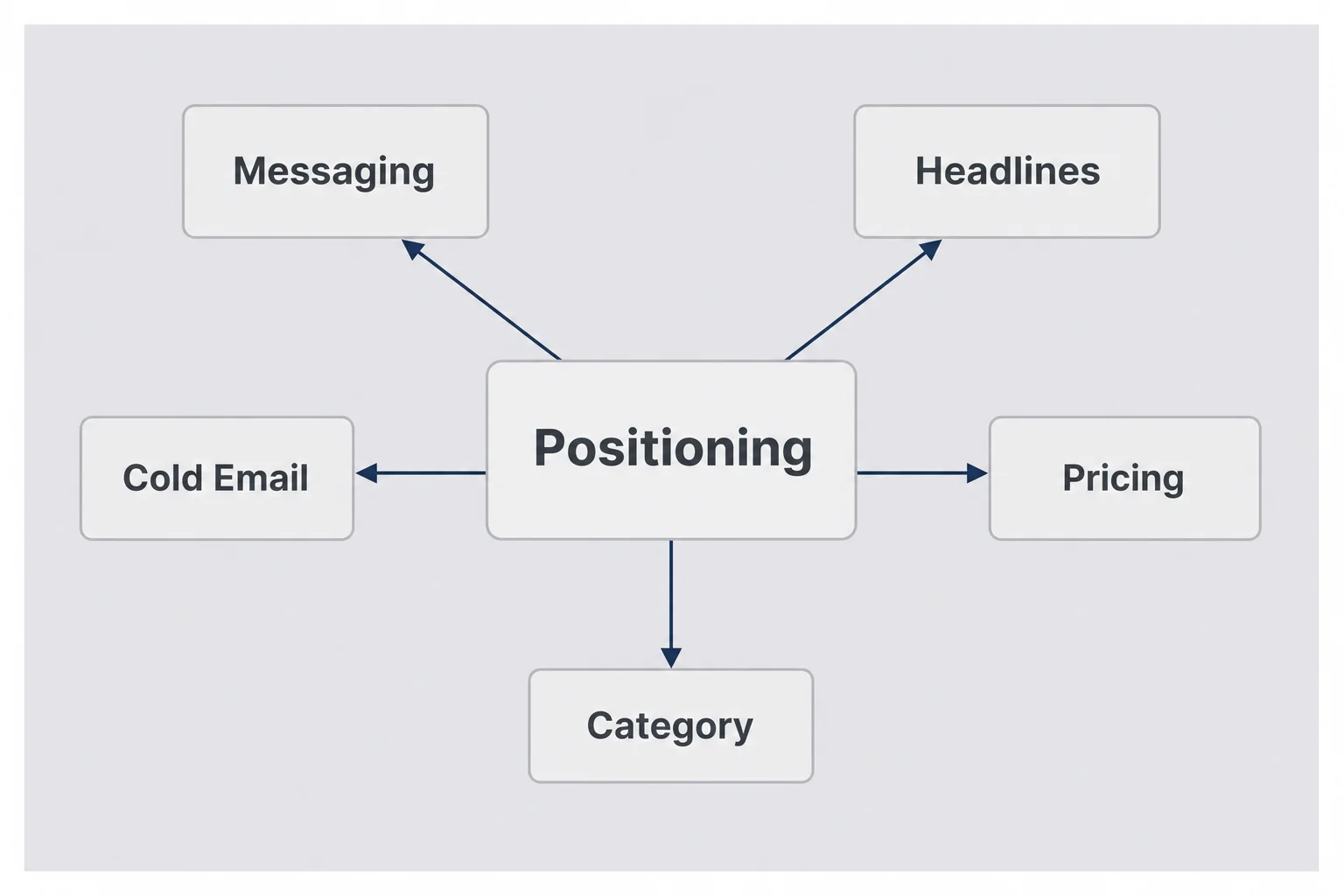
Features are easy to copy. Outcomes are harder. Category language is easiest of all, which is why half the internet sounds like the same press release.
The pattern is predictable. You ship something useful. You are proud. You open ChatGPT and ask for headline ideas. You get "streamline your workflow," "unlock productivity," and "the modern way to collaborate." You pick one because it fits the hero width. Congratulations. You have positioned yourself as noise.
AI makes this worse, not better. It generates fluent vagueness at scale. Thirty headline variants in a minute, all interchangeable. The tool does not know your buyer invoices on the 15th or hates reconciling refunds in a spreadsheet. You have to know that first. Then AI is useful for wording.
Positioning and messaging are related but not the same. Positioning is the strategic frame: who, problem, alternative, category. Messaging is the sentences on the page. If the frame is wrong, better sentences just decorate the wrong story. I see founders hire copywriters to fix conversion when the ICP is still "small businesses." No paragraph survives that.
There is also founder fear behind vague language. Specificity excludes people. Exclusion feels dangerous when you have four customers and need a fifth. I get it. But broad language does not include more buyers. It confuses them. A freelancer who lands on "platform for modern teams" does not think "that is me." They think "probably not" and leave. You lost someone you could have won with one honest sentence.
Take a position. Not a mean one. A clear one. Built for solo Shopify sellers doing their own books, not enterprise finance teams. That line repels the wrong reader on purpose. The right reader exhales. They have been looking for something that admits who it is for.
I once rewrote a hero six times for a founder who kept adding adjectives. AI-powered. Collaborative. Enterprise-ready. Each version sounded more impressive in the Webflow preview and less clear to his actual buyer, a solo agency owner who billed hourly and hated writing status emails. The winning headline was almost boring: "Send clients a weekly status update without rebuilding the doc." No AI in the headline. The AI was inside the product doing the boring part. Positioning led with the outcome the buyer already wanted. Features followed for people who cared.
That is the discipline. Resist the urge to sound big. Big is expensive to defend. Small and specific is cheap to prove. You can always expand positioning after you own a wedge. You cannot expand from a cloud of generic words. There is nothing to grab.
Start with what they would do if you disappeared
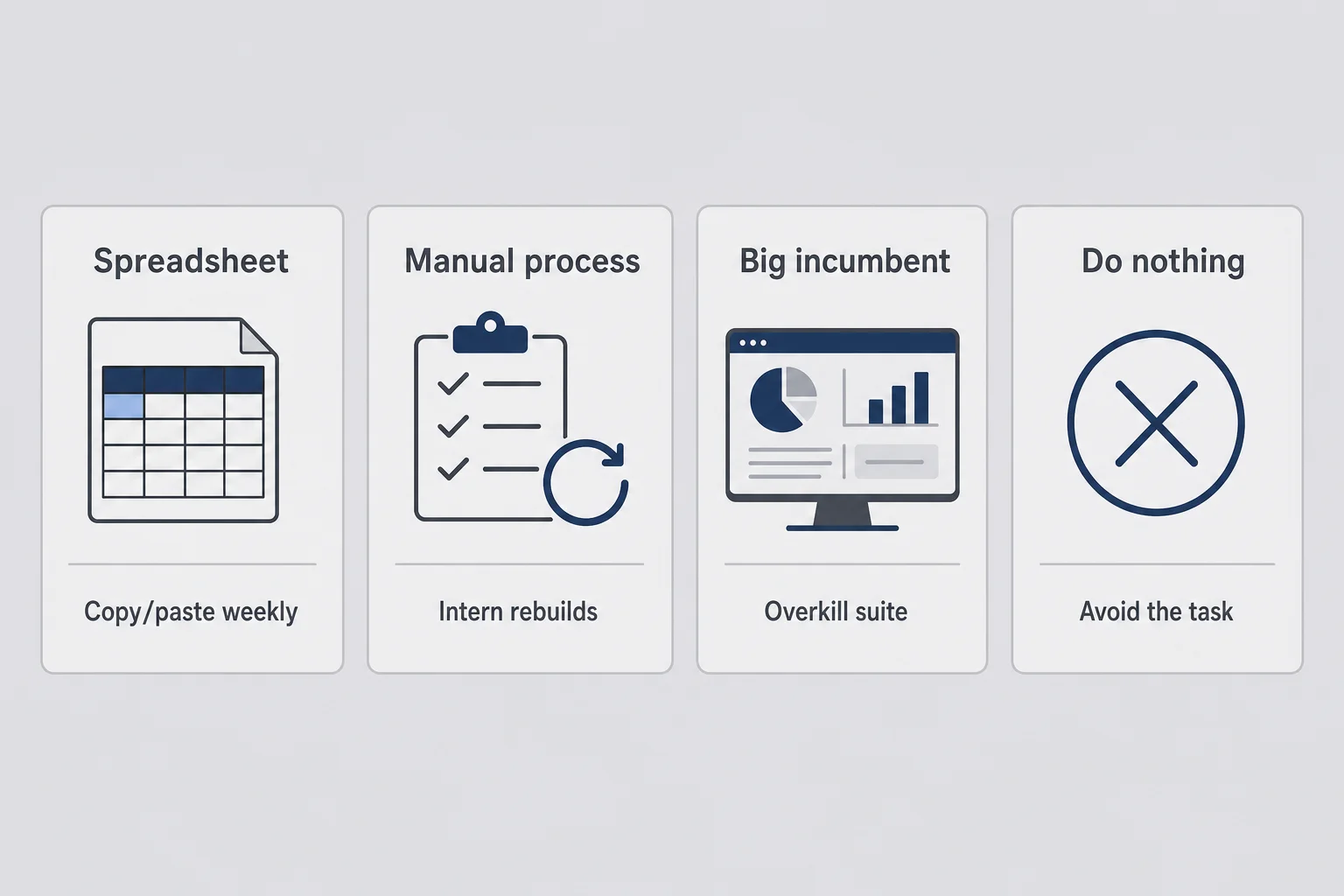
The most useful positioning question I know is not "what makes us unique?" It is "what would customers do if we did not exist?"
That sounds dramatic for a side project. It is not. Alternatives include spreadsheets, email threads, a VA, a bloated incumbent they already resent, or doing nothing and eating the pain. Your product competes with all of them. If you only list other startups on your comparison page, you are fighting the wrong war.
I learned this freelancing for indie founders who wanted a "competitive matrix" against three funded tools. Meanwhile their actual customers were copying data by hand. The matrix looked impressive in Notion. It did not help a stranger understand why switching was worth an afternoon of setup.
List alternatives honestly. For a lightweight reporting tool, alternatives might be: export CSV and pivot in Excel, ask an intern, pay for a suite they use 10 percent of, or keep avoiding the report until a client complains. Your positioning should name that reality. "Replace Sunday night spreadsheet panic with a report that builds itself" beats "advanced analytics platform."
Doing nothing is always on the list. Status quo bias is real. Your positioning has to make inaction feel worse than switching. Not with fear tactics. With specificity about the Tuesday pain they already know.
This is where micro-SaaS competitor research helps, but only if you research what buyers actually do, not what Crunchbase lists. Max wrote that guide for the teardown mindset. I am talking about the buyer's calendar. What task repeats? What breaks? What do they call the problem in their own words? Those words belong in your positioning before they belong in SEO.
Walk through a Tuesday with your buyer. Not a persona named Jessica who drinks oat milk. A real Tuesday. What meeting are they dreading? What task do they push to Friday? What spreadsheet tab is always out of date? Positioning lives in that hour, not in your feature grid.
When founders skip this step, they build comparison pages that read like investor decks. Competitor A has SSO. Competitor B has AI summaries. Your product has both plus a dashboard. The buyer scrolling at lunch does not care about SSO. They care that their client is annoyed about late numbers. Alternatives thinking forces you back to that annoyance. It is less flattering to your product and more useful to your revenue.
The status quo is usually uglier than you think
Founders underestimate manual work because they are excited about software. Buyers underestimate software because they have been burned before. Positioning bridges that gap by describing the status quo accurately.
I once interviewed five prospects for a founder who thought his competitor was another SaaS app. Four of five said they used nothing. They just did not send the report. The fifth used a template in Google Docs. The app's positioning talked about integrations and dashboards. The real enemy was avoidance. We rewrote the story around "send the client report without rebuilding the spreadsheet every month." Signups improved. Not because the product changed. Because the alternative was named.
The five-line worksheet I use before I rewrite a headline
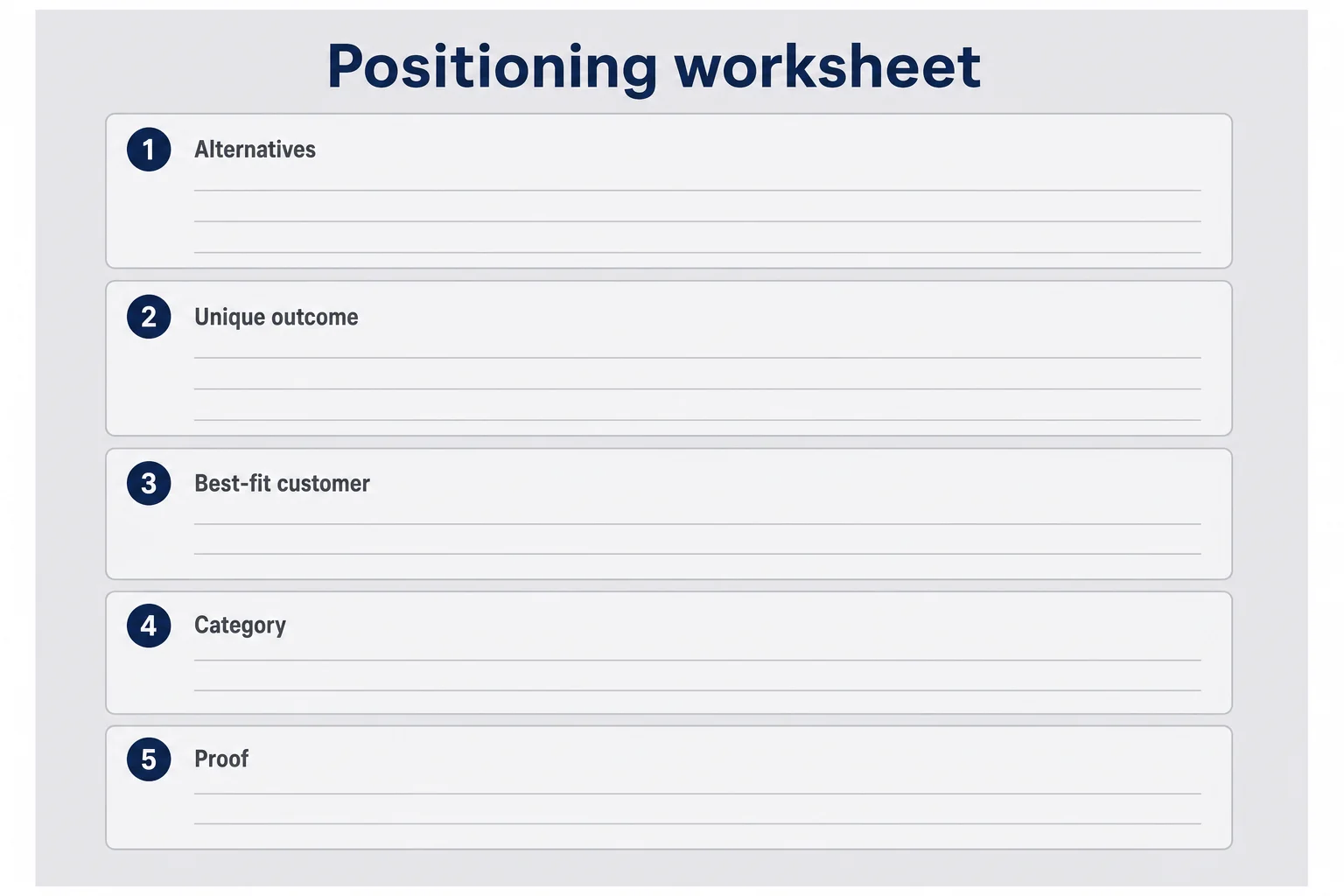
I keep a paper worksheet because it slows me down enough to think. Five lines. No logo. No mission statement.
Line one: alternatives. What do they do today? Be concrete. Spreadsheet, intern, ignoring the task.
Line two: unique outcome. What changes in their week? Not feature list. Outcome. Reports ready Monday morning. Invoices sent before the 15th.
Line three: best-fit customer. One person, not a committee. Role, situation, constraint. Solo Shopify seller doing own books. Not "SMBs."
Line four: category. What shelf do they file you on? Invoice tool for Shopify sellers. Not "business intelligence."
Line five: proof. Why believe you? Even early proof counts. Built by a former bookkeeper. Used on my own store. Ten beta users stopped exporting CSVs.
That is the whole worksheet. If you cannot fill line three without saying "everyone," you are not ready for headlines. You are ready for more customer conversations. Go read micro-SaaS customer interviews and come back.
I run founders through this on Zoom with the camera off because they will argue with line three. They want three ICPs because three people with different jobs once said nice things. I ask which one paid or would pay fastest. Pick that one. Archive the others for later. Positioning is a bet, not a census.
When the worksheet is done, headlines get easier. Outcome plus who plus alternative removed. "Stop copying Shopify refunds into spreadsheets" is a positioning sentence wearing a headline costume. You can test it in cold email, on the hero, in a community post. Same story everywhere. Inconsistent positioning is how you end up with a LinkedIn bio that disagrees with your homepage and an email that disagrees with both.
Keep the worksheet visible while you write. I tape mine next to the monitor like a rude sticky note. Every time I want to add "scalable" or "intelligent," the paper asks who pays. It is annoying. It works.
You can share the worksheet with a contractor if you hire copy help. Freelancers cannot invent your ICP. They can sharpen sentences once you hand them the five lines. Paying someone to write a homepage before alternatives and best-fit customer are defined is how you get polished vagueness delivered on deadline.
Line five, proof, deserves more words than founders give it. Early proof is allowed to be small. "Built because I needed it on my own store" is proof. "Trusted by teams worldwide" when you have four users is not proof. It is a lie with better typography. Solo founders win trust with specificity and honesty, not logo walls. Mention the niche communities you participate in. Mention the manual process you replaced for yourself. Mention the beta group if you have one. Proof is anything that makes the outcome believable, not anything that makes you sound funded.
Worksheet before Webflow
Fill the five lines on paper before you open your landing page builder. Design tempts you into layout tweaks when the story is still fuzzy. Story first. Pixels second.
Pick one best-fit customer and mean it
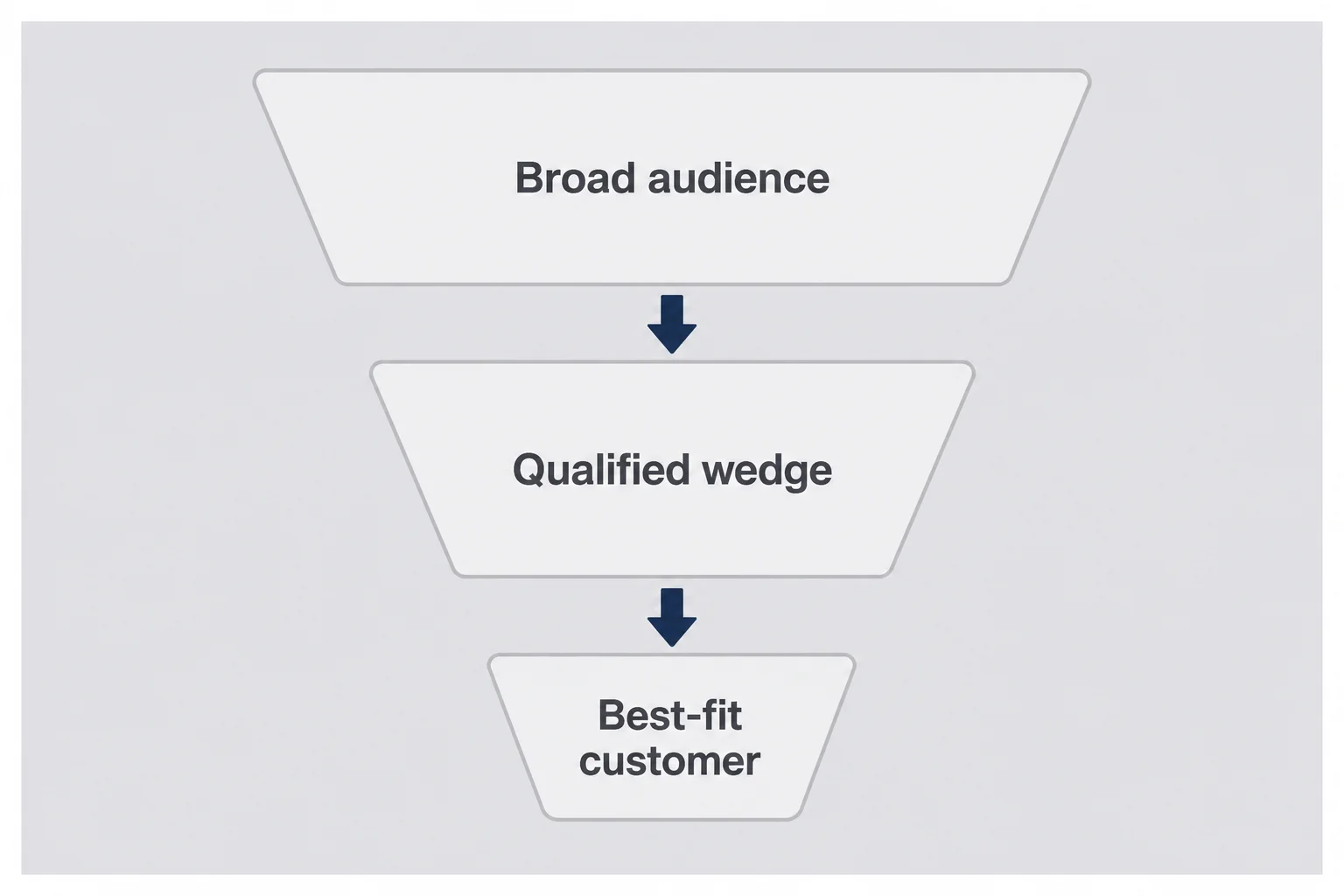
Best-fit customer is the segment that cares most about your outcome and will tolerate your rough edges. Not the biggest market. Not the most impressive logo. The fastest path to someone saying yes.
Solo founders treat ICP like a homework assignment. They write personas with coffee preferences and fictional names. Useful for empathy, useless if you stop there. I want one sentence a real human recognizes. "Freelance designers invoicing US clients who are tired of chasing PayPal fees in a spreadsheet." That person exists. You can find her in communities. You can write email that speaks to her Tuesday.
Niching feels like leaving money on the table. At zero to ten customers, the money is not on the table. It is in one wedge you can reach without a ads budget. Win the wedge. Adjacent wedges come later when word of mouth and case studies exist.
I have seen founders resist niching because their product could theoretically serve many roles. Could is not does. Position for who pays first, not who might pay someday if the stars align. The pricing post makes a related point: one plan, one buyer, one price. Positioning and pricing are cousins. Vague ICP makes vague pricing. Vague pricing makes every sales conversation a negotiation you lose.
Disappointing the wrong customer is part of the job. If enterprise HR lands on your page and bounces, good. They would have churned in week two when the feature set was built for a solo operator. The bounce saved you a support thread.
Signs you picked a real ICP
They describe the problem with the same words you use. They ask "how is this different from my spreadsheet?" not "what is this?" They find you in a place you planned to show up. They pay without a custom demo if the product matches the promise.
If none of that is happening, the ICP is still a guess. Go talk to five people who match the sentence and five who do not. Compare answers. Adjust the sentence. Repeat. Positioning is iterative, not revelation.
Widening too early is a common second mistake. You get three customers in one niche and one accidental customer in another industry. The accidental one feels like a signal to go horizontal. Sometimes it is. Usually it is noise. Study whether the accidental customer has the same alternative, the same urgency, and the same willingness to pay without hand-holding. If they needed a custom onboarding call you cannot repeat, they are not ICP. They are a consulting client who wandered into self-serve pricing.
The best-fit customer sentence should help you say no. No to feature requests from wrong industries. No to podcast interviews that reach the wrong audience. No to partnership ideas that dilute the story. Every yes to the wrong segment is a week you are not winning the right one.
Category is the frame, not the flex
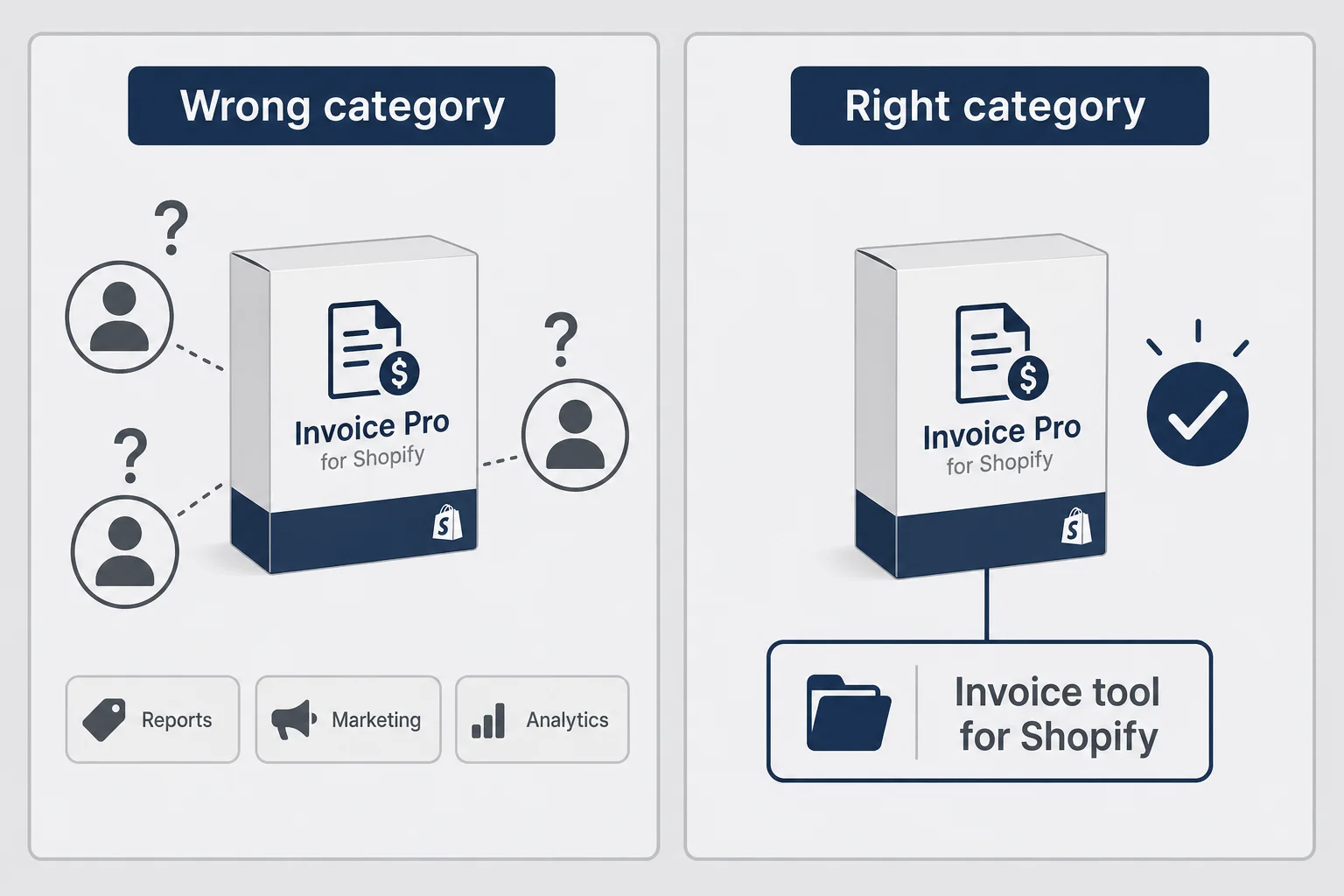
Category tells the buyer which mental shelf to put you on. Wrong shelf, wrong expectations, wrong comparison set.
Calling yourself a "platform" when you are a focused tool invites disappointment. Calling yourself "AI-powered" when you are a reliable export puts you in a hype bucket you cannot win. Category is context, not aspiration. Pick the frame where your outcome is obviously valuable.
April Dunford's work is the gold standard here, and solo founders should steal the mechanics without hiring a workshop. Start from alternatives, derive value, identify who cares most, then choose the category that makes the value obvious. You can read a bookshelf of strategy books, or you can ask: when my buyer explains this to a friend, what noun do they use?
If they say "I found this little invoice thing for Shopify," you are an invoice tool for Shopify sellers. Not a revenue operations platform. The second phrase might feel small. Small is findable. Findable pays rent.
Category also sets competitive expectations. In "project management," you fight Asana in the buyer's head. In "client approval tracker for freelance video editors," you fight email chaos. Choose the fight you can win. This connects directly to SEO for solo founders: you cannot rank for "project management software." You might rank for the long phrase your ICP actually searches when they are annoyed on a Tuesday.
Category mistakes show up in pricing conversations too. If you call yourself analytics software, people expect charts and compare you to mature BI tools. If you call yourself a weekly client report for agencies, they compare you to the Sunday they waste in Google Docs. The second comparison is winnable at $39 a month. The first is not.
You do not need a trademarked category name. Invented categories are for companies with conference budgets. Solo founders win in existing categories with a tight qualifier. Not CRM. CRM for solo recruiters. Not automation. Shopify refund exports for sellers without an accountant. The qualifier does the positioning work. The category noun makes it legible.
Positioning is not branding theater
Founders confuse positioning with personal brand. Those are different games. Personal brand is you on LinkedIn. Positioning is the product story a stranger believes without knowing your name.
Branding theater shows up as origin stories above the fold, founder photos where the product should be, and vague manifestos about the future of work. None of that helps a busy bookkeeper decide if your export is trustworthy. Save the manifesto for after conversion.
I am not anti-story. Story that proves credibility belongs near proof. "I ran books for twelve Shopify stores" supports positioning. "I believe in empowering modern teams" does not. One is evidence. One is fog.
Visual identity matters less than you think at the start. A plain page with a sharp sentence beats a beautiful page with "intelligent workflows." Spend positioning energy on words that change decisions, not on gradient tweaks.
I am not saying design is irrelevant. Ugly trust signals still hurt. Broken mobile layouts still kill conversion. I am saying founders often reach for Figma when the worksheet is empty. The worksheet is cheaper and fixes more leaks. Once positioning is stable for a month, then polish the page. Not before.
Founders who come from product or engineering backgrounds sometimes treat positioning as marketing fluff because it is hard to unit test. Fair. But you can test it with ten emails and three user calls. That is enough rigor for stage one. Waiting for perfect data is how vague homepages survive quarter after quarter while MRR flatlines.
Red flags that your positioning is still fuzzy
You know positioning is fuzzy when every channel feels hard for a different reason. Cold email gets ignores. Community posts get polite applause. SEO traffic bounces. The common thread is the story, not the tactics.
Specific red flags I watch for:
Strangers ask "what do you do?" after reading the hero. That question should be answered before they scroll.
Sales calls start with education, not fit. You spend twenty minutes explaining basics instead of discussing implementation.
Paid customers look nothing like the people you marketed to. Someone unexpected found value and you are chasing more of them without updating the story.
You have three elevator pitches depending on who asks. That is not flexibility. That is three unfinished positions.
Your comparison page lists competitors the buyer has never heard of while ignoring the spreadsheet they use daily.
Each flag has the same fix: return to alternatives and best-fit customer. Rewrite the five lines. Align homepage, email, and community intro to match. Alignment beats cleverness.
I keep a simple log when I work with founders: date, channel, message variant, replies that showed understanding. When understanding replies cluster around one sentence, that sentence becomes the hero. When replies ask for clarification, the worksheet goes back on the desk. It is crude. It beats guessing.
Another flag: you attract tire-kickers who want a demo but never buy. They are often people who like exploring tools but do not feel the pain you solve. Your positioning spoke to curiosity, not urgency. Add the alternative. Add the Tuesday pain. Make the cost of inaction visible without hype.
Founders with technical backgrounds sometimes hide behind feature depth because it feels safer than choosing a buyer. Engineering detail belongs in docs for people already convinced. Positioning belongs at the top for people not yet convinced. If your homepage opens with architecture, you are talking to yourself.
How to test positioning with twenty strangers
You do not need statistically significant A/B tests. You need fast embarrassment while change is cheap.
The five-second test. Show the hero to someone outside your industry. Timer on. At five seconds, hide the page. Can they say what it does and who it is for? If not, positioning failed before design mattered.
Two-email test. Send ten prospects version A headline and ten version B. Same body, same offer. Measure replies that show understanding, not just opens. "Can you tell me more?" is fine. "What is this?" is a positioning miss.
Community comment test. Post a helpful comment with your positioning sentence embedded naturally. Not a link drop. A sentence that names the problem and outcome. Do people ask for the tool, or do they ask what you mean?
Landing page qualitative test. Watch three session recordings if you have enough traffic. Where do people pause? Do they scroll to pricing or bounce from the hero? Confusion at the top is almost always positioning.
Pricing page reaction. If everyone says "seems expensive" without understanding value, you positioned the category wrong or the outcome is unclear. Price is part of positioning context. A $29 tool and a $299 tool require different frames.
Iterate weekly, not quarterly. Solo founders can rewrite a hero in an afternoon. Use that speed. Positioning is never done. It tightens as you learn who pays.
Bring positioning into weekly metrics even when numbers are tiny. One confused reply in ten emails is data. One bounce after eight seconds on the hero is data. Founders wait for hundreds of visitors before they trust the signal. At solo scale, qualitative signal is the signal. Write down the exact words confused prospects use. Those words are either objections to handle or clues that your category frame is wrong.
When a test wins, document why. "Headline B won" is useless next month. "Headline B named the spreadsheet alternative" is reusable. Positioning knowledge compounds if you store it like product knowledge. Future you is busy. Future you will not remember why Tuesday's rewrite worked.
How positioning feeds outreach and SEO
Once positioning is clear, channels get easier to choose. Cold email works when the first line names the recipient's alternative. Cold email for first customers is a channel guide. Positioning is the first line.
SEO works when the article title matches the problem phrase your ICP types. Not the phrase you wish they typed. Positioning research and keyword research should be the same conversation. If your ICP is solo Shopify sellers, write for their Monday, not for "workflow automation trends."
Community posts work when you sound like a member who understands the pain, not a vendor who dropped a link. Reddit, LinkedIn, Twitter guides on this site all assume you know who you are talking to. Positioning is that knowledge written down.
Waitlist pages fail when the form promises a vague platform. They work when the capture line repeats the outcome sentence. Same story, smaller surface.
Even channel tone changes; positioning stays constant. On Reddit, you sound like a member describing the pain. On LinkedIn, you sound like a founder sharing a lesson. On Twitter, you sound like a person in the replies. The nouns and outcomes should still match the worksheet. Channels are accents. Positioning is the language.
If you run a Product Hunt launch with a vague tagline, you get a spike of confused signups. PH amplifies whatever story you already have. Sharp positioning makes launch day useful. Vague positioning makes launch day a screenshot you regret posting.
Onboarding and retention posts downstream assume people understood what they bought. Customer onboarding cannot fix a signup who expected a different product. Positioning is the first retention lever. Misaligned expectations churn before week two.
Questions founders ask when they are stuck on who this is for
What is positioning for a solo founder micro-SaaS?
Positioning is the context a stranger uses to decide if your product is for them. It answers what problem you solve, for whom, against what alternative, and in what category they should file you. It is not a tagline exercise. It is the upstream decision that makes your landing page, cold email, and pricing feel obvious instead of vague.
How is positioning different from messaging?
Positioning is strategy. Messaging is the words on the page. If positioning is fuzzy, better copy just polishes confusion. I fix positioning first with a short worksheet about alternatives and best-fit customers, then rewrite headlines. Messaging without positioning is decoration.
How specific should my ICP be at launch?
Specific enough that a real person recognizes themselves in one sentence. Solo Shopify sellers doing their own books beats small businesses. Freelance designers invoicing US clients beats creatives. You can widen later after ten paying customers prove the wedge. At zero customers, broad positioning is how you get polite interest and no revenue.
Should I position against competitors or spreadsheets?
Usually against the status quo first. For many micro-SaaS products, the real competitor is a spreadsheet, a manual process, or doing nothing. Naming a funded startup as your enemy often makes you look smaller than you are. Start with what your buyer actually does today when your product does not exist.
How do I test positioning without ad spend?
Run a five-second test with strangers, send ten cold emails with two positioning variants, and watch whether sales calls start with confusion or recognition. If people ask what category you are in after two minutes, positioning failed. If they say oh this is for people like me, you are close.
When should I reposition?
When the customers who pay look nothing like the customers you marketed to, when every sales conversation re-explains the basics, or when traffic arrives and nobody converts despite a decent page. Repositioning is not failure. Shipping the wrong story for six months is.
You already know who pays. You are avoiding saying it out loud.
Positioning is not a creativity contest. It is a commitment contest. The founders who struggle most already have the answer buried in support tickets, Stripe charges, and the three customers who use the product every week. They know who loves it. They are afraid to scare everyone else.
You will scare everyone else. Good. Your marketing budget is time, not money. You cannot afford to educate the whole internet. You can afford to be unmistakable to fifty people who share one problem.
Write the five lines. Pick the best-fit customer. Name the spreadsheet. Put it on the page. Send the email. The channels did not fail you. The story did. Fix the story, then give landing page structure and outreach another month before you declare marketing dead.
A product nobody hears about is an expensive hobby. A product everyone hears about but nobody understands is the same hobby with better analytics.
If you are still tempted to keep the broad headline because it feels safer, run one experiment. Split your next ten outreach emails. Half get the vague line. Half get the specific line with the alternative named. Count replies that sound like recognition, not confusion. The worksheet is not theory. It is a bet you can settle in a week.



Comments