Nobody Is Googling Your Product Name Yet
SEO for micro-SaaS solo founders without a content team: pick one winnable search phrase, write one useful article, and send that traffic to a page that converts.
 By Reese23 min read
Listen to this article
21:27AI-generated podcast-style overview of this article (not a word-for-word narration).
A founder sent me his Ahrefs screenshot last April. Domain rating: four. Organic traffic: zero. He had published eleven blog posts in six weeks because a YouTube creator said content is how you grow. Every post was titled some variation of "Why [Product Name] Is the Future of [Vague Category]." I asked him what his last paying customer had typed into Google before they found him. He stared at me. "They came from a friend." Right. And nobody is Googling your product name yet either.
That conversation is why I wrote this. Micro-SaaS SEO for solo founders is not a content calendar, not a link-building campaign, and not something you outsource to an agency for $3,000 a month while your MRR is $400. It is the boring work of finding one phrase your buyer already searches, writing one page that answers it honestly, and sending that traffic somewhere that can turn a click into a trial. Know your MRR before you know your keyword — a solo founder MRR calculator beats guessing whether you can afford SEO experiments. Search is a distribution channel. It is slow. It is also one of the few channels that does not require you to perform on social media every day.
I have done growth for small B2B SaaS since 2014. I have watched founders rank on page two for a phrase that mattered and get more qualified signups than a Product Hunt spike. I have also watched founders publish for six months and learn nothing because every article was written for Google's imagined algorithm instead of a human with a problem. The difference is almost never technical wizardry. It is whether you picked a fight you can win.
If you already read marketing for solo founders, you saw the line about writing the one article your customers are already searching for. This post owns that channel. Max covers the build. Imani covers shipping without code. I cover how search traffic actually shows up for a one-person company, what to measure when your monthly visitors still fit in a text message group chat, and when SEO is the wrong bet entirely.
This sits at Part 5.5 of Micro-SaaS From Zero, between the marketing overview and the landing page that has to convert whatever traffic you earn. If you have not launched yet, read how to launch a micro-SaaS first. SEO amplifies a real offer. It does not invent demand.
Micro-SaaS SEO for solo founders when nobody searches your product name yet
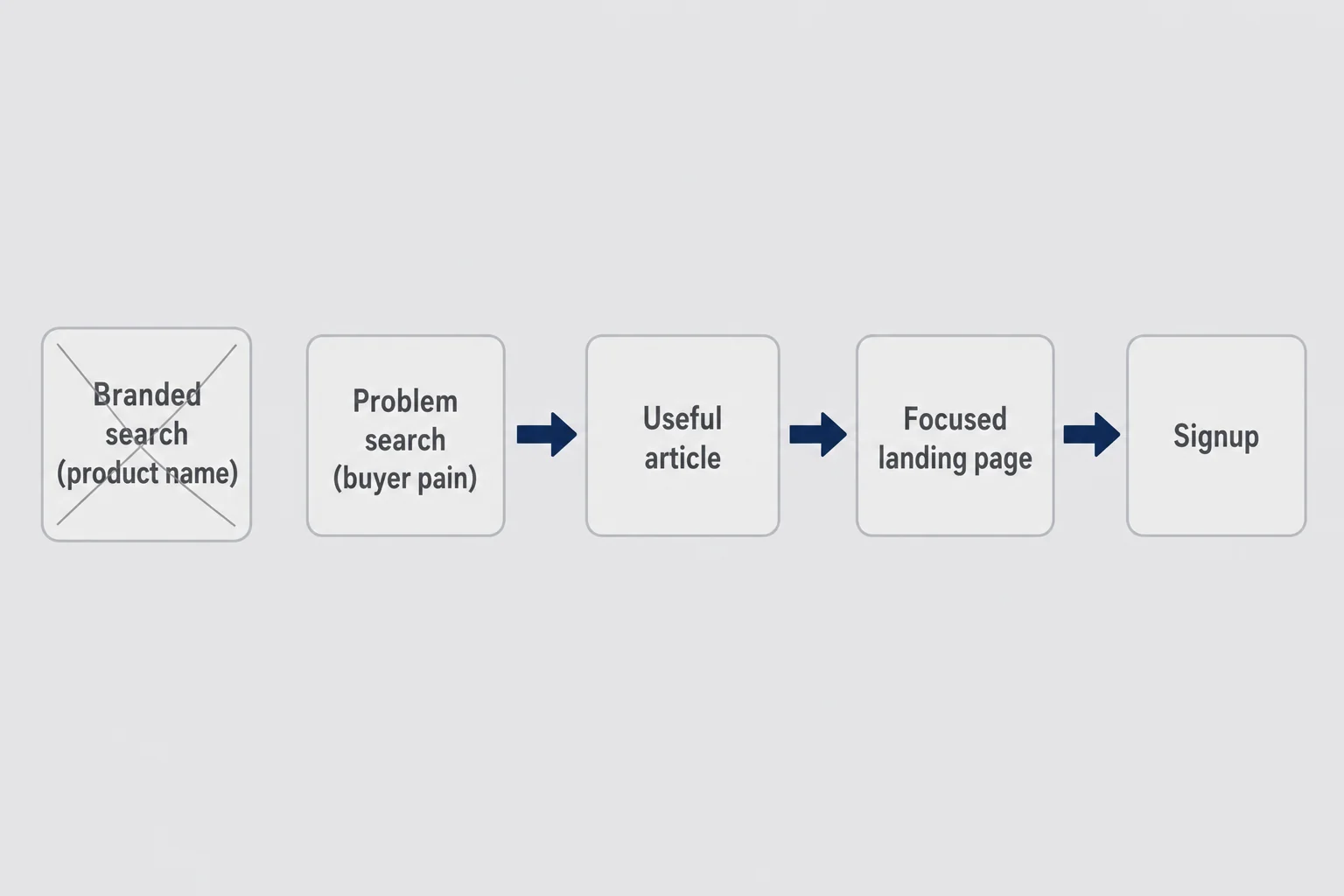
Branded search is when someone types your product name. Problem search is when they type the pain. Early micro-SaaS lives entirely in problem search because your brand is unknown. That is not an insult. It is the game.
Say you built a tool that exports Shopify orders to a clean Google Sheet. Nobody is searching "SheetBridge" on day one. Somebody is searching "export shopify orders to google sheets" or "shopify google sheets integration without zapier." Your SEO job is to figure out which of those phrases has buyers behind it, not which one flatters your positioning deck.
Solo-founder SEO fails when founders skip that step and write about their own narrative. Founding story posts do not rank. Feature announcement posts do not rank. "We are excited to launch" posts definitely do not rank. What ranks is a page that matches the words in someone's head when they are annoyed on a Tuesday.
I think of micro-SaaS SEO as three layers stacked in order. First, problem keywords where strangers already look for help. Second, a useful answer that proves you understand the problem better than a generic listicle. Third, a destination page that makes the next step obvious. Miss any layer and you get the classic failure mode: traffic with no signups, or a beautiful landing page nobody finds.
You do not need fifty articles. You need one corner of the internet where your name shows up next to a problem you actually solve. Everything else is expansion after you learn whether search converts for your product at all.
Branded versus problem search in practice
Say your product is called LedgerLoop and it helps freelancers reconcile Stripe payouts. Month one, Search Console shows twelve impressions for "LedgerLoop" and zero clicks. That is normal. Nobody knows you. Month three, after you publish a guide, impressions appear for "stripe payout spreadsheet freelancer" and "reconcile stripe without accountant." Those are the queries worth obsessing over.
Branded search grows later, when word of mouth and content compound. Problem search pays rent early. Your SEO strategy should assume strangers describe pain in their words, not yours. If your internal docs say "revenue reconciliation workflow," but customers say "I hate copying Stripe into Excel every month," the article title uses the second sentence, not the first.
What SEO is not for solo founders
SEO is not a substitute for validation. If nobody will pay when you email them directly, a blog post will not save you. SEO is not a vanity play. Ranking for a phrase that attracts students, competitors, and "just researching" browsers feels good in Search Console and does nothing for revenue. SEO is also not fast. If you need ten paying customers this month and have no list, start with cold email or warm outreach while you plant the SEO seed. Different channels, different timelines.
Why most solo founders start SEO at the wrong end of the funnel
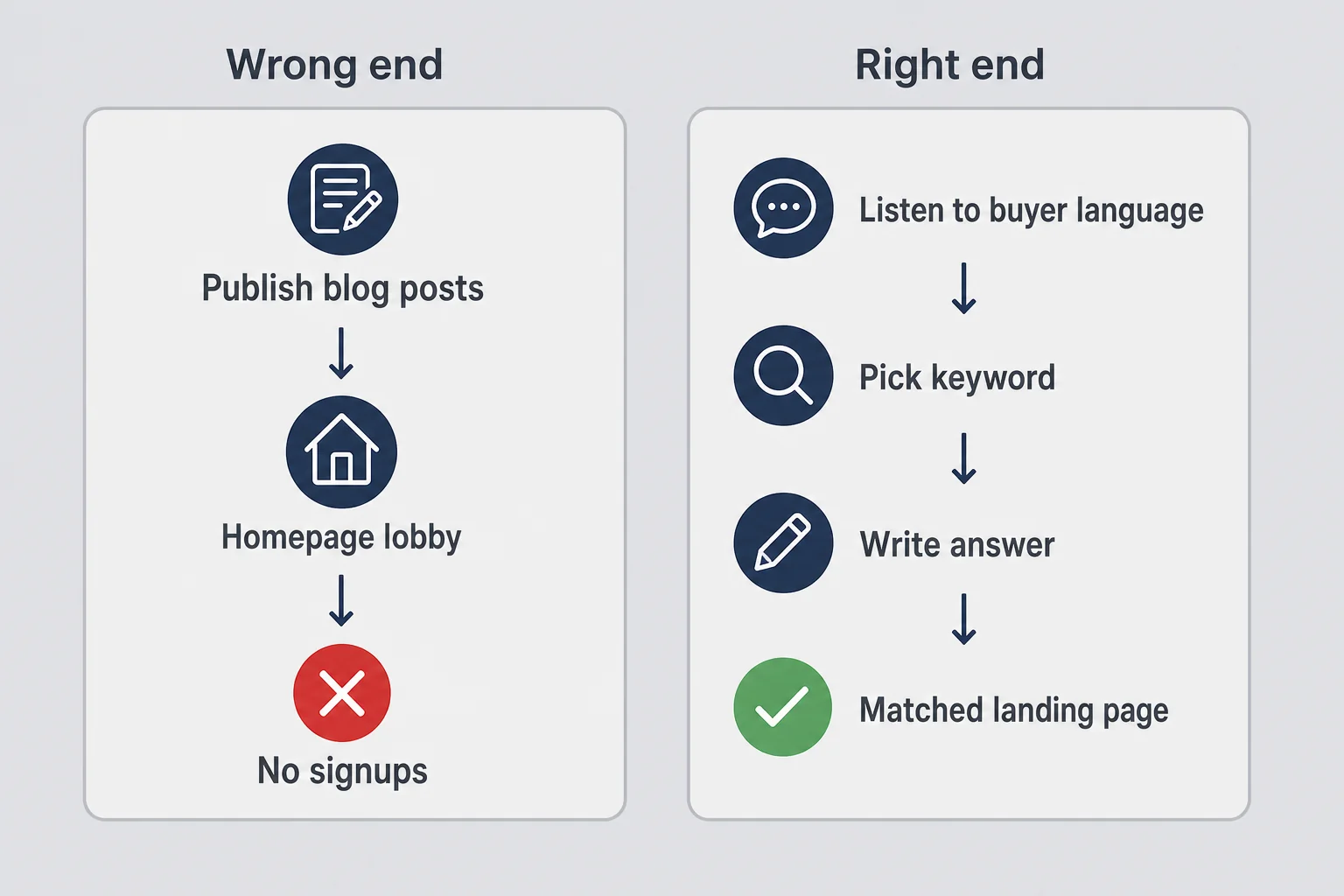
The wrong end is publishing. The right end is listening.
Most founders treat SEO like a publishing problem because publishing feels controllable. You can sit down Sunday afternoon, prompt an outline, hit publish, tell yourself you did marketing. Keyword research is messier. It forces you to admit your buyer might not use your vocabulary. It forces you to look at page one results and notice that Forbes and HubSpot own the head terms you wanted. That discomfort is useful. It steers you toward long-tail phrases where an honest post from a practitioner can compete.
I see the same pattern in consulting calls. Founder opens Ahrefs, searches "invoice software," sees difficulty 78, gets discouraged or delusional. Either they quit SEO entirely or they write another article about AI anyway. Neither is a strategy. The move is to scroll down to the questions people ask in forums, the "how do I" phrases in autocomplete, the three-word queries where the top results are Reddit threads and outdated blog posts from 2019. That is solo-founder territory.
Another wrong-end mistake is optimizing the homepage. Your homepage is a lobby. It introduces the brand, links to the blog, maybe lists two products you are experimenting with. Google can index it, sure. It will not rank for a specific problem query because it does not answer one specific problem. Search rewards focus. Your homepage answers "what is this company." Your SEO page answers "how do I fix this exact headache."
I learned that lesson on a client project in 2019. They ranked number six for a phrase with four thousand monthly searches. Decent article. Every internal link pointed to the homepage hero, which had been rewritten by a committee and said something about "empowering modern revenue teams." Organic traffic climbed. Trials from organic did not. We did not need more content. We needed a page that said the same thing as the article, with a buy button.
I once audited a micro-SaaS with decent blog traffic and zero trials from organic. The articles ranked. They linked to the homepage. The homepage said "streamline your workflow." The articles said "how to reconcile Stripe payouts in QuickBooks." Those are different conversations. We built one landing page that mirrored the article promise, linked every relevant post to it, and signups from organic moved within a month. The writing was fine. The plumbing was wrong.
The content calendar trap
Content calendars are built for teams with editors. A solo founder with a content calendar often ends up manufacturing posts to fill slots. The posts sound fine. They do not rank because nobody searched for "5 tips to optimize your SaaS workflow in 2026." Cut the calendar. Replace it with a single question on a sticky note: what did my last customer Google before they bought?
If you cannot answer that, call three customers. Email five trial users. Read support tickets. The phrase you need is usually in plain language there, not in your pitch deck.
A ninety-minute keyword sprint I still use
Block ninety minutes. No publishing. No outline. Just research.
Minutes zero to twenty: write down five problems your product solves in plain English. Not taglines. Verbs. "Copy Shopify orders into a sheet." "Send invoice reminders without QuickBooks." "Export Stripe fees for taxes."
Minutes twenty to fifty: type each problem into Google. Screenshot page one. Note who ranks (brands, forums, indie blogs, Reddit). Click the top three results and ask if you could write something more useful for a practitioner. If no, long-tail the phrase until yes.
Minutes fifty to seventy: check volume and difficulty in Ahrefs or Ubersuggest if you have it. Ignore volume below ten if difficulty is low and intent is perfect. A phrase with ninety searches a month and buyer intent beats a phrase with eight thousand searches and zero conversions.
Minutes seventy to ninety: pick one primary phrase. Write the sentence "Someone searching for ___ should land on ___ because ___." If you cannot finish it, you are not ready to write.
That sprint is unglamorous. It beats six months of random blogging.
Pick one keyword you can actually win before you write ten articles
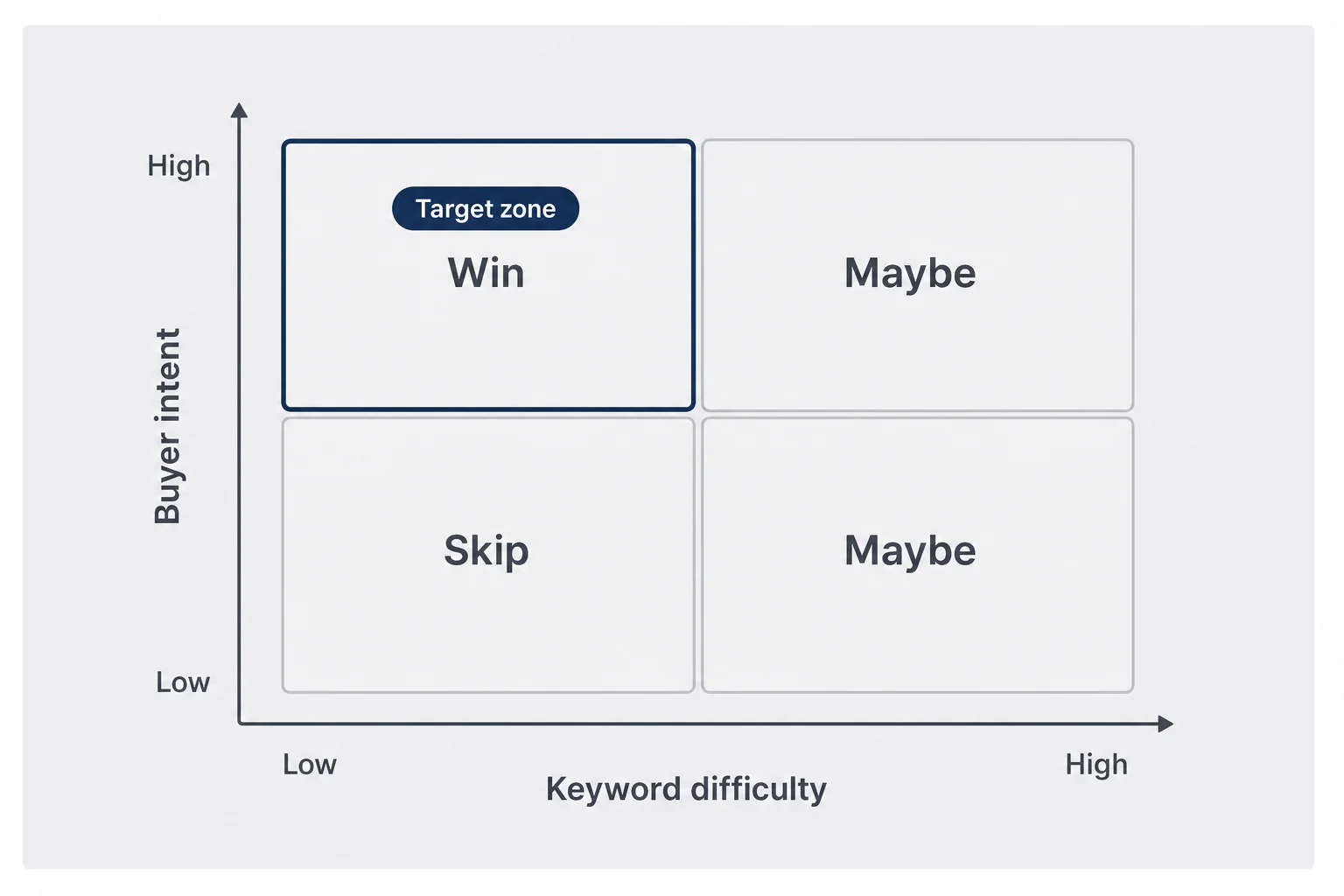
Keyword research for solo founders is not about volume. It is about fit: does this phrase describe a problem my product solves, and can I beat what is on page one without a domain authority of 60?
I use a simple filter before I write anything. Four questions. Does the person searching this look like my buyer? Does the top ten include at least two results I could realistically outwrite (forums, thin listicles, old posts, Quora)? Does the phrase imply intent to solve a problem, not just learn a definition? Can I link the article to a page where someone can try or buy within one click?
If you pass three of four, you have a candidate. If you pass one, keep looking.
Tools help but they do not think for you. I use Ahrefs or Ubersuggest for difficulty scores and related phrases. Google Search Console after you publish, because reality beats estimates. I also type the phrase into Google in a private window and read page one like a skeptical buyer. If every result is a 4,000-word guide from a brand with a podcast, pick a longer-tail variant. "Shopify accounting" is a bloodbath. "Shopify payout reconciliation spreadsheet" might be yours.
Long-tail does not mean obscure. It means specific. Three to six words is usually the sweet spot for micro-SaaS. Long enough to filter tourists. Short enough that someone actually types it.
How I steal phrases from sales calls
My favorite keyword source is still sales. When a prospect says "I have been manually copying rows every Friday," I write that down. That is a headline. When someone replies to cold email with "actually I was looking for something that handles multi-currency," that is a secondary keyword. Your customers are already writing your SEO brief. You are ignoring it because it does not look like marketing.
Compare that to inventing keywords from a tool's "related terms" list without context. Tools will happily suggest thousands of phrases. Most are noise. Pick one primary phrase per article. One. You can add secondary phrases in subheads, but the page needs a single job or Google gets confused and so do readers.
Reading page one like a competitor
Before you write, study page one like you are trying to beat it, not admire it.
Open the top five results. For each one, note word count, publish date, and format (tutorial, listicle, forum thread, video). Ask what is missing. Old screenshots from 2021. No mention of the tool your buyer already uses. Generic advice that never names a price or a failure mode.
Your opening paragraph should signal you live in the same world as the reader. If every ranking post assumes an enterprise budget, you win by naming the solo-founder constraint. If every ranking post is theory, you win with a screenshot of the spreadsheet you actually use. You are not out-spending brands. You are out-specific-ing them.
I am not promising page one overnight. I am saying page one is often weaker than it looks from the difficulty score. Difficulty scores aggregate backlinks. They do not measure whether the top article answers the question well in 2026.
The one-keyword rule
Do not publish until you can fill in this sentence: "Someone searching for ______ should land on this page because ______." If the second blank is vague, you are not ready.
Write one useful article, not a content calendar fantasy
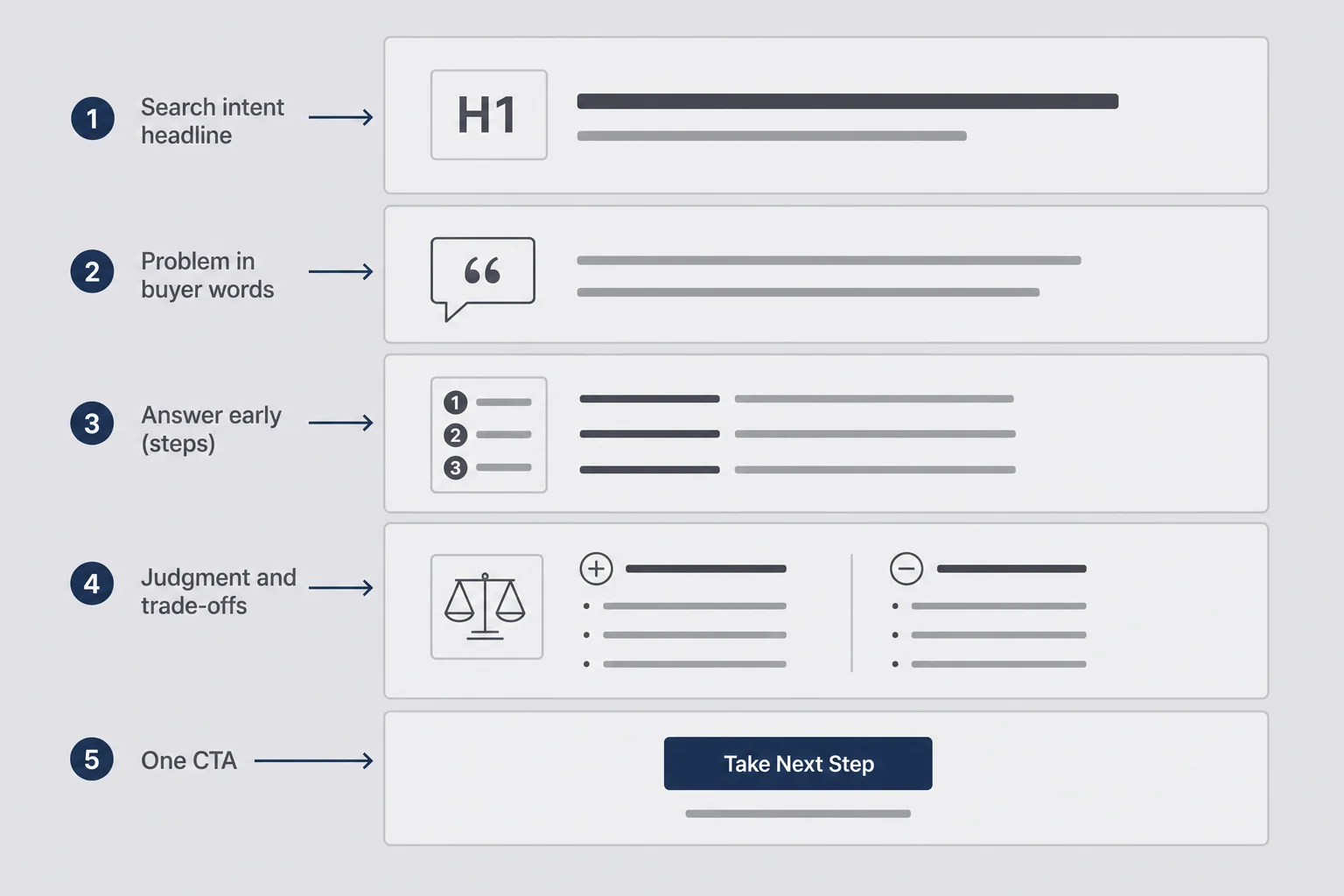
The article that ranks for solo founders is usually ugly in the way that matters: specific title, clear answer in the first screen, examples from real usage, no filler section called "What is X."
Structure I use:
Open with the problem in the customer's words, not a definition. If you are writing for "export shopify orders to google sheets," start with the Friday night copy-paste ritual, not "Shopify is a leading e-commerce platform."
Deliver the answer early. Google and humans both reward pages that do not hide the point. A short how-to with screenshots or numbered steps beats a 2,000-word essay that meanders.
Show judgment. Say what you would skip, what breaks, what tools you tried and rejected. Listicles without opinion rank sometimes. Honest practitioner posts rank and convert better because trust starts on the page.
End with one next step. Not five CTAs. One link to try the product, or one link to a deeper guide, or one email capture if you are still pre-launch.
AI can help with outlines and meta descriptions. It cannot tell you which Friday-night ritual your buyer recognizes. Do the thinking first. Use AI to speed drafts, not to replace knowing who you built for.
What a good solo-founder SEO post looks like in the wild
Imagine an article titled "How to export Shopify orders to Google Sheets without Zapier." Good version opens with the manual export ritual. Names the columns that break. Shows the exact menu clicks or a simple script alternative. Mentions when Zapier is worth it anyway. Ends with "if you want this automated every night, here is the tool I built."
Bad version opens with "In today's e-commerce landscape, data integration is crucial." Defines Shopify. Defines Google Sheets. Lists ten tools with affiliate links. Never admits trade-offs. You have read that article. So has Google. It does not need another one.
Length is whatever the answer requires. Some posts land at eighteen hundred words and rank for years because they are the best answer. Some need four thousand because the problem has steps. Do not pad to hit a word count. Do not stop early because you got bored. Stop when a skeptical reader would say "okay, that actually helped."
Screenshots and diagrams help when they show the workflow. Stock photos of laptops on beaches help nobody. If you are not a developer, screenshots of the no-code path you used are credibility. Imani ships without code; the SEO article can still show the outcome a buyer cares about.
Title tags and meta descriptions without theater
Your seoTitle and on-page H1 can differ slightly, but they should rhyme. Put the primary keyword near the front of the title tag. Keep it under roughly sixty characters so it does not truncate ugly in results. The meta description is a sales line for the click, not a summary of your life story. One hundred fifty to one hundred sixty characters. Mention the outcome. Do not stuff keywords until it reads like spam.
On-page, use the primary phrase in the first paragraph naturally. Use it in one subhead. Do not repeat it every sentence. Google's semantic understanding is good enough that "solo founder SEO" and "search strategy for bootstrapped SaaS" can coexist without keyword stuffing.
Internal links matter more at small scale than backlink campaigns. Link from your article to your landing page. Link from older posts if you have them. Link from the landing page footer to the article if it helps visitors self-educate. You are building a tiny cluster, not a silo.
When not to write
If page one is all video results and you hate being on camera, consider whether text is the right format. If the query is pure news, skip it. If the query is comparison shopping for enterprise suites, skip it. Solo-founder SEO wins on depth in a narrow lane, not on breadth.
Send search traffic to a focused page, not your homepage lobby
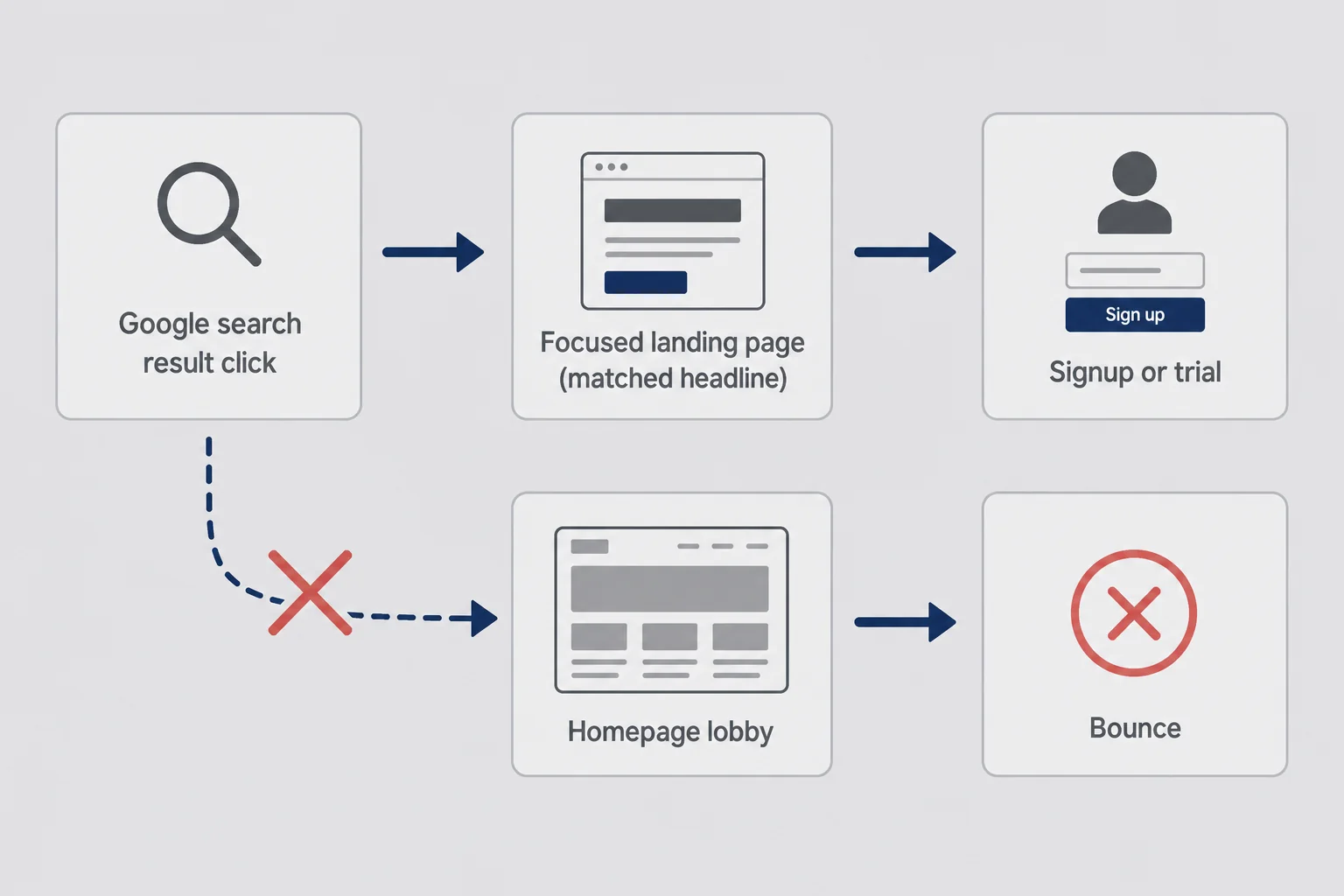
Traffic without a matched destination is how founders conclude SEO does not work.
When someone clicks from search, they have a specific question in mind. They clicked your result because the title promised an answer. If they land on a homepage with six navigation links and a hero that says "the modern platform for agile teams," you broke the promise. Bounce. Tab closed. You blame SEO. SEO was fine. The lobby killed the visit.
The fix is a focused landing page aligned with the article. Same language in the headline. Same problem in the subhead. Pricing visible if your product is self-serve. One button. This is the same discipline I cover in the landing page guide; search traffic is just colder than email traffic. The page has even less time to translate intent.
You have three reasonable destinations for SEO clicks:
Product landing page when the article is bottom-funnel ("best tool for X," "how to automate Y"). The reader is close to buying.
Useful article with a soft CTA when the reader needs education first. The CTA points to a trial or a more specific page.
Dedicated page per keyword cluster when you have two distinct buyers. Rare early. Common after your first win.
What does not work: blog → homepage → wander → leave. I have seen the analytics. It is depressing and preventable.
Blog on the same domain
Host the article on your product domain. yourapp.com/blog/how-to-export-shopify-orders or /guides/... is fine. What matters is domain authority accrues to you, not Medium. Syndication later is optional. Ownership first.
If you use Framer or Webflow for marketing, you can ship both the article and the landing page without a developer. When you need technical fixes (sitemap, canonical tags, weird Next.js routing), ask Max. Do not let perfect technical SEO block shipping a good article on a sane subdomain.
Match the promise in the SERP snippet
Your title tag and meta description are a mini sales pitch in search results. If the article title promises "without Zapier," the landing page headline cannot pretend Zapier does not exist. If the article is a how-to, the landing page should not jump straight to enterprise demo language.
I align three strings before publish: the search phrase, the article H1, and the landing page hero. They do not have to be identical word for word. They have to describe the same job. Misalignment is how you get clicks and bounces, which teaches Google your result disappointed people.
For B2B micro-SaaS at $29 to $79 a month, I show pricing on the SEO landing page when traffic is cold. The article earned trust. The page should not hide the number and force a call. That pattern is borrowed from the landing page guide and it applies double for search traffic.
On-page SEO without turning into an SEO professional
You do not need a certification. You need a short checklist you run once per publish.
Page loads in reasonable time on mobile. You do not need a perfect Lighthouse score. You need a page that does not feel broken on a phone.
One clear H1. Subheads that scan. No wall of text without breaks.
Images compressed. Alt text that describes the diagram or screenshot, not "keyword keyword keyword."
URL slug that matches the topic. yourapp.com/blog/export-shopify-orders-google-sheets beats yourapp.com/blog/post-7.
Submit the URL in Google Search Console after publish. Request indexing once. Then wait. Refreshing Search Console hourly is a personality disorder, not a strategy.
Schema markup and fancy structured data are nice-to-have for early stage. FAQ schema can help if your FAQ answers are real. Do not spend a weekend on JSON-LD if you have not written the article yet.
Search Console habits that do not waste your life
Check Search Console once a week, not once an hour. Look at the Performance report filtered to your new URL. Note queries you did not expect. Sometimes Google ranks you for a variant phrase. That is free keyword research.
When an article is new, use URL Inspection and request indexing once. Then leave it alone. Rewriting title tags every three days sends mixed signals and wastes your energy.
Fix crawl errors if they appear. Broken sitemap, accidental noindex, staging domain leaking into production. Those are worth a developer hour. Tweaking H2 wording for the fourth time this week is not.
Thin content and AI slop
Google is not stupid. Neither are readers. Ten AI-generated posts with the same outline and no experience signals will not build a business. One post where you clearly used the product, named the failure modes, and showed screenshots of the workaround might rank for years. Quality is a moat at long-tail scale because big brands do not bother writing "how I reconcile Stripe and QuickBooks as a solo bookkeeper." You will.
How I measure SEO when monthly traffic is still in double digits
Early SEO metrics are fragile. A single mention in a newsletter can spike visits and fool you. A Google algorithm update can drop you two positions and starve you for a month. Do not panic on weekly noise. Do look for trend plus conversion.
In Search Console I watch impressions and average position for my target phrase. Impressions climbing means Google is testing you. Position improving from eighteen to nine is real progress even if clicks are still small.
In Plausible or Analytics I watch landing page entries from organic and whether those sessions hit signup or pricing. One signup from organic search with ten total clicks is a ten percent conversion rate on that channel. That is worth more than five hundred homepage visits from a viral post that bounced.
I keep a simple spreadsheet. Month, target keyword, position band, organic sessions to the money page, signups or trials from organic. Five rows a month. That is enough to decide whether article two is worth writing.
When to write the second post
Write article two when article one ranks on page one or page two for the intended phrase, or when you learn the phrase was wrong and you have a better one from customer language. Do not write article two because you feel guilty about not blogging. Guilt is not a keyword strategy.
If organic converts but volume is low, consider adjacent phrases with the same buyer. If organic traffic is high and conversion is zero, fix the landing page before you publish again. More top-of-funnel into a leaky page is cruelty to yourself.
SEO alongside other channels
SEO compounds while you do other work. That is the point. You can run cold email Tuesday, fix onboarding Wednesday, and your article quietly climbs.
I do not recommend SEO as your only channel until you have proof it converts. I do recommend planting the seed early even while warm outreach is your main bet. Articles written after launch still need months to rank. Founders who wait until they are desperate for traffic start the clock too late.
Community posts and SEO can reinforce each other without being the same work. A helpful Reddit answer can inspire an article that ranks. An article that ranks can be linked when someone asks the question again six months later. Do not spam communities with your blog. Do write the definitive answer once and let search carry it.
Questions I get about micro-SaaS SEO
Should I hire an SEO agency? Not at sub-$2k MRR unless you have budget to burn and no time. Most agencies optimize for deliverables (reports, links, posts) not for your one phrase that matters. Learn the basics yourself first. Hire for a specific technical audit later if indexing is broken.
Does blogging help App Store apps? Different game. Iryna owns ASO for consumer iOS. Web SEO can support a marketing site, but App Store search is its own machine. Do not mix the playbooks.
What about programmatic SEO? Tempting when you see templates scale. For solo founders it usually produces thin pages that age badly. One great page first. Programmatic only after you understand what converts.
Can I rank without backlinks? Often yes in long-tail B2B niches. Internal links, a clear page, and genuine usefulness beat zero-backlink corporate fluff. Backlinks help. They are not step one.
Search is slow distribution, not a lottery ticket
Nobody is Googling your product name on day one. They are Googling their problem. Pick one phrase that proves you speak their language. Write one page that helps them without asking for applause. Send the click to a destination that makes saying yes easy. Measure whether strangers from search actually try the thing.
That is micro-SaaS SEO for solo founders. Not glamorous. Not fast. Cheaper than ads and calmer than performing on Twitter daily. Plant one article this month. Give it three months. Fix the landing page if traffic arrives and nobody signs up. Then decide if article two earns your weekend.
If you need strangers to reply to email instead of search, cold email for first customers is next. When text stalls on a visual B2B product, loom demo outreach and the Loom outreach fit picker help you decide if async video belongs at touch three. If search is starting to work and the page leaks, fix the landing page before you write another word.



Comments