Your Loom Got Three Views. Nobody Replied.
Async Loom outreach for micro-SaaS when cold email needs more than text: permission-first video, ninety-second demos, and where Loom actually belongs in a solo founder sequence.
 By Reese25 min read
Listen to this article
23:00AI-generated podcast-style overview of this article (not a word-for-word narration).
I recorded a Loom on a Wednesday afternoon. Personalized opener on their homepage. Ninety seconds. Clear CTA. I sent it to twelve people who had ignored my first two text emails. Three watched. One replied. That reply turned into a fourteen-day trial and a $49 monthly plan three weeks later.
That is not a channel. That is not scale. It is also the moment I stopped treating video outreach like a magic trick and started treating it like a follow-up tool with rules.
Most solo founders hear "add a Loom" the same week they hear "post on LinkedIn" and "run Product Hunt." Video feels human. It feels differentiated. It feels like effort strangers will reciprocate. Sometimes they do. More often, a Loom link in the first cold email gets you filtered into spam, deleted without opening, or watched once by someone's assistant who never forwards it. Run the Loom outreach fit picker before you record — it saves an afternoon of videos for the wrong list.
I am not a developer. I have spent more time on outbound, landing pages, and onboarding emails than on pull requests. I have freelanced for indie founders who could ship in a weekend and could not explain their product in thirty spoken seconds. I have sent emails that got ignored and recorded videos that got watched with no reply. Both taught me something.
This post is loom demo outreach micro saas for people who already tried text cold email for first customers and hit the wall where "I built something useful" is not enough to earn a response. If you do not have a narrow buyer yet, fix positioning before you polish a demo reel. If your landing page still explains features to strangers, read micro-SaaS landing page for solo founders first. This is the layer between a decent email and a conversation: async demo outreach that does not waste your Tuesday.
Max covers warm launch mechanics in how to market a micro-SaaS as a solo founder. His channel-picking advice applies here too: video is not a channel, it is a format inside a channel you already chose. If email is wrong for your buyer, Loom in email will not fix that. If email is right but flat, video might unlock the next step.
Loom demo outreach micro saas when a paragraph is not enough
Text email works when the problem is legible in one sentence and your product is easy to picture. "You export client reports manually every Friday" fits in eighty words. "We orchestrate cross-functional workflow intelligence" does not. When the buyer cannot visualize the fix, a short screen recording often beats another paragraph of abstraction.
Async demo outreach is not a separate channel from email. It is a format inside outbound. You still need a list. You still need relevance. You still need a follow-up cadence. The video changes what happens after someone opens, not whether you earned the right to send.
I use Loom because it is fast, hosted, and does not require the prospect to install anything. There are alternatives. Vidyard, native screen recorders, even a YouTube unlisted link if you are disciplined about privacy. The tool matters less than the placement in the sequence and the length of the recording. Founders who obsess over software pick the wrong fight.
The solo-founder constraint is time. You are not a sales team with SDRs cutting custom demos for every account. You have maybe two hours on a weeknight to outreach. Async video lets you batch record once per segment, send many times, and still look more invested than a template blast. That trade is real. It is also easy to abuse by recording forty mediocre videos instead of ten good emails.
My rule: add video when text has failed twice or when the prospect explicitly asked how it works. Not when you are bored of writing. Not when a growth Twitter thread told you video 10x replies. Replies go up when relevance goes up. Video amplifies relevance. It does not create it from nothing.
Say you sell a reporting tool to boutique marketing agencies. Your text email says you cut Friday export time. They have heard that promise from twelve tools. A ninety-second clip that starts on a messy spreadsheet they recognize, then lands on a finished client PDF with their logo placement, can land differently. The words and the pixels reinforce each other. That is the case for async demo outreach. Not "video is warmer." Specific visual proof of a specific job.
The opposite also happens. I consulted for a founder who recorded four-minute Looms explaining architecture because he was proud of the stack. Prospects watched twenty seconds and closed the tab. The product was fine. The video was a lecture. Micro-SaaS buyers at solo-founder price points are not looking for a webinar. They want to know if this solves Tuesday's problem.
What async demo outreach is not
It is not a product tour. Strangers do not want fourteen features in chronological order. It is not a pitch deck read aloud. It is not you talking for four minutes while a static slide says "About Us." It is not a replacement for knowing who you are emailing.
It is also not permission to skip warm launch work. If you have waitlist names, interview contacts, or community relationships, email those people with plain text first. Video is expensive attention currency. Spend it after you have exhausted easier warmth, or on prospects where the visual proof is the whole argument.
Why your first email should not contain a Loom link
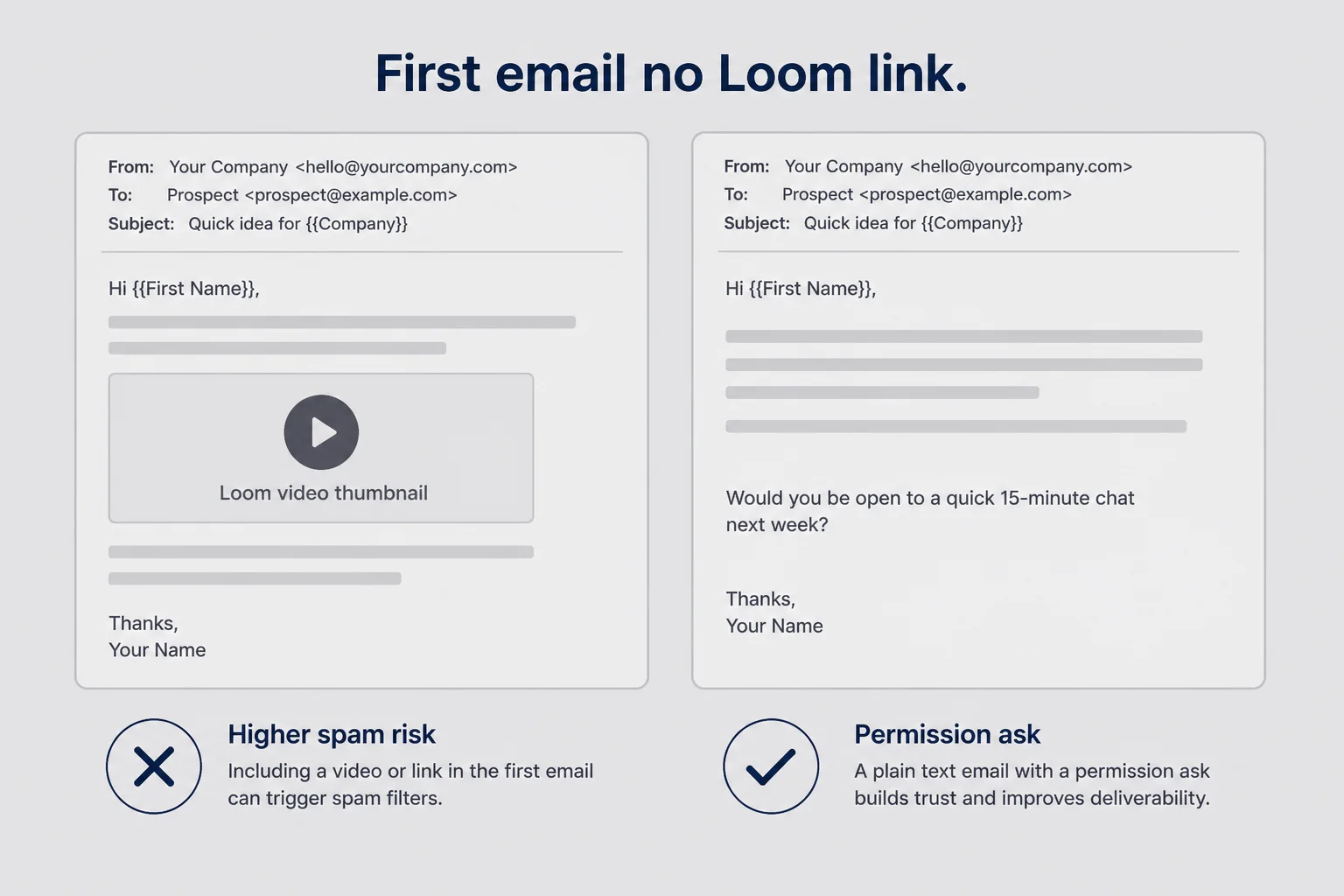
I tested this the hard way. First email: personalized line, Loom thumbnail, "two-minute walkthrough for your team." Sent from a secondary domain I had warmed for two weeks. Open rate looked fine. Reply rate was embarrassing. Several people told me later they assumed it was automated because of the video block.
Cold inboxes are trained to distrust links from strangers. Video links are worse than calendar links because they look like marketing payloads. Image-heavy emails tip filters. Some corporate gateways strip or sandbox them. You are fighting deliverability and skepticism at the same time.
The permission-first pattern fixes half of that fight before you record anything. Email one is text only. Short. Specific. No attachments. Ideally one link or zero links. You reference something true about them. You state a hypothesis about a problem. You ask if a quick async walkthrough would be useful.
Example shape, not a script to copy: "Saw you still publish weekly PDF reports for clients. I built a small tool that auto-builds those from live data. Worth a ninety-second screen recording if I send it, or not your stack?"
If they say yes, you record. If they ignore you, you follow up with text twice before you consider video. If they say no, you learn faster than a watch count ever will.
Founders resist this because recording feels productive and waiting feels idle. Recording for people who never asked is busywork with a view counter. I have been that founder. The view counter lied to me for a month.
The spam filter reality at small scale
You might think "I only send twenty emails, filters do not matter." They still matter if your domain is new, your copy sounds like SaaS marketing, or your first touch includes three links and a logo banner. Solo founders often send from the same domain that hosts signups and support. Poison that domain early and your transactional email suffers too.
Separate outreach domain or subdomain when you scale past hand-sent batches. At ten to fifteen emails a week, personal founder voice from a looked-up address can work if you are not embedding heavy HTML. Keep the Loom out of email one even then. Earn the second touch.
I once watched a founder paste a Loom link above the fold in a Mailchimp template with a hero banner and three social icons. The email was beautiful. It landed in Promotions and stayed there. He concluded that "email doesn't work for B2B" the same week he poisoned deliverability with design. Plain text is not ugly when it is the difference between seen and spam.
Corporate buyers sometimes have assistants who triage inbox. Assistants delete video links from unknown senders faster than they delete short text. You are not always emailing the decision maker on first touch. Assume an filter-human exists. Text survives filters better. Video comes after a human chose to care.
When async demo outreach fits a micro-SaaS
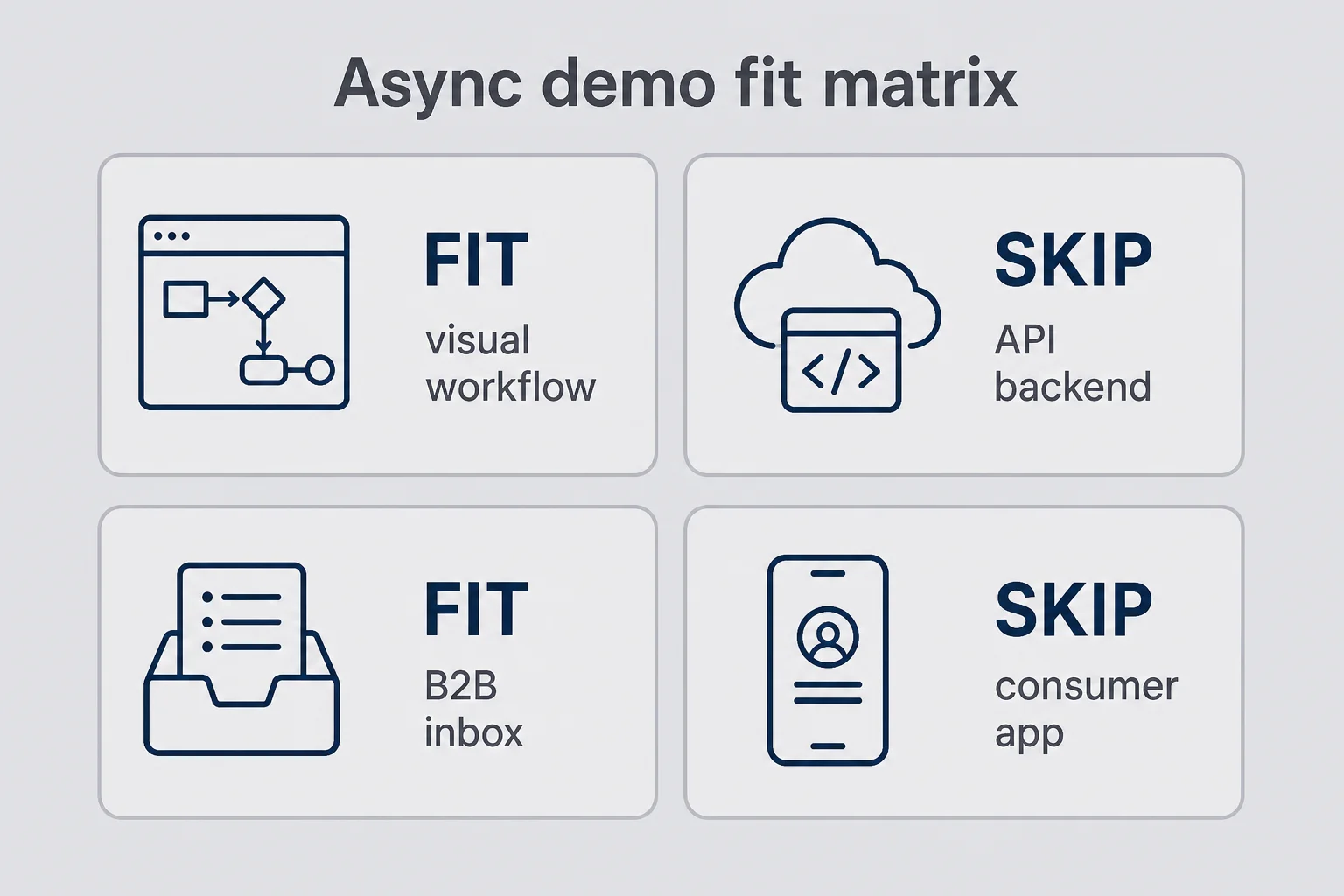
Video outreach is not for every micro-SaaS. It shines when the product is visual, the workflow is unfamiliar, or the ROI is easier to show than to describe. It fails when the buyer is allergic to unsolicited media, the product is a backend integration, or you are selling to a market that lives in Slack threads instead of email.
I ask four questions before I recommend Loom to a founder I am advising. Run the full eight-question version in the Loom outreach fit picker if you want a text-first, touch-three, or skip-video recommendation before you record.
Can you show the outcome in under two minutes on screen? Dashboards, exports, before-and-after documents, time saved in a UI. Yes. Pure API middleware with no interface. Probably skip video until you have a case study in text.
Is the buyer a professional with a work inbox? B2B operators, agency owners, ops leads. Often yes. Broad consumer apps. Usually no. Iryna's world is the App Store and the first phone session, not a Loom in a Gmail thread.
Did text already fail or stall? If you have not sent thoughtful plain emails, video is not your missing lever. It is avoidance.
Can you personalize the opening frame without faking intimacy? Opening on their website or a public asset they care about works. Pretending you audited their entire company when you spent twelve seconds on the homepage does not.
Async demo outreach also fits when scheduling is the bottleneck. Some prospects will watch a ninety-second clip at 11 p.m. but will not book a call with a stranger. Video lowers friction. It does not remove the need for a next step. Always end with a reply-based CTA, not a calendar wall of availability.
Horizontal products struggle with segment video more than vertical ones. "Project management for everyone" does not give you a clean opening frame. Narrow tools win on Loom because the prospect recognizes the screen instantly. If you are still broad, fix positioning before you invest in demo infrastructure. The video will force you to pick a scene anyway.
Price point matters quietly. At $9 a month, a live calendar link can feel absurd. At $299 a month, prospects expect more hand-holding and may want a call before a trial. Loom sits in the middle: proof without a meeting. Match the ask to the ticket. Asking a stranger to watch ninety seconds for a $19 tool is reasonable. Asking them to watch twelve minutes is not.
When I tell founders to skip Loom entirely
Skip it if you are still unclear on who the product is for. A confused demo confuses faster than confused copy. Skip it if you are mass-blasting hundreds of contacts from a cold list you bought. Skip it if your product is not ready to show. A Loom of a broken onboarding flow is a churn accelerator. Skip it if your channel is community-native and video would feel bizarre in context. Reddit and niche forums punish self-promo. A Loom link in a first DM is self-promo with a play button.
Permission first beats dropping a video cold
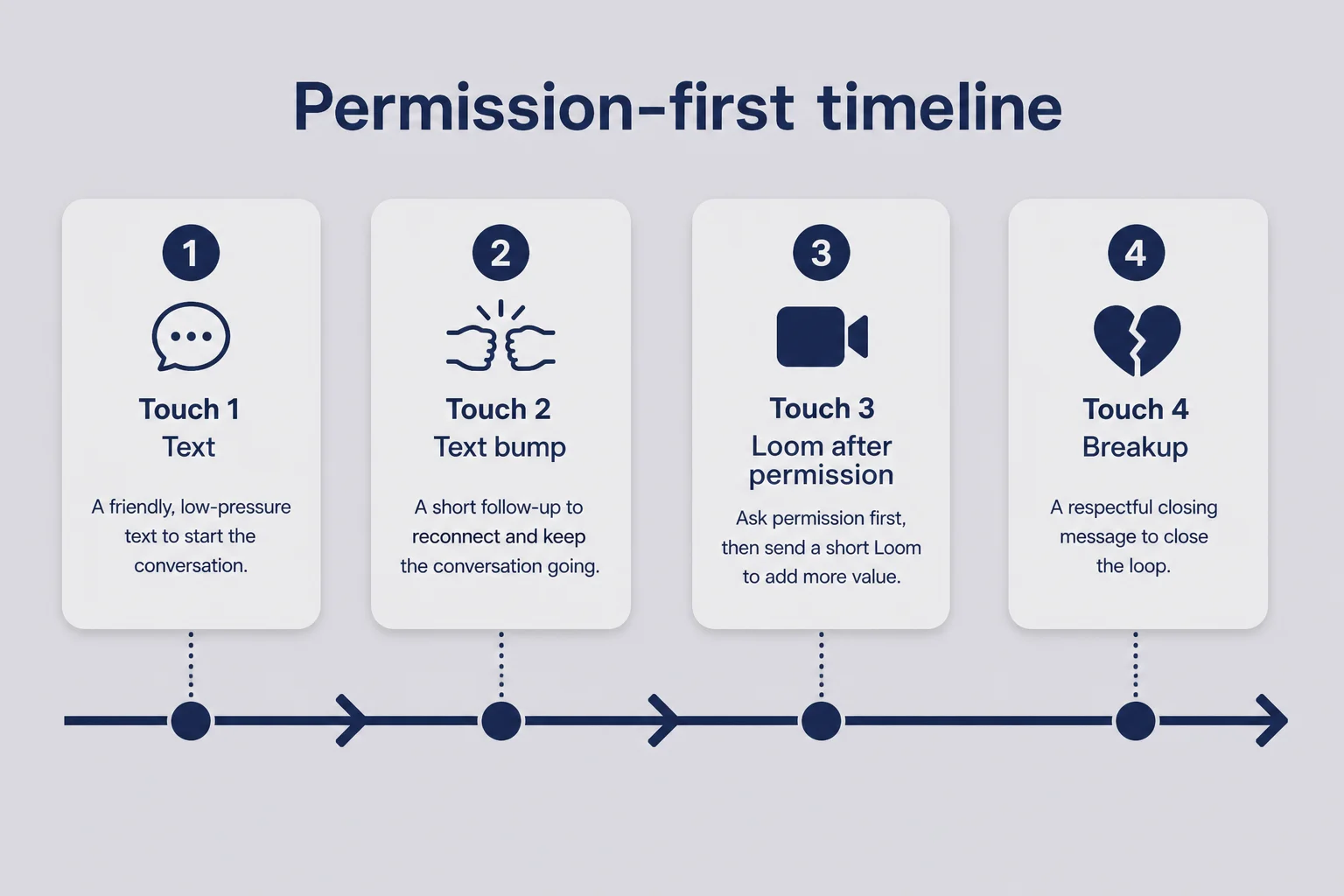
Permission-first means you do not send the recording until the prospect has opted into the format or you have earned a third touch in a thread they already saw. Opt-in is ideal. Earned follow-up is the pragmatic solo-founder version when nobody replies to email one.
Touch one: text, specific, no video. Touch two: short bump, new angle, still no video. Touch three: "I recorded a quick walkthrough focused on [specific thing]. Ninety seconds. Happy to delete if not relevant." Link.
That sequence feels slow when you want customers this week. It is faster than burning domain reputation and faster than recording fifty videos for people who never open email one.
When someone replies "sure, send it," you have permission. Record within twenty-four hours if you can. Delay signals disinterest. Keep the recording tighter than your practice take. Send the link in the same thread. Reference what they said in the reply so the thread stays coherent.
When someone replies with a question, answer in text first. Do not reflexively respond with video for every question. Video is for "show me" moments. "How much does it cost" deserves a number and a link to pricing, not a six-minute tour that hides the price until the end.
The reply you want
A reply that says "send the video" is better than a silent view. Views are vanity. Replies start conversations. Optimize for permission, not watch time.
What permission sounds like in practice
It does not require a formal yes. "Interesting, how does it work?" is permission to show. "We use Competitor X already" is permission to show differentiation if you can do it without being petty. "Not a priority" is not permission. Move on.
Some founders use a hybrid: text email with no link, then a second email that says "I went ahead and recorded this in case it helps" only for tier-one accounts. I tolerate that for ten dream customers, not for a whole list. The line between proactive and presumptuous is thin. When you cross it, you are the salesperson they warn each other about.
Permission can be implicit in a forward. Someone introduces you in a thread: "Talk to Jane about reporting." Jane did not opt into video, but the thread has context. A short Loom in that warm intro thread is different from cold outreach. Treat intros as warm even when Jane has never heard your name. The intro is the permission.
Document the permission in your spreadsheet so you do not fool yourself. Column: "asked for video / earned touch three / cold drop." Founders lie to themselves with view counts. Data beats vibes.
The ninety second Loom I record for strangers
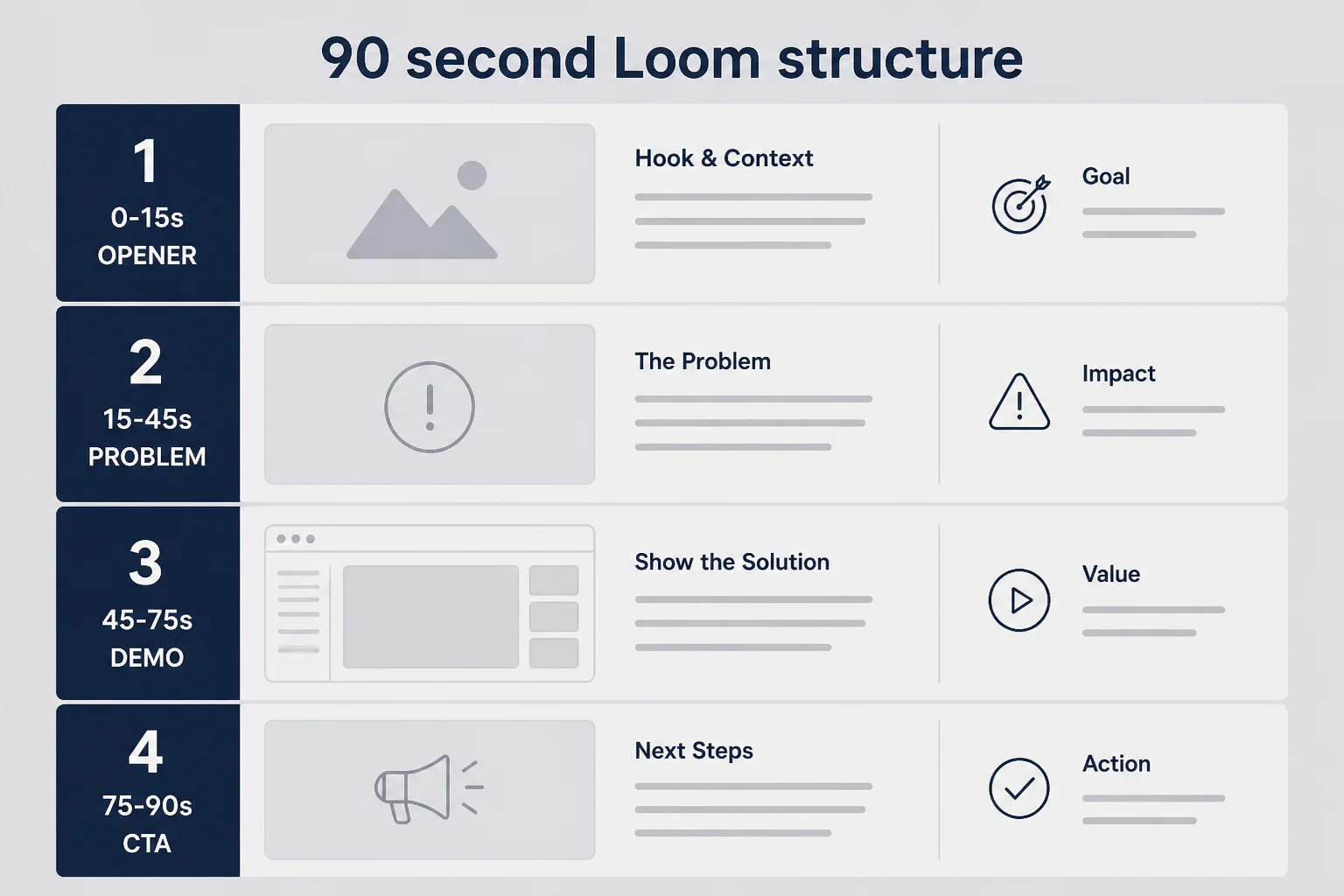
Ninety seconds is not arbitrary. It is long enough to show one workflow, short enough that a busy operator might finish. Past two minutes, watch rates drop unless they already trust you. I structure every cold-destined Loom the same way even when the content changes.
Seconds zero to fifteen: say their name if you are sending to one person, or say the segment if the video is reusable. State why you recorded. "You mentioned manual exports" or "Agencies like yours usually hate this step." No company biography.
Seconds fifteen to forty-five: show the problem on screen. Their site, a sample workflow, a spreadsheet shape they recognize. If you open on their homepage, scroll naturally. Do not linger on their logo like you are performing an audit. One specific observation.
Seconds forty-five to seventy-five: show your product handling that case. Not every feature. One path. Click slowly. Narrate outcomes, not button names. "This becomes the client PDF" beats "I click export here."
Seconds seventy-five to ninety: one ask. "Reply if you want access" or "Worth a fifteen-minute call next week?" Do not offer three CTAs. Do not apologize for four seconds. End.
I record with screen plus small webcam bubble when I want humanity. Face helps for founders selling founder-led products. Face-less screen-only works when the UI is the star. I have seen both work. I have seen both fail when the script was vague.
Record in a quiet room. Mute notifications. Close tabs that show client data. Nothing kills trust faster than a Slack message popping up with someone else's name.
Practice the script out loud once without recording. You will hear the corporate phrases creep in. "Leverage our platform" shows up when you are nervous. Replace with "this sends the PDF." Founders who wing it every time add thirty seconds of filler. Filler is where viewers bail.
If your product has a slow loading state, preload the page before you record. Waiting on screen is death. Edit is not cheating for solo founders when edit means trimming the first five seconds of dead air in Loom's trim tool. Do not publish a four-minute ramble because you are afraid to cut yourself.
The homepage opener without being creepy
Opening on a prospect's public site is common advice. The creep line is tone and accuracy. "I noticed your pricing page still lists legacy plans" is fine if true. "I studied your entire funnel" when you glanced at the hero is not.
I keep a checklist before I hit record: correct URL, no autofill embarrassment, mic test, script outline on a sticky note, timer visible. I do one take for segment videos. For tier-one accounts I allow two takes max. Perfectionism is how Tuesday becomes Thursday and the thread goes cold.
Where Loom belongs in a follow-up sequence
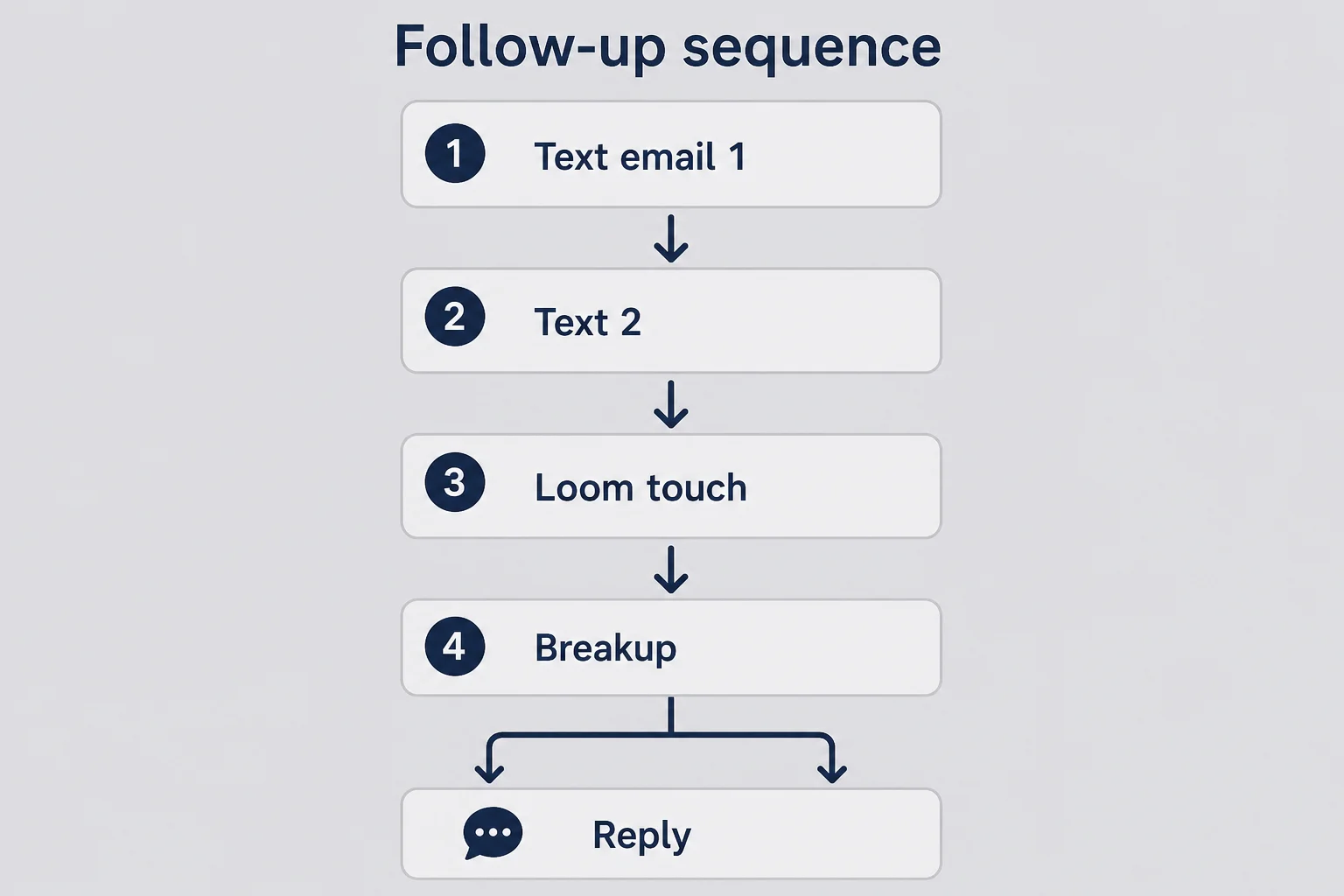
Think of outbound as a sequence, not a single send. Max's launch content covers warm paths. My cold email post covers list building and copy. Loom slots into the middle and late touches when text alone did not move them.
Day zero: text email one, no Loom. Day four: text follow-up, add one new fact or case shape. Day nine: Loom if the thread is open or if this is a high-fit silent prospect you are allowed to nudge again. Day fourteen: breakup text, gracious, no guilt. Some conversions happen on the breakup. Video on the breakup is rare for me. Text respect wins more than a final dramatic demo.
If they watched but did not reply, that is a different branch. Day plus two after a view notification: "Saw this might have landed in a busy week. The piece about [specific thing] was the part I thought fit your team. Still useful?" Short. No new video.
If they replied after watching, do not send another Loom unless they ask. Move to conversation. Trial link. Live call. The video did its job.
Track outcomes in a spreadsheet if you do not have a CRM. Columns I use: name, date, touch number, video sent yes or no, reply yes or no, trial yes or no. At fifty prospects you learn which segment actually watches. That is more valuable than Loom's aggregate analytics.
Pairing Loom with other channels
LinkedIn research plus email send is a common stack. I do not embed Loom in LinkedIn DMs to cold strangers. LinkedIn penalizes weird outbound. Email carries the link after permission. Twitter replies can mention "happy to send a quick recording" but do not drop unsolicited links in public replies. That is how you become a reply guy with a funnel.
Community posts are not Loom threads. If someone asks in a forum how to solve a problem you built for, a short Loom answer can help when the norm allows links. That is warm context. Different game from cold outreach.
Compare your reply rate on text-only batches versus Loom touch-three batches for the same ICP. I run small A/B tests by accident because I forget which segment got video. When I finally sort the spreadsheet, the lesson is usually the same: video helps when the list was already tight. Video does not rescue a loose list. Track trial starts, not views. A watched Loom with zero trials is a content problem or a product problem. Views alone will lie to you for months.
One video per ICP segment, not one video per prospect
Custom Loom for every prospect is the advice that burns solo founders out. It scales on paper. It collapses in real life when you have a day job and fourteen signups. Segment recording is the sustainable version.
Define one ICP slice. "Marketing agencies with five to fifteen employees who report to clients weekly." Record one strong Loom for that slice showing a fictional but realistic scenario. Personalize the email wrapper heavily. Mention their agency name, their client type, a public detail. The video stays the same. The first line proves you did not blast five hundred people with identical text.
For ten dream accounts, customize the opener on their site. Record ten times. Budget that time explicitly. It is a sales week, not a background task.
For fifty similar prospects, one segment video is enough if the email first line is specific. Reply rates will not match fully custom. They will beat a generic tour with a mail-merge first name.
I keep segment videos in a folder with boring filenames: agency-reporting-v2, freelancer-invoice-v1. Date the file. When the product changes, retire old videos. Sending a Loom where the UI does not match the live app is worse than sending text.
Batch recording day is a real calendar event. I block two hours, coffee, closed door, four segment takes maximum. First take is warmup. Second is usually the keeper. If I need six takes, the script is wrong or I am tired. Stop. Fix the outline tomorrow. Exhausted founders ramble. Rambling is how ninety seconds becomes four minutes while you apologize for the cursor.
Store the Loom link in your notes doc with a one-line description of who it is for. When you reuse a segment video three months later, you will forget which scenario it shows. Future you is busy and cynical. Label things.
Micro-personalization without rewriting the whole script
Change the first eight seconds in a new recording overlay if you must. Some founders record a ten-second personalized intro per prospect and splice it. I only do that when the deal size justifies it. Otherwise, email personalization carries the weight.
Spintax in subject lines is fine. "Quick walkthrough" vs "ninety-second demo" vs "screen recording for you." Body stays human. Do not spin into nonsense.
Deliverability: links, thumbnails, and the stuff that flags spam
Loom gives you a link and often an animated thumbnail when you paste into email clients. That thumbnail is convenient and risky. More images and links mean more filter scrutiny. At low volume with plain text around the link, I accept the thumbnail. At higher volume I test text-only link on some sends.
Never attach an mp4. Attachments trigger gateways. Never send from a domain you cannot afford to burn. Warm secondary domains for scaled outbound. Keep your main product domain clean for receipts and password resets.
One link per email. Not Loom plus calendar plus landing page plus unsubscribe marketing footer. The email should look like a person wrote it in Gmail, even if you use a sending tool.
Test your own deliverability like a paranoid founder. Send to a fresh Gmail and Outlook address. See where it lands. Open on mobile. Does the thumbnail load weird? Does the preview text repeat the subject in a robotic way? Fix that before you blame the channel.
If open rates crater after you added video to touch three, pause video and return to text for a batch. Diagnose domain, list quality, or copy. Video is not always the culprit, but it is an easy variable to isolate.
Plain-text link formatting matters. Paste the raw URL once if your tool allows clean preview suppression. Some founders use loom.com/share/... with a sentence above: "Ninety-second walkthrough (video link)." Honest labeling beats mystery meat thumbnails when you are unsure about filters.
Mobile opens are half your list for some ICPs. Watch your own Loom on a phone before you send. Tiny text in your product UI becomes illegible. Zoom the window. Slow the clicks. Mobile viewers forgive less than desktop viewers because they are half distracted already.
They watched the Loom and still did not reply
Watch without reply is the most common outcome. It stings because Loom shows you a view count. Views are not validation. They are not revenue. They are someone clicked play, maybe.
Reasons I have seen: wrong person watched, they watched half while distracted, they liked it but lack authority to buy, timing is wrong, they are comparing three tools and you are not first, your CTA was too weak, your CTA was too aggressive, they intended to reply and forgot.
Your move is one short bump, not a guilt trip, not a second Loom, not "just circling back" with no content. Reference a specific frame. "The part about auto-publishing client reports is what I thought matched your stack."
If still silence after the bump, archive or move to a long-cycle nurture. Some people return three months later. Most do not. Your list is finite attention. Do not spend a fifth touch on someone who watched twice and never typed a word.
Internal forwards are invisible. A view in Ohio when your prospect is in London might be a colleague. Ask lightly once: "Did this land with the right person on your team?" Not everyone will answer. Some will.
Async Loom vs booking a live demo
Async video scales. Live demo converts when there is real interest. The solo-founder play is sequential: text earns permission, Loom proves competence, call closes nuance.
Live demos fail when you use them as a barrier. "Book a demo to see anything" kills micro-SaaS with low price points. Nobody wants a calendar dance for a $29 tool. Loom removes that for the first touch.
Live demos win when the product requires discovery. Complex integrations, multi-seat permissions, security questions. A recording cannot answer "what happens if our SSO does X" at 11 p.m.
Offer both paths in late touches. "Happy to send a quick recording or jump on a call if easier." Let them pick. Forcing live calls because you read that demos close better is how you lose async-first buyers.
I still take live calls for anyone who watched more than half and asked a question. That is the warmest lead in your pipeline. Protect your calendar for those, not for strangers who ignored three emails.
On live calls, do not re-demo everything they already saw. Ask what stuck, what confused them, what would need to be true for them to try it this week. The Loom was the trailer. The call is the conversation. Founders who repeat the full demo on a call waste the async work and prove they do not listen.
Some buyers will never watch video and will only book calls. Respect that. Offer a one-line alternative in touch three: "Happy to send a quick recording or walk you through live if easier." Two doors, same relevance. Forcing async on a phone-first buyer is the same mistake as forcing calendar links on everyone.
Questions solo founders ask about Loom outreach
Should I put a Loom link in my first cold email?
Usually no. A video link in email one reads like a mass blast and hurts deliverability. Send a short text email that proves you researched them. Ask if they want a quick walkthrough. Record the Loom only for people who reply yes or for follow-up touches three and four when you already have context.
How long should a cold outreach Loom be?
Ninety to one hundred twenty seconds for strangers. Open on their site or a relevant screen, name one specific observation, show how your product handles that case, end with a soft ask. Longer videos are fine for warm leads who already said they are interested. Cold prospects rarely watch past two minutes.
Do I need a unique Loom for every prospect?
No at solo-founder scale. Record one strong video per ICP segment and personalize the email wrapper. Custom intros on their homepage are powerful for ten to twenty high-value accounts. For fifty prospects in the same niche, one segment video plus specific first lines beats burning out on forty near-identical recordings.
Loom vs live demo for first customers?
Async Loom scales your time and removes scheduling friction. Live demo converts better when someone is already warm. Use Loom to earn the live call. Do not treat a Loom as a replacement for talking to customers when they are willing to book. Treat it as proof you are not a bot.
Why did they watch my Loom but not reply?
Watch without reply usually means mild interest or curiosity, not commitment. The video might have been clear but the ask was weak, the problem was not urgent, or they forwarded it internally and you never followed up. Send one short bump referencing something specific from the video. If still silence, move on.
Does Loom hurt email deliverability?
Links and image thumbnails can trigger filters when you send volume from a cold domain. At small scale from a warmed or secondary domain, one Loom link in a follow-up is usually fine. Avoid Loom in email one, avoid attaching video files, and keep most of the email plain text with a single clear link.
The recording is not the hard part
I have watched founders polish Loom intros while their landing page still confuses cold traffic. I have watched them send videos to lists built from scraped databases with no relevance. Video makes you feel like you did the hard work because recording is viscerally uncomfortable. The hard work is still the list, the positioning, and the follow-up.
A product nobody hears about is just an expensive hobby. A Loom nobody asked for is just a view counter attached to that hobby. Use async demo outreach when showing beats telling, when you have earned a third touch or a yes, when ninety seconds can carry one clear outcome. Keep your first email human text. Keep your domain clean. Keep your ask small.
Then record once, send carefully, and spend the rest of the week on replies, not on re-editing the same thumbnail because your hair looked weird. The hair never mattered. The specific problem on their screen did.
The founders who win with async demo outreach treat it like a scalpel, not a personality. They send fewer emails than they want to. They record fewer videos than they want to. They follow up more than feels comfortable. That combination is boring. Boring outbound is outbound that still works six months later when you are tired and the product is no longer novel to you.
If you are reading this because cold email felt dead, check the basics one more time before you blame the format. List quality. Subject line specificity. Landing page match. Onboarding emails after someone trials. Video is downstream of clarity. Clarity is upstream of everything. If text stalled on a tight list, confirm async video fits with the Loom outreach fit picker before you blame the channel.
Start tomorrow with ten text emails. No Loom. See who bites. Record one segment video for the slice that replied. Send it only where it fits. Count replies, trials, and paid conversions like a person who has seen too many dashboards, not like a person chasing views. That is the whole loom demo outreach micro saas playbook at solo-founder scale. Un glamorous on purpose.



Comments