The Demo Went Well. Nobody With a Budget Was on the Call.
Enterprise sales demo for solo founders: who must attend, discovery before screen share, live demo structure, procurement follow-up, and when Loom beats a live call.
 By Derek27 min read
Listen to this article
AI-generated podcast-style overview of this article (not a word-for-word narration).
I once watched a founder demo for forty-two minutes. Screen share flawless. Transitions smooth. Questions answered. The prospect said "this is exactly what we need."
Two weeks later: ghosted.
I asked who was on the call. An operations coordinator who had been using the free tier for three months. Lovely person. Zero budget authority. The director who owned the tool budget had never been invited. The demo was perfect. The deal was already dead.
That is the enterprise sales demo solo founder trap. You optimize the performance. Nobody optimizes the room.
I am Derek. I sold B2B SaaS at small companies long enough to lose deals to procurement I never met and win a few because someone with a signature block actually showed up on call two. I have freelanced with bootstrapped founders who could explain every feature and could not ask "who signs checks under fifteen thousand dollars" without apologizing.
This post is for solo founders who already have SMB traction and are running live calls with bigger accounts. If you are still sending cold Looms to strangers, start with Reese on Loom demo outreach. Async video has rules. Enterprise live demos have a different room map. If you are not sure you should be upmarket yet, read when to sell enterprise first. Demos are expensive in founder hours. Earn the right to run them.
A champion is not a buyer. Interest is not budget. A great demo is not a signed order form. My job in this article is to help you run demos that produce real next steps, not standing ovations from fans.
Enterprise buyers have seen a thousand demos. They can smell a script. They respect founders who listen more than they talk in the first fifteen minutes. That is hard when you built the product and want to show the clever part. Save the clever part for when it maps to their pain.
I use Zoom or Google Meet. Same rules either way. Camera on is polite for first calls. Screen share second. Notes in a doc, not scattered sticky notes. If you use Fathom or Gong, great. Many solo founders cannot justify the cost yet. A good doc template is enough.
The emotional shift from SMB to enterprise demos is underrated. SMB calls can be casual. Enterprise calls feel like you are borrowing someone's calendar from a meeting that mattered. Show up prepared, not performative. They do not need you to sound like a VP of Sales. They need you to sound like a founder who understands their problem and will still answer email after the contract signs.
Pipedrive or HubSpot can track demo stages if you maintain them. One person, three stages: scheduled, completed with next step, stalled. That is enough CRM. Fancy automation is not what closes five-figure deals. Follow-up speed is.
An enterprise demo is not a Loom to strangers
Enterprise demo is a live conversation with stakes. Someone blocked time. Someone may have forwarded an internal email. You are being evaluated as a vendor, not as content.
A Loom to strangers is outbound theater. Useful in the right sequence. Wrong tool for mapping a buying committee. You cannot ask "who else needs to see this before you can move forward" to a view counter.
Live enterprise demos have different physics. Silence means something. A director typing while you talk might be good or bad. Questions about data residency are not curiosity. They are gates. You hear tone. You notice who leans in when you show reporting and who only wakes up at pricing.
Founders hide behind Loom because live calls feel high stakes. They are. That is the point. Enterprise deals require trust you cannot fully build async. The founder on the call is the credibility. "We are small" is honest. "We are small and I answer security emails personally" can be a feature.
That does not mean record nothing. It means sequence matters. Permission-first async video is Reese's lane. I am talking about the call that happens after someone agreed to evaluate you seriously, or should have.
The demo is not the product tour you give at a conference. It is a tailored proof that you solve their stated pain, with their words echoed back, in front of the people who matter for the next step.
If your "enterprise demo" is the same thirty-minute click path you give everyone, you are not demoing. You are broadcasting. Broadcasting feels efficient. It loses deals when the buyer needed three screens and you showed thirty.
Cold Loom to a VP is not enterprise outbound. It is spam with a face. Reese built a whole framework for when async video earns replies from strangers. Enterprise is different. By the time you are on a live demo, someone already agreed this problem is worth solving. Your job is to prove you are the vendor worth the internal fight, not to win a beauty contest against every competitor they are also evaluating.
I ask founders before every live demo: what would make this a waste of their time? If they say "another generic pitch," you already know the bar.
Some founders ask whether they need slides. Slides are optional. A live product with a clear narrative beats fifty slides about "the market landscape." If you use slides, use them for one diagram: before workflow, after workflow. Then get back into the product.
The Zoom gallery view tells stories
Watch who has camera on. Watch who multitasks. Watch who asks pricing questions versus feature questions. Pricing questions often signal buyer mindset. Feature questions often signal user mindset. You need both eventually. You need buyer mindset before you send a proposal.
Who has to be on the call for the deal to be real
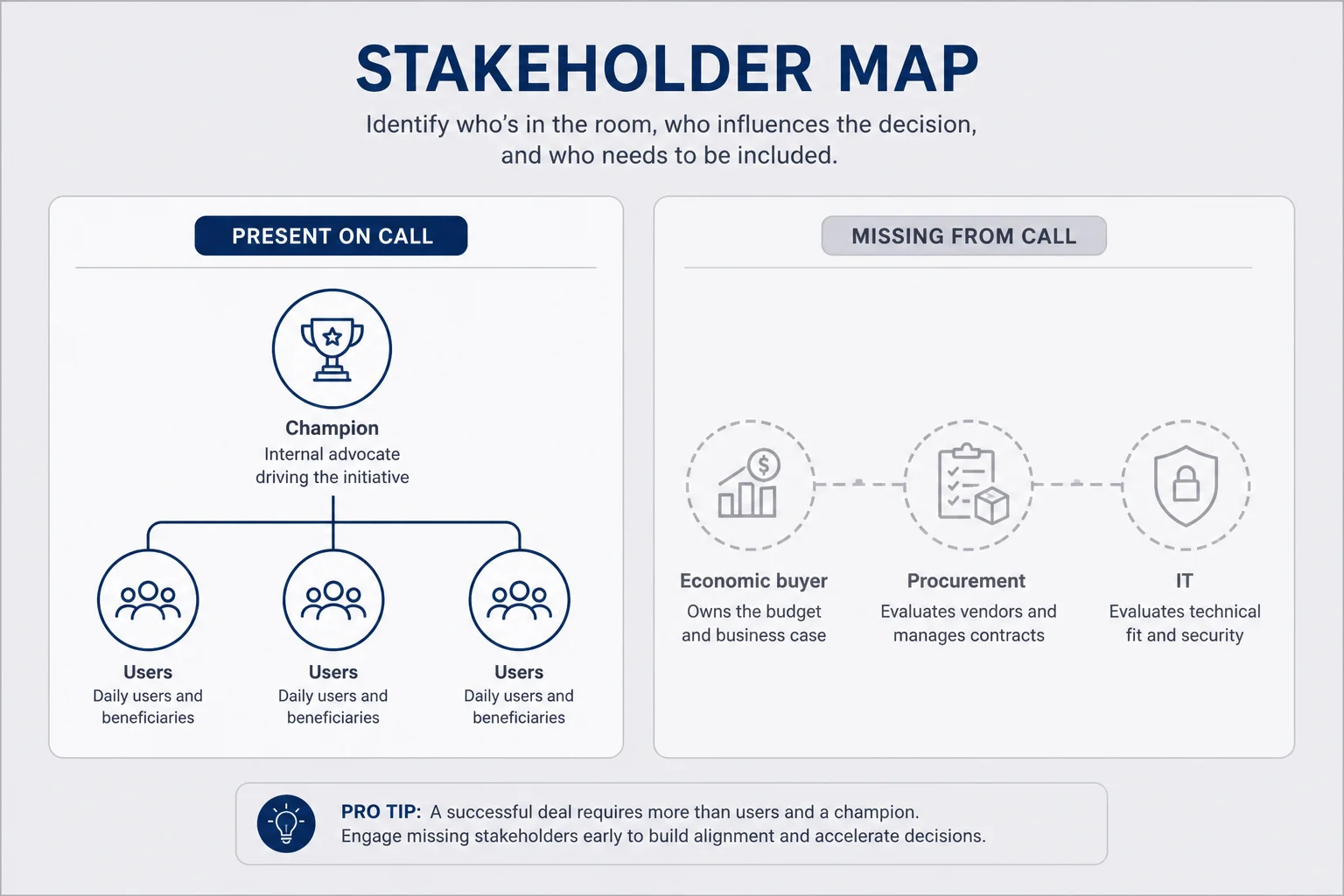
The attendee map is the whole game.
Champion: internal advocate. Feels the pain. Will sell for you when you are not in the room. Cannot sign alone in most orgs.
Economic buyer: controls budget or reports to someone who does. Cares about ROI, risk, rollout, not your keyboard shortcuts.
Users: will live in the product. Valuable for feedback. Dangerous if they are the only people you ever see.
IT / security: show up when data, SSO, or compliance matters. Often call two unless that is the blocker.
Procurement: appears after intent exists. You rarely demo to procurement first. You demo to pain and budget, then procurement negotiates.
For the deal to be real on demo one or two, you need a line of sight to the buyer. Not "leadership is looped in." A name. A role. A plan to get them on the next call if they were not on this one.
I send a polite pre-call email: "Who else should join so we can answer budget and rollout questions in one session?" If they refuse to answer, that is data.
Solo founders apologize for asking. Do not. You are saving everyone's calendar. A fourth demo without the buyer is cruelty with extra steps.
Red flags in the invite list
Only junior roles. Only external consultants with no signing power. "We'll record it for the team" with no follow-up meeting scheduled. Champion says "I will present internally" every time you ask for the boss.
Each flag alone is not fatal. Stack three and you are in fan territory.
Buying committees are not always formal. At a forty-person company the buyer might be the founder. At four hundred people it might be a director you have never heard of. Ask your champion to draw the org sketch in the doc. Stick figures are fine. Titles matter.
If IT is required before rollout, ask whether they need to be on demo one or can join for a twenty-minute security slice on demo two. Forcing everyone into call one often schedules nothing. Sequencing beats heroics.
I lost a deal once because I insisted the CFO join demo one. The champion stopped replying. Overreach spooked them. Now I ask what is minimum viable attendance for a decision path, not maximum possible attendance.
Multi-threading without a sales team
Multi-threading means more than one contact at the account. Solo founders can do it carefully. Champion plus their manager on call two. Email recap CC'd to a named buyer. LinkedIn connection request after value, not before. Do not spray five cold contacts. That feels like enterprise spam.
The delegate question
Sometimes the buyer legitimately delegates evaluation. Fine. Ask what decision authority the delegate has. "I can recommend" is different from "I can approve pilots under ten thousand." Write it down. Forward the recap email and ask the champion to confirm with the buyer CC'd.
Fifteen minutes of discovery before you share screen
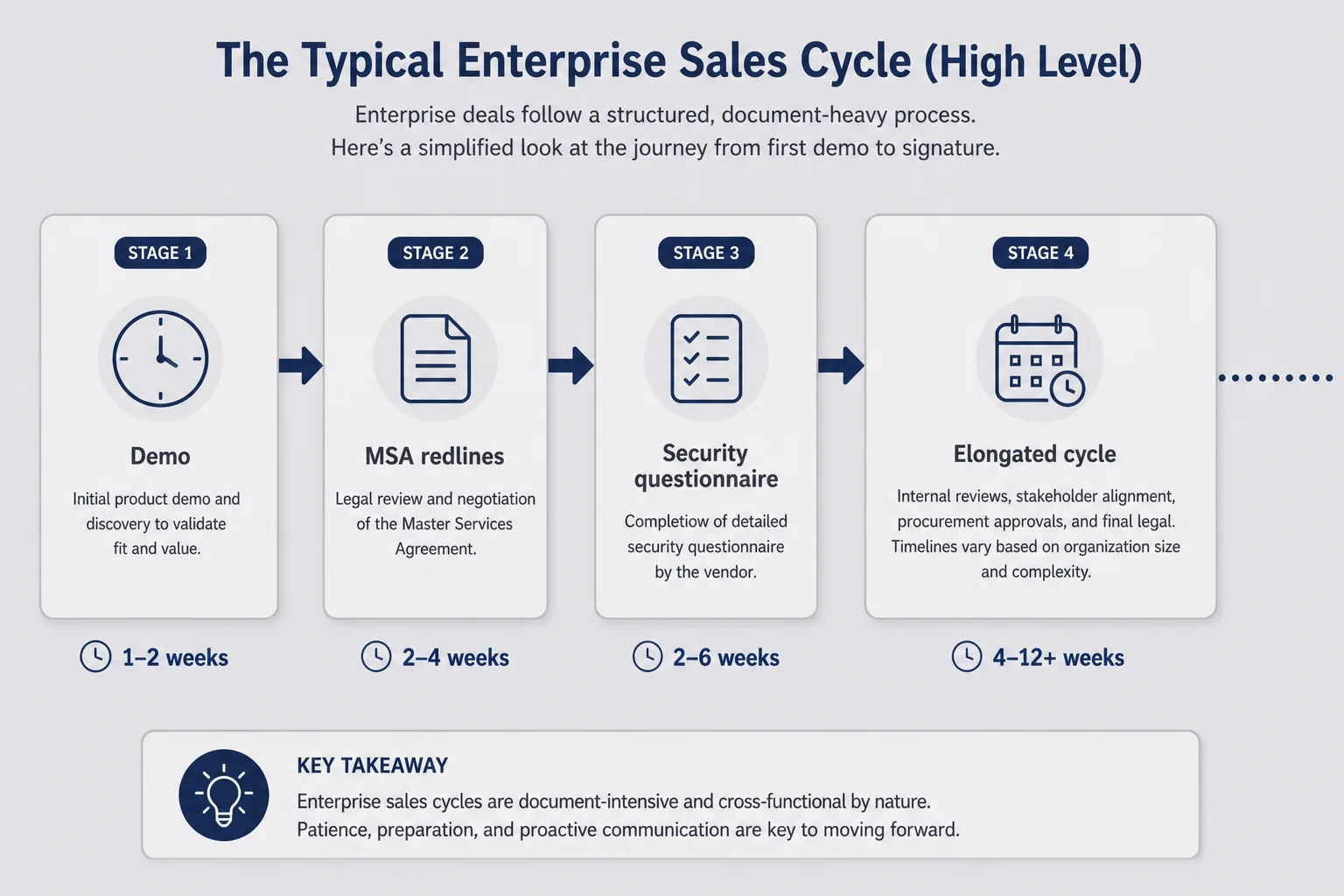
The worst demos start with "let me share my screen."
The best start with questions you already partially know the answers to, because you did homework, but you let them talk anyway.
Fifteen minutes minimum. Twenty if the account is complex. Cover:
Current state: what they do today, what breaks, what it costs in time or money.
Pain in their words: write these down verbatim. Use them later in the demo.
Success criteria: what would make this project a win internally.
Stakeholders: who cares, who blocks, who signs.
Timeline: real or aspirational. Both useful.
Competition: including spreadsheets and status quo. Status quo wins more than you think.
You are not interrogating. You are mapping. Take notes visibly. Founders who type during calls look serious. Founders who wing it look like tourists.
Discovery also earns the right to narrow the demo. If they only care about audit logs for HIPAA, do not start with integrations.
I use a simple doc template: prospect name, date, pain quotes, stakeholders, next step. After the call it becomes the recap email. One artifact, two jobs.
Questions that sound human
"What prompted you to take this call now?" Better than "what is your budget."
"If we nail this, what changes for your team in ninety days?" Better than "what features matter."
"Who besides you gets annoyed if this problem stays unsolved?" Surfaces buyers and blockers.
"When you have bought tools like this before, what went wrong?" Gold for objection handling.
When they try to skip discovery
Some prospects say "just show us the product." Smile. "Happy to. Two quick questions so I show the right three minutes instead of the wrong thirty." Almost everyone agrees. If they refuse entirely, show a narrow slice and leave time to ask who else weighs in.
AI can draft question lists. It cannot hear that "we need to run this by IT" is a stall versus a real blocker. That is your ear.
Homework before discovery: read their site, skim the champion's LinkedIn, check if they are already a customer. Mention one specific thing. "I saw your team post about Q3 audit prep" beats "I love what you guys are doing."
Take notes in their language. If they say "reconciliation nightmare," your recap email says "reconciliation nightmare," not "workflow optimization." Mirroring is not manipulation. It is proof you listened.
Discovery on a second call can be shorter. First call carries the load. Do not re-interrogate on call two unless the room changed.
Budget questions without being weird
"Do you have a budget range for solving this?" is fair on call two, not always call one. Earlier, ask "have you bought tools like this before and what did they cost roughly?" That surfaces bands without sounding like you only care about money.
If they refuse budget talk entirely, your demo should still end with a pilot size question. "Would a paid pilot under ten thousand be feasible to test this quarter?" No is data.
Silence on a discovery question is also an answer. If they cannot describe success criteria, they are not ready to buy. You can still demo, but downgrade expectations.
I bring a printed list of questions to some calls. Looks old school. Stops me from forgetting when nerves hit. Founders forget that nerves are normal. Buyers expect some awkwardness from a founder. They do not expect you to forget their company name.
Discovery is where you earn the right to say no. If the fit is wrong, say so on the call. "Based on what you shared, we might not be the right tool for X. Here is what we are great at." That honesty saves you both six weeks.
Demo structure when you are the only seller in the room
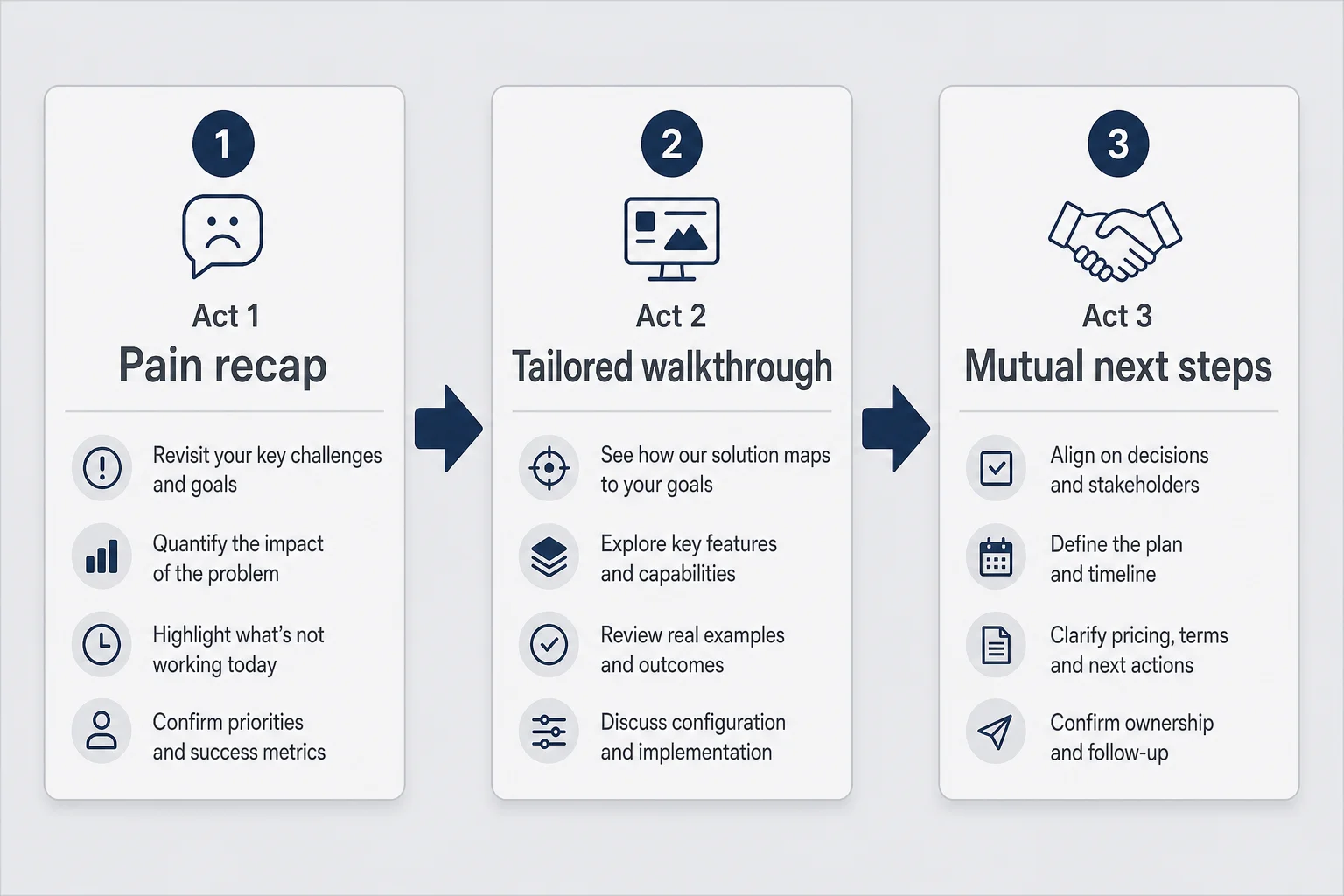
You are presenter, SE, and note-taker. Structure is how you survive.
Act one — recap (three minutes): "Here is what I heard. You are trying to X, current process is Y, success looks like Z. Did I miss anything?" Let them correct you. Corrections are engagement.
Act two — tailored walkthrough (twenty to thirty minutes): Shortest path to their success criteria. Three to five beats, not twenty tabs. Pause after each beat: "Does this match how you imagined it?"
Act three — close the loop (five to ten minutes): Pricing band if appropriate. Implementation roughness. Security overview if they care. Mutual next steps with names and dates.
One hour max on first call unless they pull you deeper technically. Longer demos dilute urgency. Leave them wanting a second call with the buyer, not exhausted.
When you are alone, ruthlessly cut scope. No sidebar features. No roadmap tour unless they ask. If IT joins, have a second browser profile ready with admin settings. Do not hunt menus live.
Share screen after you know the path. Rehearse the three beats. I have seen founders lose credibility searching for a button while a director watches. Practice the click path like a musician practices scales.
Handle objections by repeating the concern, then answering. "You mentioned data export. Here is exactly how that works and who can trigger it." Do not get defensive about small product gaps. Honesty builds trust. "We do not do that today. Here is the workaround and whether it is on the roadmap" beats a waffle.
End every demo with a written recap within four hours. Same day is best. Bullet pain, what you showed, open questions, next step with owner. Ask them to reply confirming or correcting. Paper trail saves deals when champions change jobs.
Technical depth without an SE
If they ask something you cannot answer live, say "I will confirm and email you by tomorrow with the exact behavior." Write it down visibly. Follow through. Bluffing kills enterprise trust faster than "I do not know yet."
Keep a FAQ doc for security and architecture. Copy-paste beats improvisation on encryption questions.
The pricing moment
Do not hide pricing until minute fifty-nine unless the deal is truly custom. Anchors help champions sell internally. Ranges are fine. "Team plans start at X annual for up to N seats" gives them ammunition.
Demo environment matters. Use clean demo data that resembles their industry. "Acme Corp" jokes are tired. Fake names that sound like their vertical land better. Reset the environment before every call. Stray test data from last demo is unprofessional luck.
If the product is slow live, acknowledge it once. "This query is heavier in demo than in production because of X." Do not apologize six times. Once, then move.
Pause for questions but control the room. "I will show reporting in two minutes; hold security questions until then and I will dedicate time." Buyers respect structure.
After technical buyers join, expect a detour. Budget thirty minutes of buffer in your calendar so you are not rushing the mutual next steps because you have a hard stop.
Debrief yourself in five minutes
Right after the call, voice memo or bullet dump: who seemed engaged, who seemed skeptical, what you forgot to ask, what the next step actually is. Memory lies by evening.
Bring water. Seriously. Forty minutes of talking dry mouth makes you rush. Rushing makes you feature dump. Small physical details affect demo quality.
The second demo is a different animal
Founders rehearse the first demo until the click path is muscle memory. Then call two arrives with a different cast. IT wants five minutes on encryption. Finance wants contract terms. The champion wants to replay everything the buyer missed on call one. Your carefully planned twenty-minute walkthrough is not what this room needs.
Second demos are triage, not encore. Open by asking who joined and what they need that call one did not cover. "I know Sarah from security has questions on access logging. I will cover that first, then open for rollout questions." Structure beats starting over from the login screen.
If the buyer finally shows up on demo two, do not punish them with a full product tour. They are giving you scarce calendar. Give them decision information. Problem, fit, price band, implementation roughness, security summary, next step with owner. Fifteen focused minutes with a buyer beats forty-five minutes of features they will never use.
I watched a founder re-demo every tab because the buyer "had not seen it yet." The buyer checked email on mute. When we switched to "here is what approval looks like on your side," the buyer closed the laptop lid. Engagement returned. Buyers are not users. They are risk managers with a budget line.
Technical deep dives on call two are fine when IT is the blocker. Budget a separate thirty-minute security slice instead of stapling it to a business demo. IT remembers vendors who wasted their time with marketing slides. They also remember vendors who answered the logging question in plain English and got off the call.
Sequence your second call assets before the call. Security FAQ PDF. One-page architecture summary. Subprocessors list. Pilot proposal draft with blank price if needed. Send the bundle when the invite goes out. Attendees read zero attachments. Your champion might forward one. That is still a win.
What "the demo went fine" usually hides
Prospects say fine when they mean polite. Fine without a next step is not fine. Fine without a buyer name is fan territory. Fine with "send me something" is a soft stall unless something specific was requested.
Train yourself to hear the gap after fine. "Glad that was useful. Who else needs to weigh in before you can move forward?" Pause. Let silence work. Founders rush to fill silence with more product talk. Silence after that question is data.
"The demo went fine" from your champion on Slack is not pipeline. Ask for forward proof. "Did you send the recap to your director? Can you cc me on the forward or tell me what they said?" Specific beats vibes.
Sometimes fine means you are one of three vendors in a bake-off you did not know existed. Ask on call one or two: "Are you comparing alternatives right now?" If yes, ask what criteria matter. If they refuse to say, assume spreadsheet comparison and arm your champion with differentiation in their language, not yours.
Fine can also mean the problem is real but priority is low. Your champion enjoyed the call because it was a break from their actual fire. The buyer is not thinking about your category this quarter. Downgrade the deal. Stay friendly. Stop forecasting.
Post-demo surveys are rare in small B2B. You are the survey. Five questions in your debrief doc: buyer identified? buyer engaged? blocker named? dated next step? champion willing to forward recap? If you score below three, the demo did not go fine. It went pleasant.
I keep a list of phrases that mean stall: "we are still socializing internally," "leadership is aligned," "lots of excitement," "circle back after the holidays." Not automatic death. Automatic trigger to ask for names and dates. Excitement without a calendar is marketing.
When the demo actually went well, you hear logistics. "Can you send a draft order form?" "What is implementation timeline?" "Who on your side handles vendor onboarding?" Logistics mean someone is trying to buy. Chase logistics. Ignore applause.
If multiple people talk over each other, name it gently. "I want to make sure I answer everyone. Sarah asked about exports, then I will come to James on permissions." Facilitation is a sales skill.
Objection handling on live demos is not a battle. It is clarification. "Too expensive" might mean "I need to justify this to finance." "We need SSO" might mean "IT will block us without it." Ask what sits under the objection before you defend.
Competitors come up. Do not trash talk. "Happy to compare on the criteria you care about" plus honest gaps wins long term. Buyers smell fear when you dodge comparison questions.
If they ask for a custom feature on the call, note it, do not promise dates live unless you are sure. "I will confirm feasibility and email you by Friday" preserves trust.
Custom demos for every account do not scale forever. At solo-founder scale they do. Segment by use case, not by logo. Three demo paths beat thirty bespoke recordings.
When the demo goes well and they ask for a trial, define trial success criteria in writing. "Two weeks, three users, goal is to process ten real records." Otherwise trials become free forever limbo.
Follow-up when procurement goes quiet
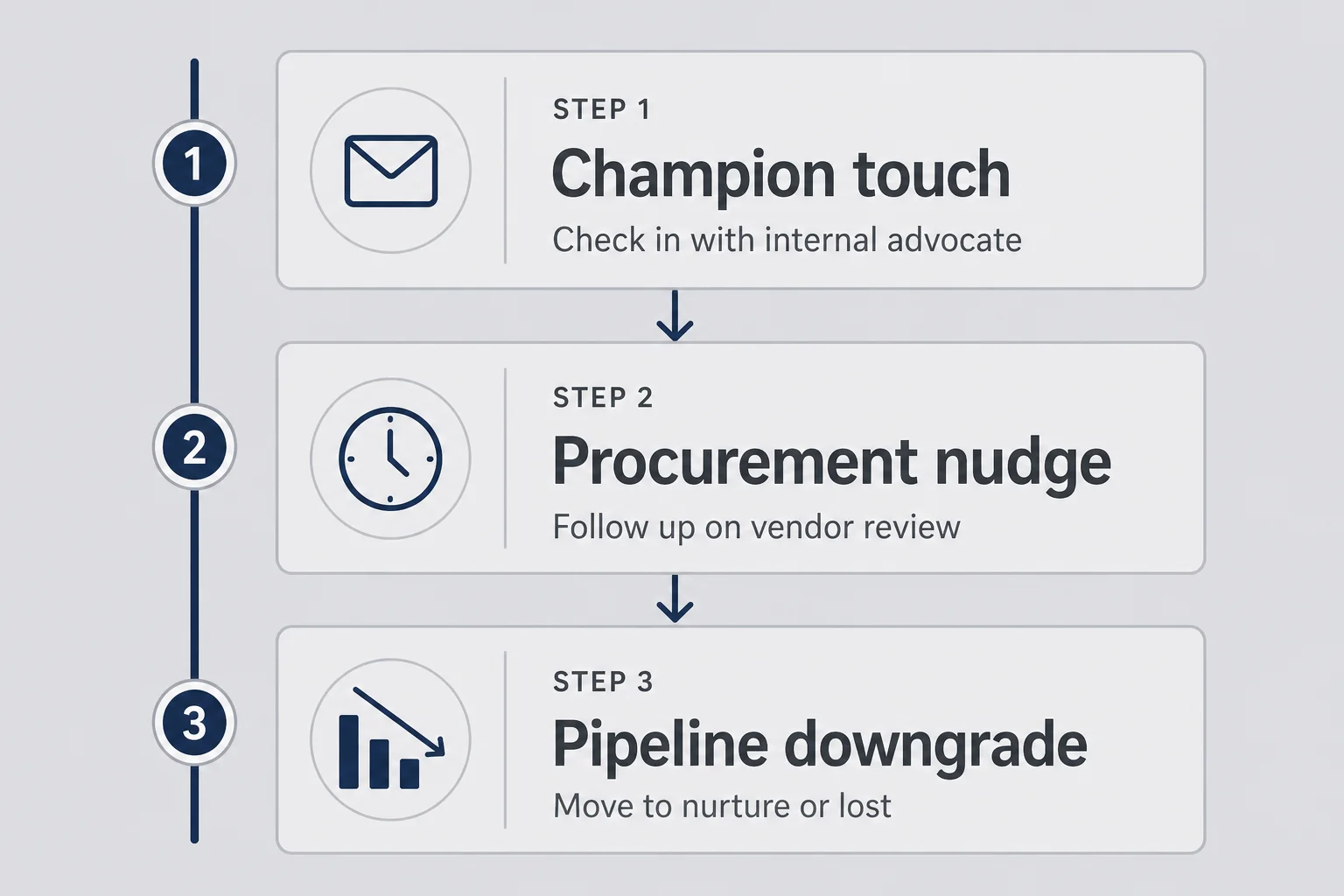
Procurement quiet is normal. Panic is optional.
Week one after demo: recap email with next steps. Champion confirms buyer saw it.
Week two: champion check-in. "Anything blocking you internally? Happy to join a short call with whoever owns vendor review."
Week three: direct note to procurement if you have a contact. Polite. Specific. "We submitted the questionnaire on the 12th. What else do you need from us to move to signature?"
Week four onward: if no movement and champion cannot advance, downgrade the deal. Not delete. Downgrade. Your pipeline should not lie.
Silence is information. Champions who cannot get procurement to reply often lack internal priority. Pushing harder rarely fixes priority problems.
Offer assets that unblock: completed security form, insurance cert, DPA PDF, reference customer willing to email. Make it easy to say yes.
Avoid the weekly "just checking in" email with no ask. Each touch should have one question or one attachment.
I use a mutual action plan shared doc: task, owner, due date. Procurement recognizes the format. It also exposes when every task is assigned to you and none to them.
When to walk
No buyer access after three attempts. Champion stops replying. Procurement reopens security from scratch for the third time with no timeline. Legal demands terms you cannot afford for the contract size.
Walking is not failure. It is inventory management for a solo founder.
Document every procurement stall pattern you see. After three deals you will notice repeats. "Waiting on legal" for six weeks with no redlines returned is different from "procurement queue" with a ticket number. The second might move. The first might be a soft no.
Founders sometimes offer discounts to unstick procurement. Discounts without a deadline just train buyers to wait. If you discount, tie it to signature date. "Ten percent if signed by month end" is a tool. Permanent discounting is panic.
Your champion is still your asset during procurement silence. Weekly five-minute check-ins. Not "any update?" but "is there a form I can pre-fill?" Action beats vibes.
Internal politics you will never see
Someone in finance might hate your champion's department. Someone might have backed a competitor internally. You will not get the org chart memo. Quiet procurement sometimes means internal war, not vendor neglect. Ask your champion directly: "Is there internal competition for this project?" Awkward question. Cheaper than another month of hope.
The polite breakup email
After enough silence, send release valve: "I will assume timing is not right this quarter unless I hear otherwise. Happy to reconnect when priorities shift." Sometimes that produces a reply. Sometimes it frees your headspace. Both wins.
Re-engaging next quarter
If they said "budget next quarter," calendar a touch one week before that quarter starts. Not the first day. One week. "You mentioned Q4. Still worth a fifteen-minute sync to see if timing still fits?"
References help unstick vendor review. Offer a similar customer willing to take a fifteen-minute call. Not a fake testimonial. A real human. Procurement loves peers more than your marketing site.
Procurement silence is not always about you
Week three of quiet feels personal. Your recap was good. The questionnaire went back clean. Then nothing. Founders assume they failed a hidden test. Sometimes procurement is a queue with no owner. Sometimes legal is buried. Sometimes the champion's project lost an internal priority fight you will never see.
Ask your champion the awkward version. "Is this still a priority internally, or did something else take the budget?" Awkward saves months. Champions often answer honestly when you give them permission to say no.
Internal reorgs kill deals quietly. A buyer goes on leave. A new VP freezes software purchases for sixty days. Your form sits in a portal nobody checks until someone escalates. You cannot fix reorgs. You can notice when every internal task is assigned to your champion and zero to their side.
When procurement does reply with a new request, respond fast and ask for timeline. "Happy to provide the updated insurance cert by Thursday. What is your target date for vendor approval?" Turn their request into a mutual deadline. Passive vendors get forgotten.
If procurement copies legal on every email, the deal is real enough to hurt. Read those threads carefully. Legal questions without a buyer on the thread mean the paperwork is moving while priority might still be weak. Buyer plus legal on the same email is healthier than legal alone.
Founders sometimes ghost procurement back because they are scared of saying something wrong. Silence matches silence. Send the short professional note. One attachment. One question. "Is there anything else blocking approval from your side?"
Your pipeline row should note procurement contact name and last touch date. "Procurement quiet since 9/12" is a stage note, not a moral judgment. Review those notes weekly. Downgrade deals where quiet exceeds your threshold.
The mutual action plan helps here because it makes shared waiting visible. If their column is empty for three weeks, your champion sees it too. Shared visibility beats you privately panicking while the champion assumes everything is fine.
Keep your pipeline honest. "Demo completed" is not a stage. "Buyer identified, security submitted, legal reviewing" is a stage. HubSpot defaults are too vague for solo founders. Rename stages to match your actual motion.
Loom vs live: when each is enough
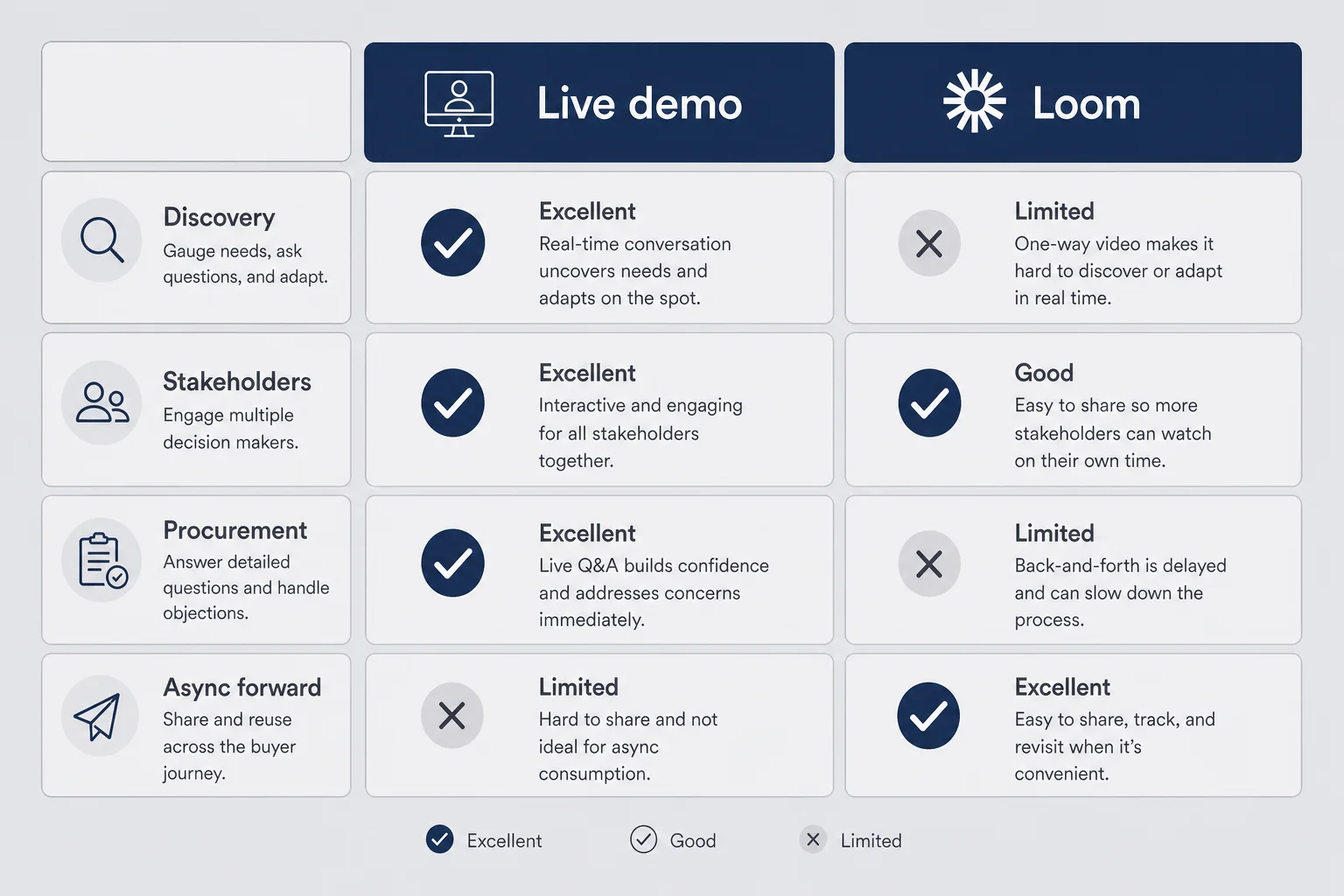
Live wins when: first serious evaluation, stakeholder mapping needed, objections are unknown, price and security are live topics, you need to hear who asks what.
Loom wins when: champion needs to forward internally, committee cannot schedule together, recap of a live call for someone who missed it, second touch after discovery already done, geographic time zones make live painful.
Loom loses when: it replaces discovery, it is the first touch cold to strangers (Reese's warning), you use it to avoid asking for the buyer, you record forty minutes because you can.
Keep Loom short. Five to eight minutes for internal forward. Structure: their pain in sentence one, three beats of product, clear CTA with calendar link.
Personalize the wrapper email, not always the video. Segment video per ICP is enough at solo scale.
Contrast with Reese's Loom outreach motion: permission-first, async, earning a reply. Enterprise Loom is internal selling ammunition for a champion who already wants you. Different job.
After a strong live demo, I often send a five-minute Loom recap: "Here is what we covered for anyone who could not join." Champion forwards. Buyer watches on 1.5x speed. You still need the buyer on a live call eventually for hard questions.
Hybrid sequence I like
Discovery live fifteen minutes. Full demo live with champion and hopefully buyer. Recap Loom for absent stakeholders. Security docs async. Procurement call live if they will take it. Signature async.
You are one person. Stack async where it saves calendar, not where it hides from hard conversations.
Audio quality on Loom matters for enterprise forwards. Bad mic makes you sound small. Quiet room. Close the garage door. Same bar as a live call.
View counts lie. Three views might be one person rewatching. Ask the champion who watched and what they thought. Engagement beats analytics.
Live demos build relationship. Loom builds documentation. You need both in a healthy enterprise thread, in the right order.
When the buyer asks for a recording instead of live
Sometimes security policy blocks live screen share tools. Offer a recorded walkthrough plus a live Q&A with no screen share, or a live call with slides instead of product. Flex format, not flex standards on buyer access.
Prep your champion to sell internally. Send them a forwardable paragraph they can paste into Slack. "We saw X, it solves Y, next step is Z." Champions are busy. Make forwarding effortless.
The worst Loom mistake I see in enterprise threads: a forty-minute uncut recording because the founder did not want to edit. Nobody watches minute thirty-eight. Cut ruthlessly. Respect their calendar even async.
Live calls also need a hard stop. "I have us down for forty-five minutes. Does that still work?" Respecting time is a buying signal. Rambling past the hour tells buyers you will be hard to implement with too.
Enterprise demos fail when founders treat them like theater and buyers treat them like risk management. Your job is to reduce perceived risk in real time. Show the happy path. Name the edge cases honestly. Confirm who decides. That is the whole script.
Questions founders ask about enterprise demos
Who needs to be on an enterprise sales demo?
At minimum you need your champion and either the economic buyer or someone explicitly delegated to evaluate on their behalf. IT or security can wait for a second call unless SSO is the main topic. A demo with only end users and no budget path is practice, not pipeline. Ask who signs before you share screen for forty minutes.
How long should discovery take before a demo?
Fifteen to twenty minutes of questions before you share screen on a first live call. You need pain, current workflow, success criteria, and who else weighs in. Skipping discovery turns demos into product tours strangers politely endure. Discovery also tells you which features to show and which to skip.
Should solo founders use Loom for enterprise demos?
Loom works for async follow-up, internal forwarding, and busy buying committees that cannot align on a live slot. It is a weak substitute for a first enterprise conversation where you need to map stakeholders and hear objections in real time. Use Loom after permission, not instead of discovery.
What do I do when procurement goes quiet?
Send a short status email to your champion with a specific ask and a date. Offer to join a fifteen-minute call with procurement if that unblocks them. If silence exceeds two weeks with no internal movement, downgrade the deal in your pipeline and focus elsewhere. Polite persistence beats panic; six months of maybe beats neither.
How do I structure a demo when I am the only seller?
Open with recap of their pain from discovery. Show the shortest path to that outcome, not every feature. Pause for questions every few minutes. End with mutual next steps: who does what by when. Leave five minutes to confirm the buyer path. One hour max for a first call unless they ask for technical depth.
What is the difference between a good demo and a real deal?
A good demo produces enthusiasm from someone who cannot sign. A real deal has a named buyer, a budget line or pilot path, and a next meeting with a deadline. Track those three, not applause. Champions forward Looms. Buyers ask about terms, security, and rollout.
The room matters more than the script
I still lose deals where the demo went well. I lose fewer when I map the room before I share screen.
Your product does not have to be perfect. Your questions have to be honest. Your follow-up has to be fast. Your pipeline has to tell the truth about who can sign.
Next time a prospect says "great demo," ask who else needs to see it and whether that person controls budget. The silence after that question teaches more than any feature you ship.
Run the demo for the buyer's pain, not your roadmap. Invite the buyer before you polish the slides. Count procurement silence as data, not personal rejection.
The demo is not the close. It is the proof that a close is possible. Possible is enough to keep going. Impossible is enough to stop.
Read when to sell enterprise if you are still deciding whether these calls should be your main growth lever. Demos are downstream of readiness. A perfect demo cannot fix a product that is not team-ready, a champion without a buyer, or a pipeline built on logos instead of motion.
I will take a good room with a mediocre demo over a perfect demo in an empty room every time. Map the room first. Then share screen.
Before your next enterprise demo, write three names on a sticky note: champion, buyer, blocker. If you cannot fill buyer after the invite goes out, reschedule or downgrade expectations. The sticky note takes ten seconds. The deal it saves might be your quarter.
Reese teaches strangers to reply. I teach founders to run the room once strangers become prospects. Same pipeline, different skills. Master both or stay stuck in great demos that never invoice.



Comments