Spend $100 on Ads. Keep $150. Then Decide.
How solo founders run profitable paid ads for a micro-SaaS: a $100 profit test, ROAS gates that actually matter, and when it makes sense to scale spend into the tens of thousands.
 By Reese28 min read
Listen to this article
AI-generated podcast-style overview of this article (not a word-for-word narration).
A founder DM'd me a screenshot last March. Google Ads dashboard. Four hundred dollars spent. ROAS sitting pretty at 3.8x. He wanted permission to 10x the budget before his next rent check cleared.
I asked one question he had not answered in the screenshot: how much profit landed in Stripe after refunds, payment fees, and the one annual plan that made the ROAS look heroic for three days?
Silence. Then: "I think we're profitable?"
That is the profitable paid ads micro saas solo founder trap in one notification. The ad platform counts revenue the second someone clicks pay. Your bank account counts money after chargebacks, failed activations, and the customer who bought annual on impulse and regretted it by Thursday. Ads can work for a one-person SaaS. They work far less often than Twitter threads promise. When they work, it looks boring: spend a hundred, keep a hundred fifty in profit, pass a few gates, then scale in steps instead of leaps.
I have run performance marketing for small B2B teams since 2014 and burned my own card on side projects since 2022. I am not anti-ads. I am anti-theater. Vanity ROAS is theater. Scaling because the graph went up on a Tuesday is theater. The operators I trust treat paid like a lab experiment with a kill switch, not a personality trait.
Portland winter, my kitchen table, three browser tabs open to different dashboards that disagreed with each other. That night I wrote the sticky note rule I still use: spend, count what stays, decide. No ad platform gets the final word. Stripe does, after refunds.
This guide is for solo founders who already have something to sell and want a realistic path: when ads are worth testing, what profitable means before you open Ads Manager, the $100 profit loop, ROAS gates that keep you honest, how to read tiny sample sizes, and when scaling to tens of thousands actually makes sense. If you have not picked a channel or a message yet, start with marketing for solo founders. If pricing still feels like a guess, fix pricing before you pay strangers to visit your site. Ads multiply clarity. They do not create it.
Paid traffic is not a moral choice. It is a math choice with feelings attached. You can build a fine micro-SaaS without ever running ads. Plenty do. This post is for the founder who tried organic, has a page that mostly works, and wants to know whether renting attention is sane at solo scale. The answer is sometimes, with gates, and never because a podcast made you feel behind.
Profitable paid ads micro saas solo founder: the $100 test I wish more people ran
The whole game fits on a sticky note. Spend $100. Measure what you keep. Decide.
Not spend $100 and hope MRR looks different eventually. Not spend $5,000 because someone on a podcast said you have to lose money to learn. A hundred dollars is small enough that a bad week is tuition, not trauma. It is large enough that strangers either pay you more than the ads cost or they do not. That binary is the gift.
Say you sell a $49/month tool for freelancers cleaning up exports. You run search ads to one landing page for fourteen days. You spend $102. Stripe shows $251 in new cash from people who came from those ads. After payment fees and two refunds, you keep roughly $218 in net revenue. Subtract ad spend. You are near $116 in profit on the test window.
That is a pass. Not a victory parade. A pass. You do not scale yet. You run the same test again and see if the number repeats without a heroic outlier. Two clean windows beat one lucky spike every time.
If the same math lands at negative $40, you also have an answer. The channel might be wrong, the page might be weak, the price might not match the pain, or the keyword intent might be tire-kickers. All useful. Cheaper than three months of "optimizing" audiences you do not understand.
I care about profit in the test window because MRR lies politely in week one. Annual plans, trials that have not converted, and customers who have not activated yet all dress up a dashboard. Cash in minus cash out over fourteen days is rude in a helpful way.
Why $100 and not $10 or $10,000
Ten dollars buys almost no data on search or social. You will conclude ads "do not work" because the sample size was a joke. Ten thousand dollars buys a false sense of confidence if your gates are wrong. You will scale a leaky funnel and call it growth.
One hundred is the awkward middle where solo founders live. It matches a modest card float, one focused landing page, and a single offer. You can run it twice in a month without explaining anything to a co-founder or a board.
What you are really buying
You are not buying customers at scale. You are buying an answer to a narrow question: will a stranger with no relationship to you pay more than it cost to get them in the door, inside a window you can afford?
Everything else is downstream. Creative tests, new audiences, retargeting layers, hiring an agency. Those are luxuries for after the sticky note math works twice.
I keep a paper template in the drawer for every new test. Date started. Network. Daily cap. Landing URL. Pass rules written in pen before spend. Sounds precious. It stopped me from moving goalposts mid-campaign when I wanted a win. The template also makes year-two me grateful when I cannot remember which headline cleared margin.
Some founders ask if they should run ads during a free trial period. Usually yes, if trials convert to paid at a rate you already measured organically. Ads into a brand-new trial with no activation data just accelerate confusion. Know what "activated" means before you buy cold traffic.
The uncomfortable honesty about luck
A $100 test can pass because one customer loved you and one keyword was weirdly cheap. That is still data. It is just fragile data. Repeat the test. If profit collapses on repeat, you learned the first pass was luck. If profit holds, you learned something sturdier. Both outcomes beat guessing.
Paid ads are the wrong first channel for most solo founders
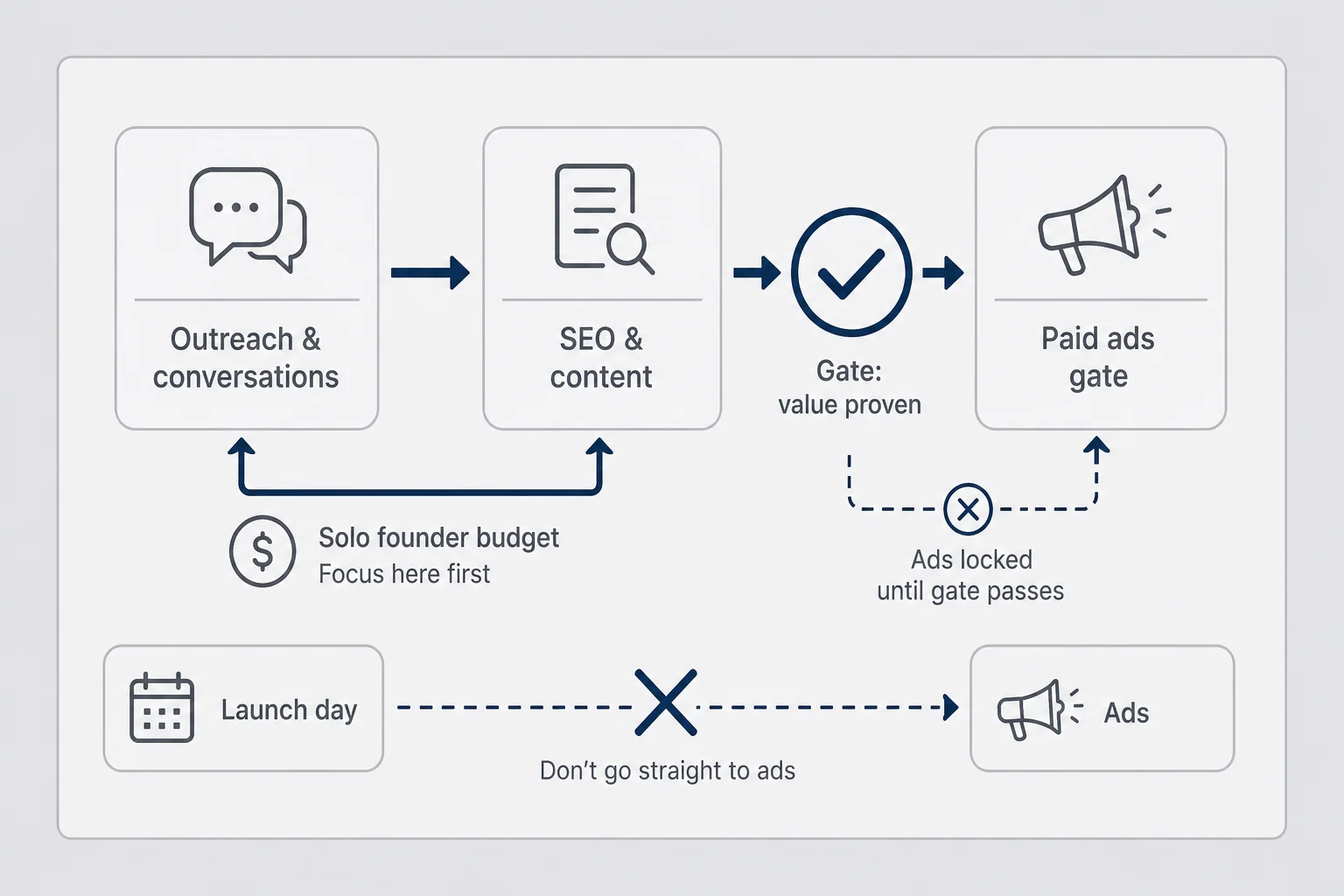
I need to say this plainly because the internet will not. If you have zero paying customers and no idea which sentence makes someone lean forward, do not run ads yet. Talk to humans. Post in communities. Send cold email. Write one SEO article that answers a question your buyer already types. Ads are a megaphone. Megaphones do not help when you have nothing coherent to say.
The founders who win with paid early are rarer than LinkedIn admits. Usually they already sold manually, already know the words buyers use when they are frustrated, already have a landing page that converts warm traffic. Paid finds more of those people. It does not invent demand.
I once watched a solo founder spend $800 on Meta before he had talked to five customers. The creative was polished. The hook was vague. "Save time on workflows." The landing page listed features like a spec sheet. Cost per click looked fine. Trials were empty. He blamed the algorithm. The algorithm was fine. The offer was fog.
Warm channels teach you faster at small scale. A reply on Reddit costs time, not cash. A sales call costs ego, not budget. SEO costs a weekend, not a credit card bill. Each one returns language you can paste into ad copy later. Skip that homework and you are paying rent on Google's classroom.
That does not mean wait forever. It means earn the right to test. Ten paying customers from non-ad channels is a reasonable bar for many micro-SaaS products. Not a law. A bar. If you cannot convert people who already kind of trust you, strangers will be brutal.
I think about readiness as a short checklist. Do you know which sentence makes a buyer lean forward? Does warm traffic convert at a rate you can name, even if the number is ugly? Can you point to three real customers who would buy again? Is support load stable enough that ten new users will not drown you? If two of those are no, ads are premature.
Organic channels also give you negative keywords for free. Customer calls surface phrases that convert. Community threads show which pains are real. SEO teaches which questions get typed. Ads work best when they import that homework instead of replacing it.
The exception I actually believe
Sometimes search intent is so sharp that ads are the fastest honest test. If people are already Googling "export Shopify refunds to CSV" and your tool does exactly that, a small search campaign can be validation and distribution at once. Even then, keep the budget at $100 until profit math repeats.
High-intent search is the exception. Brand awareness campaigns for an unknown solo founder are the rule you should avoid.
Ads amplify, they do not fix
Broken onboarding is a marketing problem. Confusing pricing is a marketing problem. A landing page that explains features instead of outcomes is a marketing problem. Paying to send more people into that mess is not bold. It is expensive denial.
Fix the bucket or accept that ads will pour water on the floor. I have no patience for "we'll optimize later" when later means refunds.
What profitable actually means before you touch a budget
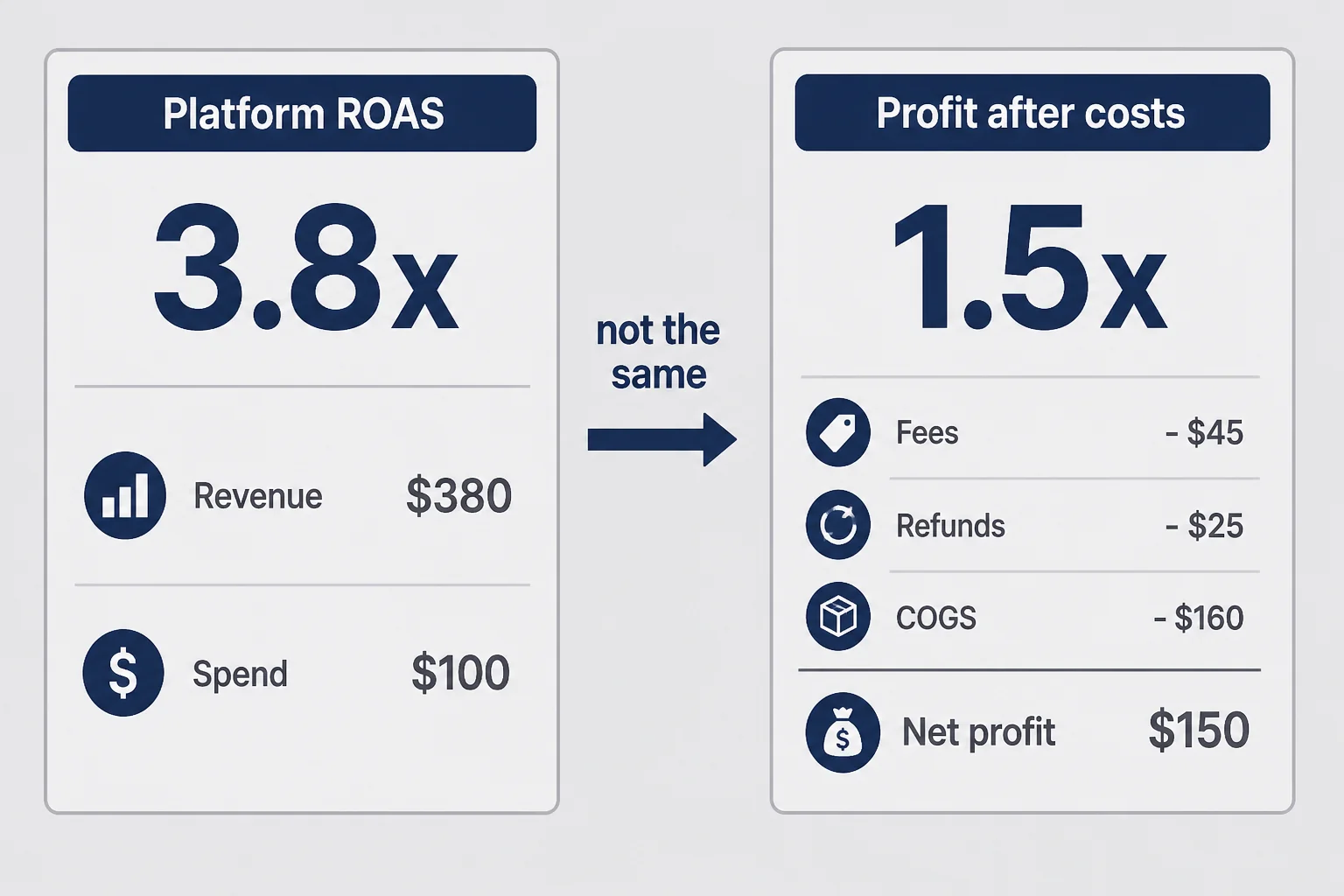
Profitable sounds obvious until you open three dashboards that disagree.
The ad platform shows ROAS based on conversion value you told it to count. Stripe shows cash. Your spreadsheet should show what you keep after the costs that actually scale with customers. Payment processing. Refunds. Support time if it is heavy. API costs if usage matters. Taxes if you are prudent. The ad platform will not subtract those for you. It is not being malicious. It is being an ad platform.
I use a ugly word on purpose: contribution margin. For each new customer in your test window, what is left after variable costs? If you sell $49/month software with negligible marginal cost, contribution margin might be close to revenue. If you resell API calls or pay per seat for infrastructure, margin is thinner and ads need a higher bar.
Gross ROAS is revenue divided by ad spend. Profit ROAS is what you keep divided by ad spend. Solo founders should live in profit ROAS once real money moves. Gross ROAS is a directional hint, not a green light.
Say your test spends $100 and generates $250 in cash. Payment fees take roughly $8. One refund costs $49. Contribution margin on the rest might be around $193. Profit ROAS is 1.93x on spend. That is a pass for many bootstrap products if payback is fast. If the same $250 was one annual plan that refunds in week three, you do not have a pass. You have a mirage.
MRR is a lagging cheerleader
Monthly recurring revenue smooths reality. Ads hit cash and behavior first. A trial signup is not profit. An annual prepay is profit with a refund risk attached. Watch both. I like a simple test window: fourteen days from first click to cash counted, refunds subtracted at the end of the window.
Your analytics setup does not need to be fancy. You need UTM tags on ad URLs, a note in Stripe about which charges came from the test, and honesty about refunds. PostHog can tell you if trials activated. Stripe tells you if money stayed.
Pricing changes the ad math more than creative does
A $19 plan and a $49 plan are different ad businesses. Lower price can mean higher conversion and worse payback if support load is real. Higher price can mean fewer clicks convert but each conversion clears margin faster. If you are still guessing price, run pricing experiments before you scale spend. Ads punish fuzzy offers.
I have seen founders double ad efficiency by changing the headline and the plan on the same page. Same traffic. Different sentence. Different threshold for "yes."
Stripe exports beat dashboard feelings
Once a week during a test, export charges and refunds. Filter by date and, if you tagged metadata, by campaign. Sum gross, sum fees, sum refunds. That number is your profit numerator before ad spend. Boring. Correct.
If you cannot tag in Stripe yet, use UTMs in your analytics and match signup timestamps manually for fourteen days. Annoying at ten customers. Still doable. Guessing is not doable once spend rises.
Annual plans need a separate line in your notebook
Annual prepay from cold traffic is not wrong. It is a different bet. Write plan mix beside every test result. If one $490 annual sale turns a failed week into a pass, you need to know that before you scale. Some products thrive on annual cash upfront. Some manufacture refund weeks. Your notebook tells you which story you are in.
The $100 profit loop: spend, measure, decide
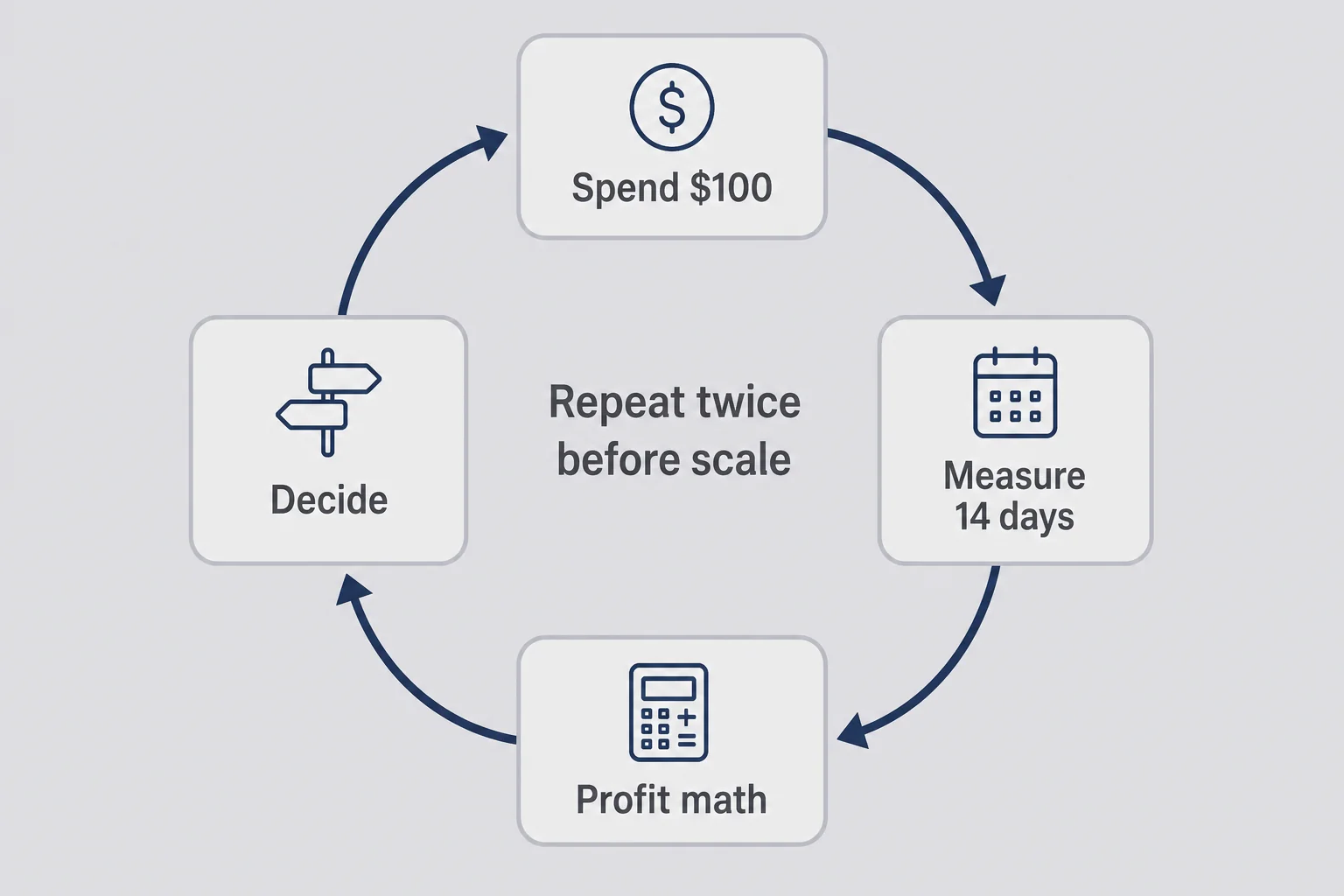
Think of paid ads as a loop, not a lever you yank once.
Spend a fixed test budget. Measure profit in a fixed window. Decide: repeat, fix, or kill. That is the entire operating system until you have two consecutive passes.
Spend. Cap it. $100 is the default I recommend. Pick one network. Pick one landing page. Pick one offer. No audience safari. You are testing economics, not discovering every targeting trick in the interface.
Measure. Start the clock when the first ad dollar leaves. End fourteen days later. Count cash collected from attributed traffic minus refunds and variable costs. Ignore trials that have not paid. Ignore "pipeline." Cash.
Decide. If profit is positive and not carried by one outlier, schedule a repeat test with the same setup. If profit is negative, change one variable. Not five. One. Headline, price, keyword set, or landing page above the fold. Run another $100. If two thoughtful iterations fail, kill or pause the channel for a quarter.
Repeat is the part people skip. They pass once and 5x budget by Friday. I get the urge. Revenue feels close. Discipline feels slow. Slow is how solo founders keep their apartments.
A concrete loop example
Week one: $100 on Google search for three exact-match phrases you heard on customer calls. Landing page headline mirrors those phrases. Result: $88 gross revenue, $12 in fees, negative profit. Decision: change headline and proof block, not keywords yet.
Week two: same spend, new headline, one testimonial with numbers. Result: $240 gross, $18 fees, one refund $49, profit about $73. Decision: repeat unchanged.
Week three: repeat. Result: $210 gross, similar fees, profit about $65. Decision: pass gates, plan modest scale step.
That story is illustrative, not a promise. The shape matters more than the numbers. One variable per loop. Two passes before scale.
Between loops, resist platform busywork. New audiences, bid strategy essays, and attribution settings are seductive because they feel like expertise. At $100 scale they are usually procrastination. Change the message or the offer first. Platforms reward clarity more than tinkering.
If loop two fails after a headline fix, consider keyword intent before you touch bids. Search terms reports are customer language written by people who do not know you. Mine them. Kill junk queries. Add negatives. That single habit saves more money than any guru bid script.
Write the rules before you spend
Decide your pass/fail thresholds on paper before ads go live. Example: profit ROAS at least 1.5x on $100 spend, at least three paying customers, no single customer over 60% of revenue. Written rules prevent Sunday night rationalization.
Annual plans distort small tests
One annual signup can make a $100 test look like a lottery win. Note plan mix in your spreadsheet. If profit depends on annual prepay from cold traffic, require two tests where annual is not more than half of cash collected.
ROAS gates that keep solo founders from lighting money on fire
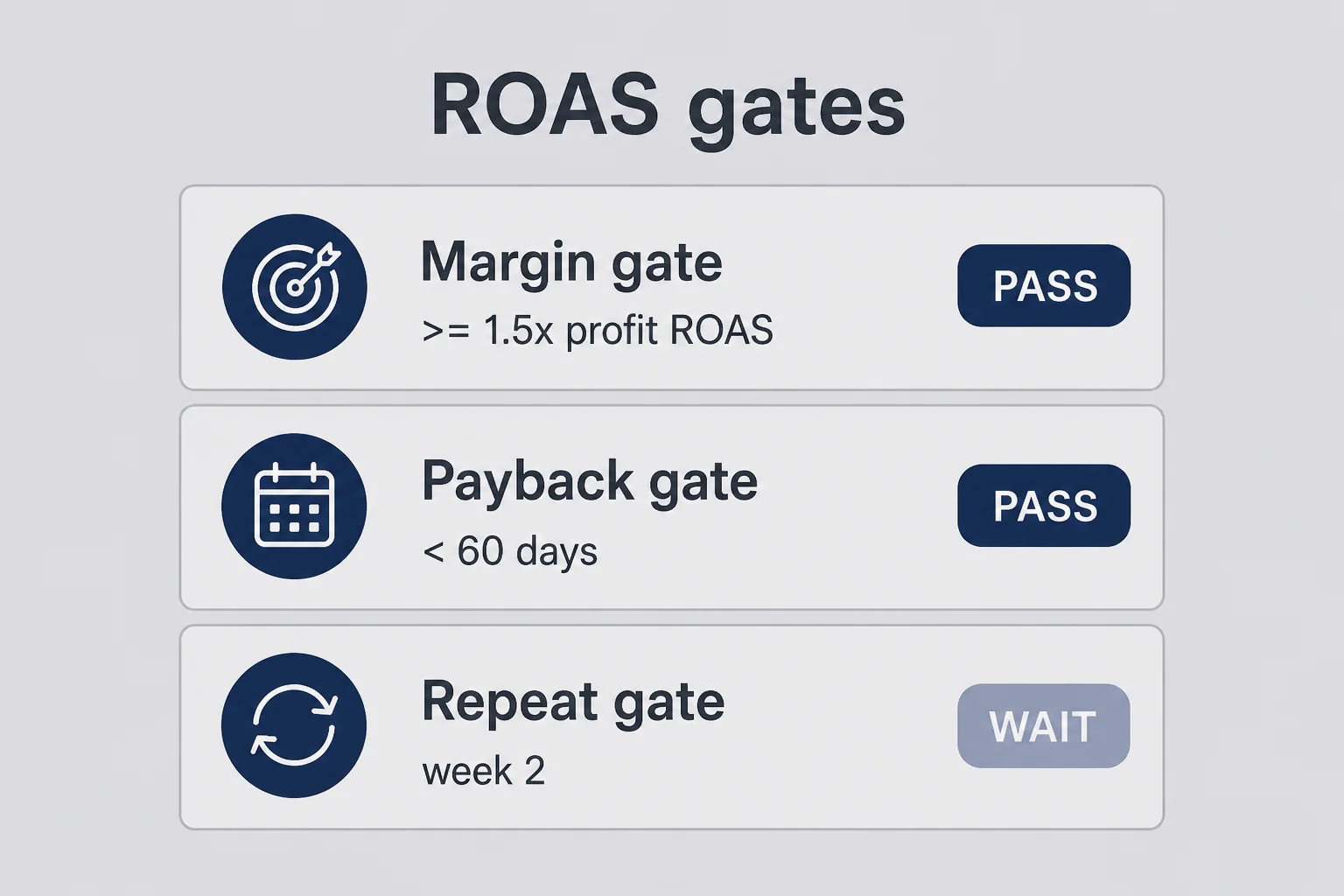
ROAS gates sound corporate. For a solo founder they are just pre-commitments that stop you from scaling a feeling.
Gate 1: Margin. Profit after variable costs must clear ad spend in the test window with room left over. I like 1.5x profit ROAS as a starting bar for low marginal cost SaaS. Thinner margin products need higher. If you do not know your margin, you do not have a gate yet. You have hope.
Gate 2: Payback. How fast does profit from a customer cover what you spent to acquire them? Solo founders should think in days they can float on a card, not LTV fantasies. Under sixty days to payback on the test cohort is a reasonable starting point for subscription tools under $100/month. Longer payback can work if you have cash reserves. Most solo founders do not.
Gate 3: Repeat. Two consecutive test windows pass gates one and two without a single customer carrying most of the result. Repeatability beats heroics. If week two only works because you changed everything, you are still searching.
Fail any gate twice with honest fixes between attempts? Pause. Not forever. Pausing is not moral failure. It is risk management.
Between tests, talk to two customers who came from ads if you got any. Ask what almost stopped them from paying. That sentence belongs in your next headline. Ads buy traffic. Interviews buy language. Use both.
Platform ROAS is input, not output
Google and Meta will show ROAS if you feed them conversion values. Useful for comparing ads to each other inside the platform. Dangerous as your north star. Platform ROAS ignores refunds, ignores annual distortion, ignores customers who never activate.
Track platform ROAS for creative decisions. Track profit ROAS for budget decisions. Mixing them is how founders post screenshots that age badly.
When to bend a gate
Gates bend when you know why. Entering a crowded category and buying learning data might justify one failed month if you cap total loss. Rebranding with new positioning might reset tests. Bending because you are bored is not a reason.
Write the exception before you spend, same as pass rules.
A gate cheat sheet you can steal
Margin gate: profit after variable costs divided by ad spend is at least 1.5 in the test window. Payback gate: days until profit from the cohort covers ad spend is under sixty. Repeat gate: two back-to-back tests pass without one customer being most of the cash. Customize the numbers for your price and float. Write them down. Stick them on the monitor.
When a founder tells me they "feel good" about ads but cannot recite their gates, I know what comes next. A scale-up, a soft month, and a panicked thread about algorithms. Gates are boring until they save you.
Pick one ad channel and one landing page
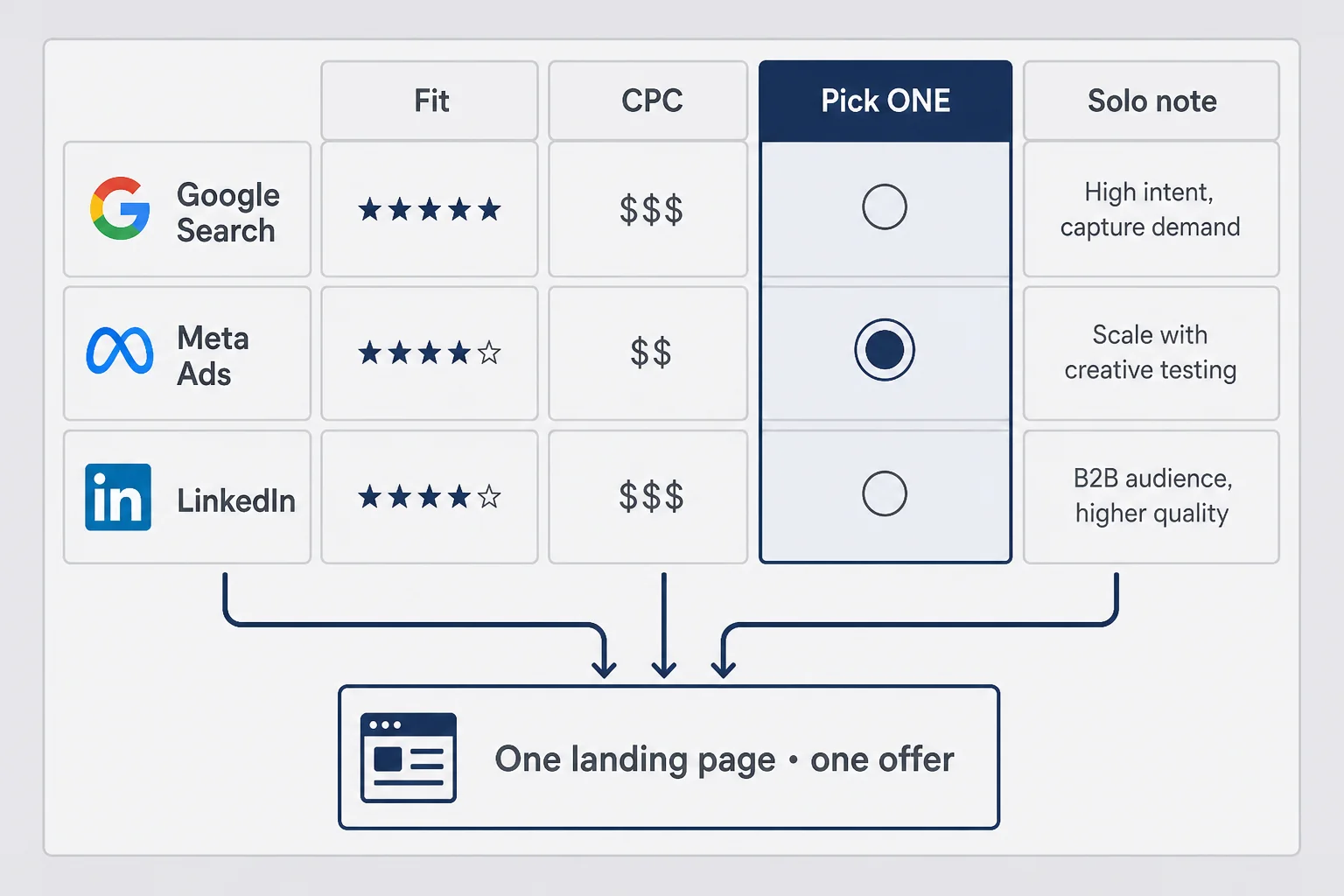
Channel sprawl is how $300 disappears with no lesson.
Google Search fits problem-aware buyers typing specific pains. Start with exact and phrase match on language from customer calls. Avoid broad match until you have conversion data worth feeding the algorithm.
Meta (Facebook/Instagram) fits visual products, founder-adjacent audiences, and retargeting once you have site traffic. Cold prospecting on Meta with a vague promise burns fast. Creative matters more here. Still one offer.
LinkedIn fits expensive B2B with clear job titles and painful workflows. CPCs hurt. Only worth it when contract value supports the math.
Pick one for the $100 test. Send every click to one URL. No homepage roulette. No "learn more" without a next step. The page should match the ad promise in the first screen. Outcome headline. One primary CTA. Pricing visible or one click away.
Retargeting is a second campaign, not day one. You need volume to retarget. Solo sites rarely have it at launch.
Landing page discipline
If SEO traffic converts and ad traffic does not, compare messages. Ads often fail because the page was written for people who already know you. Cold traffic needs sharper pain and faster proof. Borrow language from SEO articles that already earn clicks. Do not send ad traffic to a blog post without a CTA path unless you are testing content funnels on purpose.
I keep ad landing pages boring on purpose. One problem. One proof block. One price. Boring converts when clarity is the bottleneck.
Tracking that survives reality
Use UTM parameters on every ad URL. utm_source, utm_medium, utm_campaign at minimum. Match campaign names to notebook labels so future-you remembers what changed.
In Stripe, tag metadata on checkout if you can. At small scale, a weekly export and a highlighter works. Fancy stacks come later.
Match ad promise to landing fold. If the ad says "fix CSV exports in one click," the first screen should mention CSV exports, not your company origin story. Founders love origin stories. Cold traffic does not read that far.
Test mobile and desktop lightly. At $100 you will not get statistical confidence on device splits. Still worth noticing if mobile bounce is wild while desktop converts. Sometimes the fix is a simpler mobile headline, not a new campaign.
What to run when your budget is smaller than a team lunch
You are not building a full funnel studio. You are running a lab.
For Google, three to ten keywords, two ad variants, one landing page. Ads mirror the keyword in the headline when possible. Negative keywords after week one if you see junk queries in the search terms report. That report is free education. Read it like customer interviews written by strangers.
For Meta, one campaign, one ad set, two creatives maximum. Static image or simple screen recording beats polished brand film at $100 scale. Founder face optional. Specific pain mandatory.
Keep geographic targeting wide enough for data unless your product only serves one country for legal reasons. Keep device targeting default until you have reason not to.
Schedule ads to run evenly across the test window if the platform allows. Do not blow $100 in six hours on a misconfigured daily cap. I have done that. It is a humbling notification.
Creative is copy first
At micro budgets, creative is mostly words. Headline. First line. CTA. Screen recording with a mouse clicking the actual fix beats abstract value props.
Change creative one element at a time between loops. New headline, same visual. Same headline, new proof quote. Document what changed in a notebook. Future you will not remember.
When to add retargeting
After you have a few hundred visitors from organic or the first ad test, a small retargeting campaign can be efficient. Cap it inside the same profit loop. Retargeting is not permission to stalk people who bounced in two seconds. It is a reminder for people who read pricing and left.
Bidding and caps for nervous founders
Manual or max clicks bidding is fine at micro spend. You are not optimizing for algorithm glory yet. Set a daily cap that spreads $100 across fourteen days. Check once a day. Resist the urge to pause ads at 2 a.m. because anxiety spikes. Pause only on rules you wrote sober.
Exclude placements you do not want to learn about. Display network junk on search campaigns. Audience network surprises on Meta if your creative is not built for it. Exclusions are not advanced tactics. They are hygiene.
Reading ad numbers when your sample size is embarrassingly small
Statistics textbooks assume volume solo founders do not have. You still have to decide.
At $100 spend, you might get four clicks or forty depending on niche. Neither is "significant" in academic terms. Both can be useful if you treat them as directional. Four clicks and zero trials tells you something. Forty clicks and two trials at $49 tells you something else.
Watch rates, not just totals. Click-through rate on search ads hints if the promise matches intent. Landing page conversion rate hints if the page delivers. Checkout conversion hints if price or trust is wrong. One broken step stands out even at low volume.
Compare to warm traffic. If email converts at 8% and ads at 0.5%, the gap is message or audience temperature, not "ads don't work."
Use your analytics weekly during a test, not hourly. Hourly checks at this scale are anxiety with extra steps. Write one sentence each Sunday: what moved, what you will change, what you will not touch yet.
Red flags that mean stop, not tweak
Lots of clicks, zero time on page: message mismatch or slow load. Few clicks, high impressions: weak ad copy or wrong audience. Trials but no activation: product onboarding, not ads. Paid customers who refund in days: positioning or annual push, not bid strategy.
The one-number temptation
Pick one primary number for the test window: profit dollars after costs. Secondary numbers inform fixes. Do not let CPC become a hobby. Cheap clicks that do not pay are not a win.
Confidence without fake precision
You will not get statistical significance at $100. Welcome to solo-founder life. You still make decisions with incomplete data every week. The trick is pairing small numbers with tight rules. Fail twice, pause. Pass twice, step up slightly. That is confidence without pretending you are Netflix running lift tests.
When in doubt, compare cohorts qualitatively. Read support tickets from ad users. Did they ask smart questions or did they misunderstand the product entirely? Misunderstanding traffic is expensive traffic even if ROAS looks fine for a moment.
When to scale from hundreds to tens of thousands
Passing a $100 test does not mean you are ready for $30,000 a month.
Scale in steps. Twenty to thirty percent budget increases per week after gates pass twice. Hold creative stable for one step so you know what changed. Watch refund rate and week-one activation as spend rises. Algorithms need conversion volume to optimize. Sudden 10x jumps often reset learning and hide what worked.
Hundreds per month is learning with teeth. Low thousands per month is a real channel if payback holds across a bad week. Tens of thousands per month is a business line, not a side experiment. You need support capacity, onboarding that does not break, and cash to float payback if cycles stretch.
I am not going to pretend every solo founder should hit tens of thousands in ad spend. Many profitable micro-SaaS companies stay in the low thousands monthly forever and live well. Scale is optional when margin is real.
Signs you can step up
Two consecutive months pass profit gates at the current budget. Payback stays under your float limit when you model a 20% worse week. Support tickets stay manageable. Churn in the ad cohort is not worse than organic.
Signs you are stepping up too fast
CAC rises and you keep raising budget because "scale fixes it." Refunds cluster in the ad cohort. You change creative and audience every three days. You cannot explain which keyword or ad produced the last ten customers.
Cash is the silent gate
Payback math must include money you can actually tie up. Tens of thousands in spend with sixty-day payback might need tens of thousands floating. Bootstrap founders sometimes discover they are profitable on paper and illiquid in practice. Plan the float before you heroically increase caps.
What scaling actually feels like
The first time you spend $1,000 in a month on ads that pass gates, it will feel louder than the revenue sounds. That is normal. You are trading certainty for reach. Keep the notebook habit. Weekly profit math, not daily mood checks.
At $5,000 a month you start noticing operational edges. Support replies take longer. Onboarding cracks show up in the ad cohort first because those users did not get your personal welcome email. Fix product before you blame bids.
At $20,000 a month you are running a machine that needs maintenance. Creative fatigue becomes real. Competitors copy hooks. Platforms change attribution. This is still doable solo. It is not passive. If you want passive, SEO and word of mouth are slower and kinder to blood pressure.
I know founders who happily live at $2,000 monthly ad spend with clean payback and no desire to push further. That is a good business. Do not let internet scale culture shame you into tens of thousands if thousands already funds your life.
The mistakes I see at every budget level
At $100, founders split budget across three ad sets and learn nothing. They send traffic to the homepage. They count trials as revenue. They tweak bids daily.
At $1,000, founders scale because platform ROAS looked good on annual plans. They ignore search terms reports. They add retargeting, prospecting, and brand campaigns simultaneously.
At $10,000, founders outsource creative to someone who does not know the customer language. They chase cheap CPC into junk traffic. They stop talking to customers because ads feel like automation.
The through-line is skipping gates. Every budget has a fantasy that replaces repeatability. Fight the fantasy with notebooks and caps.
Another mistake: optimizing ads before positioning is sharp. If ten cold visitors cannot explain what you do, a thousand will not save you. Positioning work is cheaper than ads. Do it once, then buy traffic.
Founders also hide behind "learning." Learning has a bill. Cap it. Date it. End it.
Agency temptation
Around $3,000 monthly spend, someone will DM you offering to "scale your ROAS." Some agencies are great. Many are fine at spend levels where you already have a machine. At solo-founder scale they often cost more than they return because the account is too small to deserve real attention. Learn the loop yourself first. Hire when repetition hurts and margins survive a bad week.
If you hire later, give them your gates and your notebook language. Agencies optimize what you measure. Measure profit.
Where ads fit next to SEO and outreach
Paid is rent. SEO is equity. Outreach is proof.
SEO compounds slowly and rewards articles that sound like a human helped someone. Ads buy speed once you know which phrase converts. I like SEO first for founders who can write one excellent post. I like ads first when search intent is urgent and the offer is already proven manually.
Outreach and community teach language faster than any keyword tool. Paste that language into ads. Do not let ads replace conversations until conversations stop teaching you new words.
The broader marketing rhythm still applies: one primary channel depth, warm before cold where possible, measure revenue not applause. Ads are one channel, not the whole system.
Some weeks ads win. Some weeks a single Reddit reply wins. Portfolio thinking without portfolio budget is how solo founders go broke. Pick an order. Stick to it long enough to learn.
A sane sequence for most solo founders
Month one: conversations and one warm channel until ten paying customers. Month two: one SEO article or one community habit that compounds. Month three: $100 ad test with gates written down. Month four: repeat or fix, still not scale. Month five and beyond: modest scale steps only if gates held.
Your calendar will differ. The principle does not. Earn language before you rent reach.
I run ads on some projects and ignore them on others. Channel fit is real. A B2B export tool and a consumer habit app do not share the same playbook. The profit loop is shared. Spend small. Count honestly. Decide without drama.
Questions founders actually ask about paid ads
How much should a solo founder spend on ads to start?
One hundred dollars is enough for a first test if you send traffic to one focused landing page and measure profit inside a two-week window. You are not buying scale yet. You are buying a yes or no on whether strangers will pay more than the ad costs you. Bigger budgets before that answer just make the mistake more expensive.
What ROAS do I need before scaling paid ads?
Platform ROAS is a starting point, not the finish line. You want profit after ad spend, payment fees, refunds, and any per-customer costs in the same window you measured. For many micro-SaaS products at solo-founder scale, that means roughly 1.5x profit ROAS on a small test before you raise budget. If you need a miracle week to hit the number, you do not have a channel yet.
Google Ads or Meta for a micro-SaaS?
Pick the network where your buyer already searches or scrolls with intent. B2B tools with problem-aware search often start on Google. Visual products, founder audiences, and retargeting-heavy plays often start on Meta. One channel, one landing page, one offer. Splitting a tiny budget across both teaches you almost nothing.
When should I stop running paid ads?
Stop when two clean test windows fail your profit gates, when payback stretches past what you can float, or when refunds and churn eat the margin within sixty days. Also stop if you have not fixed onboarding or pricing. Ads amplify what already converts. They do not fix a leaky bucket.
Can profitable ads work without organic traffic first?
Sometimes, if your offer is sharp and your landing page converts cold traffic. Usually it is easier after you have talked to ten customers and know the words they use when they are annoyed. Organic and outreach teach you the message. Paid buys reach once the message is not a guess.
How do I scale from hundreds to tens of thousands in ad spend?
Raise budget in steps of twenty to thirty percent after two consecutive weeks pass your gates with stable payback. Duplicate what worked instead of reinventing creative every Monday. Watch refund rate and activation, not just cost per click. The jump to serious spend only makes sense when unit economics survive a bad week, not only a lucky one.
The megaphone only helps if the words are true
I still run small ad tests on projects where the economics make sense. I still kill them quickly when profit math says no. That rhythm took years to internalize. The founders who last treat ads like a contract with themselves: fixed spend, fixed window, honest math, explicit gates.
You do not need permission from a growth guru to spend $100. You need a landing page that tells the truth, a price that survives refunds, and the discipline to run the loop twice before you touch the scale slider.
If your next test passes, raise budget a little and watch whether the pass was real. If it fails, you bought an answer cheap. Both outcomes beat a screenshot that looked good until someone asked about profit.
Spend $100. Count what you keep. Then decide. Everything else is commentary.
The founders who treat ads like this sleep better. They know the difference between a channel that pays and a dashboard that flatters. They scale when the math repeats, not when the timeline applauds. That is the whole job. Boring, profitable, repeatable. I will take boring every time.



Comments