How to Market a Micro-SaaS When You Are the Only Employee
Marketing for solo founders running a Micro-SaaS: practical growth tactics that fit a one-person budget, one calendar, and limited attention.
 By Max19 min read
Listen to this article
22:46AI-generated podcast-style overview of this article (not a word-for-word narration).
Most founders who come to me with a finished Micro-SaaS have one thing in common. They treated marketing like it begins on launch day. That is convenient. Launch day is concrete. Conversations with real strangers are uncomfortable.
I have launched a few Micro-SaaS products that made money, and several that did not. The difference was rarely the stack or the checkout page. Mostly it was whether someone had heard of the problem before I sent them to pricing. This guide gives you a marketing rhythm that fits a one-person team: where to spend attention, where to spend nothing, and what to measure when attention is your scarcest resource.
If you already know you need a broader business foundation first, the earlier guide on how to build a micro-SaaS with AI covers validation, stack choices, and the build itself. If you are still shaping demand, read validate before you build first. If you already have a product, how to launch a micro-SaaS covers the quiet launch sequence before any public launch moment.
The hardest part of micro-SaaS marketing for solo founders is admitting you are the marketing department
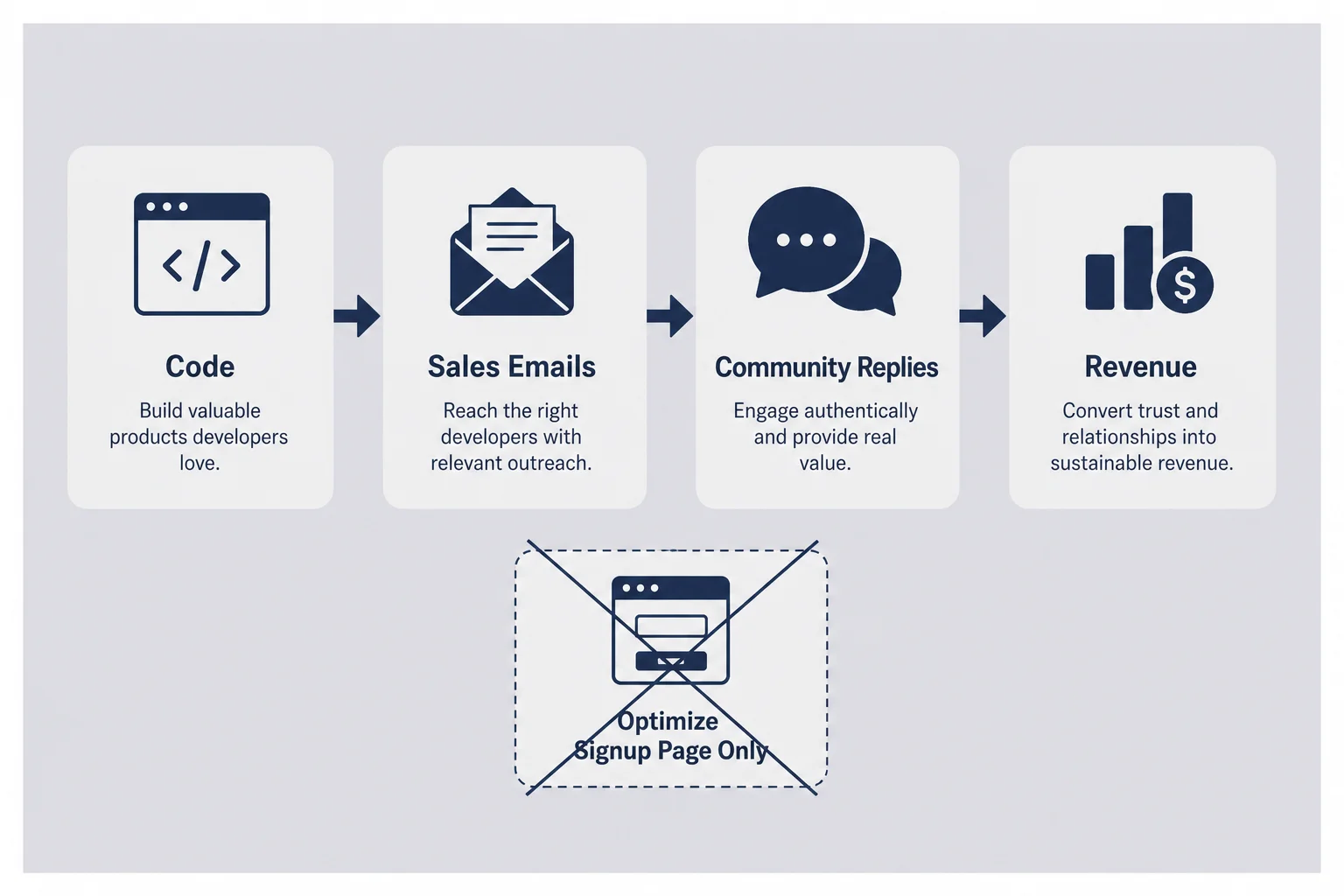
I once spent three weeks optimizing a signup page nobody was finding. The form converted well. The traffic problem was entirely upstream. I learned later that the weeks would have been better spent writing one outreach email, joining one community, or fixing one onboarding email that confused real users.
Coding feels like progress. Replying to a personal email about your unfinished product feels like asking for money. Most founders delay that moment until launch week. That delay is why so many launches feel like someone sealed a room and then posted a sign outside.
The shift I needed was simple. I stopped thinking of marketing as a later department and started treating it like one more thing I had to ship. Code ships. Sales emails ship. Community replies ship. Some of them work. Some need to be cut. That is the normal product rhythm, and it belongs in a Micro-SaaS from day one.
I am not saying you must become a talking-head marketer. I am saying you cannot leave growth outside the door while you build the product. The earlier you accept that, the less you fight against reality.
The difference between marketing and pretending
Not everything that looks like marketing is marketing. Twitter threads with generic advice, LinkedIn comments on viral posts, and daily "progress" updates often benefit the builder's ego more than the product's revenue. They create the emotional feeling of being visible without the harder work of turning visibility into a buying decision.
Real marketing has a different smell. You send one useful message to one person with a clear problem. The reply rate tells you whether the signal was real. You write one article that answers one specific question. Search traffic tells you whether someone was actively looking for that answer. You ship one small public thing. Signups tell you whether people actually want it.
That process is not glamorous. It is also far more honest than generating follower counts while revenue stays flat. If your "marketing" cannot be traced to a revenue event, it is probably noise dressed up like progress. That does not mean content is useless. It means content without intent is mostly comfort food for founders.
Pick a channel you can stick with, not the one everyone is talking about
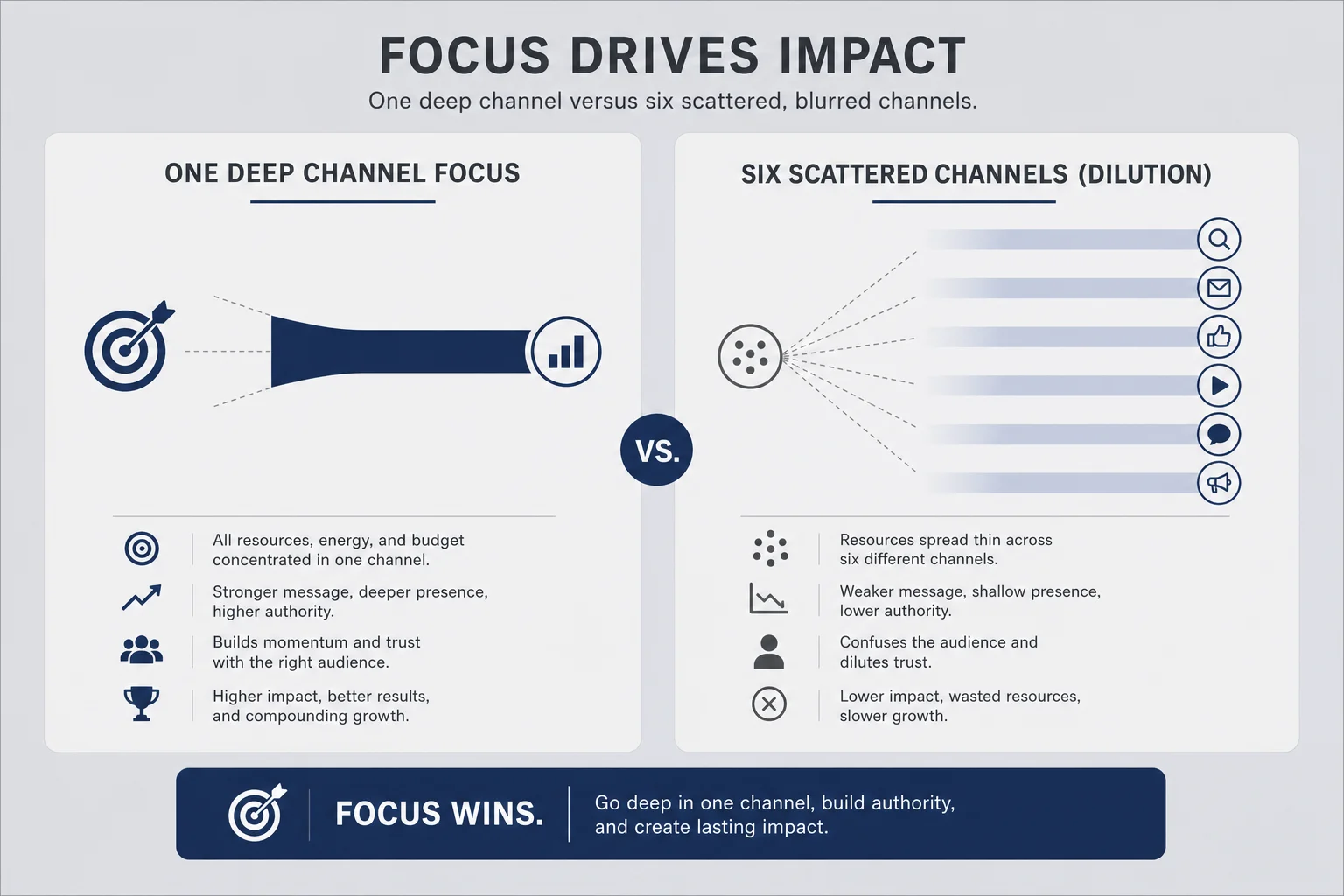
When a founder asks me which channel to use, my first answer is another question. What could you do twelve times next month without hating it? Not which channel is highest potential. Which one is not a burden.
Why I ignore most growth advice
Most growth advice is written by teams with money, separate roles, or both. It works for them because they can run seven experiments in parallel. A solo founder running a Micro-SaaS does not have that option. You have one brain, one calendar, and a support ticket queue that can grow while you sleep.
That means volume-based advice fails almost instantly. You cannot email five hundred people cold every morning. You cannot run five paid campaigns and optimize them weekly. You cannot publish three blog posts a week while staying inside the product work that keeps the business actually working.
When I read growth advice now, my filter is not whether it works but whether it respects my constraints. If the method assumes an engineering manager and a junior marketer already exist, I stop reading. I am looking for something one person can do alone. The good ideas are quietly boring. They look like "write one useful thing per week" and "answer every support email personally for the first month."
I once spent a week reading launch strategies, then realized I had not sent a single outreach email in that same week. That was the moment I stopped chasing growth frameworks and started sending messages instead.
The one-channel rule for the first year
Pick one channel and stay there until it either works or teaches you something. Your first channel does not need to be permanent. It needs to be learnable.
If you choose email, go deep. Build a small list of people who already know your problem. If you choose communities, become a regular responder before you ever mention your product. If you choose content, pick one narrow audience and one common search phrase. The channel matters less than the depth of practice.
Most founders I have worked with quit too early. Two weeks of outreach with no first customer is not a failed channel. It is a failed opening. Real channels teach you formats, tones, and what buyers actually type into search bars. Treat your first channel like a research project, not a lead-gen lever.
If you iterated on one approach for six weeks and still got no replies, you should switch. If you tried six approaches for one week each, you have no data. That distinction changes everything.
Warm beats cold, and nobody wants to admit that
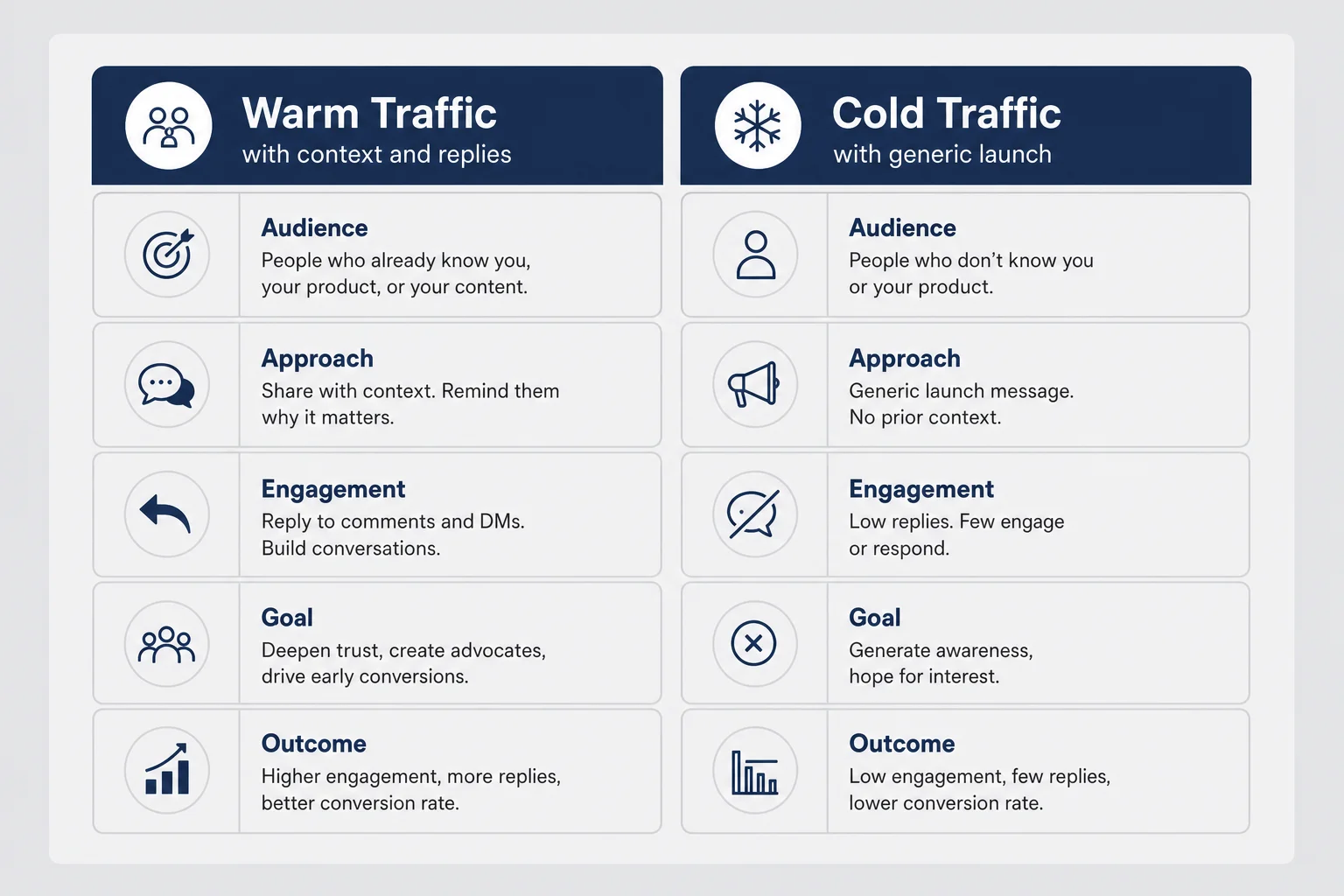
For high-ticket enterprise software, cold outbound can work because the pain is often obvious and the deal size justifies longer persuasion.
Most Micro-SaaS problems are not like that. Most are small irritations people have already worked around. Cold outreach asks someone to change behavior before they felt enough pain to seek a fix. That is a difficult sale.
Why strangers do not care about your launch
Your launch is not news to most of your market. They have their own products, their own customers, their own bugs. A generic "I built something you might like" message has no reason to cut through that.
The counterintuitive truth is that warm outreach is not always relationship outreach. Warm simply means context. You are replying to a thread someone started. You are responding to a question they asked publicly. You are introducing yourself after someone mentioned the exact pain you solve. That message does not feel like spam because it acknowledges their actual context. People answer those messages far more often than cold intros.
You can manufacture warmth from a small amount of public research. Read the complaints in a Reddit thread. Read the questions in a Discord help channel. Quote the exact language back in your reply. Suddenly you are the person who understood their problem instead of the person who had a thing to sell.
How to find people already looking for what you built
Search is the most honest demand signal you can get. If someone is typing phrases that match your solution, that person is already in the market. They do not need convincing that the problem is real. They need convincing that your approach is the right one.
Forums, support communities, Reddit search, YouTube comments, LinkedIn posts, and even forgotten Hacker News threads let you watch your buyers describe their own problem in unstructured language. Listen for the exact words they choose. Then write your outreach, your content, and even your landing page copy using those same words. That alignment removes the hardest part of marketing: proving you belong in their world. If Reddit is going to be a real weekly channel, set the lurk-and-reply quota in the Reddit outreach planner before you spray five subs on launch day.
I do not mean keyword research in the SEO sense. I mean watching how a specific human being describes frustration naturally. That dialect is the one your message should speak fluently. Small differences in vocabulary can change response rate from two percent to twelve percent. I have seen it happen.
Show up where your users already are
Communities often look like a shortcut. Join ten spaces, drop a link, get traffic. In practice, communities reward trust, not transactions. A single reference from someone recognized as helpful is worth more than fifty links from an unknown account.
Communities that work versus communities that waste time
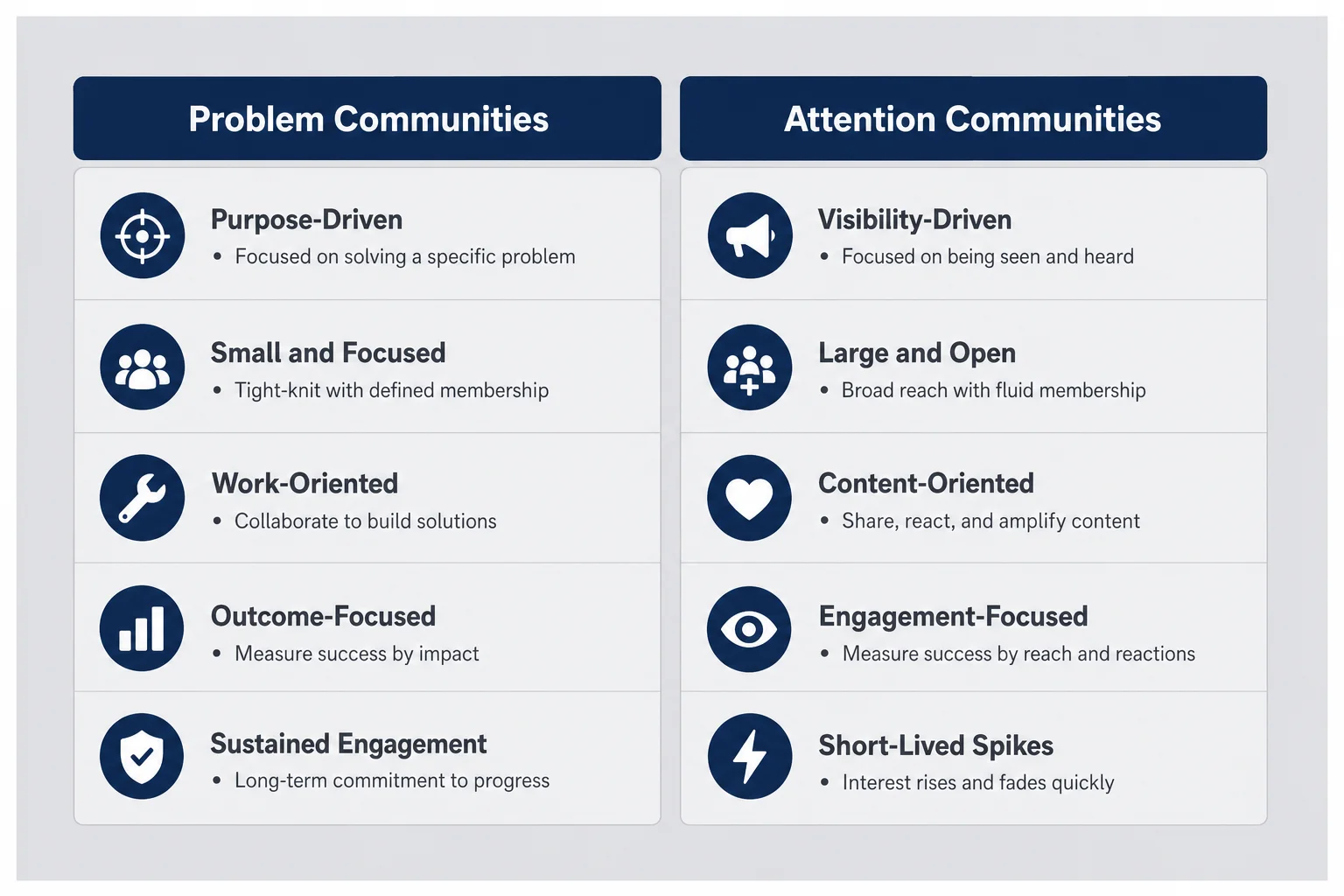
I separate communities into two kinds. Problem communities and attention communities.
Problem communities discuss actual work. Marketing automation, PostgreSQL tuning, invoice workflows, online course platforms, devops dashboards. Their members are already buyers or operators. If your product sits inside one of those conversations, regular participation is worth hours a week.
Attention communities treat participation as its own economy. Posting advice becomes the product. Real problems become content. Those communities are fun, but they rarely convert into buyers for a narrow developer tool. Use them for learning, not for distribution.
Here is the test I use now. Search the community for the exact name of the problem you solve. Is the conversation active? Do people swap workarounds, or do they just exchange opinions? Active problem conversations are worth joining. Opinion conversations are worth watching rarely.
How to mention your product without becoming spam
I follow a personal rule. Do not mention your product until you have answered two questions or helped two people without asking for anything. That sequence does three good things. It proves you understand the problem. It establishes reputation instead of imposing it. It gives people a reason to read your later messages instead of marking them as noise.
When you finally mention your product, describe it inside a solved example. "I was fixing the same CSV problem last month and ended up building a small importer that gives me Stripe-ready output. I am testing it with a handful of operators now if you want to try it." That framing does not scream HUSTLE. It signals shared context and a possible answer.
Write the one article your customers are already searching for
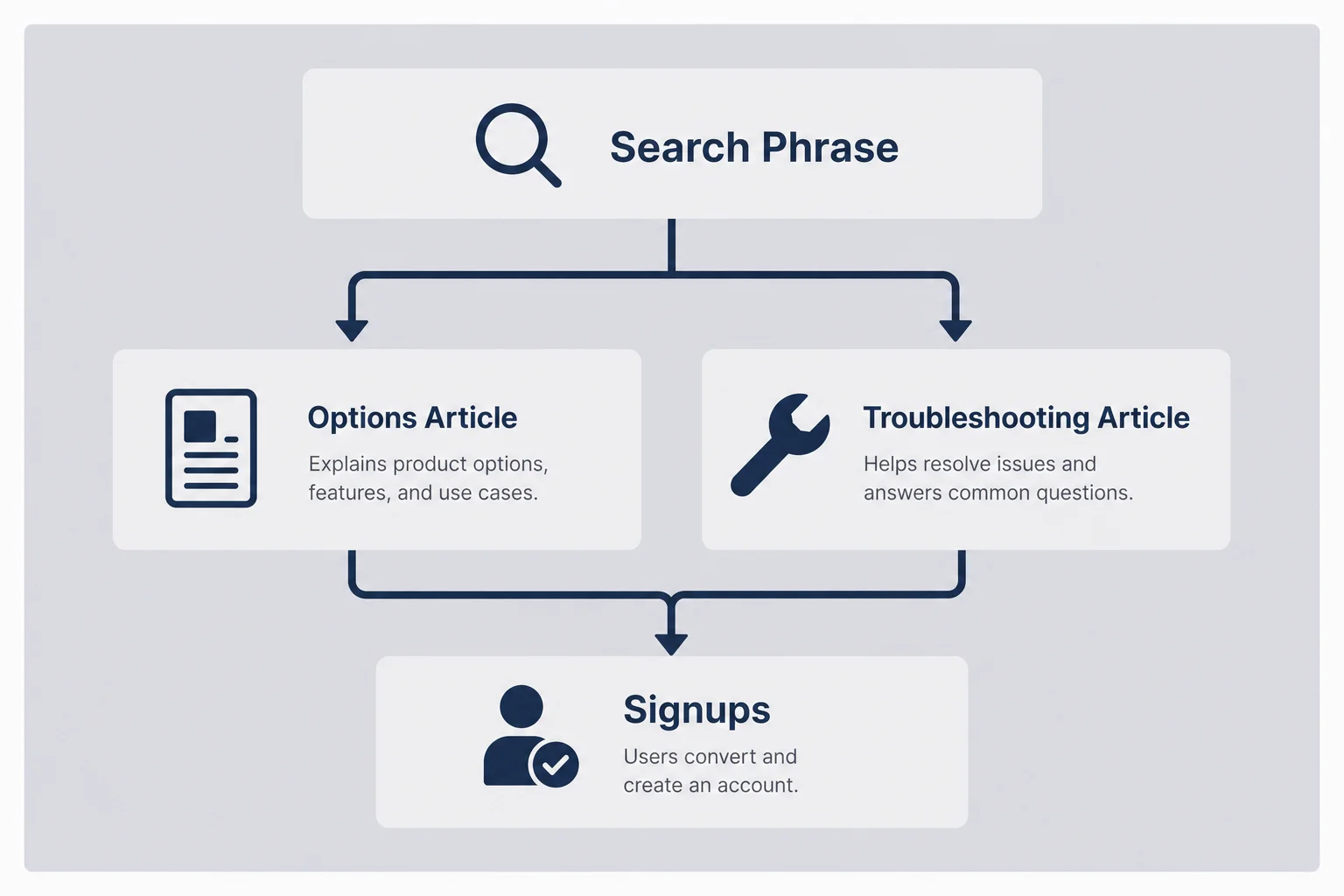
SEO sounds intimidating until you notice that most ranking content is answer-shaped, not essay-shaped.
You do not need to become a blogger. You need to answer one specific question your market is already asking. That article becomes an asset that works while you sleep, recurs without creative effort, and builds trust with readers closer to buying than a Twitter follower ever is. For the full playbook on keyword choice, article structure, and sending search traffic to a page that converts, read micro-SaaS SEO for solo founders.
I used this pattern before I had an audience. I wrote one comparison-style article, linked to it from outreach, and sent enough people to it that search started remembering it was relevant. That pattern has outlasted most of my other experiments.
The SEO approach that does not require being a blogger
Most solo founders overcomplicate SEO because they think blogging means a publishing calendar. It does not. A Micro-SaaS blog can be three to five genuinely useful posts that target problems your users search for before they buy.
The first article I would write for any product is the options article. "X versus Y versus doing it yourself." That format converts because readers are comparing, which means they are close to a buying decision. It also lets you explain why your approach exists without sounding defensive.
After that, write troubleshooting articles. "Why my CSV export keeps failing in Stripe." "How to send invoice reminders without a manual batch job every Friday." Those titles match specific frustration. People search them during the moment of pain.
If you want discipline around this, build a tiny schema of related topics so posts eventually support each other. Even a handful of interconnected articles becomes a small network over time.
How to pick topics that turn into signups
Use one filter before you write. If someone reads the article and never learns about your product, did you still help them? If yes, it is a good topic. If the only way the article makes sense is by teasing the product, that article is advertising with extra steps, not content.
Helpful content builds trust. Advertising content builds ad blindness. The best Micro-SaaS sites convert because readers trust that the writing was not written to manipulate them.
Launch quietly before you launch loudly
A loud launch amplifies what you have already built. If you have no traffic, no email list, and no reputation, a launch date will not fix that. It will just make the silence louder.
The options article that doubled my outreach replies
One of the best marketing investments I made was not a feature, a price cut, or a big launch. It was one comparison-style article that answered the exact question buyers argued about before buying my product.
I wrote an honest "X versus Y" post that explained why each approach fits different goals. Then I linked to it from every related conversation. When people asked, "How does your product compare to X?" I sent the article instead of writing another long explanation. The effect was immediate. Outreach replies increased because readers already had context. Sales calls became introductions instead of tutorials. Product Hunt and other public moments mattered more because the article already existed as a stable reference.
That article was not viral. It just answered one clear question well, and I was consistent about pointing people to it.
I teach the same pattern now. One article, one clear comparison, one place to send people when they ask a logical question. That article will outlast most newsletters, social posts, and tweaks to your homepage copy.
The email that gets replies
The quiet launch is not launch day at all. It is outreach to fifty people who fit your ideal customer profile, sent individually, with a short message that asks for honest feedback rather than purchase.
Here is the message I have used more than once.
"Hi, I have been working on a small tool for people who do X. It does A, B, and C. I am testing it with a handful of operators before opening it up. Would you have twenty minutes this week to try it and tell me what you think?"
That message rarely gets a spam response because it asks for a realistic exchange: your time for their opinion. Many people will say yes. A subset will try it. Some of those will pay, or refer others, or become the first public users.
This step also forces you to refine your offer. Hearing five people describe your product differently than you intended is better than any onboarding copy review.
What Product Hunt and Hacker News are actually good for
Product Hunt works best when you have an audience willing to upvote at the moment of posting. That usually means an existing email list, active community presence, or prior press. Without that preparation, the page dies by afternoon.
Hacker News works for products with clear technical value. If your product makes developers faster, infrastructure cheaper, or cron jobs less frightening, it can perform extremely well starting from cold. If your product solves a business problem an accountant would care about, HN is usually not the right room.
I treat public launches as optional, not required. They are wonderful when the conditions are right. They are a distraction when they become the entire growth plan. Build proof before the public moment, not after it.
Free tools and content that pull people toward you
Most solo founders overestimate the power of "viral" freebies and underestimate the power of small useful things.
A free checklist, template, or mini tool works only when it solves a problem related to your paid offer. Random free downloads with a big opt-in form are reminders that attention is worth something. Give something away only if it makes the buyer's first step feel smaller.
Lead magnets that do not feel like homework
One of my favorite Micro-SaaS patterns is giving away a tiny, useful part of the product itself. If you build invoicing software, release a free invoice template generator. If you build customer support tools, release a free response timer. The giveaway previews value, teaches users the vocabulary of your product, and qualifies leads who already believe in solving the problem your way.
Avoid quizzes, assessments, and multi-step funnels unless you have researched that your market actually prefers them. Most developers and operators I know skip them and go directly to real tools or honest templates.
How a tiny blog becomes a distribution channel
You do not need a huge blog. You need one post that answers the question a buyer asks when they are ready to evaluate. That single post generates repeatable traffic, attracts backlinks from other operators writing about the same problem, and gives you a place to point strangers instead of rewording the same pitch repeatedly.
The blog supports outreach, supports ads, supports launch announcements. It does not need to be the main growth channel. It only needs to be good enough to hold its own in search for one precise topic.
When to spend money on ads, and when to skip them entirely
Paid ads are amplifiers, not discovery tools. If your offer, positioning, and onboarding are not proven yet, ads will accelerate the wrong experiment instead of saving you.
That said, ads eventually become useful for Micro-SaaS. I have seen refined ad campaigns make sense once organic signals, customer interviews, and onboarding data all pointed the same direction. At that point, ads become cheap research because every click becomes a learning event.
The small-budget test I would actually run
Spend fifty to one hundred dollars across a single campaign with a single creative and a single audience. If you cannot turn that spend into a sale or a signup at a cost below what you would pay in one hour of your own time, stop. The product, channel, or market signal is not ready. Throw the data away and go back to outreach or content.
Return to ads only after you have documented what did not work and changed something tangible.
Why most solo founders should wait on paid traffic
Paid traffic works worst for unknown products with unclear positioning. Strangers will not solve your positioning problem faster than your best customers will. If you do not trust the offer enough to spend your own time on outreach first, you are not ready to pay strangers to disagree with you.
Ads also encourage a focus on metrics that feel good. Clicks, impressions, click-through rates. None of those mean revenue. When you are bootstrapping, metrics that do not correlate with revenue are expensive distractions.
The metrics I watch when marketing feels like nothing is working
Marketing fails when it rewards performance that does not convert. It fails personally when it burns out the only person performing it. You need a small set of metrics that survive vanity and still map to business reality.
I track three things.
One, response rate. How many outreach emails or community replies turn into real conversations. If that rate is under five percent for several weeks, your targeting, your message, or your proof is wrong. Fix one variable and test again.
Two, converted visits. What share of visitors becomes trial or paid. If traffic is growing but conversion is flat, the product experience or the messaging is the problem. Marketing more traffic at the same leaky funnel will only make the leak more obvious.
Three, repeat behavior. Are people staying, returning, or renewing? Retention is the final judge of marketing. You can attract attention all day. If the product does not keep people, marketing is rearranging deck chairs on a ship that was never moving.
When nothing feels like it is working, do not add more channels. Look at those three numbers. They are already telling you the story.
Questions I get about marketing a Micro-SaaS
How much time should a solo founder spend on marketing each week?
Ten focused hours is enough for most early Micro-SaaS products. The trick is not the total time but whether it is spent on things that can realistically lead to a conversation or a sale.
What marketing channel should a solo founder start with?
Pick one channel and stay there until it either works or teaches you something. Launching on every platform at once is not marketing, it is distraction with extra tracking.
Can I market a Micro-SaaS without public social media?
Yes. Direct outreach, communities where you already have reputation, useful content, and early email tend to work better for quiet, revenue-first products.
How do I know marketing is working?
When outreach gets replies, when content becomes consistent inbound traffic, or when paid tests turn a dollar in spend into more than a dollar in revenue. Vanity metrics like impressions are not the point.
When should a solo founder spend money on ads?
Only when organic and outreach stops giving you new information, when you already have a clear matched offer, or when your product repeats itself well enough that small spend compounds.
A simple micro-SaaS marketing checklist for solo founders
If your week gets messy, come back to this and run it in order.
- Talk to people in one place where your buyers already ask questions.
- Send a handful of personal outreach messages with clear context.
- Publish one useful SEO article tied to a real buying question.
- Track response rate, converted visits, and repeat behavior.
- Keep what works for six weeks before switching channels.
Marketing is not a separate thing you start later
Most Micro-SaaS founders think they need a finished polished product before any marketing is possible. They are wrong. Marketing is not a launch page and a press release. Marketing is the sequence of small public and private actions that turn strangers into users who keep coming back.
Start before launch. Answer one honest question someone asks publicly. Send one thoughtful message to someone who already complained about the problem. Ship a very small public artifact. That rhythm will teach you more than any launch checklist because it gives you real replies instead of quiet public silence.
Your product will rarely outrun its marketing, but a one-person team can absolutely outrun its doubt. Keep the task small. Keep the audience specific. Keep the metric honest.
The best Micro-SaaS marketing does not look like marketing at all. It looks like someone who understands the problem talking to the person who has it. Embrace that. It is the only growth model a solo founder can afford to run for years.




Comments