
Pricing
Charge More Than Feels Comfortable
How to price a micro-SaaS as a solo founder: one plan, a floor that doesn't embarrass you, when to skip freemium, and the signals that tell you it's time to raise.
27 min read
Free mrr calculator for micro SaaS solo founders. Calculate monthly recurring revenue, ARR, and how many customers you need for $1k, $5k, or $10k MRR — with optional churn modeling.
Monthly Recurring Revenue (MRR) is the total predictable subscription revenue your product generates in a single month. For a micro-SaaS with one plan at $29/month and 50 paying customers, MRR is $1,450.
Solo founders use MRR as the simplest health metric: it compounds when you add customers and erodes when people cancel. Unlike one-time sales, MRR tells you whether the business can pay you consistently next month.
Enter your monthly subscription price and your current number of paying customers. The calculator instantly shows your MRR, ARR, and average revenue per user.
Optionally add your monthly churn rate to see net MRR after cancellations. Use the milestone table to answer the most common pricing question: how many customers do I need to hit $1,000, $5,000, or $10,000 MRR at my current price?
Change any input to model a price increase, a growth target, or a churn scenario. Copy the link to save or share your scenario.
$1,000 MRR is often the first serious milestone — enough to cover hosting, tools, and confirm strangers will pay for your product.
$5,000 MRR is a common solo-founder target: meaningful income without a team, especially when margins are high and costs stay low.
$10,000 MRR puts you in range of full-time founder income in many markets. The customer count required depends almost entirely on your price — charging $99/month instead of $29 cuts the customers needed for $5,000 MRR by nearly two-thirds.
MRR (Monthly Recurring Revenue) is the predictable revenue you earn each month from subscriptions. ARR (Annual Recurring Revenue) is simply MRR multiplied by 12 — use this page as a SaaS ARR calculator alongside the MRR view. Solo founders often track MRR week to week; ARR is useful when comparing to annual salary goals or talking to potential partners.
Divide your target MRR by your monthly price — that is the core math behind any how many customers for 5k MRR scenario. At $29/month you need about 173 paying customers. At $49/month you need about 102. At $99/month you need about 51. The milestone table in the calculator updates automatically as you change your price.
Yes, once you have real data. Early on churn may be noisy, but even a rough estimate (5–10% monthly for a young micro-SaaS) helps you see how many new customers you need just to stay flat. Ignoring churn makes every growth plan look easier than it is.
There is no universal number — it depends on your costs and location. Many solo founders treat $1,000 MRR as proof of demand, $5,000 MRR as meaningful side income, and $10,000+ MRR as a full-time salary replacement in lower cost-of-living areas. Use this solo founder MRR calculator to map your price to the milestone that matches your goal.
How a consumer app founder thinks about subscription MRR, churn, and milestone math — and why the calculator above is not just for B2B SaaS people.
 By Iryna32 min read
Thursday morning. Coffee still too hot. I unlock my phone and open App Store Connect before I open Twitter, which is a habit I developed on purpose and still feel slightly embarrassed about. Not because checking revenue is shameful. Because I used to check Twitter first and tell myself I was "doing marketing" while my actual business sat in a tab I avoided.
The Subscriptions dashboard loads. Active subscriptions. Proceeds. Renewal rate. A number that is not quite MRR because Apple reports net proceeds after their cut, and because annual plans prorate weirdly in your head until you sit down and do the math. I scroll anyway. I want to know if strangers are still paying for Finish Him Replies this week, or if everyone who subscribed during a launch spike quietly decided the app was a one-week novelty.
I am not a SaaS founder in the Reese-and-landing-page sense. I do not have Stripe invoices and a pricing page with three tiers and an annual toggle that took six hours to word correctly. I have a consumer iOS app with a monthly subscription, a yearly option I agonized over in Figma, and a calculator on this page that I keep open in another tab because it translates App Store chaos into the same milestone language every indie builder uses: what is my MRR, what would it take to hit $1,000, $5,000, $10,000.
If you build for the App Store and you have ever felt like MRR talk is for people with dashboards full of MRR charts and not for you, I wrote this for us. The tool above works for micro-SaaS pricing scenarios. It also works when your "customers" are subscribers behind Apple's wall and your "sales team" is your App Store listing plus whatever word of mouth you earn by not being creepy.
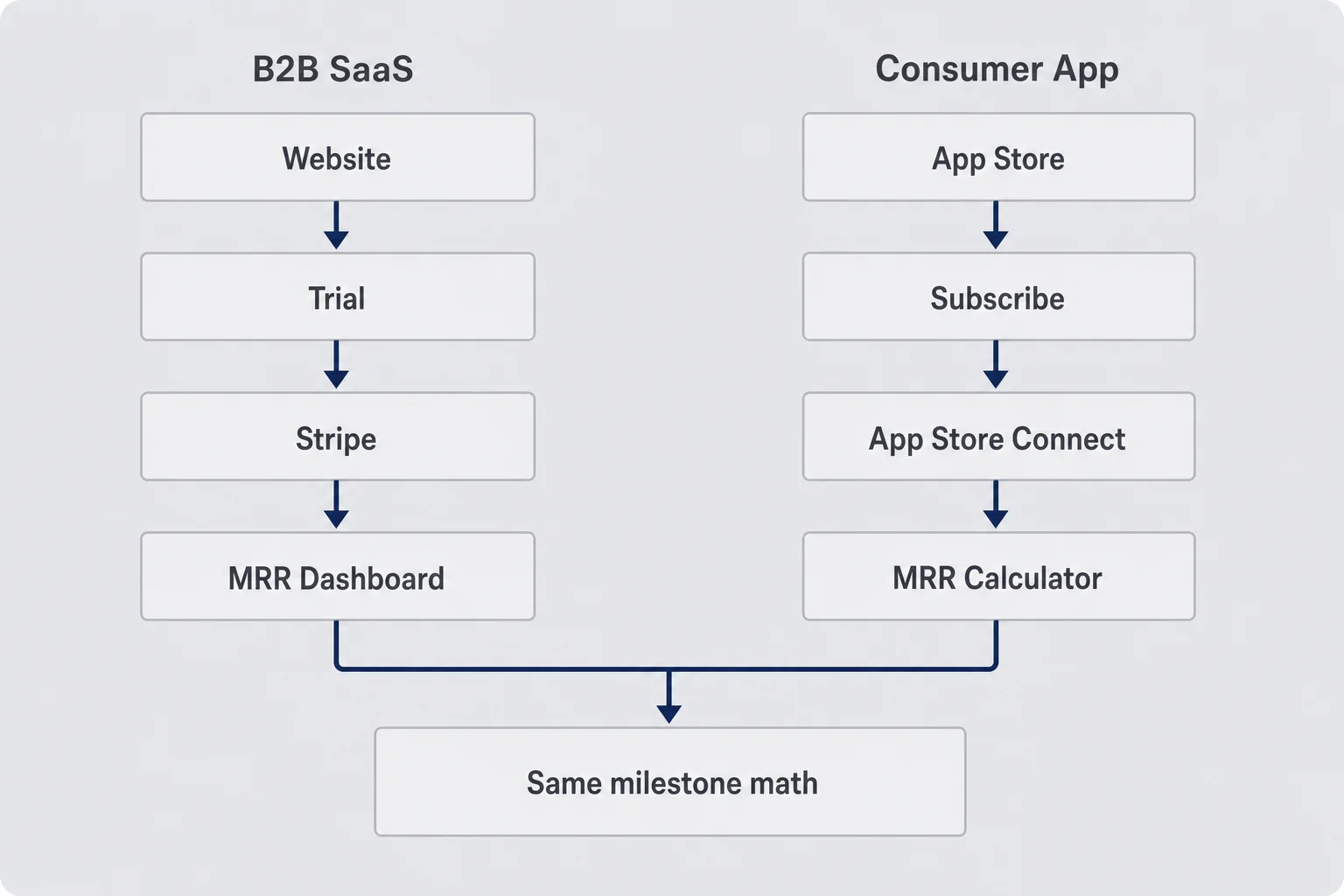
When I first started reading indie founder content, I assumed MRR was a vocabulary word for people who sold project management software to remote teams. The articles assumed you had a website, a free trial, maybe Stripe billing wired up on day one, and a spreadsheet where "customer" meant a company email domain. I had an app that helped you reply to a text without overthinking it. My customers were individuals paying $4.99 a month because they did not want to stare at a blinking cursor at 11pm. Nobody was going to expense that.
I almost talked myself out of tracking MRR entirely. Downloads felt more tangible. Apple shows you installs in big friendly numbers. Product page views. Impressions. You can screenshot those and feel like progress even when your bank account disagrees. MRR felt like borrowing a metric from a business model I was not running.
That was a mistake, but an understandable one. Consumer apps get judged on charts that move fast: viral moments, featured placements, a TikTok that sends two thousand people to your page in an afternoon. Subscription MRR moves slow. It is boring. It is also the only number that tells you whether you built something people keep paying for after the novelty wears off.
Monthly Recurring Revenue, stripped of jargon, is predictable subscription money normalized to a month. Say you have forty people on a $4.99 monthly plan and nobody on annual yet. Your MRR is roughly $200. Say six of them are on a $39.99 yearly plan. You take the annual price, divide by twelve, multiply by six, and add that to the monthly subscribers. The calculator above does that normalization for you so you are not rebuilding a spreadsheet every Sunday night.
You are still "not a SaaS company" in the sense that you are not selling seats to teams. You are absolutely in the recurring revenue game if you charge a subscription. Apple calls them auto-renewable subscriptions. Your accountant might call them revenue. Your nervous system calls them proof that a stranger trusted you enough to tap Subscribe and then did not tap Cancel when the renewal email showed up.
The reason MRR matters for consumer apps is the same reason it matters for B2B, but the emotional texture is different. B2B founders often talk about MRR like a scoreboard for a game they chose. Consumer founders, especially first-timers, talk about downloads like validation and hide from revenue because revenue feels personal. If nobody pays, the app is not just a failed experiment. It is a failed experiment you told your friends about.
I am not going to pretend revenue is the only metric that matters. Retention matters. Session quality matters. Whether users trust you with a screenshot of their dating app conversation matters. But retention without revenue is a hobby, and revenue without retention is a cliff you walk toward one renewal cycle at a time. MRR sits in the middle as the number that asks a blunt question: if nothing else changed, how much money comes in next month?
App Store Connect does not show you a clean MRR line the way Stripe might. You get proceeds. You get units. You get subscription events. You get churn expressed as a percentage if you know where to look. That fragmentation is why I use the calculator on this page as a translation layer. I pull active subscriber counts and my price tiers, plug them in, and suddenly I am speaking the same language as the micro-SaaS pricing articles without pretending I have a pricing page.
There is another reason MRR belongs in your consumer app vocabulary: milestones. Indie culture has these informal checkpoints. $1,000 MRR means the thing is real. $5,000 MRR means you can breathe. $10,000 MRR means you might quit the day job if your costs are sane. Those numbers hit differently when you are solo and your costs are mostly Apple’s cut, an API bill, and your own time, but they still function as orientation. Without MRR you end up celebrating install spikes that do not compound.
I think about the two paths a lot. B2B SaaS path: visitor lands on site, starts trial, enters card, shows up in Stripe as a subscription. Consumer path: stranger finds you in search or a share link, installs, hits your paywall on day two or day seven, subscribes through Apple’s sheet, shows up in App Store Connect as a unit you have to interpret. Different plumbing. Same question: how much recurring money did I earn this month, and what happens next month if I add zero new subscribers?
If you are building your first consumer app, you are probably deep in how to build your first consumer iOS app territory: SwiftUI tutorials, TestFlight invites, privacy labels. Good. Ship. But when you turn on subscriptions, start tracking MRR early, even when the number is embarrassing. Especially when the number is embarrassing. Small numbers kept honest teach you more than big download counts kept vague.
Some founders argue consumer apps should focus on ARPU or LTV or cohort retention curves before MRR. Fine for later. Early on, MRR is the simplest composite. It forces you to confront pricing. Say you price at $2.99 a month because you are scared to ask for more. Your MRR climbs slowly even with decent subscriber counts. The calculator’s milestone table makes that visible without moralizing. At $2.99 you need about 335 active subscribers to hit $1,000 MRR. At $9.99 you need about 100. Same goal. Very different paths through App Store discovery and paywall conversion.
I am not saying charge more because math says so. I am saying MRR math reveals tradeoffs your feelings might hide. Cheap pricing feels kinder. It also means you need more strangers to find you, trust you, and stick around. Expensive pricing feels arrogant until you realize you only need a small group of people who really care. Neither is morally better. They are different shapes of the same solo-founder problem.
Consumer apps also have seasonality B2B sometimes ignores. Dating apps spike in January. Budget apps spike after holidays. A reply helper might spike on Sunday nights. MRR smooths some of that if subscribers stay, but gross downloads can lie month to month. MRR asks what stayed.
Let me be honest about what MRR does not do. It does not measure cash in your bank account on the day you look. Apple pays on a delay. It does not include one-time lifetime purchases unless you choose to amortize them in your own model. It does not capture ad revenue if you run a hybrid monetization model. It is not a GAAP income statement. It is a founder compass.
Still, when someone asks how the app is going, I do not answer with downloads anymore. I answer with whether MRR went up, flat, or down, and whether I know why. That shift changed how I prioritize work. App Store optimization matters because it feeds the top of the funnel. MRR matters because it tells you if the funnel ends in something that renews.
You are allowed to be a consumer founder and still use SaaS metrics. You are allowed to open App Store Connect before Twitter. You are allowed to use a calculator built for micro-SaaS founders because the math does not care what icon is on your home screen.
I tried tracking everything once. Active devices. Sessions per user. Trial starts. Trial conversions. Refund requests. Proceeds per paying user. Churn by cohort. Subscription events by source. It lasted about four days before I opened the analytics tab, felt my brain flatten, and went back to designing a paywall button I had already redesigned twice.
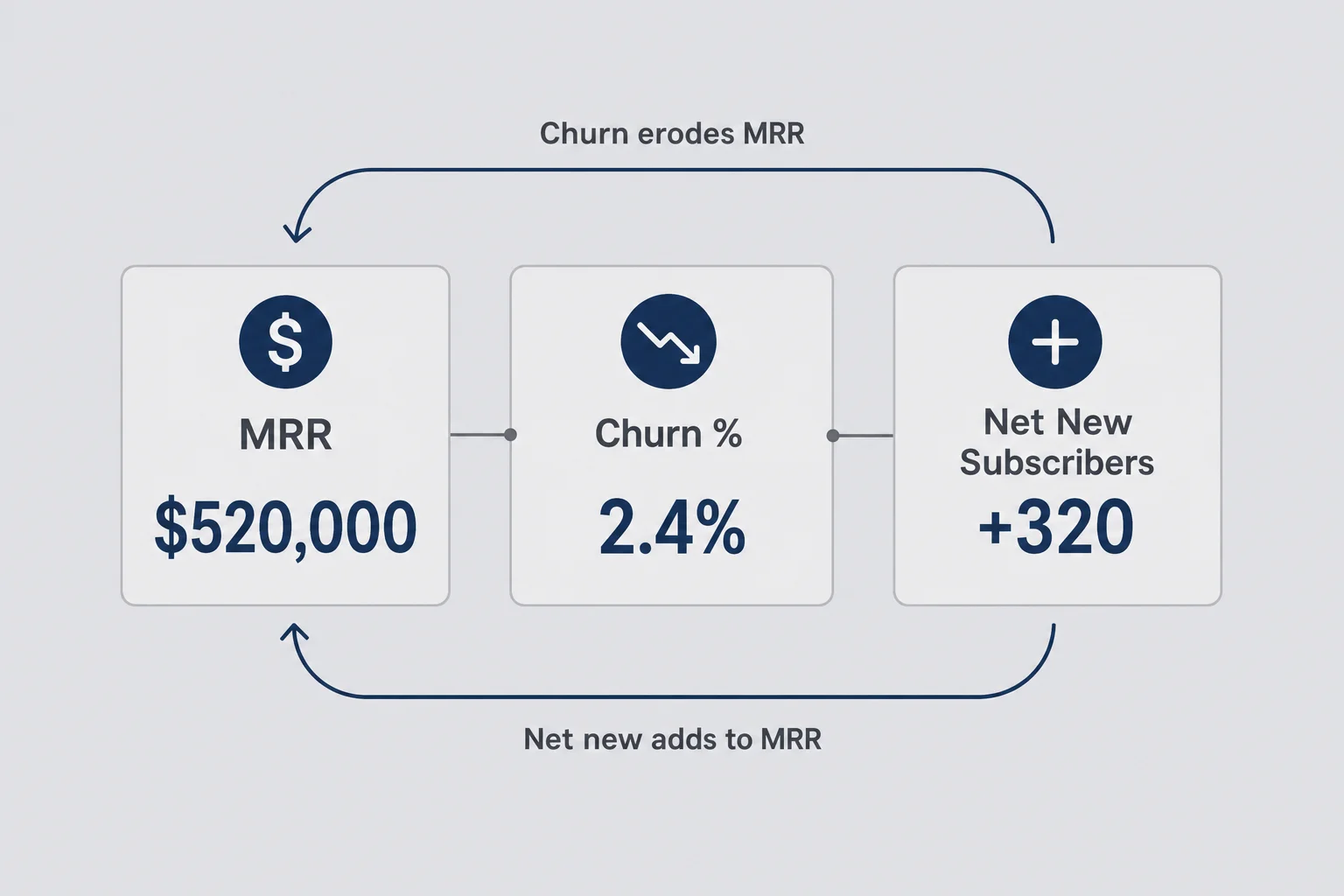
Now I watch three numbers. MRR. Churn. Net new subscribers. That is it for the weekly ritual. I still glance at other things when something breaks. But the standing appointment with myself is those three.
MRR first. I calculate it with the calculator above or a simple sheet, same result if you are consistent. I take active paying subscribers per tier, normalize annual plans to a monthly equivalent, multiply, sum. I note whether MRR grew because I added subscribers or because I raised a price for new users while grandfathering old ones, which is a whole separate emotional topic. Price increases help MRR. They also create support emails.
I write down the MRR number and the date. Not because the single point matters. Because next week I want a line, not a vibe. Consumer founders are prone to vibes. "Feels slow." "Feels like something is working." Numbers argue back.
Churn second. Churn is the percentage of subscribers who cancel in a period. Apple reports retention and churn in subscription analytics if you dig. Early on your churn percentage might bounce wildly because you have eighty subscribers and one cancellation is more than one percent. That is fine. You are not building an investor deck. You are looking for direction.
Say your monthly churn is five percent. That means roughly five out of every hundred subscribers cancel each month. At two hundred subscribers, you lose about ten a month just to stay flat. Ten new paying subscribers only replaces the hole. Eleven grows MRR. This is where the calculator’s optional churn field earns its keep. You can model staying flat versus growing. Without churn in the picture, every growth plan looks easier than it is.
I learned churn’s importance the hard way after a small launch bump. I gained thirty subscribers in two weeks and felt giddy. I did not notice that week three brought almost as many cancellations as new signups. Net new was almost zero. MRR barely moved. Downloads were still up. The store page looked active. Underneath, the bucket had a leak.
Net new subscribers third. This is the count that answers: how many more paying users do I have than I had at the start of the period? It is the bridge between marketing effort and MRR growth. You can get net new from trials converting, from direct subscriptions, from win-backs if you run promos. I do not over-segment early. I want the headline: did the paying count go up, and by how many?
These three numbers talk to each other. MRR is the outcome. Net new is the input. Churn is the tax. If net new is twelve and churn cost you ten, MRR inches up slightly. If net new is twelve and churn cost you fifteen, you are going backward even if gross installs looked fine. The calculator shows MRR from price and count. Your job is to notice which lever moved.
I do not watch daily active users as a primary metric for a subscription consumer app unless ads are the model. DAUs can rise while paying subscribers fall if you give more away free. That might be strategic. It might be accidental. MRR tells you if the strategy pays rent.
Trials complicate the story in a way that matters for iOS. If you offer a seven-day free trial, your subscriber count might rise on day eight when trials convert, then churn might spike on day fifteen when people who never intended to pay cancel. I watch trial conversion rate, but I fold it into how I interpret net new, not as a fourth forever metric. Otherwise you are back to dashboard tourism.
Here is how a Thursday check-in sounds in practice. Open App Store Connect. Export or manually note active subscribers by product ID. Open the MRR calculator. Enter monthly price, enter count, toggle churn if I have a stable enough estimate. Read MRR. Compare to last week’s note. Check churn percentage for the last thirty days. Ask whether cancellations cluster after onboarding or after a specific OS update. Count net new. Decide one action.
The action might be product, not marketing. High churn after week one often means the first session did not deliver the promise. High churn after month two might mean you attracted curious subscribers, not committed ones. Low net new with healthy churn might mean your App Store listing is not reaching new people, or your paywall timing is off, or you simply have not shipped anything worth talking about in three months.
I do not use enterprise analytics stacks. Plausible on a web companion page, App Store Connect for subscriptions, a notes app for the weekly snapshot. That is enough. The goal is not precision to the penny. The goal is catching a trend before it becomes a crisis.
Founders building hybrid models sometimes ask whether to include lifetime purchases in MRR. My rule: subscriptions in MRR, lifetime reported separately. If you sell a $49.99 lifetime unlock, that is great cash today. It is not recurring unless you are deliberately modeling expected repeat purchases, which you are not for a lifetime SKU. Mixing them inflates MRR and makes churn look better than reality.
Apple’s cut belongs in your head even if you calculate MRR on gross price. I track MRR on the customer-facing price because that is what the calculator uses and what milestones reference. I mentally haircut thirty percent when I think about take-home. Say $1,000 MRR at the price tier. Proceeds are not $1,000. Planning your life around gross MRR without Apple's share is a common solo-founder mistake.
The three-number ritual also keeps me from optimizing the wrong emergencies. A bad week of downloads stings. If MRR is stable and churn is low, I might ignore the sting and fix onboarding instead of panic-refreshing keywords. A good week of downloads that does not convert to trials or subs is an ASO or paywall problem, not a reason to celebrate.
Max would probably wire webhooks and build a dashboard. I am not Max. I am a designer who needs a small repeatable habit that fits between dinner and whatever show I pretend to watch while checking subscription stats. Three numbers. Once a week. Honest notes.
If you take nothing else from this section, take the relationship: net new minus churn’s damage equals whether MRR rises. Everything else is decoration until you have enough volume for cohort charts to mean something.
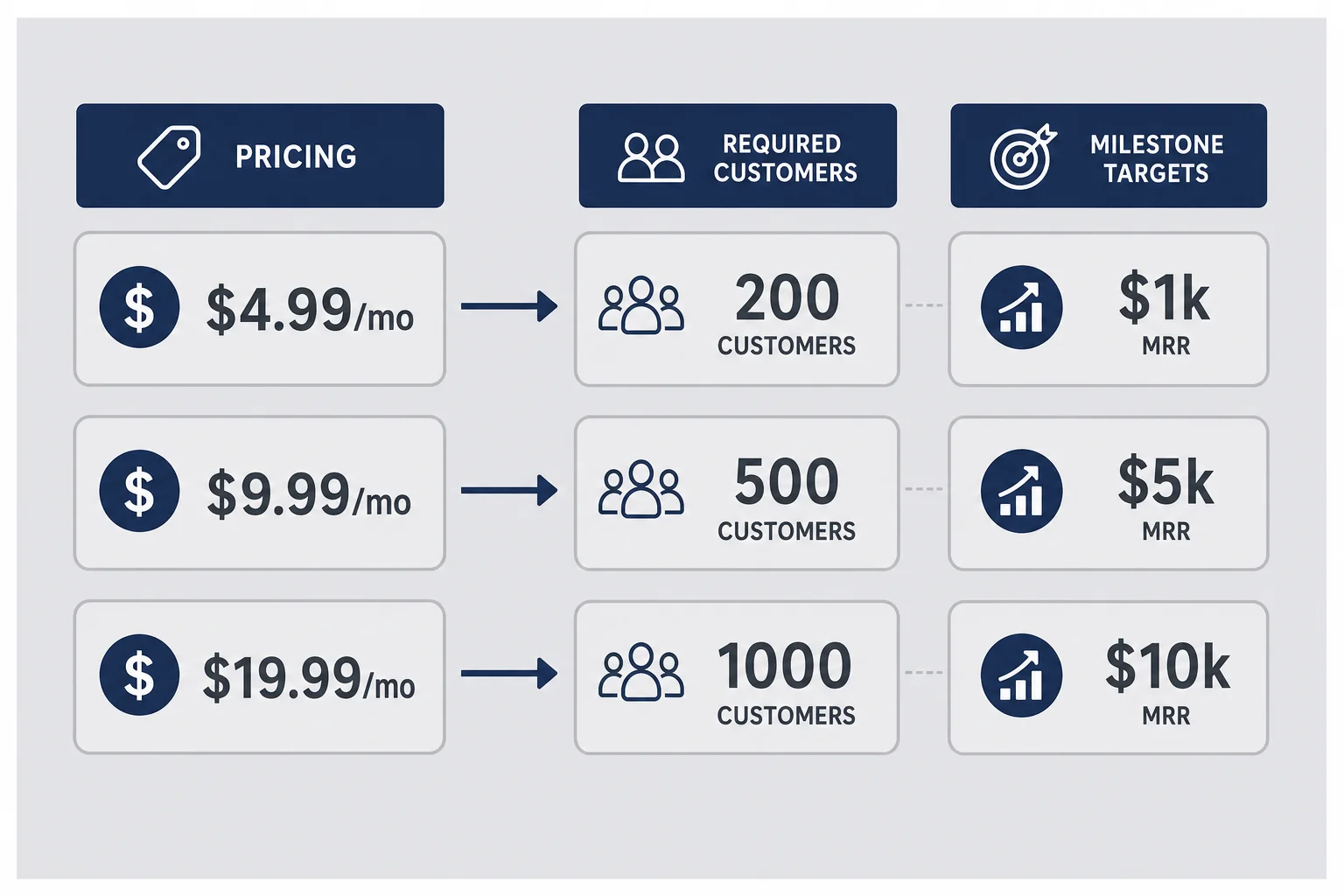
The milestone table in the calculator above is the part I stare at when I am tempted to lower my price out of fear. It answers a question I ask in plain language: how many paying subscribers do I need to hit $1,000, $5,000, or $10,000 MRR at the price I set in App Store Connect?
That question sounds simple. On iOS it is simple math sitting on top of complicated feelings.
Apple lets you pick price tiers, not arbitrary dollar amounts. You choose a tier close to what you want. You decide monthly versus yearly. You decide whether to offer a trial. You decide whether to show the yearly plan as "best value" on your paywall screen. Each choice changes how the milestone table feels when you look at it.
Say you pick $4.99 a month. The calculator shows you need about two hundred active subscribers for $1,000 MRR. About a thousand for $5,000. About two thousand for $10,000. Those are round illustrative numbers; your exact count depends on annual mix and whether every subscriber is on the monthly SKU. Two thousand paying subscribers for a niche consumer app is not impossible. It is also not a weekend project. The table is not judging you. It is showing distance.
Say you pick $9.99 a month instead. $1,000 MRR needs about a hundred subscribers. $5,000 needs about five hundred. $10,000 needs about a thousand. Same milestones. Half the people at double the price. You still have to convince each person that your app is worth two fancy coffees. But the discovery hill is shorter.
This is where pricing for solo founders content overlaps with consumer apps even when the tone of the articles differs. Price is not just revenue. Price is positioning. Price is a filter for who subscribes and how seriously they use the product. Cheap apps attract curious subscribers who churn when the trial ends. Expensive apps attract fewer people who might actually depend on what you built.
I priced Finish Him Replies after redoing the paywall four times. Not because the fourth version was magically correct. Because I needed to see the milestone table with real tiers I could live with. I asked what would feel fair to me as a user embarrassed about a text thread. I asked what would cover API costs if a few hundred people used it weekly. I asked what number would not make me wince when I told a friend the price aloud.
Yearly plans change the milestone math in a way the calculator helps you see if you convert annual subscribers to monthly equivalents. Say you offer $29.99 a year, which many users read as "cheap enough to not think about." Each annual subscriber contributes about $2.50 to MRR in normalized terms. You need a lot of annual subscribers to move MRR compared to monthly $4.99 users. But annual subscribers often churn less because they already committed. Tradeoffs everywhere.
Trials affect when subscribers appear in your MRR count, not how the milestone table works. The table assumes paying subscribers. If you run a seven-day trial, your path to a milestone includes trial conversion rate as a hidden multiplier. Say you need a hundred paying subscribers for $1,000 MRR at $9.99. If only thirty percent of trials convert, you need roughly three hundred thirty trial starts to land a hundred payers, ignoring churn during trial. The calculator does not replace that funnel math. It tells you the destination.
Apple’s introductory offers add another layer. Pay one month, get one month free. Discounted first year. Those can spike conversions and confuse your MRR trend for a quarter. I note when a promo runs so I do not panic when MRR jumps then softens.
When I map App Store pricing to the calculator, I do this literally. I open Subscriptions in App Store Connect. I list each active product ID with its customer price. I count active subscribers per ID from the summary report. I enter the dominant monthly price or split tiers if I have multiple monthly SKUs, which most solo apps do not. I read MRR. I scroll the milestone table. I ask which milestone I am aiming for in the next six months and whether my current price makes that goal brave or delusional.
$1,000 MRR as a first target is common for a reason. It is proof strangers pay. For a $4.99 app, that is on the order of a few hundred active subscribers after Apple's cut still leaves you with something meaningful if your costs are API and hosting, not payroll. For a $14.99 app, you need fewer people but each person needs a stronger reason to stay.
$5,000 MRR is where many solo founders start calling it a real business on the side. Not rich. Real. The calculator table at $7.99 a month shows you need around six hundred twenty-five subscribers. That is a marketing and retention problem, not a "maybe someday" problem. You can name it.
$10,000 MRR is full-time territory for a lot of people if they live somewhere sensible and do not hire prematurely. At $9.99 that is roughly a thousand subscribers. A thousand people who renew is a different product job than a thousand people who download. Support load grows. Edge cases appear. Refund requests become a pattern you recognize.
I am not telling you to pick a price so the milestone table looks easy. I am telling you to look at the table before you pick a price out of fear. Fear pricing is common on first apps. You undercharge because asking for money feels rude. Then you need twice the subscribers to hit the same milestone as someone who charged confidently for a narrower audience.
The App Store also nudges you toward standard tiers. You might want $6.50 because it feels right. Apple gives you $6.99 or $5.99. Fine. Use the nearest tier in the calculator. Close enough for planning.
Localization matters later. A $4.99 USD tier might display as different amounts in other countries. MRR in USD for planning is still fine early on. Do not let currency perfection block you from using the tool.
Some consumer founders bundle web and mobile. If you add a Stripe web subscription later, the calculator still works if you sum subscribers at the same normalized monthly price, or you run scenarios separately and add. Stripe billing is a different checkout experience, same milestone language.
Paywall placement interacts with pricing more than the calculator shows. A hard paywall on day zero might increase subscriber quality and decrease trial volume. A soft paywall after value might increase trials and decrease immediate revenue. I tested showing value before asking for money because my app touches personal conversations. Asking before trust felt wrong. That choice slowed early MRR and improved retention later. The milestone table does not know your ethics. You do.
If you are choosing between monthly only versus monthly plus yearly, model both in the calculator over time. Yearly upfront cash feels good in month one. Normalized MRR might look modest. Investors care about MRR. Your rent might care about cash. Solo founders hold both truths.
I keep a saved scenario link from the calculator when I debate a price change. Same subscriber count, new price, see MRR delta. Same price, subscriber goal from milestone table, see how far I am. It beats arguing with myself in Figma.
Pricing is a product decision. The milestone table is the honest mirror. App Store Connect is where you commit. The calculator is where you think before you commit.
Milestones are numbers on a table until you live near one. Then they become a weekly mood.
$1,000 MRR felt less like champagne and more like exhaling. I remember refreshing the calculator, plugging in subscriber counts, seeing four digits in the MRR field, and not telling anyone for a day. Not because I was secretive. Because I did not trust it yet. I wanted one more renewal cycle. One more week where the number stayed above the line.
At roughly $1,000 MRR on a consumer app priced in the single digits to low teens, you are often in the low hundreds of subscribers. Support is still mostly you reading emails or App Store reviews. Refunds sting personally. A one-star review feels like someone insulted your kitchen table, because that is where you shipped from.
$1,000 MRR covers tools. Hosting. API bills. The Apple developer fee amortized into something you stop resenting. It might cover a part-time contractor for a specific task if you are careful. It does not cover a salary in most cities. It covers proof. Proof matters more than people admit when they are ashamed of small numbers.
Psychologically, $1,000 MRR changed what I optimized. Before it, I chased visibility. More keywords. More posts. More anything that moved installs. After it, I chased retention and quiet improvements to the core loop. The app’s job was to earn the second month, not just the first tap.
Operationally, $1,000 MRR is where you start building boring habits. Weekly MRR notes. Watching churn without spiraling. Saying no to feature ideas that do not touch why people subscribed. You might still have a day job. You almost certainly should.
$5,000 MRR felt different in texture, not just scale. Say you reach it with five hundred subscribers at $9.99 or thereabouts. The app has a shape. You see patterns in cancellations. You know which OS version broke something. You have a list of small papercuts users mention twice and then you fix one.
$5,000 MRR is meaningful side income in many places. It is not automatic quit-your-job money if you have dependents and rent in Austin or Chicago. It is "this could become the main thing if it keeps growing and I do not burn out" money. The calculator milestone table puts $5,000 as a line you can point to in planning. Living near it feels like carrying a fragile plant. You made something grow. You worry about frost.
Emotionally, $5,000 MRR brought me less public excitement and more private responsibility. More subscribers means more edge cases. Someone will use your app in a way you did not imagine. Someone will request a feature that sounds reasonable and would derail you. Someone will accuse you of something in a review that is half true and half misunderstanding.
At $5,000 MRR I started taking privacy and support more seriously not because I was careless before, but because scale multiplies trust failures. A consumer app about personal messages does not get to be sloppy about data. Even when you are solo.
Time allocation shifts. Marketing still matters. Product quality matters more. Churn at $5,000 MRR hurts in absolute dollars. Ten cancellations at $9.99 is nearly a hundred dollars of MRR walking out the door. You feel that.
$10,000 MRR is the milestone people whisper about in indie forums like it is a secret level. Say you get there with a thousand subscribers at $9.99 or fewer at higher prices. The math is on the calculator table. The feeling is not on the table.
$10,000 MRR as one person is full-time work even when it is not full-time money yet. Support volume. Bug reports. App Store review responses. Tax paperwork you have been procrastinating. The app is no longer a side project that sometimes gets evening hours. It is a small business that competes with your sleep.
I have not personally sat at $10,000 MRR with Finish Him Replies. I am telling you what founders I trust describe, plus what I can infer from running a smaller line. I will not invent my own ten-thousand story as if I lived it. What I know from lower milestones still applies: the number changes your identity slowly. You stop saying "I am trying to launch an app" and start saying "I run a subscription app."
At $10,000 MRR, pricing mistakes echo. A poorly communicated price increase might work at two hundred subscribers. At a thousand, it becomes a narrative. Competitors appear. Copycats arrive. Your App Store optimization moat erodes unless you keep improving the product, not just the metadata.
The emotional trap at any milestone is comparing gross MRR to salary without subtracting Apple's cut, taxes, tools, and the opportunity cost of your hours. $10,000 MRR is not a $120,000 salary. It is a strong signal you might be building toward one if growth continues and costs stay flat.
Another trap is treating a milestone as permanent. Churn does not congratulate you at $5,000 and stop. Markets shift. Apple changes search behavior. Your API provider changes pricing. Milestones are checkpoints, not finish lines.
For solo consumer founders, I think the honest mapping looks something like this in feeling terms, not accounting terms.
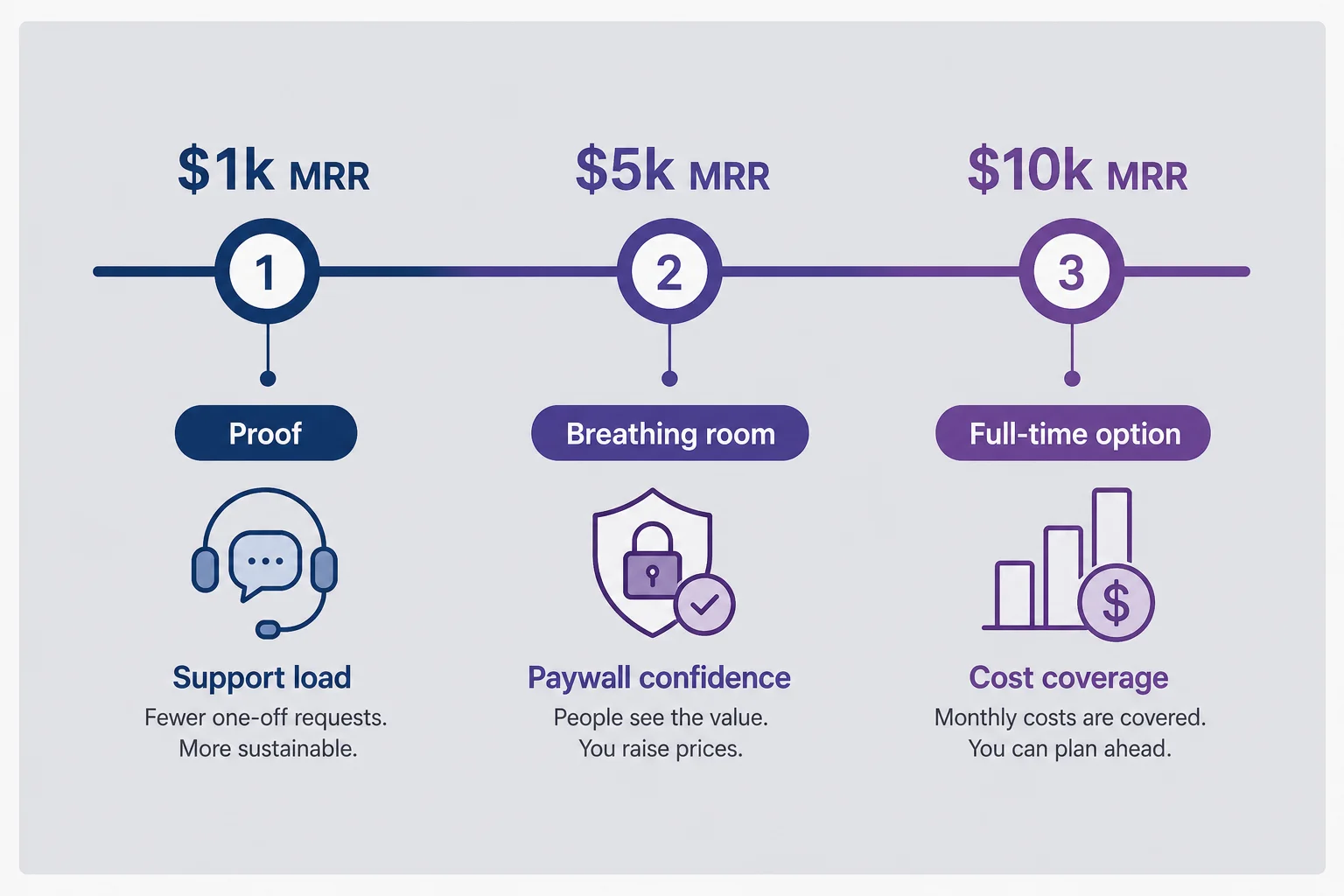
$1,000 MRR is validation you can point to when you doubt yourself at midnight.
$5,000 MRR is optionality. You can invest in the product. You can reduce day-job resentment. You can hire small help.
$10,000 MRR is responsibility at scale. Fewer excuses. More visibility. More reason to get legal and accounting boring parts right.
Your feelings may vary. A parent with a mortgage experiences $5,000 differently than a twenty-two-year-old with a low cost of living. The calculator is universal. Your life is not.
I use the milestone table not to fantasize but to plan patience. If I am at $400 MRR and my price is $4.99, I can see how far $1,000 is in subscriber terms. I can ask whether I am willing to walk that distance marketing-wise and product-wise. If the answer is no, the problem might be price, positioning, or product-market fit, not motivation.
Celebrate small milestones privately if public posts make you cringe. I am not here to tell you to build in public. I am here to tell you that feelings attach to numbers whether you tweet them or not.
When MRR dips after you hit a milestone, the dip hurts more. That is human. Keep the three-number ritual. Figure out if churn spiked or net new stalled. Fix one thing.
Milestones are tools for orientation. The calculator puts them on a map. Walking the map is still your job.
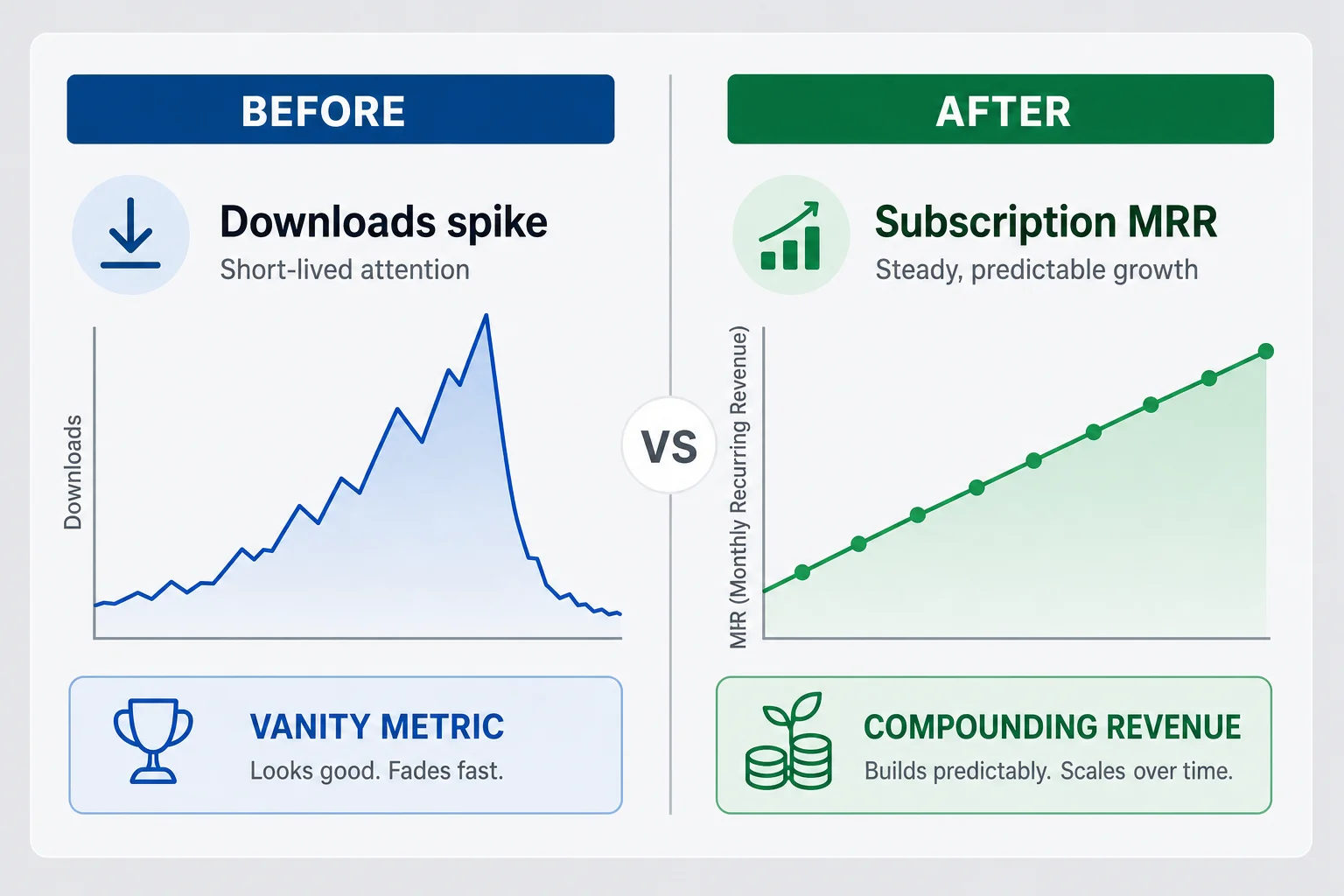
The worst month I lied to myself was a good month on the surface.
Installs climbed. Product page views climbed. A short video mention sent a few hundred people to the App Store listing in forty-eight hours. I took a screenshot of the analytics graph because I am human and wanted proof that something happened. I sent it to a friend with a triumphant caption I have since deleted. The caption implied the app was "taking off."
MRR moved a little. Not nothing. Not matching the shape of the install curve. Trials started. Some converted. Many canceled before the second billing cycle. Net new subscribers for the month was modest. Churn ate a chunk of what I thought I had gained.
I had treated downloads like revenue because downloads are what Apple surfaces prominently and what people congratulate you for. "How many downloads?" is the first question non-founders ask. Nobody at a dinner party asks about normalized MRR unless they also ship apps, in which case they understand why you look tired.
Downloads measure interest. MRR measures commitment. Those are not the same species.
Interest spikes are fun. They validate that a hook works, that a screenshot communicates, that a stranger was willing to tap Install. Commitment is quieter. Commitment is someone leaving your app on their phone, using it when the problem returns, and letting Apple charge them again.
After that month I made a rule: no celebrating install spikes until I see what happens to trial conversion and thirty-day retention of paying subscribers. I still feel the dopamine. I just do not make decisions from it.
The download trap pairs naturally with another trap: optimizing listing for breadth instead of fit. Broad keywords can increase impressions. If the app solves a narrow embarrassing problem well, broad traffic might inflate installs with users who bounce and hurt conversion metrics Apple uses in opaque ways. I would rather have fewer installs from people who recognized themselves in screenshot two than thousands who thought the app did something else.
Free tiers make this worse if you are not careful. A generous free tier can pump DAUs and installs while MRR stalls. That might be strategic. It might be fear of asking for money. Only MRR and churn tell you which.
I also confused product page conversion rate with business health. Conversion from view to install matters for ASO. Conversion from install to paid matters for your life. A listing can improve install rate while MRR stays flat if the paywall is late, weak, or misaligned with the promise.
There was a week I almost changed the entire positioning because installs dipped. MRR was stable. Churn was low. The rational move was hold steady and improve onboarding for the users who found me organically. The emotional move was panic-rewrite keywords. I did a little of both and learned to check MRR first.
Paid user acquisition makes the download trap expensive. If you run Apple Search Ads or social ads, installs cost money. MRR tells you if you bought vanity or subscribers. Say you spend $200 to acquire forty installs and two subscribe at $4.99. You did not buy revenue. You bought learning, if you pay attention.
Refunds and chargebacks show up in feelings land before they show up clearly in MRR notes. A refund is not churn, but it is a warning shot about perceived value. If refunds cluster after a marketing push, your positioning oversold something the first session did not deliver.
I track downloads still. I am not pretending they are irrelevant. They are top-of-funnel. I just no longer let them drive my emotional weather. MRR drives the weather. Net new drives the forecast. Churn drives the umbrella decision.
The calculator helped retrain me because it has no field for downloads. It asks price and subscribers. When I feel excited about a spike, I open the tool, update subscriber count, see MRR change, and reconcile fantasy with arithmetic.
Another mistake under the download umbrella is comparing my week one to someone else's year three screenshot on social media. They post ten thousand installs. They do not post that half came from a market they are not in, or that MRR is flat because the app is free with ads, or that the spike was paid. You are comparing your inside to their outside.
Consumer founders need stories that sell the dream. I get it. I still fall for them sometimes. The antidote is boring weekly notes in your own voice: this week MRR, this week churn, this week net new. Your story becomes data.
If you are pre-revenue, downloads are all you have for a moment. Fine. Watch them while you ship the paywall. The moment subscriptions go live, promote MRR to primary in your head even if the number is $47.
The shift from downloads to MRR also changes how you read advice. Growth hacks that spike installs without improving retention become less tempting. Pricing conversations become more tempting because price changes MRR without needing a viral moment.
I think about that month sometimes when I feel the old habit twitch. A press mention. A ranking bump. A friend shares the app. The install graph ticks up. I breathe, open App Store Connect subscriptions, then open the calculator. I ask what converted. I ask who stayed. I ask what I would do if installs doubled again but MRR did not.
That question sounds pessimistic. It is protective. Downloads flatter. MRR tells the truth slowly enough that you can still fix things.
If you are building your first consumer app, you will feel the pull of the download trap because downloads are public and social and easy to explain to your mom. MRR is private and slow and sometimes embarrassing. Choose the embarrassing number for decisions. Save the screenshot of installs for the group chat if you must. Build the business on subscribers.
I open App Store Connect before Twitter now not because I am obsessed with money. Because I want the first number I see to be something that renews. Twitter is full of spikes. Subscriptions are full of Tuesdays where nothing viral happens and the app still has to be worth keeping.
The calculator on this page will keep asking you the same honest questions: what do you charge, how many people pay, what happens at the next milestone. App Store Connect will keep showing you installs in a bigger font. You get to decide which voice you listen to when you plan your week.
I am still figuring this out with one app and a kitchen table desk. The math is not glamorous. Neither is shipping something strangers pay for month after month. That is the point. Downloads are applause. MRR is the work continuing.