Fourteen Days to Convince a Stranger
How to design a micro-SaaS free trial as a solo founder: trial length, credit card upfront, activation, Stripe wiring, and why freemium usually steals your time.
 By Max25 min read
Listen to this article
19:19AI-generated podcast-style overview of this article (not a word-for-word narration).
Last month a founder DM'd me a screenshot of his analytics. Four hundred trial signups in six weeks. Twelve paid conversions. He was proud of the top of the funnel and quietly panicking about the bottom.
I asked what happened on day one after signup. He said they got a welcome email and a link to the docs. I asked what specific action predicted payment. Long pause. "I guess when they use the main feature?"
That's the whole problem in one conversation. He didn't have a bad product. He had a trial that was technically running and strategically absent. Four hundred people walked through an open door into a warehouse with no signs. Twelve of them found the thing worth paying for on their own. The rest were never going to convert, and he spent six weeks answering support tickets from people who were never going to pay.
If you've already figured out what to charge, your micro-SaaS free trial solo founder strategy is the next lever that decides whether those prices ever see a card. Pricing picks the number. The trial decides who reaches for their card. The Stripe wiring matters, but billing is easy compared to the product experience between signup and day fourteen. This is not a post about growth hacks or "10x your conversions." It's about designing a micro-SaaS free trial as a solo founder when you are also support, onboarding, billing, and the person who fixes webhooks at 2 a.m.
I learned this the expensive way on a small reporting tool I shipped in 2019. I offered a generous thirty-day trial because a competitor did. Signups looked healthy. Conversions didn't. Users would connect data on day two, forget the product existed, come back on day twenty-eight, panic, and ask for an extension. I spent hours in email negotiating extra days instead of fixing the onboarding that should have gotten them to value on day three. When I cut the trial to fourteen days and rewrote the first-run flow around one action, conversions didn't drop. They doubled. Same product. Different filter.
The trial is not generosity. It's a filter. Get it wrong and you'll feel busy while revenue flatlines.
Micro-SaaS free trial solo founder: what the trial actually decides
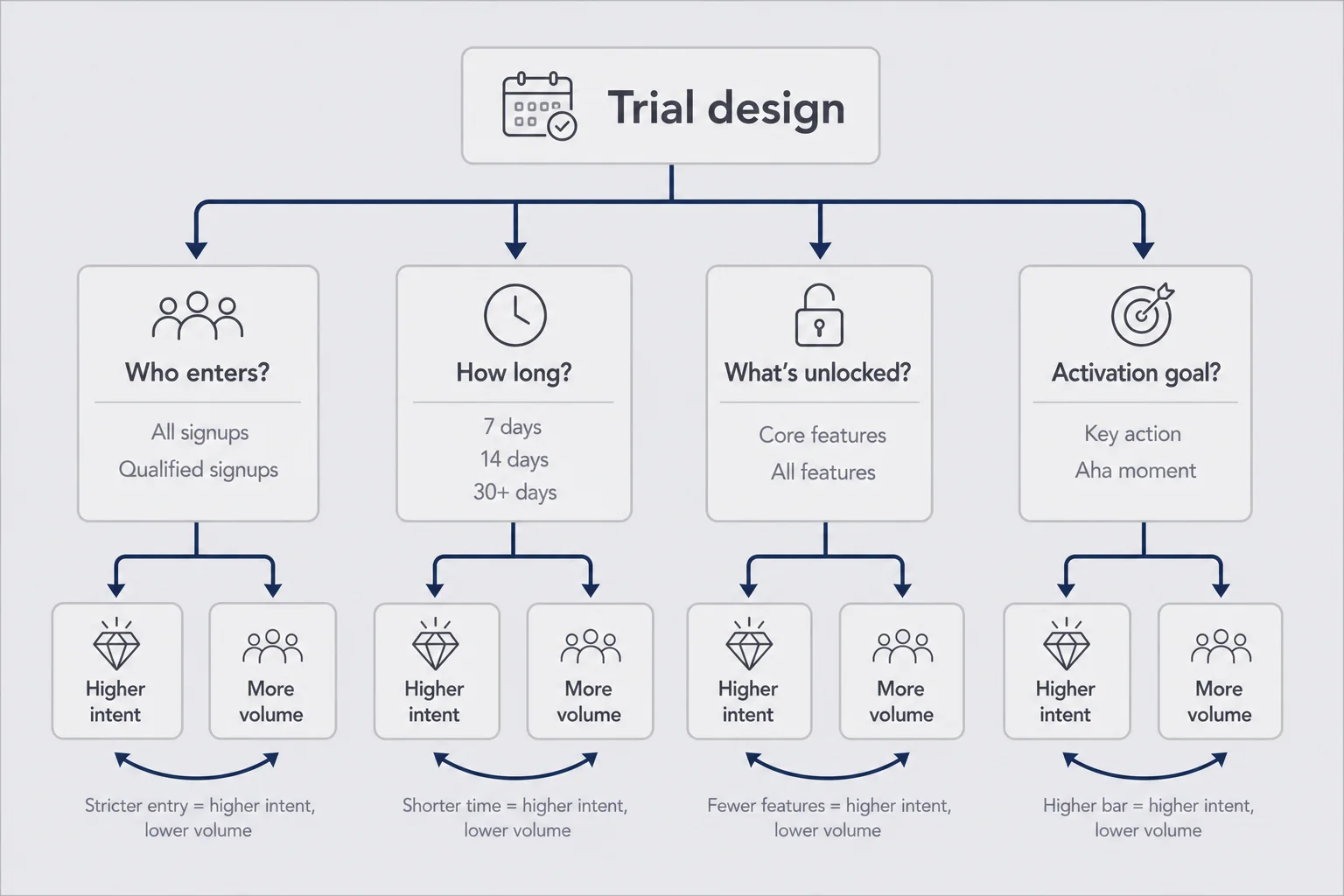
People talk about free trials like they're a marketing checkbox. Flip it on, add a banner, move on. For a solo founder, the trial is closer to hiring policy. It decides who gets through the door, how much of your week they consume, and what evidence you collect before money changes hands.
A trial answers four questions whether you design it or not. First: who is allowed to poke around without paying? Second: how long before they have to decide? Third: what do they get for free versus what stays behind the paywall? Fourth: what has to happen inside the product for conversion to be likely? If you don't answer those on purpose, your defaults answer them for you. Usually badly.
The micro-SaaS free trial solo founder problem is constraint, not ignorance. You don't have a growth team to A/B test fourteen onboarding variants. You don't have a success manager calling trial users on day three. You have a Stripe account, an email tool, and maybe PostHog if you're disciplined. The trial has to do more work with less machinery.
That means simplicity wins. One trial length. One access level during the trial. One activation goal you can explain in a sentence. One upgrade path when the clock runs out. Complexity is how bigger companies paper over weak positioning. You're not bigger. You're one person who needs to know by next month whether strangers will pay forty-nine dollars.
Here's the frame I use. The trial is not the product. It's a timed interview. The candidate is a stranger with a problem. You get fourteen days (or seven) to prove you solve it. They get to leave without paying if you don't. Your job is to make the proof happen fast enough that busy humans notice. Everything else is decoration.
Think about what you're optimizing. A VC-backed company with a sales team might optimize for "get them in the door and let SDRs work them." You don't have SDRs. You have a login form and whatever happens after. Every trial user who activates and doesn't pay still taught you something. Every trial user who never activates and emails you twice consumed your only resource that doesn't scale: Tuesday.
The four decisions I listed aren't independent. Card upfront plus seven days plus full access plus a clear activation action is a coherent strategy for a sharp B2B tool. No card plus fourteen days plus feature gates plus vague onboarding is also a strategy, just one that selects for confusion. Most "bad trial conversion" stories I hear are really inconsistent strategy stories. The founder copied one competitor's trial length, another's freemium tier, and a third's onboarding video, then wondered why nothing compounded.
Trial vs freemium for solo founders: time-boxed vs paid-only
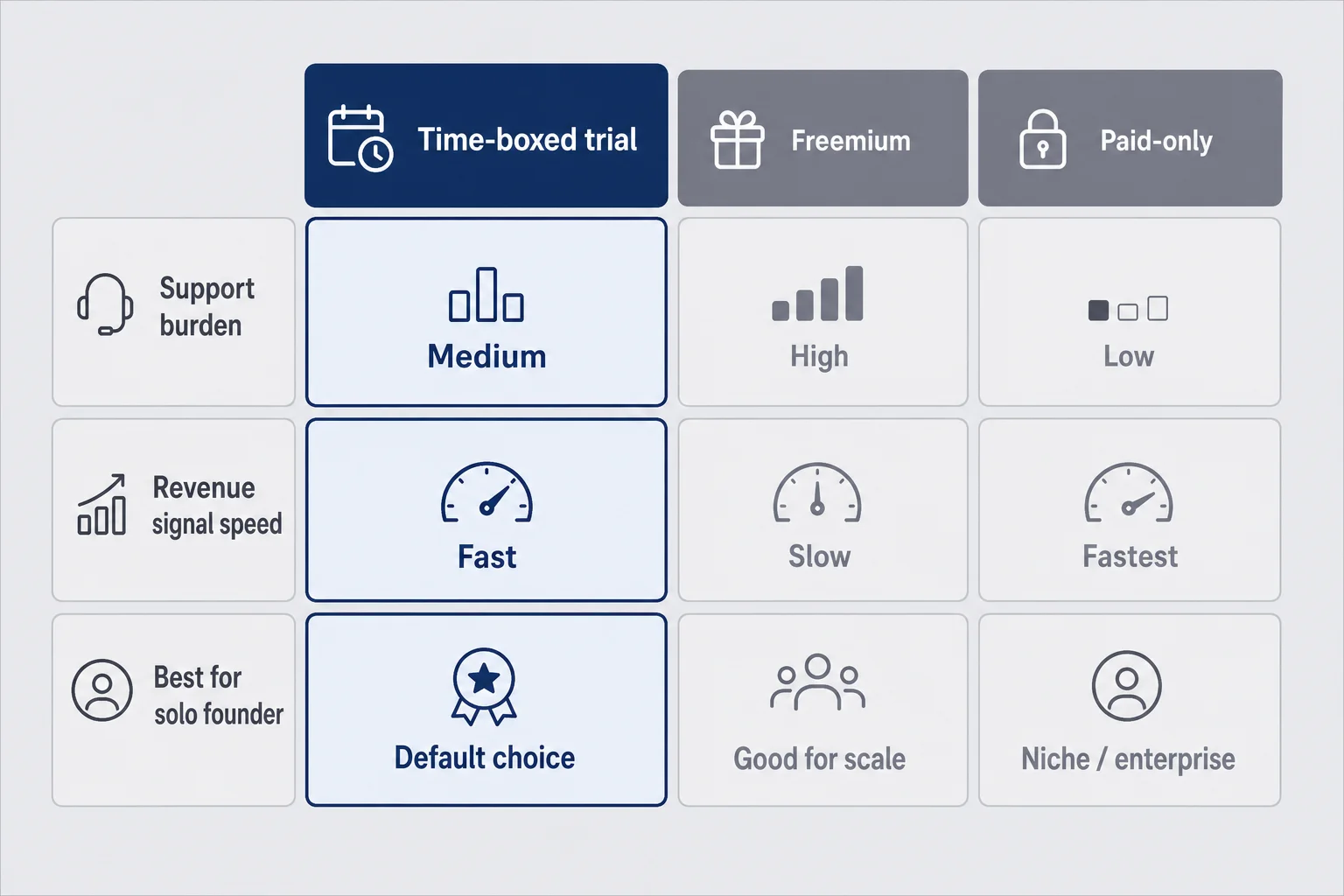
Every pricing conversation eventually lands on the trial vs freemium solo founder question. Freemium, time-boxed trial, or no free tier at all. Founders pick based on what feels generous. I want you to pick based on what your calendar can survive — or run the free trial vs freemium picker if you want a structured recommendation before you read the rest. Getting the SaaS free trial strategy right matters more than copying whatever Notion did in 2019.
Freemium means a permanent free tier with limits. Someone can use your product forever without paying as long as they stay under the ceiling. That model works when free usage advertises the product. Testimonial widgets on customer sites. Shared Notion pages. Collaborative docs where every free user invites two more. The free user is a billboard.
Most micro-SaaS products are not billboards. They're workflow tools, niche dashboards, single-player utilities. A free user does not recruit paying users. They recruit support emails. Say you have five free users for every paid user, which is a common freemium ratio in small products. Those free users don't send you zero tickets. They send you a fraction of what paid users send. Multiply that fraction by five and your Tuesday disappears.
A time-boxed trial is different psychology. Scarcity. The product works fully (or mostly fully) for seven to fourteen days, then it stops unless they pay. Users who sign up are signaling intent at least strong enough to try. Users who convert are signaling money. The signal is noisy early, but it's revenue-shaped noise. Freemium noise is engagement-shaped. Engagement pays your server bill, not your mortgage.
Paid-only with no trial is underrated when you're tiny and your ICP is specific. Some B2B tools sell fine with a demo call and a credit card on day one. If your buyers already pay for adjacent tools and your value prop is obvious in a three-minute Loom, forcing a trial can actually slow things down. But for self-serve micro-SaaS, some form of "try before buy" is usually expected. The debate is rarely trial versus nothing. It's trial versus freemium.
When freemium is a growth engine (rare for solo founders)
I'll name the conditions so you can stop pretending they're yours. Large addressable market. Product usage visible to non-users. Low marginal cost per free account. Upgrade trigger that's obvious and automatic ("you hit the export limit"). If all four are true, freemium can compound.
I've seen it in embeddable widgets and social proof tools. The free tier is marketing spend with a dashboard. If your product is "CSV cleaner for Shopify merchants" or "invoice reminder for freelancers," none of that applies. You're not going viral. You're solving a boring problem for people who will happily pay forty-nine dollars if you prove it works.
When paid-only with a short trial wins
Default here. Fourteen days, full access, clear expiry. Maybe no credit card upfront if you're still proving demand. Maybe card required if you're tired of tourists. Pair it with the pricing floor you already chose so the trial ends at a number you can defend.
The solo founder math is brutal and simple. Revenue equals price times paying customers minus time spent on non-paying users. Freemium optimizes the wrong variable unless the free tier is acquisition. Trials optimize for paying customers per hour of your life. As a bootstrapper, that's the variable I care about.
Say you're at $29/month and you want $1,000 MRR. That's thirty-five customers, not thirty-five thousand signups — plug your price into the MRR calculator to see milestone targets at a glance. A trial that converts at fifteen percent needs roughly 230 trials to get there. A freemium funnel that converts at three percent from free to paid needs over a thousand active free accounts, many of them chatting with you about features you'll never build. Which pipeline do you want to nurse alone?
Hybrid models exist. Trial first, then a limited free tier after expiry. That can work when the free tier is genuinely unusable for serious work but keeps the data warm. It's also twice the billing logic to maintain. I've seen solo founders ship hybrid flows and spend a month debugging edge cases while competitors shipped a simple trial and moved on. Simple isn't always optimal. It's usually shippable.
Credit card upfront or not: pick your conversion filter
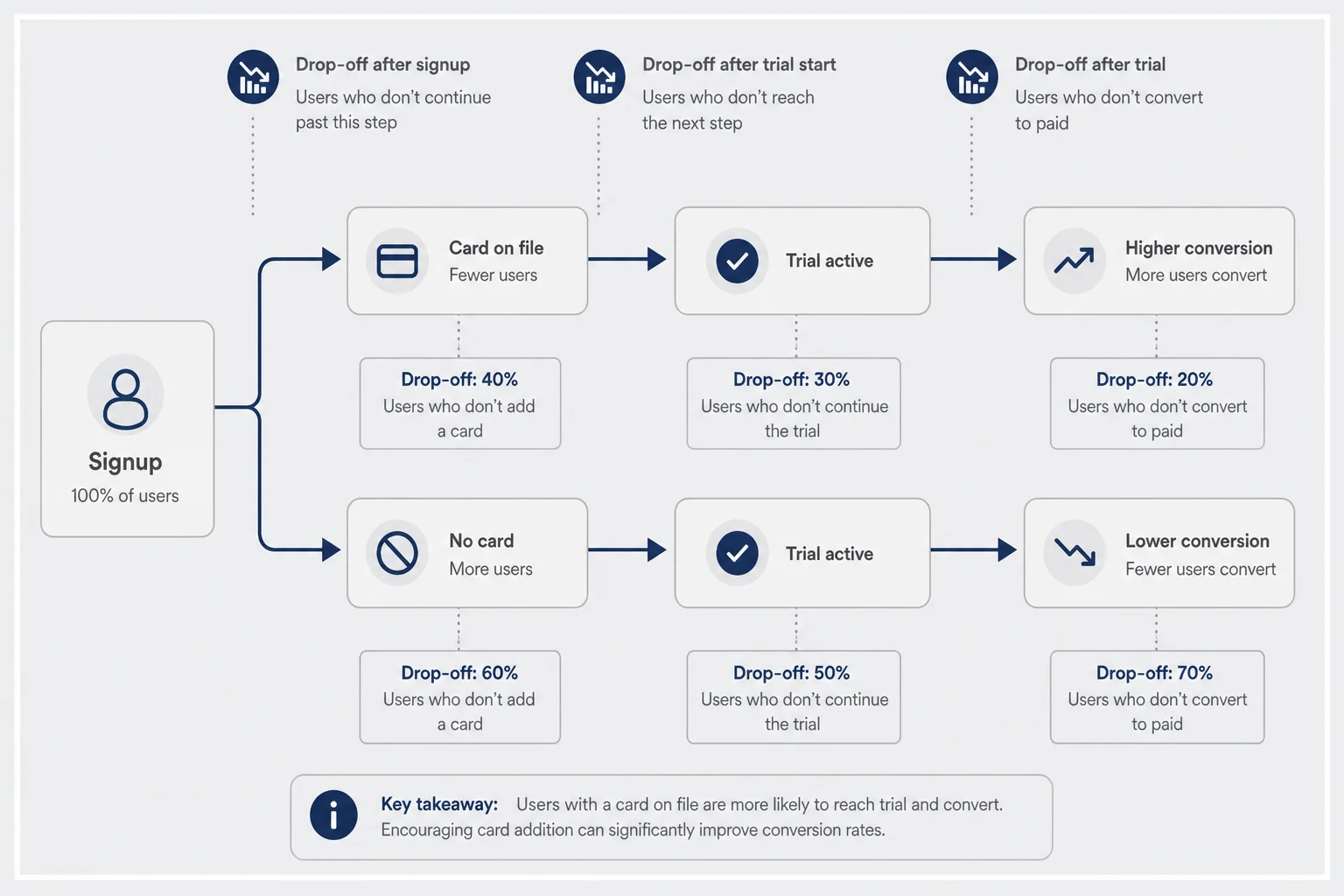
Requiring a credit card at trial signup is a fight every founder wants to avoid because it feels like putting a bouncer at the door of an empty club. I get it. You just launched. The signup graph is the only graph going up. Asking for a card feels like sabotage.
It's not sabotage. It's a different filter. No card means more signups, lower intent, more support from people who were never going to pay. Card required means fewer signups, higher intent, angrier tweets from people who "just wanted to look." Both are valid. Pick consciously.
I usually recommend card upfront for B2B micro-SaaS once you're past the first ten paying customers and activation is decent. Your buyer has a company card. Forty-nine dollars a month is below the threshold where procurement gets involved. The card is a small commitment that correlates with showing up.
Early on, when you're still not sure anyone wants the thing, no card can be the right call. You need bodies in the product to learn where they get stuck. Just don't confuse signup volume with validation. Two hundred trial accounts without activation data is not traction. It's a pile of email addresses and guilt.
No-card trials and the tire-kicker problem
Tire-kickers aren't evil. They're human. They saw a tweet, clicked, signed up with Google, clicked around for ninety seconds, left forever. Without a card, you'll have a lot of them. The cost isn't Stripe fees. It's your attention when one of them emails "how do I integrate with Salesforce" for a product that doesn't integrate with anything yet.
Mitigate with tight onboarding toward one action, not a product tour. Cap trials per email domain if you see abuse. Don't offer unlimited concierge calls to everyone who signs up. Save your calendar for users who hit the activation milestone.
Card-required trials and the honesty tax
You'll hear "I would have paid but I don't give my card to trials." Some of those people are telling the truth. You lose them. Ask whether you wanted them. If your product saves real money, a serious buyer tolerates a card hold. If you're selling vitamins, friction hurts more.
Be honest in copy. "We'll charge you on day fourteen unless you cancel" is better than hiding the card field below the fold. Surprise charges are how you get chargebacks and one-star comments. Stripe billing makes trials straightforward, but trust is still your copy problem.
There's a middle path some founders use after they have signal: optional card. "Start trial without card" as the primary button, smaller link for "Add card now and skip reminders." Power users self-select. Tourists take the easy path. You still learn from both cohorts if you tag them in your database.
B2C and prosumer tools skew no-card. People are allergic to card fields for apps they've never heard of. B2B skews card, especially when the buyer isn't the person typing the card in. If your champion is an ops manager who needs boss approval, forcing a card on day zero can kill the trial before the boss ever sees the output. Know your buyer, not just your competitor's signup form.
How long your free trial should run
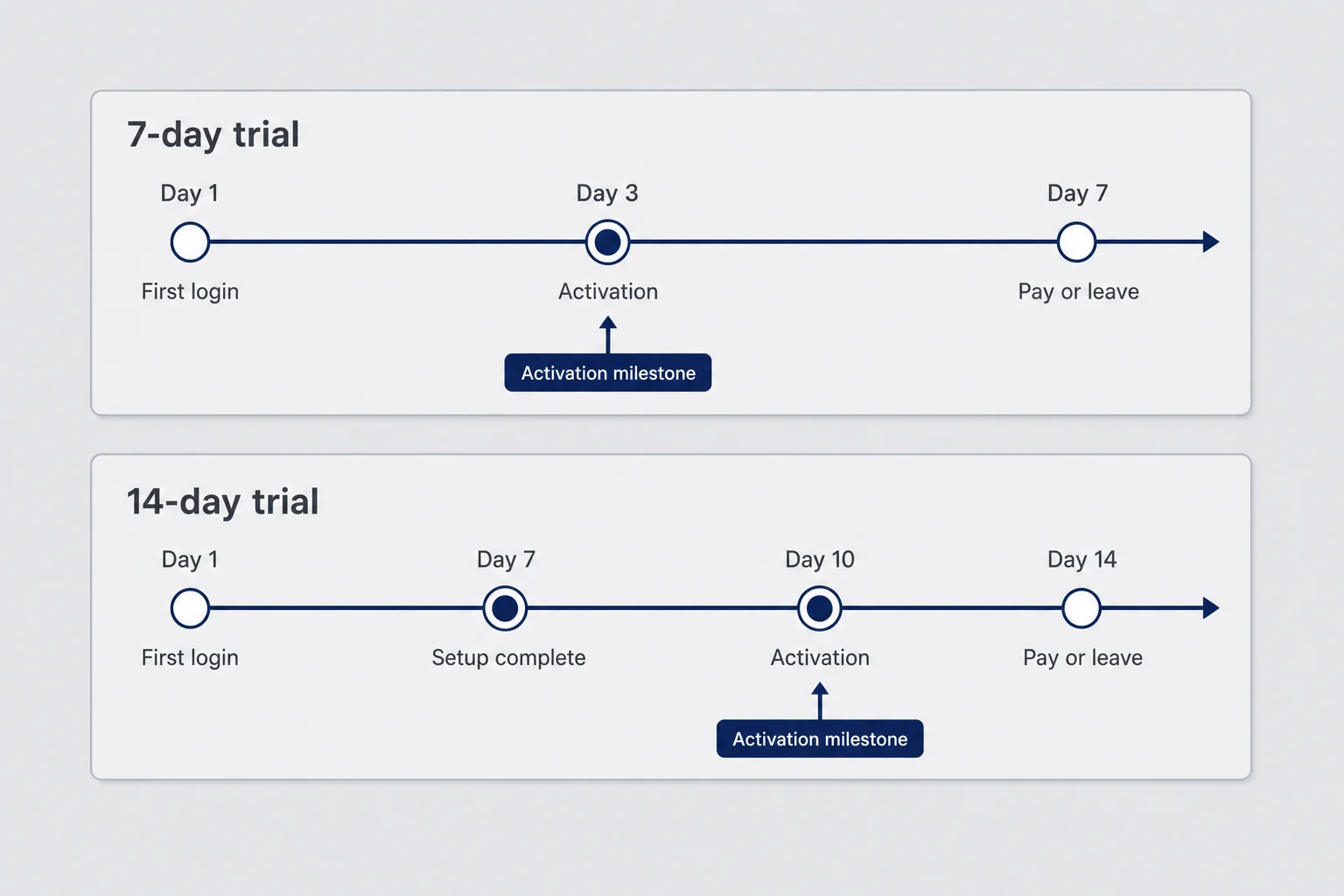
Seven or fourteen days is the solo founder band. Not because those numbers are magic. Because longer trials mostly delay the word no without improving yes. If someone hasn't seen value in two weeks, day thirty won't save you. It'll extend your hope.
Pick length based on time-to-value, not competitor pages. If a new user can connect an account, run the core workflow, and see output in twenty minutes, seven days is plenty. They're not using your product eight hours a day. They'll log in three times. Give them a week of calendar time to do that.
If setup is real, imports take a day, habits form over a week of standups, stretch to fourteen. Inventory tools, reporting dashboards, anything that needs data to accumulate. Fourteen days says you understand their reality. Thirty days says you're afraid to ask for money.
Seven days when value shows up fast
AI wrappers, simple automations, generators, single-purpose utilities. The user either gets the wow in session one or they don't. Shorter trial adds urgency. It also forces you to fix onboarding because you don't have time to coast.
I like seven days when I'm still iterating fast. Fewer dead accounts hanging around. Faster feedback loop on pricing and activation.
Fourteen days when setup takes a week
B2B tools with integrations, team invites, or data backfill. Also when your buyer is a small business owner who only touches software after the shop closes. They need two weekends, not two lunch breaks.
Don't go to fourteen because you're scared of conversion. Go because your honest answer to "when do they see value?" is closer to ten days than ten minutes.
Weekends count. A founder who signs up Friday afternoon might not touch your product until Monday. A seven-day trial that starts Friday ends next Friday. They had two working days. If your ICP is salaried people doing side-project evaluation at night, fourteen days maps to real life better.
You can extend manually. One founder I know keeps fourteen days as default but offers a single seven-day extension if someone replies to the expiry email with a specific blocker ("waiting on API access from vendor"). That's support-heavy. It works at low volume. It breaks at scale. Document the policy so future-you doesn't negotiate forever.
What to unlock during the trial: full access beats fake limits
The worst trial experience is a neutered product. Three exports. One project. Watermarked output that nobody would show a client. Users can't evaluate what they'll actually buy. You learn nothing except that people dislike teasers.
Default to full access for the trial period. Let them hit the real ceiling. If your paid plan limits projects at ten, let trial users make ten projects. They should experience the actual product, not a demo mode that hides the rough edges.
Feature-gated trials make sense when one expensive feature is the whole value. Say API access burns real money. Gate that feature but let everything else run. Be explicit: "Trial includes everything except bulk API." Don't silently throttle performance.
Limits during trial should match limits after payment. Otherwise day fifteen feels like a bait and switch. That's churn fuel before they're even customers.
The one exception I'll grant: usage that costs you real money. If your product sends SMS or calls an expensive model API, cap those during trial with transparent counters. "Fifty messages in trial" is honest. "Unlimited AI" that bankrupts you on day six is not a trial strategy, it's a lottery ticket.
Show the limit early. A meter in the sidebar that says "12 of 50 trial exports used" does two jobs. It proves the product works. It previews what paying unlocks. Users who slam into the cap and upgrade are often your best customers. Users who never touch the cap were never going to pay.
The activation moment that predicts who pays
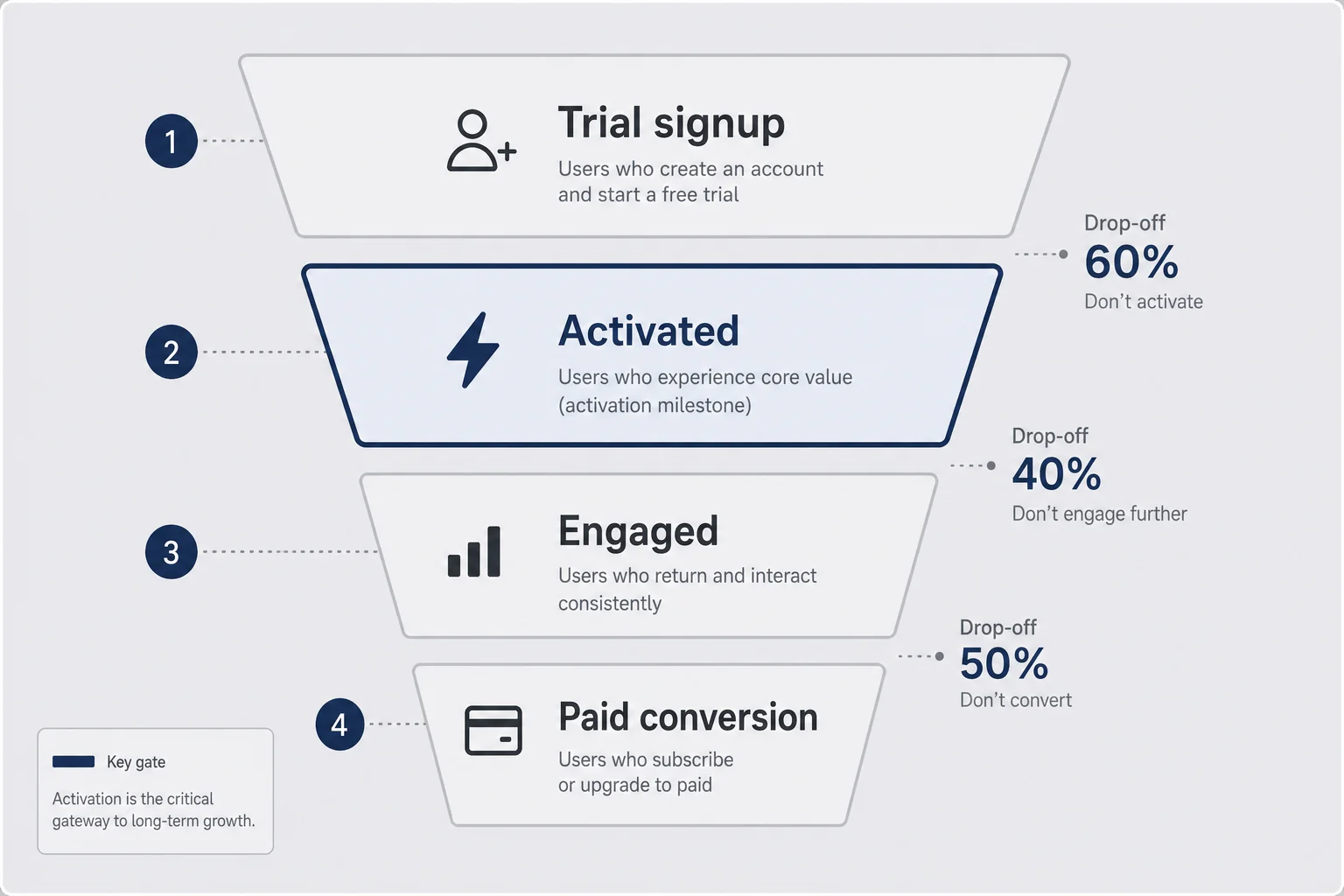
Trial length doesn't matter if users never reach the moment they think "yeah, I'd pay for this." That moment is activation. Not login. Not "completed onboarding wizard." A specific action correlated with conversion.
For a scheduling tool, it might be "published first booking page." For an analytics tool, "viewed first report with their data." For an email tool, "sent first campaign." You find it by talking to people who paid and asking what they did first. Then you engineer the trial toward that action like your revenue depends on it, because it does.
If you don't know the action yet, your trial is a waiting room. Fix that before you tweak card requirements or send discount codes.
Define the magic action before you write onboarding copy
Write it down. One sentence. "Activated user has done X." Put it on a sticky note. Every onboarding email, empty state, and tooltip should point at X. Delete steps that don't help.
Measure signup-to-activation rate before you obsess over trial-to-paid rate. If only eight percent of signups activate, improving conversion from five percent to eight percent at the bottom is lipstick. Get forty percent to activation and the bottom fixes itself.
Concierge trials for your first ten signups
Before you automate, manually walk ten trial users to activation. Screen share. Watch where they hesitate. That's cheaper than a month of ads sending people into a broken funnel.
This overlaps with customer onboarding for solo founders. Trials are onboarding with a timer. Treat the first cohort like humans, not metrics.
Concrete example. Imagine a tool that syncs inventory between Shopify and a spreadsheet. Activation might be "first successful sync completed with real store data." Everything before that is noise. Your trial onboarding shouldn't tour every settings page. It should say: connect Shopify, pick a sheet, run sync, look at the result. Three screens max. If they bounce on OAuth, that's the bug you fix this week, not the trial length.
Another example: a weekly report email for ad spend. Activation might be "received first scheduled report." That means you need their ad account connected and a schedule saved. Trial day one goal isn't "explore dashboard." It's "get the first email in your inbox before lunch." Design backward from the inbox moment.
Track time-to-activation in hours, not days. If median time is forty-eight hours, your trial length should survive a weekend plus one slow day. If median is twenty minutes and conversion still stinks, the trial isn't the problem. The price or the problem is.
Trial emails that do not turn you into a spam cannon
Email is your cheapest nudge and your fastest way to annoy people. Three to five emails during a fourteen-day trial is enough. Day zero: welcome plus the one action. Day two or three: only if they haven't activated, short and specific. Three days before expiry: here's what you'll lose. Day zero expiry: pay or pause. For templates, branching rules, and conversion copy in more depth, see the micro saas onboarding email sequence.
Behavior beats calendar when you can swing it. "You haven't connected your store yet" beats "It's day four of your trial!" The second email assumes they're paying attention to your schedule. They're not.
Write them yourself. No "we're excited to have you on this journey." Tell them what to click. One link. One job.
Keep unsubscribe honest. Trial users who opt out of marketing should still get expiry notices if they're still in trial. That's transactional, not promotional.
Rough copy sketches, not gospel. Day zero subject: "One thing to do first." Body: two sentences, link to the activation screen, no logo parade. Day three if inactive: "Still stuck on [specific step]?" with a thirty-second Loom if you have one. Three days left: "Trial ends Friday. Your projects pause unless you upgrade." Expiry day: "Trial ended. Pick a plan to keep going" with one button.
I write these in plain text first. If it sounds like marketing automation, delete adjectives until it sounds like a note from a person who built the thing. Because you did.
Don't CC yourself on every trial email and don't auto-reply when they respond. You'll drown. Route replies to a single inbox you check daily. Trial users who reply are warm, even when they're confused.
In-product upgrade nudges without popup clown energy
Banners beat modals. A slim bar at the top: "Six days left in your trial" with an upgrade button. Modals on every login teach people to hate your product.
Show value first, ask second. When they complete the activation action, that's a fair moment to mention what paid unlocks long term. Not before they've seen anything work.
After expiry, one clear screen. Not a maze of disabled buttons. "Your trial ended. Upgrade to keep your projects." List what they keep losing if they wait. Don't hold their data hostage. That's sleazy and it burns bootstrapping reputation you can't afford.
Discounts on the last day are a tool, not a strategy. Ten percent off because you panicked teaches buyers to wait for the popup. If you discount, tie it to a reason: annual plan, early supporter, something with a story.
Stripe free trial setup when you are the billing department
Stripe wants you to use Checkout with a subscription that includes a trial period. That's the happy path. Customer checks out, Stripe creates a subscription in trialing state, sets trial_end, and fires webhooks. Your app gates features based on status in your database, not vibes.
Do not build custom trial logic in localStorage. I've seen it. Day fourteen arrives, user's session still says trial because you forgot to sync. Trust webhooks. Store the customer id, subscription id, status, and trial end in your database. When customer.subscription.updated fires, update your row.
Card upfront trials use the same flow. Card is collected at signup, charge happens at trial end unless they cancel. No-card trials are harder in Stripe because you need a way to attach payment later. Common pattern: trial without payment method, email them to add a card before expiry, lock the app if they don't. Some founders use Setup Intents on day ten. Pick one path and test it with your own card five times.
The Stripe billing post covers products, prices, webhooks, and the 2 a.m. failure modes. Trials are a flag on the subscription, not a separate product. One price. One plan. Trial is temporal, not a SKU.
Minimal mental model after Checkout:
{
  "status": "trialing",
  "trial_end": 1720137600,
  "items": [{ "price": "price_..." }]
}
Your app reads status and trial_end from your database on every gated request, or caches them with a short TTL and refreshes on webhook. When the trial ends, Stripe attempts a charge if a payment method exists. These events flip access to paid:
| Webhook event | What changes |
|---|---|
| invoice.paid | Trial converted; subscription is active |
| customer.subscription.updated | Status, trial_end, or cancel_at_period_end changed |
| customer.subscription.deleted | Subscription ended; gate features |
Edge cases worth coding once. User cancels on day five — subscription should move to canceled at period end or immediately, depending on your policy. Be consistent with copy. User adds card on day twelve after a no-card trial — use Checkout in setup mode or the Customer Portal. Card fails on day fourteen — show a failed-payment state, not a silent lockout. That's dunning territory, and it's miserable, but a confused lockout is worse.
Test with Stripe's test clocks if you can. They're fiddly. Manually setting trial_end in test mode and firing webhooks with the CLI is uglier but works. I've shipped trials without test clocks plenty of times. I have also been woken up by a user who paid but still saw a locked screen because my webhook handler returned 500 on customer.subscription.deleted. Test the sad paths.
If you're on Lemon Squeezy or Paddle instead of Stripe, the nouns change. The architecture doesn't. External billing truth, local database mirror, webhooks, feature gates. Don't duplicate subscription state in three places unless you enjoy incident response.
Before you ship trials
Run through cancel, expire, and card-decline flows yourself. Solo founders lose more money to confused expiry than to competitors.
When the clock hits zero: lock, downgrade, or last-chance offer
Three schools. Hard lock: no pay, no access. Soft downgrade: free tier with tight limits. Extended trial: "need more time?" link for humans who were close.
I default hard lock for B2B micro-SaaS without a viral free tier. Clear line. They knew the date. Paying customers deserve a product maintained with revenue, not with your hope.
Soft downgrade only if the free tier is sustainable. One project, read-only mode, export disabled. If free tier users will flood support, skip it. A dead account is cheaper than a needy one.
Extended trials for enterprise-shaped deals are fine one-off. Don't make "ask for more time" the default button on expiry. You'll train everyone to click it.
Grandfather data politely. Let them export. Don't delete their work on day fifteen to extort payment. They'll remember, and they'll tweet.
Read-only mode is a decent compromise. They can see their projects but not run the core action. That keeps the loss visible without hostage tactics. Pair it with an export button. Some will export and leave. Good. They weren't buyers. Others will upgrade because rebuilding is annoying. That's honest commerce.
Last-chance offers need a story. "Twenty percent off if you upgrade in forty-eight hours" works when you frame it as early supporter pricing, not desperation. If you run the same discount every month, savvy users wait for expiry. I prefer annual prepay discounts at expiry over monthly percentage off. Annual prepay improves cash and filters for people who intend to stick around.
Free trial conversion for micro-SaaS without a data team
You need four numbers for free trial conversion micro-SaaS style: trial signups, activated trials, paid conversions, support tickets per trial user. Everything else is vanity until those are sane.
Trial-to-paid rate equals paid divided by signups. Activation rate equals activated divided by signups. Fix activation first. Segment by source if you can. Twitter trials behave differently than Google trials.
A spreadsheet works for your first hundred trials. Date, email, activated yes/no, paid yes/no, notes. PostHog or Plausible if you want funnels without enterprise pricing. Don't stall shipping because analytics isn't perfect.
Review weekly. Fifteen minutes. Where did last week's signups die? One fix per week. Maybe it's onboarding copy. Maybe it's the card requirement. Maybe it's that your activation action is wrong. The trial exposes product problems faster than marketing ever will.
Cohort thinking helps even in a spreadsheet. Week of June 2: forty signups, twelve activated, four paid. Week of June 9: thirty-five signups, eighteen activated, six paid. Something improved. Was it the onboarding tweak or random noise? You won't know at forty trials. You will know at four hundred if you kept notes.
Interview converters and non-converters. Five emails each month. "What almost stopped you from paying?" and "What made you not pay?" are better questions than star ratings. Patterns show up fast. "I couldn't get data in" beats a hundred analytics sessions.
Don't optimize trial conversion before you have twenty paid customers total. Before that, you're still proving the product deserves to exist. Trials are a magnifying glass, not a substitute for validation. If nobody converts after you fix activation twice, the trial length is probably not the villain.
| Metric | What it tells you |
|---|---|
| Signup → activation | Is onboarding broken? |
| Activation → paid | Is pricing or value broken? |
| Support tickets per trial | Are you attracting the wrong users? |
| Time to activation | Is your trial too short or too long? |
Questions I get about free trials
Should I require a credit card for my micro-SaaS free trial?
Require a card if you sell B2B and your product is easy to evaluate in a week. You get fewer signups but higher intent. Skip the card if you are early and need any signal you can get, or if your buyers are individuals who bounce at payment fields. Either way, be explicit before signup so nobody feels tricked on day fourteen.
How long should a micro-SaaS free trial be?
Seven days if a new user can reach real value in one sitting. Fourteen days if setup, imports, or team habits need time. Longer than fourteen rarely helps solo founders and mostly delays the honest no. Pick one length and stick with it until you have fifty completed trials to measure.
Is freemium better than a free trial for solo founders?
Freemium only wins when free users naturally bring you more users, like embedded widgets or shared outputs. Without that viral loop, freemium piles support work onto people who never pay. A time-boxed trial with full access filters for intent and tells you faster whether anyone will convert.
What trial-to-paid conversion rate should I expect?
For B2B micro-SaaS with decent activation, ten to twenty-five percent is a reasonable band early on. Below five percent usually means activation is broken, not that the trial is too short. Fix the first magic moment before you tweak trial length or add discount emails.
How do I set up a free trial in Stripe?
Create one product and one recurring price, then use Checkout or a customer portal with a trial period on the subscription. Store the Stripe customer ID and subscription status in your database and trust webhooks over hope. The billing post on this site walks through webhooks; trials use the same plumbing with a trial_end timestamp.
What happens when the trial ends?
Default to a hard stop with a clear upgrade path, not a silent downgrade into a broken free tier. Email before expiry, show an in-app banner three days out, and on day zero either charge the card on file or lock access with one obvious pay button. Confusion at expiry is how trials become churn you never counted.
The trial is not generosity. It is a filter
I still see founders treat the free trial like a gift they hand strangers out of kindness. It's not. It's the narrowest part of your funnel on purpose. You're allowed to make people qualify for your time.
Design the trial so a busy, skeptical buyer can prove to themselves that your product works. Design it so you learn fast when they don't. Cut freemium fantasies unless free users literally advertise you. Wire Stripe once, test expiry like your rent depends on it, and measure activation before you argue about seven versus fourteen days.
A boring micro-SaaS with a clear trial and twenty percent conversion beats a generous free tier with a thousand users and no path to profit. You're not trying to win a signup contest. You're trying to find out whether strangers will pay you consistently enough that you can keep building without getting a job. For the pricing decision that comes before the trial, pick the number first.
Pick a length. Pick a card policy. Name the activation action. Ship it this week. The trial will tell you the truth faster than another week of tweaking the landing page hero.



Comments