Two Months Free Sounds Generous Until You Do the Math
How to set an annual billing discount for a micro-SaaS: when monthly still wins, how much to knock off, what to show on the pricing page, and how to invite monthly customers to switch without a fire sale.
 By Max26 min read
Listen to this article
23:22AI-generated podcast-style overview of this article (not a word-for-word narration).
I used to treat the annual toggle like a free upgrade for my bank account. Flip the switch, knock off a couple months, watch Stripe light up with a four-digit charge, feel briefly rich.
Then someone refunded in week six.
Not because the product was broken. Because they had bought a year of "I'll figure this out later," and later never arrived. I had already spent the cash on hosting and a weekend of features they never touched. On paper the annual plan looked like loyalty. In practice it was a prepaid maybe.
That is the whole problem with the annual billing discount micro saas play founders obsess over too early. The discount is not the strategy. The strategy is deciding when twelve months of commitment helps you, and when it just hides the fact that people would have canceled on month two. Cash feels like progress. Quiet customers feel like nothing until renewal day reminds you they were never really there.
If you already have a price that does not embarrass you and you are not still guessing every week, annual billing can be one of the cleanest levers you pull. It improves cash, lowers the number of cancel-decision days, and gives serious buyers a way to self-select. Done badly, it becomes a refund machine and a vanity retention chart that looks calm until December.
This is the playbook I wish I had before I offered "two months free" like it was a personality trait. Not a manifesto. Just the decisions that kept me from confusing a Stripe spike with a healthy business, and from treating prepaid silence like proof the product was sticky.
Annual billing discount micro saas: what you're actually buying
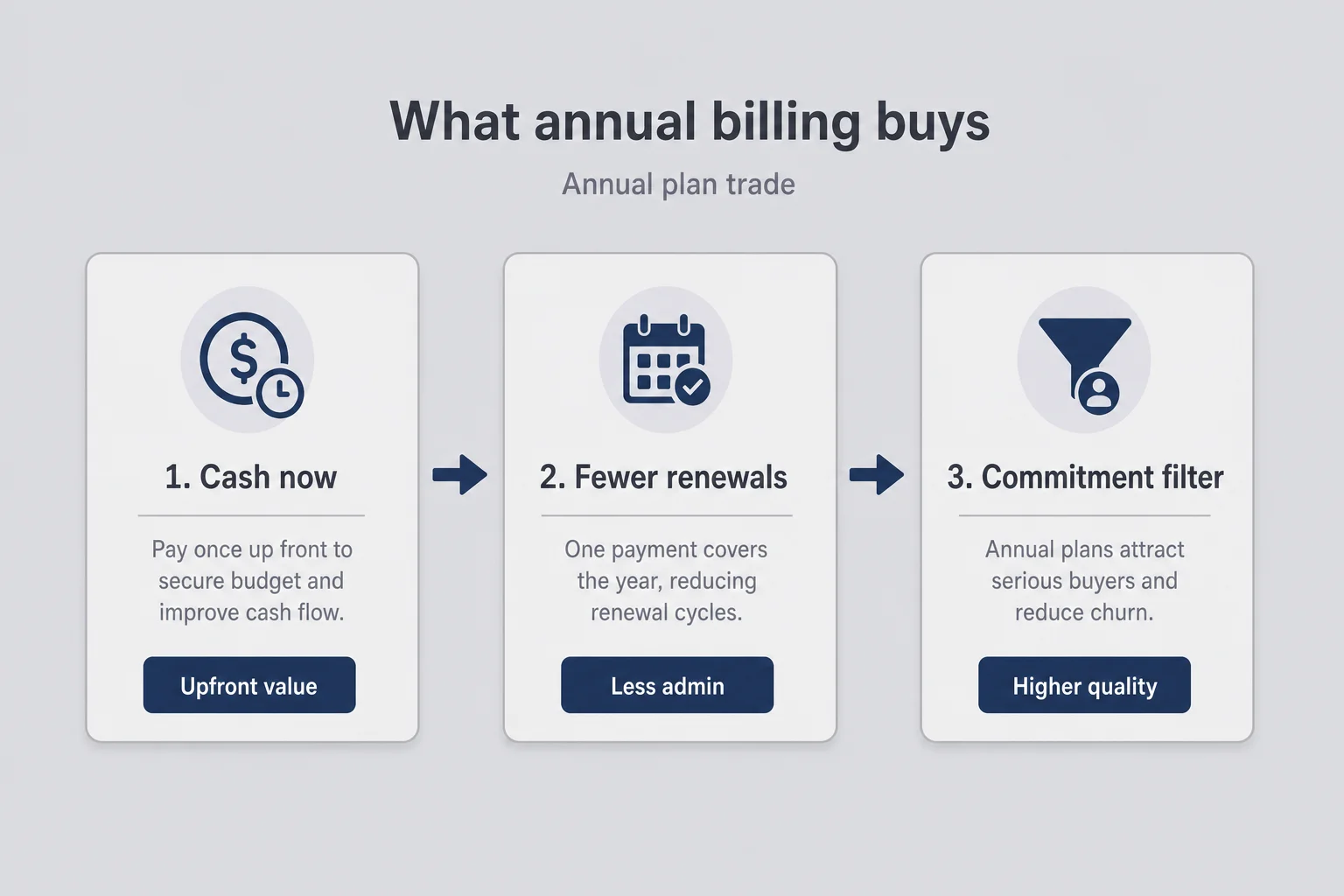
An annual plan is not a nicer version of monthly. It is a different product decision for both of you.
You are buying three things at once: cash now, fewer renewal moments, and a filter for people who already believe they will stick around. The customer is buying a lower effective monthly price and the psychological relief of not thinking about your bill every four weeks.
What you are not buying is proof that the product is great. Prepaid does not equal happy. It equals prepaid.
I see founders celebrate a spike in "retention" the week they ship annual, as if the product suddenly got stickier overnight. No. You just moved the cancellation decision from every month to once a year. That is useful. It is not magic.
The discount is the price of that shift. If your monthly plan is $49, a common annual offer is something like $490 for the year (about 17% off, or "two months free"). You give up $98 of list price to collect $490 on day one instead of hoping twelve separate $49 charges survive the year.
Whether that trade is smart depends on how long your monthly customers usually stay, how painful refunds are for you, and how stable the product is. A brand-new tool that changes every Tuesday should not be locking strangers into a year. A boring tool that already has people renewing for three or four months in a row? Different story. Same discount percentage. Completely different risk.
Think of annual as a cash-and-commitment instrument, not a growth hack. If your pricing page still cannot explain the product in eight seconds, fixing the offer beats inventing a yearly coupon.
I once watched a founder celebrate four annual checkouts in a single afternoon. Four. For a product that was three months old. By Friday two of them wanted refunds because the "CSV import" they assumed existed was still a Notion doc titled "soon." The founder had not lied on purpose. He had just sold a year of a story he was still writing. Monthly would have let those buyers leave quietly after thirty days. Annual turned a product gap into a reputation problem.
That is the texture I care about more than the tidy industry average. Your discount percentage is not the hard part. The hard part is knowing whether the person paying today will still recognize the product in November.
When monthly is still the right default
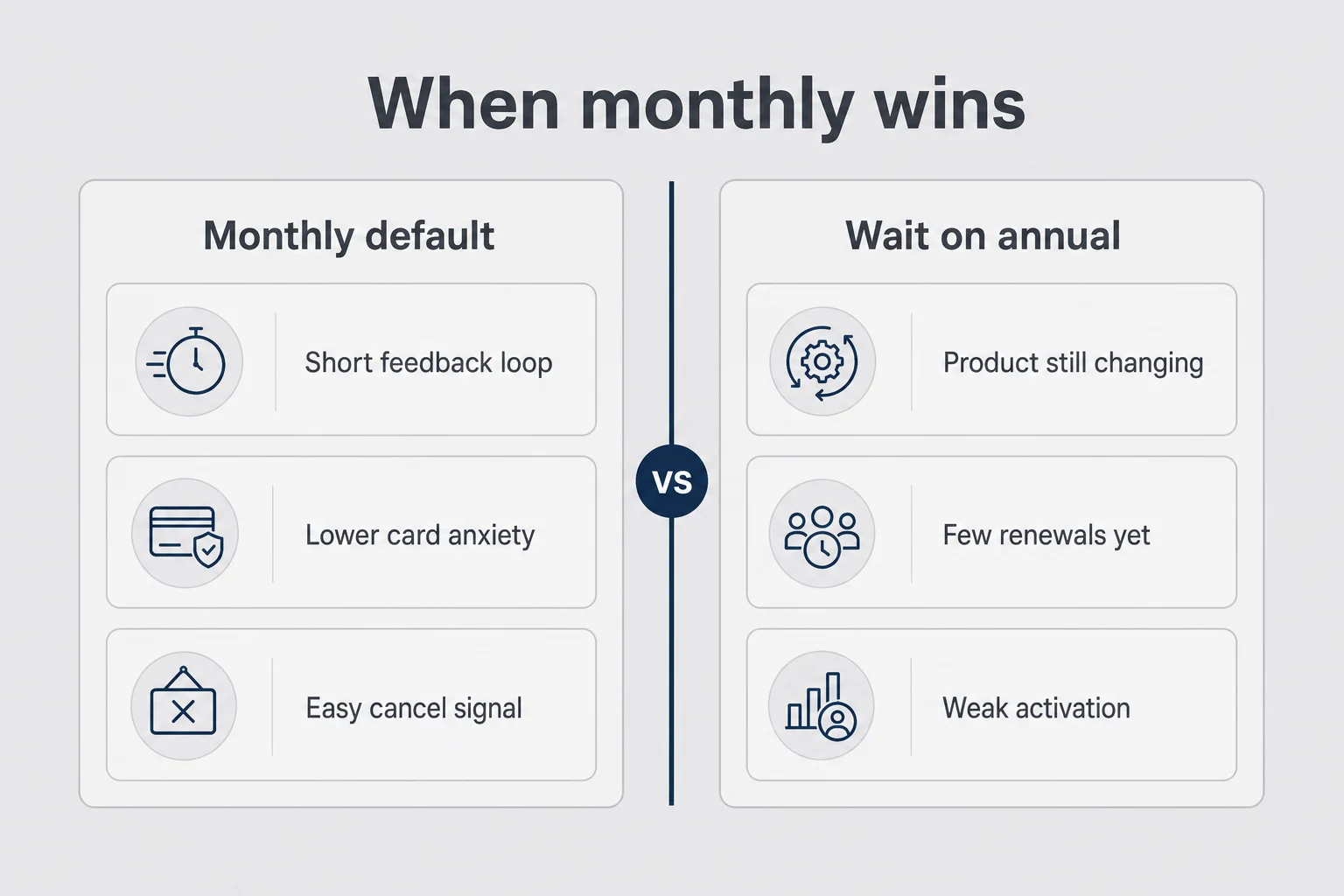
Monthly is not the "weak" option. For a lot of micro-SaaS products, especially early ones, it is the honest option.
Monthly keeps the learning loop short. Someone pays, uses it for three weeks, and either renews or leaves. That feedback is ugly and useful. Annual stretches the feedback until you have forgotten what you shipped in March.
I like monthly while I am still wrong about the product in important ways. Wrong about which feature is the real job. Wrong about who the buyer is. Wrong about whether people need a weekly habit or a once-a-quarter rescue tool. Those mistakes are cheaper when the contract is thirty days long.
Monthly also matches how a lot of small buyers actually approve spend. A $39 charge hits a card. A $390 charge makes someone ask a co-founder, a spouse, or their own anxiety. If your buyer is a solo operator or a tiny team, forcing annual as the only path can crush conversion even when the product is fine.
I stick with monthly as the default when I do not yet have people renewing, when the product still changes shape every couple of weeks, when the price is so low that the annual total feels like a weird lump for a tiny tool (think under about $20/month), or when I am still fiddling with trial length and card-upfront rules. Those are learning problems. Annual does not accelerate learning. It delays the grade.
There is also a quieter reason. Monthly customers who stay are teaching you something annual customers cannot teach as fast: what keeps people around when leaving is easy. If you only study annual cohorts, you will overestimate stickiness and underestimate onboarding debt. The person who could cancel with one click and still pays again next month is giving you a cleaner signal than the person who prepaid in January and forgot your login by April.
My bias: launch with monthly as the default path. Add annual as an option once the product has a pulse. Push annual harder after you have evidence people stick, not before.
Caveat, because there is always one: if you sell to companies with annual budgets and procurement habits, they may prefer yearly invoicing. That is a B2B buying process issue, not a growth trick. A five-person agency that budgets software once a year is not "more loyal." They are organized. In that case annual can be the expected packaging earlier. Still do not use lock-in to paper over weak activation. A purchase order does not fix a confusing first session.
Annual vs monthly saas pricing: the math that matters
Annual vs monthly saas pricing arguments online are usually ideology with a spreadsheet costume. The useful version is smaller. You only need two numbers and one uncomfortable question.
The two numbers: your monthly price, and how many months a typical monthly customer actually pays before they cancel.
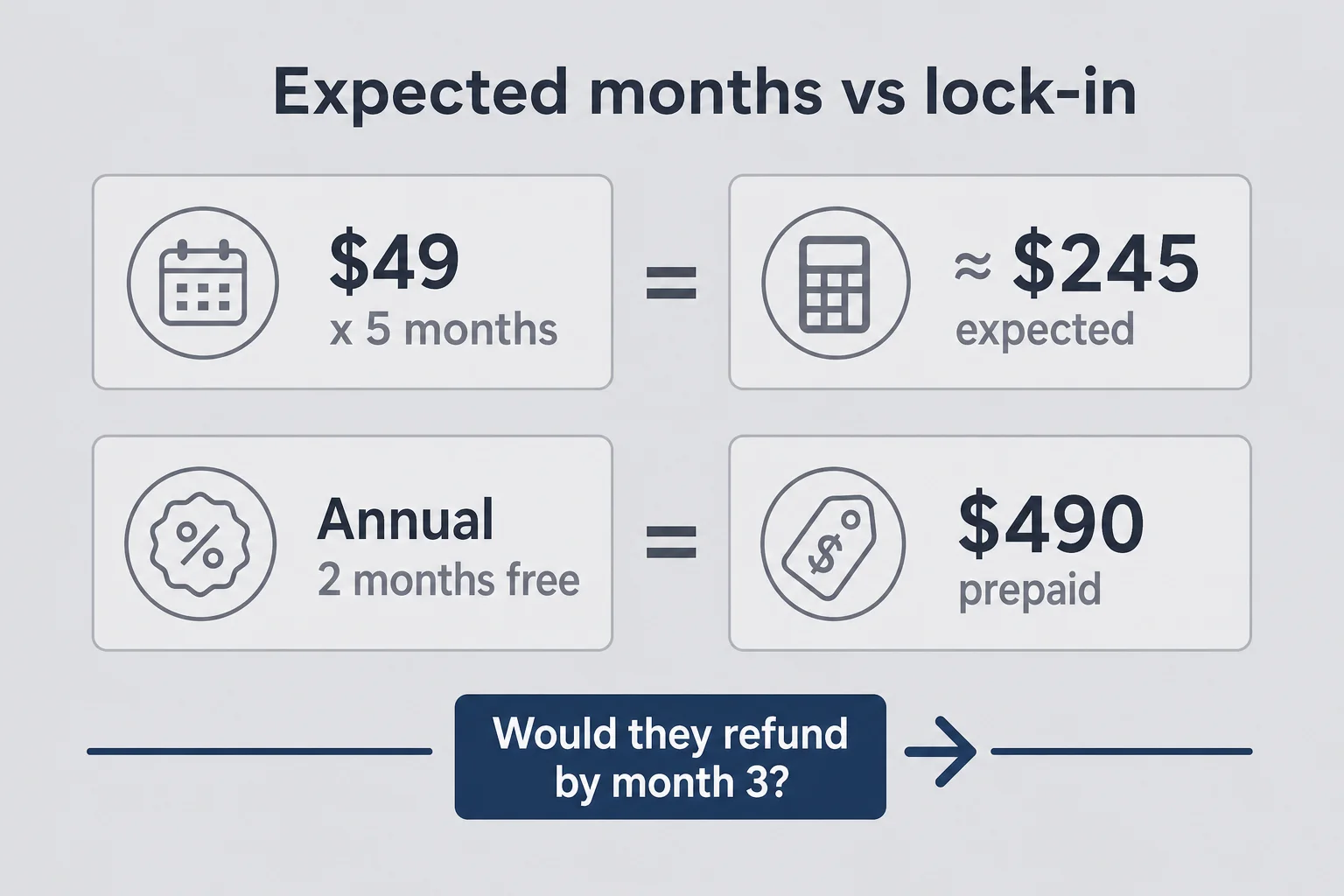
The uncomfortable question: if that customer had paid annually up front, would they have asked for a refund by month three?
Expected months paid vs twelve months locked
Say your plan is $49/month. Over a perfect year that is $588. Nobody is perfect.
If your average monthly customer lasts about five months, expected revenue from that person is roughly $245 before you get romantic about LTV models. An annual plan at two months free is $490. On paper, annual looks like a huge win against a five-month average.
But only if that annual buyer would have been a long-term user anyway. If they would have churned at month two on monthly, the annual charge is not "retained revenue." It is a refund waiting to happen, or a quiet resentful customer who never opens the app again and leaves a one-star review in December.
A cleaner way to decide the discount is to price annual just above what you expect to collect from a typical monthly journey, then leave a little room so the customer still feels a deal. If people usually stick six to eight months, "two months free" is often fair. If people usually stick three months, a fat annual discount can still look profitable until the refunds start.
I do not pretend this is precise when you have twelve customers. It is directional. Use the ugly average you have, not a fantasy LTV from a Twitter thread.
A worked example helps more than a slogan. Imagine thirty monthly customers at $49. If ten of them cancel by month three, ten last about six months, and ten become the boring loyal ones who stick a year-plus, your blended average is not "everyone is an annual candidate." Your blended average is a mix. The annual offer should mostly target the third group and the better half of the second. If your switch email blasts all thirty the week after signup, you are optimizing for Stripe notifications, not for fit.
Another angle founders miss: annual changes your concentration risk. One $490 charge feels great. Five refunds in a week after a bad release feels like a punch. Monthly spreads pain. Annual bunches it. That is fine if your product is stable. It is a reason to wait if you are still shipping breaking changes on Friday nights.
Cash today versus revenue recognized later
Cash is what pays your rent. Revenue recognition is what your accountant cares about. Solo founders mix them up constantly.
When someone pays $490 for the year, your Stripe balance looks great on Tuesday. That does not mean you "earned" $490 of business health on Tuesday. You earned a prepaid obligation to keep the product useful for twelve months.
For bootstrapping, cash today still matters a lot. One solid annual payment can cover a hosting bill, a contractor weekend, or a month of runway you were about to stress about. I have paid a Redis bill with an annual checkout and felt briefly competent. Then I remembered I still owed that customer eleven months of uptime and answers.
Just do not spend every annual dollar as if next month's support load disappeared. Annual cash is easy to treat like profit because it arrives in a chunk. Profit is what remains after you keep the promise.
If you want a simple operating rule: treat a meaningful chunk of each annual payment as reserved for the months ahead. Mentally, I like keeping at least half of a new annual charge off-limits for "fun" spending until the customer has been active for a couple of months. Not a formal accounting policy. A personal brake pedal.
If you use Stripe, this is also why I like separate Price objects for monthly and yearly on the same Product. Your billing setup stays boring: one product, two prices, webhooks that write the cadence into your database. When someone asks "am I yearly or monthly?" you should be able to answer from a field, not from archaeology in the Dashboard.
How much yearly plan discount saas founders should offer
People ask for a number because numbers feel like certainty. Here is the range I actually use, and then the cases where I break it.
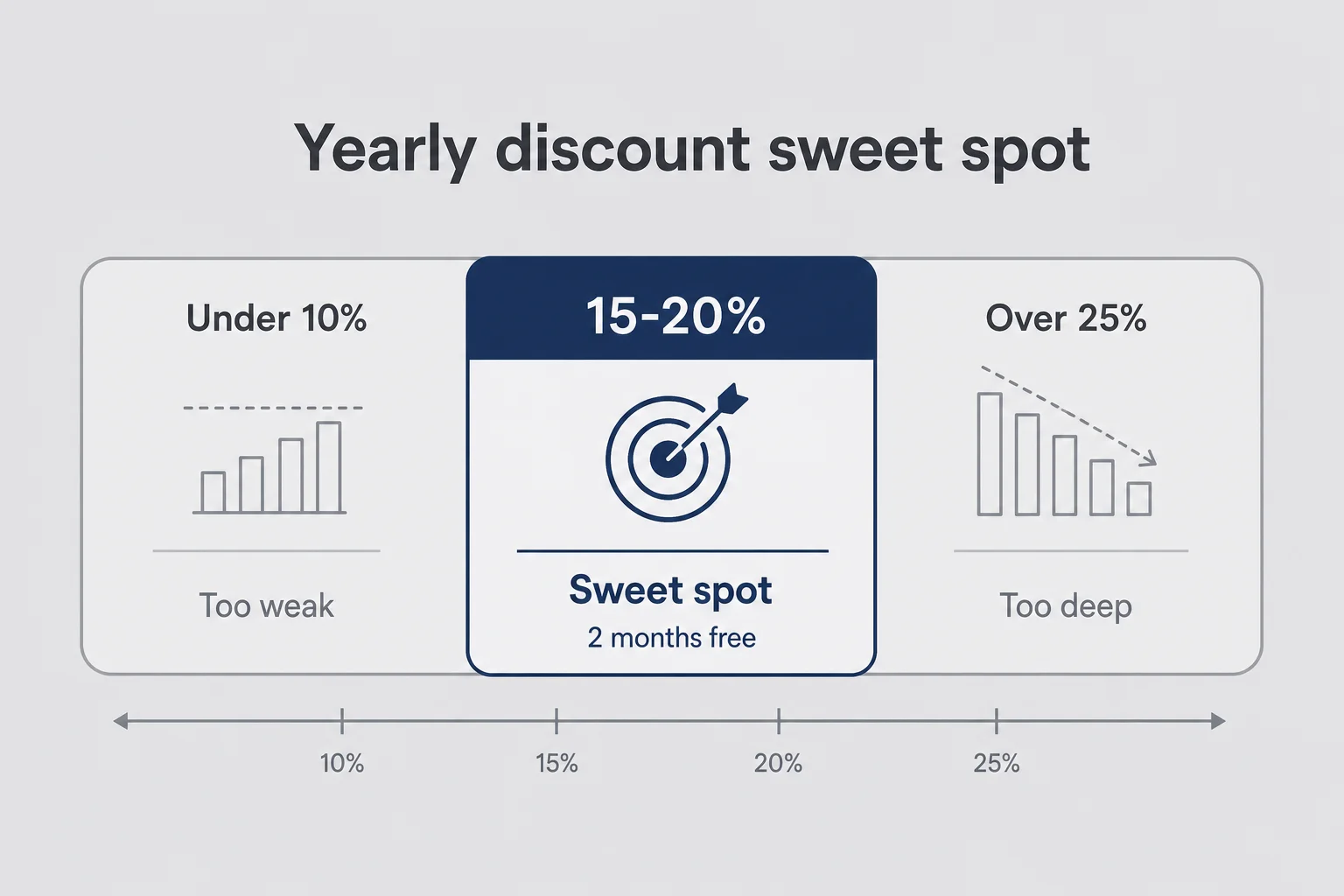
For most B2B-ish micro-SaaS products in the $29 to $99/month band, the yearly plan discount saas range I trust is about 15% to 20%. "Two months free" lands in that zone and is easier to understand than "17% off."
Under about 10%, almost nobody bothers. The savings do not clear the mental cost of committing. Over about 25%, you are often training buyers to wait for a bigger coupon, and you are selling next year's work too cheap.
Two months free vs a percentage
"Two months free" beats "save 16.7%" almost every time I have watched people choose. Humans are bad at percentages and good at months.
If your monthly price is $39, two months free means $390/year, or $32.50 effective per month. Say that out loud on the page. Do not make people do homework.
If your monthly price is $79, two months free is $790/year. That is a real number. Some buyers will still want monthly. That is fine. The annual option is a filter, not a moral test.
I avoid weird discounts like 13% or 22% unless the math is forced by a clean round yearly total you care about. Round prices reduce support questions. "$468/year" looks like a formula spat it out. "$490/year" looks like a person chose it.
When a deeper discount is a mistake
Deeper discounts feel brave. They are often laziness with a sale badge.
I go deeper than 20% only in narrow cases: a true migration offer for long-term monthly customers you are thanking, a temporary bridge after a price raise, or a niche where competitors have trained the market to expect "buy 8 months, get 12." Even then I treat it as a campaign, not the forever list price.
What I do not do: invent a 40% annual discount because conversion felt soft last week. Soft conversion is usually positioning, trust, or onboarding. Discounting the year will not fix a homepage that still talks about features nobody asked for.
Also watch the absolute dollars. Twenty percent off $19/month is pocket change. Twenty percent off $199/month is a serious concession. The percentage can be identical while the business meaning is not.
I also look at support cost before I get cute with discounts. If your product needs white-glove help in the first month, a deep annual discount can leave you underpaid for the expensive part of the relationship. The customer locked in cheap. You still did the hard onboarding work at full intensity. In those cases I would rather keep the annual cut modest and improve activation than buy a year of underpriced labor.
One more anti-pattern: stacking discounts. Annual plus "launch week" plus "newsletter code" plus "I know a guy." Pretty soon nobody knows what the real price is, including you. Pick one annual offer. Make it the offer. If you run a temporary campaign, put an end date on it and mean it.
Pick the frame, then lock it
Decide whether you sell "two months free" or "save 20%" and use the same frame on the pricing page, in Checkout, and in switch emails. Mixed frames make people distrust the math.
What to show on a saas annual pricing page
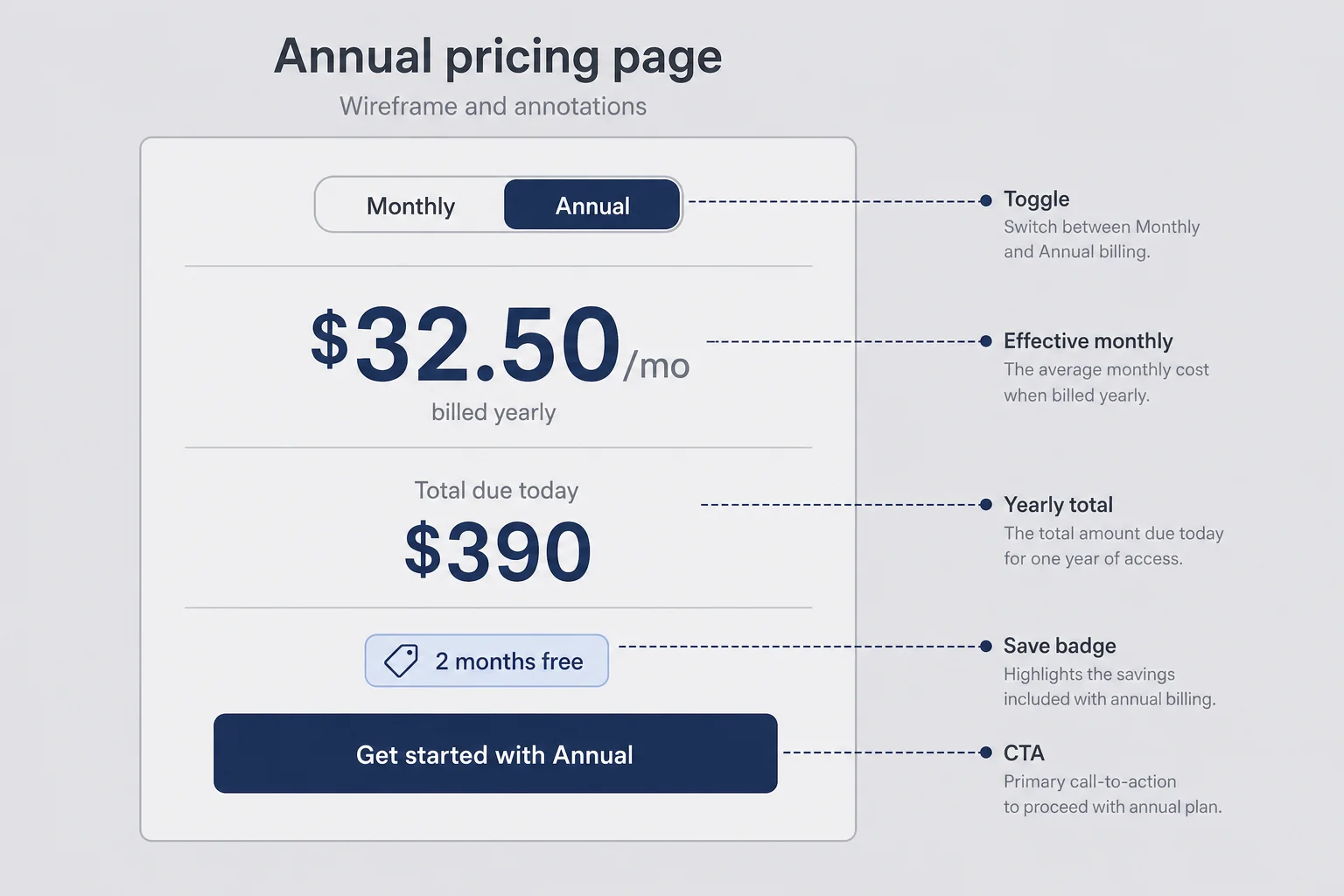
A saas annual pricing page fails in predictable ways. Too many toggles. Hidden monthly. Annual total with no monthly equivalent. Or the opposite: a monthly price so loud that annual looks like a footnote for accountants.
You want one clear comparison and one clear next step.
I sketch the page the same way every time. One plan name. One plain sentence about who it is for. Monthly price. Annual price with savings. One button. If I need a second plan, I add it only after the first plan has customers. Annual does not fix a pricing page that already has four tiers and a "contact us" fog machine.
Default toggle and the "save" badge
Early on, I default the toggle to monthly. Uncertain buyers convert better when the smaller commitment is the first thing they see. Annual sits next to it with a quiet badge: "2 months free" or "Save 17%."
Later, after retention looks real, I am comfortable defaulting to annual. Not before. Defaulting to annual while your product still has sharp edges is how you manufacture refund week.
The badge should be short. Not a paragraph. Not a confetti animation. A small savings signal next to the annual price is enough. If you need fireworks to sell the year, the discount is doing too much of the selling.
I have also seen founders put annual in a giant gold card and monthly in gray fine print. That can work for a mature product with strong reviews and a clear job to be done. For a young micro-SaaS, it often reads as pressure. Pressure converts some people and creates refund fuel in others. I would rather win the annual sale with clarity than with visual bullying.
Effective monthly vs total yearly
Always show both the effective monthly on annual ("$32.50/mo billed yearly") and the total charged today ("$390 today"). People compare in months. Cards charge in totals. If you only show one, someone will feel tricked.
I also keep the monthly plan visible without a scavenger hunt. Buried monthly options are a conversion trick that turns into trust debt. Solo founders cannot afford trust debt. You do not have a brand team to clean it up.
A small copy detail that saves support tickets: say "billed yearly" near the effective monthly number. Without that phrase, people argue they were promised $32.50 charged every month. Yes, even if the total is on the page. Write for the skimmer.
If you use Stripe Checkout or a Billing Portal flow, make sure the copy in Checkout matches the page. Nothing kills an annual upgrade like a pricing page that said $390 and a Checkout session that says something else because you wired the wrong Price ID. Test the happy path yourself with a real card in test mode, then once in live mode with a tiny price if you are nervous. The fifteen minutes feel dumb until the alternative is an angry email that starts with "your site lied."
When to introduce annual (and when to wait)
Timing matters more than the exact discount.
I wait until I have a handful of monthly customers who renewed at least once (twice is better), until support is no longer mostly "how do I do the basic thing?", and until I can describe the product's job in one sentence without apologizing for half-built corners. Those are boring milestones. Boring milestones are how you avoid theatrical pricing.
Before that, you can still list annual on the pricing page as an option for the rare confident buyer. Listing is fine. Pushing is different. A quiet yearly Price in Stripe that almost nobody clicks is harmless. A homepage campaign screaming "LOCK IN 40% OFF FOREVER" while the app still 500s on invite links is not strategy. It is coping.
In the first couple months after paid users show up, I keep monthly as the default, leave annual optional, and almost never promote it. Once a renewal cohort exists, I keep monthly default and start a polite switch offer to engaged monthly users. After the product feels stable for a quarter, I consider making annual the public default, still with monthly one click away.
Notice what is missing from that sequence: a launch-day annual push, a Product Hunt-only coupon, and a panic discount after a slow week. Those are calendar events pretending to be pricing strategy.
If you are still changing your core workflow every sprint, annual is prepaid churn with extra steps. Fix activation and the first-week experience first. Your onboarding problems will not be solved by a yearly invoice. Neither will a weak cold email list or a landing page that still leads with your tech stack.
One more timing trap: introducing annual the same week you raise prices. You can do both, but do not stack confusion. Raise first for new customers, or offer annual lock-in at the old rate as a thank-you to existing ones. Mixing three pricing stories in one email is how support weekends are born.
A simple test I use before I promote annual hard: would I be comfortable if ten strangers paid for a year today and then ignored the product until month eleven? If that thought makes my stomach drop, I am not ready. If that thought feels like a normal cost of doing business because the product already delivers without me hovering, I am closer.
Switch monthly to annual billing without sounding desperate
The best annual conversions I have seen did not come from a homepage toggle. They came from a calm note to people who already liked the product.
That is the whole game when you switch monthly to annual billing: ask the people for whom the switch is obviously rational.
Who to ask first
Start with people who already renewed at least once on monthly, logged in recently or used the core feature recently, are not currently in a support fight with you, and are not sitting on a special grandfather deal you promised to leave alone.
Skip the person who signed up four days ago and has not finished setup. They do not need a loyalty discount. They need a win inside the product. Offering them annual is like proposing marriage on the second date because the restaurant had a prix fixe.
If you have even a crude sense of usage, prioritize the top third of active monthly accounts. Those are the people for whom twelve months is a convenience, not a leap of faith. A founder with twenty monthly customers does not need a fancy cohort tool for this. Export a CSV. Sort by last active. Use your eyes.
I also avoid asking someone who just had a billing failure or a confusing invoice. Fix the trust nick first. Annual is a commitment conversation. Commitment conversations go badly when the last email they got from you was a dunning notice written like a parking ticket. (If failed payments are already a theme in your business, sort that path before you chase yearly upgrades. The dunning work is related cash hygiene, not a side quest.)
The email that doesn't feel like a fire sale
Keep the email boring. Boring converts better than fake urgency.
Something in this shape has been enough more than once:
Subject: Want two months free if you switch to yearly?
Hey [name],
You've been on the monthly plan for a bit. If you'd rather pay once and save two months, yearly is [annual_price] today (about [effective_monthly]/mo).
Same product. Just fewer invoices.
Switch here: [link]
If monthly is easier, ignore this. No hard feelings.
No "only 14 hours left." No "founders special." No novel about your burn rate. If you need invented scarcity to make annual look good, the discount is wrong or the product confidence is wrong.
If they say no, leave them alone for a long time. Repeated annual nagging makes the product feel needy. Once or twice a year is plenty for a quiet reminder. Weekly banners inside the app are how you train people to ignore you.
For the checkout link, use a Stripe Checkout session or Customer Portal flow pointed at the annual Price. Do the proration math carefully or keep it simple: cancel monthly at period end and start annual now, or use Stripe's subscription update with proration if you already trust that path. Simple and correct beats clever and wrong.
A practical detail: tell them what happens to their current monthly period. "We'll apply unused time" or "yearly starts today and replaces monthly" should be explicit. Ambiguity here creates the exact support tickets you were trying to reduce by moving people to annual.
Refunds, mid-year cancellations, and the awkward cases
Annual billing forces you to write a refund philosophy before you need one. If you wait until someone is angry, you will negotiate from panic.
My default for a self-serve micro-SaaS is simple. In the first 7 to 14 days, I refund in full if they barely used it and ask in good faith. After that, it is case by case. If the product was down or I broke a promise, I refund. If they just changed their mind in month five after heavy use, I am much less automatic about it. Chargebacks I treat as a process failure. Make cancellation and refund requests easy enough that people do not need Visa to get your attention.
Publish a short policy in your terms or a help doc. Ambiguity is expensive. People invent the policy that benefits them when you have not stated yours. "We'll be reasonable" is not a policy. It is a hope.
Mid-year "I want to cancel but keep access until the end" is usually fine. That is what they paid for. Mid-year "I want a pro-rated refund because I found a competitor" is where you decide what kind of business you are. I lean toward protecting goodwill on small accounts and being firmer when usage was deep and the request is pure buyer's remorse.
There is a version of this that is not about money. Sometimes the annual customer is unhappy because a promised integration slipped, or because your roadmap turned left. That is not a pricing dispute. That is a trust dispute. Refunding may be cheaper than arguing, even if your formal policy could let you keep the cash. Solo founders live on reputation longer than they live on any single invoice.
Also plan for the opposite awkward case: the customer who wants to switch from annual back to monthly early. I rarely allow that as a free transformation of prepaid into a discount monthly forever. Either they keep annual until term end, or you refund under your policy and they resubscribe monthly. Endless plan gymnastics become a second product.
If your volume is tiny, you can handle edge cases by hand. That is a privilege of being small. Write down what you decide so the next edge case does not invent a new precedent every time. A note in your own Notion titled "refund decisions" sounds unglamorous. It will save you from becoming the founder who refunds everyone who uses the word "disappointed."
What annual billing hides about churn
This is the section founders skip because the chart looks prettier without it.
Annual plans suppress visible churn. Fewer cancel events. Smoother MRR. A dashboard that says "we are stable" while a pile of annual customers have not logged in since February.
If you only watch logo churn, annual will flatter you. Watch product engagement too. A simple monthly check: how many annual customers used the core feature in the last 30 days? If that number slides while MRR looks flat, you do not have retention. You have prepaid silence.
I once saw a spreadsheet where annual "churn" looked almost cute for nine months. Then renewal week hit and a third of the cohort vanished. The product had not suddenly gotten worse in week fifty-one. The customers had been gone in spirit since spring. The billing system just had not been invited to the funeral.
Renewal month becomes the real exam. A cluster of annual renewals failing or canceling at month twelve is not a random bad week. It is delayed truth.
I pair annual billing with a light habit of looking at activation and returning use, the same way I would on monthly. The metrics that matter for a solo founder do not disappear because the invoice is yearly. They just get easier to ignore.
Another hidden cost: voluntary churn and involuntary churn still exist, but the shape changes. Failed cards matter less month to month when you billed once. Instead you get more weight on "do I renew this year?" and on refund requests after long quiet periods. Different failure mode. Same need to pay attention.
There is also a human version of hidden churn: the annual customer who feels stuck. They stop answering emails. They stop using the product. They wait out the clock. That is not a win just because Stripe still shows active. If you care about reducing churn for real, treat silent annual accounts as a warning light, not as a vanity trophy.
If annual is working, you should see two things together: better cash, and annual customers who still show up in the product. One without the other is a story you are telling yourself.
A practical ritual that takes ten minutes a month: open your list of annual subscribers, sort by last active, and personally nudge the quiet ones with something useful, not a sales pitch. "Saw you have not exported a report in a while — want a hand?" is retention work. "Don't forget you are locked in until December!" is how you make people resent the receipt.
Questions founders ask me about annual plans
How much annual billing discount should a micro-SaaS offer?
Fifteen to twenty percent off the monthly rate is the range most solo founders can live with. Framing it as two months free is usually clearer than a raw percentage. Below about ten percent, almost nobody switches. Above twenty-five percent, you are often buying cash flow with margin you will miss later.
Should I offer annual pricing from day one?
Offer the option early if you want, but do not push it hard until you have monthly customers who renewed at least once or twice. Annual lock-in before product-market fit turns confused buyers into refund tickets and angry reviews. Monthly is still the better learning loop while the product is changing every week.
Does annual vs monthly SaaS pricing change your cash flow?
Annual wins on cash today. You collect most of the year up front instead of waiting for twelve separate charges. The trade-off is deferred revenue on the books, higher refund risk if someone hates the product in month three, and churn signals that get quieter until renewal. Use annual to buy runway, not to paper over a product people would cancel next month.
How do I switch monthly customers to annual billing?
Start with people who already renewed monthly and use the product regularly. Send a short email with the yearly price, the effective monthly cost, and one clear button. Skip countdown timers and invented urgency. Offer the same discount you show on the public pricing page so existing customers do not feel like second-class buyers.
What should a SaaS annual pricing page show?
Show both cadences side by side or behind a clear toggle. Put the effective monthly price next to the annual total. Add a short savings line such as two months free. Default to annual only after you trust retention. Keep the monthly path obvious so uncertain buyers are not trapped into a twelve-month bet.
Cash now is nice. Product fit still comes first
I like annual billing. I like waking up to a Checkout notification that covers a dull, important bill. I like fewer cancel buttons clicked on random Tuesdays.
I do not like pretending a discount is a business model.
Get the product to a place where monthly customers renew because the thing helps them. Set a price you can say out loud without flinching. Then offer an annual billing discount that is clear, moderate, and easy to understand. Put it on the page without tricks. Invite the people who already trust you to switch. Keep a refund policy you can defend when you are tired.
If the yearly plan only works when you hide monthly, inflate the savings, or ignore quiet customers until renewal day, you did not build a better pricing system. You built a delay.
The founders who get this right treat annual as a thank-you and a cash tool for people who already voted with renewals. The founders who get this wrong treat annual as a patch for weak retention and then act surprised when December is full of cancellations and side-eye.
Charge for the year when the year is a fair bet for both of you. Everything else is costume jewelry on a pricing toggle.




Comments