Two Hundred Emails and Still Nobody to Launch To
How to run a pre-launch waitlist as a solo founder without vanity signup counts: one-page capture, qualifying questions, and the emails that turn a quiet list into paying customers.
 By Reese26 min read
Listen to this article
23:15AI-generated podcast-style overview of this article (not a word-for-word narration).
I once watched a founder celebrate two hundred waitlist signups like he had closed a funding round. He screenshotted the counter. He posted it. Then launch week arrived and he sent one email: "We're live! Sign up here." Twelve opens. One reply. Zero paid customers. The list was real. The relationship was not.
That is the failure mode I see over and over with a waitlist micro saas solo founder setup. People treat the form like a scoreboard. They optimize for the number on the page instead of the conversation that number was supposed to start. A quiet list you actually talk to beats a loud list you ignore until "launch day."
The funny part is he had done real work. The page looked fine. The problem statement was clear enough. What he skipped was every touch between "thanks for joining" and "buy now." Strangers do not stay warm on their own. Lists cool off the same way inboxes do: one ignored week at a time.
I am not a developer. I have spent years on the growth side of small B2B SaaS, freelancing for indie founders, and shipping side projects that lived or died on distribution. Waitlists are useful when you use them as a warm launch list. They are theater when you use them as proof you are busy.
If you are still figuring out whether anyone wants the product at all, start with how to validate a micro-SaaS idea before you polish a capture page. If the product is close and you need strangers to click something, micro-SaaS landing page for solo founders covers the conversion craft. This post is the middle piece: how to build a waitlist before launch, keep it alive with waitlist to launch email, and turn fifty real names into people who show up when you finally ask for money.
Waitlist micro saas solo founder: what you are actually building
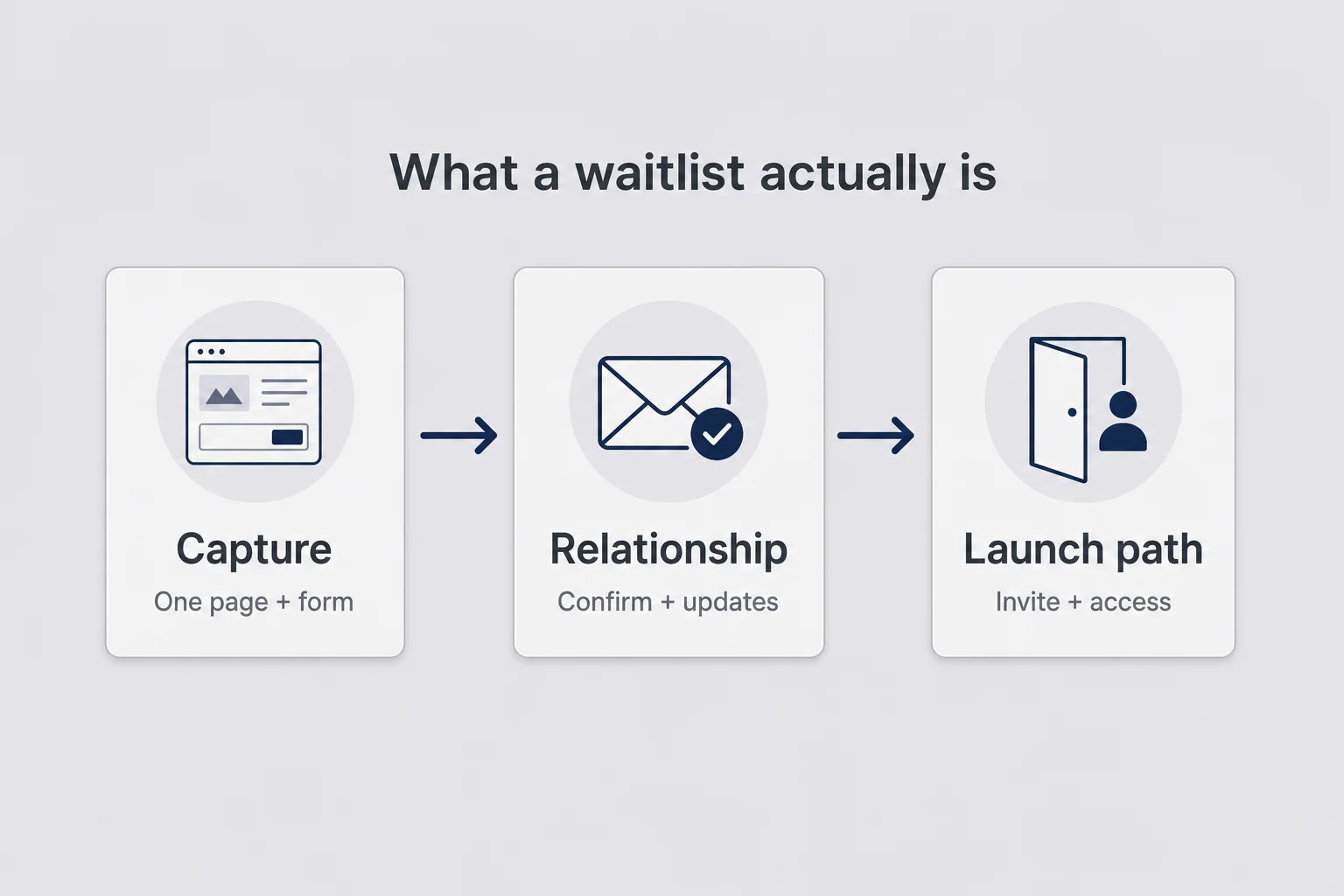
A waitlist is not a product. It is a permission slip. Someone said, "Tell me when this exists," which is a softer commitment than "I will pay you next Tuesday," but harder than a like. Your job as a waitlist micro saas solo founder is to treat that permission with enough respect that the person still remembers you when the product is ready.
I think about a waitlist as three things stacked:
The capture surface. Usually a short page or a form on your site. One promise. One field or two. No feature tour pretending the product is finished.
The relationship layer. Confirmations, updates, occasional questions. This is where most founders disappear for three months and then wonder why launch day feels like emailing a graveyard.
The launch path. Early access, founding pricing, a clear invite. The list only matters if it ends in a decision: try, buy, or politely leave.
When those three pieces are connected, a waitlist becomes a warm launch. When only the first piece exists, you have a spreadsheet with hopes attached.
I have also seen the opposite mistake: founders who refuse to put up any form until the product is "ready." Ready is a moving target. If the problem is clear and you can describe the outcome without lying, a small waitlist is a useful parking place for interest while you finish the boring parts. Billing. Onboarding. The one edge case that makes demos awkward. You are allowed to collect names before the checkout button works. You are not allowed to pretend those names are customers.
A list is not a launch plan
I have seen founders confuse "people signed up" with "I know how to launch." They are different skills. Signup is distribution plus curiosity. Launch is timing, offer, and follow-through. You can nail the first and still fumble the second if you never planned the emails, the early access window, or what "founding member" actually means.
Write the launch invite before you obsess over the form design. Seriously. Draft the email that says the product is ready, what they get, what it costs, and what to do next. If you cannot write that email yet, you are not ready to collect emails. You are collecting a problem for Future You.
A launch plan for a solo founder does not need a war room. It needs dates, a short sequence, and a page that can take payment or trial signups without apologizing. The waitlist feeds that plan. It does not replace it. If you want the wider launch framing, how to launch a micro-SaaS is the sibling piece. This article stays on the list itself.
When a waitlist helps (and when it is theater)
A waitlist helps when the product is not ready to sell but the problem is clear enough to describe. You need a place for warm interest to land while you finish billing, onboarding, or the one feature that makes the demo stop being embarrassing. You also need a reason to keep talking to people who already raised their hand.
A waitlist is theater when you use it to delay talking to customers. "I will interview people once I hit five hundred signups" is a stall dressed up as strategy. Five honest conversations beat five hundred unread emails. A waitlist is also theater when the page promises a product you have not scoped, priced, or even named clearly. Curiosity without a sharp promise produces junk leads.
Use a waitlist if you can answer three questions in plain English: who it is for, what painful job it removes, and roughly when you expect to invite people in. If those answers are fog, fix the fog first. The form will not clarify your positioning for you.
There is one more case where a waitlist helps even after you could take payments: soft capacity. You are solo. You can only onboard ten people this month without dropping support quality. A waitlist with a clear "I will invite the next batch on the first of the month" message is an honest throttle. That is operations, not hype. Just do not invent a fake queue length to manufacture FOMO. People notice.
The pre-launch waitlist saas trap most founders fall into
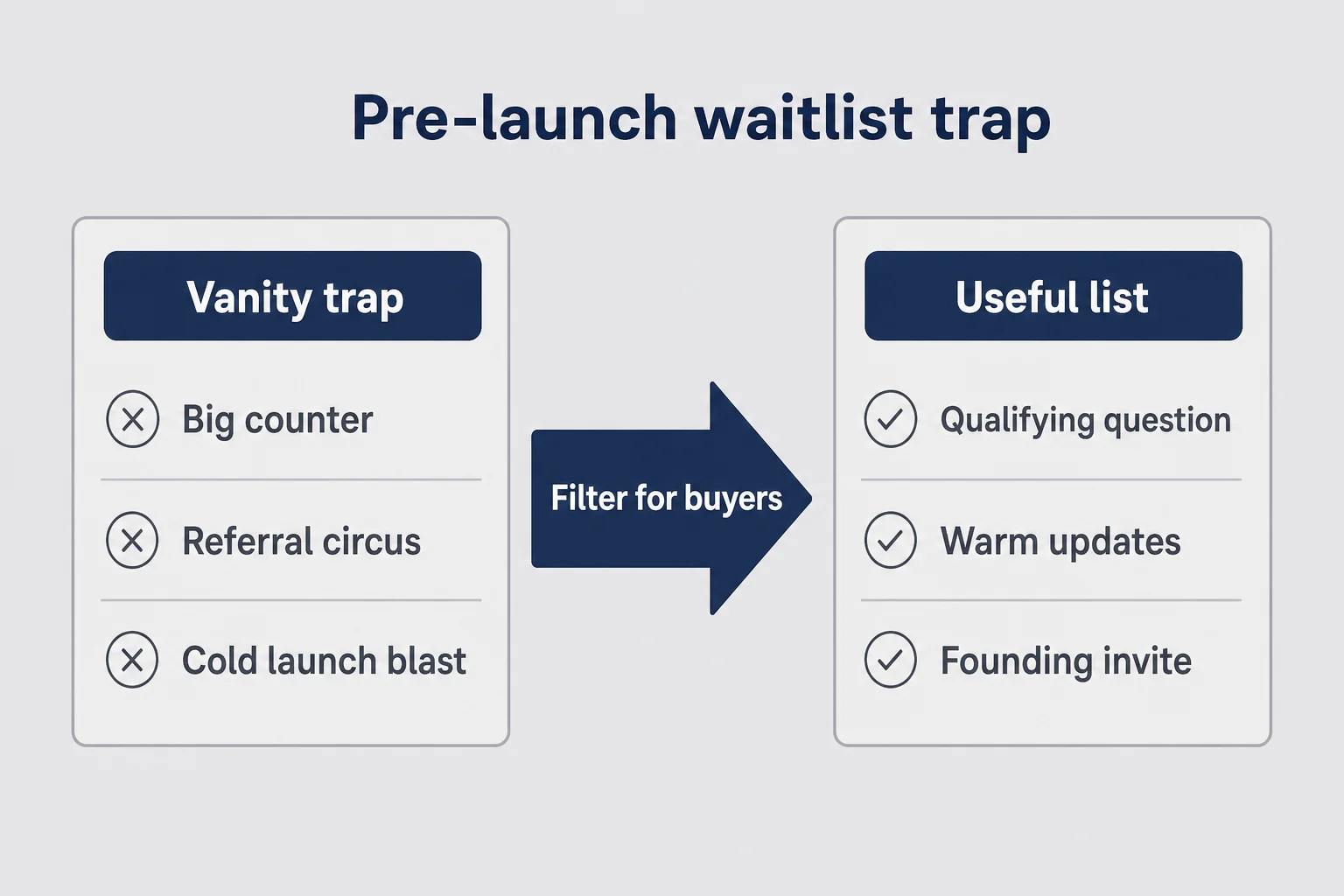
The pre-launch waitlist saas trap is simple. You copy the Consumer App Playbook. Referral ladders. Position numbers. "Invite three friends to move up." It looks smart because big consumer launches do it. For a $29 per month B2B tool aimed at a niche of a few thousand buyers, it often poisons the list.
I watched a founder hit twelve hundred signups with a viral waitlist widget. Launch conversion was worse than a previous project that had ninety emails from niche communities. The big list was full of people chasing free stuff and leaderboard status. The small list was full of people who had the workflow pain in their calendar every Monday.
Vanity growth is sticky because it feels like marketing. Real growth for a micro-SaaS usually looks quieter: a useful post, a careful outreach batch, a Reddit comment that earns a reply, a waitlist that grows slowly and answers one qualifying question.
Collecting emails is not validation
An email address is cheap. People give it away for PDF checklists they never open. Validation, for a solo founder, looks more like someone describing the problem in their own words, or putting a card on file, or booking a call without you begging. Signups can support validation. They are not the whole proof.
If your waitlist page has zero questions, you are measuring interest at the lowest possible bar. Add one question that forces a little specificity. What tool do you use today? How often does this break? Would you pay for a fix if it existed next month? You do not need a ten-field survey. You need one signal that separates "curious browser" from "person with the problem."
I treat waitlist replies the way I treat cold email replies. A short, honest answer is gold. A blank signup is a maybe. Build for the gold first.
The vanity number that feels like progress
Founders refresh the counter the way they used to refresh analytics. The number goes up. Dopamine arrives. Shipping slows down because the dashboard feels like work. I have done this myself with side projects. It is comforting and mostly useless.
Pick a quality threshold instead of a vanity target. Example: twenty people who answered the qualifying question and opened at least one update email. Or ten who replied to a personal note. Those thresholds force behavior. A target of "one thousand signups" forces you to widen the message until it means nothing.
If you need a number for your own sanity, make it small and attached to action. Fifty engaged names is a real warm launch for many micro-SaaS products. Two thousand cold names is a mailing list with amnesia.
Another trap: copying a consumer app waitlist page that promises "something big is coming" with zero specifics. Mystery can work for entertainment products. For B2B tools, mystery reads as unfinished thinking. Name the job. Name the audience. Leave the exact feature list fuzzy if you must, but do not leave the problem fuzzy. Vague promises attract vague people.
Build a waitlist before launch without a referral circus
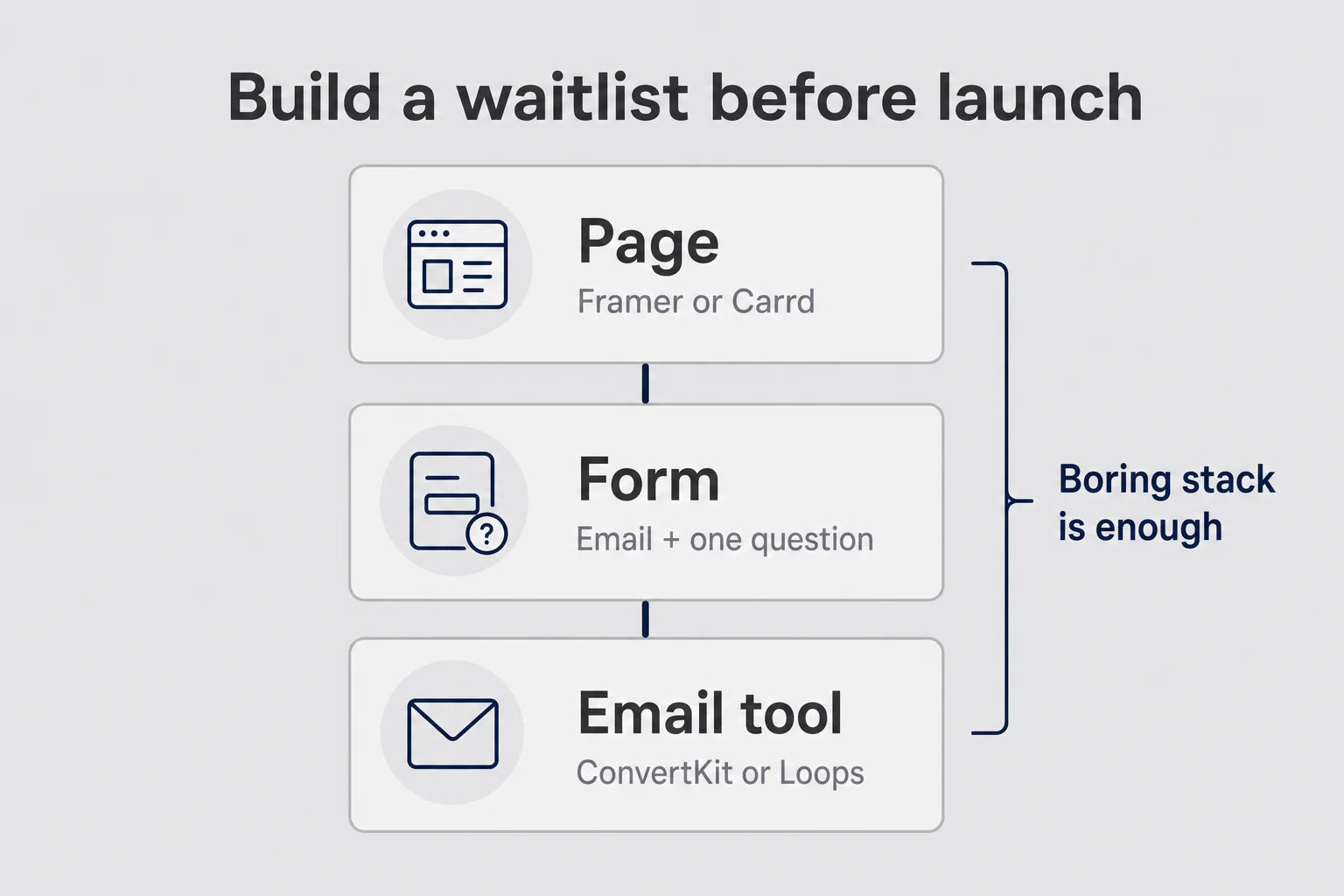
You can build a waitlist before launch with tools you already know. You do not need a viral growth platform, a custom queue, or a leaderboard that turns your early adopters into marketer recruits. You need a page, an email tool, and a habit of writing to the list before the product is perfect.
My default stack for clients and for my own side projects looks boring on purpose. Framer or Carrd for the page. ConvertKit or Loops for the list. A simple form that dumps into a segment called "waitlist." Optional: a Typeform or Tally redirect for one or two questions after signup. That is enough to run a clean pre-launch.
Dedicated waitlist products can be fine. Some of them are excellent. Just notice what they optimize for. If the first tutorial is "enable referrals," ask whether referrals match your buyer. For a narrow B2B tool, they often do not. For a consumer habit app, maybe. Match the mechanic to the audience, not to the template.
One page, one promise, one form
The capture page should feel unfinished in a good way. You are not shipping a full product site. You are making a clear invitation. Headline that names the outcome. Two or three sentences of context. Form. Optional social proof if you have any that is real (a quote from a discovery call, a logo if someone gave permission, a note that you are building in public). Stop there.
Resist the urge to add a fake feature grid. People can smell mockups that promise six modules when you have one half-working flow. If you need visuals, show the painful before state or a simple sketch of the after. Honesty converts better than theater at this stage.
One form field is ideal. Email. If you add a second field, make it the qualifying question, not "company size" theater for a product that does not care yet. Every extra field costs signups. Only pay that cost for information you will actually use in the first month.
Tools that are enough for a solo founder
Here is the practical bar. Can you export CSV? Can you send a broadcast? Can you tag people who clicked the launch email? If yes, the tool is good enough. If the tool locks your contacts behind a plan you cannot afford after launch, fix that before you grow the list.
I like owning the relationship in a proper email tool even if capture happens elsewhere. Waitlist widgets come and go. Your ability to email people who raised their hand should not depend on a trendy queue product surviving another funding round. Export early. Tag clearly. Keep a local backup if you are paranoid. Paranoia is underrated when the list is your whole warm audience.
Do not duct-tape seven apps because a Twitter thread said "stack." Two tools that you understand beat a Rube Goldberg machine you abandon on week three.
If you already have a site on Framer or Webflow, a waitlist page can live as a single route with UTM parameters for each channel. That tiny habit pays off later when you wonder whether Reddit or your newsletter produced better replies. You do not need a full attribution suite. You need enough breadcrumb to learn which messages deserve more of your limited hours.
Your saas waitlist landing page needs one job
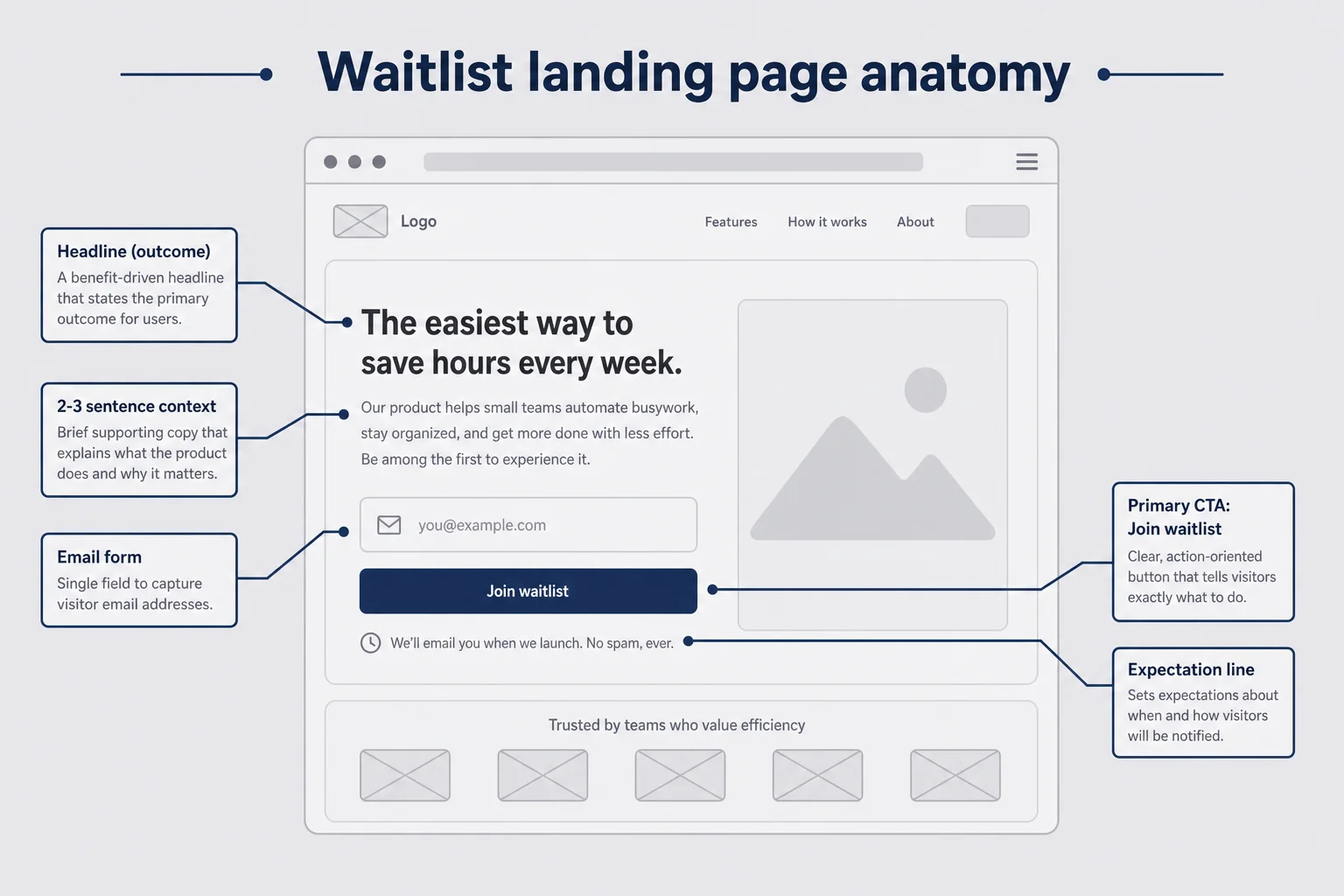
A saas waitlist landing page is not your future homepage. It is a focused ask. The job is to get the right person to raise their hand without confusing them into bouncing. That sounds obvious. Then founders paste their whole vision deck above the fold and wonder why the form sits empty.
Write the page for a skeptical stranger who has seven seconds and a calendar full of other tools. Lead with the problem in their language. Follow with the outcome you intend to sell. Ask for the email. Everything else is optional.
If you already have a fuller marketing site, do not force the waitlist into the nav as an afterthought. Give it a clean URL. Send traffic there on purpose. Homepages with six links leak attention. Waitlist pages should not.
Headline, proof, and the ask
Headline patterns that work at this stage are boring and specific. "Stop rebuilding the same client report every Monday." "Get early access to X for Y people who hate Z." Avoid "revolutionizing" anything. Avoid naming the category before you name the pain.
Proof can be thin and still honest. "Built with operators who currently use spreadsheets and Slack reminders." "Based on twenty discovery calls with freelance bookkeepers." You do not need a G2 badge. You need a reason to believe you are not inventing a problem from a weekend brainstorm.
The ask should be explicit. "Join the waitlist for early access." Not "Learn more." Buttons that hedge get polite ignores. Tell people what happens after they submit. "I will email you when beta opens, roughly in September. No spam. Unsubscribe anytime." Clear expectations reduce rage later.
What to leave off until you have a product
Leave off pricing tables you have not stress-tested. Leave off six integration logos you have not built. Leave off a changelog for a product that does not exist. Leave off a blog that redirects energy away from conversations.
You can mention an expected price range if it filters the right people. "Targeting around $29 per month" is useful honesty for B2B tools. Fake countdown timers are not. Scarcity you cannot defend will follow you into launch week when the same people feel tricked.
Also leave off the novel-length origin story. One sentence of "why this" is plenty. Save the rest for an update email when you have something to show.
Mobile matters more than founders admit. Plenty of waitlist traffic arrives from a phone during a lunch break after a community link. If your form is buried under a long manifesto, they bounce. Put the form high. Make the button fat enough for a thumb. Test it yourself on your phone before you share the URL with anyone you respect.
Waitlist to launch email: the sequence that earns the open
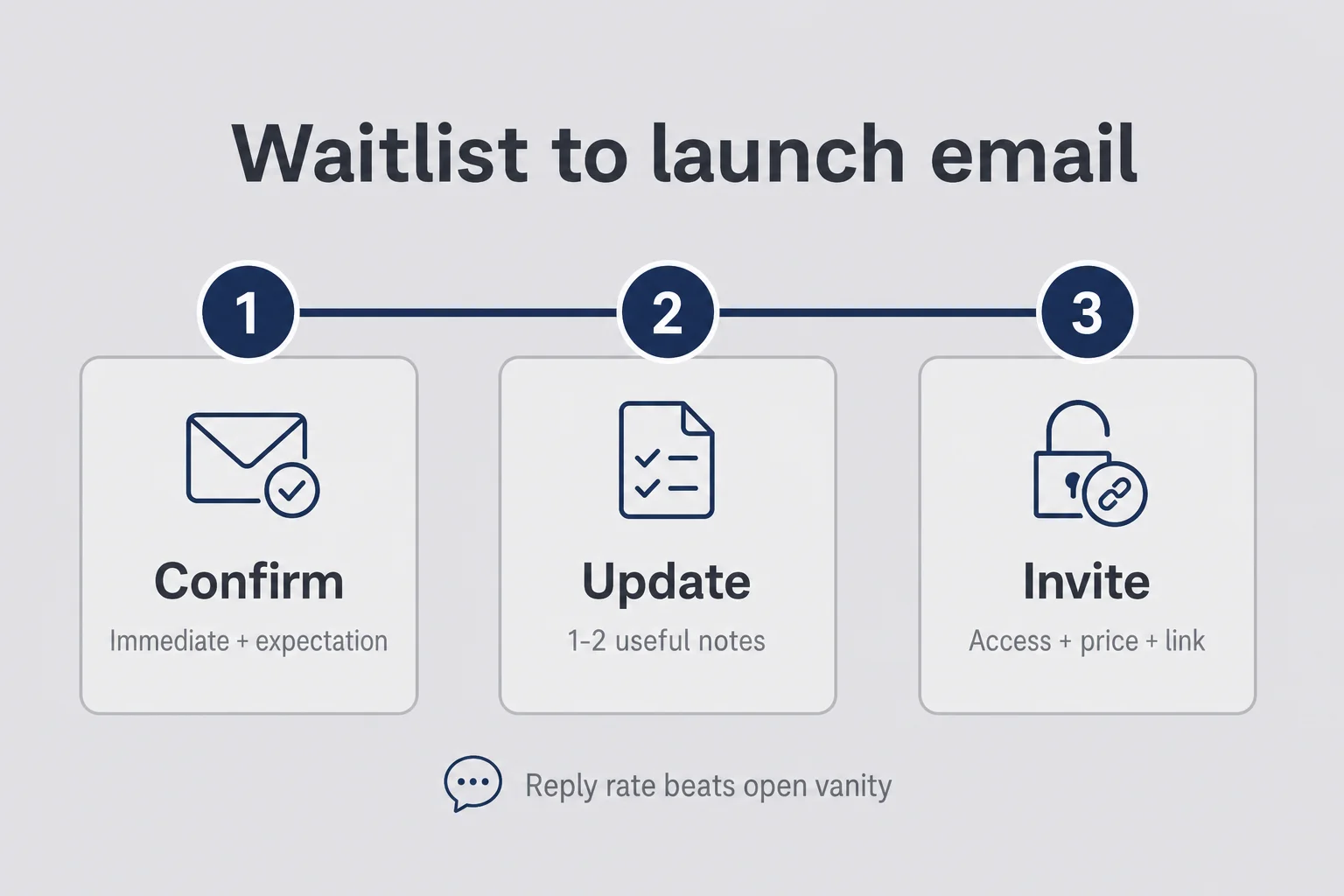
Waitlist to launch email is where the list becomes an asset or a corpse. Most founders send two messages in their whole lifecycle: the automatic "thanks for joining" and the panicked "we launched" blast. That gap is where trust dies.
Think in a short arc, not a twelve-step drip. Confirmation. Occasional progress that is actually useful. Launch invite with a clear next step. Optional: a follow-up for people who opened but did not click. That is a sequence a solo founder can run without a marketing ops hire.
I write these like notes to a smart peer, not like a brand newsletter. Subject lines that sound like a person. Bodies that respect time. One link when there is a link. No "we're thrilled to announce" energy. Thrilled is what you feel. The reader wants to know what changed for them.
Confirm, update, invite: not a drip of noise
Confirmation email: send it immediately. Restate what they joined. Set expectations for how often you will write. Invite a reply with one question if you did not ask on the form. Replies at this stage are the best leads you will get before launch.
Update emails: one or two before launch if the build takes more than a few weeks. Share a decision, a screenshot that is real, or a lesson from talking to users. Do not send "still grinding" fluff. If you have nothing useful, do not send. Silence is better than empty enthusiasm.
Invite email: this is the money email. Subject line names the product and the access. Body explains what is ready, what is not, what it costs, and the deadline if founding pricing is real. Make the primary button unmissable. Assume they forgot who you are. Remind them in one sentence why they signed up.
A simple shape I reuse:
Subject: Early access is open (founding price through Friday)

Hey. You joined the waitlist for [outcome].

It is ready enough for real use. Here is what works today: [2 bullets].
Here is what is still rough: [1 honest bullet].

Founding price: $X/month through [date]. Then it goes to $Y.

Start here: [link]

If this is no longer relevant, ignore this and I will not chase you.
That last line matters. Pressure sells gym memberships. Clarity sells software to busy adults.
What to write when you have nothing to announce yet
Founders freeze because they think every email needs a launch. It does not. You can ask a question. "Which of these two workflows hurts more?" You can share a competitor observation without trash-talking. You can admit a scope cut and why. People on a waitlist opted into the journey. Treat them like adults who can handle a build diary that is not performative.
If you truly have nothing for six weeks, you probably started the list too early or you are avoiding customer conversations. Go talk to five people on the list. Then you will have something to write.
AI can help draft variants. It cannot tell you which update is honest. Do the thinking first. Let the model tighten the sentences second.
Subject lines deserve a minute of care. I avoid ALL CAPS and fake urgency. I prefer specificity: "question about your Monday reporting mess," "beta opens Thursday," "cut the scope: here is what ships." Open rates at waitlist scale are noisy. Reply rates are the better signal. If people answer you, the list is alive.
One more operational detail: unsubscribe links are not optional, and neither is a calm tone when someone leaves. Celebrate the people who stay by writing better emails, not by guilt-tripping the people who leave. A clean list is a gift on launch day.
Who belongs on the list (and who you should filter out)
Not every email is a gift. Some people collect waitlists the way others collect browser tabs. Some are competitors. Some are friends supporting you emotionally, which is kind and not the same as a buyer. Your job is not to be rude. Your job is to know the difference when launch week arrives.
I care more about concentration than volume. Twenty freelance agency owners who invoice clients monthly are a better waitlist for an invoicing helper than two hundred random indie hackers who upvote anything with a cute landing page. Niche lists convert. Broad lists flatter.
One qualifying question beats a thousand cold emails
Put the question on the form or in the confirmation email. Keep it answerable in under thirty seconds. Multiple choice is fine. Free text is better when you can actually read the answers.
Good questions sound like the buyer's world. "What do you use today for this?" "How often does this break your week?" "Would you try a paid beta at around $29?" Weak questions sound like a CRM template. "What is your role?" without context rarely teaches you anything you will use.
When someone answers well, reply like a human. Not a template. Two or three sentences. Thank them. Ask one follow-up. This is how a waitlist becomes a pipeline without pretending you are running enterprise SDR motions.
Segment early or regret it on launch day
Even a crude segment helps. "Answered survey" versus "email only." "Said they would pay" versus "just curious." "Came from Reddit" versus "came from my newsletter." You do not need perfect CRM hygiene. You need the ability to email the warmest slice first on launch day.
I launch to the warmest segment first on purpose. They get the founding offer a day early. They reply with bugs while the stakes are still low. Then I widen to the rest of the list. Blasting everyone at once feels efficient. It is how you drown in noise and miss the people who would have paid if you had treated them like early partners.
If your tool cannot segment, export to a spreadsheet once and tag manually. Ugly systems that work beat elegant systems you never open.
Friends and family deserve a separate tag. Their encouragement is real. Their willingness to pay for a niche B2B workflow usually is not. Invite them if you want cheerleaders. Do not let their polite "looks cool!" pollute your read on demand. When launch numbers disappoint, founders often discover half the list was moral support. Tag early. Thank them separately. Measure buyers separately.
Where to put the link without sounding like a billboard
Distribution for a waitlist is the same discipline as distribution for a product. Warm first. Specific second. Broadcast last. The link should appear where the problem is already being discussed, not where you wish people hung out.
I start with people who already know me. Old coworkers. Newsletter readers. Past consulting clients who fit the ICP. A personal note with a link outperforms a public launch post for the first twenty signups. Ego wants the big post. Math wants the warm note.
Warm channels first
Email people individually when the number is small. "I am building X for people who hate Y. Want early access?" That sentence has closed more waitlist signups for founders I advise than any Product Hunt teaser. It feels slow. It is fast compared to rebuilding a dead list later.
Your own tiny audience beats a stranger's huge audience if the tiny audience matches the problem. A hundred newsletter subscribers in the niche will outperform a generic tweet to ten thousand people who build apps for fun.
If you write in public, share progress with the link in context. "I am testing this page. If the problem is yours, join." Not "LINK IN BIO, DROP EVERYTHING." Context is the difference between community and spam.
Communities, Reddit, and the line you should not cross
Niche Slack groups, forums, and subreddits can fill a waitlist if you have earned the right to post. Earning usually means lurking, answering questions, and being useful before you ask. If you want the longer version of that discipline, Reddit marketing for micro-SaaS solo founders is the playbook. The short version: do not drop a waitlist link into a help thread and call it value.
When you do post, lead with the problem and what you are trying to learn. Invite critique. Offer the waitlist as optional. Moderators and readers can smell extractive posts from a mile away. One banned account can cost you a channel for years.
Cold email can feed a waitlist too, carefully. You are not selling the product yet. You are asking whether the problem is real enough for a conversation or an early list. Keep it short. Offer an easy no. If you are already doing outbound for first customers, micro-SaaS cold email for first customers pairs with this stage. Just do not pretend a waitlist signup is a closed won deal.
SEO can feed a waitlist later, once you have one page that ranks for a painful query. Early on, do not stall the list waiting for organic traffic. Organic is slow. Warm outreach is fast. Use search as a compounding channel after you know the promise converts. I wrote more on that lane in micro-SaaS SEO for solo founders.
Wherever you place the link, match the promise in the post to the promise on the page. If your Reddit comment says "spreadsheet export for Shopify freelancers," the waitlist headline should not suddenly say "AI workflow intelligence." Mismatch is how you get signups who feel baited and launch opens that go nowhere.
Turning a quiet list into launch-day customers
Launch day is not when you finally remember the list exists. Launch day is when the sequence you already designed starts. The page can take a signup or a payment. Support can answer the first confused email. You are ready enough.
I like a warm launch before a loud launch. Email the waitlist. Watch what breaks. Fix the embarrassing bugs. Then post more publicly. Product Hunt and Twitter are optional amplifiers. They are terrible first customers if your onboarding still apologizes for itself. Max covers Product Hunt timing elsewhere if you go that route. Your waitlist should be ready before the traffic spike, not during it.
Founding-member pricing and early access that feel real
Founding pricing works when it is a thank-you with boundaries. Lower price locked for a year, or locked forever at a clearly stated rate, or a free month for people who report bugs in week one. Pick one. Write it down. Keep it.
Fake urgency trains people to ignore you. Real urgency sounds like: "I can only support twenty founding accounts while I am solo, so the window closes Friday." If that is true, say it. If it is not true, do not say it.
Early access should set expectations. Tell people what is rough. Invite feedback through one channel you will actually check. A waitlist that becomes a beta group is more valuable than a waitlist that becomes a neglected newsletter.
The warm launch before you go loud
Day minus one: email the warmest segment. Personal if the list is tiny. Day zero: email everyone else on the waitlist with the same clear invite. Day one and two: reply to humans like a human. Fix the onboarding hole everyone hits. Only then widen to public posts.
This order feels conservative. It is how you avoid the founder nightmare where strangers hit a broken checkout while your best leads are still unread in the inbox. Warm first is not timid. Warm first is operationally sane when you are the whole company.
If conversion from waitlist to paid is weak, do not immediately blame price. Read the replies. Watch where people stall. Often the page promise and the product first run do not match. That is a positioning and onboarding problem, and it shows up fast when the audience already raised a hand once.
Support on launch week is marketing. Every confused reply is a copy bug or a product bug wearing a customer costume. Answer quickly. Fix the FAQ. Update the invite email if half the list asks the same question. The waitlist gave you a second chance to clarify. Use it.
I also like a short "still deciding?" note three days later to people who opened the invite but did not click. One paragraph. One link. No guilt. Some people need two touches because their week was chaos, not because your offer was wrong.
What I would do with fifty names (and what I would not)
Fifty good names is enough to learn. Here is what I would actually do.
I would email all fifty within a week of signup with a personal-feeling note and one question. I would hop on ten short calls if people offered time. I would keep a simple sheet: name, pain, current workaround, willingness to pay, notes. I would send two useful updates during the build. I would launch to them with founding pricing and a calendar reminder so I do not "forget" for a month.
I would not buy a viral waitlist tool to juice the counter. I would not post daily "building in public" screenshots that never ask for a reply. I would not wait for five hundred signups to start conversations. I would not send a twenty-link newsletter to people who only asked for early access.
Fifty names will not make you rich. Fifty names can tell you whether the product deserves another three months of nights and weekends. That is the real job of the list at solo-founder scale.
If you cannot get to fifty qualified signups after consistent warm outreach and a clear page, believe the signal. Widen the wrong promise until the internet shrugs is how people waste a year. Tighten the problem, change the audience, or stop. A quiet failed waitlist is cheaper than a loud failed product.
What I would not do with fifty names is build a twelve-email nurture sequence full of educational content nobody asked for. Waitlist people asked for access, not a mini-course. Teach when teaching advances the product conversation. Otherwise you are writing a newsletter with a confusing label.
I would also not hide for two months "until it is perfect." Perfect is how lists go cold. Ship a constrained early access. Tell them what is missing. Let the first ten users complain in useful ways. That feedback is worth more than another week of polishing alone.
Questions people ask before they put up a form
How many waitlist signups do I need before I launch?
Fewer than you think if they are the right people. Fifty qualified emails who answered a real question beat two thousand strangers who wanted a freebie. I would rather launch to forty people who said they would pay for this problem than celebrate a thousand signups I never emailed. Aim for conversations and replies, not a round vanity number.
Should I use a viral referral waitlist with leaderboards?
Usually no for a first micro-SaaS. Referral ladders inflate the list with friends-of-friends who do not have the problem. You spend launch week apologizing to people who never wanted the product. A plain form plus one qualifying question is enough until you have proof strangers care about the outcome.
What tool should I use for a solo founder waitlist?
Start with whatever you already understand. A Framer or Carrd page into ConvertKit or Loops is enough for most launches. Dedicated waitlist tools are fine if they save you hours, not if they tempt you into referral theater. Own the emails so you can leave the tool when you ship.
How often should I email the waitlist before launch?
Enough that people remember you exist, not so often that you become noise. For a six to eight week build, that usually means a confirmation, one or two progress notes, and a clear launch invite. Silence for months then a sudden launch blast is how you train people to ignore you.
Is a waitlist the same as validating my idea?
No. A waitlist measures curiosity under low commitment. Validation needs willingness to talk, willingness to pay, or both. Pair signups with a short survey or a few calls. If nobody will spend fifteen minutes explaining the problem, the email count is not a business signal.
Should I offer founding-member pricing to the waitlist?
Yes if the discount is real, time-bound, and you can deliver. Founding pricing rewards people who took a risk on an unfinished product. Do not invent fake scarcity. Tell them what they get, for how long, and what happens after the window closes. Then keep the promise.
A list is only useful if you talk to it
The founders who get leverage from a waitlist are not the ones with the biggest counters. They are the ones who treat every signup as the start of a short relationship. They ask one good question. They send a few honest emails. They launch to humans before they launch to the timeline.
I still catch myself wanting the counter to move because it feels like progress. Then I remember the launch with twelve opens. Progress is a reply. Progress is a card on file. Progress is someone saying "I would pay for that on Tuesday" and meaning it.
If you put up a form this week, decide now what the first three messages will say. Write the launch invite while the promise is still sharp in your head. Then go get fifty people who actually have the problem. The number on the page can wait. The conversation cannot.




Comments