You Are the Support Queue Now
How solo founders run micro-SaaS customer support without a CX team: one inbox, batch replies, docs that deflect tickets, and templates that still sound human.
 By Reese24 min read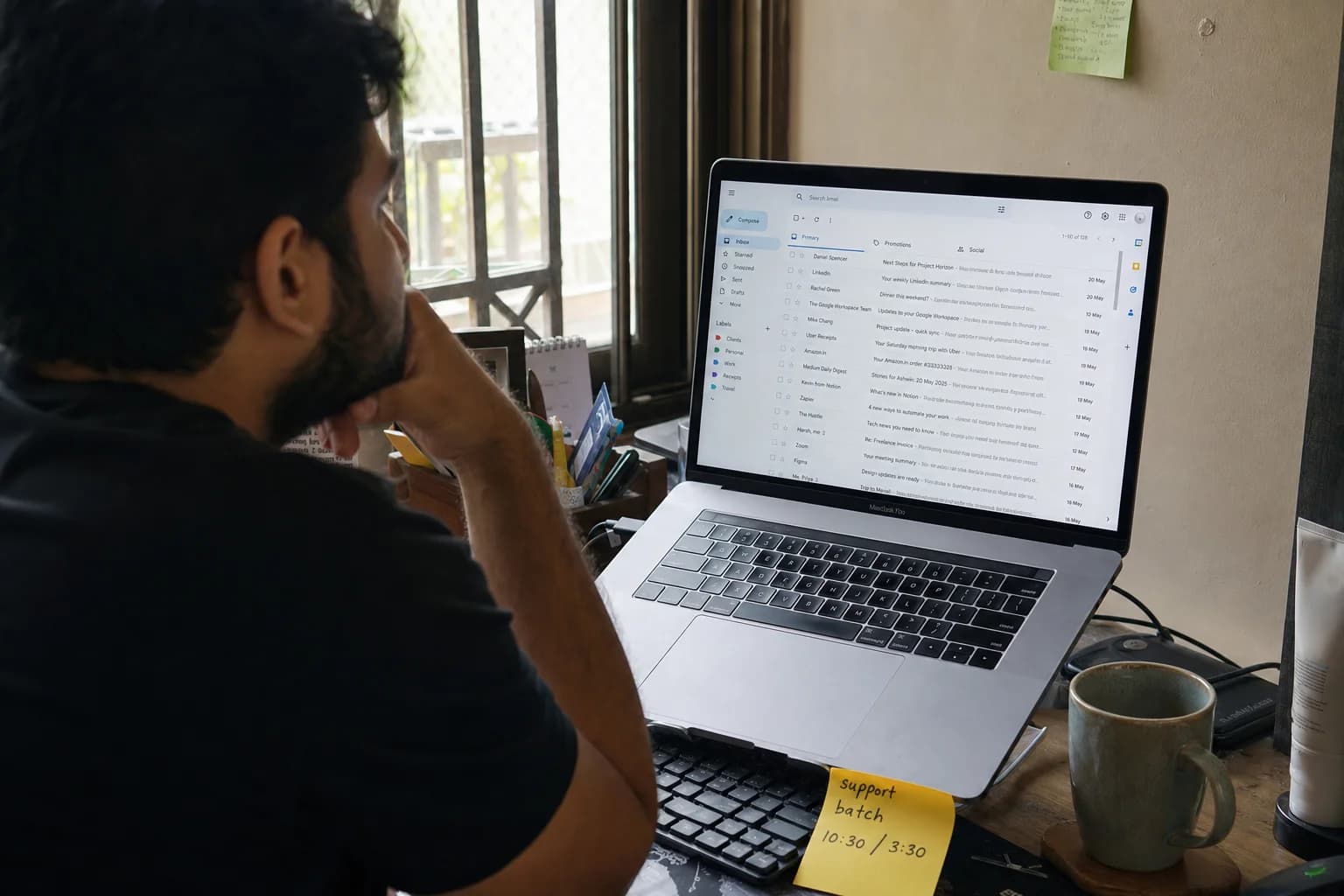
Listen to this article
21:12AI-generated podcast-style overview of this article (not a word-for-word narration).
A founder emailed me on a Tuesday at 6:14 p.m. with the subject line "sorry to bother you." Three paragraphs about a billing question that would take ninety seconds to answer. He had not replied to his own customer in four days because support lived in the same inbox as investor updates, newsletter drafts, and a receipt from Costco.
By the time he sent the forward, the customer had already canceled.
That is the micro-SaaS customer support solo founder trap in one screenshot. Not bad intentions. Not a bad product. Just no system, so every ticket feels like an interruption and every delay feels personal to the person waiting.
I have done growth and lifecycle work at small SaaS companies since 2014. I have watched founders treat support like a tax on building until churn proved it was part of the product. I have also watched founders answer every ping in real time until product work stopped entirely. Both failures look busy. Neither keeps revenue.
This guide is for the solo founder who already has paying users and a growing inbox. You are past the stage where you can remember every conversation. You are not at the stage where you can hire someone. You need a support workflow that protects your calendar, keeps customers from feeling abandoned, and turns tickets into fixes instead of guilt.
This is Part 10 of Micro-SaaS From Zero. If people are still getting lost in week one, read micro-SaaS customer onboarding for solo founders first. When cancellations spike after someone did reach value, how to reduce churn in a micro-SaaS picks up the retention side. For more on retention habits across the funnel, those two posts are the cluster. Max covers Stripe billing and webhooks edge cases. I cover the inbox, the reply, and the expectation you set before someone ever clicks Contact.
Micro-SaaS customer support solo founder: you are the queue now
There is no backstage at your company. When someone hits reply on a support email, it goes to the person who also ships features, writes landing page copy, and wonders whether Tuesday's ad spend was worth it. That is not a temporary phase. For most micro-SaaS products, it is the model for a long time.
Support at this scale is not a department. It is a habit attached to a single inbox. The habit either runs on a schedule or it runs on anxiety. Anxiety checks email at midnight. Schedule checks it twice on weekdays and tells the truth on your site about weekends.
The mental shift I want you to make first: support is not a pile of random tasks. It is a queue. Queues get processed. Piles get avoided.
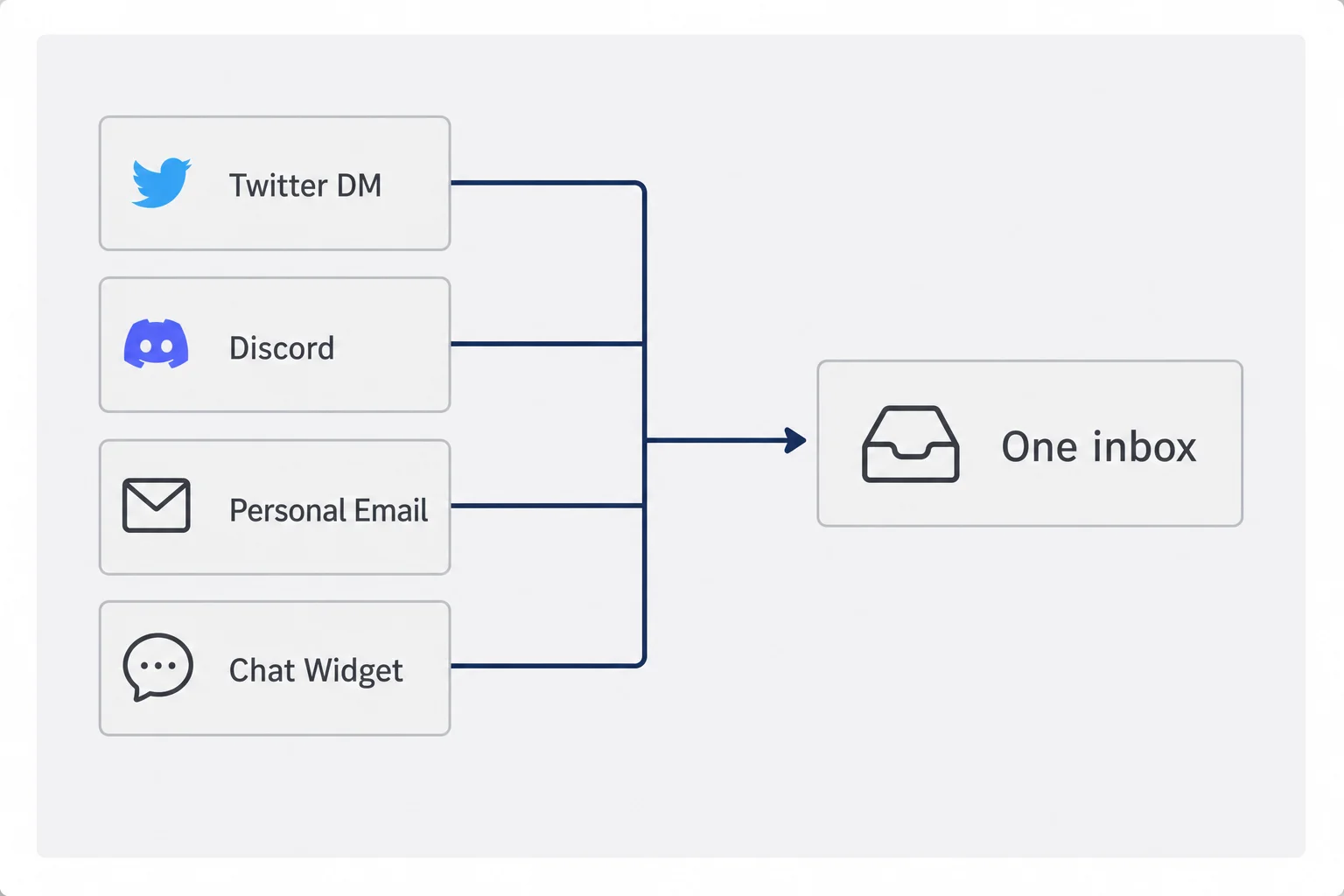
When founders tell me support is overwhelming, the problem is rarely volume. Ten tickets a week is manageable. Fifty is manageable with templates and docs. What breaks people is fragmentation. A question in Twitter DMs. A bug report in Discord. A "quick question" from a friend who is also a customer. A billing email forwarded to personal Gmail. Each channel feels small. Together they create the feeling that you are always behind.
Your first job is consolidation. One address. One tool or one labeled folder. One place where nothing is "handled" until it is answered or deliberately closed. Everything else gets a polite redirect telling them to email support@yourproduct.com so nothing gets lost.
I am not saying be corporate. I am saying be findable to yourself. The founder who lost that Tuesday customer did not ignore people on purpose. The ticket drowned in noise.
Say you are at four hundred dollars MRR with thirty-two customers. Realistically you might see five to fifteen conversations a week. That is not a call center. That is two focused blocks of forty-five minutes if you are organized. Without organization it becomes twelve micro-interruptions a day and the sense that you never finished "real work."
Support also carries emotional weight that product tasks do not. A bug report feels like judgment. A refund request feels like failure. A confused user feels like you failed to explain. None of that is true, but your nervous system does not know MRR. Building a queue mindset separates "I owe this person a clear reply by Thursday morning" from "I am a bad founder." One is operational. The other is a story you tell at 11 p.m.
The redirect line
When someone DMs you on social: "I want to help — email support@yourdomain.com with your account email so I can look you up and nothing slips through." Short, not cold. Repeat it until it is muscle memory.
Support is distribution in disguise
Marketing people like me are supposed to say distribution is channels and copy. That is half true. The other half is what happens after someone pays.
A confused customer does not recommend you. A customer who emailed once, got a clear answer in twelve hours, and saw the fix in the product within a week tells three friends. Not because you ran a referral program. Because you treated their problem like it mattered.
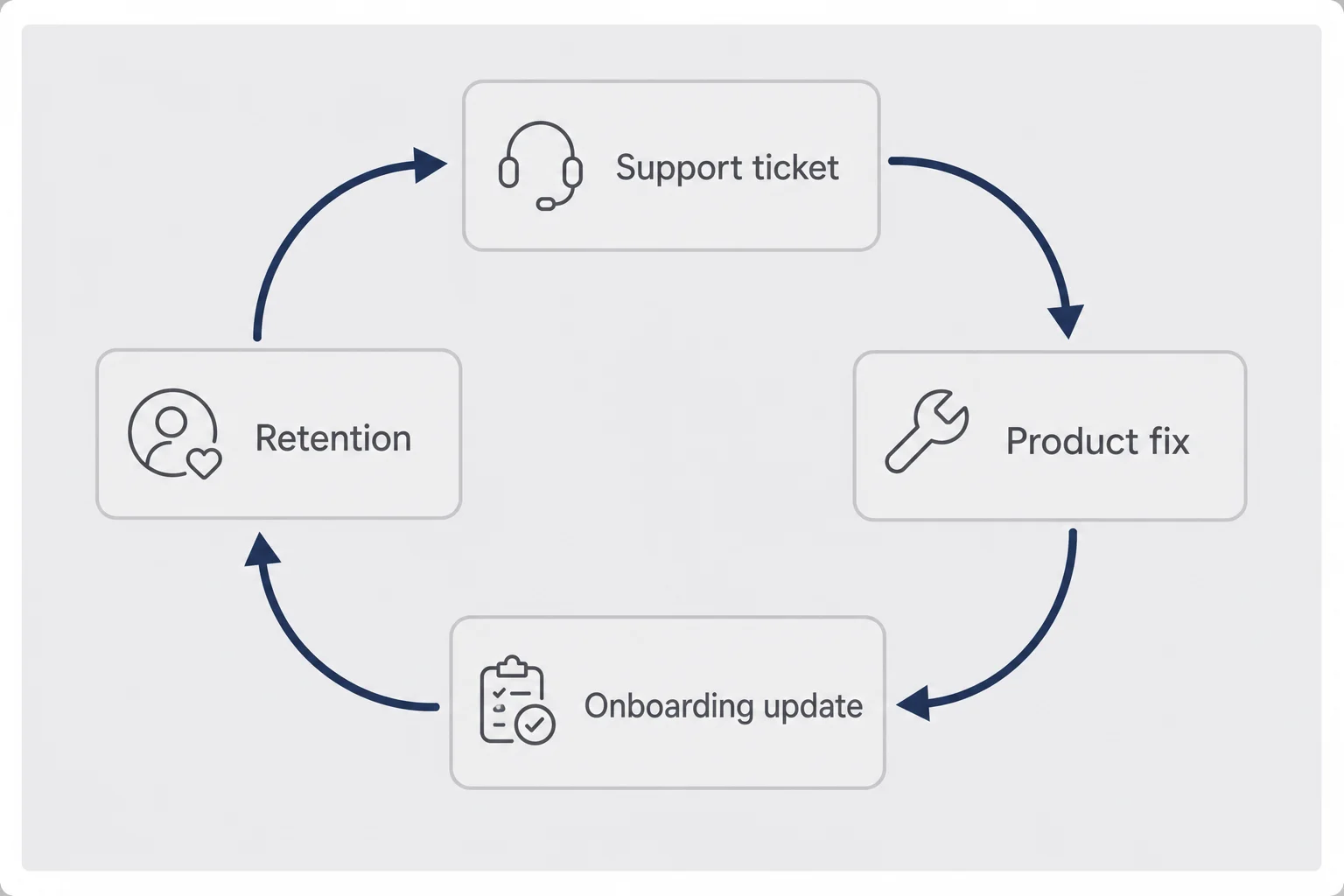
Support is where your positioning meets reality. Your landing page promised an outcome. Onboarding tried to deliver it. Support catches everyone who still slipped through. That is not failure. That is the cheapest research panel you will ever have, because the participants already paid.
I once consulted for a founder who wanted to double ad spend because signups were flat. I asked to see his last twenty support threads. Fourteen were the same question about exporting data. The landing page never mentioned exports. The onboarding email assumed people knew where the button lived. He did not need more traffic. He needed one doc article and a tooltip.
That is a marketing fix born in the inbox.
Tyler Tringas wrote years ago that every support ticket is an opportunity. I agree with the spirit and I would add a solo-founder caveat: every ticket is an opportunity if you have boundaries. Otherwise it is an opportunity for one customer to consume your entire Thursday.
The opportunity shows up in three forms. First, confusion you can fix with copy or docs. Second, product friction you can fix with a small release. Third, a mismatch between who you built for and who is actually buying. The third one is strategic. The first two are weekly hygiene.
Support also feeds retention directly. Someone on the fence about canceling often sends a "quick question" before they churn. How fast you answer and how human you sound can be the difference between a saved account and a silent departure. Churn reduction talks about signals before cancellation. Support is often where those signals arrive in plain language.
Do not outsource the thinking here to a chatbot on day one. You need to read the raw words while the product is still changing. Later you can automate the patterns you are tired of typing. Not before you have typed them enough to know which patterns matter.
Deflection first: docs and the questions you should never answer twice
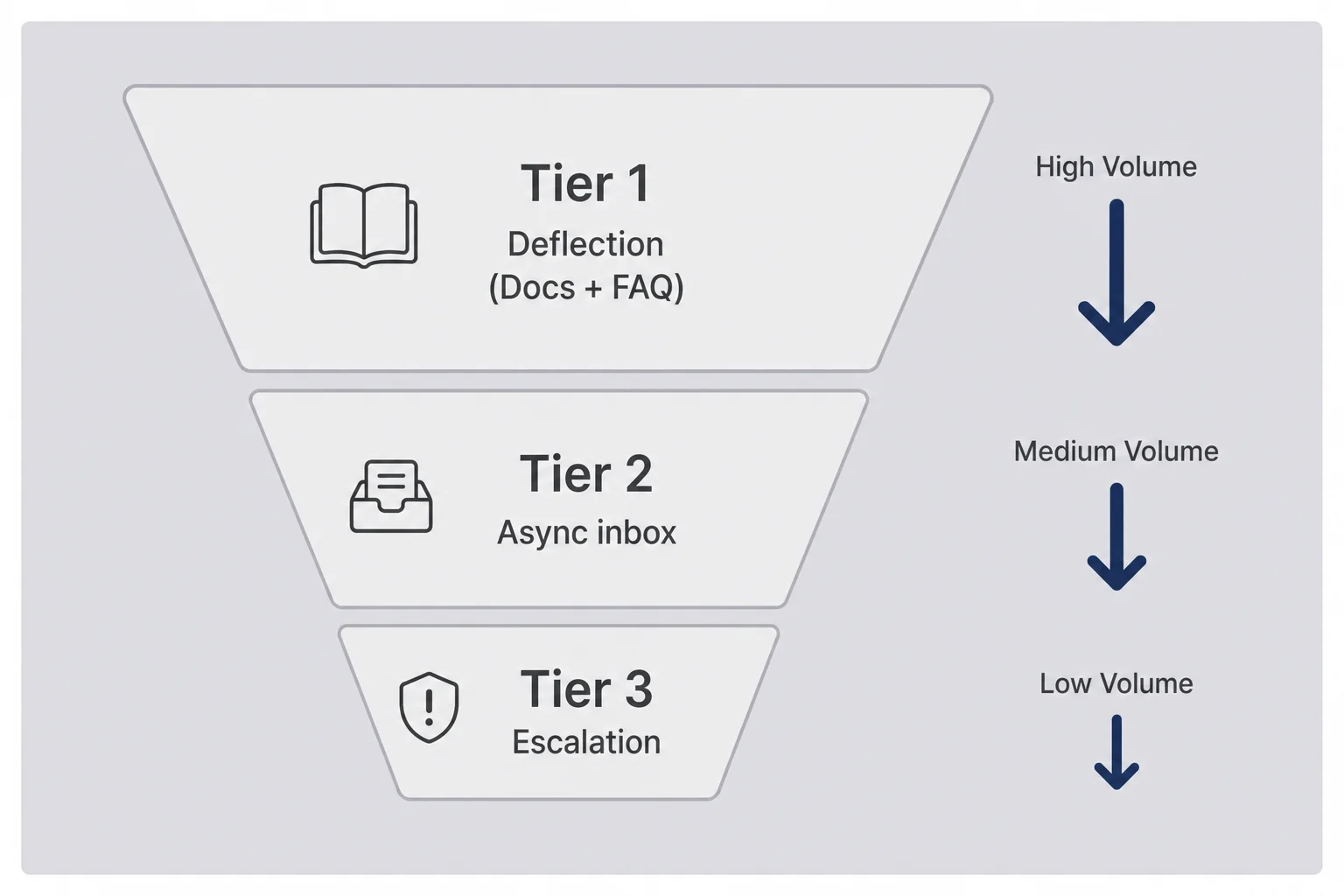
The cheapest support ticket is the one that never gets sent.
Deflection sounds cold until you realize what it replaces: the same how-to question arriving in your inbox every Monday from a new user who never saw the answer anywhere else. Deflection is not "go away." It is "here is the answer before you wait on me."
A useful docs layer for micro-SaaS has three parts. A short FAQ on your marketing site for prospects and nervous new signups. A search-indexable help center for step-by-step tasks. Release notes or a changelog when behavior changes. That is it. You do not need a knowledge base the size of Salesforce.
Write docs from real tickets. Not from imagination. When the same question appears twice, you are allowed to answer it a third time with a link instead of fresh prose. When it appears five times, the doc is overdue.
Good deflection material names the user's situation in plain language. Bad deflection is a single page titled "Getting Started" with eleven paragraphs and no headings. People scan. Write for scanning.
Search matters more than polish. Google indexes public help pages. So does the search box inside Help Scout or Crisp if you use one. Title articles the way users type questions: "How to connect Stripe" beats "Billing integrations overview."
Inside the product, link to docs at the moment of confusion. Account settings? Link to the billing doc. Empty export screen? Link to the export walkthrough. The best support is a link shown one click earlier than the user would have emailed you.
FAQ on the marketing site should cover pricing, refunds, data handling, and the one weird objection your niche always has. B2B buyers ask about invoices. Creators ask about file formats. Pick yours.
I am not asking you to automate empathy. Some situations should never be deflected. Billing disputes. Accessibility problems. A report that data looks wrong. A customer describing a bug that could affect others. Those skip straight to a human. Deflection is for the repetitive middle: how do I, where is the, can I change my.
Track deflection loosely. If you add a doc and a question type drops for two weeks, the doc worked. If volume stays flat, the doc is hard to find or poorly titled. Fix discovery before you write another article.
Docs are marketing
A prospect who googles "your product + export csv" and lands on a clear help article learns you are serious before they pay. Support content is SEO for people already considering you.
Async batching: one inbox, two check-ins a day
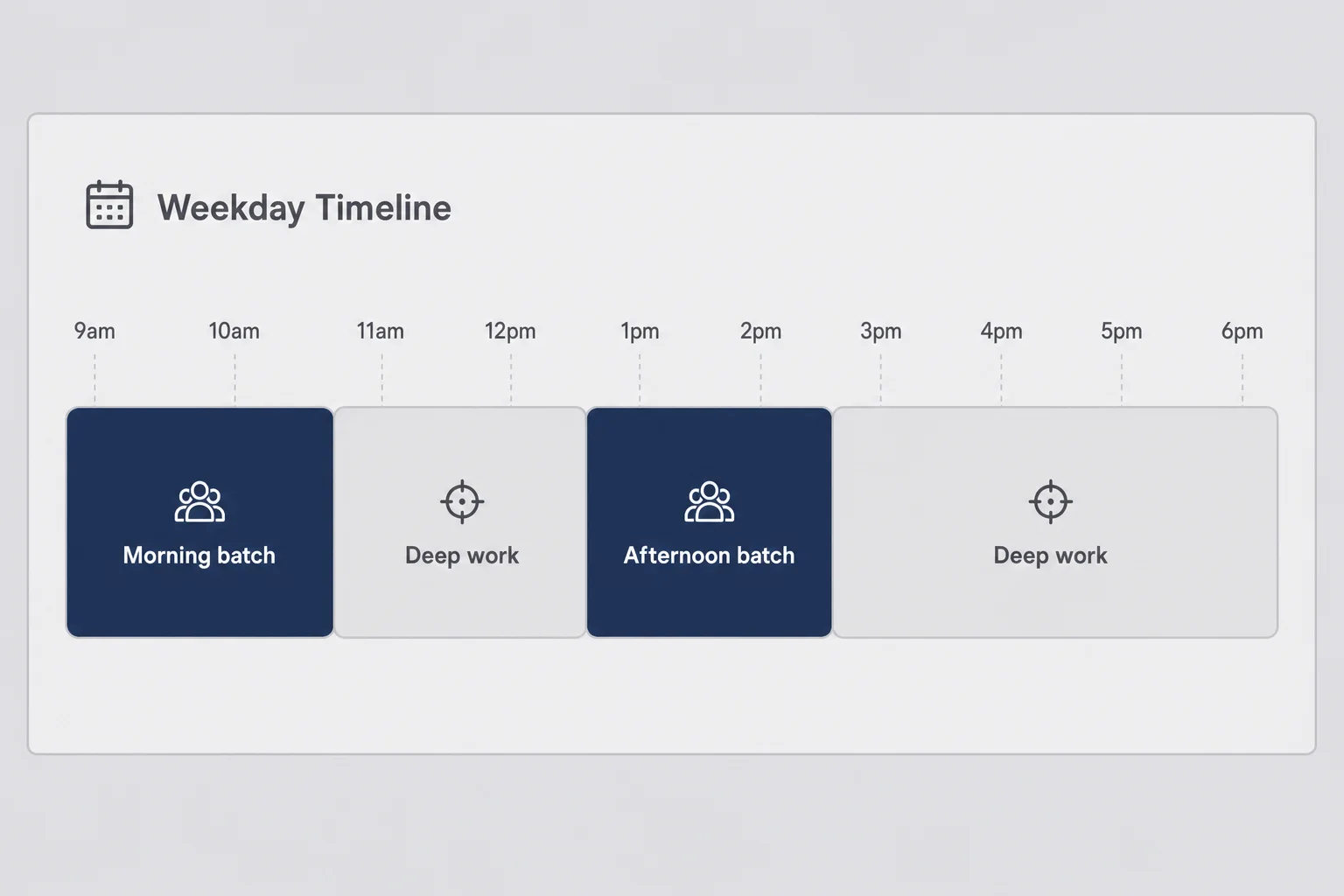
Real-time support is a luxury product. Async support is a solo-founder survival strategy. A solid micro-SaaS support inbox workflow is simple: one address, two batches, honest hours on your site.
Async means you do not answer the moment a notification appears. You answer in batches at predictable times. Most solo founders I trust run two windows on weekdays: late morning and mid-afternoon. Some add a short Friday review. Almost none answer support before product work on days they are trying to ship.
The rule sounds simple. The hard part is enforcing it against your own guilt.
Customers do not need you instantly at forty-nine dollars a month unless you promised instant. They need to know you saw them and when they will hear more. An auto-reply helps here if it states hours honestly. "We typically reply within one business day" is better than a chat widget that implies you are always online while you are in a three-hour build block.
During a batch, work the queue top to bottom or oldest first. Pick one method and stick with it. Snooze nothing into a mythical "later" folder unless your tool supports real snooze with a date attached.
Mute notifications outside batch windows. Not minimize. Mute. Your phone does not need to buzz for a password reset while you are writing onboarding copy. If you cannot mute, route support to an address you do not check on your phone's mail app.
Batching protects deep work. It also makes replies better. You answer five tickets in one sitting, notice two are the same issue, update a doc once, and send two variations of the same fix. Scattered replies turn into five slightly different answers and five future confusions.
Say your batches are 10:30 a.m. and 3:30 p.m. A ticket that arrives at 10:45 waits until 3:30. That is fine if your site says so. A ticket that arrives at 4:15 on Friday waits until Monday morning unless it is tagged urgent. Also fine if your site says so.
Urgent needs a narrow definition. Outage. Payment taken but access missing. Data loss report. Security concern. "I cannot figure out how to invite my teammate" is not urgent. It feels urgent to them. Your policy can still be kind and async.
Weekends are a policy choice, not a moral test. Many solo founders do not support on weekends and say so on the contact page. Some do one Sunday night sweep because their customers work weekends. Pick a rule that matches your audience and energy. Breaking your own rule every week trains customers to expect exceptions.
Escalation: when to break the batch rhythm
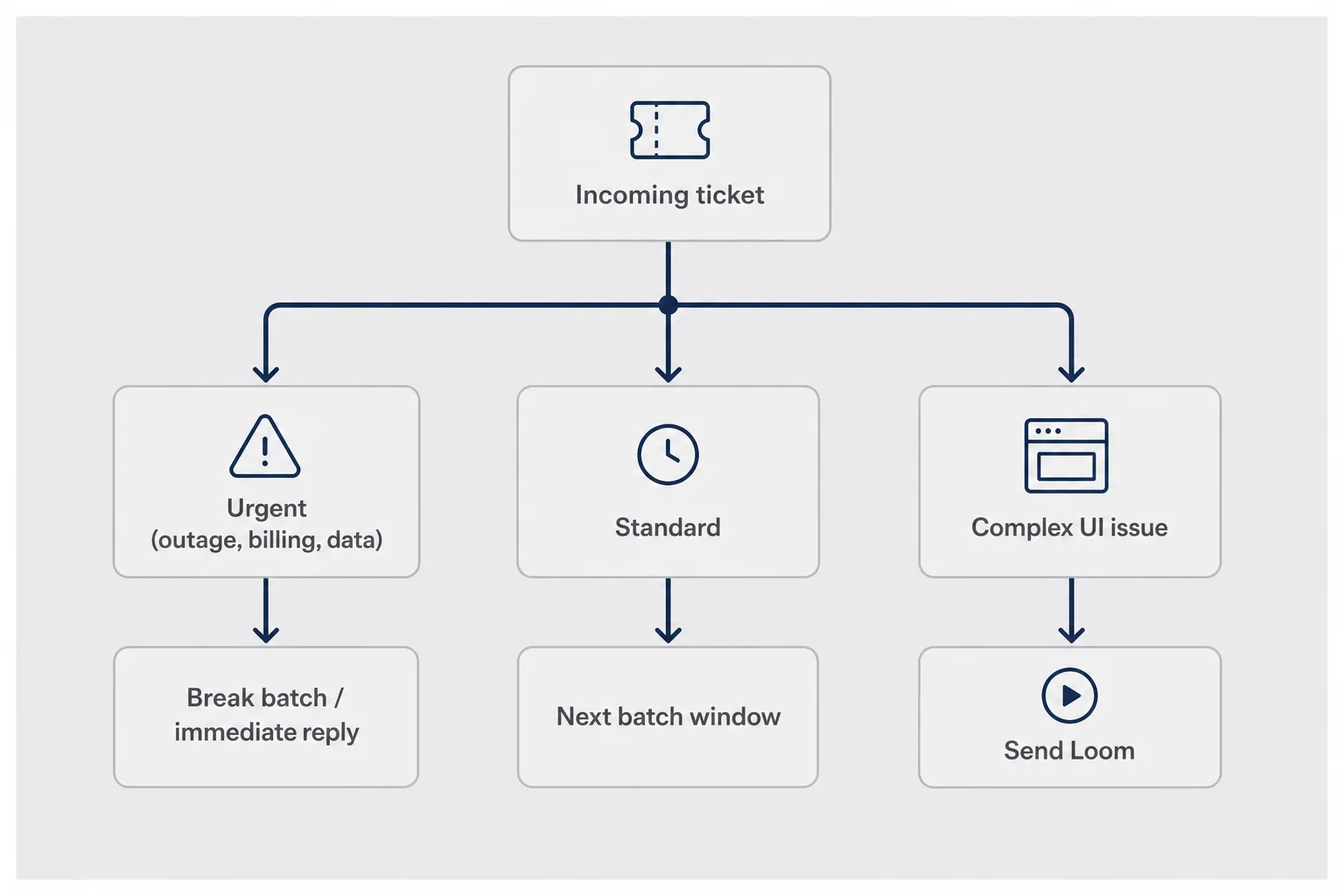
Batching is the default. Escalation is the exception with a clear trigger list.
Break the rhythm when delay would cause measurable harm: someone cannot access a paid account, you broke something in a deploy, money moved incorrectly, or a customer is about to leave and the fix is fast. Those get a same-day reply even if it is not batch time. Everything else stays in the queue.
Escalation also means mode of response, not just speed. Some threads need a five-minute Loom instead of six paragraphs. Some need a refund without negotiation. Some need you to open the database, fix one row, and confirm. Recognize which shape you are in before you type.
Angry emails reward calm brevity. Acknowledge the impact. State what you are checking. Give a time boundary. Do not match length with length. A furious three-paragraph email can earn a four-sentence reply if those sentences are specific.
Refund and cancel requests are escalation types founders slow-walk because refunds feel like defeat. Slow-walking increases chargebacks and bad reviews. Process legitimate requests quickly. Ask one optional follow-up question after, not before. "I've processed the refund — if you have thirty seconds, what made you leave?" beats a survey link.
When a bug affects multiple accounts, escalate to public communication. Status note on your site, email to affected users, fix deploy. Silence during an outage makes every individual ticket feel like a private argument. Shared problems deserve shared updates.
If you are on the fence whether something is urgent, ask: would waiting until my next batch plausibly cost money or trust I cannot get back? Yes means break batch. No means hold the line.
Escalation without boundaries burns you out. If everything is urgent, nothing is. Write your trigger list on a sticky note above your desk. Outage, billing, data, security, imminent churn with a quick fix. That is usually enough.
The reply templates that handle most of your volume
You are going to repeat yourself. Good support ticket templates for micro-SaaS cover four patterns, not forty macros. Templates are how repetition stays fast without sounding like a bot.
I learned this the hard way consulting for a solo founder who rewrote every email from scratch because he thought templates were "impersonal." His average reply took eighteen minutes. His product had not shipped an update in six weeks. The emails were warm. The business was stuck.
Templates are not the opposite of care. They are care encoded once so you can spend your custom sentences where they matter. The person who needs a refund does not need your original prose about refund policy. They need confirmation you processed it. The person stuck on step four of an integration needs a link and an offer to look at their screen if the doc fails.
I do not mean forty macros on day one. I mean four strong patterns you paste and personalize. Acknowledgement. How-to with doc link. Account or billing fix in progress. Cancel or refund processed.
Template one acknowledges and sets time. "Hi — got this, digging in now. You'll hear back from me by tomorrow morning." Personalize the name. If you already know the fix, skip the wait and send template two.
Template two points to a doc and offers a human escape hatch. "This walkthrough should get you there: [link]. If anything still looks off after step three, reply with a screenshot and I'll take another look." The escape hatch matters. Pure deflection feels cold.
Template three handles access and billing. "I found the issue on our side and reset your access. Can you try logging in again? If it still fails, tell me the email on the account." Do not over-explain internal tools.
Template four closes cancellations cleanly. "Done — your subscription is canceled and you'll see the refund in five to ten business days. Thanks for trying us." Optional one-line question after.
Store templates in your help desk or a notes file. Title them the way you search: "reset access", "export help", "refund done." Use text expansion if you like. I use whatever keeps me from rewriting the same greeting fifty times a month.
Variables help sparingly. First name yes. Fake personalization from a merge field no. A short Hi [first_name] greeting is fine. "As a valued customer on the Pro plan since March" is robot speak.
Update templates when your product changes. An old screenshot link in a macro is worse than no macro.
Template smell test
Read the email out loud. If you would not say it to someone on a call, rewrite one sentence until you would.
Personal voice without typing the same paragraph forever
Templates save time. Voice saves trust.
The failure mode I see on the other side is founders who paste the same block without reading the thread. Customers notice. They reply with "I already tried that" and now you are behind. Templates are starting points. The two minutes you spend reading their message before you paste saves twenty minutes of back-and-forth.
Voice also shows up in what you refuse to hide behind. If a feature is beta, say beta. If a bug is yours, say so without a paragraph of passive voice. Users at micro-SaaS scale often chose you because you are small and reachable. Sounding like a ticket system wastes that advantage.
I keep a short list of phrases I ban from my own replies: "We apologize for any inconvenience." "Your feedback is valuable to us." "Please do not hesitate to reach out." None of those mean anything. Replace them with the specific next step you are taking.
The solo-founder advantage in support is that replies come from the person who builds the product. That beats a tier-one script until you sound like one. Customers forgive slower replies more easily than they forgive feeling like a ticket number.
Voice does not mean long. It means specific. "I checked your workspace and the integration failed because the API key expired" beats "We apologize for the inconvenience."
Sign emails with your first name. Use the same name on your site. Consistency signals that a human is accountable.
Admit small mistakes directly. "That button label is confusing — we are renaming it this week" turns frustration into collaboration. Over-apologizing in corporate language does the opposite.
Match tone to the customer without mirroring anger. Warm for confused users. Crisp for business buyers. Plain language for everyone.
One custom sentence per template is usually enough personalization. Reference their use case. Mention the feature they asked about. Acknowledge if they are on a trial versus paid.
Do not perform availability you lack. "I'm heads-down on a release until Thursday but wanted you to know I saw this" is honest. "Happy to hop on a call anytime" is a lie at solo scale unless you mean it.
If you use AI to draft replies, edit every send. AI can suggest structure. It cannot know which customer is on the edge of churn or which bug you already fixed in staging. Read once. Cut buzzwords. Send.
Loom, screenshare, and the five-minute fix
Some tickets are faster to show than to type.
When a user is clearly trying hard but missing a UI step, record a short Loom walking through the click path on a test account. Keep it under five minutes. Send the link with one sentence of context. Many people prefer watching one honest screen recording to decoding a wall of text.
Loom is also useful for bugs you cannot reproduce from their description. Ask permission to see their flow if they share sensitive data concerns. Offer a call only when video would expose private information.
Live screenshare is heavier. Reserve it for high-value accounts or situations where async video failed. A thirty-minute call for a nineteen-dollar plan is usually not worth it unless you are in heavy learning mode with your first ten customers.
Screen recordings double as internal assets. If three Looms explain the same confusion, that is your next doc article with screenshots pulled from frames.
Do not record over sloppy UI without commenting. "Yeah this is awkward — here is the workaround and we are fixing the layout" builds more trust than pretending the product is perfect.
Audio quality matters less than clarity of cursor movement. Pause before clicking. Name what you are clicking. End with what they should see if it worked.
Every ticket is a product signal if you tag it
Support becomes strategic when you can count patterns without rereading every thread.
Without tags, you end up in anecdote mode. "I feel like a lot of people ask about exports." Feel is not planning. Tags turn feelings into a bar chart you can act on in thirty minutes on Friday.
I recommend a weekly ritual. Same time every week. Open the inbox analytics or export labels. Write three bullets: what went up, what surprised you, what you will fix before next week. If exports jumped, write the doc or fix the button. If billing jumped after a pricing change, your pricing page and Stripe portal copy are out of sync. If churn-risk tags appeared, read those threads before you touch ads.
Feature requests deserve an honest backlog note. Solo founders cannot build everything users ask for. You can still log requests and tell people they were logged. Silence feels like dismissal. "Logged for Q3 — not building this month" respects both of you.
Tag tickets by type: bug, billing, how-to, feature request, churn risk. Your tool may call them labels. A spreadsheet works at tiny volume if you are disciplined. Without tags, you only have memory, and memory lies.
One feature request is noise. Five from paying customers is a column on your roadmap debate. One bug report might be edge case. Three in a week is a deploy you rushed.
Review tags weekly in fifteen minutes. Sort by volume. The top how-to tag becomes a doc. The top bug becomes a fix. The top feature request gets an honest "not yet" reply or a small iteration if it is small.
Connect support tags to onboarding gaps. If how-to questions cluster right after signup, your activation path is missing a step, not your intelligence.
Share summaries with yourself in plain language. "This week: six export questions, two Stripe portal confusions, one real outage." That sentence is a standup for a team of one.
Customers who suggest features appreciate being heard even when you say no. "Not on the roadmap this quarter — I logged it for when we revisit integrations" respects their time.
Do not build a feature live in the thread unless it is truly trivial. Promise timelines you can hit. Missing a promised fix date hurts more than saying nothing.
Picking tools at zero, five hundred, and five thousand MRR
You do not need enterprise software to run a serious inbox. SaaS support for a solo founder is mostly inbox discipline, not enterprise budget. Customer support bootstrapping starts with one address and two daily batches, not a tool comparison rabbit hole. Know your MRR band before you add seats — a free MRR calculator takes thirty seconds when you are deciding whether Help Scout pays for itself yet.
Tool selection is where founders procrastinate because it feels like progress. Reading comparison blogs is easier than answering ticket fourteen. Pick something good enough in an afternoon and move on.
At pre-revenue or your first ten customers, Google Workspace with support@ forwarded to you works if you use filters and starred messages for open threads. Add a simple contact form that posts to that address. Notion or a simple static site for three help articles costs nothing but an hour. The failure mode here is using your personal Gmail for business mail. Separate the identity early. Upgrade when you lose track of open conversations.
Between roughly five hundred and three thousand MRR, you will feel the pain of lost threads. That is when a help desk pays for itself. Help Scout is email-native and calm. Crisp bundles chat if you want a widget later. Plain is newer and minimal. Front is powerful but easy to overconfigure when you are alone. Any of these beats Zendesk for a solo founder who still ships code. Pick based on whether you want email-first or chat-first UI, not based on which logo you saw on Twitter.
Past five thousand MRR, consider whether your time is worth more than the tool cost plus occasional contractor help. Some founders bring in a part-time support person for twenty hours a month before they hire engineering help. That only works if your templates, docs, and tags exist. Otherwise you hire someone into chaos and call it delegation.
Avoid running two systems. Intercom plus Gmail plus Discord is how tickets die. One system of record.
Help desk features worth paying for early: collision detection if you ever add a contractor, saved replies, simple reporting on volume, customer history attached to email. Features you can ignore until later: AI deflection, complex routing, SLA dashboards nobody reads.
If your product is deeply technical and bugs dominate, a lightweight issue link in replies may help. Max's world more than mine. Still keep the conversation in one thread.
Switching tools is annoying but possible. Do not let tool research replace answering Tuesday's queue. A mediocre tool used daily beats a perfect stack configured never.
Support hours, response targets, and saying no to weekend heroics
Publish expectations before customers invent them.
Put support hours and typical response time on your contact page, footer, or auto-reply. Example line: Email support@yourdomain.com — we reply within one business day, Monday through Friday, US Eastern. Specific beats vague.
Adjust targets as revenue grows. Under five thousand MRR, twenty-four business hours for first reply is reasonable. Five to twenty-five thousand, many founders tighten to same-day. Above that, you might hire part-time help. The numbers are guides, not laws.
First reply can be acknowledgement. Resolution can follow. Customers handle waiting better when the wait is named.
Saying no to weekend support is valid. Saying yes every weekend until you resent users is not. If your audience is global, pick a narrow weekend window instead of full coverage.
Holidays deserve the same clarity. A one-line banner beats silence.
Saying no also applies to scope. You do not owe custom development per ticket. You do not owe instant phone access because someone threatened a bad review. You owe honest, clear help within the policy you published.
When you change policy, announce it. "Starting next month we are focusing async email support so we can ship faster — here is how to reach us." Most paying users understand if you are transparent.
Protect product time explicitly. Some founders block mornings for build and afternoons for support. Some invert it. Either works if the calendar is real.
Questions I get from founders staring at their inbox
How fast should a solo founder reply to support emails?
Below five thousand dollars MRR, replying within twenty-four business hours is reasonable. The first reply does not need to fix the issue. Acknowledge the ticket, state when you will follow up, and meet that promise. Predictable beats instant when you are one person.
What is the best support tool for a micro-SaaS with no team?
Whatever keeps every ticket in one place and off your personal email. Help Scout, Crisp, or even a shared Gmail label works at early scale. Avoid running Slack DMs, Twitter messages, and a widget at the same time. One inbox you check twice a day beats three channels you check constantly.
Should I offer live chat as a solo founder?
Usually not at the start. Live chat trains customers to expect real-time answers you cannot sustain. Async email or ticket-based support with clear hours on your site is kinder to you and honest to them. Add chat when volume and revenue justify blocking time for it.
How many canned responses do I need?
Four solid templates cover most early-stage volume: acknowledgement, how-to with a doc link, billing or access fix, and graceful cancel or refund. Write them in your voice, leave room for one custom sentence, and update when the same question hits three times in a week.
When should support tickets change my product roadmap?
When three unrelated paying customers describe the same confusion or missing piece. One angry email is a data point. Three similar tickets from people who already paid is a pattern. Log tags on every ticket so you can spot repeats without rereading your whole inbox on Sunday night.
How does customer support connect to churn?
Slow or vague support makes small problems feel like betrayal. Many cancellations at micro-SaaS scale are not feature gaps. They are someone who got stuck, emailed you, and did not hear back in time. Good support is retention work, not a separate chore after onboarding ends.
Support should not own your calendar
The goal is not inbox zero. The goal is customers who trust you will show up, plus enough protected time to make the product worth supporting.
You will never feel done with support. There is always another question, another edge case, another person who did not read the doc. Done is the wrong metric. Reliable is the right one.
Build the three layers. Deflect the repetitive stuff. Batch the rest. Escalate the few threads that need speed, video, or money moved. Tag what you learn. Fix the product when the same tag won't stop appearing.
You are still the queue. That is fine for longer than you think, as long as the queue runs on rules instead of mood.
The customer who emailed on Tuesday deserved an answer before they canceled. The founder who forwarded me that thread deserved a system that took ninety seconds without stealing his afternoon. You can build that system this week. One inbox. Two batches. Four templates. A doc page for the question you answered three times already.
Then close the tab and go ship something worth emailing about.




Comments