They Hit Cancel. That Was the Conversation You Skipped.
How solo founders design a saas cancellation flow that saves the right customers, collects real cancel reasons, and runs a win-back sequence without sounding desperate.
 By Reese27 min read
Listen to this article
20:07AI-generated podcast-style overview of this article (not a word-for-word narration).
A customer opened billing settings on a Thursday night, scrolled past the upgrade CTA you spent a week polishing, and clicked Cancel subscription. Your product showed a confirm dialog that said Are you sure? They clicked yes. Stripe flipped the status. You found out Monday when MRR dipped and the dashboard looked slightly emptier.
That is not a saas cancellation flow solo founder problem in the technical sense. That is a missing conversation. The person who left had a reason. You never asked for it. You never offered a pause. You never sent a useful email two weeks later when the sting had cooled. You just lost the revenue and told yourself churn is normal.
I have watched this movie at small B2B SaaS companies and on my own side projects. Founders pour energy into onboarding and acquisition, then treat cancel like a plumbing fixture. A button. A webhook. A sad Slack notification if they remembered to wire one. Meanwhile how to reduce churn in a micro-SaaS stays abstract because the moment of exit has no design.
Say you are at eighteen hundred dollars MRR with sixty-two customers. Two cancel in a week. Without a flow, those two look identical in Stripe: status canceled, ended on the same Friday. With a flow, one said "not using it" after logging in twice total, and the other said "too expensive" after exporting reports every Monday for four months. Those are different problems. One is activation. One might be plan design. Treating them as the same "churn event" is how you spend March building the wrong thing.
This guide is for the solo founder who already has paying customers and a cancel button that ends the relationship in one click. You do not need a retention team. You need a cancel page with one job, a reason survey you will actually read, honest save options, and a short win-back sequence that does not beg. Max covers failed payment recovery when the card declines. I cover the intentional leave: the click, the conversation, and the second chance.
SaaS cancellation flow solo founder: what you are actually building
A saas cancellation flow solo founder can maintain is not a ten-step maze copied from a Series B playbook. It is a short path that does three things in order: understand why they are leaving, offer a relevant alternative when one exists, and close the door cleanly so win-back later does not feel like harassment.
Think of cancel as a lifecycle moment, not a support ticket. Support is "something broke." Cancel is "I am choosing to stop paying." Those need different tones. Support should be fast and concrete. Cancel should be calm, specific, and optional to engage with. If someone wants out immediately, let them out. Trapping people in dark patterns burns trust faster than a lost month of MRR.
I have sat with founders who proudly showed me cancel UX that took seven screens, two surveys, and a calendar link before the confirm button appeared. They called it retention. Customers called it hostage-taking. One of those founders later posted a screenshot of a one-star review that quoted the flow word for word. The revenue they "saved" that quarter did not cover the reputation cost.
Cancel is a conversation, not a button
The conversation can be short. One screen. One question. One offer that matches the answer. Or no offer, just a clear confirmation and an email that says the door stays open. Conversation does not mean a salesperson pops up. It means you treat the exit as information instead of a mute event in Stripe.
I once reviewed a founder’s cancel UX that was literally a native browser confirm. No reason. No pause. No link to export data. Customers who canceled for "too expensive" looked identical in the database to customers who canceled because a competitor shipped the one feature they needed. The founder kept shipping random features. The data had never told him which problem was real.
The shift I want you to make is simple. Cancel is not the end of the story. It is the last moment you still have their attention while they are emotionally honest. People soften their complaints in support tickets. At cancel, they are already leaving, so the reason field is often more truthful than a NPS survey they filled out while still paying.
That honesty is uncomfortable. You will read "your onboarding is confusing" and feel attacked. Read it anyway. Then fix the next customer’s first week instead of arguing with the person who already left.
What "good" looks like before you have a CX team
Good at fifty customers is not good at five thousand. At early scale, good means you can cancel in under two minutes without emailing the founder. You capture one primary reason. You offer pause or downgrade when it fits. You send a receipt-style confirmation with export and reactivation links. You have three win-back emails scheduled, then silence.
That is the whole system. Fancy save modals, chat intercepts, and "talk to success" calendars can wait until you have someone whose job is retention. Solo, simplicity is the feature.
If you are still under roughly one thousand dollars MRR, I would rather you ship reason capture and a clean confirmation email this week than spend two weeks designing a save offer carousel. Data compounds. Coupons do not, not in a useful way.
Ship the boring path first
If you only have time for one improvement this week, add a cancel reason field and a confirmation email with a reactivation link. Save offers can come next. Data before discounts.
Cancel is not the same problem as failed payments
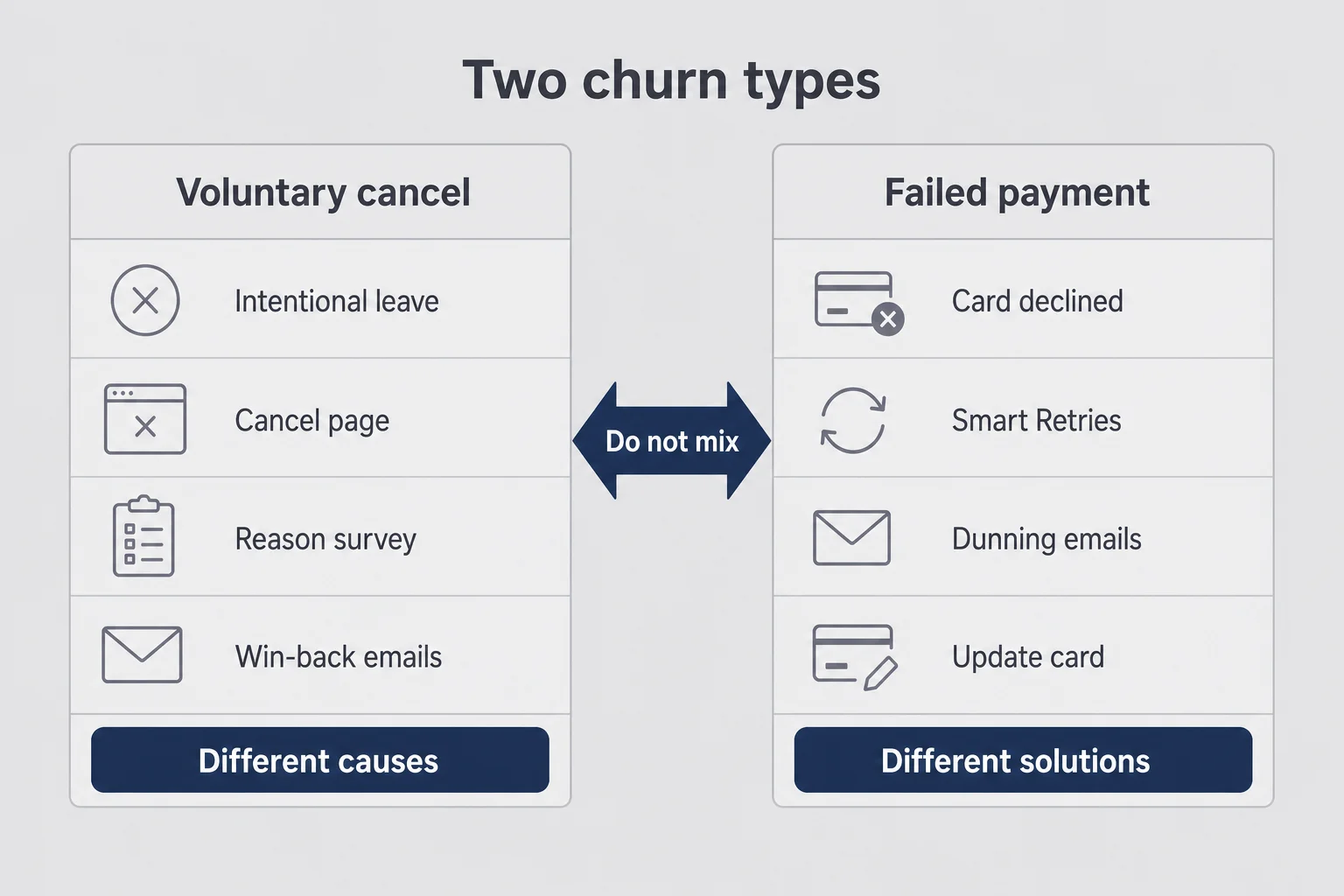
Voluntary cancel and involuntary churn get smashed into one "churn" number on dashboards, and that hides the work. A card that fails is a recovery problem. Max’s Stripe dunning playbook covers retries, past_due states, and emails that get cards updated. Do not bolt a discount coupon onto a dunning email and call it a cancel flow.
When someone intentionally cancels, they already decided the product is not worth the next invoice. Your job is different: learn why, reduce friction for people who might stay on a different plan, and leave the relationship in a state where a later email can reopen it.
Mixing the two also confuses your metrics. If you "save" a past_due customer by pausing instead of updating the card, you did not fix payment health. You delayed the problem. Keep failed payments in dunning. Keep intentional exits in the cancel path. Your future self reading analytics will thank you when the numbers mean something.
Here is a practical split I use when founders ask what to build first. If involuntary churn is half or more of total churn, fix Smart Retries and dunning copy before you polish cancel UX. If voluntary cancel dominates and reasons are unknown, build the cancel conversation first. You cannot prioritize what you cannot see.
One more boundary: refunds are not cancel UX. Refunds are policy. Link your refund rules from the cancel confirmation if you offer them. Do not invent a new policy mid-screen because someone typed an angry sentence in the reason box. Consistency protects you when volume grows. The founder who refunds "just this once" for every emotional cancel ends up with an informal policy that only exists in their guilt.
Also watch for the hybrid case: someone intends to cancel, hits a failed renewal first, then never completes the cancel UI because they already feel done. Your dunning email should still help them update the card or confirm they want out. A single sentence in dunning that points to the cancel page is enough. Do not make them hunt.
The cancel page has one job
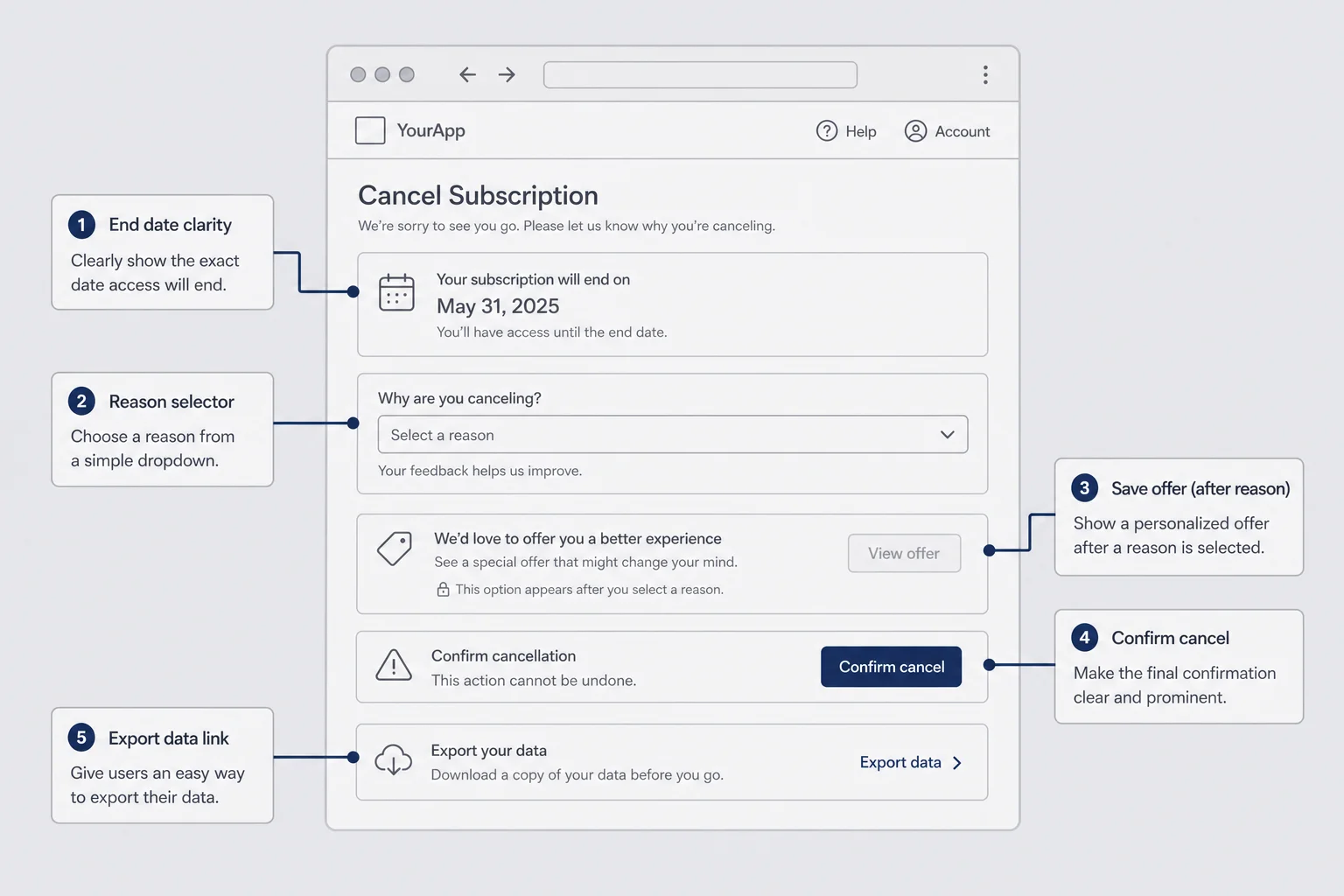
The cancel page is not a last chance to pitch your whole product. It is not a wall of testimonials. It is not a guilt trip about how hard you worked. One job: help the person finish leaving with clarity, while giving you a clean signal and an optional fork that might keep revenue without disrespect.
Above the fold, name what happens next. "Your plan stays active until March 14. After that, projects become read-only." Ambiguity at cancel creates support tickets and chargebacks. Clarity reduces both. I have seen chargebacks that started as confusion, not fraud. The customer thought cancel was immediate. The invoice hit anyway. Their bank sided with the story that felt simpler.
Write the date in human language. Do not rely on "end of billing period" alone. People know their rent day better than your Stripe interval.
What belongs above the fold
Keep the primary actions obvious. Confirm cancel for end of period should be the default for most subscriptions. Optional immediate cancel only if your policy allows and you can explain data loss in one sentence. One reason selector. One contextual save path that appears after the reason, not before. A link to export or download their data if you store anything they would miss.
I like reason-first, offer-second. If you show a 40% coupon before they tell you why they are leaving, you train people to open cancel whenever they want a deal. Ask first. Then match. The order is the strategy.
Visual hierarchy matters more than copy cleverness here. The confirm cancel action should look like a normal destructive action, not like a trick. The save option can be visually secondary. If the save option is the only bright button and cancel is a gray text link buried under a fold, you have built a dark pattern whether you meant to or not.
Mobile matters too. A lot of cancel clicks happen on a phone after a frustrating session. If your reason dropdown is tiny and the confirm button jumps when the keyboard opens, people rage-complete the flow and never read your offer. Test the cancel path on your own phone once a month. It takes four minutes.
What to leave out until later
Skip live chat intercepts. Skip "book a call with the founder" unless you personally want those calls and have calendar space. Skip multi-page wizards. Skip requiring a paragraph essay. Skip dark patterns that hide the confirm button under "Are you sure you want to lose everything?" copy. Soft friction that clarifies is fine. Soft friction that tricks is not.
Also skip featuring every plan upgrade on the cancel page. Upsell at exit reads as tone-deaf. Downgrade can be a save. Upgrade rarely is. The customer is trying to spend less or leave. Pitching Pro Annual is a special kind of deafness.
If your product is B2B and seats matter, show what happens to teammates’ access. Solo founders forget this and then spend Friday night restoring accounts by hand. One sentence prevents that: "Canceling removes access for you and any invited seats on March 14."
Finally, leave nostalgia out of it. Progress bars that say "You have been with us 11 months" can feel warm in consumer apps and manipulative in B2B tools. Know your audience. For most micro-SaaS selling to freelancers and small teams, clarity beats sentimentality.
Cancel page save offer: when a discount is honest
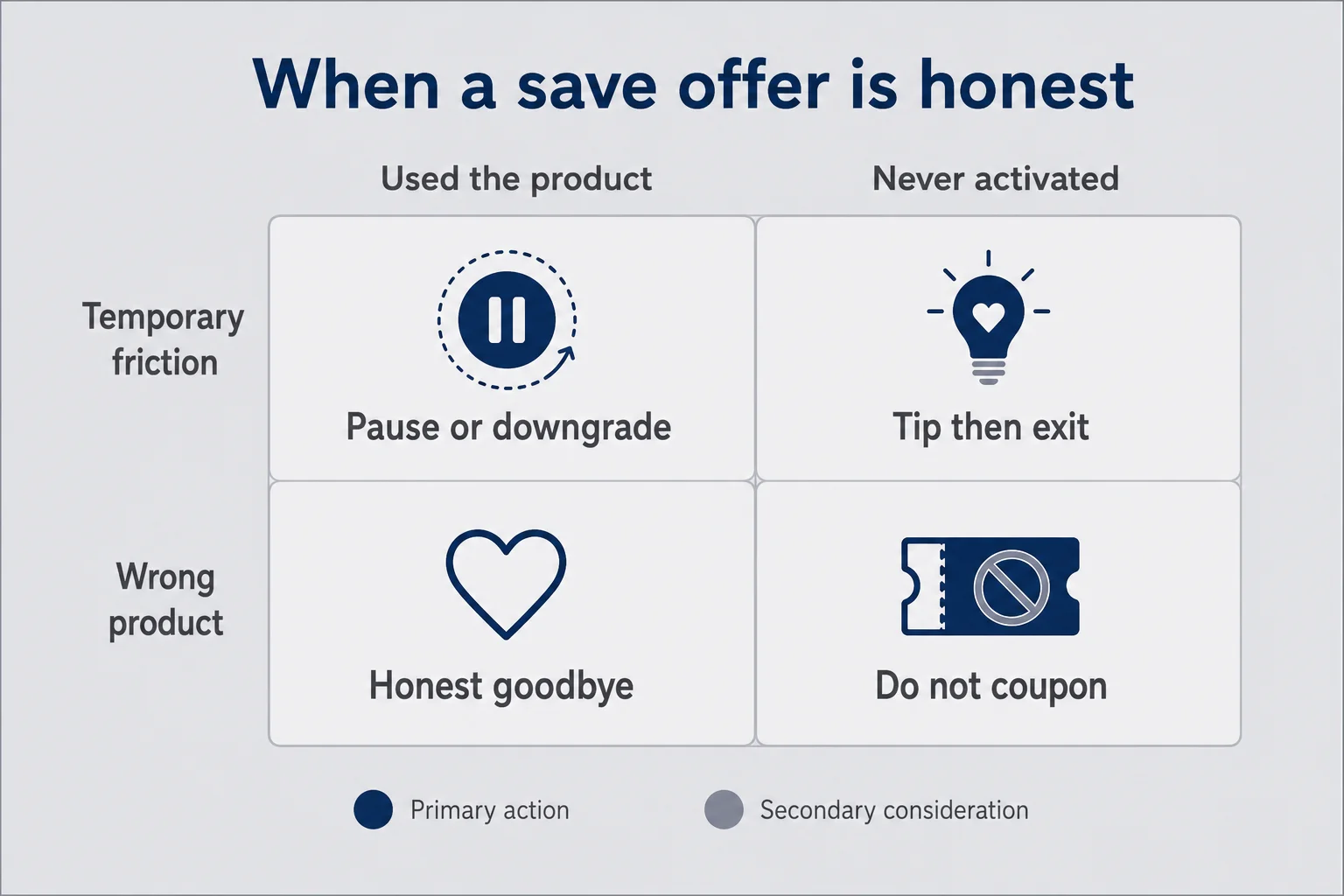
A cancel page save offer is useful when three conditions line up. They used the product enough to know what it does. The stated reason is something you can temporarily fix (price, timing, plan size). And the offer does not teach the whole customer base that cancel equals coupons.
When those conditions fail, a discount is bribery. It keeps a mismatched customer for one more cycle and makes the next cancel louder. I have seen "saved" accounts cancel again sixty days later with a nastier reason note. The coupon bought time. It did not buy fit.
Before you design the offer UI, decide your rules in writing. Who sees a pause? Who sees a downgrade? Who sees a discount? Who sees nothing but confirm? Rules prevent you from improvising when someone writes a long angry paragraph. Improvisation at cancel feels personal in the moment and inconsistent in the aggregate.
Pause and downgrade beat a panic coupon
Pause is my default save for seasonal users and temporary cash pressure. "Pause for one or two billing cycles, keep your data, resume when you are ready." It costs you near-term MRR. It preserves goodwill. It does not train bargain hunting.
Define the maximum pause length up front. Ninety days is a common ceiling for solo products. Infinite pause turns into abandoned accounts you still store and still worry about. Auto-resume with an email warning a week before billing restarts. Silence at resume is how you recreate chargebacks.
Downgrade is the right fork when they say "too expensive" but still need a thin version of the job. Move them to a cheaper plan with honest limits. Do not hide the limits. A surprised downgrade becomes a one-star review later. Show a before/after of what they keep and what they lose. If you cannot explain the cheaper plan in three bullets, it is not ready to be a save path.
Discounts work best as a short, named offer: two months at 30% off, then back to regular price, with the reason tied to "you said price was the issue." Evergreen "secret cancel coupon" culture will hollow out your pricing. If you need a permanent lower price, that is a plan design problem, not a cancel modal problem. See micro-SaaS pricing for solo founders before you invent another coupon. And if you are already thinking about raising prices later, read raise micro-SaaS prices so your cancel discounts do not fight your pricing strategy.
When you should not try to save them
Do not save people who never activated. They do not need a discount. They need a better first week, which is an onboarding problem you fix for the next cohort, not a coupon for this one. Offering 50% off to someone who never finished setup is paying them to stay confused.
Do not save clear product mismatches. If they needed accounting and you sell scheduling, a pause just delays an honest goodbye. Thank them. Ask what they switched to if they volunteer it. Move on.
Do not save abusers of the flow. If the same account cancels for a coupon every quarter, stop showing the offer. Your rules can be simple: one save offer per account per year. You can enforce that with a flag on the customer record. It is not rude. It is how you protect the customers who pay full price without playing games.
And do not save with guilt. "We will be sad to see you go" is not a strategy. Respect the decision. Leave the door open. That tone converts better in win-back than any sad emoji. Guilt is what founders write when they feel rejected. Customers can smell it.
One more non-save: legal or safety exits. If someone cancels because of a privacy concern or a billing dispute, route them to a clear policy page and support, not a coupon. Some exits are not commercial conversations.
SaaS cancel reason survey: ask once, then act
A saas cancel reason survey only earns its place if you read it. Founders love adding dropdowns. Founders hate opening the spreadsheet on Sunday. If you will not review reasons weekly, skip the survey and admit you are flying blind.
Ask one primary reason. Make the options mutually exclusive enough to act on. Then one optional free-text line: "Anything else we should know?" That free-text is where the real product truth hides. The dropdown is for sorting. The sentence is for understanding.
I schedule thirty minutes every Monday morning to skim new cancel reasons. Not a meeting. Not a dashboard review with twelve charts. Just the raw notes. Patterns show up faster in prose than in pie charts. The week I saw three people mention the same export bug in free text, I stopped debating roadmap priorities for the afternoon.
The five reasons that actually change what you ship
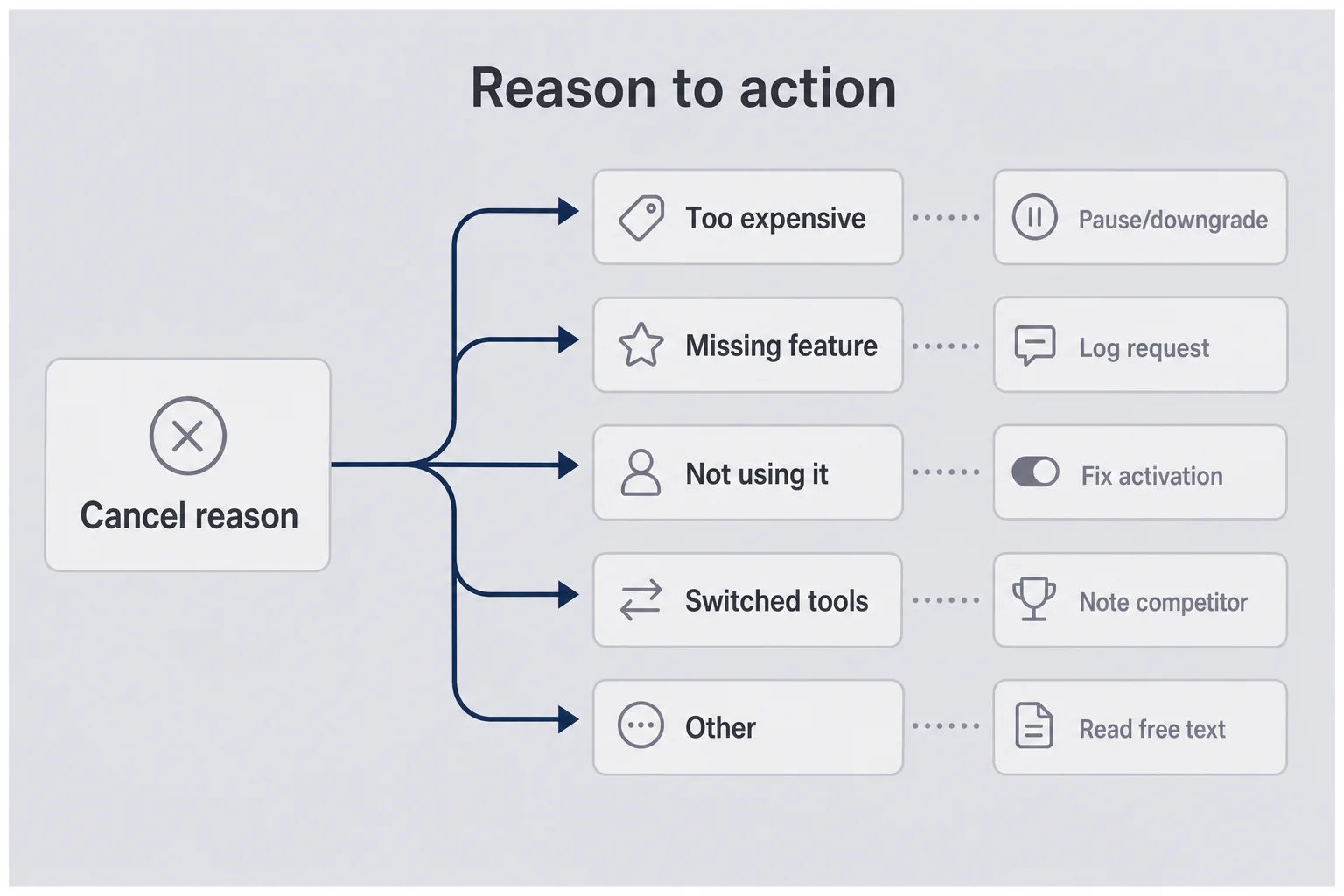
These five cover most early micro-SaaS cancels I have seen: too expensive or budget; missing a feature I need; not using it enough; switched to another tool; other, with free text.
Map each to an action. Too expensive goes to pause or downgrade path. Missing feature gets logged, maybe a soft follow-up asking which feature, with no fake roadmap promises. Not using it points you at onboarding and activation work for future users; for this user, a tip email later beats a coupon now. Switched tools is a chance to note the competitor name when they volunteer it. Other means read carefully and resist the urge to force it into a neat bucket.
Do not turn the survey into a product interview. You already had your chance during customer interviews and support. At cancel, friction must stay low. One click reason. Optional sentence. Done.
Avoid overlapping labels. "Too expensive" and "not worth the money" are the same reason wearing two shirts. Avoid cute labels too. "Going on a journey" is not a reason. "Budget" is.
Store the reason on the customer record. When you look at churn later, slice by reason. "Churn is 4%" tells you almost nothing. "Half of voluntary cancels say not using it" tells you where to spend the next month. If you use PostHog or a simple warehouse, attach reason as a property on the cancel event. Future you will want that join when someone asks why MRR flattened.
Share a monthly reason summary with yourself even if you are the only employee. Write five bullets. "Eight cancels. Five not using it. Two price. One switched to X." That ritual beats a beautiful churn chart you never open.
Do not promise ship dates on the cancel page
"We are building that next month" turns into a credibility hit when next month slips. Capture the request. Say thank you. Fix the roadmap in private.
What happens after they still click cancel
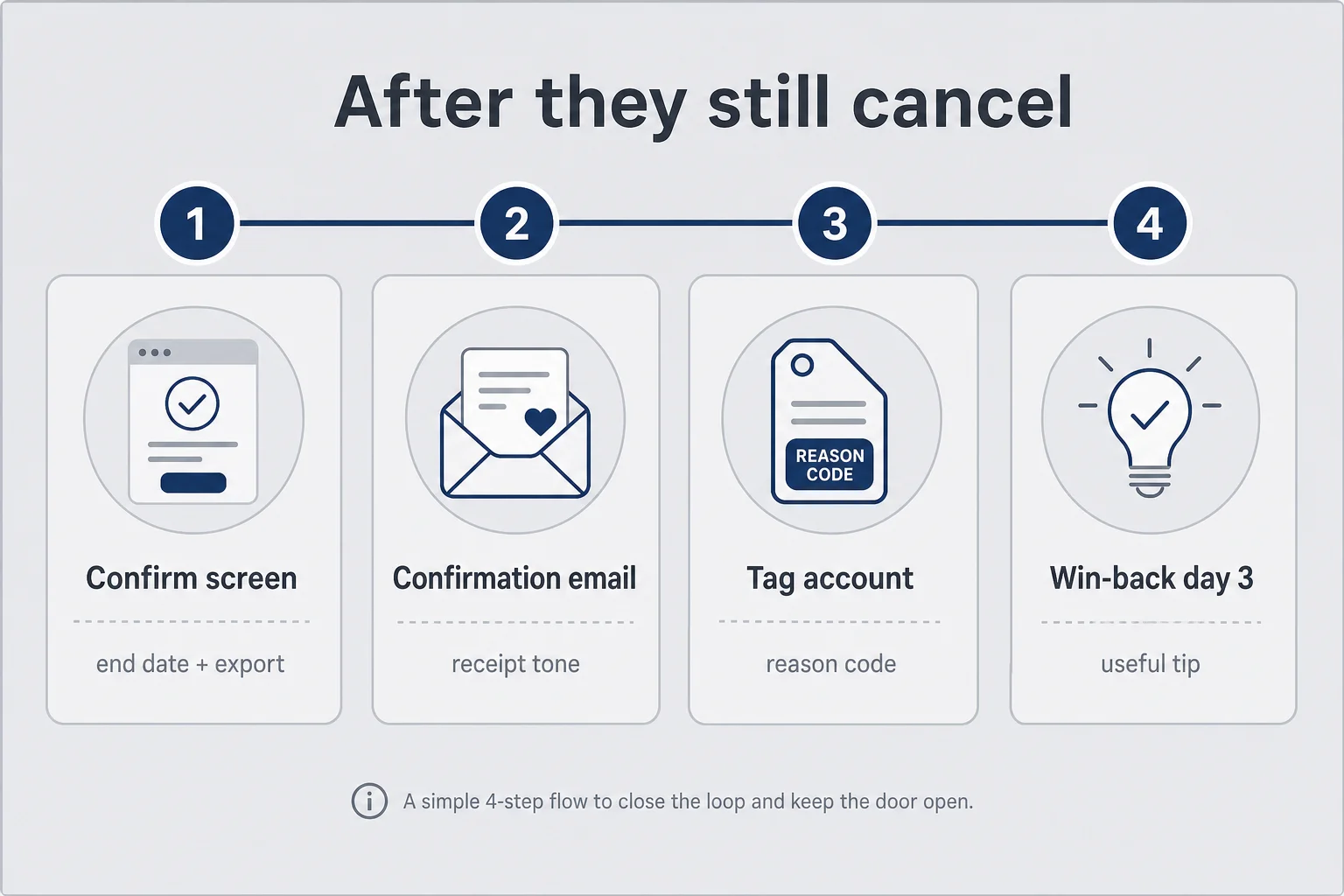
Most people will still cancel. That is fine. Your flow succeeded if the exit was clear and you captured a reason. The save rate is a bonus, not the grade. Founders who obsess over save rate start building traps. Founders who obsess over clarity keep their reputation when people leave.
After confirm, show a short confirmation screen. Restate the end date. Link to data export. Link to your status or docs if relevant. Tell them how to reactivate in one sentence. Then send the same information by email within a few minutes. People screenshot nothing. Email is the artifact they keep.
Write that confirmation email like a receipt, not like a breakup letter. Subject line can be plain: "Your subscription is set to cancel on March 14." Body: what happens to access, how to export, how to reactivate, how to reach support if something looks wrong. Sign with your name. Not "The Team."
If you delete data on a schedule, say when. "We keep your workspace for 30 days, then delete." Ambiguous retention policies create panic emails and, worse, legal confusion. Put the real policy in your terms and mirror the short version here. If you are in consumer iOS land, privacy expectations are even sharper. Do not invent a different story in the app than the one on the website.
Operationally, tag the account as voluntarily canceled with the reason code. That tag feeds win-back segments. Without it, you will email people who left because of a card failure the same copy you send to people who hated the product. Those are different humans. Segment or do not bother.
Also close the loop in support. If they had an open ticket, resolve it with a short note that the account is set to cancel and you are here if they need export help. Leaving open tickets on canceled accounts creates zombie work. I have watched founders answer a week-old bug report for someone who already left, then wonder why the week felt empty.
One operational habit that pays off: a weekly "canceled this week" glance. Not to spiral. To catch anomalies. Three cancels mentioning the same outage. A spike after a price change. A quiet week that means your cancel tracking broke. Anomalies are where products improve.
Win-back email sequence saas: three emails, not a calendar
A win-back email sequence saas founders can actually maintain is short. Three messages. Then stop. Lifecycle tools love twelve-step nurtures. Solo founders abandon twelve-step nurtures by email four. Three is enough to be useful without becoming wallpaper.
Write them in your voice. Not "We miss you!" brand theater. Not a fake personalization token parade. One human who runs the product, writing to someone who already paid once. If you would be embarrassed to read the draft out loud to a friend, rewrite it.
I draft win-back emails the same way I draft cold outreach: specific, short, one ask. The difference is they already know you. You do not need to introduce the product. You need to respect the leave and offer a door.
Day three, day fourteen, day forty-five
Day three: acknowledge the cancel without drama. Give one concrete tip related to the job they hired you for, even if they are not paying. Include a reactivation link. Goal: leave a useful last impression and prove you are not only emailing to extract a card. Example shape: "Your account is set to end on March 14. If you exported nothing yet, here is the fastest path. If you already moved on, ignore this. If you want back later, this link works."
Day fourteen: if you shipped something relevant to their cancel reason, say so in one paragraph. If you did not, skip feature theater. Share a short case of how another customer solved a similar problem, or a checklist they can use with any tool. Soft CTA to come back. No countdown timers. Countdown timers at win-back feel like a clearance aisle.
Day forty-five: clean reopen. Price is clear. What is new is clear if anything is. One button. Then suppress them from win-back unless they engage. Continuing past this point without a reply is how you train people to filter your domain. Forty-five days is long enough that life circumstances may have changed. It is also soon enough that they still remember who you are.
Branch when you can. "Too expensive" gets a different day-fourteen note than "missing feature." If your ESP cannot branch yet, write one sequence and keep the day-fourteen email generic and useful. Branching is an upgrade, not a launch requirement. ConvertKit, Loops, and similar tools make basic branching boringly available now. Use it when the volume justifies the setup time.
For the broader lifecycle system around trials and activation, my notes on onboarding email sequences still apply: map to events, not vanity calendars. Win-back is the mirror image after the relationship pauses. The same discipline that stops you from sending seven "just checking in" trial emails should stop you from sending seven "we miss you" win-backs.
Measure replies, not only opens. A thoughtful reply that says "still not the right time" is a gift. It tells you to wait. A click with no reply is weaker signal than founders pretend.
Micro saas win back flow: timing, tone, and the offer
A micro saas win back flow fails in two common ways. Too fast, and it feels like you ignored the cancel. Too salesy, and it feels like you ignored the person.
Timing: give the cancel a few days of air. Immediate win-back emails read as "we did not accept your decision." Waiting months with silence wastes the window where they still remember why they signed up. The day-three / day-fourteen / day-forty-five cadence is a starting point, not scripture. If your product is seasonal (tax tools, event tools, school-year products), align the last email to the season when demand returns.
Tone: adult to adult. Assume they left for a real reason. Do not imply they made a mistake. Invite them back because the product may fit again, not because you are lonely for MRR. Avoid "come home" metaphors. Avoid fake scarcity. Avoid comparing them to "successful customers who stayed." That last one is especially ugly.
Offer: optional, and matched. If price was the reason and you can stand a time-bound discount for returning customers, say it once in the day-forty-five email. If the reason was usage, lead with a simpler path to value, not 50% off. If they switched tools, be honest that you will not match every competitor feature, and name the one job you still do unusually well.
I have seen founders attach a huge coupon to every win-back and wonder why returning customers churn again in sixty days. The coupon got the card. The product fit never returned. Prefer reactivation without a discount when you can. Prefer a better onboarding link over a price cut. A returning customer who lands in the same confusing empty state will leave again, faster.
Keep unsubscribe obvious. Win-back is still marketing email. One-click unsubscribe is not optional. People who opt out are not prospects. They are people who asked you to stop. Honor it immediately. Also suppress win-back if they already reactivated, if they asked for deletion, or if support flagged the account as hostile. Common sense beats automation.
One more timing note: do not run win-back on top of a Product Hunt spike or a big outbound push without checking your ESP reputation. A burst of cold-ish email to canceled users plus a launch blast can look like spam to filters. Stagger. Your deliverability is part of retention whether you like systems thinking or not.
Stripe cancel, pause, or downgrade — decide before the UI
Pick the billing behaviors before you design the pretty cancel page. Stripe can cancel at period end, cancel immediately, pause collection depending on how you model it, or change the subscription to another price. Your UI should map to decisions you already made in the dashboard and docs.
For most micro-SaaS products, cancel at period end is the default. Customers feel treated fairly. You avoid mid-cycle refund math. Immediate cancel is for edge cases and clear policy exceptions. If you offer both, explain the difference in plain language next to each option. "Cancel at period end" and "Cancel now and lose access today" should not require a lawyer.
Pause: if you offer it, define maximum length and what happens to data and seats. Write it down. Implement it the same way every time. Half-implemented pause is worse than no pause. Some founders "pause" by setting a manual reminder and canceling in Stripe, then forget to resume. That is not a product feature. That is a calendar hazard.
Downgrade: create the cheaper price in Stripe first. Test the proration rules on a real test clock or a throwaway customer. Then expose the button. Founders love mocking a downgrade CTA and then discovering proration surprises on the first real click. Surprises at cancel destroy trust faster than almost any other billing mistake.
If custom UI is too heavy right now, start with Stripe Customer Portal for plan changes and cancel, and add a thin reason form that writes to your database before redirecting. Perfect cancel UX is not required on day one. A captured reason plus a working portal beats a gorgeous flow that never ships. I would rather you learn from twenty real reasons this month than ship a polished flow in eight weeks with zero data.
Whatever you choose, log the event. Subscription canceled. Reason code. Save offer shown. Save offer accepted or declined. Those four fields power everything in the next section. If engineering time is scarce, even a row in a spreadsheet updated by a Zapier hook from your form is better than nothing. Move it into the app when the volume hurts.
Test the unhappy paths. What if Stripe is down when they confirm? What if the portal session expires? What if they click cancel twice? Boring edge cases are where support tickets are born. A simple "something went wrong, email support@ with this code" is enough. Silence is not.
How you know the flow is working
You do not need a retention dashboard the size of a Series A company. Track a handful of numbers monthly: cancel attempts, completed cancels, save acceptances split by pause and downgrade and discount, reason distribution, win-back reactivation count and revenue, and reply rate on win-back emails. Even a few replies teach you tone.
If cancel attempts rise but saves are healthy, your acquisition or onboarding may be putting the wrong people into paid. If reasons cluster on "not using it," stop polishing the cancel modal and fix activation. If "too expensive" dominates and nobody takes downgrade, your cheaper plan may not be real value, just a smaller invoice.
Compare voluntary cancel to involuntary churn separately. Improving dunning will not fix a broken cancel conversation, and a beautiful cancel page will not recover expired cards. Put both numbers next to each other on the same monthly note so you do not "fix churn" by fixing the wrong half.
When a reason repeats three times from unrelated customers in a month, that is a product or positioning task, not a copy tweak on the save offer. The cancel flow’s job is to surface the truth. Fixing the truth happens elsewhere: in the roadmap, the landing page, or the first-run experience.
Beware vanity save rates. A high save rate driven by aggressive coupons can mask a product that only retains when bribed. Prefer quality of save: did paused accounts resume and stay for ninety days? Did downgrades still use the product weekly? Did discounted accounts convert back to full price without another threat to cancel? Those questions are uglier and more useful.
If you want a single north-star for this system, use this: every voluntary cancel leaves you with a reason you trust and a relationship that is not poisoned. Revenue saves are the upside. Truth and reputation are the baseline.
Questions founders ask me about cancel flows
Should every micro-SaaS have a cancel save offer?
No. Offer a pause or downgrade when the product still fits and the timing is wrong. Skip discounts for people who never activated, for clear product mismatches, and when a coupon would train them to threaten cancel for a deal. Save offers work when usage was real and the friction is temporary.
How many questions should a cancel reason survey ask?
One primary reason plus one optional free-text field. A long form at cancel is a trap. Five labeled reasons cover most early-stage volume: too expensive, missing feature, not using it, switched tools, or other. Read the free-text weekly. Patterns beat anecdotes.
When should a win-back email sequence start after cancel?
Wait at least a few days so the cancel does not feel like an ambush. A practical cadence for solo founders is day three with a useful tip, day fourteen with a product change if you have one, and day forty-five with a clean reopen invite. Stop after three emails unless they reply.
Is pausing a subscription better than a discount?
Often yes. Pause keeps the relationship without teaching customers that cancel equals a coupon. Use pause for seasonal users and temporary cash crunches. Use a short discount only when price was the honest reason and they already got value. Downgrade sits between the two when a cheaper plan exists.
How do I cancel in Stripe without building a custom portal?
Stripe Customer Portal can handle cancel, plan changes, and payment method updates with less custom UI. Configure what customers can change, then deep-link from your account settings. Custom cancel flows are worth building when you need reason capture and save offers. Portal alone is fine until volume justifies the work.
What is a healthy cancel save rate for a solo founder?
There is no universal number. Track saves as a share of cancel attempts, not of total customers. Early on, even a handful of paused or downgraded accounts per month matters more than a vanity percentage. If nobody ever accepts a save offer, the offer is wrong or you are showing it to people who already decided to leave.
The cancel button is not a failure. Ignoring it is.
Every product that charges money will see the cancel click. Pretending otherwise is how founders get blindsided by a quiet MRR slide and a spreadsheet full of anonymous churn.
Build a saas cancellation flow you can run on a Tuesday afternoon: one page, one question, one honest fork, three emails, then silence. Treat the people who leave as sources of truth, not as personal rejections. Some will come back when the timing is better. Some will never come back, and that is still useful if you learned why.
The founders who keep more customers are rarely the ones with the cleverest coupon. They are the ones who designed the exit with the same care they gave the signup. That care is not romantic. It is operational. And it is available to a solo founder who decides the cancel click deserves a conversation instead of a mute confirm dialog.



Comments