Your Best Tweet Got Praise. Nobody Signed Up.
How solo founders use Twitter/X for micro-SaaS distribution: fix the profile, reply before you pitch, post founder-led notes, and measure conversations - not vanity likes.
 By Reese26 min read
Listen to this article
26:31AI-generated podcast-style overview of this article (not a word-for-word narration).
A founder sent me a screenshot of a tweet with four hundred likes and twelve quote-tweets calling it "so true." His MRR the next morning was unchanged. The replies were other founders nodding. Not a single person asked how the product worked. He had won the timeline and lost the week.
That is the twitter marketing micro saas solo founder trap in one notification stack. X will feed you dopamine for observations that sound sharp. It will not automatically turn those observations into customers. Distribution on this platform is still possible. It just refuses to reward billboard energy the way people remember from old Product Hunt cross-posts.
I have run growth for small B2B SaaS teams since 2014 and shipped my own side projects since 2022. I have watched founders treat Twitter like a content calendar and then wonder why warm replies never show up. I have also watched quieter operators get their first ten customers from threads that never cracked a thousand impressions because the right twelve people saw them and DM'd.
This guide is for solo founders who already have something to sell and need a realistic X habit: profile that reads like a landing page, reply-first distribution, founder-led notes that do not sound like press releases, soft pitches that do not train mutes, and metrics that ignore vanity. If LinkedIn is your lane, I already wrote that LinkedIn playbook. If Reddit is your lane, that too. This one is the noisy app that still works when you stop performing for other founders.
I am not nostalgic for 2019 growth Twitter. The room changed. The rule did not. Talk where buyers already argue. Be useful before you are promotional. Measure conversations. Leave when the room is empty.
One more framing before the tactics. X is a conversation network wearing a media costume. If you act like a media company with a newsroom of one, you will burn out. If you act like a sharp operator who shows up in the right threads, you can stay for years. Choose the identity that matches a solo calendar.
I keep a simple filter for every draft: would I say this to a smart customer at a meetup without cringing? If not, delete. The timeline rewards confidence, but buyers reward accuracy. Accuracy with a little edge travels. Fake certainty dies in the replies.
Also decide what you will never post. For me that list includes fake revenue screenshots, dunking on customers, and "hustle harder" lectures. Your never-list is personal. Write it down. Boundaries keep the account from becoming a different person at midnight. Protect that line.
Twitter marketing micro saas solo founder: what X is actually good for
Twitter marketing micro saas solo founder work is not "go viral." It is repeated proximity to people who already feel the pain you solve. The platform is still useful for discovery, for borrowing attention under other people's posts, and for short public thinking that proves you understand the job.
What it is bad at: replacing a landing page, replacing onboarding, replacing a clear offer. A great tweet funneling into a confused site just trains people to like you and leave. Fix the destination while you build the habit. My landing page notes still apply. Eight seconds on X followed by eight seconds of confusion on your site is still failure.
Think of X as a room where your buyers already argue about tools, workflows, and money. Your job is to join the argument as a human who ships, not as a brand mascot. The algorithm changes. The human rule does not: useful replies from a credible person beat polished announcements from an empty account.
Say you sell a tool that cleans messy CRM exports for freelancers. The useful X move is not a thread titled "We launched." The useful move is answering freelancers who are already complaining about CSV hell, then pointing to a short page when they ask what you use. Proximity first. Pitch second.
Distribution is a habit, not a launch day
I see founders "do Twitter" the week of launch and disappear. That pattern teaches the platform and your followers that you only show up when you need something. Show up when you do not need something. Reply when someone else's post is the center of gravity. Post when you have one clean observation. Over ninety days that rhythm compounds more than a single heroic thread.
If you only have thirty minutes a day, spend twenty on replies and ten on drafting one note. Most people invert that and wonder why nobody talks back. Inversion feels productive because typing a thread looks like work. Replies feel small. Small is where the customers are.
Launch day on X is a multiplier, not a factory. If you have zero familiarity in the room, launch day is a whisper into a nightclub. Warm the room for weeks. Then launch into recognition.
What "good" looks like before you have a following
Good before scale is ugly and specific. Your bio names who you help and what breaks. Your pinned post shows a useful artifact or a clear offer. You reply daily in three niches you can sustain. You post a few times a week without guilt. You can point to conversations, not just impressions.
Good is not a blue check vanity sprint. Good is a stranger saying "how do you handle X?" in a reply or a DM. That question is the unit of progress.
I would rather have forty thoughtful followers in my ICP than four thousand random accounts that like aesthetic screenshots. Follower count is a costume. Conversation count is the business.
When Twitter fits a micro-SaaS (and when you should skip it)
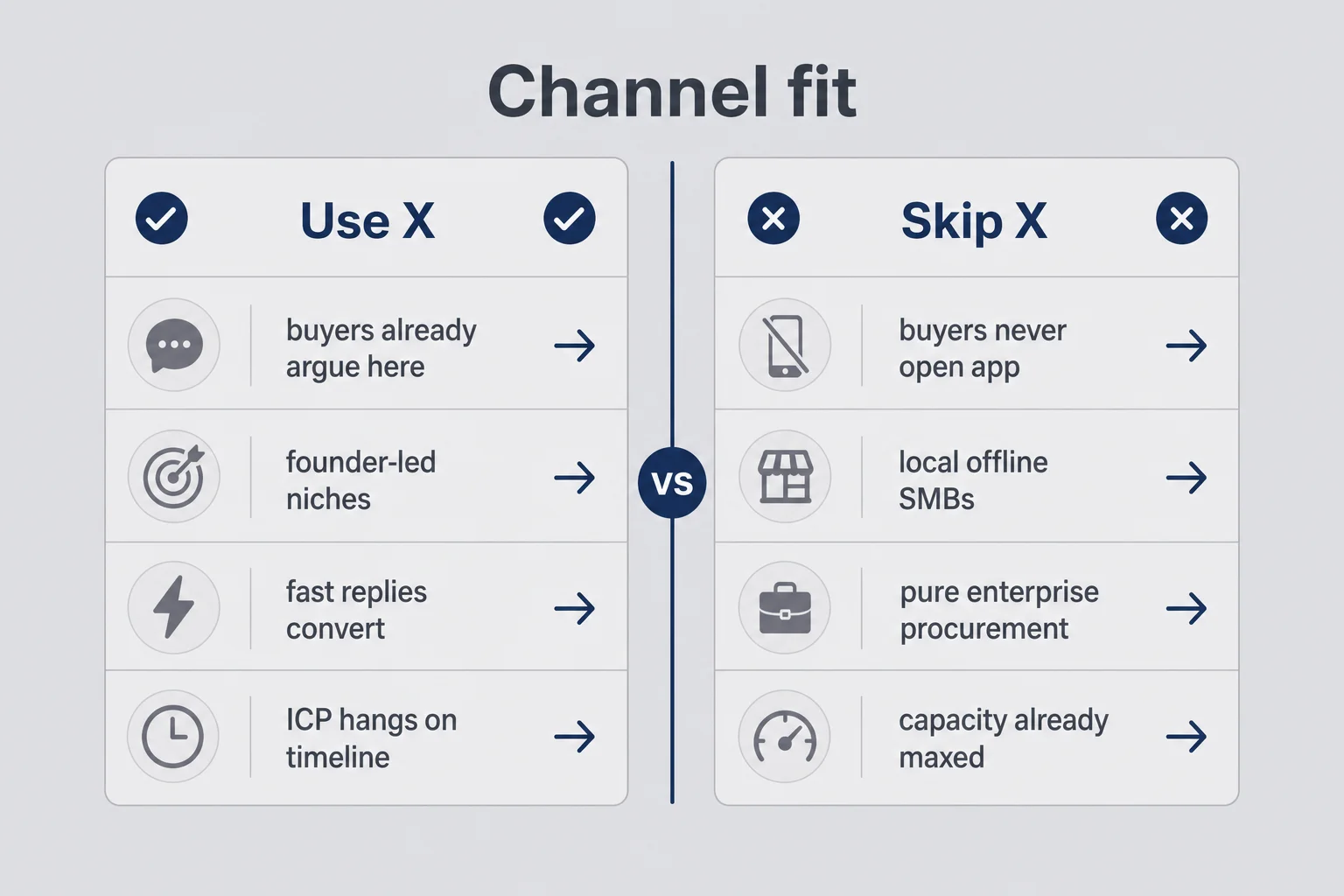
Skip X if your buyers are not there. Consumer parents, local service owners, and many offline SMBs will not see your carefully crafted threads. Channel fit beats hustle. Check whether your ICP already posts, lurks, or follows tool makers on the platform before you commit ninety days.
X tends to fit developer tools, indie SaaS, AI utilities, design-adjacent products, and founder-to-founder B2B. It also fits when your category already has loud public conversation. If the problem is whispered in Slack communities and never posted publicly, you may get better leverage elsewhere.
A practical test: search three phrases your buyer would type when annoyed. If active accounts discuss those phrases weekly, you have oxygen. If the search is a graveyard of bots and crypto spam, do not force romance with the platform.
When X fits, it still is not your only channel. Pair it with an owned list eventually. Timeline reach is rented. Email is closer to owned. Use X to earn the right to continue the conversation somewhere quieter. A waitlist or simple newsletter capture on your site turns timeline spikes into something you can message next month.
Also be honest about energy. If the timeline makes you angry every morning, you will not sustain the habit. Pick a channel you can stand. Sustainability is a growth strategy. Rage-scrolling is not.
Competitors on the timeline are not a strategy
Founders sometimes mirror whatever the biggest account in their niche does. That account has a different audience, a different offer, and often a media business attached to the product. Copying their cadence without their trust is cosplay. Steal structure, not voice. Steal questions, not catchphrases.
Watch which posts from competitors earn replies from real buyers, not from other founders. Buyer language is the map. Founder applause is the distraction.
Fix the profile before you post
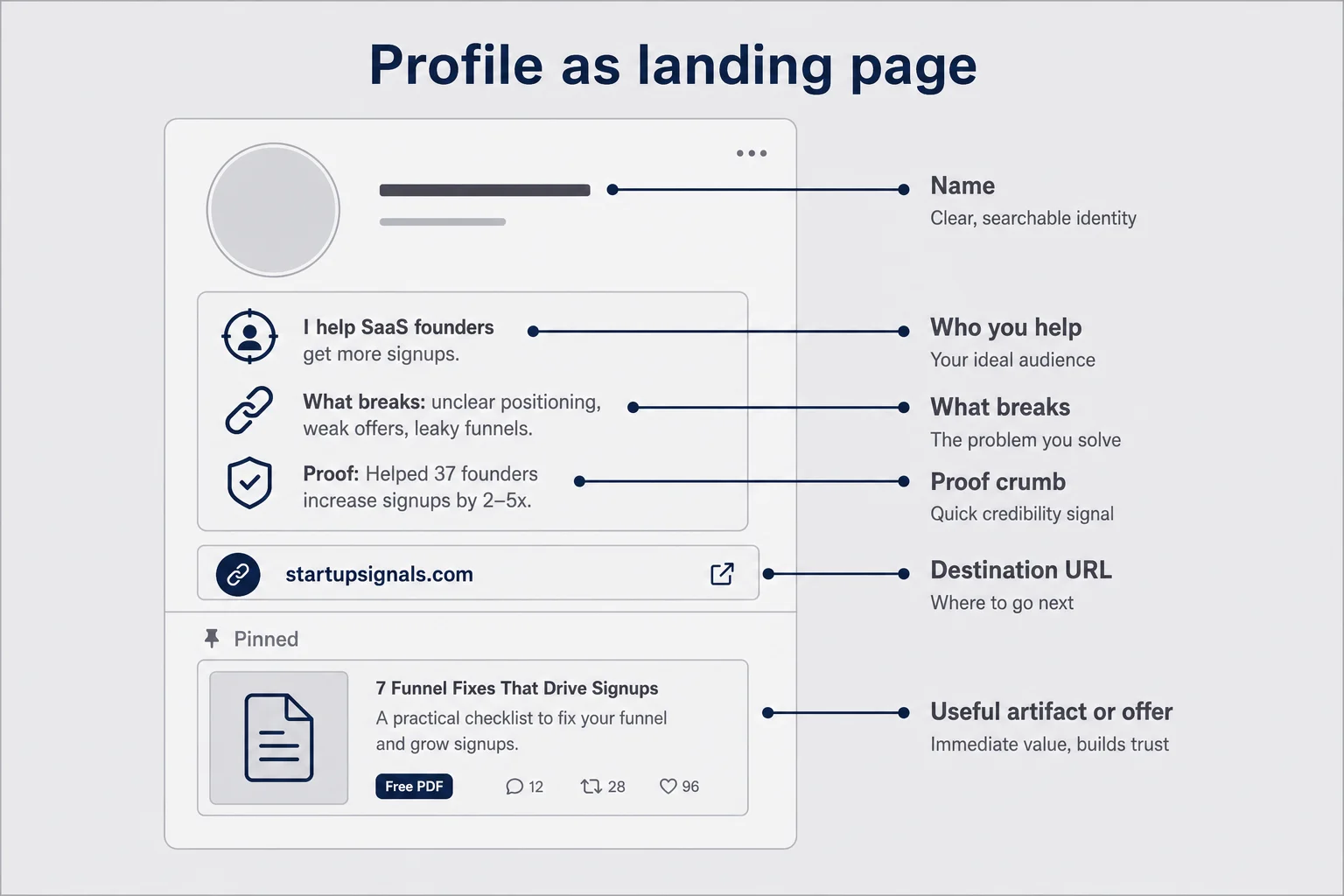
People click your face after a good reply. If the profile is a joke bio and a link to a half-finished Carrd, you waste the click. Treat the profile like a tiny landing page.
Name: human name beats clever brand handle for most solo founders. Photo: clear face, not a logo that looks like a spam account. Bio: who you help, what outcome, optional product name. Link: one destination. Location and banner: optional, not a design thesis.
Pinned post: either a short proof of the problem you solve, a useful teardown, or a clear "here's what I built and who it's for." Rotate the pin when the offer changes. Do not pin a vague motivational quote.
I once audited a founder whose bio said "Building in public" and whose product helped accountants stop pasting bank CSVs into spreadsheets. The bio mentioned neither accountants nor CSVs. Building in public is not a value proposition. It is a hobby label. Rewrite until a stranger knows whether to care in three seconds.
Twitter for saas founders starts with clarity, not cadence
Twitter for saas founders fails when the calendar is full and the sentence is empty. Clarity first. Cadence second. If you cannot write one plain bio sentence, posting daily will only scale confusion.
Write the bio like a positioning line. Outcome over identity. "I help agency owners ship client reports without Friday rebuilds" beats "Founder | SaaS | AI | Coffee."
Test the bio with a friend who does not work in startups. If they cannot explain who you help after one read, rewrite. Your ICP is not obligated to decode founder hieroglyphics.
Keep the link honest. If you are pre-product, link a useful article or a waitlist with one job. If you are live, link a page that matches the bio promise. Mismatch between bio and destination is a quiet conversion killer.
Update the banner only if it helps recognition. A clean product shot or a simple statement can help. A busy collage helps nobody. Same with the name field: avoid keyword stuffing that makes you look like a bot. Humans follow humans.
If you rebrand, change the pin and bio the same day. Stale pins create mismatched expectations. Expectations that break on click become distrust, and distrust does not convert later when your product is actually ready.
Founder led twitter content that does not sound like a press release
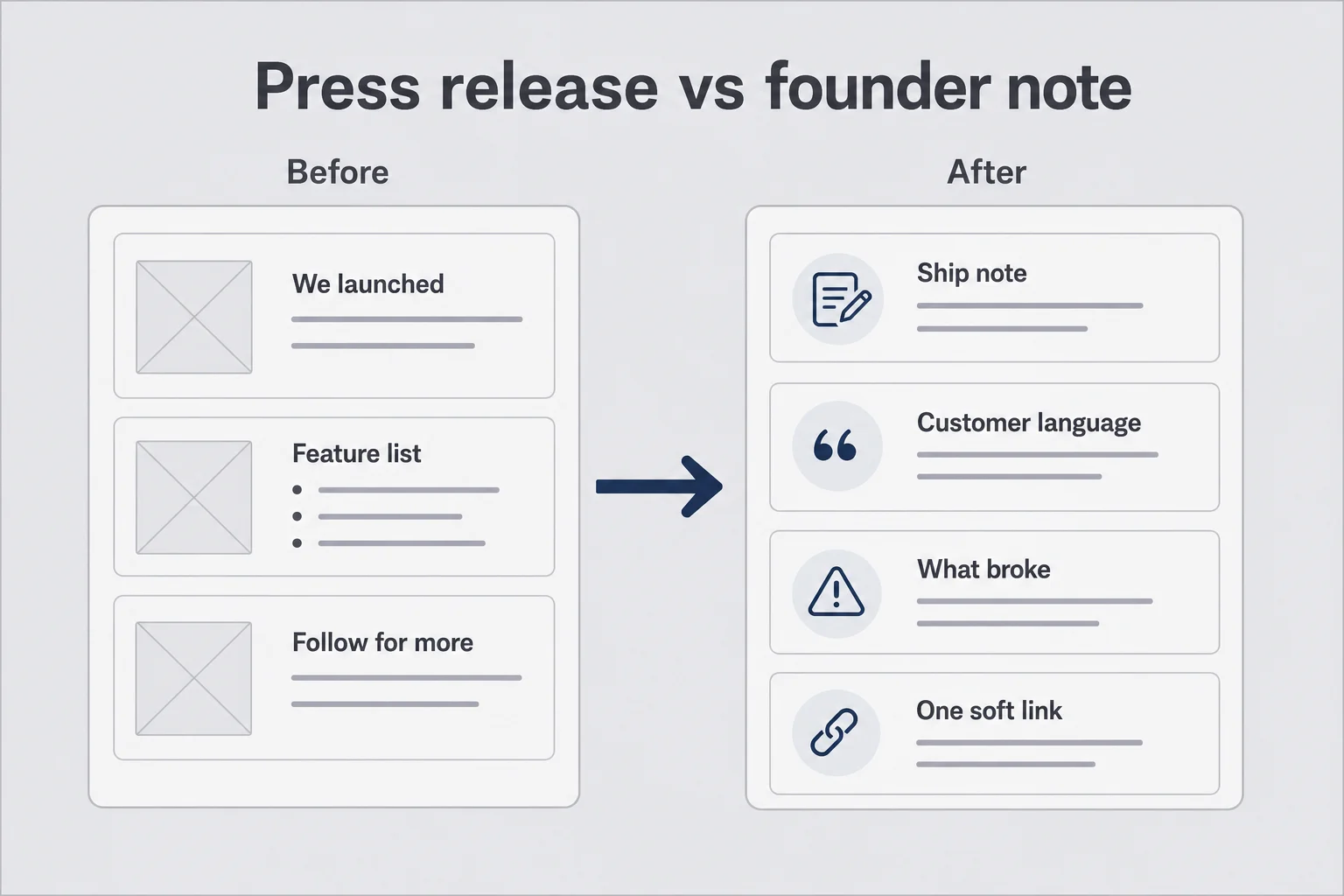
Founder led twitter content works when it sounds like you talking after a real week of work. Ship notes. Mistakes. Customer language. Small metrics without flexing. Tradeoffs you chose. Questions you are still answering.
It fails when every post is a launch announcement with three emojis and a link. It also fails when every post is vague inspiration that could belong to any founder in any category. Specificity is the whole game.
I draft tweets the way I draft cold email subject lines: one idea, one edge, one human verb. If the draft could be posted by a competitor with one noun swapped, rewrite. If it requires a thread to make sense, ask whether a single note with a screenshot would be clearer.
Write like you are debriefing a founder over coffee after a launch that underperformed. Direct. Useful. No guru energy. The timeline already has enough people performing certainty.
Formats that earn attention without theater
Short observations with a concrete noun. Before/after of a workflow. A customer sentence with permission and anonymized details. A screenshot of a UI decision with the reason. A "I was wrong about X" note. Occasional threads when the topic truly needs sequence, not because threads feel like thought leadership.
Avoid fake engagement bait. "Agree?" under a banal take trains people to scroll. Ask real questions when you want real answers. "How are you handling failed Stripe webhooks without a support team?" will filter for operators. "Who else hates Mondays?" will not.
Humor helps when it is dry and attached to the work. Sarcasm without substance is just another mute. My rule: if the joke needs the product to be funny, it is an ad. If the joke works and the product is an optional punchline, you are safer.
Screenshots convert when they show a decision, not a flex. A pricing page draft with a crossed-out headline teaches. A dashboard with fake MRR brags. Be the first kind.
When you share numbers, round and frame them as examples or ranges unless you are comfortable with the precision. "We went from twelve to nineteen paying users after rewriting onboarding" is useful. Invented exact bank balances are not. Texture beats theater.
Reply-first distribution beats thread theater
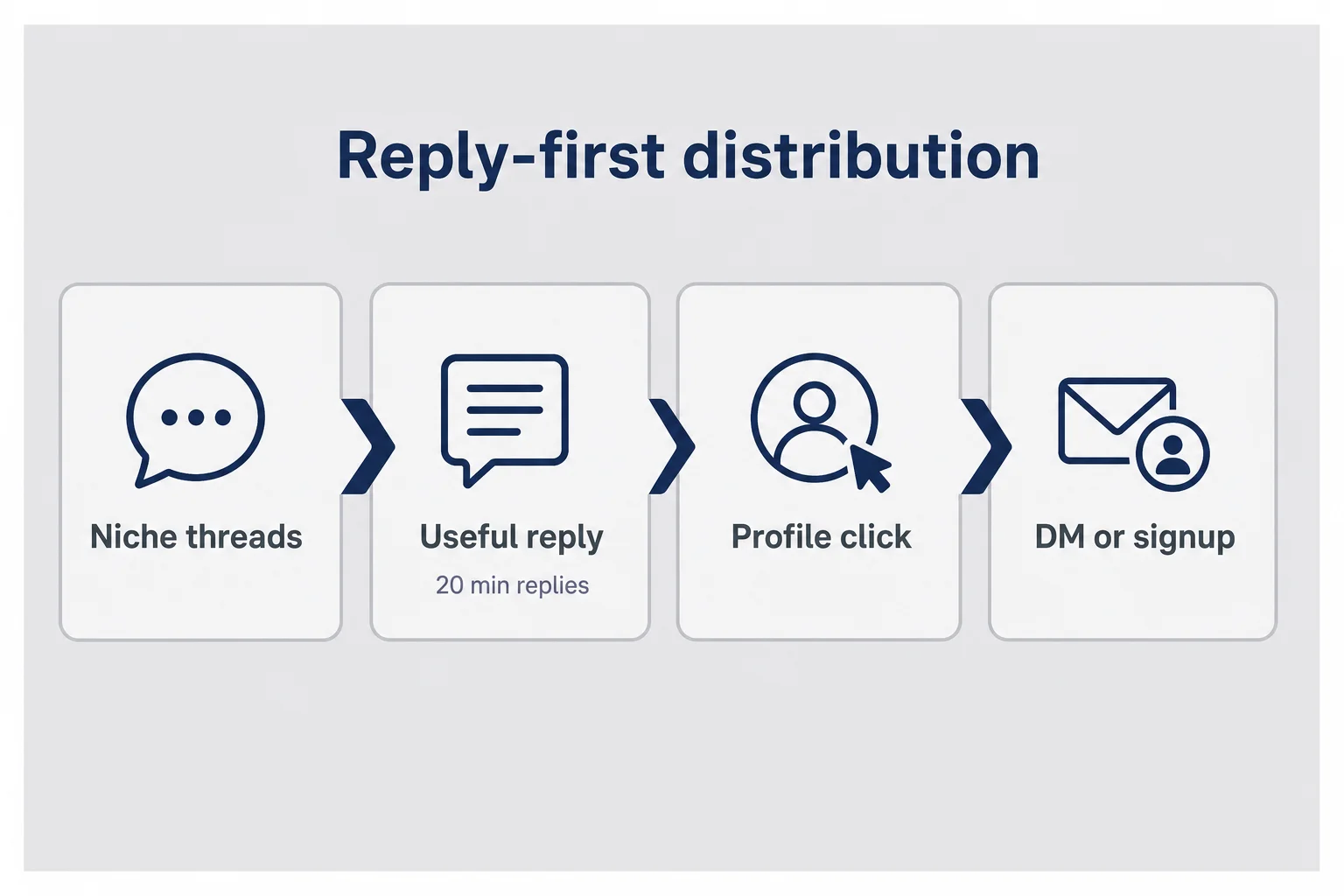
Most solo founders underinvest in replies because replies do not feel like "content." Replies are the content. They put you under posts your ICP already decided to read.
Pick three to five accounts your buyers already follow: practitioners, niche journalists, tool makers, community hubs. Every weekday, leave five to ten replies that add a second thought, a caveat, a concrete example, or a useful disagreement. Skip "This!" and fire emojis. Those are wallpaper.
When someone with your ICP asks a question you can answer from experience, answer in public. Then, if they engage, continue in replies or DM without leaping to a pitch. The sequence is respect, usefulness, curiosity, offer. Invert it and you become spam with better grammar.
I have seen founders get their first three customers from a single week of stubborn reply work under posts that were not even about SaaS. The posts were about the job: reporting, hiring freelancers, cleaning CRMs. Your product lives inside a job. Meet people inside the job conversation.
X marketing micro saas without becoming a reply guy caricature
X marketing micro saas fails when you spray identical soft pitches under every large account. Personalize. Reference the actual point. Add one detail only you would know from shipping. Then stop. You do not need to win the thread. You need one human to click the profile.
Time-box replies. Twenty focused minutes beats two distracted hours. When the timer ends, leave. The timeline will still be there tomorrow, louder and less important.
Also protect your reputation. Snark at beginners in your category reads as insecurity. Correct gently or not at all. The buyer watching the thread remembers who was helpful.
If a large account posts something wrong about a workflow you know well, you can disagree without dunking. "We tried that and broke billing for a week; this is what worked instead" teaches. "Lol wrong" just earns enemies.
Keep a swipe file of your best replies. Not to copy-paste robotically, but to remember the tone that earned DMs. When you are tired, tone slips toward snark. The swipe file pulls you back.
Some days the best reply is a question. "Are you seeing this more with freelancers or agencies?" invites the poster and the audience to get specific. Specificity is how you find buyers hiding in a general complaint.
If you cannot add value, do not reply. Silence is better than noise. The goal is not maximum replies. The goal is maximum useful presence per minute.
Soft pitch without becoming an ad account
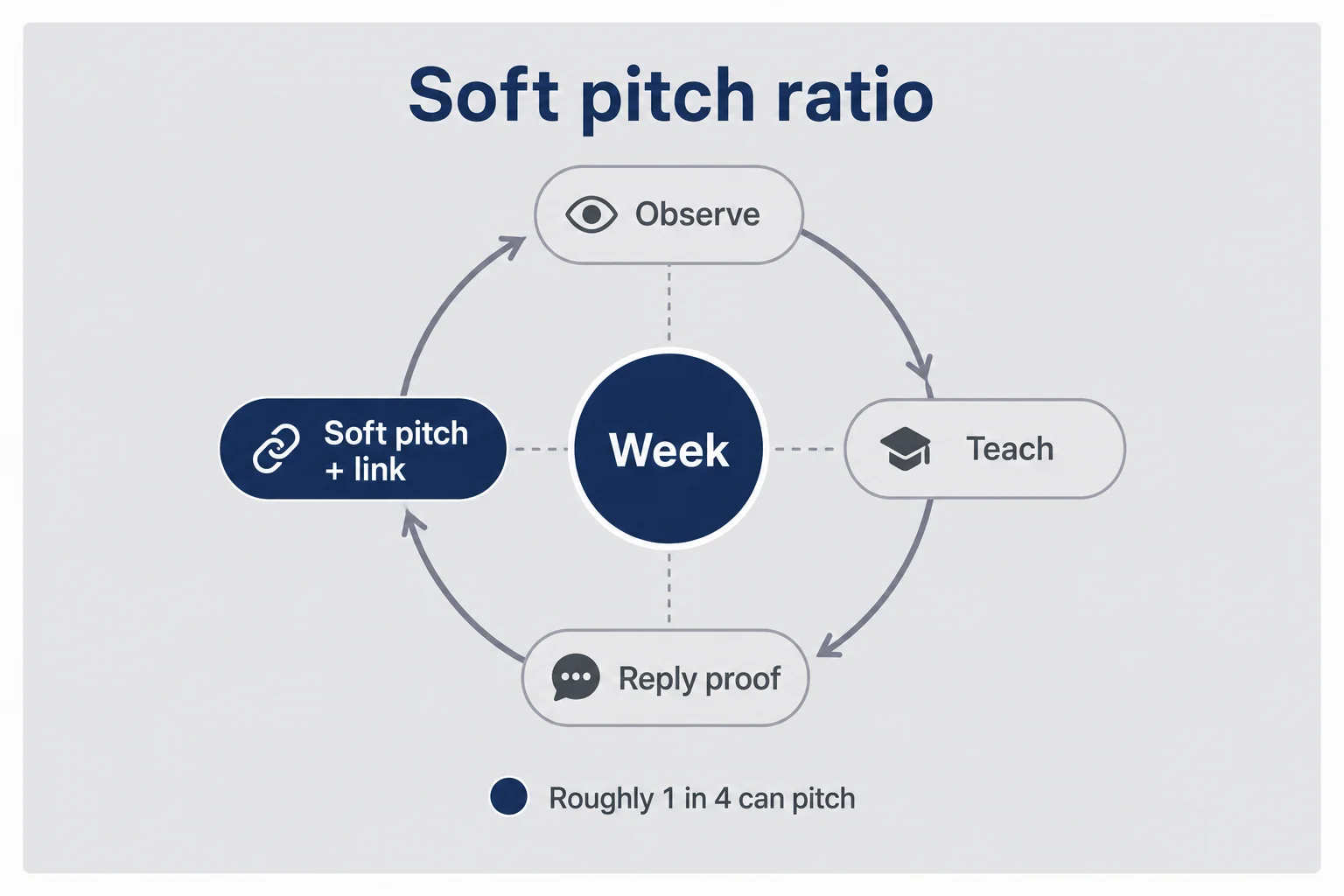
You are allowed to mention the product. You are not allowed to make the product the only personality you have.
A workable ratio for early stage: most posts teach or observe, some posts show build process, fewer posts invite a click. When you do invite a click, make the promise narrow. "I wrote how we handle cancel flows for solo founders" is better than "Check out our revolutionary platform." Link to a useful URL. Track it.
Launches still work on X when you have earned attention first. A cold audience does not owe your launch day anything. Warm up for weeks. Then launch into people who already recognize your name from replies.
If you run ads later, that is a different budget and a different skill. Organic founder presence and paid amplification are cousins, not twins. Do not buy distribution until a manual message converts. Paid spend on a confused offer just buys faster confusion.
Product Hunt cross-posts and "we launched" screenshots can work as one beat in a longer presence. They fail as your entire personality. Same with "building in public" metrics posts. Share them when they teach. Skip them when they only flex.
A soft pitch can be a sentence at the end of a useful note. It can be a reply offering a free teardown. It can be a pinned post. It should rarely be seven posts a day with the same UTM. People notice patterns. Patterns that look like ads get muted.
DMs and lists without the ick
Public replies create permission. DMs without permission feel like cold email in a smaller room. After someone engages thoughtfully, a short DM can work: reference the exchange, ask one question, offer one relevant resource. No paragraphs. No calendar link on first touch unless they asked for time.
Build a private list of ICP accounts and niche communities. Check the list more than the For You feed. The main feed is entertainment. Your list is work.
Avoid scraping tools that get accounts banned. Avoid mass-follow tricks. The short-term follower spike is not worth the long-term trust hit. Grow like a person.
When someone says they might need the product, move toward a clear next step: trial link, short Loom, or a focused page. Ambiguous DMs die. Clear DMs convert or get a clean no. Both outcomes are useful. If you are debating whether video belongs in outbound at all, the Loom outreach fit picker answers that before you record.
If you already do cold email, treat X DMs as warmer, shorter cousins. Same respect rules. Less volume. Higher context. Do not paste your email sequence into a DM box.
Mute and block liberally. Protecting attention is part of distribution. You cannot help buyers if you are arguing with strangers about politics in your mentions.
Cadence you can keep for ninety days
Pick a schedule you would keep during a bad week. Example: weekday mornings, twenty minutes of replies; Monday and Thursday, one post; Friday, optional recap or customer note. Protect the calendar like you protect shipping time.
Batch drafting if you must, but write replies live. Batched replies feel canned. Live replies feel human. Humans get customers.
Missed days happen. Do not "catch up" with six posts on Sunday night. Resume the habit. Guilt posting is still vanity.
Ninety days is long enough to learn whether the channel can produce conversations. Six days is only long enough to decide you hate the algorithm.
Write the cadence on paper. If it depends on feeling inspired, it will die. Inspiration is a bonus. Habit is the system.
When life gets busy, cut posts before you cut replies. Replies keep you in the room. Posts without replies are broadcasting into fog.
Travel weeks and launch weeks will break the ideal calendar. Pre-write two posts if you must, but keep reply time sacred. A week of only replies still moves distribution. A week of only scheduled posts with zero listening usually does not.
Share the cadence with an accountability friend if you need external pressure. Do not share it with the entire timeline as a performance of discipline. Announcing your content system is not the system.
How you know it is working
Measure get customers from twitter saas outcomes with boring numbers: ICP follows, profile clicks after replies, DMs with buying questions, trial signups from tracked links, qualified conversations per week.
Ignore most impression spikes unless they produce the above. A viral miss is still a miss. A quiet week with three serious DMs is a win.
Review monthly. Which reply topics earned conversations? Which posts earned mute energy? Double down on the first. Cut the second without ceremony.
If after two months you have only founder-on-founder applause, your content may be stuck in builder theater. Shift toward customer language. Talk about their Friday, not your stack.
Compare channels honestly. If Reddit or LinkedIn produces better conversations per hour, redistribute time. X is not morally superior. It is one room. Sit where the buyers sit.
For broader solo marketing choices, the marketing overview still holds: pick a channel you can sustain. This post is the X version of that advice with fewer illusions.
A simple weekly scoreboard I like: conversations started, profile clicks from ICP, links clicked, trials started. Four numbers. No vanity dashboard tourism. If conversations are rising and trials are flat, fix the offer page. If nothing is rising, fix the habit or the room.
Do not check the scoreboard hourly. Hourly checking turns distribution into anxiety. Weekly is enough to steer. Monthly is enough to decide whether the channel stays on the calendar.
When a post performs, ask why before you clone it ten times. Was it the topic, the specificity, the timing, or a larger account amplifying you? Cloning without understanding creates a graveyard of weaker copies.
And when nothing works, talk to three people from your ICP outside Twitter. Maybe the message is wrong. Maybe the room is wrong. The timeline is a mirror, not a strategy brain.
Extra operating notes I wish someone handed me
These are the messy details that do not fit cleanly under a single heading but decide whether you stick with the channel.
First, mute words liberally. Crypto spam, engagement bait phrases, and political keywords will eat your morning if you let them. Your attention is inventory. Protect it like runway.
Second, do not argue pricing philosophy with strangers for sport. A short clarification is fine. A twenty-reply debate is a vanity project. Buyers rarely convert from watching you win a dunk contest.
Third, screenshot your wins privately. A polite DM that turns into a trial is worth more than a public clap. Keep a private note of conversations that moved. Review it monthly. Your brain will remember the viral miss and forget the quiet yes unless you write the yes down.
Fourth, separate personal venting from operator posting if both live on one account. You can be human without turning your product account into a mood diary. People buy from humans. They also mute chronically chaotic feeds. Find the middle.
Fifth, when the algorithm feels dead, check your inputs before you declare the platform dead. Are you replying in ICP threads or scrolling entertainment? Are you posting vague takes or specific notes? Are you linking to a page that converts? Most "the algorithm hates me" weeks are input problems wearing a conspiracy costume.
Sixth, collaborate without begging. Quote-tweet with an added insight. Mention someone when their idea actually shaped your week. Ask for introductions only after you have given value in public. Social capital is real. Spending it before earning it shows.
Seventh, prepare a simple "what I sell" reply you can paste when someone asks. Not a manifesto. Three sentences: who it is for, what job it does, where to try it. Ambush pitching is bad. Being unable to answer "what do you do?" is also bad.
Eighth, accept that some weeks produce zero business outcomes and still maintain the habit. Distribution has variance. Quitting after a quiet Tuesday is how you guarantee the channel never compounds.
Ninth, if you hire a social media person later, do not outsource your founder voice on day one of traction. An agency can help with design and scheduling. They cannot invent your taste for which customer sentence matters. Keep the reply habit founder-owned longer than feels efficient.
Tenth, reconnect X to the rest of the funnel. A tweet is not a business. It is a door into a landing page, a trial, an onboarding email, and eventually retention work. If those pieces are broken, Twitter marketing becomes a hobby with analytics. Fix the path after the click with the same seriousness you bring to the reply.
A ninety-day starter plan you can steal
Week one: rewrite bio and pin. Build a private list of thirty ICP accounts. Reply ten times a day without mentioning your product.
Week two: keep replies. Add two posts that teach one specific lesson from shipping. No launch language.
Week three: introduce one soft proof post. Customer language, anonymized. One optional link to a useful article you wrote.
Week four: review conversations. Note which topics earned ICP replies. Double those topics next month. Cut the rest.
Month two: maintain reply habit. Post two to three times weekly. Run one clear soft pitch per week maximum. Track link clicks.
Month three: attempt a small launch or feature announcement into the warm audience you earned. Compare conversation quality to month one. Decide to continue, reduce, or reallocate hours to LinkedIn or Reddit.
This plan is deliberately boring. Boring plans survive contact with a real calendar. Fancy content systems die in week two when support tickets arrive.
If you already have an audience from another channel, compress the warm-up. If you are starting from zero, do not skip weeks one and two. Skipping the warm-up is how launch tweets land in silence and you conclude Twitter is dead.
What to do when a tweet actually takes off
Occasionally something spreads beyond your niche. Treat the spike as a temporary storefront, not a personality change.
Reply to serious questions first. Mute noise. Pin a clearer explanation if the viral post is being misread. Add one calm link if people ask what you built. Do not chain five promotional follow-ups while the spike is hot. That pattern trains newcomers to see you as an opportunist.
Capture emails if you can. A simple "I wrote the longer version here" beats trying to hold a relationship entirely inside the timeline. Spikes fade. Lists remain.
After the spike, do a short postmortem. Who showed up? Were they ICP or entertainment audience? What sentence traveled? Keep the sentence. Discard the fantasy that every post should do that again. Most will not. That is fine. The business is built on many small conversations, with rare amplification as a bonus.
If the spike attracts bad-faith attention, tighten replies and move real prospects to DM or email faster. Not every mention deserves oxygen. Choose your battles with the same discipline you bring to channel selection.
Tools I actually use (and what I ignore)
I draft in a notes app, schedule sparingly, and keep analytics light. A basic link tracker is enough. I do not need a twelve-step social suite to reply like a human.
I ignore tools that promise "AI that sounds like you" for the entire feed. AI can help outline. It cannot tell you which customer sentence mattered on Tuesday. If you use AI for drafts, rewrite until it sounds like you again. Same rule as landing pages.
I also ignore follower-growth services, auto-DM blasts, and pods. Short-term numbers, long-term trust damage. Micro-SaaS lives on trust. Do not rent a megaphone that burns the room.
If a tool helps you protect focus (mute lists, bookmarks, lists), use it. If a tool exists to make you look bigger than you are, skip it. Looking bigger is not the same as getting paid.
One last operator note on tools: your phone can be a reply machine and a trap. If morning replies turn into forty minutes of unrelated scrolling, move the habit to desktop with lists only. Environment design beats willpower. Make the work version of X easier to open than the entertainment version.
Questions founders ask before they live on the timeline
Does Twitter still work for micro-SaaS in 2026?
It works when your buyers already hang out there and you treat it as conversation, not a billboard. Developer tools, indie SaaS, AI utilities, and founder-adjacent B2B often still find people on X. If your customers never open the app, skip it. Channel fit beats nostalgia for 2019 growth threads.
How often should a solo founder post on Twitter/X?
Most solo founders do better with one to three useful posts a week plus daily replies in niches they care about. Daily empty posting burns you out. Ninety days of steady replies and occasional notes beats a two-week thread sprint. Consistency compounds. Volume without conversations is noise.
Should I buy followers or use engagement pods?
No. Bought followers poison your analytics and attract the wrong audience. Pods train you to trade empty likes instead of talking to buyers. Grow slower with real replies from people in your ICP. Small honest reach converts better than a inflated follower count that never clicks a link.
Is it okay to link to my product on Twitter?
Yes, when the link is the honest next step after a useful observation. Lead with the problem and what you learned. Mention the product when it belongs. If every tweet is a soft launch, people mute you. If you never name what you sell, warm readers never convert. Roughly one in four posts can point to a trial, article, or demo without feeling like an ad feed.
How do I know Twitter is working for my SaaS?
Track profile visits, quality follows from your ICP, inbound DMs about the problem you solve, and signups tagged from X links. Likes and impressions alone are not proof. After six to eight weeks of consistent replies and posts, if you have praise but zero curiosity about the product, fix positioning or ICP before blaming the algorithm.
Twitter or LinkedIn for a B2B micro-SaaS?
Often both in small doses, not both at full intensity. LinkedIn fits professional buyers who research tools at work. X fits faster founder and builder conversations. Pick the one where your ICP already talks, master reply-first habits there, then add the second channel if you still have capacity. Two half-done channels lose to one finished habit.
The timeline will not save a fuzzy offer
Twitter will amplify clarity and punish vagueness at high speed. That is uncomfortable. It is also useful. If your tweets get likes and your product page gets shrugs, the page and the offer need work more than your posting schedule does.
Show up as a person who ships. Reply where your buyers already argue. Pin a clear bio. Post when you have one true sentence. Link when the link helps. Measure conversations. Ignore the rest of the circus.
A product nobody hears about is an expensive hobby. A product everybody praises and nobody buys is a slightly louder hobby. Aim for the quieter win: the right people hearing you, clicking through, and paying. The timeline can help with the hearing. You still have to earn the rest.
If you take one practice from this guide, take reply-first mornings for two weeks before you write another thread. The thread will be better afterward because you will have heard how buyers actually talk. Then post. Then link. Then measure. Then decide whether X deserves another ninety days.
The founders who get customers from this platform are rarely the loudest. They are the most consistent in the right conversations. Be that person in a small niche. Leave the viral costume for people selling courses about virality.
Tomorrow morning, before you draft a thread, open three ICP accounts and leave three real replies. Then rewrite one bio sentence if it still hides the customer. That is enough progress for a day. Stack those days and the channel stops feeling mystical. It starts feeling like work you know how to do.
I will take twenty quiet conversations over twenty thousand empty impressions for any micro-SaaS I advise. Impressions are weather. Conversations are pipeline. Build pipeline on purpose.
And if you remember nothing else: the bio, the replies, the honest soft pitch, and the weekly conversation count. Everything else is optional costume. Wear less costume. Talk to buyers. Ship the product. Come back tomorrow and do it again.
That is the whole channel in one paragraph. Not mystical. Not dead. Just picky about who shows up with patience. Be patient in the right threads. Be impatient with vanity metrics. Your micro-SaaS needs customers, not a costume drama about personal branding. Go earn a conversation before lunch. Then open your product and ship one tiny improvement those conversations asked for. Distribution without product motion is just a louder waiting room. Make the room quieter by shipping. Make the shipping smarter by listening. That loop is the job. Now go start it before the timeline invents a more urgent distraction for you again today. Start the habit now, not later.




Comments