Your Company Page Has Twelve Followers. Post Anyway.
LinkedIn works for micro-SaaS when you treat your personal profile like a landing page, comment before you pitch, and measure conversations—not vanity impressions.
 By Reese26 min read
Listen to this article
13:30AI-generated podcast-style overview of this article (not a word-for-word narration).
I rewrote a founder's LinkedIn headline on a Tuesday because his profile still said "Founder & CEO | Passionate about innovation | Open to opportunities." His product helped agency owners stop rebuilding the same client report every Friday. The headline did not mention agencies, reports, or Fridays. It mentioned passion. Passion does not convert.
We changed the headline to something plain: helping agency owners ship client reports without rebuilding the deck every week. Same person. Same photo. Different job. Within a few weeks he started getting profile visits from people who actually matched his ICP, not recruiters fishing for "innovation." The product had not changed. The landing page above the fold had.
If you are looking at LinkedIn marketing as a micro-SaaS solo founder because Reddit feels hostile, cold email feels heavy, and SEO feels slow, you are not imagining the opportunity. A lot of B2B buyers still research tools and peers on LinkedIn. They also ignore polished company pages and pitchy DMs. The channel rewards a founder who shows up like a person with a point of view, not a brand account with a content calendar.
This is not a guru course about becoming famous online. It is not a guide to gaming the algorithm with carousels and engagement pods. I do not run those games for myself, and they age poorly. This is the practical version: fix the profile so a stranger understands the offer in eight seconds, post like a human who has done the work, comment before you spray connection requests, and measure conversations that lead to trials.
I have already written about Reddit marketing for solo founders, cold email for first customers, and SEO when nobody googles your product name. LinkedIn sits next to those channels. Max covers the broader marketing picture for solo founders. My job here is the LinkedIn piece: how linkedin for saas founders actually works when you are the entire marketing department.
LinkedIn marketing micro saas solo founder: what this actually means
When I say LinkedIn marketing for a micro-SaaS solo founder, I mean using your personal profile as a distribution surface for one specific buyer problem, publishing short useful posts that teach something true, engaging in public conversations where your ICP already hangs out, and turning the warmest of those conversations into a call, a trial, or a paid plan. That is distribution work. It is not influencer cosplay. It is not turning yourself into a content personality as a lifestyle project.
The founders who get customers from LinkedIn rarely look flashy while they are doing it. They look like knowledgeable operators who happen to have shipped a tool. That distinction matters. LinkedIn's feed is full of hollow inspiration and recycled frameworks. It still surfaces people who write with specifics: a failed experiment, a pricing decision, a support ticket pattern, a screenshot of a messy process. Specifics travel. Vague authority posts die quietly.
Not ads, not engagement pods, not a company page strategy
LinkedIn ads exist. I have run them for clients with real budgets and creative volume. For most micro-SaaS founders under a few thousand in MRR, ads are a distraction. You do not have enough conversion data. You do not have enough creative tests. Organic posting and outreach teach you the language your buyers use. Ads spend money before that language is sharp.
Engagement pods are the other trap. People join groups that like and comment on each other's posts on a schedule. The numbers look healthy. The audience is fake. When a real buyer lands on your profile and sees a pile of generic "Great insights!" comments from accounts that never buy software, the trust leak is real even if you cannot measure it in Analytics.
Company page strategy is the third trap. Founders spend a week designing a logo cover image, writing an About section for a page with fourteen followers, and wondering why nobody sees updates. Personal profiles get distribution. Company pages get ignored unless you already have a brand people search for. For a solo founder, the company page can exist as a credibility stub. It should not be your primary channel.
The channel that works when your buyer already lives there
LinkedIn works when your ideal customer has a job title, a company page affiliation, and a habit of reading work content in a browser or on their phone between meetings. Freelancers who sell to businesses. Agency owners. Ops managers. Heads of marketing at twenty-person companies. Founders buying tools for their own stack. If those people are your buyers, LinkedIn is a room they already enter.
LinkedIn does not work when your buyer is a consumer who never opens the app for work, a teenager, or a hobbyist who discovers tools through TikTok and App Store search. Iryna's consumer iOS world is a different distribution map. Do not force LinkedIn onto a B2C problem because a thread told you "B2B founders print money on LinkedIn." Fit first.
I once watched a founder post daily for two months about "building in public" while selling a tool for dental office managers. His audience became other indie hackers. The dental managers were not reading his posts. The channel was active. The buyer was absent. Activity without ICP match is a hobby with analytics.
Think of LinkedIn less like a broadcast tower and more like a hallway outside the conference rooms where your buyers already walk. You can put up a poster. You can start conversations. You cannot invent a hallway full of different people by posting harder.
Your profile is the landing page nobody fixed
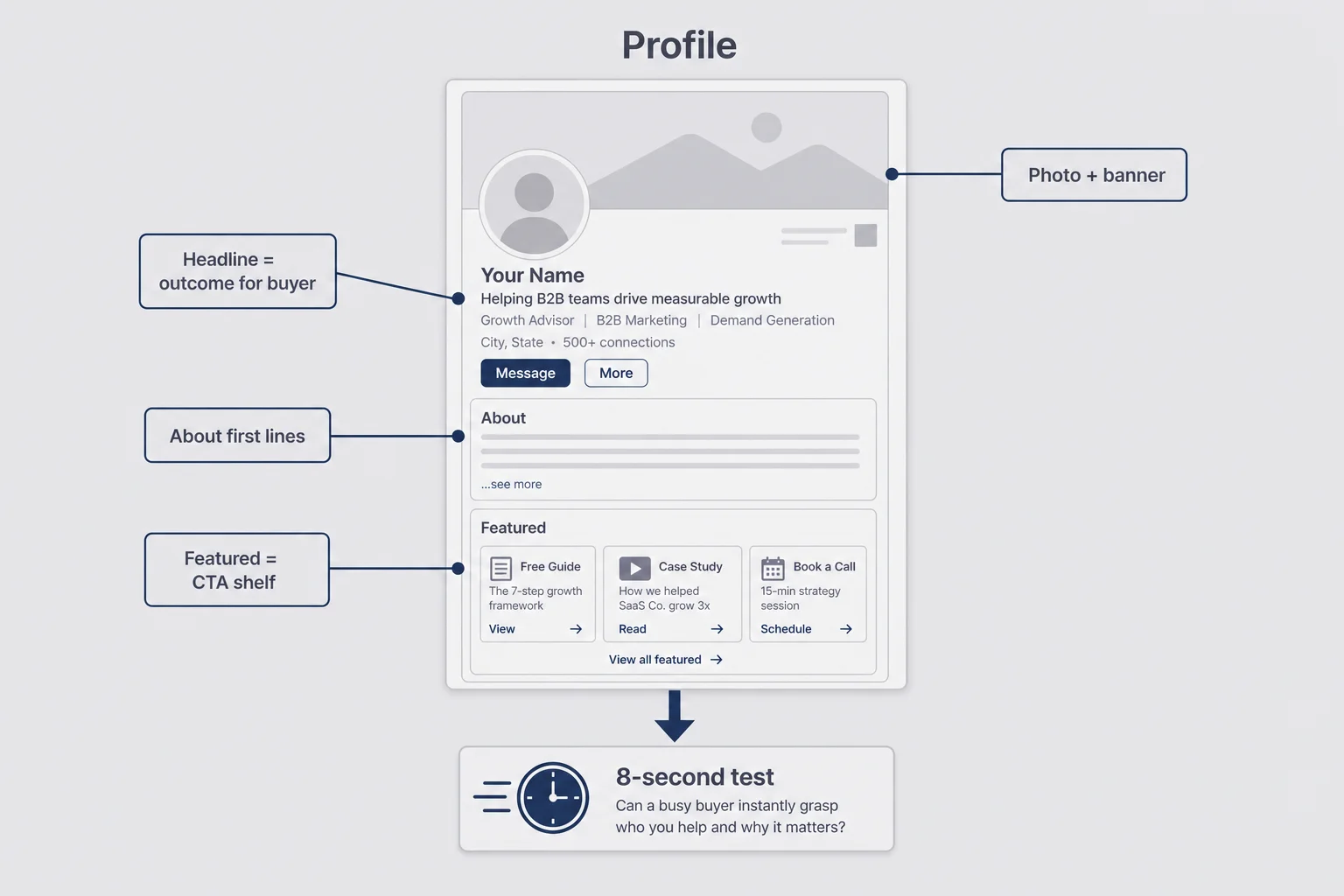
Most founders treat their LinkedIn profile like a resume they forgot to update. Headline is a job title. About section is a biography. Featured section is empty or links to a random podcast appearance. Then they wonder why warm traffic from a good comment bounces after three seconds.
Your profile is often the first page a prospect sees after they notice your name in a thread. It has to do the same job as a landing page for solo founders: name who you help, what painful job you remove, and what to do next. Eight seconds. Mobile first. No passion language.
I audit founder profiles the same way I audit homepages. I do not start with fonts. I start with comprehension. If I cannot explain the offer to a friend after one glance at the top of the page, the rest of the funnel is theater. LinkedIn just makes the failure more public because people click through from comments expecting clarity and find a CV instead.
Headline, About, and Featured without guru copy
Write the headline as an outcome for a specific person, not a stack of titles. "Founder at Acme" tells me nothing. "I help freelance bookkeepers stop rebuilding month-end reports in Sheets" tells me whether I should keep reading. You can include the product name if it clarifies, but the problem comes first.
Bad headlines I see constantly: stacked buzzwords, "Helping businesses grow," "AI-powered everything," or a list of tools the founder once used. None of those help a tired operator decide if you understand their Friday afternoon. Good headlines sound slightly boring and extremely specific. Boring is fine. Vague is expensive.
The About section is not your life story. The first three lines show before "see more." Use them. Who you help. What breaks today. What changes after. One short proof point if you have it: a customer type, a before/after process, a round number of users or hours saved. Round and honest. Do not invent precision.
A workable About shape looks like this in spirit: you help [role] stop [painful recurring job]. Today they [ugly workaround]. Afterward they [cleaner outcome]. You built [product] because you kept seeing [pattern]. Soft CTA: "If that is your week, message me or try the free trial." No novel. No origin myth about coding at age twelve unless it somehow clarifies the buyer problem.
Featured is your CTA shelf. Pin a landing page, a short Loom of the product solving one job, a useful PDF, or a calendar link if you still sell with calls. Three items max. One is fine. Empty Featured is a missed conversion step on a free platform.
Photo and banner matter less than people claim, and more than people who use cropped party photos admit. Clear face. Neutral background. Banner can be simple: one sentence of positioning or a clean product UI crop. You are not designing a billboard. You are removing reasons to distrust you.
Experience and Education can stay. Recruiters care. Buyers skim. Do not spend three evenings polishing job bullets while your headline still says "Passionate about innovation." Sequence matters. Fix the conversion surfaces first.
The eight-second test I run on every founder profile
I open the profile on my phone, cover the Experience section with my thumb, and ask: do I know who this is for and what problem they solve before I scroll? If the answer is no, the rest of the marketing stack is downstream of a broken first screen. Fix the headline and the first lines of About before you schedule another post.
This is the same eight-second instinct I use on landing pages. LinkedIn just happens to be the page people visit when they are still deciding whether you are worth a DM. Treat it with the same seriousness you would treat a homepage rewrite, even if the canvas is uglier.
Run the test after every major positioning change. New ICP? New price? New primary job-to-be-done? Update the profile the same week. Founders ship product changes and leave the public explanation stranded in 2024. Prospects notice the mismatch even if they cannot name it.
When LinkedIn fits a micro-SaaS (and when it does not)
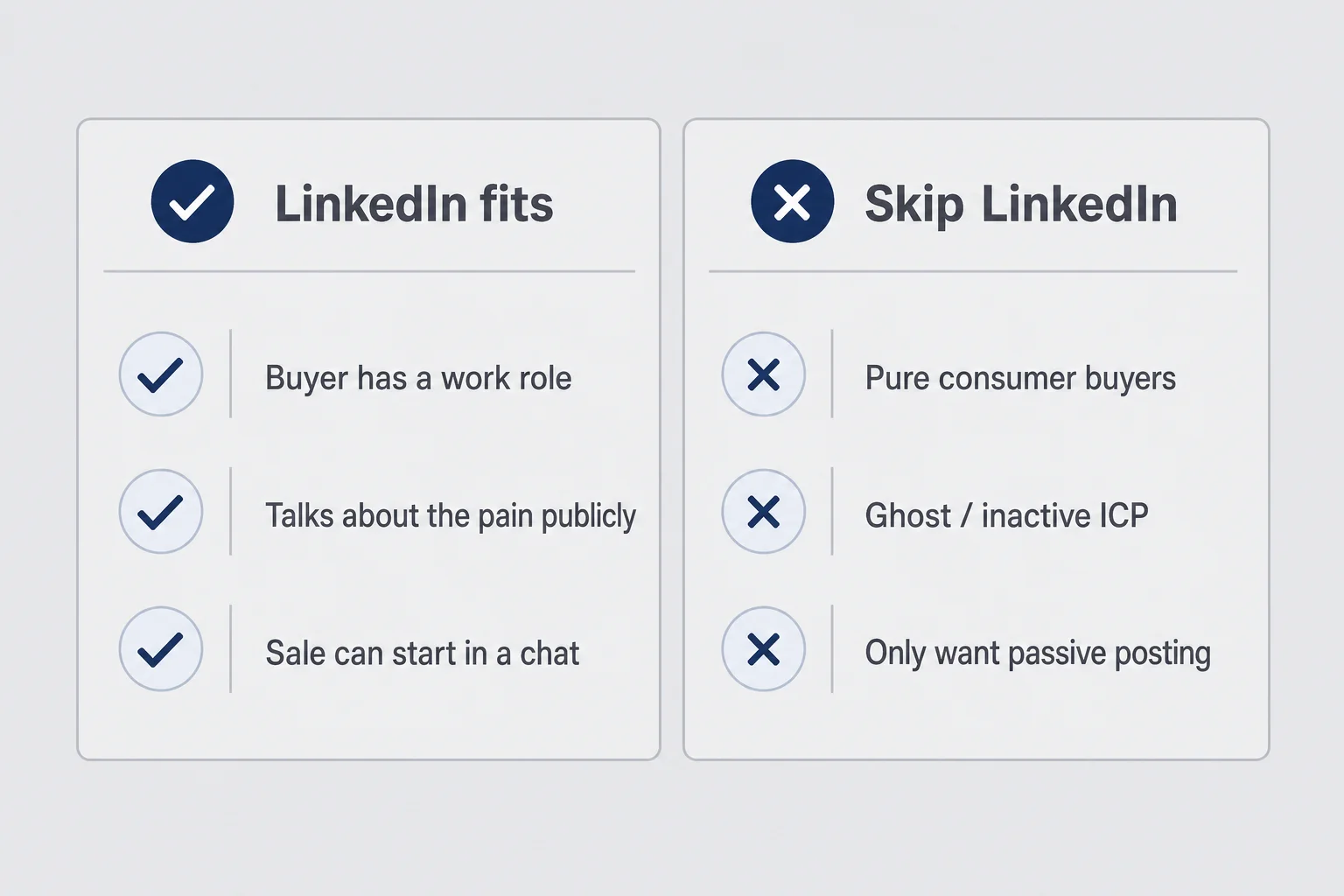
LinkedIn is a strong fit when three things are true. Your buyer is identifiable by role or company type. They already discuss work problems in public or accept connection requests from relevant peers. Your sale can start with a conversation, a short demo, or a self-serve trial that does not need a fifteen-touch enterprise process.
It is a weak fit when your ACV is tiny and the buyer never logs in, when your product is pure consumer, or when you only want passive inbound and refuse to comment or message anyone. Passive LinkedIn for a brand-new micro-SaaS is a long game measured in quarters, not weekends. That can still be worth it. It is not a substitute for launch work that creates first conversations.
B2B and prosumer yes, pure consumer usually no
If you sell to people who have LinkedIn as part of their professional identity, you have a shot. Prosumer tools for freelancers and consultants often fit. Internal tools for small teams fit. Developer tools sometimes fit if the buyer is a founder or eng manager who lurks on LinkedIn, though many developers live elsewhere. Test with ten real profiles of buyers you already know. If none of them are active in the last month, believe that signal.
Pure consumer apps, local services with no professional buyer, and products aimed at people who treat LinkedIn as a job board only will fight the platform. You can still use LinkedIn for hiring or partnerships. Do not confuse that with customer acquisition.
If your ICP never opens LinkedIn, pick another room
I say this because founders love channels that feel productive. Posting feels like work. Commenting feels like work. Building a list feels like work. None of it matters if the buyer is on Reddit, in Slack communities, or only reachable by email. Channel fit is a product decision disguised as a marketing preference.
If you are unsure, spend one week searching for your buyers by title and reading what they post. If you find twenty people who match and post about the pain, LinkedIn is live. If you find ghost profiles and recruiter spam, move on without guilt. Distribution pride is expensive.
A simple fit checklist I use with founders: Can I name the job title in one phrase? Can I find ten active profiles this week who match? Do those people post or comment about work, or only list jobs? Would a fifteen-minute conversation reasonably lead to a trial? If you answer no twice, LinkedIn is probably not your primary channel right now. Put the energy into Reddit, SEO, or outbound email instead of forcing a square post into a round feed.
Founder led LinkedIn content: post like a human, not a brand page
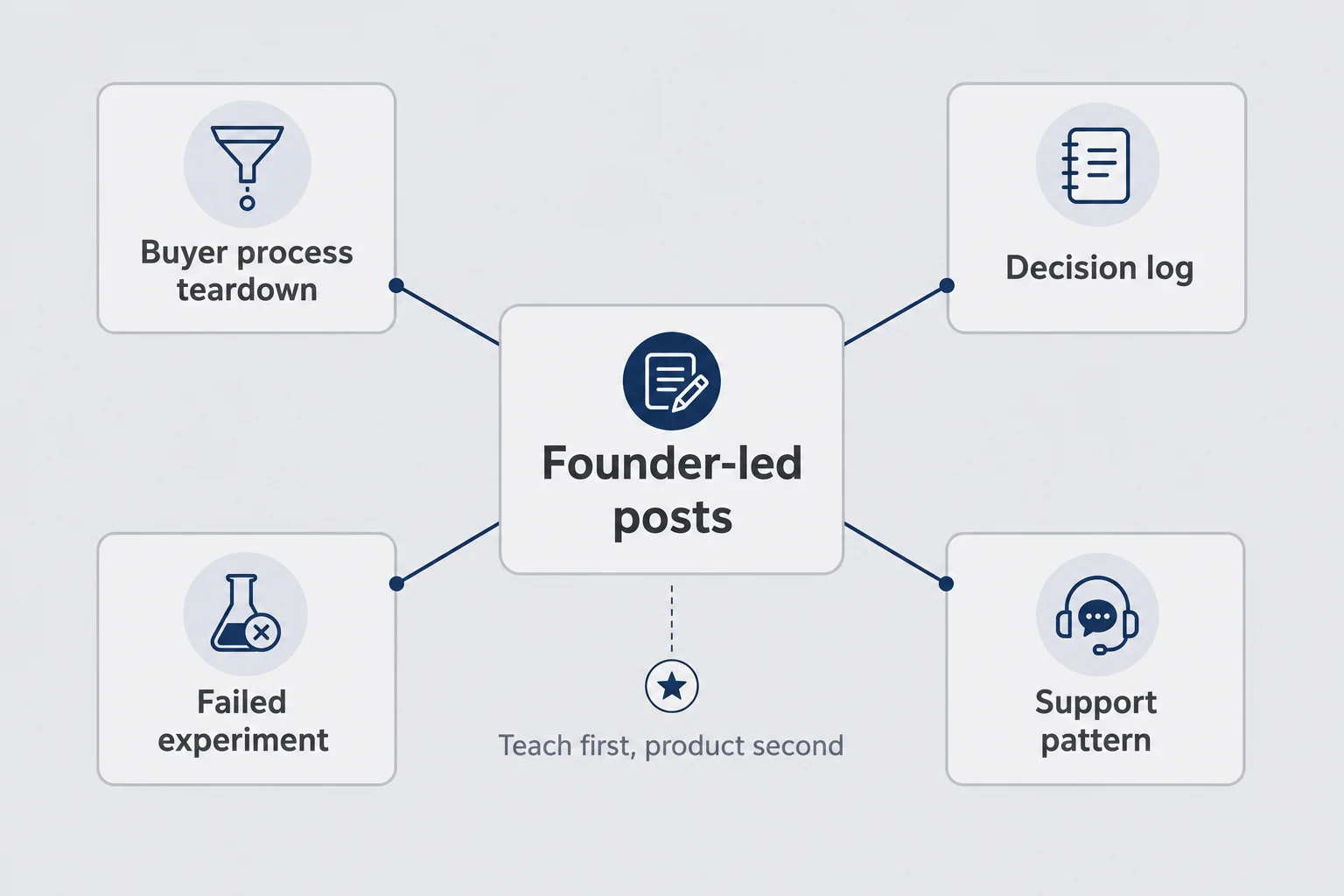
Founder led LinkedIn content is the only content strategy that works at solo-founder scale. You are the trust signal. Your face, your judgment, your scars from shipping something that almost nobody uses yet. A company page posting "Excited to announce our Q3 roadmap" into a void is not a strategy. It is a press release with no press.
Write like you are debriefing another founder after a week that almost worked. Short paragraphs. Concrete nouns. One idea per post. Stop writing like a brand voice guide approved every sentence.
I draft posts the way I draft landing page heroes. Say the true thing first. Cut the throat-clearing. If the first line could belong to any SaaS company in any category, delete it and start again. "In today's competitive landscape" is how you lose a reader who already knows the landscape is competitive because they live in it.
What to write about when you have almost no customers
You do not need case studies with logos. You need proximity to the problem. Write about the messy process your buyer still uses. Write about a support question you keep hearing. Write about a pricing decision you are wrestling with and what you are trading off. Write about a failed experiment with honest numbers that are illustrative, not performative.
"I talked to eight agency owners last month. Six still export CSVs and paste them into a deck every Friday." That kind of post does more work than "5 tips for agency productivity." The first one smells like fieldwork. The second one smells like a content mill.
Building in public works when it is specific. "Shipped a new filter" is noise. "Shipped a filter because three trial users bounced when they could not find last month's report" is a story with a buyer inside it. Keep the product mention proportional. Teach first. Point second.
Topic buckets that rarely fail when the details are real: a process teardown of how buyers do the job today; a decision log (why monthly, why no freemium, why one plan); a mistaken assumption you corrected after customer conversations; a short teardown of a competitor's public positioning without being cruel; a week-in-the-life note that includes the boring support tickets, not only the ship announcements.
Avoid the inspiration genre. "Your only limit is you" does not help a freelance bookkeeper. Avoid engagement bait questions with no point of view. Ask a question after you have said something worth reacting to.
AI can help you outline or tighten a draft. It cannot tell you which Friday pain is real for your ICP. If you paste "write a LinkedIn post about SaaS growth" into a chatbot and publish the result, you will sound like everyone else who did the same thing that morning. Use AI after you have the specific observation. Not before.
Formats that work when you have twenty minutes
Text posts with line breaks travel fine. You do not need a designer. One idea, five to twelve short lines, a concrete example, an optional question at the end. Write it in a notes app. Paste it. Move on.
Carousels can work for frameworks and checklists, but they take longer and tempt you into slide theater. Use them when the idea is naturally sequential: a three-step teardown, a before/after workflow. Skip them when you are manufacturing complexity to look professional.
Short native video or a screen recording of a painful workflow can outperform text for tool-shaped products. Keep it under sixty seconds. Narrate the problem, show the break, stop before the hard sell. A Loom link in the comments is fine if LinkedIn compresses the upload into sludge.
Document one real week of work and you will have more post ideas than a content calendar template. The constraint is courage to be specific, not a lack of topics.
A practical batching trick: after customer calls or support sessions, write three ugly notes in your phone. Raw. Incomplete. Those notes become posts later. Waiting until Sunday night to "create content" is how you invent generic tips. Capture residue from real work while it is still warm.
The comment-first habit that beats posting into a void
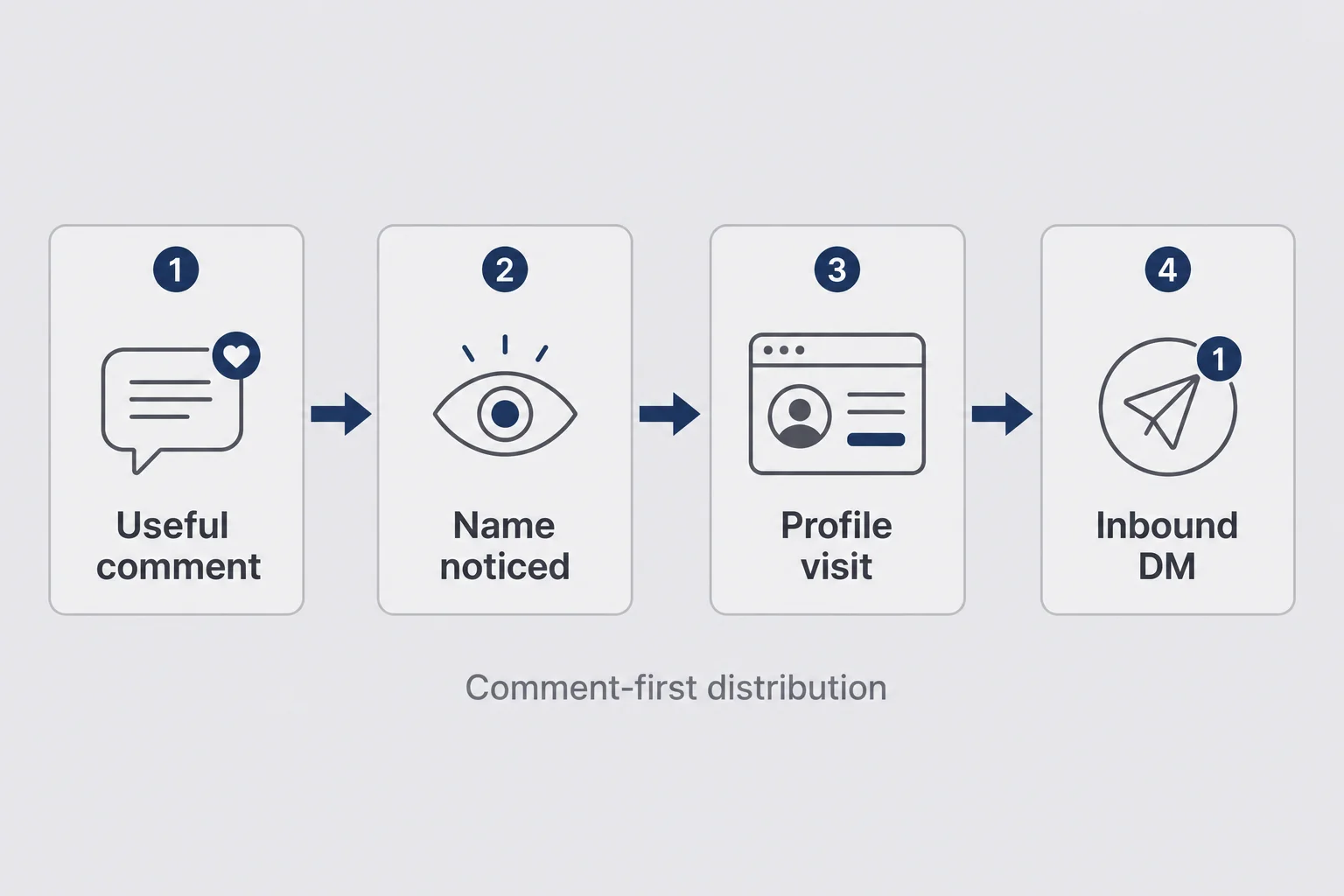
Most founders reverse the order. They write a careful post, hit publish, refresh for an hour, get seven likes from other founders, and conclude LinkedIn is dead. Meanwhile they have not left a single thoughtful comment on a post their actual buyer wrote.
Commenting is distribution you do not have to earn with follower count. When you add a useful second thought under a post from someone in your ICP's world, you borrow attention. Your name shows up. Curious people click through. Your profile does the conversion job you already fixed.
Spend fifteen to twenty minutes most weekdays on this before you obsess over your own posting streak. Find ten posts from people who match your buyer or who already speak to your buyer. Leave comments that add a detail, a counterexample, or a sharper question. "Great post!" is not a comment. It is a receipt that you were present and empty.
I have seen founders get their first inbound DM from a comment, not from a viral post. The comment named a specific failure mode the original post skipped. Three people replied. One visited the profile. One asked how the founder thought about the workflow. That is a funnel. Ugly. Real.
Pair this with your cold email instincts. Public comments warm a name before a connection request. Private outreach after a public exchange feels less like a stranger with a pitch deck. Same human. Better context.
Where to find comment targets without wasting an hour: search posts by keywords your buyers use ("month-end close," "client reporting," "onboarding checklist"), follow ten operators who already speak to your ICP, and check who comments under those posts. The commenters are often closer to buyers than the celebrity accounts at the top. Leave your best notes under mid-sized posts where a thoughtful reply can still be seen.
Track comment targets in a simple note: name, why they matter, last comment date. Not a CRM novel. Just enough so you do not ghost people for six weeks and then return with a pitch.
LinkedIn outreach for micro-SaaS: connection requests that do not get you banned
LinkedIn outreach for a micro-SaaS only works when it is narrow, personal, and low volume. Mass connection spam gets restricted, ignored, or both. You are not running an SDR team with a sequence tool and a quota. You are a founder starting conversations with people who might actually need the thing you built.
I treat LinkedIn outreach like early cold email with a smaller blast radius. The cost of sounding generic is higher because your face sits next to the message. The upside is context: you can see recent posts, mutual connections, and job changes before you write a word.
Warm vs cold on LinkedIn
Warm means they commented on your post, visited your profile, engaged with a mutual connection's thread about the problem, or you already exchanged a public comment. Lead with that context. "Saw your note about Friday reporting pain" is a reason. "I'd love to connect" is not a reason.
Cold means you found them by title and company fit and they have never heard of you. Cold can work. It works worse than warm. Keep cold volume low: a handful of careful requests per day, not fifty. Reference something real on their profile or a recent post. If you cannot find anything real, you do not know enough to message them yet. Put them on a list and engage publicly first.
Build the first list by hand. Fifty to one hundred people. Read profiles. Notice language. Save the phrases they use for the pain. Those phrases become post hooks and DM openers later. Buying a scraped list of "marketing managers" teaches you nothing and usually gets you ignored.
Automation is where founders get hurt. Tools that blast connection requests and templated follow-ups can trip LinkedIn limits and train you to sound interchangeable. If you use any assistant tool, keep it slow and review every message. Your name is on it. Restrictions cost more than the time you thought you saved.
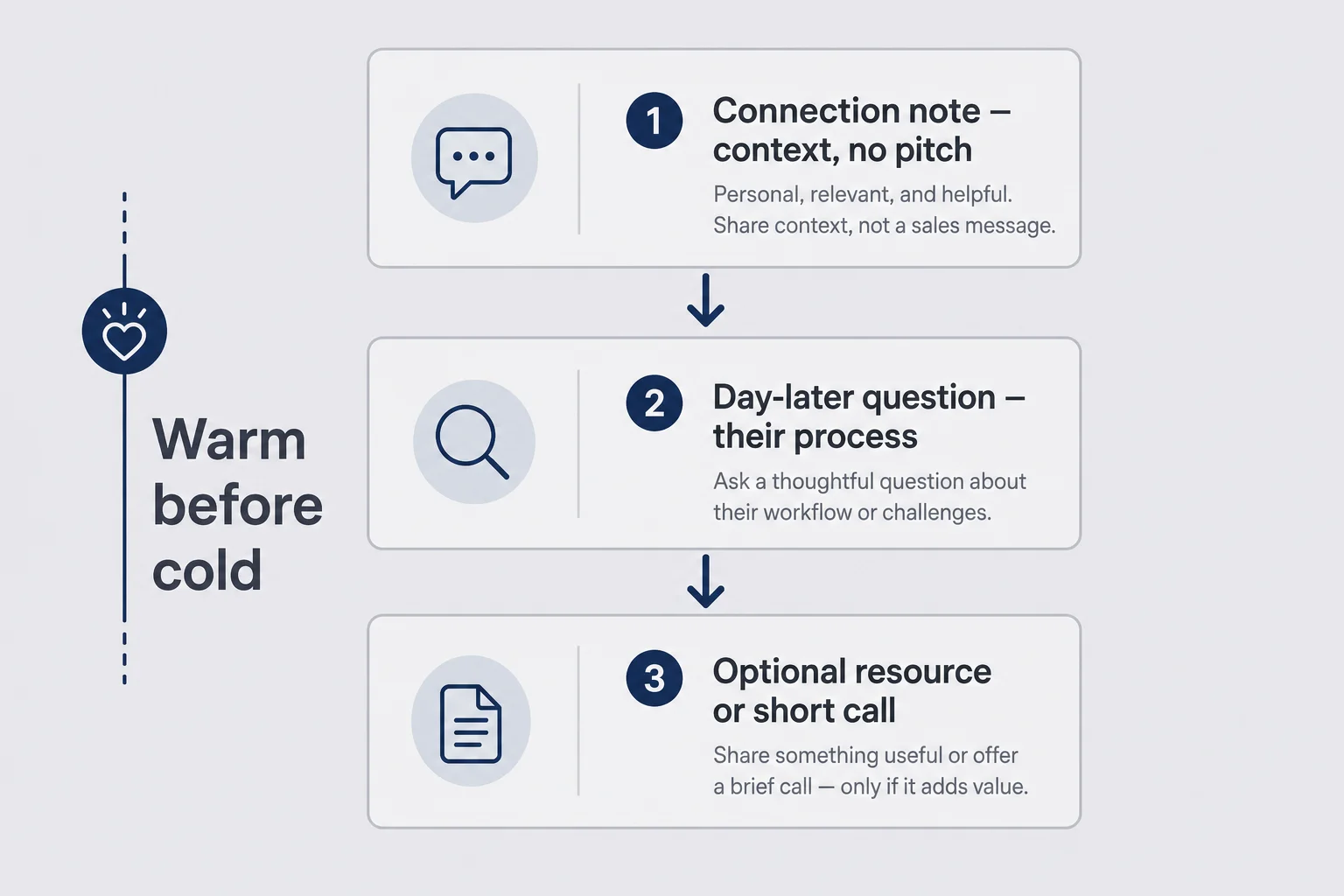
The three-message sequence I actually use
Message one is the connection note, if LinkedIn still lets you add one for that account type. Two or three sentences. Context. No pitch. No link. Ask nothing except the connection.
Example shape, not a script to paste forever: "Hey Jordan — caught your comment about rebuilding client decks every Friday. I work on that exact mess with agency owners. Would be good to connect." Specific. Human. Easy to decline.
Message two, after they accept, waits at least a day. Thank them. Mention one specific observation. Offer one useful note or question about their world. Still no demo hard sell. "Curious how you're handling X right now" beats "Can I show you our platform?"
Message three is optional and only if there is a thread to continue. Share a short resource, a relevant post you wrote, or a clear offer to walk through their workflow for fifteen minutes. If they go quiet, stop. Silence is information. Chase sequences that nag for weeks teach people to mute you.
This is closer to good cold email than to social selling theater. Short. Specific. Easy to ignore without punishment. Easy to answer if the timing is right.
If someone accepts and then never replies, that is normal. Do not take it as a referendum on your product. Timing, inbox noise, and low urgency kill more threads than bad offers. Stay visible with useful public posts. Some people come back weeks later when the pain flares.
How to get customers from LinkedIn without sounding like a sales bot
Getting customers from LinkedIn as a SaaS founder is mostly about turning recognition into a next step without switching into brochure mode. People can smell the moment you stop being a peer and start being a script.
When someone DMs you after a post, answer the question they asked. Then ask one question back about their current process. Discovery before demo. If they want a link, send the link. If they want a walkthrough, offer a short call or a Loom tailored to their workflow — for email sequences, see loom demo outreach and run the Loom outreach fit picker before you drop an unsolicited recording. Do not paste a feature list.
When you mention the product in public, sandwich it in earned context. "I built a small tool that does X because I kept seeing Y" is fine after you have already contributed. Leading every comment with your URL is how you become wallpaper.
Your CTA should match readiness. Early curiosity gets a useful post or a checklist. Clear pain gets a trial link. Budget and urgency get a call. One CTA per conversation. Founders who send the calendar link, the deck, and the case study PDF in the same message are asking the prospect to do project management for them.
I once helped a founder rewrite his default DM from a paragraph about "seamless workflows" into two sentences: what the tool does in plain language, and a question about whether Friday reporting was still manual. Reply rate jumped because the second version sounded like a person. The first version sounded like a homepage footer.
If you need a landing page that holds up when LinkedIn traffic arrives cold, fix the page. LinkedIn cannot save a hero section that explains features to people who still do not know the job you do. Channel and conversion are partners. Neither replaces the other.
A useful rule for product mentions: if removing the product name still leaves a useful post, you are probably safe. If the post collapses into an ad without the product name, rewrite it as teaching first. Buyers forgive occasional CTAs from people who usually help. They do not forgive a feed that only exists to harvest demos.
Company page vs personal profile (pick one and stop debating)
Post from your personal profile. Use the company page as a lightweight home base: logo, link, short description, maybe employee listings later. Do not split your scarce writing energy across both until the personal profile is clearly working.
Personal profiles get reach because LinkedIn is still, under the corporate paint, a network of people. Company pages get reach when employees reshare, when search demand exists, or when you boost posts with ads. Early micro-SaaS has none of that reliably.
Exceptions exist. If you have co-founders who will post and reshare, a page can accumulate social proof. If you sell into enterprises that check company legitimacy, a page helps the security review vibe. Those are supporting reasons. They are not reasons to abandon founder-led posting.
I have watched founders spend a full weekend on company page cover images, custom buttons, and "life at the company" photo dumps for a team of one. The page still had nineteen followers on Monday. The personal profile still said "Open to opportunities." That is a priority failure, not a design failure.
Stop debating this for a month. Ship twelve personal posts. Leave sixty good comments. Then revisit whether a page deserves more than a stub. Most founders who "need a company page strategy" need a clearer headline.
A realistic weekly cadence for a solo founder
Here is a cadence that survives contact with a real week of building and support.
Two or three posts per week. Not seven. Write them in one batch on Monday if that helps, or write them the morning you publish. Quality of specificity beats calendar purity.
Fifteen to twenty minutes of commenting on most weekdays. This is non-negotiable if you want the channel to move. Skip weekends if you need the break. Consistency is a weekday sport for most people.
Five to ten thoughtful connection requests on days you have outreach energy, skewed warm. Zero on days you are tempted to spray. Protect the account. Protect your tone.
One weekly review: which post got ICP comments, which comments led to profile visits, which DMs stalled, which message got a reply. Ten minutes. Notes in a doc. Adjust next week. This is the same experiment mindset I use in onboarding email work. Change one variable. Keep the rest steady.
If you only have ninety minutes a week for LinkedIn, spend sixty on commenting and profile-driven conversations, thirty on one solid post. Founders invert that ratio and then say organic is dead.
A sample week that does not pretend you have a content team: Monday write and publish one post from last week's customer notes. Tuesday and Thursday comment blocks after lunch. Wednesday one outreach block of warm connections. Friday a short post or a reshare of your own older post with a new first line if you learned something. Sunday off. That is enough to compound without turning LinkedIn into a second full-time job.
Protect deep work. Put LinkedIn in a calendar block, not in every anxious pocket of the day. Refreshing impressions between compile cycles is how founders confuse motion with progress.
What to measure when impressions feel like a joke
Impressions are a weather report. They are not a business metric. A post can reach eight thousand people who will never buy and miss the forty who would.
Watch profile views from people with relevant titles. Watch acceptance rate on connection requests. Watch reply rate on DMs. Watch inbound questions about the problem you solve. Watch trial signups or booked calls with a LinkedIn UTM or a simple "how did you find us" field. Those numbers are small at first. They are honest.
Follower count is a vanity cousin of impressions. Useful as a rough signal that your topics travel. Useless as a goal. I have seen quiet accounts with a few thousand followers generate pipeline because the followers were buyers. I have seen loud accounts with big numbers generate applause from other creators.
Keep a tiny scoreboard for four weeks at a time: posts published, ICP comments received, warm conversations started, trials or calls attributed. If conversations rise and trials do not, your offer or page is the bottleneck. If nothing rises, your ICP targeting or specificity is the bottleneck. Do not "post more" as the only experiment. More of a vague message just scales the vagueness.
Give the channel six to eight weeks before you declare failure, assuming you actually ran the cadence. Two viral-looking posts and a quiet month proves nothing. Two months of specific posts, daily comments, and careful outreach gives you a real read on fit.
If the read is bad, change ICP targeting or messaging before you change platforms in a panic. Sometimes LinkedIn is fine and your offer is fuzzy. Sometimes LinkedIn is the wrong room. Both answers are useful. Neither requires a coach who sells online fame.
Questions I get about LinkedIn for SaaS founders
Does LinkedIn work if my buyers are not on LinkedIn?
No. If your customers are teenagers, consumer app users, or people who never open LinkedIn for work, this channel will waste your time. LinkedIn fits B2B and professional buyers who already research tools and peers there. Fit beats effort. Check whether your ideal customer has an active profile before you commit to a posting cadence.
How often should a solo founder post on LinkedIn?
Two to three posts per week is enough for most micro-SaaS founders. Daily posting burns you out and rarely helps if the posts are thin. Consistency over ninety days beats a two-week sprint. Pair posting with fifteen minutes of thoughtful comments most weekdays. Volume without conversations is just noise with better formatting.
Should I use Sales Navigator as a solo founder?
Not on day one. Search filters on the free or basic plan are enough to build a first list of fifty to one hundred prospects. Sales Navigator helps when you already know your ICP tightly and need faster filtering at higher volume. Paying for a tool before you have a message that gets replies is a common early mistake.
Is it okay to mention my product in posts?
Yes, sometimes. Lead with the problem and what you learned. Mention the product when it is the honest next sentence, not the entire point. If every post is a soft pitch, people mute you. If you never mention what you built, warm readers never know you sell something. Roughly one in four posts can point to a resource, trial, or product without feeling like an ad feed.
How do I know LinkedIn is working for my micro-SaaS?
Track profile visits from your ICP, inbound DMs asking about the problem you solve, connection acceptances from real buyers, and signups tagged from LinkedIn links. Impressions alone are not proof. If after six to eight weeks of consistent posting and commenting you have engagement but zero curiosity about your product, revisit positioning, ICP, or offer before blaming the algorithm.
The part nobody wants to hear about consistency
LinkedIn rewards people who are still there after the novelty wears off. The first two weeks feel hopeful. Weeks three and four feel pointless. Week six is where a stranger finally DMs you about the exact problem you have been writing about, and you remember why you started.
A product nobody hears about is just an expensive hobby. LinkedIn is one way strangers hear about it, if your buyers already live there and you are willing to sound like yourself in public. Not a polished brand. Not a guru. A founder with a clear problem, a fixed profile, and enough patience to comment when nobody is clapping yet.
If you want the wider channel map, start with marketing for solo founders. If your buyers argue in threads instead of feeds, use Reddit. If you need conversations at scale in the inbox, use cold email. Pick the room that matches the humans you sell to. Then show up long enough that luck has somewhere to land.



Comments