Nobody Reads Your Privacy Policy Until They Do
How solo founders write micro-SaaS terms of service and privacy policies that match the product, especially consumer iOS apps where trust is the feature.
 By Iryna26 min read
Listen to this article
20:06AI-generated podcast-style overview of this article (not a word-for-word narration).
The first time I scrolled to the bottom of someone else's app looking for a privacy link, I was about to upload a screenshot of a conversation I would not show my therapist. The app looked cute. The reviews were fine. I tapped Privacy Policy and got a wall of words that mentioned analytics partners I had never heard of, retention schedules that sounded like a warehouse, and exactly zero sentences about what happens to the image I was about to send. I closed the app. I did not feel principled. I felt exposed.
Six months later I was the person writing those pages for Finish Him Replies, my first consumer iOS app. Same category of problem. Same category of user anxiety. Different side of the screen. If you are hunting for a micro-saas terms of service template because you finally have something worth charging for, I am not going to hand you magic legalese. I am going to tell you what I learned shipping a personal app where privacy is not a footer. It is the product.
This article is operator advice from a product designer who has been through App Store Connect forms, RevenueCat footers, and the boring work of making legal copy match server behavior. It is not legal advice. I am not a lawyer. When your app touches money, health, kids, or EU users at scale, pay someone who is. Until then, you still need pages that are honest, readable, and aligned with what your code actually does. Max covers backend data handling when you need engineering depth. Imani mentions ToS in passing in building without coding. This post owns the trust layer for solo founders, especially consumer iOS apps where strangers decide in eight seconds whether you feel safe.
The mistake I see most often is treating legal pages like a launch checkbox you paste in after the fun work. Founders polish onboarding animation, then slap a generic template in the footer five minutes before TestFlight. That order feels productive. It creates the exact mismatch that makes personal apps feel scammy. You cannot bolt trust onto a product that already trained users to be nervous. You write the promise while you design the upload flow, then you make engineering prove it.
Micro-SaaS terms of service template: what solo founders need before launch
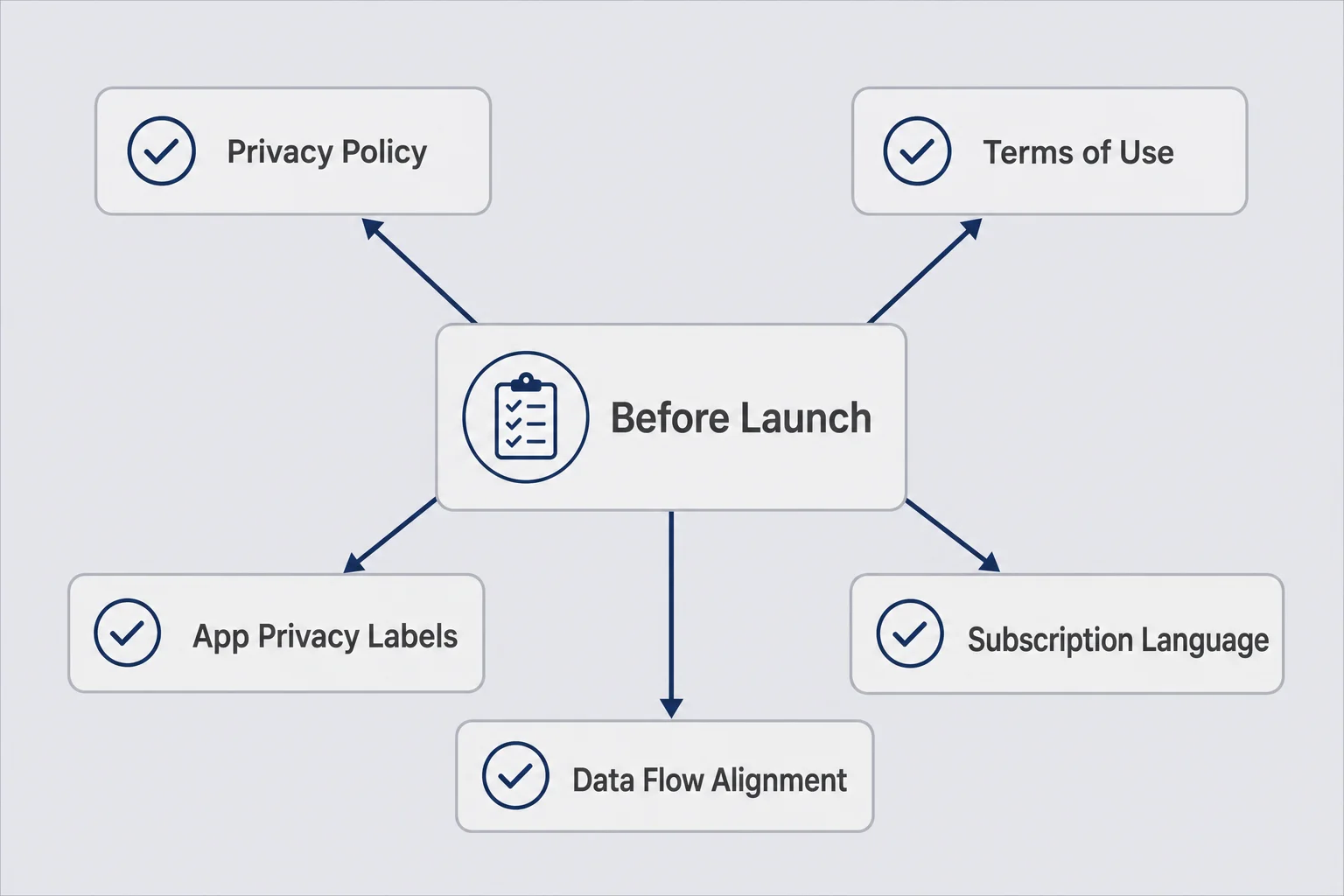
People search for a micro-saas terms of service template when they are one step away from real users and suddenly remember lawyers exist. That panic is healthy. The unhealthy version is copying the longest TermsFeed page you can find, changing the company name, and calling it done. Templates are vocabulary. Your product is the grammar. If the template says you use cookies for advertising and you do not run ads, you did not save time. You bought a future argument.
Before launch, solo founders need four things that talk to each other. A privacy policy that describes data honestly. Terms of use that explain subscriptions, acceptable use, and what you are not promising. App Privacy labels in App Store Connect that match both, if you ship on iOS. And in-app copy at the moment of trust, usually upload or paywall, that says the same thing in human language. Miss any leg of that stool and the others wobble.
I treat legal pages as part of bootstrapping infrastructure, like Stripe webhooks or onboarding email. Not exciting. Load-bearing. You can ship a TestFlight build to friends with a rough Notion page linked in settings. You should not ship to strangers on the App Store with a policy that describes a product you wish you had built. The read-like-a-customer test is the whole job. Read each paragraph and ask: could I point to the database table or API call this sentence describes?
For consumer apps, add a fifth item: review notes that repeat your privacy story in plain English. Apple reviewers are not parsing your soul. They are checking whether your app behaves like your disclosures. "User uploads screenshot, server calls OpenAI, image deleted after processing, no chat history stored" is a sentence that prevents a week of confusion. Write it before you tap Submit.
Web micro-SaaS founders need the same alignment with a different canvas. Footer links on your landing page, checkout terms in Stripe, and whatever your auth provider logs. The consumer iOS path is stricter about centralized privacy labels and in-app surfacing. The honesty standard is identical.
I keep a one-page internal doc I call the data map. Not fancy. Three columns: what enters the system, where it lands, how long it stays. Screenshot, OpenAI API, deleted after response. Device ID, Supabase auth table, until user requests deletion. Purchase event, RevenueCat webhook, per their retention policy. If I cannot fill a row, the feature is not ready or the policy sentence is lying. The map takes an hour once. It saves weeks of vague dread.
TestFlight is not a legal free pass. Friends may forgive broken builds. Apple still wants a policy URL before App Store submission, and testers are real humans handing you data. Beta labels in email help set expectations. Policy clarity helps more. "This build logs crashes only" should be true. "We might change retention before launch" is fine if you say it plainly and update the page when you ship.
Privacy copy is product design when the input is embarrassing
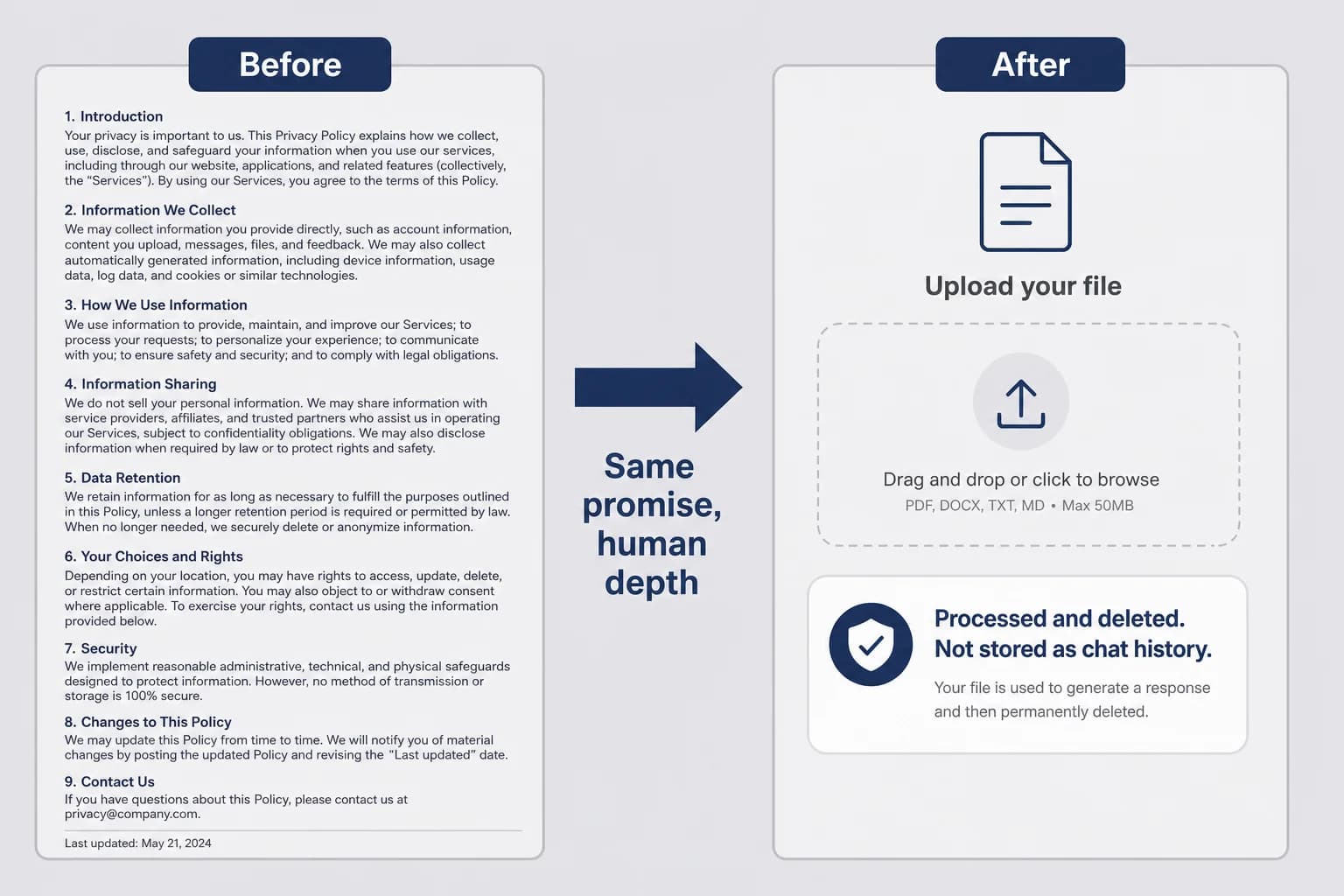
I design onboarding for a living. I know the difference between a feature bullet and a moment of relief. Legal pages fail when they sound like they were written for a regulator who will never open the app. They win when they answer the question a user has with their thumb hovering over Upload.
For Finish Him, the scary input is a chat screenshot. Names, jokes, flirtation, workplace drama, family tension. Users are not asking about GDPR Article 6. They are asking whether their ex's first name ends up in a spreadsheet. My in-app copy says the image is processed to generate replies and is not stored as chat history. My privacy policy says the same thing with more structure: anonymous sessions, ephemeral processing, no training on user content, third parties listed by name. Same story, different depth.
That is the consumer app privacy policy mindset. Lead with the database answer, not the model badge. "We use OpenAI" matters less than "we do not keep your screenshots after the session ends." Specific beats vague every time. Ephemeral processing. Anonymous auth. Delete after generation. No cross-app tracking. Those are product decisions you can verify, not adjectives you hope sound reassuring.
I learned this validating consumer app ideas before I had code. People asked about privacy unprompted in manual tests. Not as a legal checkbox. As a gut check. If your validation conversations never touch trust, your category might not be personal enough to need this article. If they always touch trust, your App Store listing and your policy are part of validation, not an afterthought.
App Store optimization is where privacy promises meet strangers who have not installed yet. Subtitle space for "no account required" or "screenshots deleted after processing" is marketing copy that must stay true in code. I would rather lose a keyword slot than lie in thirty characters.
There is a difference between privacy theater and privacy product. Theater is a shield icon in marketing with no behavior behind it. Product is a delete path you tested yesterday. Theater shows up in templates that mention bank-grade encryption while your staging database still has open RLS policies. Product shows up when support can answer "do you keep my photos?" without opening Slack to ask the developer.
I ran a cheap usability test on my own policy draft. Gave it to two non-technical friends and asked them to highlight anything that sounded like the app might keep their chats. Both highlighted the same paragraph about service providers because the names were missing. I added OpenAI and Supabase by name. Anxiety went down. That is UX research on legal copy. You can do it with coffee, not a lab.
Not legal advice
Everything here is how I think about product trust as a solo founder. Laws vary by country, category, and data type. Use this to write clearer pages and ask better questions when you hire a lawyer.
Terms of use, privacy policy, and App Privacy labels are three different promises
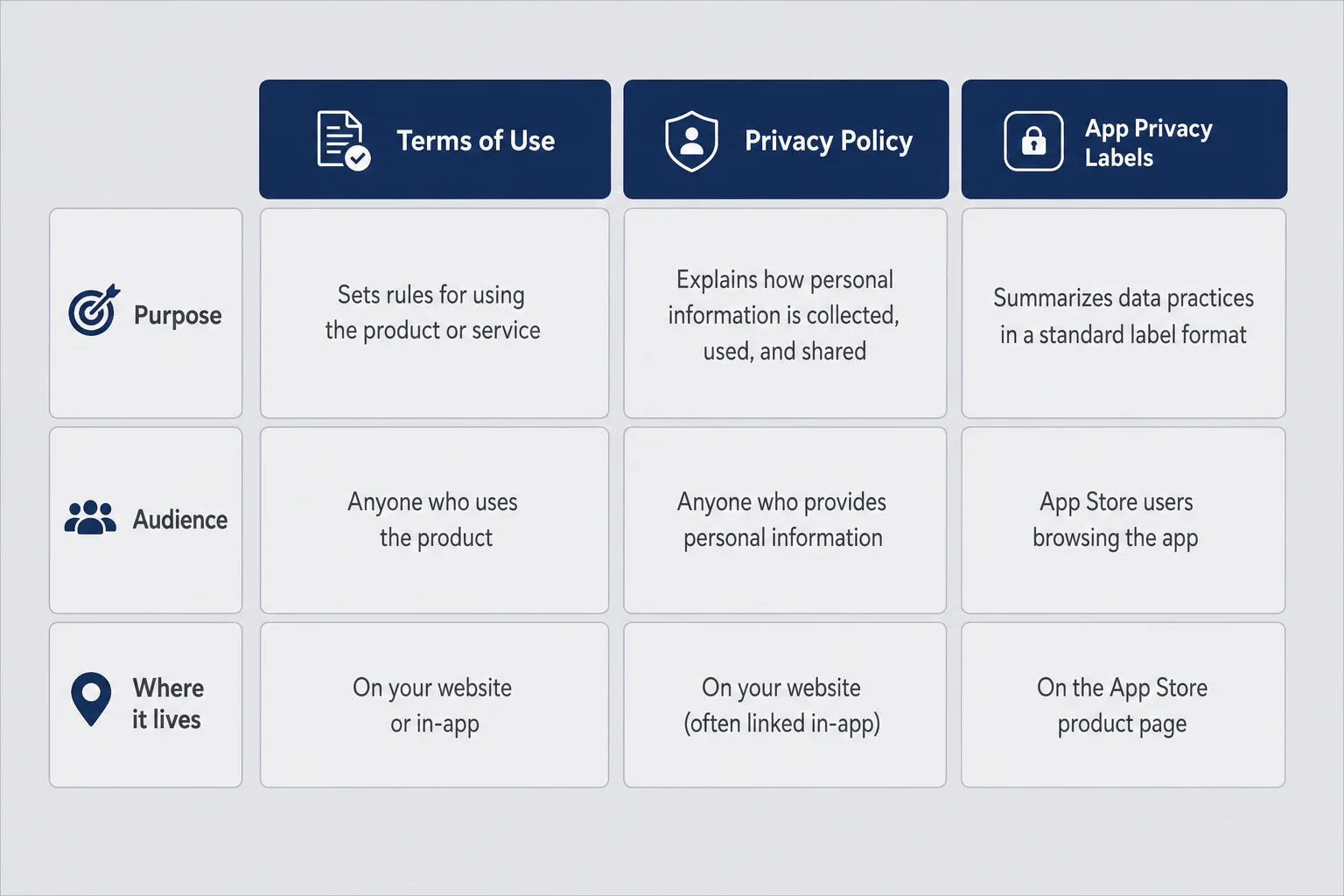
Founders mix these up because they all live in the same Settings menu nobody opens until they are annoyed. They do different jobs.
| Document | What it answers | Where it lives |
|---|---|---|
| Privacy policy | What data you collect, why, retention, sharing, user rights | Website URL, in-app link, App Store listing |
| Terms of use | Rules of the service, subscriptions, liability, acceptable use | Website URL, in-app link, sometimes checkout |
| App Privacy labels | Apple's structured disclosure of data linked to the user | App Store Connect only |
Your solo founder terms of service should say what Premium means, how auto-renewing subscriptions work, that users must not abuse the service, and that you are not liable for replies someone sends in real life because an AI suggested "you up?" in a savage tone. I am joking slightly. I am also not offering relationship counseling through Terms of Use. Boundaries belong here.
The privacy policy explains photos, device identifiers, purchase history through Apple, analytics if you use them, and contact email if someone writes support. It names subprocessors. OpenAI. Supabase. RevenueCat. Plausible. Whatever you actually use. Generic "we may share with service providers" without names feels like hiding.
App Privacy labels on iOS are a third language. Apple asks structured questions: data types, purposes, linked to user or not, used for tracking or not. Your answers populate the store listing nutrition label. Users see a summary before install. Reviewers compare labels to runtime behavior. If you mark "Photos" collected for app functionality, your app should not silently upload the entire camera roll on launch. If you say data is not linked to identity, your analytics should not stitch anonymous IDs to email addresses you also collect.
When all three agree, trust feels boring in the best way. When they disagree, you get rejection emails that read like disappointed teachers. I have not been rejected for privacy mismatch yet. I have friends who were, and the fix was never "argue better." It was align copy, labels, and code.
Terms of use also carry consumer-specific baggage my B2B friends forget. Acceptable use for a reply helper means you do not harass people with generated lines and you do not pretend the app is therapy. Sounds obvious until you read App Store reviews blaming the tool for a message the user chose to send. Your terms cannot fix bad judgment, but they set expectations that the user picks the send button, not you.
Apple's standard EULA covers some baseline App Store rules. Many developers still publish custom terms for subscriptions, content policies, and liability. I link both in settings. Redundant beats missing when a confused user is searching for anything that explains why their subscription renewed.
Web micro-SaaS gets a shorter version of the same split
If you ship a landing page tool on the web, you still need privacy policy and terms in the footer before you turn on ads or cold traffic. Reese's landing page guide covers conversion. This is the fine print those pages link to. Cookie banners enter the chat when you run PostHog, Google Analytics, or ad pixels. Stripe checkout should link terms that mention refunds and subscription renewal; Stripe billing setup covers webhooks, but your terms still own what happens when a card fails. One focused afternoon, not a month of paralysis.
What belongs in a privacy policy when you collect almost nothing
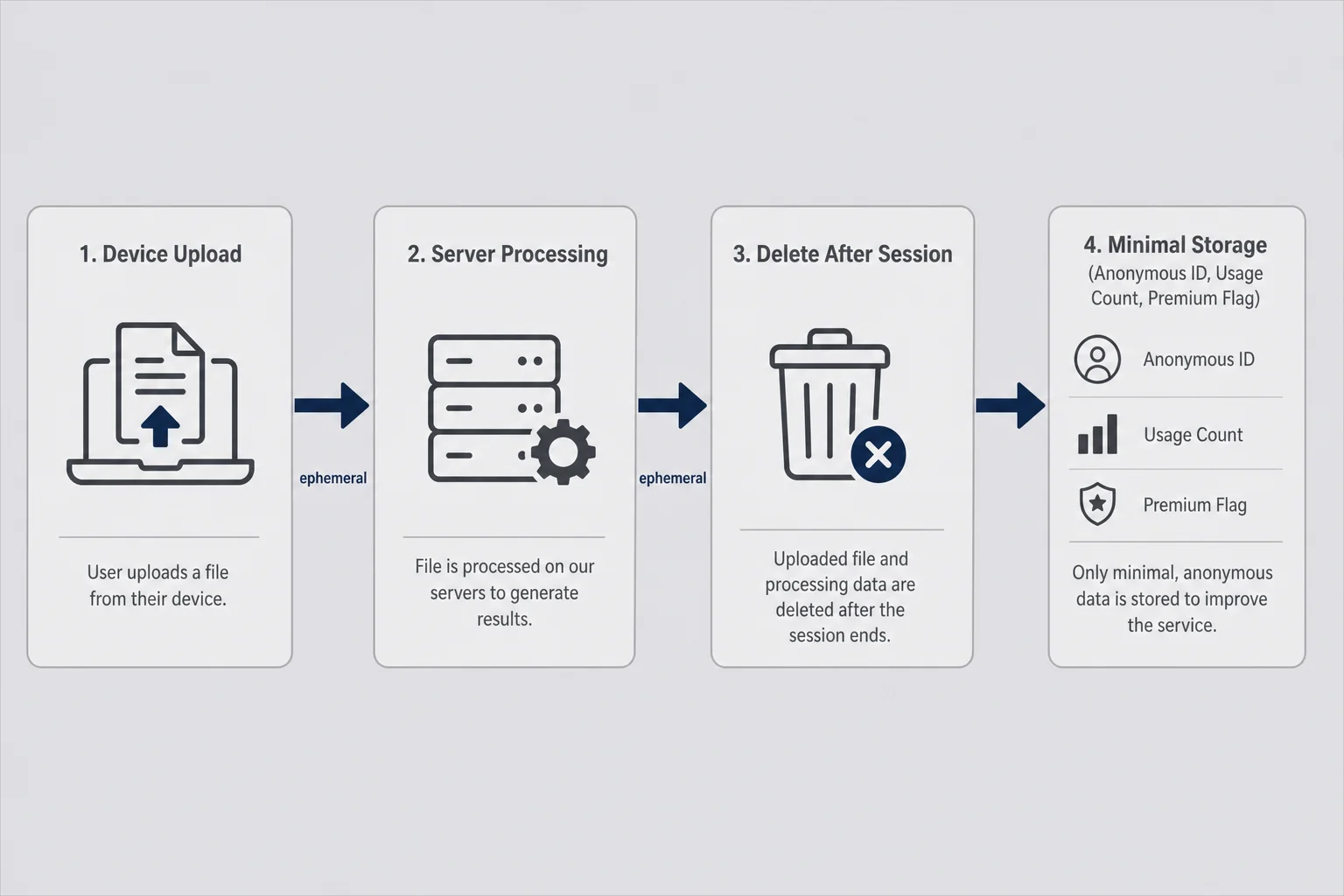
The best micro-saas privacy policy template for a small app is often shorter than founders expect. Not because laws are simple. Because honest small products touch less data than template mills assume. Start from what you actually store. Not what you might store someday when you are successful and careless.
For Finish Him, persistent backend state is tiny. Anonymous user identifier. Generation count. Premium flag. Session-scoped processing for screenshots and replies, then gone. No email gate. No chat archive. No training on user content. My policy opens with a summary section because nobody reads seventeen pages. Bullet honesty: no account required, ephemeral conversation content, what persists, what does not, who processes it, no sale of personal information.
If you collect almost nothing, say so plainly and list the exceptions. "We do not store your uploads" is powerful until you also log IP addresses in nginx and forget to mention it. Minimal collection is a goal, not a vibe. Walk your request path once with a staging account and write down every field that hits disk.
Third-party disclosure is where solo founders get lazy. If OpenAI processes the image, name OpenAI and link their policy. If RevenueCat handles subscriptions, say Apple processes payment and RevenueCat tracks entitlement. If Plausible counts page views on your marketing site, separate app analytics from website analytics in the same doc or split pages. Users forgive complexity when it is named. They do not forgive "we use industry-standard providers" without names.
User rights sections can be plain language too. How to request deletion. How to cancel subscription through Apple settings. Support email that reaches a human. GDPR and CCPA paragraphs often appear in templates as magic spells. At minimum, mean the deletion part. If someone emails delete my data, you should know which tables to touch without panicking.
Retention language should match deletion behavior. "We retain data as long as necessary" is template noise if you delete session content immediately. Say session content is ephemeral. Say anonymous usage counters persist until you implement deletion for account identifiers. Precision builds trust. Vague retention sounds like you are keeping screenshots forever because you might want them later.
Security sections in templates love vague phrases about industry-standard measures. If you encrypt data in transit with HTTPS and at rest because your host does it by default, say that plainly. If you do not encrypt something, do not imply you do. Solo founders rarely run bespoke security programs. Honest baseline beats impressive fiction.
Contact information belongs near the top, not buried in section nineteen. A support email you actually read is part of privacy practice. Users exercising deletion rights should not hunt through CSS classes to find you. I use a dedicated support address forwarded to my main inbox with a filter label. Low tech. Works.
What changes when you touch screenshots, AI outputs, or health data
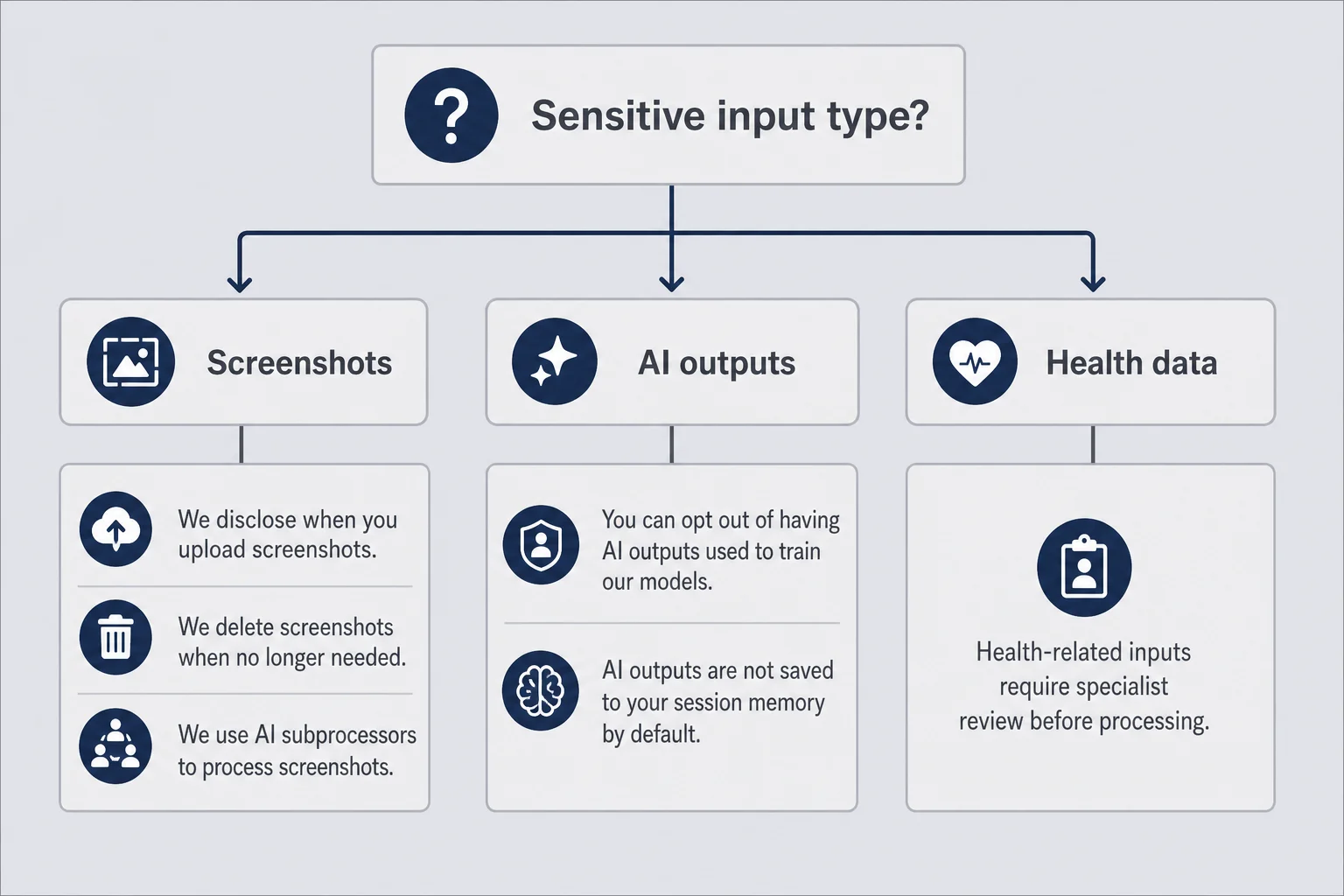
Not all personal data feels the same to users. A todo app nickname is not a fertility tracker. A reply helper screenshot is not a medical record. But screenshots sit in a messy middle zone because humans put everything in messages. Dating. Money transfers. Work complaints. Health symptoms sent to a partner. Your category label might say entertainment. Your user's camera roll says life.
When you touch screenshots, disclose upload, processing, deletion timing, and whether humans ever review content. If moderators might see uploads for abuse reporting, say so. If only machines see them, say that too. AI outputs inherit the sensitivity of inputs. Generated replies are not stored as chat history in my app, but they pass through memory during the session. That belongs in the policy in plain words.
AI adds subprocessors and purpose limits. Name the model provider. State whether content is used for training. Apple and users both care. Max can explain server-side API patterns better than I can. My job is to insist the policy matches the API settings you actually toggled, not the defaults from a tutorial you skimmed.
Health data, kids, and financial advice categories trigger stricter rules and higher user expectations. If you are anywhere near HIPAA, FERPA, or medical device territory, stop reading my blog and hire a specialist. Consumer wellness apps blur lines on purpose. Apple blurs them back during review. Age rating questions connect here. If teenagers might use your app, your terms and privacy story need to reflect that without pretending you run a school district.
Location, contacts, and microphone access are the usual iOS permission traps. Ask only when the feature requires it. Explain in policy and in the permission dialog. "We need contacts to spam your friends" is honest but bad product. "We need photos to read the screenshot you chose" is honest and expected. Alignment again.
Children's privacy rules matter even when you are not building a kids app. If your marketing could attract minors, your terms should say intended audience and prohibited use clearly. Dating-adjacent tools sit in awkward territory. Age rating on the store listing, content moderation stance in terms, and realistic expectations about user behavior all connect. I rated Finish Him for mature themes because the use case is adult texting drama, not because the code is spicy.
Export compliance questions during App Store submission caught me off guard the first time. They are not legal pages exactly, but they are another form you fill out that must match reality. Encryption, third-party content, AI-generated output. Answer consistently with review notes and policy. A yes on one form and a no on another is the same class of problem as label mismatch.
When App Store Connect answers and your website disagree, review gets painful
App Review rejection for privacy mismatch is not mystical. Common pattern: labels say you do not collect data linked to identity while your app sends email to analytics. Or policy promises deletion while your database column still holds URLs. Or review notes claim no user accounts while login screen appears on first launch.
I treat App Store Connect as a form you fill out after auditing the app, not before thinking. Build the feature. Trace the data. Write the policy. Then answer Apple's questionnaire. Reverse order creates fiction.
Screenshot your label answers when you submit. When you add analytics later, update labels before you ship the build. Users see label changes on the store listing. That is fine. Hidden changes are not fine.
Website and in-app URLs must resolve. Broken privacy links scream scam even when you are just bad at DNS. I host policy pages on the same domain as my marketing site so reviewers and users see consistent branding. In-app settings link opens Safari to the same doc. No PDF buried in Google Drive. Respect your future support self.
Review notes are free text that saves days. Explain the happy path. Mention test credentials if login exists. Describe sensitive flows. For screenshot apps: how to get a sample image, what happens after upload, where to see premium limits. Reviewers are humans with queues. Help them help you.
If you get rejected, read the message twice. Fix the specific mismatch. Do not rewrite your entire philosophy essay. Resubmit with a short note mapping change to issue. Ego slows shipping. Accuracy speeds it.
I screenshot my App Privacy answers next to the relevant policy sections in a single PDF before major submissions. Not because Apple asks for it. Because future me forgets why I marked "Data Not Linked to You" for usage counters when I was tired. Documentation for yourself is underrated when you are solo. You are the legal, product, and engineering team. Paper trail beats memory.
Version control policies the same way you version code. Git history or dated files in your repo under /legal or on your CMS. When you add analytics, update policy first or same release. Changelog line at top: "Updated June 2026: added Plausible analytics on marketing site." Users may ignore it. You will not when debugging a trust complaint six months later.
AI can draft your ToS. It cannot know what your database actually stores
Every solo founder discovers the same trick at 11 p.m. Paste your stack into ChatGPT and ask for a privacy policy. Something comes back instantly. It looks professional. It is also wrong about half the time.
AI drafts are useful for structure: summary section, categories of data, third-party list placeholders, contact section. They are dangerous for facts. Models assume cookies, email marketing, behavioral advertising, and indefinite retention because those appear in most training documents. Your micro-SaaS might have none of that. Publishing unedited output is how you promise a Data Protection Officer you do not have.
Imani's advice in building without coding applies here: generate a baseline, then read it like a customer would. If you do not understand a paragraph, your product is too messy to charge for yet. If you understand it but the product violates it, fix the product first.
My editing pass is three sweeps. Sweep one: delete every section about data types you do not touch. Sweep two: replace generic vendor language with real names and links. Sweep three: read aloud the sentences about deletion, security, and children. If you cringe, rewrite.
Keep version dates honest. UpdatedAt in the policy header matters when you change behavior. Users rarely notice. Regulators and angry emails sometimes do. A changelog sentence at the top beats silent drift.
Terms of service need the same treatment. AI loves ALL CAPS liability walls. Some caps are normal in US terms. Random caps about "AI accuracy" need to reflect what your app actually does. If you generate reply suggestions, you disclaim that users choose what to send. Obvious legally. Also obvious product ethics.
I keep a short prompt doc for legal drafts separate from feature prompts. Same facts every time: app name, data types, subprocessors, deletion behavior, subscription platform, support email, countries served. Feeding consistent facts reduces contradictions between privacy and terms drafts. Still read both side by side before publish. Models drift.
Compare your draft to a competitor you respect, not a random enterprise SaaS. A fifty-person fintech privacy page will scare you into overclaiming. Another indie screenshot tool's page might show you how short honest copy can be. Inspiration, not copy-paste. Their stack differs. Your subprocessors differ.
Where solo founders host legal pages (in-app, website, RevenueCat footers)
Consumer iOS apps need reachable links inside the app before Apple is satisfied. Settings screen is standard. About or Legal row. Privacy Policy and Terms of Use as tappable URLs. Some founders also surface privacy summary on first launch for sensitive categories. I use settings plus in-flow copy at upload instead of a wall of text on open.
Your marketing site should host the canonical policy even if the app is mobile-only. App Store listing asks for privacy policy URL. Reviewers click it. Use HTTPS. Use headings. Mobile-readable width. No login gate.
RevenueCat and paywalls often have footer slots for terms and privacy. Use them. Premium purchase is a moment users suddenly care about money and renewal. Link the same docs, not a different older version living in Notion.
In-app web views versus Safari is a product choice. I open external Safari for legal pages so users see the URL bar. Small transparency win.
Deep links from paywall footers should not 404 after redesign. Ask me how I know. Keep legal URLs stable or redirect old paths forever. Broken terms link on a purchase screen feels like a scam even when you are just bad at site migrations.
Accessibility matters on legal pages too. Headings, contrast, readable font size on mobile Safari. A policy that is only readable on desktop tells users you did not imagine them on a phone. Ironic for iOS apps.
Subscriptions, refunds, and the sentences Apple and Stripe leave to you
Apple handles payment card details. You handle clarity. Terms should explain auto-renewal, how to cancel in iOS settings, what Premium includes, and that free trials convert unless canceled. Apple's standard subscription disclosures appear in purchase sheets. Your terms reinforce without contradicting.
Restore purchases belongs in product and in terms emotionally. People switch phones. They think you scammed them when premium vanishes. A visible restore button and a terms sentence about Apple managing billing reduce support panic.
Refund policy reality on iOS: users ask Apple, not you, for most refunds. Your terms can still say contact support for billing questions and describe good-faith fixes. Do not promise refunds Apple will not grant. Do not pretend you control Apple's ledger.
Web Stripe products need explicit refund language. 7-day, 14-day, no refunds after download. Pick something you can live with and enforce calmly. Chargebacks start when terms are vague and signup promises oversell the product. Reese's customer onboarding guide covers the promises that happen after signup — keep your terms aligned with those too.
Limitation of liability sections sound scary because they are written for worst cases. Solo founders still include them in terms templates. Read them. Remove absurdities that do not match your risk. Keep the part that says AI suggestions are not professional advice if your app could be misused that way.
Price changes and feature changes deserve a sentence. If Premium limits change, update terms and tell users in release notes. Silent nerfs destroy trust faster than silent bugs.
Free trial language needs to match App Store Connect settings exactly. If your terms say seven-day trial but App Store offers three, you created unnecessary support tickets. Subscription management links in terms should mention Settings app path on iOS plainly. "Settings > Apple ID > Subscriptions" is the phrase users search.
Dispute resolution and governing law sections appear in every template. Read them. If you are a solo founder in Texas selling globally, templates might specify Delaware because that is default filler. Changing governing law is a lawyer conversation. Leaving wrong filler is worse than plain language that says contact support first for billing disputes. I optimized for clarity over faux corporate jurisdiction early on.
GDPR and CCPA without pretending to be a lawyer
International users find cute apps too. GDPR for a micro-SaaS solo founder is mostly about honesty and workable rights, not fear theater. Template shopping spirals help nobody.
If you have EU or UK users, you need lawful basis language in your privacy policy. Often legitimate interest or contract for providing the app. Marketing emails need consent if you send newsletters. Product emails about billing might be different. Reese notes GDPR limits on cold email. Consumer apps rarely cold email strangers about their screenshots. Still, know the line.
Data subject requests sound formal. In practice someone emails "delete my stuff." You should know how. Anonymous IDs in Supabase. RevenueCat customer records. Analytics exports if you have them. Document a simple runbook before the first request, not during.
CCPA and similar US state laws add disclosure about sale of data. Most indie apps sell nothing. Say you do not sell personal information if true. If you use ad networks that qualify as sharing, templates change. Another lawyer moment.
Age gates and parental consent appear if you target kids. Do not target kids accidentally with a flirtation helper app. Keep the age rating honest. Terms prohibiting under-13 use if appropriate. Common sense product design masquerading as compliance.
Cross-border data transfers show up in templates about EU-US mechanisms. If your subprocessors store data in the US, name that and point to their safeguards. OpenAI and major hosts publish docs. Link them instead of inventing certification buzzwords.
When revenue justifies it, pay for a legal review of your draft. Cheaper than guessing wrong after press or viral growth. Until then, write plain English, keep promises minimal, align product and pages, respond to deletion emails promptly.
Newsletter signup on your marketing site is a common GDPR tripwire. If you add one later, update privacy policy before the embed goes live. Separate product privacy from marketing privacy in the same doc with headings if that helps you stay honest. App does X. Website mailing list does Y. Founders merge them sloppily and accidentally promise app users that marketing emails are transactional.
Incident response one-liner belongs in your internal notes even if not in public policy yet. If subprocessors breach, if you accidentally log screenshots longer than intended, if you ship a build with debug logging enabled, what do you do? Public policy updates come after fix. Having a plan prevents panic posts on social media that make everything worse.
I re-read how to build your first consumer iOS app privacy section whenever I add a feature. If the new feature needs a new sentence in the policy, the feature is not done. That gate feels annoying at midnight. It is cheaper than a trust post-mortem.
Questions solo founders ask about privacy policies and ToS
Do I need a privacy policy before TestFlight?
Yes, for anything beyond a tiny friends-only build. TestFlight testers are still users handing you data. Apple expects a privacy policy URL for App Store submission, and your App Privacy labels must match what you actually collect. Write a plain-language policy before you invite strangers, even if the app is unfinished. A one-page honest summary beats a fifty-page template that describes data you never touch.
Can I use an AI-generated terms of service template?
As a first draft, sometimes. Never as a publish button. AI will invent retention periods, cookies, and subprocessors you do not have. Read every section like a nervous user who just uploaded something private. If a sentence describes data you cannot point to in your database or analytics dashboard, delete it or fix the product. Confusion in your policy usually means confusion in your architecture.
What must match between App Privacy labels and my privacy policy?
The same data types, purposes, and linked-to-user answers. If App Store Connect says you collect photos for app functionality, your policy must explain photo uploads, processing, deletion, and any third parties like an AI API. If your website says you do not store chat content, your backend must not store chat content. Reviewers and users both treat mismatches as trust failures.
Do solo founders need GDPR compliance?
If you have users in the EU or UK, you need to take GDPR seriously even at small scale. That usually means a lawful basis for processing, clear privacy information, a way to request deletion, and honest subprocessors disclosure. You do not need a legal department on day one, but you do need policies and product behavior that respect those rights. When revenue or risk grows, pay a lawyer to review what you wrote.
Terms of service vs privacy policy: what's the difference?
Privacy policy explains what data you collect, why, how long, and who you share it with. Terms of service explain the rules of using the product: accounts, acceptable use, subscriptions, refunds, limitations of liability, and how disputes get handled. Users care about privacy when deciding whether to trust you. Terms matter more after something goes wrong or money is involved. Consumer apps need both before you charge.
What happens if my legal pages don't match my actual data flow?
At best you lose trust when a curious user compares your policy to your behavior. At worst App Review rejects you, a regulator sends questions, or a chargeback turns into a screenshot of your own contradictions. Fix the product first if the policy is accidentally honest about a bug. Fix the policy second if the product is right but the copy is stale. Never ship both wrong.
Ship the boring pages before the exciting feature
I wanted to spend my last pre-review week on animation timing and paywall shadow radius. Instead I spent two evenings making sure my privacy summary matched Supabase rows and OpenAI settings. Boring work. The kind that lets exciting work survive contact with strangers.
The whole micro-saas terms of service template hunt boils down to alignment for me. Policy, terms, App Privacy labels, in-app copy, review notes, and database reality telling one story. Templates give you headings. Your product gives you facts. Users do not reward legal poetry. They reward apps that feel safe in embarrassing moments.
Then go back to the fun part knowing a stranger can read your policy, compare it to what the app does, and still tap Upload. That is the consumer micro-SaaS bar. Everything else is decoration.
When you are ready for the rest of the build path, read how to build your first consumer iOS app for stack and review reality. Point yourself at Max for backend data architecture when it gets scary. Point yourself at a lawyer when the scary parts involve regulators, not screenshots. Finish the legal footers. Then finish the product.




Comments