I Googled What Is an API. Then I Shipped.
How to build a micro-SaaS without coding: validate first, pick a realistic build path, direct AI tools honestly, and ship something strangers will pay for.


Listen to this article
23:04AI-generated podcast-style overview of this article (not a word-for-word narration).
It was a Thursday night in Austin and I was sitting on my couch with my laptop, a half-finished bowl of takeout, and a browser tab open to "what is an API." I was not in a computer science class. I was trying to figure out whether the thing Bolt had just built for me could actually talk to Stripe without breaking. I had moved from Atlanta in 2023, left an ops and marketing job at a small e-commerce brand, and somehow talked myself into becoming a person who builds software. I still cannot read a production codebase the way a senior developer can. I can describe a problem, point tools at it, test with real people, and ship before I feel ready. That turned out to be enough to get strangers to pay me.
This is my first article here, so I will tell you who I am in one breath and then get out of the way. I am Imani. I am not a software developer. If you are trying to figure out how to build a micro-SaaS without coding, you are in the right place. Since 2024 I have launched four or five small micro-SaaS products using AI-assisted builders and an always-on Hermes Agent setup on a cheap VPS. One or two picked up paying users. The rest died quietly. I write about the path from zero technical background to real revenue because that is the path I am on, and I think a lot of you are standing where I stood in 2023, smart and motivated and slightly intimidated by GitHub.
If you already know how to code, you want Max's How to Build a Micro-SaaS With AI. This post is the non-coder companion in Micro-SaaS From Zero: same validate-build-price-launch path, different way the product actually gets made. You direct. Tools and agents execute. Your job is judgment, not syntax. I will point you to the other posts when we hit a step they own. Until then, stay with me on the build path itself.
I am not going to pretend this path is risk-free. You will ship things you do not fully understand. You will feel like an impostor in developer spaces. You will wonder if you should have learned React after all. I wondered that too. Then I looked at my Stripe dashboard and saw payments from people who never asked whether I knew TypeScript. They asked whether the tool worked.
One belief sits under everything below, same as on my author page and same as every honest builder I know. The product does not care who wrote the code, you or your agent. It cares whether someone pays. If you want to learn how to build a micro-SaaS without coding, that is the bar. Not a pretty demo. Not a Product Hunt badge. A stranger handing you money for something that solves one narrow problem.
Some numbers in this post are made-up examples to show what good and bad outcomes look like. I will say when they are hypothetical. Real numbers from my own products are messier and smaller than Twitter would lead you to believe, and I am not going to pretend otherwise.
How to build a micro-SaaS without coding when you are not the engineer
When people ask me how to build a micro-SaaS without coding, they usually mean "how do I skip the part where I spend two years learning JavaScript." Fair. You can skip that part in 2026. What you cannot skip is the part where you decide what to build, who it is for, and whether anyone will pay before you disappear into tools for three weeks.
I learned that the hard way on my second product, a reminder tool for Etsy sellers that I thought was clever because I used to handle vendor emails in my old job. I spent eleven days tuning prompts and colors. Hermes rewrote my onboarding copy and was right, which was rude. I shipped. Three people signed up for a free trial. Nobody converted. The product worked fine. I had built a solution to a problem I had not validated, which is the classic non-coder trap, because building feels like progress and validation feels like rejection.
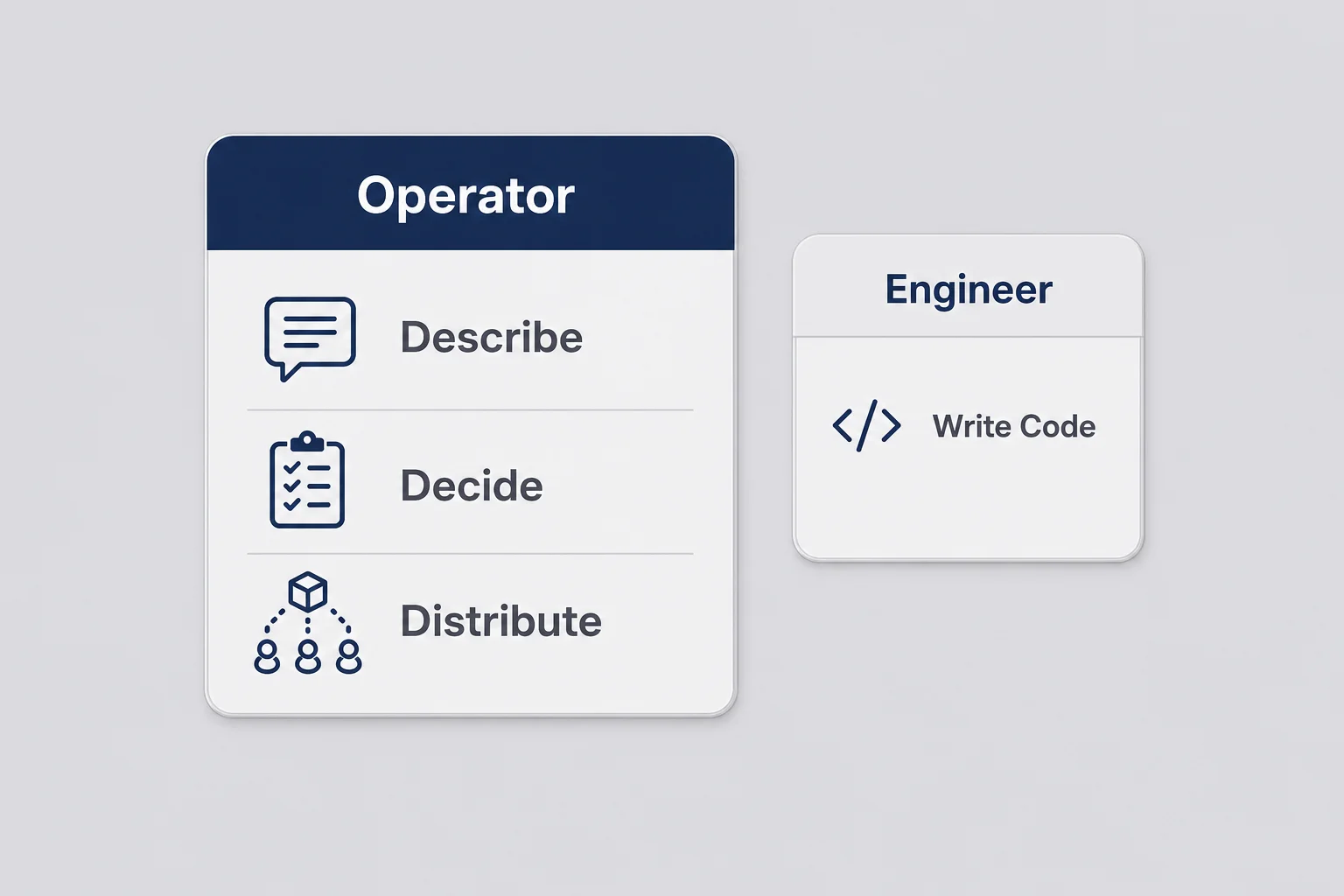
Here is the reframe that saved me time on everything after that. You are not the engineer. You are the operator. Your stack is description, decision, and distribution. You describe the workflow clearly enough that a tool or agent can approximate it. You decide what is in scope and what is not. You distribute the thing to people who might pay. The code is a middle step, not your identity.
That does not mean you get to be vague. The more precise you are about inputs, outputs, and edge cases, the less the tools hallucinate features you did not want. When I say "email me when this cell changes," that is buildable. When I say "make it smart," that is a weekend lost.
Non-coders often assume developers have some mystical ability to see the finished product. They do not. They just have more practice breaking problems into pieces. You can learn that piece-breaking skill without learning a programming language. It is closer to writing a good brief than to writing Python.
If you are coming from marketing, ops, teaching, design, or admin work, you might already be better at this than you think. You know how customers complain. You know which spreadsheet columns actually matter. You know the email that gets ignored versus the one that gets forwarded. That knowledge is the moat when the code itself is cheap. AI did not remove the need for domain insight. It removed the excuse that you need a CS degree before you are allowed to try.
A developer friend told me once that I make it sound easy. It is not easy. It is differently hard. You trade syntax stress for ambiguity stress. The bug messages look like another language. The agent confidently does the wrong thing. You wonder if you are fooling everyone. That feeling does not go away completely. You just get faster at acting anyway.
What "without coding" actually means (and what it does not)
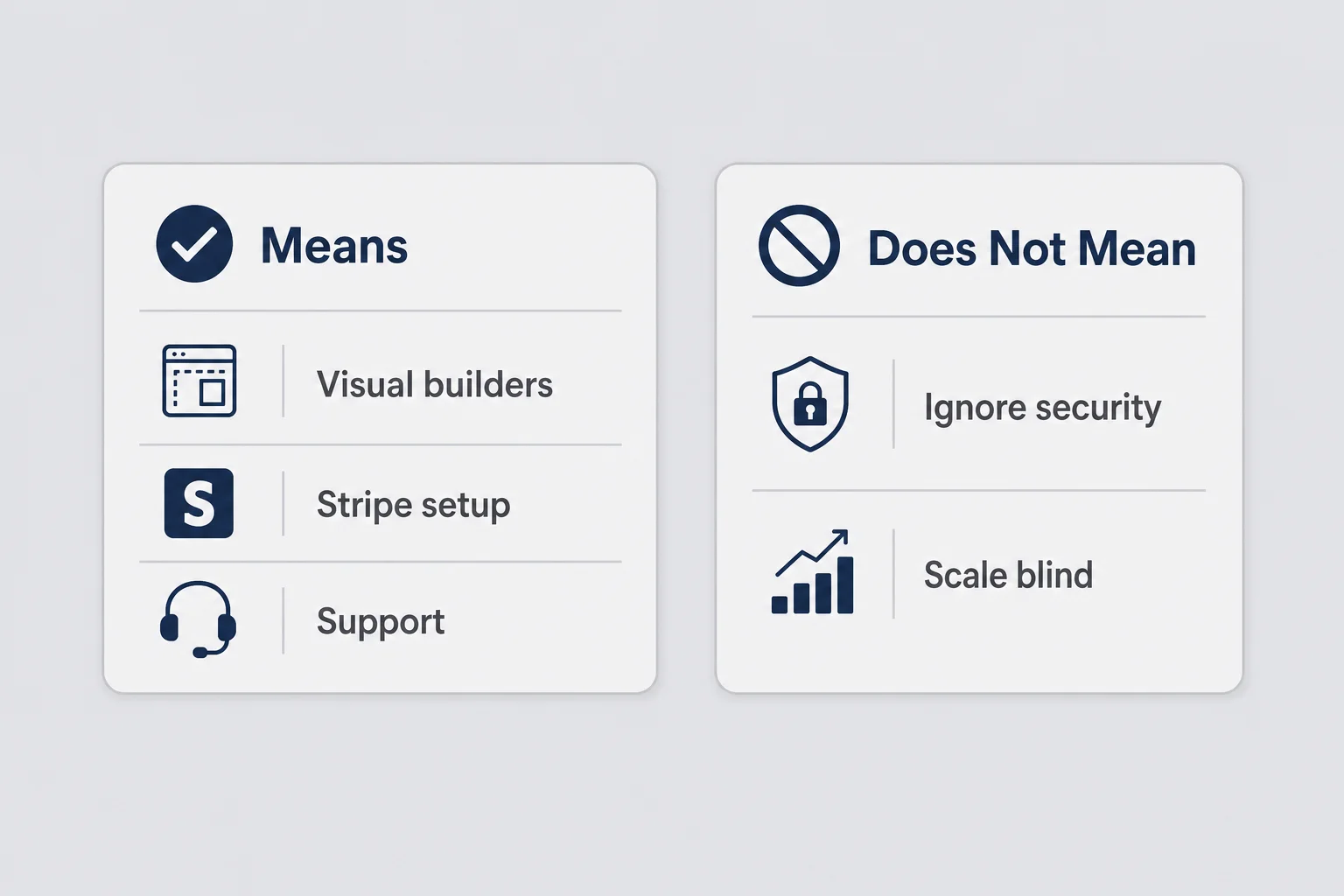
I need to be blunt here because hype will waste your year. "Without coding" in 2026 does not mean "without technical thinking." It means you are not typing production TypeScript by hand. Code may still exist. An agent may write it. A no-code platform may hide it. You still live with the consequences when auth breaks or a webhook fires twice.
What it does mean: you can ship a scoped MVP using visual builders, AI scaffolds, or agents. You can connect Stripe and Supabase with guided setup. You can fix copy, pricing, and onboarding yourself. You can run support from email and Telegram. You can iterate fast because you are not refactoring a codebase you wrote at 2 a.m.
What it does not mean: you can ignore security because "the AI handled it." You can launch a paid product you do not understand while it stores customer data. You can scale to ten thousand users on duct tape. You can avoid every error message forever. At some point something breaks and you either learn enough to direct a fix or you pay someone who can read the repo.
I still google basic terms. I still ask Cursor "what does this file do?" I still cannot debug like someone with ten years of experience. I accept that trade because my products are small on purpose. One problem, one audience, one price. Small scope is how non-coders stay safe-ish.
There is a version of this path that is honest and a version that is cosplay. Honest: you ship narrow tools, you validate early, you admit what you do not know, you get help for scary parts. Cosplay: you call yourself a founder because you generated a landing page, you skip validation because building is fun, you treat AI output as proof. I have done the cosplay version. It is faster and more embarrassing.
Think about scope the way you would think about packing for a carry-on. If you cannot lift the bag alone, you packed wrong. A micro-SaaS for a solo non-coder should fit in a carry-on. One core workflow. One audience. One billing plan. You can add a checked bag later when revenue pays for help.
A line I repeat to myself
If I cannot explain where user data lives and who can see it, I am not ready to charge money yet. That rule has saved me from shipping things I would have had to apologize for.
Validate first, or AI will build something nobody wants
Building without coding is almost too easy now. That is the danger. Bolt can give you a UI before lunch. v0 can spit out components while you are still explaining the problem badly. An agent can scaffold auth and a database before you have talked to a single customer. Speed is not your friend if you are pointed in the wrong direction.
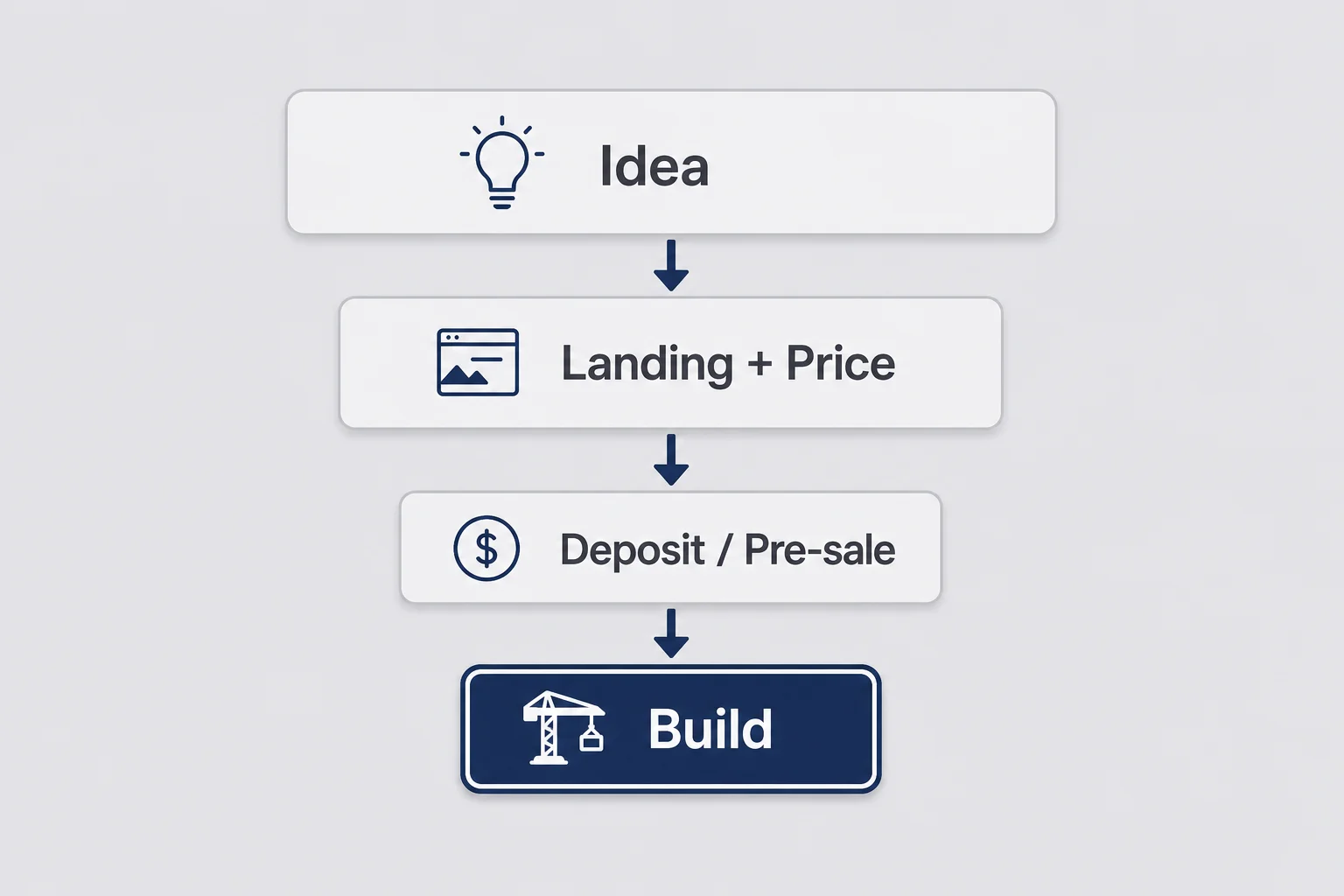
Fake doors, customer interviews, pre-sales, reading signals without lying to yourself. None of that requires being able to implement OAuth. All of it requires swallowing your ego. If you do not code, start with validate a micro-SaaS idea without coding in your own voice. Max walks through the full developer sprint in Validate Before You Build. I add one extra rule for non-coders: do not let AI build the product during validation week. Landing page, sure. Carrd, Framer, a single HTML file, fine. Not the app. Not the dashboard. Not the "just a quick prototype" that eats ten days because the agent keeps adding features you did not ask for.
Say you want to build a tool that alerts Shopify store owners when a supplier changes lead times. Week one: find five store owners, listen, do not pitch. Week two: landing page with a price, "$29/month when it launches," email capture or deposit. Drive traffic from the communities they already use, not your personal Twitter if you have twelve followers. If nobody bites, you saved a month of prompting. If three people pay a deposit, you have something worth building.
I use AI during validation for questions, not construction. "What would a store owner call this problem?" "Rewrite this headline for clarity, not hype." "What objections would you expect at this price?" Construction starts after money or a credible promise of money. Revenue is validation. A pretty prototype is not.
The non-coder advantage in validation is you are not seduced by your own engineering cleverness. You do not fall in love with an elegant database schema because you never built one. Stay in that lane. Fall in love with a painful problem instead.
I keep a note on my phone called "kill criteria." Before I build, I write down what would make me stop. Example: fewer than three deposit payments in two weeks of outreach, or five interviews where nobody mentions the problem without me prompting. Having kill criteria written down makes it harder to move the goalposts when you are emotionally attached to a landing page color scheme.
Three build paths for people who do not write production code
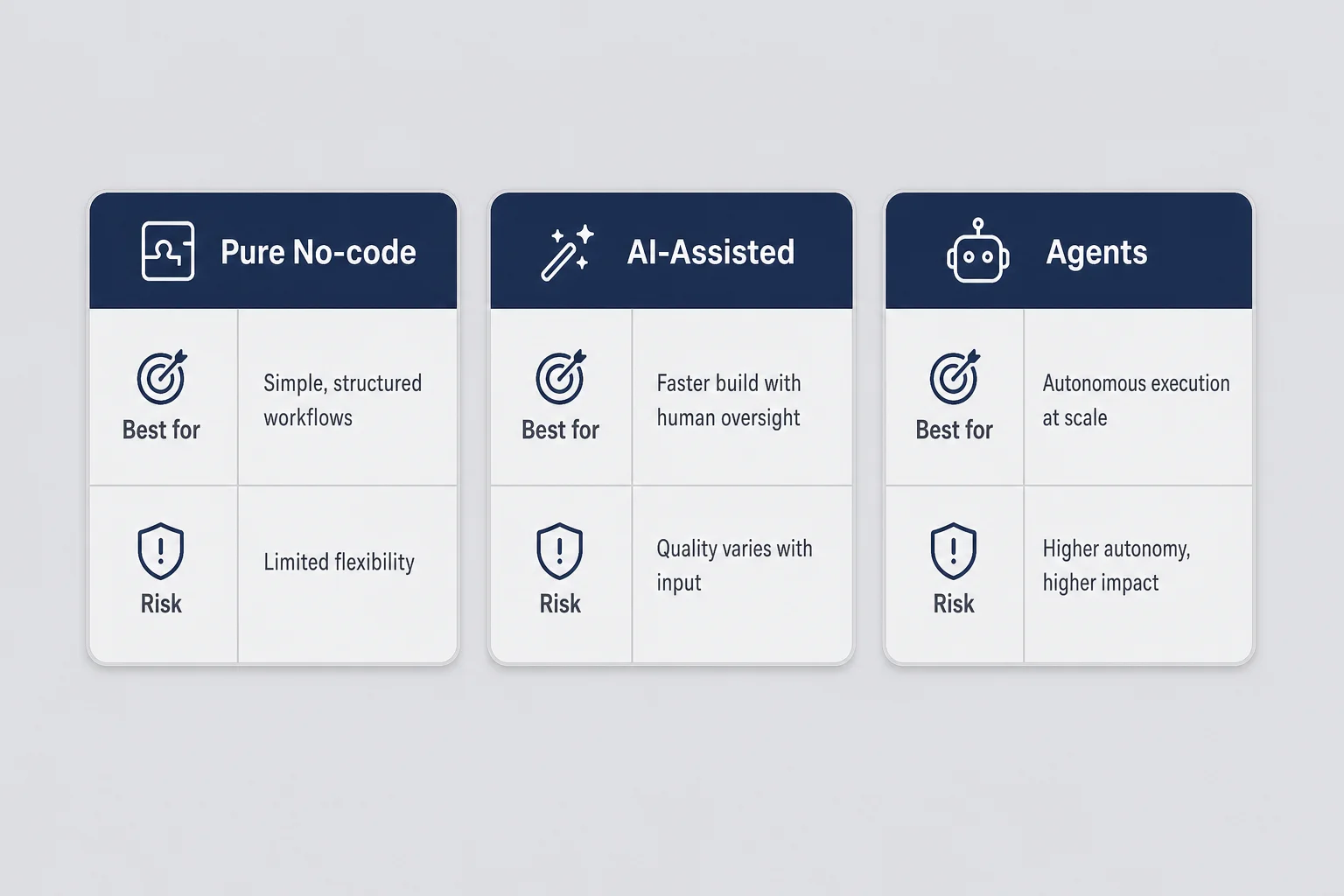
Once you have a validated problem, you pick a build path. Not the coolest path. The path you can maintain alone for six months without crying into a tutorial at midnight. I have used all three below. They overlap. Pick one primary and accept its limits.
Path one: pure no-code
Bubble, Softr, Glide, and Make-powered workflow products. Best when the product is forms, dashboards, workflows, or automations wrapped in a clean UI. You stay inside visual editors. You trade flexibility for speed. Good for internal-tool shapes, client portals, simple marketplaces. Bad when you need weird custom logic or you hate platform lock-in.
I shipped an internal-style reporting tool for a friend’s agency on Softr plus Airtable in nine days. Ugly by designer standards. She paid $49/month for four months because it saved her four hours a week. That is a micro-SaaS outcome, not a Y Combinator outcome, and I am fine with that.
Path two: AI-assisted code you do not write by hand
Bolt, v0, Lovable, Cursor with heavy prompting. Best when you want a more custom web app but still do not want to hand-author every file. The tool generates code. You steer, test, and redeploy. You need enough literacy to know when output looks wrong, even if you cannot fix it yourself. Good for standard SaaS shapes: login, dashboard, settings, one core feature. Bad when you treat the model as infallible.
This is where I live most of the time. I describe pages and flows in plain language. I click through like a user, not like an engineer. I keep a notes doc of "things that must work" and test those paths before every deploy.
The first version should embarrass you a little. If it impresses you, you probably built too much. My first screens are gray, literal, and clear. Pretty comes after strangers pay, not before. Design tools can polish later. Confusion kills non-coder products before aesthetics ever get judged.
Path three: agents as builders
Hermes Agent, Claude Code-style setups, always-on assistants on a VPS. Best when you want ongoing help, recurring tasks, or a co-builder you talk to in Telegram while doing laundry. The agent writes code, runs commands, configures skills. You manage scope like a product manager who also pays the server bill. Good for solo founders who like conversational iteration. Bad when you give an agent too much autonomy too early and come back to a repo you do not recognize.
I use this path myself, but I will save the setup details for later. Some days it feels like magic. Some days I spend four hours on a workflow I ran twice. The agent was patient. I was not.
Which path should you pick? If you have never shipped anything, start with path two or one, not three. Agents reward people who already know what good enough looks like. No-code rewards people who accept platform limits. AI-assisted code rewards people willing to test like users obsessively. For a faster gut check on Bolt vs Cursor vs Expo vs owning the code yourself, run the build path picker before you open another tool tab. Once you have a shortlist, add the invoices into the stack cost calculator so you know the monthly burn before you subscribe to a fifth AI tab.
You can switch paths mid-build, but it costs time. I migrated once from a Bubble prototype to a Bolt app because I hit a logic ceiling. That took four days I did not plan for. Better to pick the path that matches your ugliest edge case upfront, not just the happy path demo.
The stack I actually ship with
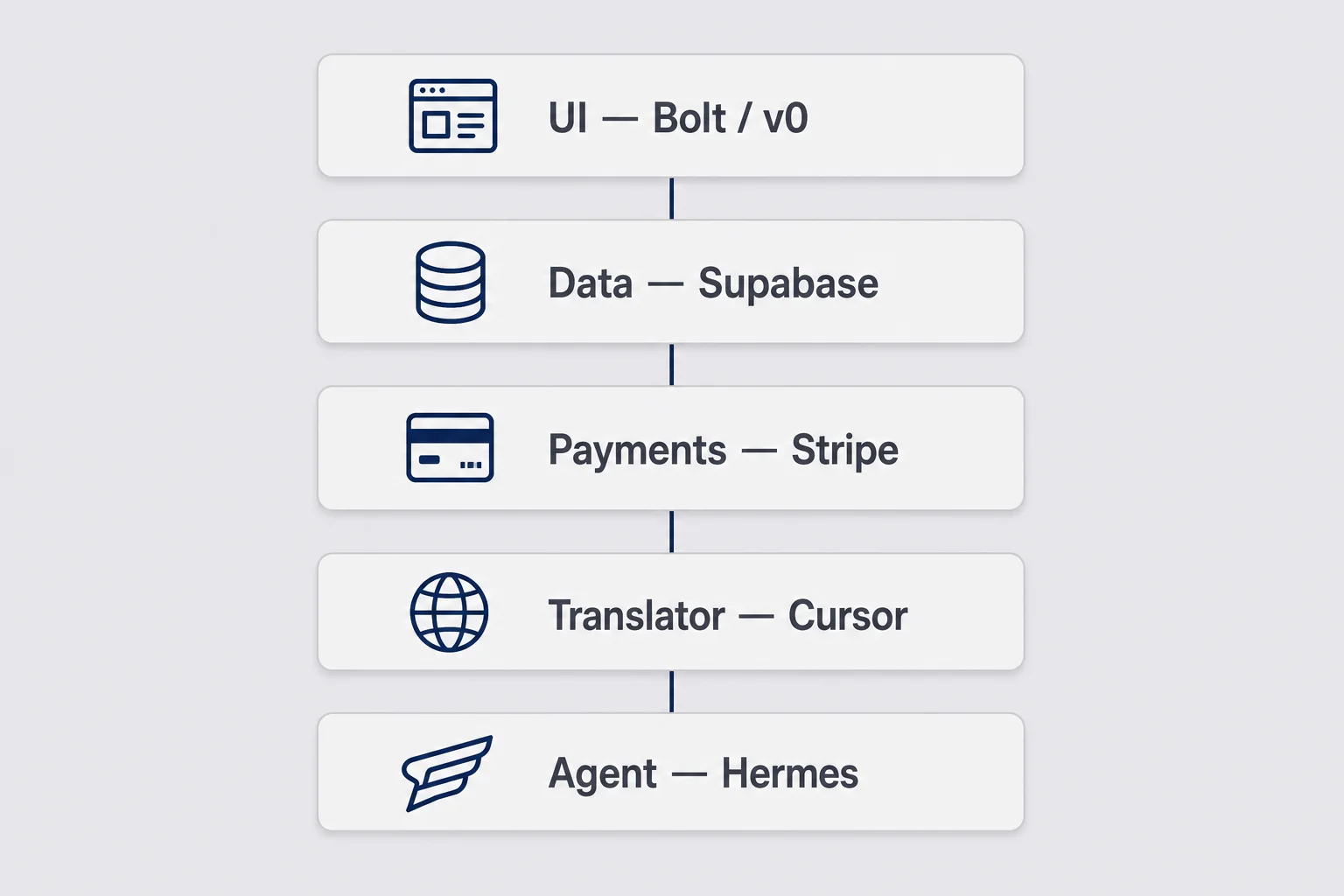
I do not have a perfect stack. I have a stack that has survived my attention span and my budget. Your list will differ. This is what I reach for when I need to go from validated idea to something I can charge for.
Bolt.new and v0 are where first versions happen. I describe the core screen and the happy path. I do not ask for admin panels on day one. Supabase is where user data usually lives, set up with AI holding my hand through database permission rules I only half understand. Stripe is payments, also AI-assisted setup, with me manually clicking through test mode until charges look right. Cursor is where I open files when I need to ask "what changed?" When a product is live and I need ongoing help, Hermes picks up the repetitive chores. OpenRouter routes models so I am not locked to one vendor.
That sounds like a lot of tools. In practice three or four matter per product. The rest are interchangeable if you prefer different brands. What matters is you know which layer does what. UI here. Database there. Payments there. Agent over here with limited permissions.
I keep a personal rule: every tool must earn its subscription monthly. If I have not opened it in thirty days, it gets cut. Bootstrapping means your stack tax is real money, not Monopoly money.
Hosting stays boring. Small VPS or managed platform. I do not optimize infra for imaginary scale. Two hundred paying users at $19/month is a good problem. I will deal with that problem when I have it.
When something breaks at 2 a.m., I troubleshoot like an operator. I reproduce the bug. I tell the agent exactly what I clicked. I ask for the smallest fix. I retest the payment path. I do not rewrite the whole app because I panic. Panic is how non-coders ship regressions.
Documentation for yourself sounds corporate until you are fixing the same Stripe webhook question for the third time. I keep a running doc per product: what Supabase project, what Stripe product ID, what environment variables exist, what the deploy steps are. AI can regenerate code. It cannot regenerate your memory of which dashboard you clicked in.
Directing AI and agents when you are the product person
You are a director, not a typist. That sounds glamorous until you are on your third hour explaining why the export button should export CSV, not PDF, and the model keeps adding a dark mode nobody asked for. Direction is a skill. It gets sharper the more products you kill.
Start every build with a one-page spec even if you are the only reader. Problem, user, core workflow, out of scope list, success metric. My out-of-scope list is often longer than the feature list. "No team accounts. No mobile app. No integrations except Stripe." Constraints save non-coders from infinite agent enthusiasm.
Prompt like you are briefing a junior contractor who is fast but literal. Bad: "Build a CRM for creators." Good: "Build a table view of contacts with name, email, last contacted date, and a button that opens a mailto link. No login yet, just the table on one page." You can add auth later. You cannot add clarity later if the foundation is mush.
Test as a user after every session, not as a builder admiring progress. Click the way a tired customer clicks. Skip the tutorial. Try to break the happy path on purpose. If you only test while looking at the code panel, you will ship confusion.
Record your screen once a week and watch it without sound. Painful? Yes. You will see hesitation clicks, rage clicks, and places you assumed were obvious because you built them. Developers use session replay tools for this. Non-coders can use a free screen recorder and brutal honesty.
When an agent proposes a clever shortcut, ask what you lose. Free tiers, open permissions, storing passwords wrong, skipping email verification. Non-coders get hurt by shortcuts they did not know were shortcuts. Slow down on auth, billing, and data deletion. Speed up on copy and layout.
I keep a "human must verify" checklist before any deploy: sign up, sign in, pay, use core feature, cancel or delete account. If I cannot complete that chain myself, nobody else should see it yet.
How I use Hermes without pretending I am a backend developer
Hermes is not magic fairy dust. It is a very capable intern with shell access if you give it shell access, which means you need boundaries.
I use Telegram as the gateway because I am often away from my desk. I send a message like "add a settings page with email preferences, default off" and Hermes works in the repo. I review what changed when I understand it. When I do not, I ask for a plain-English summary before approving. I configure skills for repetitive workflows so I am not re-explaining context every time. I limit tools when I am experimenting because an agent with permission to change anything on the server is a story that ends badly.
When I first connected Hermes to my model provider, after I already had a Bolt MVP worth keeping, I ran hermes setup --portal in the terminal. That is the wizard that links the agent to Nous Portal so it can call models without me hardcoding API keys in a dozen places. I am still learning that setup, plus skills and which tools the agent is allowed to touch. You do not need any of this on day one. It is for when you want an always-on co-builder, not your first landing page.
Treat agent sessions like meetings. Start with an agenda. End with a recap of what changed and what is still broken. Unstructured "just fix it" messages at midnight produce unstructured repos. I learned that after an onboarding flow gained three extra steps nobody asked for, because I was vague and tired and the agent tried to be helpful.
What Hermes is great at: scaffolding boring CRUD, rewriting onboarding copy, wiring a Stripe checkout from a template, explaining errors in human language, running the same deploy steps I always forget. What Hermes is bad at: deciding product strategy, choosing your ICP, knowing whether $12 or $29 is right, telling you to kill an idea. That is your job. I have tried outsourcing those decisions to a model. It agreed with whatever I said last. Useless.
I spent one weekend tuning a Hermes skill for a workflow I ran twice. That was ego, not economics. Skills shine when a task repeats weekly and the context is stable. One-off heroics are still cheaper in Bolt with your eyes on the screen.
If you are not ready for agents, skip Hermes for now. No shame. Cursor and Bolt will carry you further than most people admit. Agents are for when you already ship and you want help on repeat chores, not when you are looking for a substitute for thinking.
Here is a concrete Hermes workflow I use weekly. I paste customer support emails that mention confusion. I ask for patterns, not fixes yet. Then I ask for the smallest UI copy change that would prevent the next three emails. That loop keeps me out of the codebase for problems that are actually communication problems. Non-coders should fix copy before they fix architecture nine times out of ten.
The lines I will not cross with payments and user data
This section is the unglamorous one. Read it anyway.
I will not store sensitive data in a tool I do not understand. Health info, government IDs, children’s data, full payment card numbers. If your product needs that, you need a real engineer and probably compliance advice. Micro-SaaS for solo non-coders should not start there.
I will not launch paid auth without testing password reset and email verification. Sounds basic. AI-generated auth often looks fine until a customer locks themselves out and you realize there is no reset flow.
I will not give an agent production credentials on day one. Read-only first. Staging environment. Manual approve before deploy. I learned that after an agent "helpfully" cleaned up files that were not trash.
I will not promise features on a pricing page that are not built. Non-coders move fast and oversell in copy because writing is easier than building. Customers remember the promise, not your sprint velocity.
When in doubt, shrink scope until the scary parts disappear. A tool that sends one kind of email alert is shippable. A platform that "manages your entire business" is where you drown.
Privacy policies and terms pages are boring. Generate a baseline with AI, then read them like a customer would. If you do not understand what data you collect, your product is too messy to charge for yet. I am not a lawyer and this is not legal advice. It is operator advice. Confusion in your own policy usually means confusion in your database schema.
Pricing and Stripe when you cannot read the codebase
You do not need to understand every Stripe webhook to charge money. You need to understand what your customer is buying, what happens when payment fails, and how to refund someone without drama. On numbers and nerve, see Charge More Than Feels Comfortable. My addendum for non-coders is mechanical: keep billing simple until you have fifty customers who love you.
One plan. One price. Monthly. Maybe an annual toggle later. Do not build a pricing page with four tiers because a template looked professional. Pick a number that would matter if one person paid it, say $19 or $29 for a B2B-ish tool, and test it during validation before you wire Stripe.
When you connect Stripe, stay in test mode until you have clicked through checkout yourself ten times. I mean literally ten. Different cards, failure cases, cancel from the browser mid-flow. AI can wire the integration and still miss the cancel URL. You find that by clicking, not by reading code.
Refund someone once on purpose in test mode. Cancel a subscription. If you only have one plan today, skip upgrade testing, but know where the billing portal link is. Customers find these buttons before you do. Non-coders win trust by handling money questions calmly, not by having perfect webhooks on day one.
If a customer says they were double charged, you fix it same day and explain plainly. Non-coders win on support speed more often than on architecture. People forgive small tools when a human answers email fast.
Raise prices when the support load proves value, not when you feel brave. I raised a product from $12 to $19 after three customers said "this saves me an hour a week" unprompted. Nobody churned. That sample size is tiny. It was still a signal. Before a bigger jump on an existing base, plug the scenario into the price raise impact calculator so you know how much cancel rate you can afford.
Annual billing can wait. So can coupons, affiliate programs, and lifetime deals. Non-coders should resist every pricing gimmick until monthly renewals prove the product stays useful after the novelty wears off. Boring recurring revenue is the whole point of micro-SaaS for solo founders.
Launch embarrassed, not unsafe
You will launch something ugly. Good. Ugly and safe beats polished and leaky.
My launches are smaller than Max’s developer launches because I am still learning what I shipped. I email ten people who talked to me during validation. I post once in one community where I have been helpful, not spammy. I write a short honest note about what it does and what it does not do yet. I do not pretend I have a team. I do not fake social proof.
Warm before loud, one community done well, email like a human. That is the launch habit Max breaks down in Nobody's Waiting for Your Launch. The non-coder twist is you should ship even sooner than developers think you should, because your MVP is already simpler, but only if the unsafe parts are handled. Embarrassed is fine. Unsafe is not.
Build in public if it fits your personality. Skip it if you hate performing online. I do a low-key version, screenshots and honest counts, not thread cosplay. Your first customers might come from a DM, not Product Hunt. That is normal for small tools.
When launch week feels like a flop, check whether anyone used the core workflow. Sometimes five serious users beat five hundred signups. Especially when you are solo and support is your bottleneck.
I track one metric the first month: did a stranger complete the core workflow without me hand-holding them on a call. If yes, even once, I keep going. If everyone needs a Zoom, the product is still a service business wearing a SaaS hat, and that is okay temporarily as long as you admit it and price accordingly.
What the quiet failures taught me
Most of my products died quietly. No dramatic postmortem thread. Just zero renewals and me closing the Stripe product six months later. The failures were faster and cheaper. The wins were more instructive. I talk about both for the same reason.
The Etsy reminder tool I mentioned earlier was the loudest lesson in building before validating. The AI made it fun. Fun is not a business metric. I also copied a tool I saw on Twitter once without talking to the people it was supposed to serve. Support emails showed up fast. I had no idea how to answer half of them. That is what happens when you build for an audience you read about instead of one you have listened to.
Another product died when I added a second feature before the first one worked reliably. Complexity explodes invisibly when you do not read code. A permissions bug I ignored because it only hit one edge case cost me a customer who told two friends. Edge cases are where strangers churn.
The wins were boring. Narrow problem I understood from ops work. Validation conversation before build. One price. Fast support. Small stack bill. That pattern repeats.
If you are on your first product, expect the first one to teach you. Maybe it pays a little. Maybe it dies. Both outcomes are useful if you pay attention. My GitHub profile looks like a museum of projects I am emotionally not ready to discuss. That is fine. Each one made the next one faster to kill or ship.
Say you ship a tiny reminder tool at $12/month. Thirty people sign up, that is $360 MRR. Not retirement money, but proof strangers will pay. Run the same price and customer count through a solo founder MRR calculator when you are sanity-checking the next milestone. That math is hypothetical, but the shape is real. The first time you see it, you stop asking whether you belong in this industry. You start asking which problem to solve next.
Questions I get about building without code
Can you really build a micro-SaaS without knowing how to code?
Yes, if you define without coding honestly. You can ship a paid product using no-code platforms, AI-assisted builders, or agents that write code you do not fully understand. You still need to validate demand, handle support, and know enough to keep payments and user data safe. You cannot outsource judgment to a chat window.
What is the best no-code stack for a micro-SaaS?
There is no universal best stack. Pick based on your product shape. Bubble or Softr for database-backed web apps, Bolt or v0 for AI-assisted UI scaffolds, Make or Zapier for workflow products, Supabase plus Stripe when an agent or AI builder handles the backend wiring. The right stack is the one you can maintain alone for six months. If you are stuck between Bolt, Cursor, Expo, or custom code, the [build path picker](/tools/build-path-picker) turns that into a short checklist.
How do I validate a micro-SaaS idea without building the product?
Run the same validation moves developers use: narrow the problem, talk to five to ten strangers who have it, put up a landing page with a visible price, and ask for a deposit or pre-sale before you build. AI makes building cheap, which makes skipping validation even more expensive emotionally. Validation is not a developer skill. It is a business skill.
When should a non-coder stop building and ask for help?
Stop when the product touches money, health data, or sensitive personal information and you cannot explain where that data lives or who can access it. Also stop when you have fixed the same bug three times with AI and it keeps coming back. At that point you need a human who reads code, even if only for a paid audit or a small scoped fix.
Is AI-generated code safe to ship for a paid product?
Sometimes, with limits. AI-generated code is fine for early MVPs if you test the critical paths yourself, keep scope small, and do not store sensitive data you cannot protect. It is not fine to launch blind on auth, billing, and permissions because a model said it looked good. Read enough to ask good questions, or hire someone for the scary parts.
How much does it cost to build a micro-SaaS without coding?
Say you spend forty dollars a month on hosting and tools, another thirty on model access, and zero on salary because you are the team. That is under a thousand dollars for the first six months if you ship small. The expensive part is not software subscriptions. It is building the wrong thing for three months because validation felt boring.
People DM me variations of the same fears. Am I too late. Am I too non-technical. Is AI cheating. Cheating would be faking revenue screenshots or copying someone’s entire product verbatim. Using tools to build is just the job now. Developers use Copilot. You use Bolt and Hermes. The customer still only cares if the problem gets solved.
Another common question: should I learn to code properly first? Learn in parallel if you want, not as a gate. Learn enough to read errors, understand where data lives, and talk to a contractor without sounding lost. You do not need to become a senior engineer to sell a $29/month tool to fifty people.
Partnerships help at specific moments. I hired a freelancer for two hours once to audit auth on a product before I turned on ads. Best sixty dollars I spent. You do not need a co-founder. You need scoped help when risk spikes.
The last thing I will say in this FAQ section before the close: comparison is a tax. You will see developers ship faster and influencers post bigger numbers. You do not know their runway, their audience, or their exaggeration rate. Run your own validation, your own price test, your own small launch. The only comparison that matters is whether you are less confused this month than last month.
You do not need permission from a bootcamp
I googled "what is an API" in 2023. By 2024 someone was paying me $19/month for a small tool. The timeline still confuses me. I did not get smarter about computers overnight. I got clearer about problems, and I stopped waiting for credentials that were never coming.
If you are trying to build a micro-SaaS without coding, you already have the hard parts inside you if you have ever been the person who fixes the spreadsheet everyone else breaks, or writes the email that calms an angry customer, or notices the workflow step that wastes an hour every Tuesday. AI removed a gate. It did not remove judgment, pricing, support, or the courage to ask strangers for money.
Start narrow. Validate before you build on the non-coder path, or use Max's validation guide if you want the developer sprint. Keep the smallest stack you can maintain. Charge before you feel ready, but not before you feel safe with data and payments. Launch small. Kill fast when signals say no. Keep the one that gets paid and make it less confusing.
That is the whole loop. No credential required. No single perfect tool. Just repeated honesty with yourself and with strangers who might pay you. I will keep writing here about what breaks, what ships, and what I had to google at embarrassing hours. If you are building without coding, you are not behind. You are early to a path that is still being invented in public.


Comments