My Phone Buzzed. The Agent Had Already Fixed It.
How I use an always-on AI agent to build micro-SaaS without writing production code — setup, boundaries, and when agents beat chat windows.
 By Imani26 min read
Listen to this article
23:42AI-generated podcast-style overview of this article (not a word-for-word narration).
My phone buzzed at 2:14 on a Tuesday while I was standing in line at a coffee shop in Austin. Not a friend. Not a customer complaint. Hermes, my always-on agent, telling me it had finished wiring a settings page I asked for that morning before I left the apartment. I had not opened my laptop since breakfast. I read the recap on my phone, frowned at one line I did not understand, typed "explain that like I am tired," got a plain-English answer, and told it to hold deploy until I was home. That is what an ai agent micro saas solo founder setup looks like in real life. Not a demo video. Not a keynote slide about the future of work. A Telegram thread and a small VPS doing chores I used to repeat every week while I pretended I was too busy to automate them.
I am Imani. I am not a software developer. I build micro-SaaS with AI tools and agents because that is the path I actually walk, not the path I wish I had walked after a bootcamp. If you read my build without coding post, you already know the operator-versus-engineer frame. If you read micro-SaaS tools for non-developers, you saw Hermes mentioned in one section because it deserved its own room. This is that room.
Agents are not magic. They are not a substitute for talking to customers. They will not pick your price or tell you to kill a bad idea. What they can do, when you configure them honestly, is carry repetitive build and ops work across days without you re-pasting context into a chat window like it is 2023. That matters for solo founders because your bottleneck is not typing speed. It is attention. Every hour you spend re-explaining your repo to a blank session is an hour you are not doing support, outreach, or the uncomfortable validation work that actually decides whether your product survives.
Some numbers below are illustrative examples to show what good and bad outcomes look like. I will say when they are hypothetical. I am not going to pretend my agent stack made me rich. It made me faster on chores I was already doing badly.
AI agent micro saas solo founder: what I mean when I say "agent"
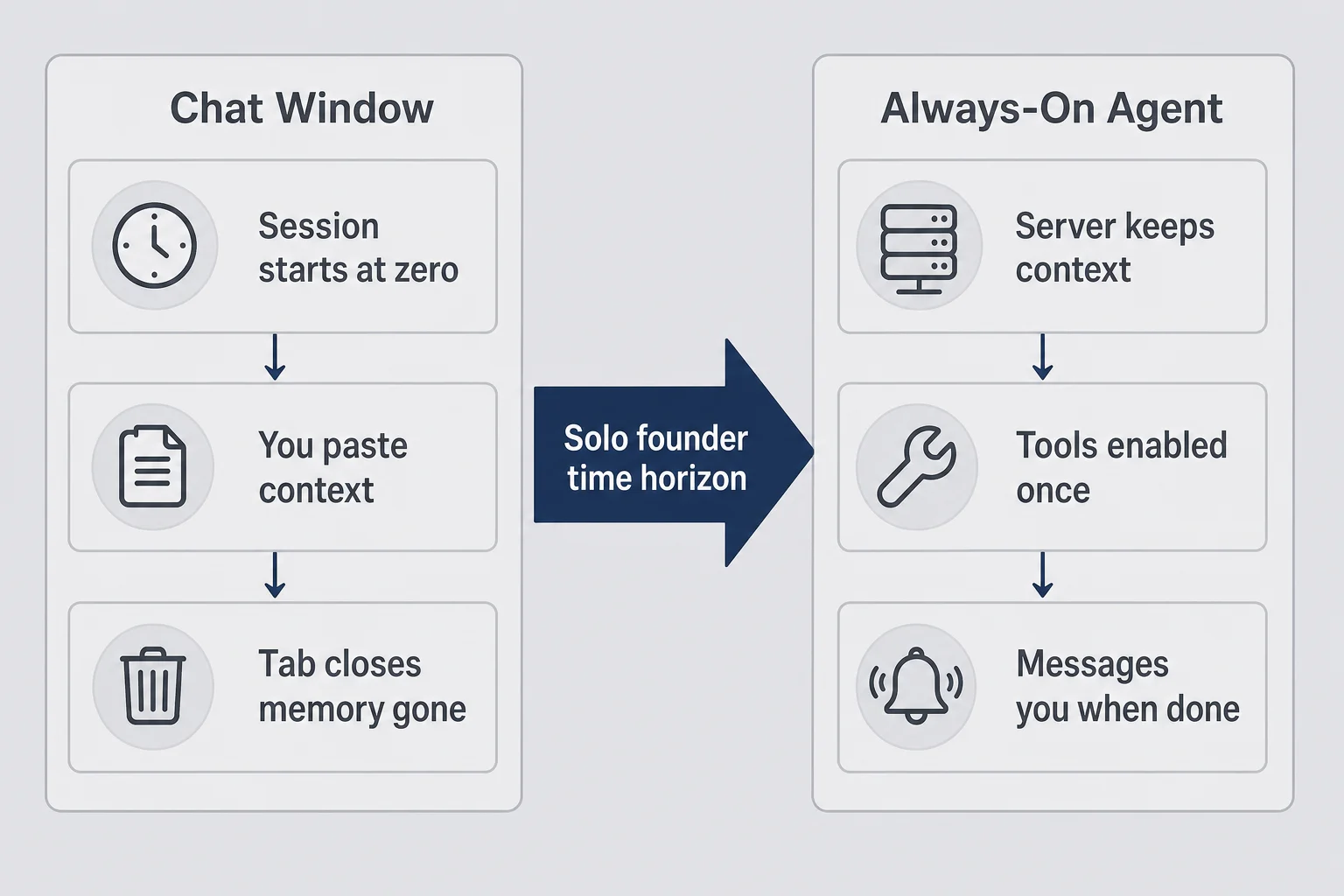
When I say agent, I do not mean ChatGPT with a personality sticker. I mean software that runs somewhere other than your browser tab, keeps working context across sessions, can call tools (files, shell, APIs you explicitly allow), and can ping you when a job finishes or breaks. You give direction. It executes steps. You review. That loop is the whole game for an ai agent micro saas solo founder who does not read production TypeScript for fun.
Chat is a conversation. Agent is a shift. In chat, you are always the project manager copying context back in. In agent setup, you are trying to build a shaky intern who remembers where the Stripe webhook lives and does not rewrite your onboarding flow because you said "make it better" at midnight.
I learned the difference the expensive way. In early 2024 I used ChatGPT for everything. New tab, paste product description, paste error message, paste again tomorrow because the tab forgot. It worked until I had a real repo, real users, and real repeat tasks. Then I was spending Sunday afternoons doing copy-paste ops instead of shipping. The model was fine. The interface was wrong for ongoing work.
Non-coders hear "agent" and picture autonomy robots taking over the company. Calm down. My agent does not run my business. It runs tasks I can name in one sentence: add a column to the settings page, summarize these support emails, run the deploy checklist, explain this error without jargon. If I cannot name the task, the agent should not touch it yet.
That narrowness is a feature. Broad "be my co-founder" prompts produce broad garbage. Specific chores produce specific diffs you can review. Review is the job you cannot outsource, especially when you do not read every line of code. The product does not care who wrote the code. It cares whether someone pays. Agents help with the middle. They do not replace judgment.
If you are still validating whether strangers want your thing at all, stop here and read how to validate a micro-SaaS idea without coding. Agents reward people who already know what good enough looks like. Validation is not an agent problem. It is a courage problem.
The word agent gets abused in marketing right now. Every chatbot with a logo is an "agent." Every automation zap is an "agent." I use the word narrowly because narrow keeps me safe. If it cannot run without you sitting in front of it, it is not an agent for my purposes. If it cannot use tools you explicitly enabled, it is a fancy autocomplete. If it cannot message you when work completes, it is still a session. Those three tests filter out most of the hype in about ten seconds.
Why a chat window is not the same as an always-on co-builder
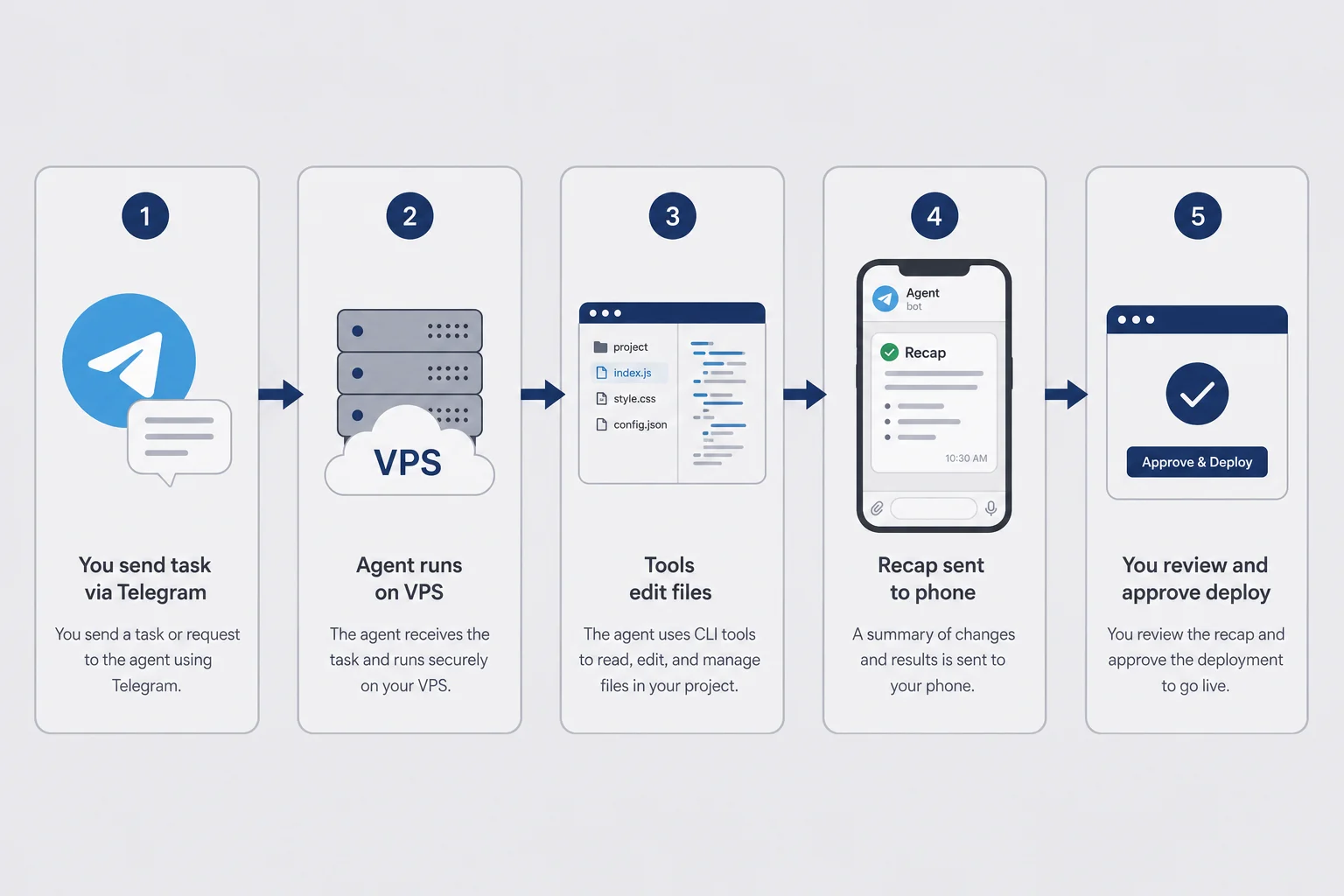
Chat windows are incredible for thinking. They are awkward for operating. The difference is not intelligence. It is continuity plus tools plus timing.
A chat session starts at zero every time you open it unless you manually feed it memory. An always-on agent keeps a thread on a server, tied to your project, with tool access you configured once. You message from Telegram on the bus. It edits files on the VPS or connected repo. You get a recap. You approve or reject. That is solo founder ai agent setup in one paragraph, and it is why I stopped treating "AI builder" and "AI agent" as the same category.
Timing matters more than people admit. Chat requires you to be present. Agents can work while you are grocery shopping, in a meeting, or pretending to listen on a Zoom call. I am not saying you should automate your life into oblivion. I am saying micro-SaaS maintenance has a lot of "come back to this later" tasks, and later-you is tired and forgetful.
Chat also nudges you toward performance. You paste logs. You paste code snippets. You perform competence because the interface feels like an interview. Telegram with your agent feels like texting a contractor. Shorter messages. Uglier questions. "What does this mean?" is a complete sentence. That tone helps non-coders ask what we actually need instead of faking fluency.
The always-on part has a cost. You pay for a VPS. You maintain permissions. You read recaps even when you do not feel like it. Chat is free until you upgrade. Agents are infrastructure. Infrastructure is only worth it when repeat work exists. If you ship one landing page and quit, skip agents. If you are on week six of the same deploy dance, an agent starts to look like a bargain.
I still use ChatGPT and Claude for writing, pricing gut-checks, and angry-email drafts that should never send as written. Thinking tools stay in chat. Doing tools graduate to agents. Mixing them up is how you end up with a brilliant paragraph about your value prop and a broken checkout flow nobody tested.
There is an emotional shift too. Chat feels like asking for help. Agents feel like delegating. Delegating is uncomfortable when you do not trust your own specs. I spent my first month over-managing every agent task because I was scared of what I could not read in the diff. That was correct caution with bad time management. The fix was smaller tasks and better recaps, not abandoning agents entirely.
Another difference: chat rewards eloquent prompts. Agents reward operational clarity. Your best chat prompt might be three poetic paragraphs. Your best agent prompt might be "ENV=staging, TASK=add timezone label to reminder settings, FILES=settings page only, STOP if more than two files change." Boring wins.
The three jobs I actually give my agent
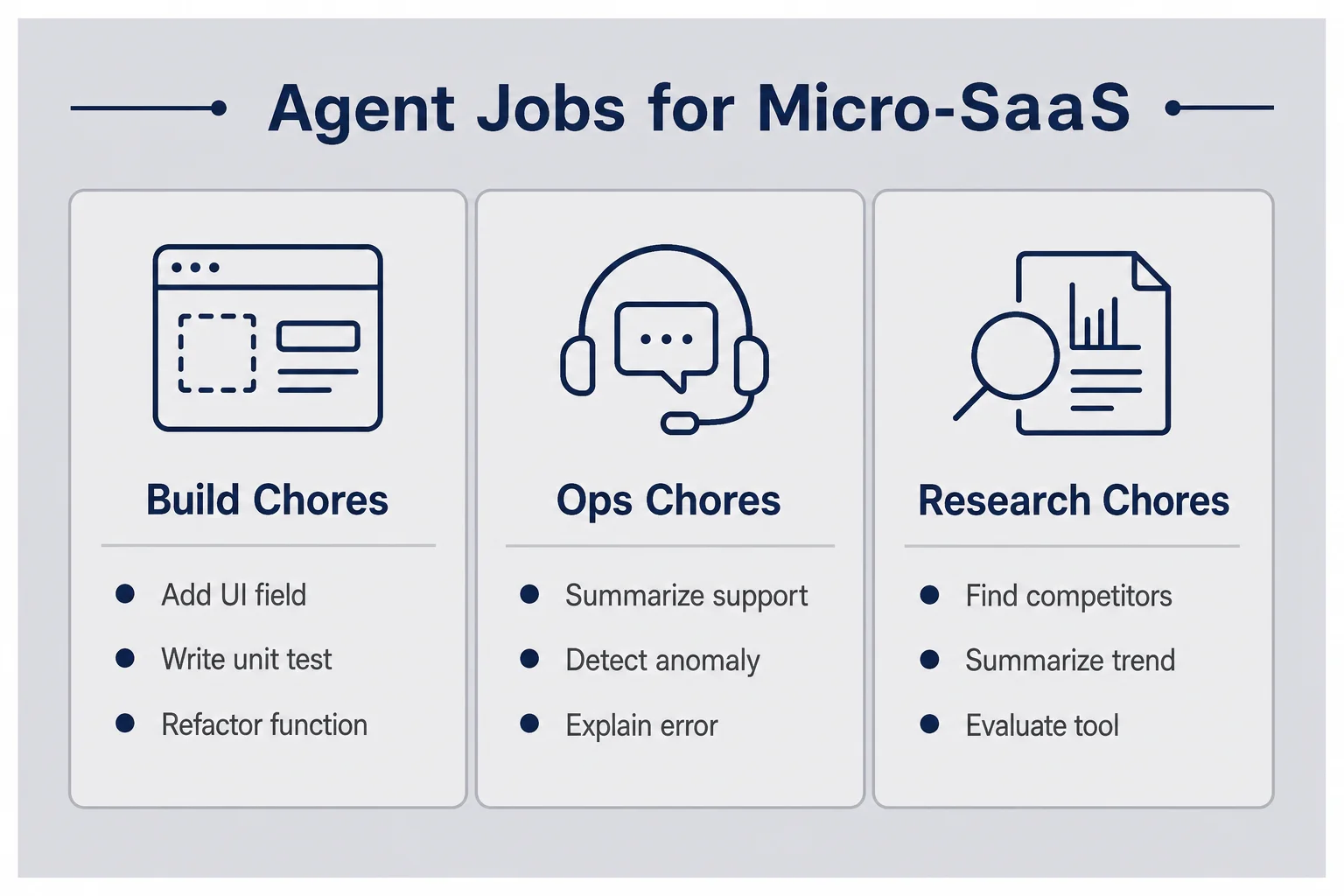
I do not give my agent a job title. I give it chores. After a year of messing this up, three buckets cover almost everything useful for micro-SaaS.
Build chores are scoped code and UI changes. Add a field. Fix copy on the pricing block. Wire a button to an existing endpoint pattern. Scaffold a page from a template you already trust. These are tasks where the shape is known and the risk is bounded if you review diffs like a user, not like a senior engineer.
Ops chores are the boring loops that eat solo founders. Summarize support themes. Run deploy steps. Check whether the webhook fired in test mode. Generate a changelog from commits you do not want to read. Ops chores are where agents save the most calendar time because they are repeat and text-heavy.
Research chores are bounded lookups. Compare two pricing page patterns. Summarize a doc you pasted. Explain an error message in plain English. Research is not "find product-market fit." Research is "translate this jargon so I can decide."
What I do not give agents: pricing decisions, ICP choice, kill-or-keep product calls, anything involving live customer data I have not thought about, and anything where the task is "make it better" without criteria. Vague goals produce vague repos. I once asked for a "better onboarding flow" and got three extra steps nobody asked for. That was my fault for hiring an intern with shell access and no spec.
Say you have a reminder tool at twelve dollars a month with forty users. A good agent week might be: rewrite onboarding tooltips from support themes, add export CSV button using the same pattern as your existing table page, run deploy checklist after each change. A bad agent week is: redesign the whole app because you were bored. The second week feels productive. It is avoidance.
Build, ops, research. If a task does not fit, it probably needs a human conversation, not more automation. Customers are human conversations. Agents are not.
I track chores in a note called "agent eligible." If a task happened twice in two weeks and I can describe it in one sentence, it goes on the list. If it happened once and might never happen again, it stays in chat or in my own hands. That note prevents me from building a spaceship to deliver pizza across the street.
Say you run a small PDF tool for freelancers. Build chore: add a second export format using the same pipeline as the first. Ops chore: summarize which export errors appear most in support. Research chore: explain what "vectorization" means in the error log without jargon. Not agent chore: decide whether freelancers or agencies are your real customer. You still need a walk and a notebook for that one.
Hermes Agent setup without pretending I am a DevOps engineer
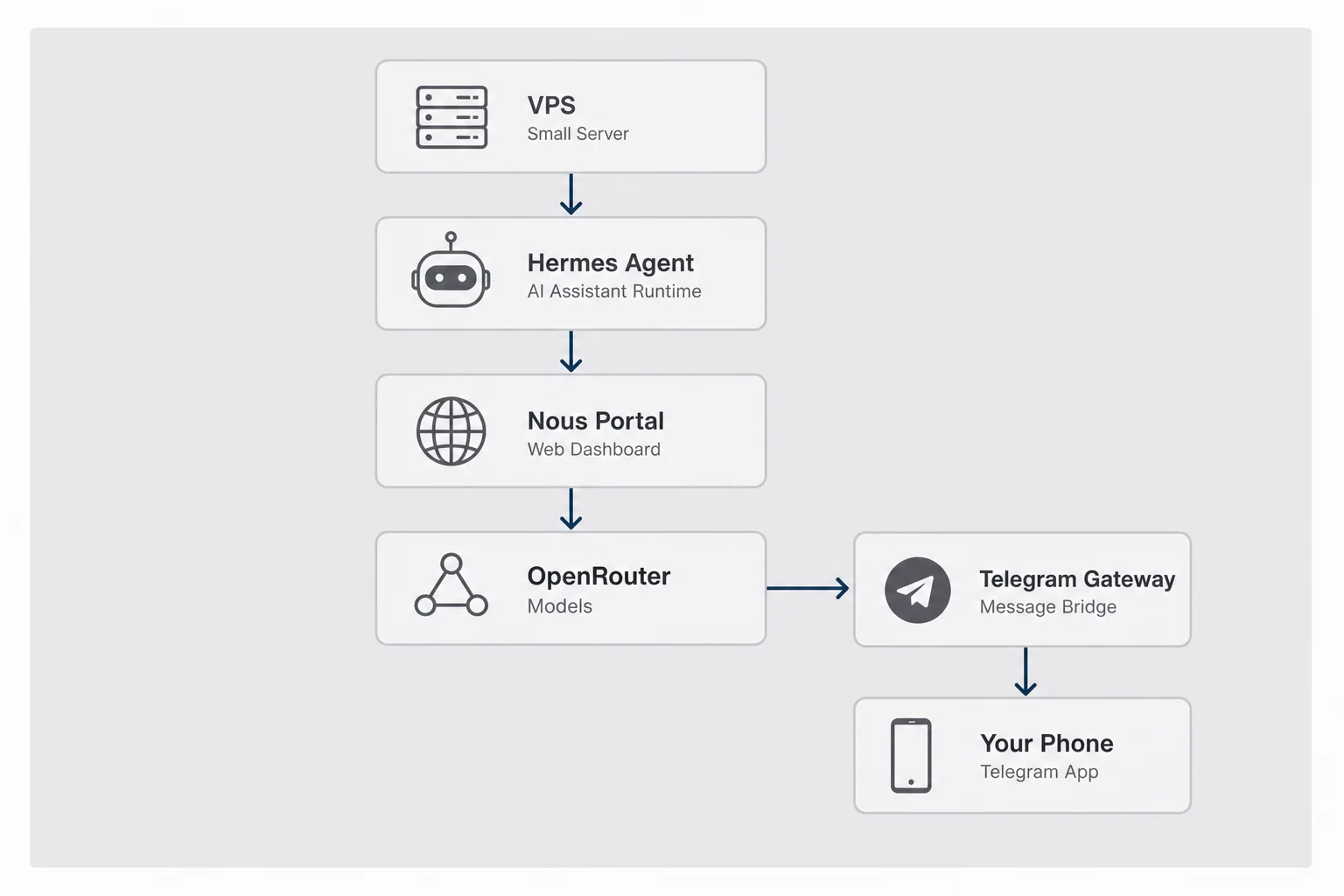
Hermes Agent is what I run for my hermes agent micro saas setup. Not because it is the only option. Because it matched how I already live on my phone and because I wanted one always-on co-builder instead of five half-configured experiments. Your stack might differ. The principles transfer: portal for model access, gateway for messaging, tight tools list, boring VPS.
Setup is closer to infrastructure than non-coders expect. That surprised me. I thought agents were "install app, press go." They are closer to "rent a small computer, connect it to models, connect it to you, limit what it can touch." Still doable. Just not invisible.
VPS and gateway in plain English
A VPS is a cheap computer in a data center. Mine costs about twelve dollars a month. Hermes runs there so it stays on when my laptop sleeps. Telegram is the gateway: how I talk to it without SSH-ing like a character in a hacker movie. I am not a DevOps engineer. I follow the setup docs, copy commands carefully, and ask the agent to explain errors when something fails. That is allowed.
Plain English version: the VPS holds the agent process. Telegram is the remote control. Your code repo connects however your setup guide says, often through git on that same machine or through linked project paths. You do not need to love servers. You need to not panic when the terminal asks a question you do not recognize.
Portal, models, and tools
After I had a Bolt MVP worth keeping, I ran hermes setup --portal in the terminal. That wizard links Hermes to Nous Portal so I am not hardcoding API keys in a dozen places. OpenRouter sits behind that for me so I can swap models without rebuilding everything. Then hermes model to pick what runs default tasks. Then hermes tools to decide what the agent is allowed to touch.
hermes setup --portal
hermes model
hermes tools
Each command is a decision, not a ritual. Portal means centralized model billing and keys. Model choice means cost versus quality for your chores. Tools mean permissions. Permissions are where non-coders get hurt. Wide tool access feels like power until something deletes the wrong file at 1 a.m.
I treat setup like moving into an apartment. You do not leave every door unlocked because you trust your future self. You lock rooms you are not using yet. Read access first. One write path at a time. Deploy only after you can summarize the change in a sentence you would text a friend who does not code.
If setup fails, I do not pretend I understand the stack trace. I paste the error to Cursor or back to Hermes with "explain like I am tired, then give me the smallest fix." Operator troubleshooting, not engineer pride.
The first time I SSH'd into a VPS I felt like I was breaking into something. I was not. I was renting a computer. The hosting provider sent me an IP address and a root password. Hermes docs told me which packages to install. I copied commands slowly. When the terminal printed a wall of text, I did not scroll past it like a Terms of Service screen. I saved it in a note called "server birth certificate" because I knew future-me would need it at 11 p.m.
Telegram setup was easier emotionally. You create a bot through BotFather, paste a token into config, send a test message, celebrate when it replies. That celebration is silly and useful. You need proof the pipe works before you trust it with chores. I still send a "ping" message before big tasks. Yes, like a person from 1998. It works.
Model selection through hermes model is where cost meets quality. I default to a mid-tier model for routine chores and reach for a stronger one when the task touches logic I cannot review easily. I am not loyal to one model brand. I am loyal to outcomes per dollar. OpenRouter behind the portal makes swapping less painful. Non-coders should not hardcode model religion into their identity. Hardcode chores instead.
Skills and SOUL.md: teaching the agent how I work
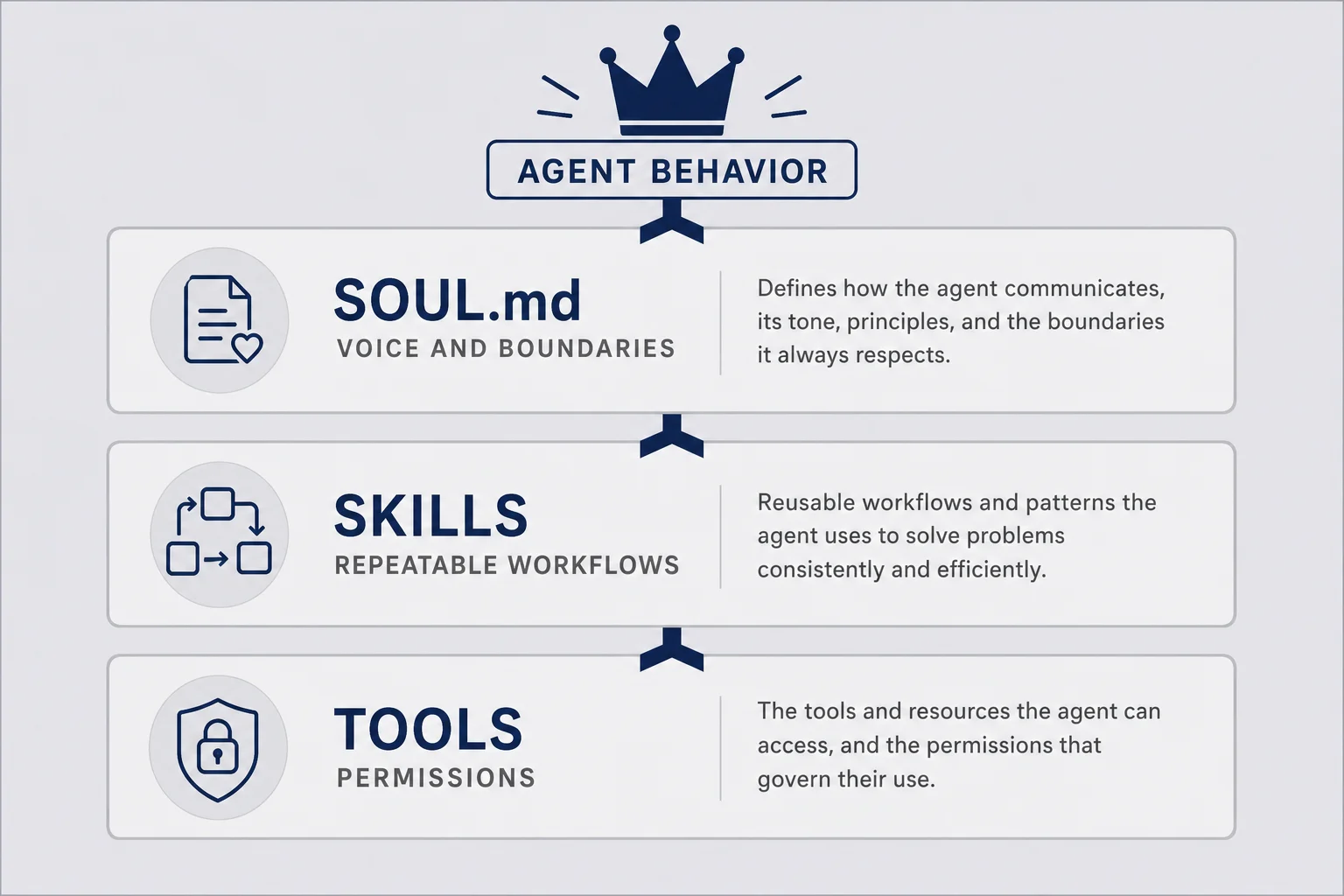
Tools tell an agent what it can do. Skills and SOUL.md tell it how you want it done. That sounds woo until you watch an agent re-invent your tone, your deploy rules, and your "never touch production billing without asking" policy for the fourth time in one week.
SOUL.md is the personality and boundaries file. I keep mine blunt. American English. No hype words. Explain errors plainly. Ask before deploy. Never add onboarding steps without explicit request. Never touch Stripe live mode. Your soul file should sound like notes you would leave for a new contractor, not like a manifesto for a TED talk.
Skills are repeatable workflows. I have one for support email theming: paste emails, ask for patterns, propose smallest copy fix, do not code yet. I have one for deploy recap: list files changed, list manual tests I must run, hold if tests not confirmed. Skills shine when context is stable and the task repeats weekly. They are ego projects when you build a skill for something you did twice and will never do again. I spent four days on one of those. The agent was patient. I was not.
Teaching the agent how you work is context engineering without the conference talk. You are building memory so Monday-you does not re-teach Friday-you's lessons. Non-coders benefit disproportionately because we cannot skim a codebase to remember decisions. We need externalized rules.
I update SOUL.md after every mistake that wasted an hour. Agent added a signup field I did not ask for? New rule in the file. Agent used a cheerful tone in error messages that made users think the app was joking about failures? New rule. This file is living, not literary.
Do not over-engineer skills on day one. Start with one chore you hate. Run it manually with the agent three times. Notice what you repeat. Then codify that. Skills are earned, not collected like Pokémon.
SOUL.md is also where I put voice rules that match how I write support email. Short sentences. No corporate warmth. Apologize once, then fix. Those sound like soft preferences until an agent writes error copy that sounds like a yoga instructor congratulating you for failing payment. Users do not want zen. They want clarity.
I keep a changelog for SOUL.md the same way engineers keep changelogs for code. Date, rule added, why. "2026-03-12: never add onboarding steps without explicit request — agent added step 4 after vague 'improve onboarding' message." That entry cost me an hour. The rule saved more than an hour.
Skills and soul files feel weird until the first week you do not re-explain your deploy rules. Then they feel like hiring someone who actually read the employee handbook. You are writing the handbook. Annoying upfront. Cheaper than every Monday being orientation day.
What I let the agent touch vs what I keep on a short leash
Permissions are the real product decision. Not which model badge is on your homepage. What can touch money, users, and production.
Short leash: Stripe live mode, auth provider settings, database schema changes that affect row visibility, DNS, deleting data, anything involving customer PII you have not mapped, deploy to production without recap approval. I learned this from almost shipping a webhook change I did not understand. Max's Stripe billing post is the technical companion. I read it like a checklist of scary parts, not like homework I will implement from memory.
Longer leash: copy changes in known files, adding UI components that follow existing patterns, running tests in staging, summarizing logs, drafting SQL or policy changes for me to review before apply, choreographed deploy scripts after I have run them manually twice.
The leash length changes with revenue and scope. At zero users, staging and production are almost the same emotionally. At fifty paying users, they are not. I renegotiate permissions when MRR crosses thresholds that would hurt if I broke checkout for a day — and I keep those thresholds written down next to the output of an MRR calculator so I am not guessing.
Agents love confidence. Confidence without comprehension is how non-coders ship regressions. My rule: if I cannot explain the change to a customer in support email tone, it does not go live. "We fixed the signup bug" is fine. "We refactored the middleware layer" is not something I say because I do not know if it is true.
I also keep a human-must-verify checklist after every agent deploy: sign up, sign in, pay, core feature, cancel or delete. Same list I use with Cursor. Agents do not replace the list. They shorten the path to needing the list.
A line I repeat
If I cannot explain where user data lives and who can see it, I am not ready to let an agent touch that part of the stack. Same rule as when I charge money without understanding the backend.
A week in my Telegram thread: real workflows, not demo magic
Demos lie by omission. They show the win screen. They skip the permission tuning, the confused recap, the "wait that was staging" moment. Here is an honest week from a product month when I had paying users and repeat chores.
Monday: Paste three support emails. Ask for themes, not fixes. Agent returns: confusion about timezone on reminders, fear that cancel is hidden, one praise line I screenshot for morale. I ask for the smallest tooltip change for timezones. Review diff. Deploy to staging. Test. Deploy.
Tuesday: Coffee shop line. Phone buzzes. Agent finished settings page from morning spec. I ask for plain recap. Hold production deploy until home.
Wednesday: No agent work. Outreach day. Agents do not replace uncomfortable email.
Thursday: Ask agent to run deploy checklist script. It fails on a test I forgot existed. Good. I would have broken prod without the script failing first.
Friday: Research chore only. Compare two competitor pricing layouts. Agent summarizes. I decide alone. Decision takes twelve minutes. Agent saved forty minutes of tab hopping.
Weekend: Off unless prod breaks. If prod breaks, agent explains error, smallest fix, retest payment path. I do not rewrite the app because I panic.
That week is not glamorous. It is also not fake. The value is cumulative boring wins, not one heroic autonomous sprint.
Real workflows look like thread hygiene. I start messages with context tags: PRODUCT=reminder-tool, ENV=staging, TASK=copy. I end with "recap what changed and what I must test." Unstructured midnight "fix it" messages produce unstructured repos. I am the manager. The agent is not.
None of that week included the agent choosing my roadmap. I chose every task before I typed. That distinction is boring and critical. Autonomy without agenda is chaos. Agenda without execution is founder guilt. Agents sit in the middle if you respect the boundary.
I also batch agent work. Mornings for specs. Afternoons for review. Evenings for humans. When I blur those, I answer Telegram during dinner and ship sloppy reviews because I was hungry and annoyed. Boundaries are not just server permissions. They are calendar permissions too.
When agents waste your time (and how I cut scope)
Agents waste time when you use them to avoid work that is actually your job. Customer interviews. Pricing conversations. Sending cold email. Deciding to kill a project. Automation is seductive because it feels like progress without rejection.
They also waste time when scope is vague, permissions are too wide, or you have not validated the product yet. Building faster in the wrong direction is still the wrong direction. I have agent-wasted whole weekends on features nobody asked for because building felt safer than hearing "no thanks."
How I cut scope: time-box agent tasks to ninety minutes of review per day max. If I am reviewing diffs all night, the chores are too big or my specs are too vague. One sentence task descriptions. Kill criteria before I start. "If this touches more than three files, stop and ask."
I cancel agent experiments the same way I cancel tool subscriptions. No named weekly chore? No skill. No recurring pain? No VPS upgrade. Demo-ware agents that promise to "run your startup" get a hard pass. I want an intern with boundaries, not a founder replacement fantasy.
Say an agent session produces a refactor you did not ask for. Revert. Update SOUL.md. Narrow tools. Do not argue with the model about whether it was a good idea. Your users do not care about the argument. They care whether signup works.
Another waste pattern: using agents before you have a repo worth maintaining. If you are still on landing-page-only validation, Bolt and Carrd are enough. Agents enter when repeat maintenance appears. That is usually after first paying users, not before.
I also watch for "agent as emotional support." You can vent to a chat window. You should not vent to a shell-enabled agent. Feelings are not tasks. I typed "I think my product is doomed" once and got a refactor suggestion. Unhelpful. Funny, but unhelpful. Keep therapy and infrastructure separate.
Finally, compare agent time to outreach time honestly. If you spent six hours tuning skills and zero hours talking to users that week, the agent is not the problem. You are avoiding the problem with better tools. I have done that. The tools were flawless.
Agent stack next to Bolt, Cursor, and v0: who does what
People ask how Hermes fits next to the tools I already pay for. They overlap at the edges. They are not duplicates if you assign roles.
Bolt and v0 are where products begin. First UI, first flows, demo shape. I use Bolt when I need app-like scaffolding with auth and dashboard in one pass. I use v0 when I need a sharp landing or component slice. They are session tools. I am present. I click. I prompt. They are bad at remembering my product three Tuesdays from now.
Cursor is the translator for repos I did not write by hand. "What does this file do?" "Smallest fix for this reproducible bug?" Cursor is my boundary tool between user behavior and code I partially understand. It is not always-on. I open it when something exists and confuses me.
Hermes is always-on chores across days. Settings pages while I am out. Deploy checklists. Support theming. Error translation. It is not where I start products. It is where I maintain them without reopening the same chat context every time.
Think of it as time horizon. v0/Bolt for hours. Cursor for focused sessions. Hermes for weeks. If you assign wrong, you will frustrate yourself. Do not ask Bolt to be your memory. Do not ask Hermes to be your first sketchpad before you have a problem worth solving.
My tools post has the spend breakdown. Agents add roughly twelve dollars VPS plus twenty-five dollars model usage in a typical month for me. Not free. Not outrageous if chores are real.
When something breaks at 2 a.m., I troubleshoot like an operator. Reproduce. Tell the agent exactly what I clicked. Smallest fix. Retest payments. I do not rewrite the whole app because panic. Panic is expensive for non-coders who cannot diff quickly.
A concrete handoff example helps. Bolt builds the first settings page UI. Cursor explains why a toggle fails on mobile Safari. Hermes adds the export button next week while I am on a call. Same repo, three tools, three time horizons. The mistake is asking Bolt to remember last week's export discussion. The win is writing the export spec once and letting Hermes execute while you do something else that only humans can do.
If you are comparing Hermes to other agent frameworks, I do not have a religious answer. I picked one, learned it deeply, and ignored most threads arguing about alternatives. Depth beats dabbling for solo founders. You are not building a platform. You are shipping a micro-SaaS. Pick a pipe that matches how you already communicate. I live on Telegram. You might live in Slack or email. Match your life, not a demo.
The $40/month reality: VPS, models, and when it pays for itself
People want a number. Say forty dollars a month for always-on agent infrastructure on top of your existing builder stack: twelve for a small VPS, twenty-five-ish for model usage through OpenRouter, Telegram free. That is illustrative, not a coupon code. Heavy weeks cost more. Quiet weeks cost less.
It pays for itself when you can name hours saved. Three hours saved at your effective rate is an easy math problem if you have revenue. Three hours saved while you have zero users is cosplay. I ran an agent before I had paying users once. It was technically interesting and commercially irrelevant.
The ai agent vs chatgpt building saas split is simple. ChatGPT Plus is twenty dollars and stays in thinking land. Agent stack is infrastructure for doing land. Different budgets, different jobs. You might need both. You might need neither if you are still validating.
Revenue is permission to add complexity. Absence of revenue is permission to subtract tabs. I do not optimize agent configs for imaginary scale. Two hundred users at nineteen dollars a month is a good problem. I will tune permissions then. Not at zero.
Always-on ai agent saas setup is also an attention trade. You pay money to buy back focus. If you spend the saved hours on more tool tinkering instead of distribution, you swapped one procrastination for another. I have done that. The agent was flawless. My outreach was not.
Track agent ROI like a boring adult. Note chore, time before, time after, whether anything broke. One line per week in a spreadsheet. If the spreadsheet is empty, you might not need the VPS yet.
Questions people ask me about agents and money
Do solo founders need an AI agent to build micro-SaaS?
No. You can ship with Bolt, v0, and Cursor alone. Agents help when you have a validated product and repeat chores that eat your week. If you have zero paying users and no landing page, an agent is procrastination dressed up as infrastructure. Validate first, then automate.
What is the difference between ChatGPT and an AI agent for building SaaS?
ChatGPT waits for you to open a tab and paste context every time. An agent runs on a server, keeps session memory, can use tools like shell commands and file edits, and can message you when work finishes. Chat is great for thinking. Agents are for doing the same chore again next Tuesday without re-explaining your whole product.
How much does an AI agent setup cost per month?
Say forty dollars all in for a small VPS, model usage through OpenRouter, and Telegram as your interface. That is on top of whatever you already pay for Bolt or Cursor. It pays for itself when it saves you three or more hours a month on chores you can name, like deploy steps or onboarding copy rewrites. It does not pay for itself if you use it to avoid customer interviews.
Is Hermes Agent safe for non-coders?
It is as safe as the permissions you give it. Hermes can run shell commands and edit files if you allow that. Start with read-only or narrow write paths. Never give an agent open production database access on day one. Test in a staging project. If you cannot summarize what changed in one plain sentence, you should not have deployed it.
Can an AI agent find product-market fit for my micro-SaaS?
No. Agents are good at execution tasks you can describe clearly. They are bad at choosing your customer, your price, and whether the idea deserves six more months. I tried asking an agent whether twelve or twenty-nine dollars was right. It agreed with whatever I said last. Use agents after validation, not instead of it.
You do not need an agent on day one
I still google things I should probably know by now. I still cannot read a production codebase the way Max can. Agents did not fix that. They removed some repeat friction so I could spend more time on the parts that actually decide whether my micro-SaaS survives: talking to users, charging money, fixing the embarrassing bugs before they become Twitter screenshots.
An ai agent micro saas solo founder setup is not a personality trait. It is infrastructure for repeat chores after validation. Chat for thinking. Bolt or v0 for first shape. Cursor for translation. Hermes, or whatever always-on tool you choose, for the Tuesday when you are tired of pasting the same context into a blank tab.
You do not need permission from a bootcamp. You need a narrow problem, an honest test, and boundaries that match how much you understand your own stack. The product does not care who wrote the code, you or your agent. It cares whether someone pays.
If you are still deciding whether anyone wants the thing, close the agent docs and open a notebook. If you have paying users and your Telegram thread is just you apologizing to a chat window for forgetting context, maybe it is time for an always-on co-builder. Start small. Lock the doors you are not using. Ship the embarrassing version. Then let the agent earn its forty dollars the same way every other tool does: by saving you from yourself on chore number six, not chore zero.




Comments