Your Paywall Price Is Not a Personality Test
How a solo iOS founder picks subscription tiers, survives Apple's cut, and models real MRR without copying B2B SaaS playbooks.
 By Iryna26 min read
Listen to this article
23:54AI-generated podcast-style overview of this article (not a word-for-word narration).
I had three price tags open in Figma on a Tuesday night and none of them felt right. $2.99 a month because I was scared strangers would think I was greedy. $4.99 because that is what a latte costs in Austin and my brain kept using coffee as a moral anchor. $9.99 because a competitor I did not want to become charged roughly that and I was pretending market research counted as a personality.
The paywall screen was pretty. Soft corners. Three reply-tone cards previewed behind frosted glass. A subscribe button I had nudged four pixels left because design instinct is sometimes just avoidance. I was not stuck on typography. I was stuck on the question every solo consumer founder hits eventually: what number makes this real without making me feel like a fraud?
If you are trying to figure out ios app subscription pricing solo founder style, you have probably already read the B2B playbooks. One plan at $49. Anchor to ROI. Skip freemium. Great advice when your buyer has a work email and a line item called software. Terrible default when your buyer is alone on a couch wondering whether an app can be trusted with a screenshot of their group chat. I am Iryna. I design consumer products, I shipped Finish Him Replies, and I am still learning what subscription pricing feels like when the product is personal. This is the guide I wanted before I treated App Store tiers like a moral test instead of a product decision.
Consumer apps live in pockets. Pricing is not separate from trust, onboarding, or what happens when someone taps Subscribe and Apple's sheet slides up. I will walk through what you are actually deciding, why Max's micro-SaaS pricing guide is useful but incomplete for your situation, how to pick weekly versus monthly versus annual without building a tier zoo, what Apple's cut does to your milestone math, and how I landed on prices for Finish Him without copying a chart I did not believe. Bring a calculator. I use the MRR calculator on this site when I want milestone targets without rebuilding a spreadsheet every Sunday.
iOS app subscription pricing solo founder: what you are actually deciding
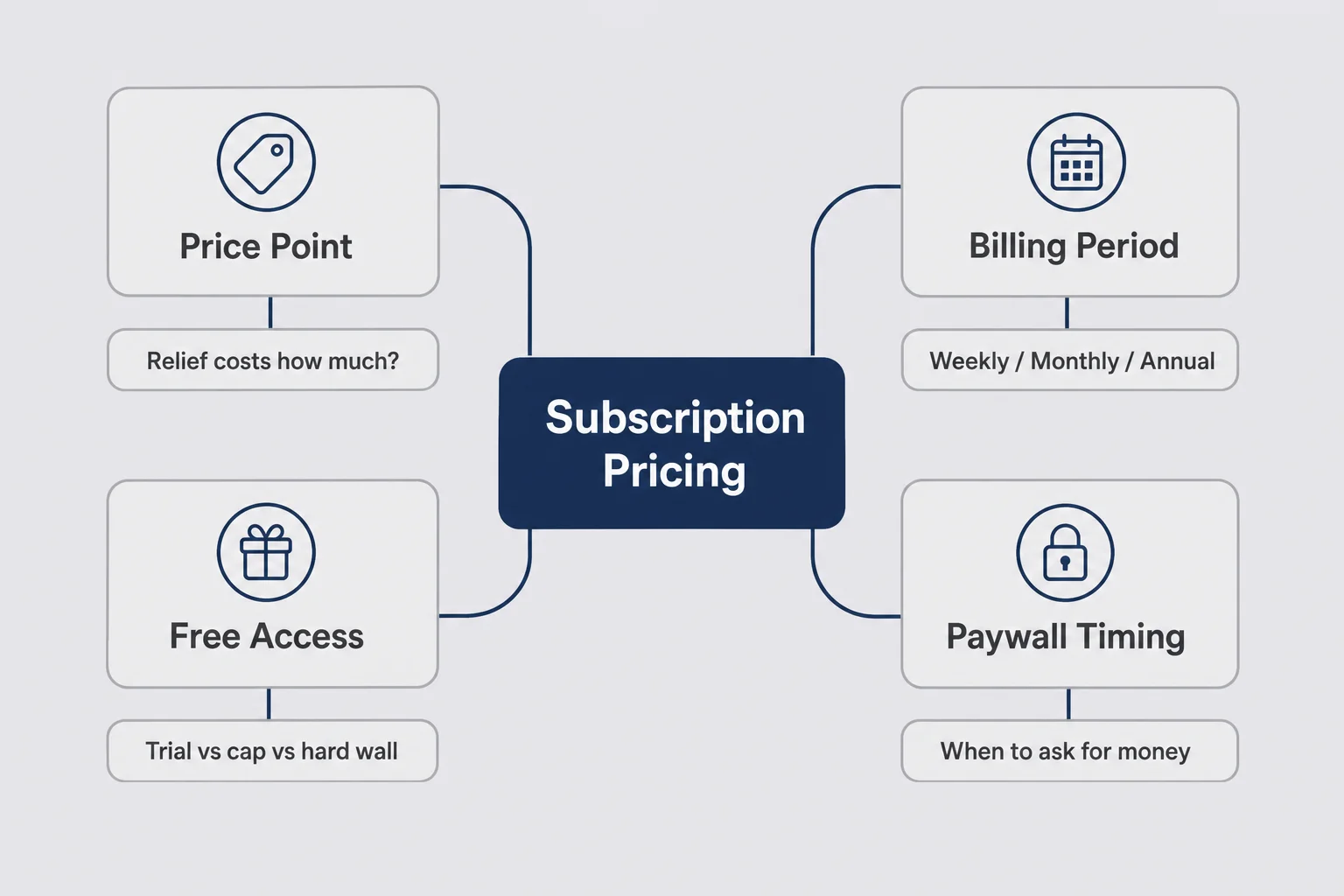
Pricing an in-app subscription is not picking a number because it sounds round. It is picking a bundle of promises at once. You are deciding how much relief costs, how often the user pays, what they get before they pay, when the paywall appears, and what happens emotionally when they miss the free limit. Miss any of those and the price on the button is almost irrelevant.
The price point is the obvious layer. It signals category. A $1.99 monthly app reads as casual utility. A $14.99 monthly app reads as serious tool or slightly delusional indie experiment, depending on the niche. Consumer buyers do not do value engineering. They ask whether the app feels fair in the moment they need it. Fair is not rational. Fair is whether paying hurts less than the problem.
Billing period is the second layer. Weekly, monthly, annual. Each one trains a different habit about your app. Weekly can feel affordable while stacking into real money fast. Annual front-loads trust before you have earned it. Monthly is the boring middle path that still tells the truth about retention every thirty days.
Free access is the third layer. Hard paywall on first open. Limited daily uses. Time-limited trial. Each option changes who reaches the subscribe button and with what level of trust. Personal apps often need proof before payment because the input is embarrassing. A dating screenshot. A budget number. A photo they would not post.
Paywall timing is the fourth layer. Day zero. After the third session. When they hit a limit. When they try to export. Timing is pricing because a paywall at the wrong second feels like an ambush, and ambushed users do not subscribe. They one-star review.
I think about these four layers as one decision because App Store Connect makes it tempting to split them. You create products in RevenueCat or StoreKit. You design the paywall in Figma. You write listing copy separately. You ship and wonder why conversion is weak when the real issue is that you asked for money before the app felt safe.
Solo founders do not have a pricing committee. You have anxiety and a competitor chart. The useful move is to write down your four answers on one page before you touch tier names. What relief am I selling? How often should a happy user pay? How much proof do they need first? When do I ask? If those answers clash, fix the clash. Do not lower price to compensate for a creepy paywall.
You are also deciding what kind of business you can run alone. Cheap pricing with high volume means more support load, more edge cases, more people who treat your app as disposable. Expensive pricing with low volume means every churn hurts and every review matters. Neither is morally better. They are different shapes of the same solo-founder constraint.
Revenue is validation for consumer apps too, even when downloads feel more flattering. Downloads spike from a TikTok or a feature placement. Subscriptions tell you whether strangers trusted you again when renewal day arrived. If you are early, read how to validate a consumer app idea before you obsess over tiers. Willingness to pay starts before Xcode. Pricing finishes the story.
I am not going to pretend there is one correct price for all consumer apps. There is a correct process for making your price intentional instead of reactive. That process starts with admitting what business you are actually in. Recurring relief. Recurring entertainment. Recurring accountability. The price follows the habit.
Consumer app subscription pricing: why B2B advice misleads you
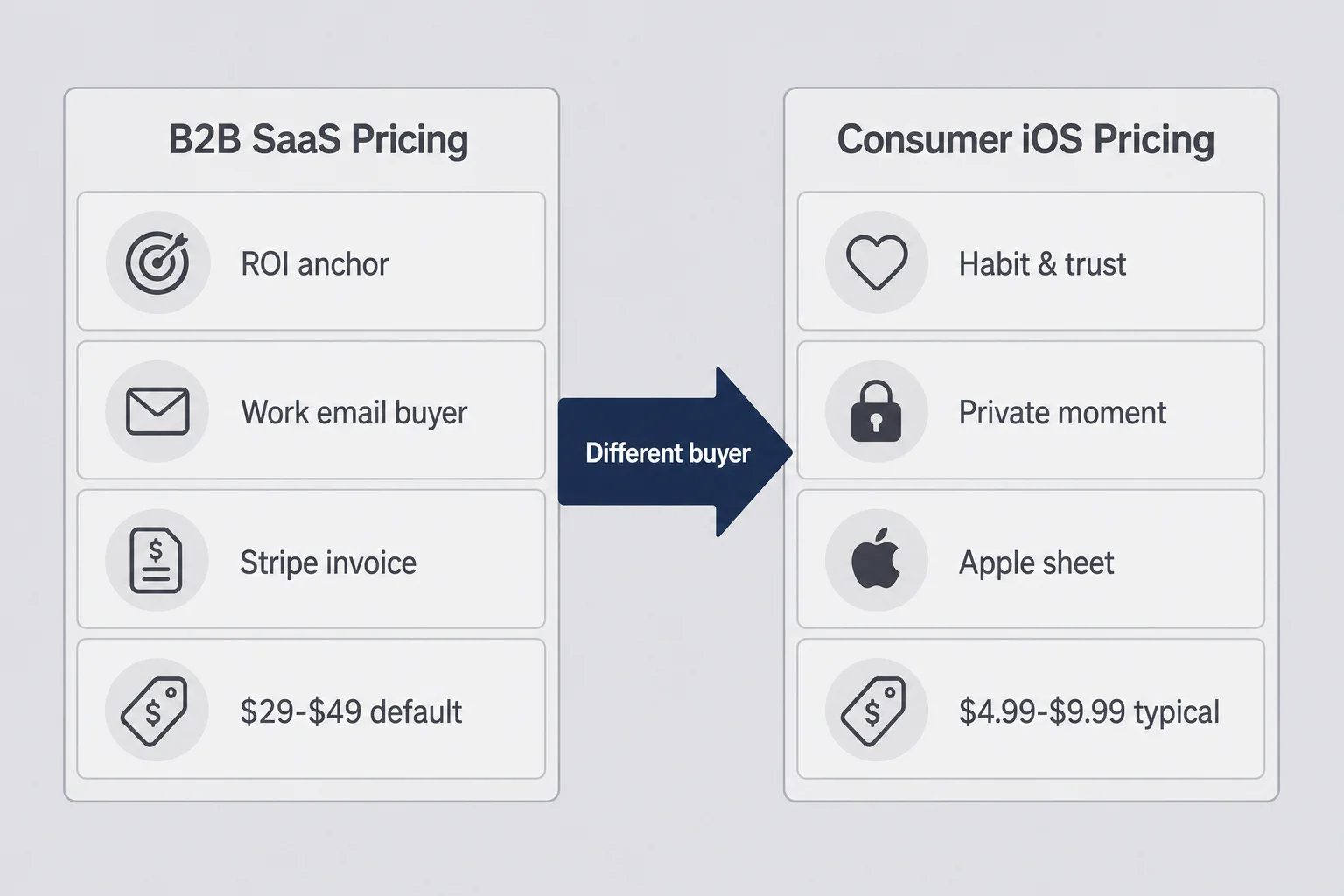
Max's micro-SaaS pricing for solo founders post is the best B2B pricing advice I have read on this site. I send people to it when their buyer has a company card. I do not follow it literally for Finish Him because my buyer is not approving a $49 monthly line item to save ten hours of spreadsheet work. My buyer is trying to send a text without spiraling. Those are different economies.
B2B pricing anchors to business outcomes. Hours saved. Revenue protected. Risk reduced. You can interview five operations managers and ask what they already pay for partial solutions. Consumer pricing anchors to habit, shame, comparison sets, and whether the app feels safe in a private moment. Try asking a stranger in a coffee shop what they would pay to feel less anxious about a reply. They will laugh. Not because the problem is fake. Because consumer willingness to pay is measured in behavior, not in interview answers.
B2B buyers expect invoices, plan names, maybe annual discounts for procurement. Consumer buyers expect Apple's sheet, one tap, and the ability to cancel before their partner notices another subscription. Friction is different. Trust is different. Churn reasons are different. A B2B user churns when the tool stops fitting workflow. A consumer user churns when the shame fades, the season ends, or the app feels predatory.
Free trial doctrine differs too. B2B solo founders often debate seven versus fourteen days and whether to require a card. Consumer apps on iOS frequently use freemium caps, introductory offers, or win-back discounts configured in App Store Connect. The platform shapes the playbook. StoreKit is not Stripe Checkout with a different font.
Support economics differ as well. A $49 B2B customer emailing about an export bug is part of the deal. A $2.99 consumer customer emailing daily because they hit a limit you poorly explained will destroy your week. Underpricing consumer apps does not just hurt MRR. It attracts the highest-emotion users for the lowest margin.
I still borrow B2B frameworks for the parts that are universal. Milestone math. One hero plan at launch. Raise prices when retention proves value. Do not copy the actual numbers. If you model $49 monthly for a personal screenshot helper, you are optimizing for a buyer who does not exist.
The comparison set is also different. B2B buyers compare you to other software. Consumer buyers compare you to other subscriptions on their phone bill next to music, storage, and whatever game their kid installed. You are competing for attention and guilt, not budget category.
Where B2B advice helps most is confidence. Solo founders underprice because asking for money feels rude. Max is right that price is alignment, not greed. Consumer founders still need that spine. We just aim it at a different number. I repeat this because I needed permission to charge more than coffee without pretending I am enterprise software.
If your app is hybrid, say a productivity tool for freelancers, you might blend lenses. Mostly consumer UX with semi-business buyer. Pick one primary buyer in your head and price for them. Flip-flopping produces paywalls that sound corporate and listings that sound like a lifestyle brand. I chose consumer-first for Finish Him because the input is a chat screenshot. That choice cascades into everything, including price.
Read Reese when you have a marketing site and cold traffic. Read Imani when you are deciding whether to build at all without code. Read Max when you need Stripe math and architecture. Read me when the product lives in someone's pocket and the first session is personal. Pricing advice is not universal. It is lane-specific.
App Store subscription tiers: weekly, monthly, or annual
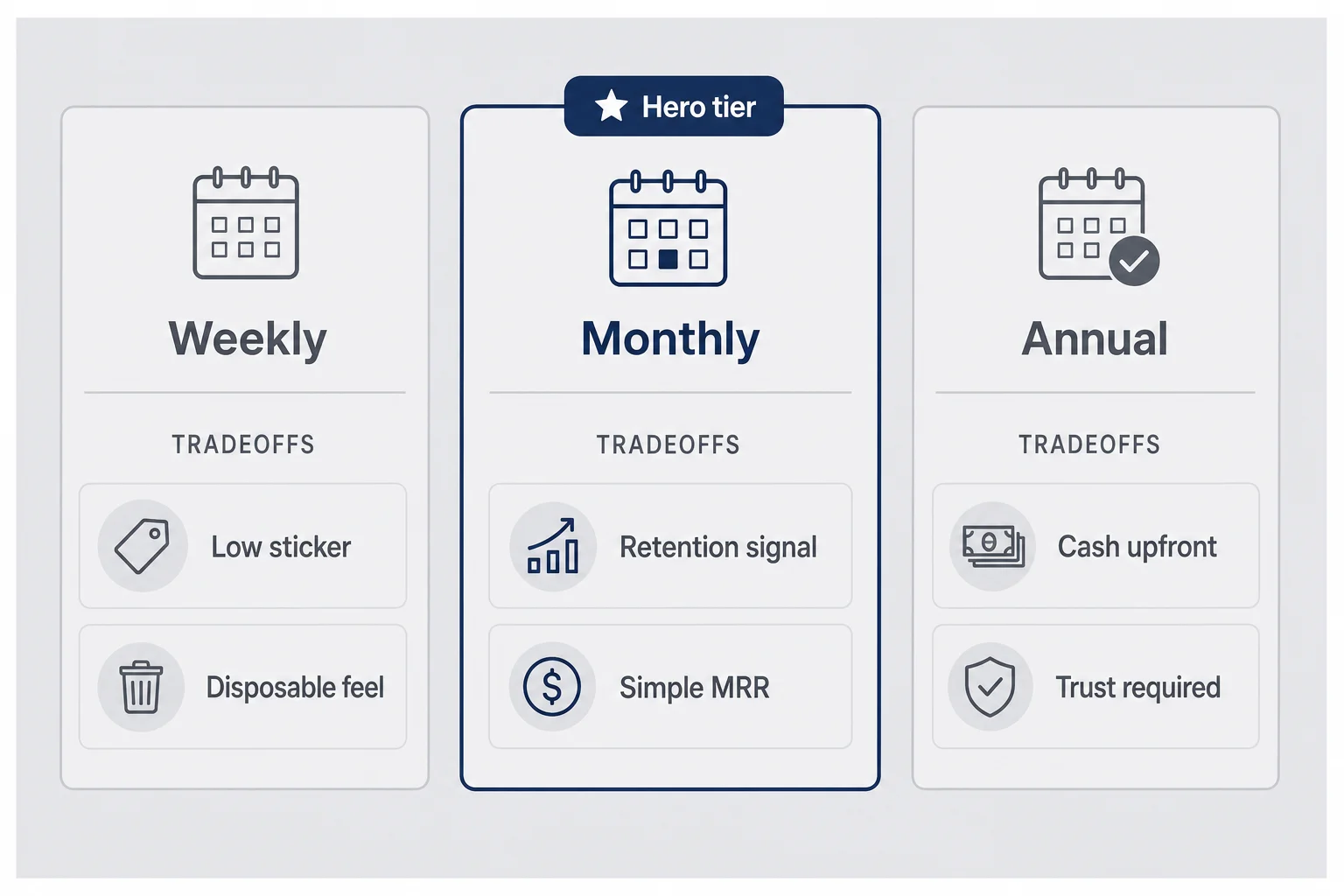
App Store subscription tiers multiply fast because Apple lets you offer multiple durations and introductory offers without asking whether you should. You should start with one hero billing period and one hero price. Complexity is not sophistication when you have zero retention data.
Weekly plans tempt solo founders because the sticker price can be lower. $1.99 a week sounds smaller than $7.99 a month even when it is not. Weekly can improve short-term cash flow when the app solves an acute recurring moment. Dating apps. Meal planning. Weekly accountability. The risk is disposable perception. Users treat weekly subs like impulse buys and cancel without the guilt they might feel on a monthly plan.
Monthly is my default for first consumer apps. It matches how most people think about subscriptions. It renews often enough to keep retention honest. It is easy to explain on a paywall. It maps cleanly to MRR math when you plug numbers into the MRR calculator. If forty people pay $4.99 a month, you are near $200 MRR before Apple's cut. That is a legible early milestone.
Annual plans are powerful later. They reduce churn noise, improve cash flow, and reward users who already know they love you. At launch they are risky because you are asking for a year of trust before you have proof. Introductory annual discounts can work when monthly retention is steady and you want to front-load revenue for API costs. Do not lead annual before monthly unless your category demands it, like education with a school-year rhythm.
I ship monthly first, then add annual when I have three months of renewal data I can stare at without flinching. I skipped weekly for Finish Him because the use case is sporadic anxiety, not a weekly ritual. A weekly plan would attract binge-and-cancel behavior that flatters revenue for a few weeks then evaporates.
StoreKit pricing solo founders actually ship is simpler than the App Store Connect UI suggests. RevenueCat and native StoreKit let you configure multiple products, but resist the urge to show five options on day one. Choice paralysis is real on a phone screen. One recommended plan highlighted, maybe a secondary annual toggle, is enough for v1. You are not Apple Music. You do not need a tier matrix.
Introductory offers are their own beast. Free trials, pay up front for X months, win-back offers. They can jump-start subscribers. They can also train people to wait for discounts. If you use a trial, decide what full access means and whether the trial starts before or after trust is established. A trial before trust feels like a credit card grab. A trial after value feels like a fair next step.
Family sharing, offer codes, and promotional pricing exist. Ignore most of them until you have a reason tied to a campaign. Founder energy is finite. Your first pricing goal is not maximal monetization complexity. It is a number that renews.
When you add a second tier, make it meaningfully different. Annual at roughly ten months price is a common pattern. Do not add a weekly tier just because you saw a chart. Add it when your retention curve shows users who would pay more frequently for a specific habit.
Naming matters more than founders admit. Monthly Pro sounds fine. Weekly Premium Ultra sounds like a scam. Consumer users are pattern matchers. Sound like a trustworthy utility, not like a slot machine.
If you are stuck between two monthly prices, pick the higher one for new subscribers and watch conversion for two weeks. You can always run an introductory offer. You cannot easily un-train people to think of your app as the cheap one.
The Apple tax and what lands in your bank account
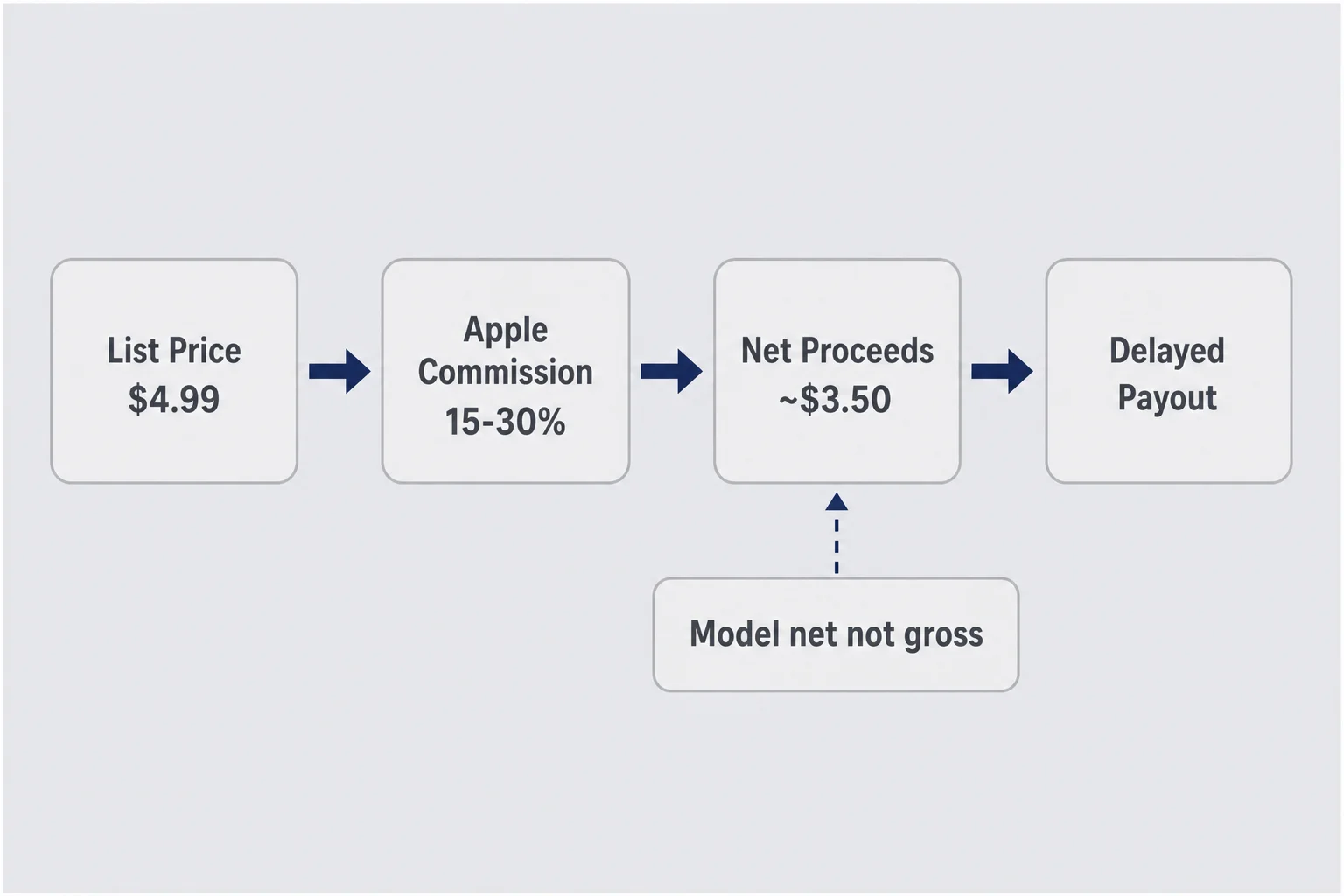
The price on your paywall is not the money in your bank account. Apple takes a cut. Depending on program eligibility and subscriber tenure, that cut is often fifteen or thirty percent. Proceeds reports in App Store Connect show net numbers, but founders still mentally budget as if the list price arrived whole.
Say you charge $4.99 a month. In year one of a subscriber's life, thirty percent might leave before you see proceeds. Your effective monthly take might land near $3.50. At forty subscribers that is roughly $140 a month net, not $200. The gap matters when you are comparing yourself to indie hackers posting MRR screenshots from Stripe dashboards — and those Stripe numbers are also gross until you run them through a Stripe fee calculator.
The Small Business Program reduces commission to fifteen percent for many indie accounts under revenue thresholds. That helps. It does not eliminate math. Annual plans prorate weirdly in your head until you normalize them to monthly equivalents. Family sharing can change units in ways that do not match simple multiplication.
Apple also pays on a delay. Sales today do not mean cash today. Plan personal runway accordingly. This is where B2B founders with weekly Stripe payouts have a different emotional experience than App Store founders refreshing proceeds reports.
Taxes and currency conversion add more fun depending on where you live and where subscribers are. I am not an accountant. I am someone who learned to model net, not gross, before calling a milestone hit.
When you set price, run scenarios in the MRR calculator with your actual expected proceeds per tier, not just list price. If your goal is $1,000 MRR using list price math while Apple and churn take their share, you will feel behind when you are actually on plan.
Introductory offers and trials affect proceeds timing too. A free trial month produces zero until conversion. A discounted first month produces less than steady state. Your MRR line is smoother than your feelings in month one.
This is not an argument against iOS. It is an argument for honest bookkeeping. Consumer founders already battle shame about money. Do not add imaginary shortfalls because you forgot Apple's share.
Some founders inflate price to compensate for commission. That can work if value supports it. It can also kill conversion in categories where users have cheap alternatives. The balance is category-specific. Finance apps can charge more. Cute utilities often cannot.
Remember refunds. Small but real. Account for them mentally so a bad week does not feel like a moral failure.
If you are comparing iOS subscription revenue to a web SaaS side project on Stripe, you are running two different games. Stripe net might be higher per dollar charged. App Store gives distribution and trust in payment handling. Tradeoffs, not winners.
Price for sustainability after platform fees, not for the number that looks best in a tweet.
How I priced Finish Him without copying a competitor chart
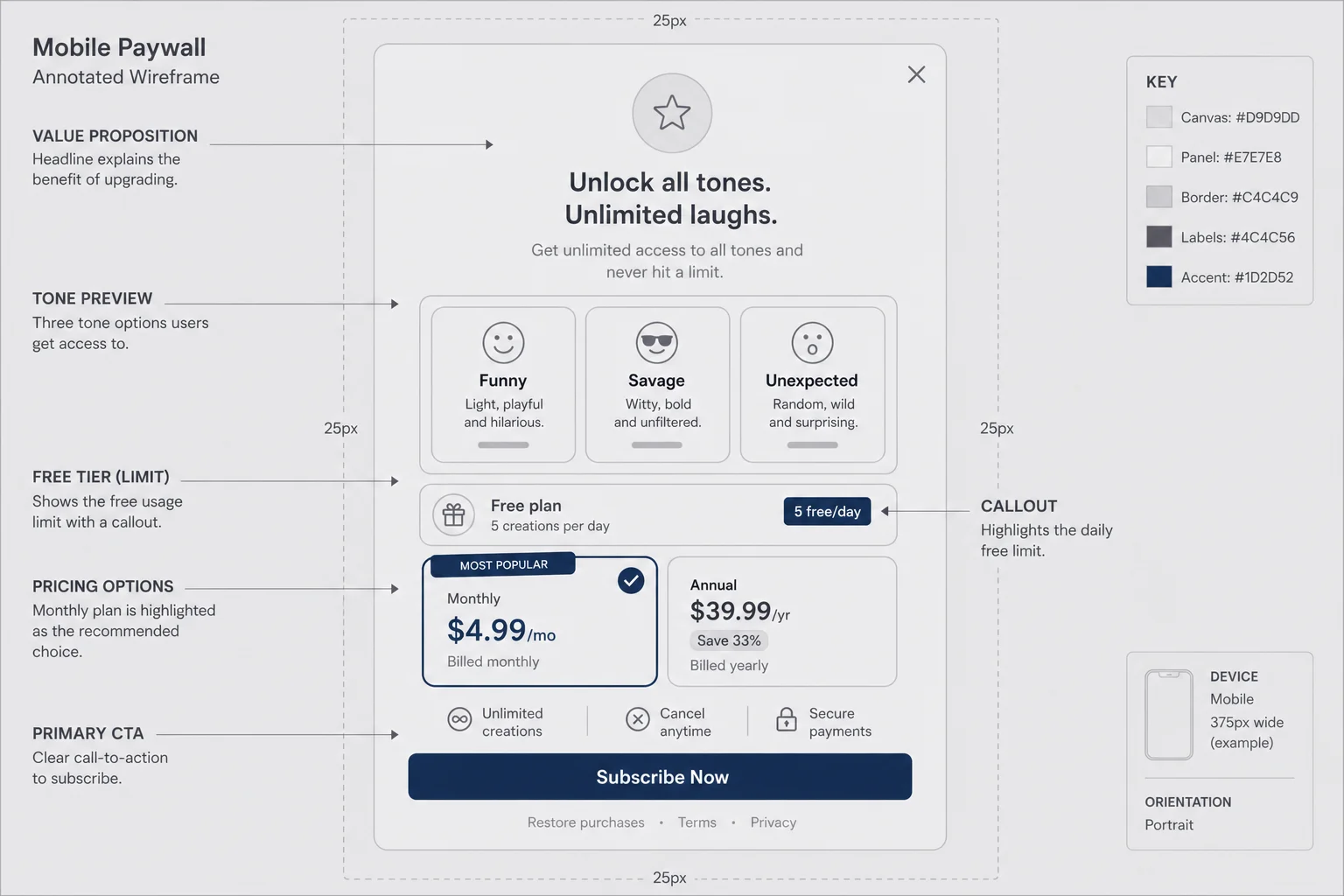
Finish Him solves a moment, not a career. You upload a screenshot of a conversation, pick a tone, get three paste-ready replies, copy one, leave. The value is immediate. The input is sensitive. The habit is irregular. Pricing had to feel low-stakes enough to try and high enough to mean something when strangers paid.
I looked at competitors because ignoring the market is its own vanity. I did not copy them because most competitors sat in a different trust posture. Some wanted account creation first. Some felt spammy. Some charged weekly in ways that made the app feel like a vending machine. Their price tags told me what survived in the store, not what I should inherit.
I started with a monthly hero tier in the $4.99 neighborhood because it is legible to consumers and because the relief per use is high. One good reply can save twenty minutes of overthinking. I am not claiming ROI math. I am claiming emotional ROI, which sounds fuzzy until you have watched someone panic about a text.
Free access uses a daily generation cap, not an unlimited trial. Five free generations per day, enough to feel the loop, not enough to never need premium. Premium raises the cap dramatically. Server-side enforcement matters because client-side limits are jokes and users notice when rules feel arbitrary.
I avoided a hard paywall on first open because trust precedes payment for screenshot apps. Asking for a card before someone believes you will not store their chat would have been a conversion killer and a moral wrong in my category. Your category might differ. Meditation apps sometimes paywall early. Utility apps with obvious value sometimes can too.
Annual tier came later in planning, not at first submit. I wanted monthly renewal truth first. Annual is attractive on paper. It also locks you into a price before you know churn.
Paywall copy focuses on what premium buys in plain language. More generations. No nagging limit mid-conversation. Not feature bullets like advanced AI pipeline v2. Consumers do not care about your pipeline. They care whether tonight's text gets easier.
I tested price in the smallest way I could before full launch. Conversations with friends who fit the awkward moment. Not formal interviews. Watching whether they flinched at $4.99 versus $2.99. Flinch is data when numbers are small.
Reviews and support messages will teach you faster than competitors' charts. If people say love it but not worth paying, your price or your paywall timing is wrong. If people pay and churn in week two, your value loop is wrong. Price is not always the bug. It is the first place anxiety concentrates.
I also priced for API cost sanity. AI inference is not free. A subscriber who generates fifty replies a day at a too-low price is a quiet loss leader. Caps protect you and set expectations.
Do not let competitor envy pick your tier. Let your embarrassing moment, your costs, your trust model, and your retention pick it.
In-app subscription pricing iOS: free tier, trial, or hard paywall
Consumer apps are permission devices. Users grant access to moments, not org charts. Free access strategy is how you earn permission before you ask for money.
Hard paywall on launch works when the value is obvious in one screen and the audience already pays for similar tools. Some fitness and utility apps can get away with it. Personal apps with sensitive inputs often cannot. A hard paywall before trust feels like you grabbed their photo album and asked for a tip.
Freemium caps are my usual recommendation for first-time consumer founders. Limited daily uses. Limited exports. Limited history. The cap should let a stranger complete the core loop once or twice, then bump gently into upgrade. Not a wall at use one unless your cost structure demands it.
Time-limited trials help when the app needs several sessions to shine. Habit trackers. Journaling. Language learning. The trial clock should start when the user understands the promise, not when they tap install.
Introductory pricing via App Store offers can boost conversion. Use it deliberately. A permanent race to the bottom teaches users to wait for deals.
Match free strategy to embarrassment level. Low embarrassment, harder paywalls can work. High embarrassment, prove safety first. Finish Him is high embarrassment. Screenshot of a dating chat is not a spreadsheet import.
Also match to cost. AI per-use costs mean unlimited free tiers can bankrupt you quietly. Caps align incentives. Users get proof. You get margin.
Watch what free users do, not just what they say. If everyone bounces at the cap without upgrading, the cap might be too tight or the upgrade value unclear. If everyone lives free forever without complaining, your free tier is too generous.
Trials with payment method upfront convert differently on iOS than on web. Apple's friction is lower than typing a card into a sketchy form, but trust is still emotional. Trial after demonstrated value usually beats trial at onboarding screen two.
Do not copy micro-SaaS free trial advice about card-upfront trials unless you have web checkout too. In-app purchases follow platform norms.
Your free strategy is pricing because it defines who arrives at the paywall and with what expectations.
Paywall copy is pricing (not a separate problem)
You can charge $4.99 and sound like a scam. You can charge $9.99 and sound fair. Words on the paywall are part of the price.
Feature lists fail on consumer paywalls. Users do not subscribe to bullet points. They subscribe to relief from a moment they are already in. Lead with the outcome. Three replies ready to paste. Sleep without rewriting the same text eleven times. Feel less stupid in the group chat.
Compare annual savings in plain language, not marketing algebra. Save two months with annual is fine. "Get 37 percent more value" as a headline is not fine.
Align paywall visuals with the app they already used. If onboarding is soft and human, a paywall that looks like a casino banner triggers distrust. Design continuity is pricing.
Button copy matters. Subscribe is generic. Continue with unlimited replies is specific. Do not lie. Do not promise what premium does not deliver.
Localization is a later problem. English clarity is today's problem.
Your App Store listing and your in-app paywall are siblings. If the listing promises one thing and the paywall sells another, conversion dies before price matters. I fix listing copy from a product lens first because the listing is the top of the funnel for strangers.
Test paywall copy before you test price. Sometimes the same price converts better with different words. Founders jump to discounts when copy was the bug.
If you are embarrassed to screenshot your own paywall for a friend, fix the paywall.
Milestone math: what $200, $1k, and $5k MRR actually require
Downloads lie kindly. MRR tells the truth slowly. Milestone math keeps consumer founders honest when install spikes feel like success.
Say you ship at $4.99 monthly with no annual mix yet. Forty paying subscribers is roughly $200 MRR at list price, less after Apple's cut. One hundred subscribers is roughly $500. Two hundred is roughly $1,000. The MRR calculator runs these scenarios in seconds if you hate spreadsheets.
At $9.99 monthly, you need about half the subscribers for the same MRR. That sounds great until you remember many consumer categories resist double-digit subscriptions unless value is obvious. Math reveals tradeoffs feelings hide.
Churn changes everything. If five percent of subscribers cancel monthly, you need new subscribers just to stay flat. Ten net new only grows MRR if churn is below that replacement rate. Model that replacement math in the churn impact calculator when you are planning growth, not just celebrating signups.
Annual subscribers smooth MRR but complicate intuition. Normalize annual to monthly equivalents when you track milestones or you will think you are richer than cash flow agrees.
$200 MRR is proof strangers paid. Not quit-your-job money. Real validation for a first app.
$1,000 MRR is the indie checkpoint where the project feels durable if costs stay sane. For solo consumer apps, costs are often API, Apple, and your time.
$5,000 MRR is serious for one person without a team. It requires retention, discovery, and a price that survives Apple's share.
I ran these scenarios obsessively before launch because consumer founders love to celebrate install spikes and ignore renewal cliffs. Plugging forty subscribers at $4.99 into the calculator took thirty seconds. Staring at the net number after Apple's cut took longer emotionally. That gap between gross and net is where a lot of first-time App Store builders give up or underprice forever. Neither helps.
These numbers are compass points, not guarantees. Your niche might top out lower and still be worth building if costs are tiny. A meditation app with loyal annual subscribers might look modest on MRR charts and still fund a quiet solo life. A viral utility might flash huge download numbers and die in six weeks. Milestone math is how you tell which story you are actually living.
When you share progress with other indie founders, use the same vocabulary they use. MRR, churn, net new subscribers. It keeps you from comparing your App Store proceeds to someone's Stripe screenshot and feeling like you failed at the wrong game.
Compare milestones using proceeds, not list price, when you are being honest with yourself.
If milestone math depresses you, that is useful. Either raise price, improve retention, or narrow the problem until the math fits solo scale.
Consumer founders avoid revenue math because revenue feels personal. Avoidance is how you keep underpricing a paywall nobody sees.
When to raise prices without feeling like a villain
Raising prices on consumer subscribers feels like betraying people who trusted you early. It is also sometimes required when API costs rise, value improves, or you simply underpriced from fear.
Raise when retention is stable enough that you are not fixing churn with discounts. Raise when new users convert without constant couponing. Raise when support messages sound like fans, not hostage negotiators.
Grandfather existing subscribers when possible. Apple provides mechanisms depending on product setup. Loyal early users are word-of-mouth in consumer apps. Burning them for an extra dollar is expensive.
Communicate inside the app with plain language. We added better models and faster replies. Premium supports higher daily limits. Not we deserve more money because servers.
Test higher prices on new subscribers first. Watch conversion for two weeks. Roll back if it collapses. Keep if it holds.
Do not raise price and remove features the same week unless you enjoy review bombs.
If you raised once and churn spiked only among recent subscribers, your value loop might not support the price yet. That is product signal, not moral failure.
Max's post on raising B2B prices applies emotionally even when mechanics differ. Confidence and transparency transfer. Stripe proration does not.
Consumer price increases will never feel clean. They can still be right.
What App Store Connect will not tell you about pricing
App Store Connect shows proceeds, units, retention, churn if you dig. It does not tell you whether your price is wrong. It shows symptoms.
It will not tell you that your paywall arrived one session too early. It will show low conversion.
It will not tell you that $2.99 attracts binge cancellers. It will show short subscriber lifetimes.
It will not tell you that your free cap is too generous. It will show many free users and few upgrades.
You still need qualitative signal. Reviews. Support emails. Watching a friend use the app and hit the paywall.
Connect also will not compare you to Stripe net on a web product. Different animal.
Use Connect for trends, not for self-esteem. Up and to the right with terrible unit economics is still terrible.
Pair dashboard data with the MRR calculator so you speak the same language as the rest of the indie ecosystem when you read posts or share progress.
If you only check Connect when proceeds dip, you will make reactive pricing decisions. Pick a weekly fifteen-minute review. Same day. Same three numbers. MRR estimate, churn direction, net new subscribers.
Build habits around numbers without becoming a dashboard tourist.
Questions I get about subscription pricing
How much should I charge for an iOS app subscription?
Start with one monthly tier between $4.99 and $9.99 if your app solves a personal problem people use weekly. That range is high enough to feel real to you and low enough that a stranger can approve it without a budget meeting. Consumer buyers compare your price to coffee and other apps, not to ROI spreadsheets. Pick a number you can defend in one sentence about the relief your app delivers, then model how many subscribers you need with an MRR calculator before you add more tiers.
Should I offer weekly, monthly, or annual subscriptions?
Pick one hero billing period at launch, usually monthly, and add annual only after monthly renewals prove the app sticks. Weekly plans can boost short-term cash but train users to treat your app as disposable. Annual plans improve cash flow and reduce churn noise but make early pricing mistakes expensive to unwind. I ship monthly first because it matches how I think about consumer trust: low commitment, easy to cancel, honest signal about retention.
How does Apple's cut affect my subscription pricing?
Apple keeps fifteen percent on subscriptions after a subscriber's first year in the Small Business Program, and thirty percent in year one for most indie accounts. Your listed price is what the user pays; your proceeds are lower. A $4.99 monthly plan might land closer to $3.50 per month in your pocket early on. Price for net proceeds, not for the number on the paywall. The gap matters when you are modeling $1,000 MRR goals.
Free trial or hard paywall for a consumer iOS app?
Use a generous free tier or limited daily uses when trust is the bottleneck, which is most personal apps. Hard paywalls work when the value is obvious in thirty seconds and the audience already pays for similar tools. Trials help when the app needs two or three sessions before the aha moment. I chose daily free generations with a clear upgrade cap because asking for a card before someone trusts me with a screenshot felt wrong for my category.
When should I raise my App Store subscription price?
Raise when retention is stable, support complaints about value are rare, and new subscribers keep arriving without heavy discounting. Grandfather existing subscribers when Apple allows it, or accept that some will churn at the new price. Test increases on new users first. Consumer apps feel personal, so communicate the change inside the app with plain language about what improved, not about your rising API costs.
Can I use the same pricing advice as B2B micro-SaaS?
Only partly. B2B founders price against business outcomes and expense categories. Consumer founders price against habit, shame, and what feels fair in a private moment on a phone. Read B2B pricing guides for milestone math and confidence, but do not copy $29 or $49 monthly defaults unless your buyer is actually a business. For personal apps, willingness to pay shows up in reviews, renewals, and whether people share the app with friends, not in procurement emails.
Your price is a promise, not a spreadsheet cell
I still overthink prices. I still compare my paywall to apps with venture budgets and teams I do not have. The difference between my first draft and now is that I treat price as part of the product promise, not as a confession of worth.
Your subscription price tells a stranger what kind of app you think you are. Cheap utility. Serious tool. Temporary toy. The number is not your identity. It is a hypothesis you test with renewals.
Ship one hero tier. Model net proceeds. Earn trust before you grab a card. Write paywall copy like a human. Raise price when retention proves you were timid, not when anxiety spikes on a slow Tuesday.
If you are earlier in the journey, go read how to build your first consumer iOS app and get something into TestFlight. Pricing matters. A paywall nobody reaches does not.
Finish Him taught me that strangers will pay for relief in a private moment if the app feels safe and the loop works fast. They will not pay because your Figma file was beautiful. They will pay because the problem hurt enough and the price felt fair enough when Apple's sheet appeared.
Pick a number you can defend out loud to one friend. Run the milestone math. Ship. Adjust when the data argues, not when fear whispers.
Your first app does not need perfect pricing. It needs honest pricing you can learn from. That is enough to start.




Comments