Product Hunt Won't Save a Broken Funnel
A Product Hunt playbook for micro-SaaS solo founders: two weeks of prep, launch day without panic, and how to turn upvotes into signups instead of a vanity spike.
 By Max26 min read
Listen to this article
24:00AI-generated podcast-style overview of this article (not a word-for-word narration).
I refreshed Product Hunt like it owed me rent.
It was a Tuesday in October. I had scheduled the launch, lined up a thumbnail I hated slightly less than the previous three versions, and told myself this was the day strangers would finally discover the tool I'd been polishing in private. By 10 a.m. Pacific I was sitting at a respectable middle-of-the-pack rank, answering comments with the manic cheerfulness of someone who knows the algorithm is watching. By evening the spike was gone. Stripe had moved. Barely. The badge looked nicer than the revenue.
That was not a failed launch. It was an expensive education in what Product Hunt actually sells.
If you're a product hunt micro-saas solo founder staring at an upcoming page and a half-finished gallery, you probably want a ranking. Confetti. A #3 of the day screenshot for LinkedIn. What you'll get, if you do this well, is a short burst of curious traffic, a strong backlink, a few sharp comments that make the product better, and maybe a handful of people who stick. What you will not get is a business model delivered by upvote.
This sits next to how I think about launching a micro-SaaS in general. Warm list first. One community done properly. Public platforms without betting the farm. Product Hunt is the public layer. Useful when your buyers hang out there. Dangerous when you treat it like a lottery ticket after skipping validation and a real landing page.
I used to think the hard part was the thumbnail. Then I launched a tool that worked fine for me and fell apart for anyone who did not already understand the mental model. The comments were polite. The bounce rate was not. That day taught me more about first-run design than a month of polishing alone in my editor. Public platforms punish private assumptions.
Some scenes below are composites. The pattern is not.
Product Hunt micro-SaaS solo founder: what a PH day is actually worth
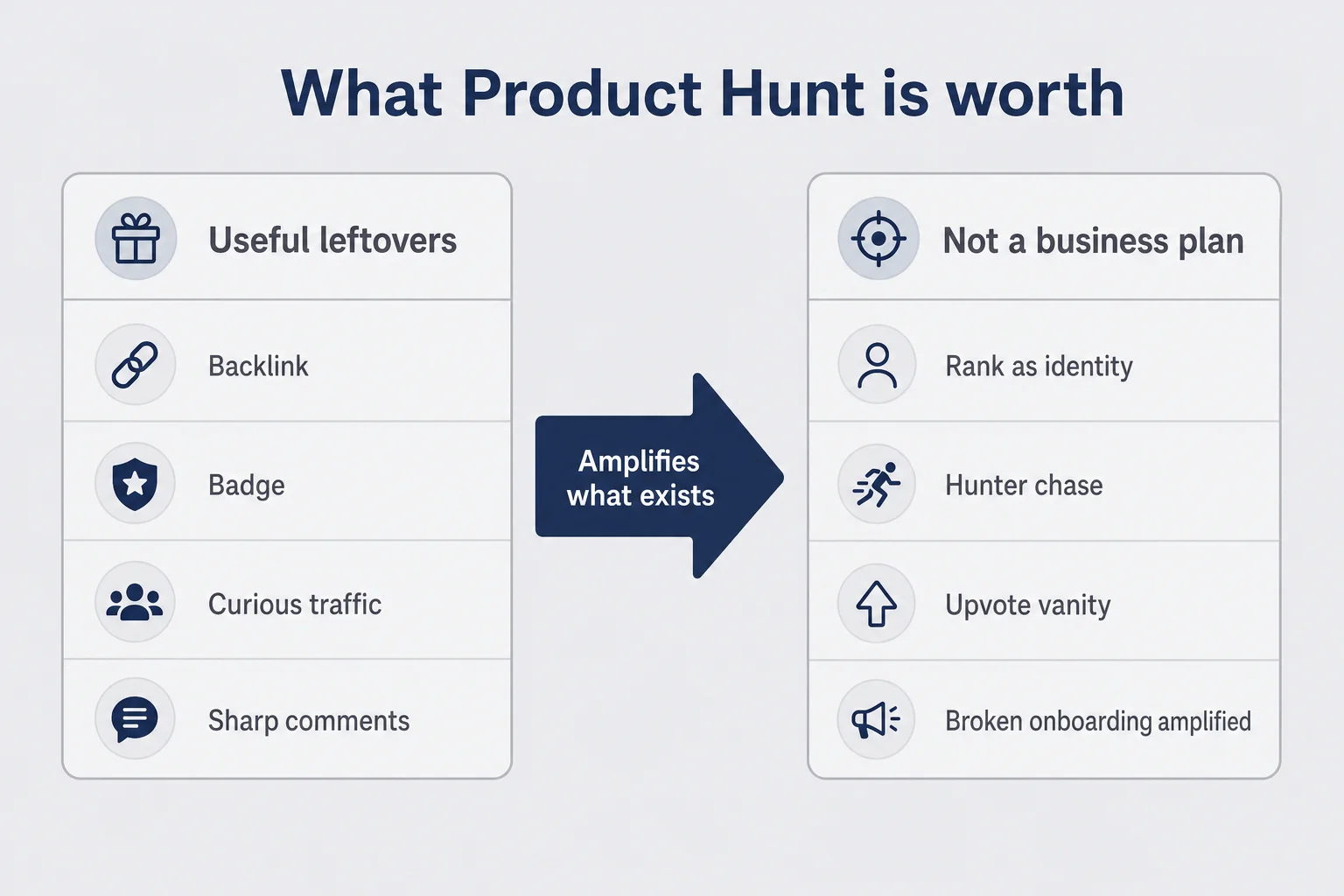
Product Hunt still moves the needle for certain products. Developers, designers, productivity tools, indie developer utilities, and anything a tech-curious early adopter would casually try on a lunch break. If that is your buyer, the platform is one of the highest-ROI free distribution days you can buy with prep time instead of ad spend.
What it is worth, concretely:
A Domain Rating that SEO people care about, because a Product Hunt link still carries weight. A badge you can put on your homepage that says "someone else thought this was interesting." A few hundred to a few thousand visitors on a decent day, most of them tire-kickers, some of them useful. Comments that tell you which sentence on your listing is confusing. Occasional press pings if you finish near the top.
What it is not worth:
Treating #1 as a business plan. Spending three weeks hunting famous hunters while your onboarding still drops people at the password screen. Measuring success by upvotes when your real metric is whether a stranger can sign up, understand the offer, and hit value without you DMing them a Loom.
I run a simple test before I schedule anything. If my product died tomorrow and the only proof it existed was a Product Hunt ranking, would I still have customers? If the answer is no, I am not ready for a public splash. I am ready for warm emails and fixing the funnel.
A product hunt launch checklist that starts with "get more upvotes" is already pointing the wrong way. Start with: Does checkout work? Does the first session produce a win? Can I explain the product in one sentence a stranger would repeat? Do I have twenty humans who will show up with real comments, not bots? Ranking amplifies whatever is already true. Broken onboarding plus a spike equals a louder complaint inbox.
I've watched founders celebrate a top-five finish and then wonder why Stripe stayed quiet. The audience browsed. The landing page explained features. The trial required a credit card and five setup steps before anything useful happened. Product Hunt did its job. The product did not.
Say you get 2,000 visitors on a decent day. A 2% signup rate is forty accounts. If half of those never finish onboarding, you have twenty people who saw the empty state and left. If two of the remaining twenty pay at $29 a month, you made $58 MRR from a day that felt like a stadium. That math is not failure. It is the realistic ceiling for a cold browse audience unless your product is unusually sticky on first use. Plan for that ceiling and anything above it is a gift.
I also care about the non-revenue leftovers. A comment that says "I almost signed up until I saw you need Slack admin rights" is worth more than twenty silent upvotes. That sentence tells you to change the listing, the landing page, or the product. Product Hunt compresses feedback into a few hours. Use the compression.
So when I say Product Hunt is worth it for a micro-SaaS solo founder, I mean it is worth it as a controlled experiment with a conversion system attached. Not as identity. Not as the week you finally "make it." One Tuesday with homework before and after.
When Product Hunt helps (and when it's a vanity trap)
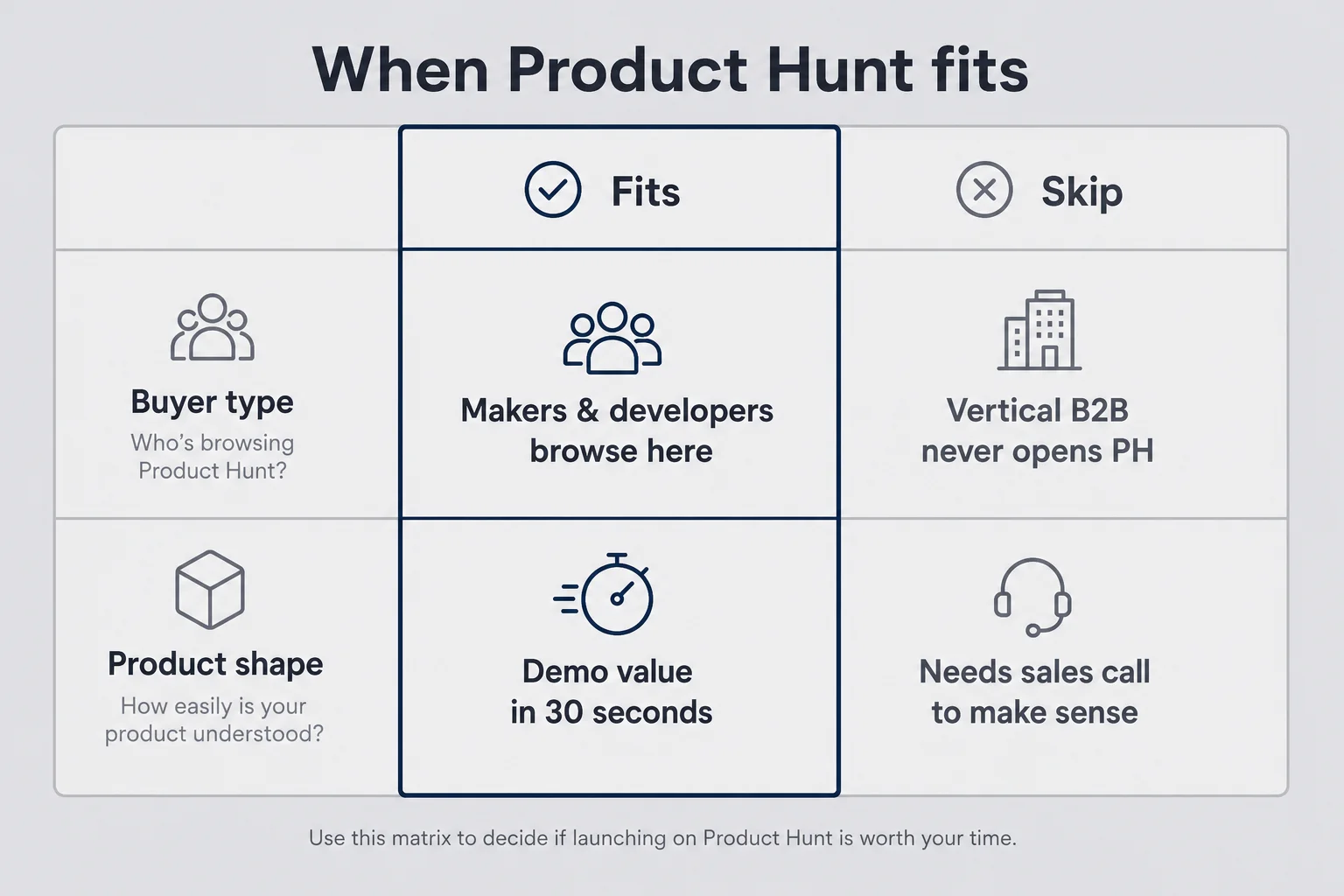
Product Hunt is a browse culture. People open it the way they open a magazine rack. They upvote interesting packaging. They try demos that feel playful. They bounce when the first screen asks for a calendar invite and a sales call.
That culture matches some micro-SaaS products perfectly and others not at all.
Developer and design tools fit better than boring B2B
If your tool is something a developer would install on a Saturday afternoon, or a designer would screenshot into a Slack channel, Product Hunt is home turf. Same for founder utilities, AI toys that do one job clearly, and anything with a visual "aha" in under thirty seconds.
If your product is a vertical workflow for dental offices, logistics coordinators, or compliance teams who have never opened Product Hunt in their lives, you are performing for the wrong room. You might still get curiosity traffic. You will not get your buyers. I've seen people force a PH launch because "that's what indie hackers do," then spend the next month explaining why none of the signups matched the ICP they validated in interviews.
The vanity trap is subtle. Upvotes feel like demand. Comments feel like traction. A badge feels like proof. None of those are revenue. Revenue is someone paying after they got value. If you need a reminder of that distinction, read your own Stripe dashboard, not your Product Hunt rank.
If your buyers never browse Product Hunt, skip it
Skip does not mean forever. Skip means "not this quarter." Spend the same prep energy on the community where your buyers already complain about the problem. One good thread in the right niche forum beats a mediocre Product Hunt day aimed at tourists.
When Product Hunt helps:
Your ICP overlaps with makers, developers, designers, or tech-forward operators. You can demo value without a twenty-minute setup. You have a free trial or a free tier that matches browser intent. Your landing page can convert cold traffic in eight seconds of attention. You already did a warm launch to people who know the problem.
When it becomes a vanity trap:
You are launching because you are lonely and want applause. Your product still needs a guided onboarding call to make sense. Your buyers are offline or in industry Slack groups Product Hunt users do not join. You have no plan for the seventy-two hours after the spike. You are measuring the day by rank instead of by activated trials.
There is a middle case I see a lot. The product could work on Product Hunt, but the founder is still mid-pivot. Tagline changes every other day. ICP is "anyone who hates spreadsheets." Listing copy argues with the landing page. In that state, a public launch does not clarify anything. It freezes a confused pitch in front of thousands of people and turns the confusion into screenshots. Wait one more week. Talk to five more buyers. Rewrite the one sentence. Then schedule.
I am not anti-Product Hunt. I am anti-self-deception. The platform is a tool. Tools are useful when the job matches. If your job is "get my first ten customers from people who already said they care," start with email, not with a public leaderboard.
The two weeks before you go live
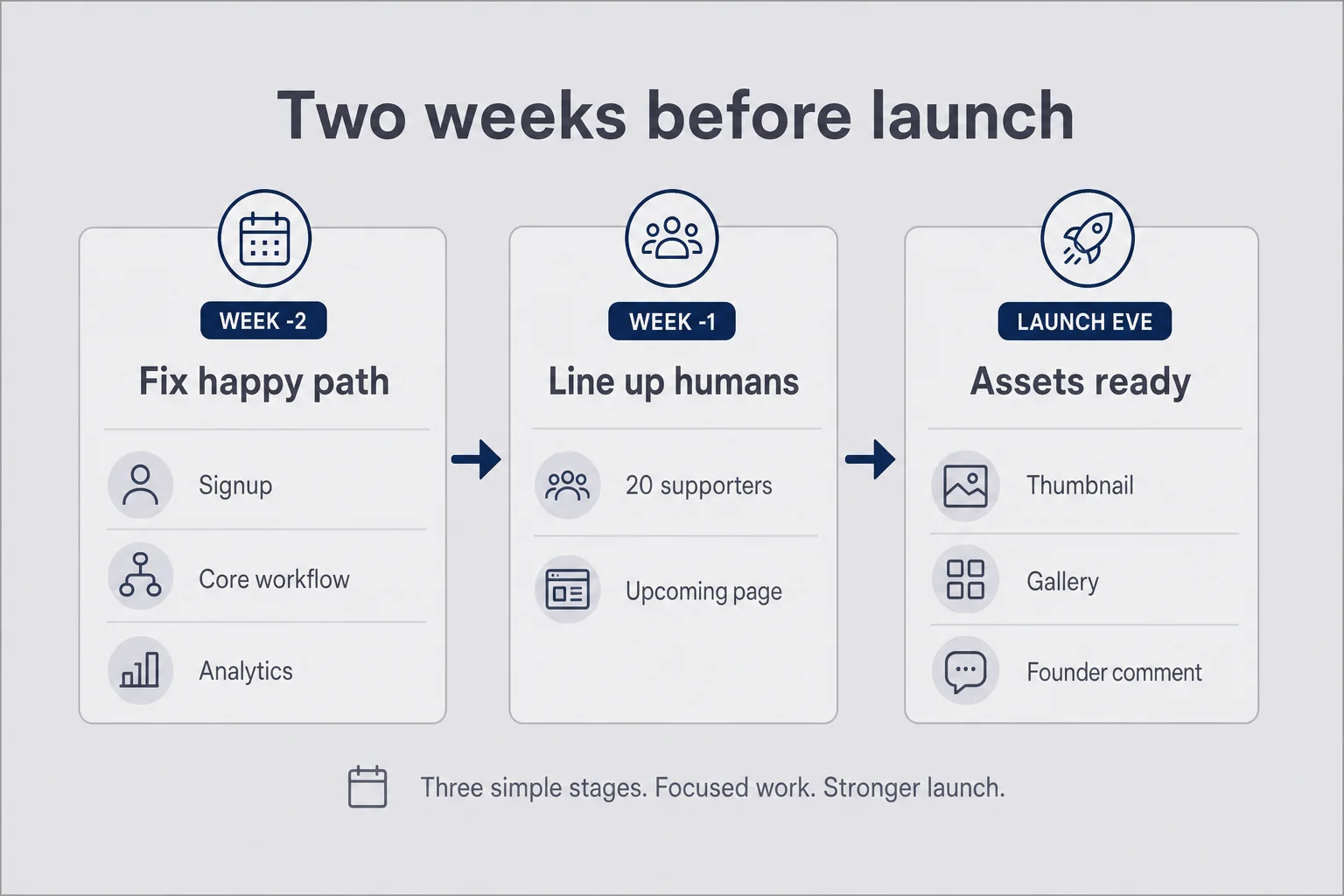
Most of the launch is decided before midnight Pacific.
I treat the two weeks before as a product hunt launch checklist that has almost nothing to do with hunting. It has everything to do with not embarrassing yourself in front of strangers and not wasting the one free traffic spike you might get this quarter.
Fix the happy path, not the roadmap
In the first week, I stop building features. I run the signup flow in an incognito window on my phone. I create an account the way a tired person would, not the way I know the product works. I watch where I hesitate. That hesitation is where Product Hunt traffic dies.
Minimum bar before I schedule:
Auth works. Billing works if you charge during trial. The core workflow completes without a support email. Empty states do not look abandoned. The landing page headline matches the Product Hunt tagline so people do not feel bait-and-switched. Analytics can tell me where they drop, even if the stack is just a simple event table.
I do not need every edge case handled. I need the path from "clicked from Product Hunt" to "got the job done once" to survive contact with reality. If that path is fragile, fix it. Public launch amplifies fragility.
A practical drill I run with friends: send them the upcoming page link and ask what they think the product does before they click through. If three people give three different answers, the tagline is not done. Fix language before you fix gradients.
Also load-test the boring stuff. Password reset. Magic link email. Stripe test mode flipped to live with the right price. Favicon that is not the Next.js default. These are not glamorous, and hunters notice them in the first five minutes when they decide whether you seem serious.
Line up twenty real humans, not a Discord blast
Week two is people.
You want roughly twenty to fifty humans with real Product Hunt accounts who will upvote and leave a genuine comment in the first hour or two. Not a Discord @everyone with "please upvote my thing." That pattern gets products ignored, and worse, it trains you to think distribution is begging.
Where those people come from:
Beta users who already tried the product. Interview contacts from validation. Friends who actually use tools like yours, not friends who feel socially obligated. Indie Hackers acquaintances who have traded feedback with you before. People who subscribed to your upcoming page because the promise matched a problem they have.
I message them personally a few days out. Short. Specific. "Launching Tuesday. If the product helped you, a comment about what you used it for means more than a silent upvote." I do not send a script that sounds like a campaign. I also do not ask strangers in random Slack channels to fake enthusiasm. Fake enthusiasm reads as fake. Product Hunt users can smell it.
Timing the ask matters. Message people too early and they forget. Message them at 11:50 p.m. Pacific and you are asking tired friends to perform on command. Two or three days out with a calendar reminder for yourself is enough. One gentle ping on launch morning for people who offered help. No guilt trips if someone is busy. Busy people who care will still show up when they can.
If you cannot find twenty people who have touched the product or care about the problem, you are not under-networked. You are under-validated. Go back to warm outreach. Product Hunt will not invent an audience you never built.
Also schedule the upcoming page early enough that you can collect "notify me" followers. Drive a bit of warm traffic there from your list and social posts. A hundred people waiting is nicer than launching into a void, but twenty engaged supporters still beat two hundred passive notify-mes.
I keep a plain text checklist on my desk the week before. Not a Notion temple. A page. Incognito signup on phone must pass. Core workflow once without help must pass. Tagline must match the landing headline. Analytics on signup and first key action must be live. Twenty supporters named with Product Hunt usernames must be listed. Founder comment drafted. Gallery captions written. Warm email draft ready to send. Sleep plan for the night before, even if I break it.
If signup or the core workflow still fails, I slip the date. Slipping feels like weakness when you have already told people a Tuesday. Shipping a broken happy path on that Tuesday feels worse for longer.
Self-hunt or find a hunter
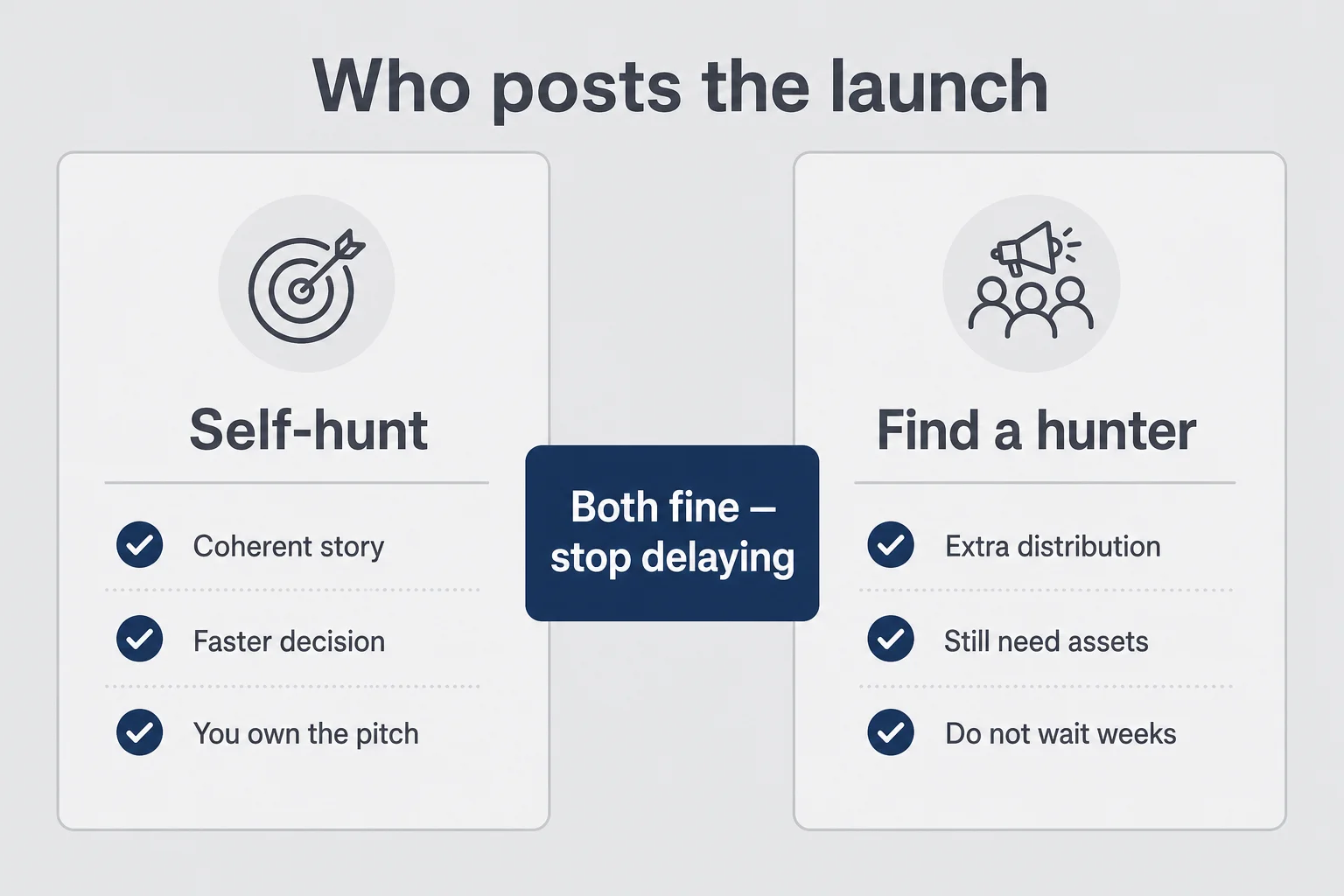
This question eats more calendar time than it deserves.
Self-hunt is fine. For a long stretch, Product Hunt messaging has treated hunting as less magical than the lore suggests. Plenty of strong launches are self-hunted. If you are a solo founder, self-hunting keeps the story coherent: the person who built it is the person posting it.
A hunter can still help in narrow cases. Someone with an active following may surface your launch to people who already trust their taste. That is distribution, not alchemy. It does not fix a confusing tagline. It does not convert traffic if your trial is a maze.
What I tell people who are stuck hunting for a famous hunter for three weeks: stop. Ship the listing. Line up your twenty humans. Self-hunt. Spend the reclaimed hours on the gallery and the first comment. Those assets matter more than a hunter's avatar next to your name.
If a hunter you already know offers to post it, great. Accept. Do not build a weeks-long side quest around collecting hunter status like baseball cards. That is procrastination dressed as strategy.
One more practical note. Make sure your Product Hunt profile looks like a person who ships things. A barren account that only appears on launch day looks odd. Comment on other products for a couple weeks beforehand. Be useful. It is not a ranking hack. It is basic membership in the room you are about to ask for attention.
If you do work with a hunter, write the assets yourself. Do not outsource the tagline to someone who has never used the product. Hunters amplify. They should not invent the pitch. Send them the final gallery, the first comment draft, and the exact link you want tracked. Misaligned assets on launch morning are a special kind of panic.
Your listing assets: thumbnail, gallery, first comment
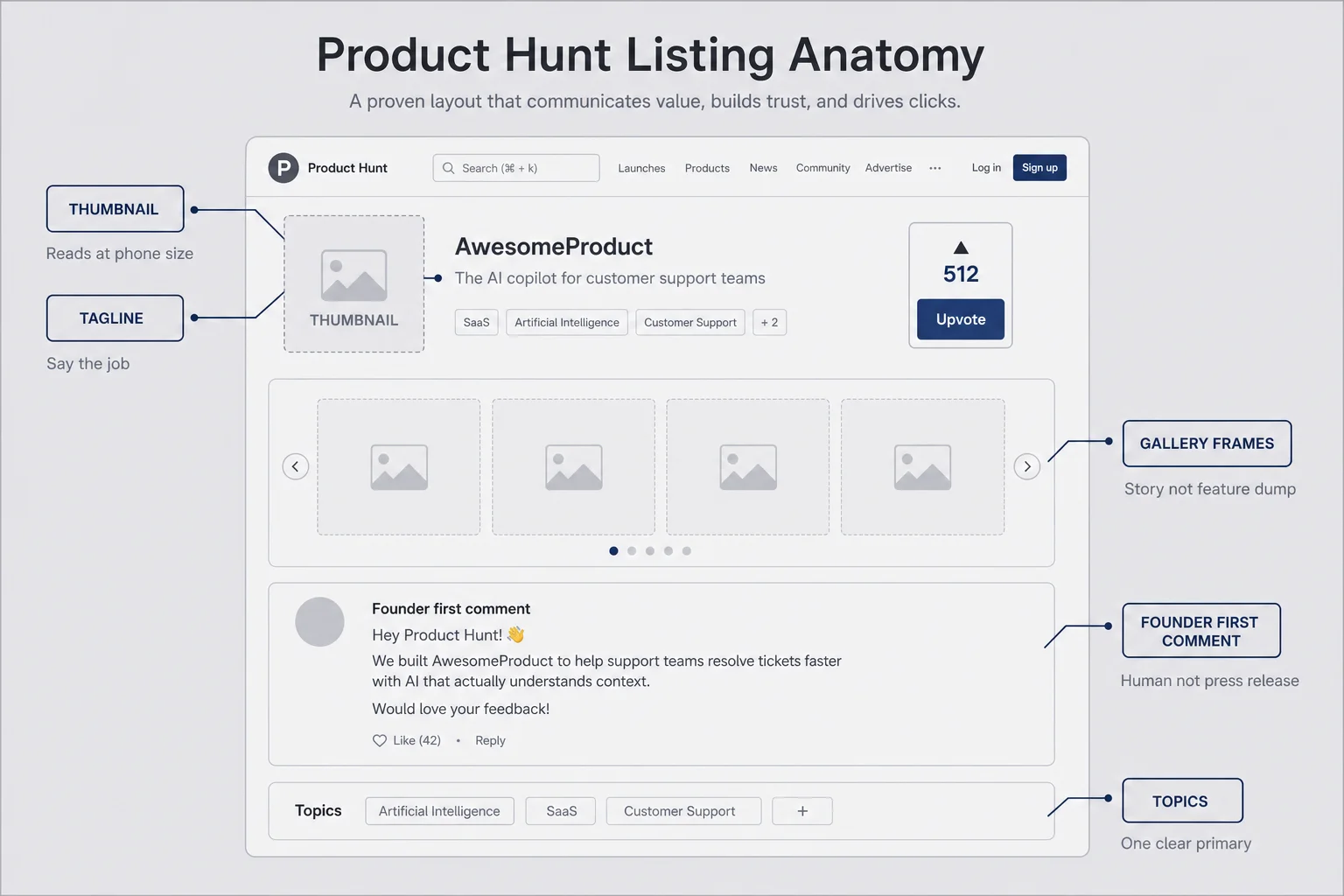
Your listing is a landing page with worse constraints and a louder audience. Treat it that way.
Thumbnail that reads at phone size
Most people will see your thumbnail the size of a postage stamp on a phone. If the point of the product is not obvious at that size, redesign it.
I avoid tiny text, busy screenshots, and logos that only make sense if you already know the brand. A simple visual metaphor or a clean UI crop with one obvious action beats a collage. Test it by squinting at your phone from arm's length. If you cannot tell what category of tool it is, neither can a scroller.
Gallery frames that tell a story
Gallery images are not a feature dump. They are a short comic strip.
Frame one: the problem in one sentence and a visual of the pain. Frame two: the product solving it in one screen. Frame three: the outcome or the "after." Frame four and five: proof, pricing clarity, or a specific workflow detail that removes doubt.
I write the captions like headlines, not like alt text nobody reads. Each frame should stand alone. Assume half your visitors will only look at two of them.
Demo video, if you include one, should be short. Twenty to forty seconds. Show the magic moment, not a tour of settings. Product Hunt viewers are impatient in a productive way. Respect that.
I record demos twice. First take is usually me narrating like a conference talk. Second take is silent or near-silent with on-screen captions, because half the audience will watch with the sound off on a commute. Pick the version that still makes sense muted.
The founder comment you write the night before
The first comment is your chance to sound like a human instead of a press release.
I draft it the night before. Origin in two or three sentences. Who it is for. What it deliberately does not do. One honest limitation. A question that invites useful feedback, not empty praise. "Would love upvotes" is not a question. "If you tried the export flow, where did it feel slow?" is a question.
On launch day I post that comment early and then I live in the replies. The founders who rank and convert are usually the ones who treat comments like a support shift, not like a trophy case.
Tagline and description get the same honesty pass. No "revolutionary OS for modern teams." Say the job. "Turns messy client feedback into a single prioritized list for freelancers." Specific beats poetic when strangers are deciding in one second whether to care.
I rewrite taglines out loud. If I cannot say it to a friend without sounding like a brochure, it is not ready. Friends are a better filter than thesaurus tools. Also check length. Long taglines get truncated in places you will not notice until launch morning when it is too late to feel clever.
Topics and categories matter less than founders think, but pick ones that match how hunters browse. Do not stuff every adjacent topic hoping for reach. One clear primary topic beats five weak ones.
Launch day without losing your mind
Launch day is an operations problem wearing a party hat.
Midnight Pacific and the first hour
Product Hunt's day runs on Pacific Time. Launching right after midnight PT gives you a full day on the board. Use the scheduler when you can so you are not fighting the submit form at 12:01 while half asleep.
The first hour matters. Early genuine engagement helps momentum. That is why the twenty humans exist. They should already know roughly when you go live. They should not need a frantic group chat at 12:07.
My first-hour checklist is boring on purpose:
Listing is live and looks correct. Founder comment is up. Supporters have been nudged once, politely. Landing page and signup still work. I am sitting at the keyboard ready to reply, not out celebrating early.
I do not refresh rank every ninety seconds. I refresh the comments. Rank is a lagging indicator. Conversation is the leading one.
Reply like a human, not a brand account
Every comment gets a real answer. Even the snarky ones. Especially the confused ones, because confusion is free UX research.
I keep a simple note of repeated questions. If three people ask the same thing about pricing or data export, that sentence belongs on the landing page by tomorrow morning, not in a FAQ nobody opens.
Social posts go out once the listing is live. Email to the warm list goes out the same day, not three days later when you finally come down from the adrenaline. Ask people to try the product and leave feedback. Do not send a corporate "we're thrilled to announce." You are a solo founder. Write like one.
If someone reports a bug in public, acknowledge it fast and fix what you can the same day. Public launches surface sharp edges. That is a feature of the day, not a humiliation.
Sleep the night before if you can. A tired founder writes worse replies and misses obvious product breaks. The internet will still be there at 12:01. Your brain needs to be there too.
Have food and water near the desk. That sounds like parent advice. It is also how you avoid being the founder who disappears for ninety minutes at peak comment volume because blood sugar hit the floor. Launch day is a shift. Treat it like one.
If something catastrophic breaks, say so in the comments. "Signup is broken for Google login, fixing now, ETA thirty minutes" beats silence while people upvote a dead door. Honesty buys patience. Silence buys one-star energy in a room that loves to pile on.
Convert Product Hunt traffic before it evaporates
Upvotes are not customers. Traffic is not MRR. The window after a Product Hunt spike is short and merciless.
Landing page, trial, and the offer for hunters
Send Product Hunt clicks to a focused page. One promise. One CTA. Proof that matches what the listing claimed. If your homepage is a maze of product lines and blog links, make a dedicated launch URL and use it in the Product Hunt link field.
Match the offer to browser intent. Many hunters will not enter a credit card on impulse for an unknown tool. A free trial without card, or a clear free tier with an upgrade path, usually fits better than a hard paywall on day one. If you do require a card, make the value obvious before the form feels extractive.
A launch-day deal can help if it is honest. "50% off annual for the first fifty customers this week" is a reason to act. "Lifetime forever because we launched" is a discount addiction you will regret. I prefer time-boxed or quantity-boxed offers tied to the launch week, then normal pricing after.
Watch activation, not just signup count. Ten activated users who hit the magic moment beat two hundred signups who bounced at the empty state. If you have been thinking about onboarding, launch week is when those empty states collect their debt.
Email the warm list the same day
Product Hunt traffic is cold-curious. Your warm list is pre-sold attention. Email them when you launch. Tell them the Product Hunt link if they like supporting public launches, but give them a direct signup link too. Some people hate Product Hunt UI. Meet them where they already said yes.
I also reply to Product Hunt comments with links only when it helps, not as spam. The conversion work happens on your site and in your inbox. The listing starts the conversation. It should not be the whole funnel.
Within forty-eight hours I look at drop-off. Signup to first key action. First key action to second session. Trial to paid if that applies. I fix the worst leak while memory of the launch is fresh. Waiting a week means you are optimizing a corpse.
Sometimes the leak is copy. Sometimes it is a button that looks disabled on mobile. Sometimes it is a pricing page that introduces a second product you forgot you mentioned in a footer. Launch traffic is ruthless about leftovers. That ruthlessness is useful if you stay curious instead of defensive.
This is how you convert product hunt traffic in practice: treat the spike as a stress test you scheduled on purpose, then repair what broke while strangers are still arriving.
One more conversion detail people skip: UTM parameters or a dedicated launch path in analytics. You want to know which visitors came from Product Hunt versus your email versus a random retweet. Otherwise you will invent stories about what worked. Invented stories make bad next launches.
If a hunter asks for a lifetime deal in the comments, answer in public with the real policy. Do not invent a custom price for every loud person. Consistency protects you when the next fifty people ask for the same exception.
What to do with the badge (and the silence after)
Put the badge on the homepage if you earned a finish you are proud of. Social proof helps later visitors who never saw the launch day. Do not make the badge the hero of the page. The product promise stays the hero. The badge is a nod.
Then accept the silence.
The day after Product Hunt feels rude. Traffic falls off a cliff. Comments slow down. Your brain interprets the quiet as failure even when the launch was fine. That emotional hangover is normal. Plan for it.
Day two through seven is follow-up, not mourning:
Thank people who left thoughtful comments. Invite the most engaged hunters into a short feedback call if they fit your ICP. Publish a short retrospective on your blog or Indie Hackers while the story is fresh. Add any repeated objections into the landing page. Keep shipping the small fixes you promised in public replies.
The backlink keeps working long after the upvote count freezes. That is part of the real ROI. So is the habit of explaining your product under pressure. Solo founders who never do a public launch sometimes never learn how strangers hear their pitch.
If you finished lower than you hoped, keep the lessons and discard the shame. Plenty of products that never cracked the top five still found customers through quieter channels. Plenty of #1 launches produced almost no revenue because conversion was an afterthought. Rank is a weather report. Business is climate.
I write a short private postmortem within three days while details are still sharp. What I expected. What happened. Which comments changed the product. Which drop-off hurt most. Whether I would launch this product on Product Hunt again. That note is more valuable than the badge image in your press kit folder. Future you will launch something else and forget how this one actually felt.
The mistakes I still see every week
Launching before the happy path works. You get the traffic you wished for and the support load you deserve.
Optimizing for hunters instead of buyers. Three weeks of outreach to influencers, zero hours on the first-run experience.
Asking for upvotes in a way that sounds like a ransom note. "Please upvote, it would mean the world, tag your friends." People help products they believe in. They resent campaigns.
A tagline written for investors. "AI-powered platform for next-gen collaboration." Nobody knows what to do with that. Say the job.
Sending Product Hunt traffic to a homepage that argues with the listing. Listing says "invoice reminders for freelancers." Homepage says "the operating system for modern work." Trust dies on impact.
Ignoring comments that are not praise. The critical comments are often the only ones worth the day.
Measuring the launch by screenshots. If you need a number, pick activated trials or paid conversions in the following two weeks. Upvotes go on the scrapbook page, not on the board that decides whether you keep building.
Doing Product Hunt as your first launch instead of your public layer. Warm list first. Always. Product Hunt second or third. That order has saved me from amplifying confusion more times than I want to admit.
Treating a quiet result as a product funeral. One channel on one Tuesday is not a verdict on your life's work. It is data. Use it.
Copying someone else's launch thread word for word. The internet has seen that thread. Your product has different buyers and different sharp edges. Steal structure if you want. Write the sentences yourself.
Launching on a holiday week because the calendar was empty and you felt restless. Empty calendars on Product Hunt often mean empty attention. Midweek, ordinary weeks still tend to behave more predictably than the week everyone is traveling.
Questions founders ask before they hit Launch
Is Product Hunt worth it for a micro-SaaS solo founder?
Worth doing once if your buyers hang out there and your signup-to-value path works. Treat it as a distribution experiment with a backlink and social proof attached, not as your whole launch. Many products get a traffic spike and almost no paid conversions because the audience browses more than it buys. Prep onboarding, have a clear offer, and email your warm list the same day.
Should I self-hunt or find a Product Hunt hunter?
Self-hunt is fine for most solo founders. Product Hunt has said hunting advantage is mostly gone. A connected hunter can still help with early visibility, but chasing famous hunters for weeks is usually worse than shipping a solid listing and lining up twenty real supporters yourself.
What time should I launch on Product Hunt?
Aim for right after midnight Pacific Time so you get a full day on the leaderboard. Schedule through the official upcoming page when you can. The first hour matters more than the exact minute. Have your supporters ready and your founder comment posted early.
How many upvotes do I need to finish in the top five?
It varies by day and competition. Rough ranges people talk about for a strong day are a few hundred upvotes, sometimes more on crowded Tuesdays. Do not chase a number. Chase genuine comments, a working product, and a landing page that converts strangers. Ranking without conversion is a screenshot, not a business outcome.
How do I convert Product Hunt traffic into paying customers?
Send hunters to a focused landing page with one clear CTA, not a marketing homepage with six paths. Offer a trial or a launch-day deal that matches browser intent. Reply to every comment with a human answer. Email your warm list the same day so you are not relying only on cold Product Hunt curiosity. Fix drop-offs in signup and first-value within forty-eight hours while traffic is still warm.
What if my Product Hunt launch flops?
Most solo launches do not go viral. Check whether checkout and onboarding work, whether the tagline makes sense to someone who did not build the product, and whether you asked the wrong audience. Keep the backlink and the feedback. Then return to warm outreach and one community. Product Hunt is one Tuesday. Your business is the next ninety days.
Product Hunt is one Tuesday, not a business
I still launch on Product Hunt when the product fits the room. I still get nervous at midnight Pacific. I still refresh more than I admit.
I just do not confuse the ceremony with the company.
A product hunt for indie hackers day can give you attention, a backlink, a badge, and a crash course in how strangers describe your work. It cannot give you positioning, a working funnel, or customers who stick around because the product removed a real pain. Those come from the boring weeks: talking to users, fixing the first session, showing up in one channel after the spike fades, and charging enough that the business is allowed to exist.
If you take one thing from this playbook, take the sequence. Make the product survive an incognito signup. Line up twenty real humans. Write a listing that tells the truth. Launch after midnight Pacific. Live in the comments. Convert on a focused page. Email the warm list the same day. Then go to bed knowing Tuesday was a chapter, not the book.
The founders who get lasting value from Product Hunt are not the ones with the prettiest rank screenshot. They are the ones who used the spike to learn faster, then went back to work while everyone else was still arguing about upvotes.
If you want a next step after this article, do not open the Product Hunt submit form yet. Open an incognito window. Run your own signup. Write the one sentence a stranger would repeat. Name twenty humans. Then pick a Tuesday that is ordinary enough that you can actually be present for it. The leaderboard will sort itself. Your job is to be ready when the strangers arrive.



Comments