I Stopped Hunting Inspiration. I Started Shipping Tuesdays.
A founder content creation system for solo micro-SaaS operators: idea bank, weekly board, one spine for SEO, X, and LinkedIn — without pretending you have a content team.
 By Reese27 min read
Listen to this article
AI-generated podcast-style overview of this article (not a word-for-word narration).
Sunday night I opened Notion, stared at a content calendar with twenty-eight empty slots, and felt the familiar dread. Not because I had nothing to say. Because I had seventeen half-said things in support tickets, three customer quotes I never used, and a Google Doc titled "blog ideas" that had not been opened since March. The calendar was full of promise. The shipping column was empty.
That is the gap a founder content creation system solo founder work is supposed to close. Not more inspiration. Not a prettier template. A repeatable path from raw ideas to published posts to distribution on the channels you already committed to. You are not building a media company. You are building a machine that turns what you already learn from customers into things strangers can find before you burn another Sunday on "what should I post Monday?"
I have run growth for small B2B SaaS since 2014 and shipped side projects since 2022. I have watched founders treat content like a personality project and then wonder why their best thread got four hundred likes and zero trials. I have also watched quieter operators ship one article, three social posts, and a short email from the same spine and get their first ten customers without a content team, without daily posting, without pretending to be a thought leader.
This article is the system I wish those founders had on day one. Idea bank. Weekly board. One spine for long and short form. Distribution as step two, not step seven. If you already read my micro-SaaS SEO guide, my Twitter playbook, and my LinkedIn playbook, think of this as the layer above them. Those posts are channel tactics. This one is how you feed all three without tripling your workload.
The system assumes you already have something to sell and at least a handful of conversations to learn from. It does not assume you enjoy writing. Most growth work I like is ugly spreadsheets and awkward emails. Content is ugly too when it works: paste, tag, pick, ship, link. Glamour is optional. Clarity is not.
I am not selling a content agency fantasy. I am not telling you to become a creator. I am telling you how to stop losing customer language in Slack threads while you hunt trending topics on a app you do not enjoy.
Some founders ask whether they need separate systems for B2B and B2C. The capture and pick rules are the same. The channels differ. Consumer apps might lean on App Store assets and short video before long SEO. B2B micro-SaaS usually leans on search and professional social. The weekly board still caps at three. The bank still fills from support. Do not build two systems. Build one and route outputs to the room your buyer already enters.
Founder content creation system solo founder: what this actually means
When I say founder content creation system for a solo founder, I mean four connected habits, not a software stack. Capture every idea that already proved itself in support, sales calls, or failed demos. Pick three pieces per week maximum on a board you can read in ten seconds. Ship one spine piece (usually an article or long post) and slice it for shorter channels. Distribute deliberately on SEO, X, and LinkedIn using playbooks you already trust instead of improvising every Tuesday.
That is operations, not artistry. The founders who grow with content at solo scale rarely sound like influencers. They sound like operators who document what they fixed this week. Their posts are short on hype and long on specifics: a pricing mistake, a support pattern, a screenshot of a messy workflow, a sentence a customer actually said. Specifics travel. Vague authority dies in the feed.
Not a content calendar, not a personal brand, not volume for Google
Content calendars are commitment trackers dressed up as strategy. Twenty-eight empty boxes do not create demand. They create guilt. Personal brand building is a different game with different rewards. If you want a creator career, optimize for audience size and sponsorships. If you want micro-SaaS revenue, optimize for ICP curiosity and trial clicks. Those overlap sometimes. They are not the same job.
Volume publishing for imagined algorithms is the third trap. Eleven posts in six weeks with zero search intent is how founders burn weekends and learn nothing. One article that answers a question your buyer already Googles beats twelve posts titled why your product name is the future of something vague. I have seen the Ahrefs screenshot. Domain rating four. Organic traffic zero. The calendar was busy. The business was not.
The system that feeds SEO, X, and LinkedIn from one spine
Channel tactics fail when each channel is a separate creative project. Monday you write a LinkedIn essay. Tuesday you panic-tweet. Wednesday you open the SEO doc and realize you have no angle. Thursday you send a newsletter that does not match anything you posted. By Friday you are exhausted and the support queue is louder than your analytics.
One spine fixes that. You capture a customer problem in the idea bank. You pick it for the week. You write the full answer once: article for search, long post for LinkedIn, three short notes for X, one email paragraph for people who already know you. Same outcome headline. Same example. Same CTA. Distribution becomes adaptation, not reinvention.
If SEO is your slow compounding channel, read micro-SaaS SEO for solo founders for keyword choice. If X is your reply room, read Twitter marketing for micro-SaaS. If LinkedIn is your professional hallway, read LinkedIn marketing for micro-SaaS. This system decides what goes into each channel after you pick the week's spine.
Tools are deliberately boring. I use a single Notion page for the bank, Apple Notes on my phone for capture on the go, and a printed sticky on my monitor that says pick 3. I have tried Airtable, Trello, and "content ops" templates from influencers. They all became another calendar of empty boxes. The weekly board fits in one screenshot. If your stack needs training videos, it will fail by March.
The system also has a kill switch. If a picked idea survives two draft attempts and still feels vague, it goes back to the bank with a tag: needs customer. Not deleted. Demoted. Vague ideas are almost always missing a conversation, not missing a better prompt.
Inspiration is a trap when nobody hears you yet
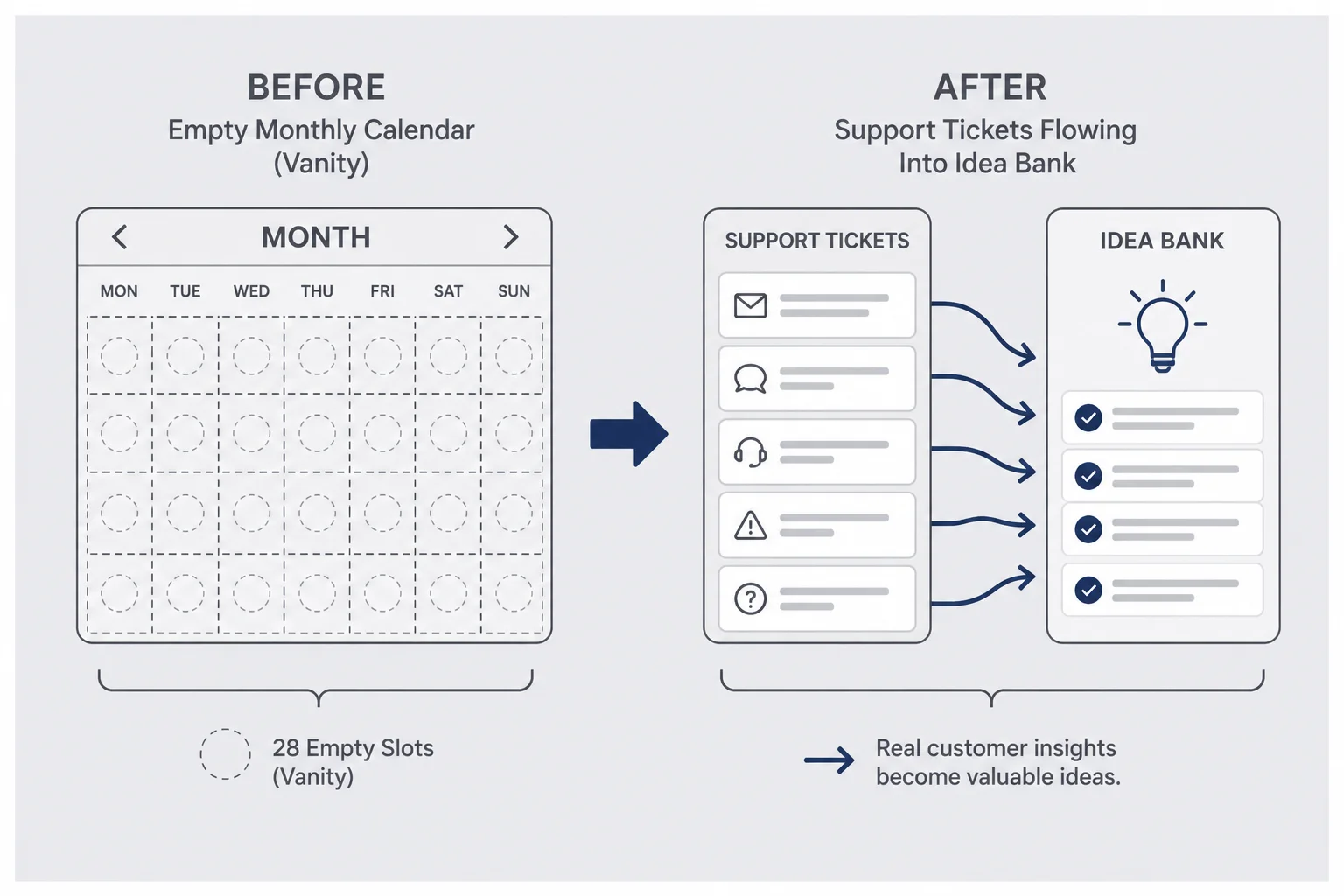
Inspiration hunting feels productive because it is emotional. You scroll until something sparks. You save thirty threads. You tell yourself you are "doing research." Research without a capture habit is consumption with extra steps. The support ticket that explained your buyer's Friday panic is still in Intercom. The prospect who said "we rebuild the deck every week" is still in a call note you never reopened. Inspiration from strangers will not match your ICP as often as your own customers already did.
I once watched a founder post daily for eight weeks about "building in public" while selling to dental office managers. His audience became other indie hackers. The dental managers were not reading. He was inspired every morning. He was not distributed to buyers. Activity without ICP match is a hobby with analytics.
The trap has a second layer: performing for peers. Founder Twitter and LinkedIn reward observations that sound sharp to other founders. "Distribution is hard" gets likes from people who also sell to founders. Your buyer might be a head of ops who never posts. Your content system has to pull from their language, not from the timeline's mood.
When you feel stuck, the fix is usually not more scrolling. It is opening the idea bank and reading what customers already told you. If the bank is empty, the fix is not content. It is five conversations this week. Content amplifies clarity. It does not manufacture it.
I learned this the hard way on a freelance project in 2021. The founder wanted "a content engine" before he had ten users. We built a Notion wiki of prompts and a thirty-day calendar. Week three he still could not say who paid. The calendar became wallpaper. Engines need fuel. Customer language is fuel. Prompts are not.
Another pattern: founders who consume courses about content strategy while ignoring onboarding emails. The course says post daily. The signup email still says "Welcome to our platform" with no next step. Fix the email first. One onboarding email that names the outcome and links to a two-minute setup beats four threads about your journey. Content inside the product is content too. It just does not get likes.
Why scrolling the timeline is not research
Timeline research mixes signals. You see a viral thread about AI agents, a carousel about productivity, a founder celebrating MRR you cannot verify. You borrow tone and topic from whoever won the hour. Your product might be a boring export tool for agency spreadsheets. Boring is fine. Boring pays when the right person finds you. Viral is irrelevant when the audience is wrong.
Set a rule: scrolling is allowed after the weekly pick is done, or for fifteen minutes of reply work in your niche. Otherwise you are feeding the inspiration trap. Replace scroll time with idea bank time. Same phone. Different folder.
The difference between audience applause and buyer curiosity
Applause is fast. Buyer curiosity is slow and specific. Applause sounds like "so true" and "needed this." Buyer curiosity sounds like "how do you handle multi-currency exports?" and "can I try this on my team's account?" Track which posts produce the second kind. If you only get the first kind, your positioning or channel fit is wrong before your writing quality is.
I keep a crude split in my notes: founder applause versus ICP question. If the ratio is wrong for six weeks, I stop posting and fix the headline on the landing page instead. Content cannot rescue a offer strangers do not understand in eight seconds.
The idea bank that stops Tuesday panic
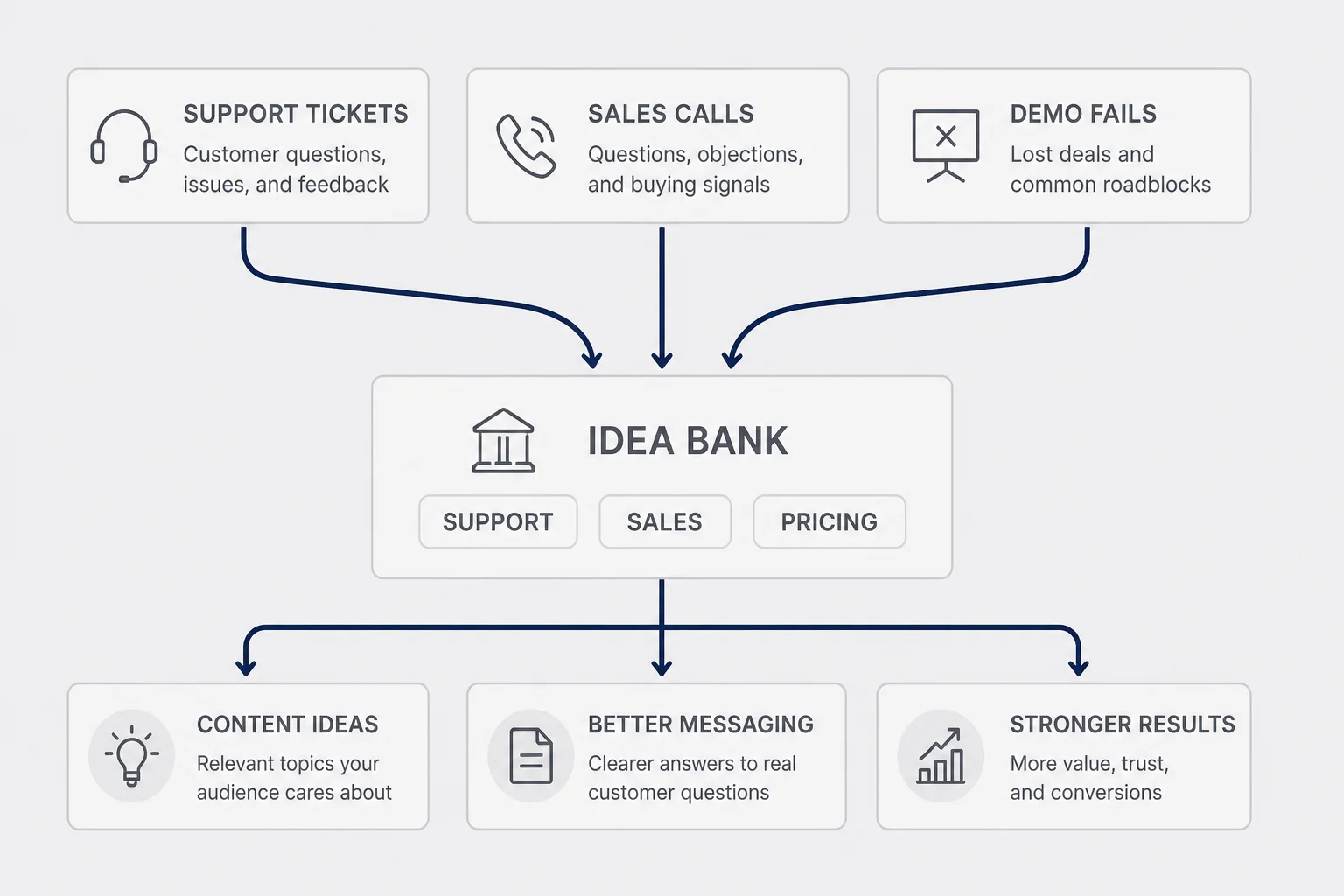
Tuesday panic is what happens when you have no approved list and the clock says post something. You reach for a generic take. You rewrite the same launch tweet. You publish and feel nothing. The idea bank is a single capture surface, not seventeen apps. One Notion page, one Apple Note, one text file in the repo. Every entry is one sentence: who hurts, what breaks, what they tried, what you learned. Tag it: support, sales, demo fail, feature request, pricing objection.
Capture at the moment of pain, not at the moment of content planning. Finished a support shift? Paste the theme, not the ticket number. Ended a call where the prospect went quiet at pricing? One sentence. Demo where they loved the UI but would not connect data? Write that before you close the tab. The bank fills from operations. Planning sessions do not fill banks. Operations do.
Say you run a tool that exports Shopify orders to clean spreadsheets. Your bank might hold: "Agency owner exports every Monday manually." "Prospect asked if Zapier is required." "Third ticket this month about timezone on order dates." None of those are blog titles yet. They are raw ore. The weekly pick turns ore into spine.
What belongs in the bank versus what belongs in chat
Chat is for thinking out loud with yourself or an AI. The bank is for decisions. If an idea needs a forty-minute rant to explain, it is not bank-ready. Compress first. If you cannot compress, you do not understand the problem yet. Talk to another customer before you write.
Do not bank "thought leadership" abstractions. "The future of work" is not an entry. "Ops lead still copies CSV into slide deck every Friday" is. Do not bank competitor gossip unless it changes your positioning. Bank what your buyers said in plain English.
How support tickets become your best outline
Support is unfiltered buyer language under stress. The subject line is often the search query. The body is the story. When three tickets rhyme in a month, you have an article. When one ticket is weird, bank it anyway. Weird becomes pattern at scale.
I copy paste the customer's phrasing when it is clear, then strip names and numbers. "I thought this would replace our Zapier zaps but I cannot map custom fields" beats my summary every time. Their words become H2s. My job is structure and honesty, not poetry.
Bank hygiene matters once a month. Scroll the list. Merge duplicates. Kill entries that were one-off weird tickets. Promote entries that appeared three times to spine candidate. The bank is not a journal. It is inventory for ship week.
Voice memos count. Walking the dog after a frustrating demo, I dictate one sentence into Notes. Transcription is messy. The mess still beats memory on Monday. Capture speed beats capture elegance.
One weekly board for the whole month
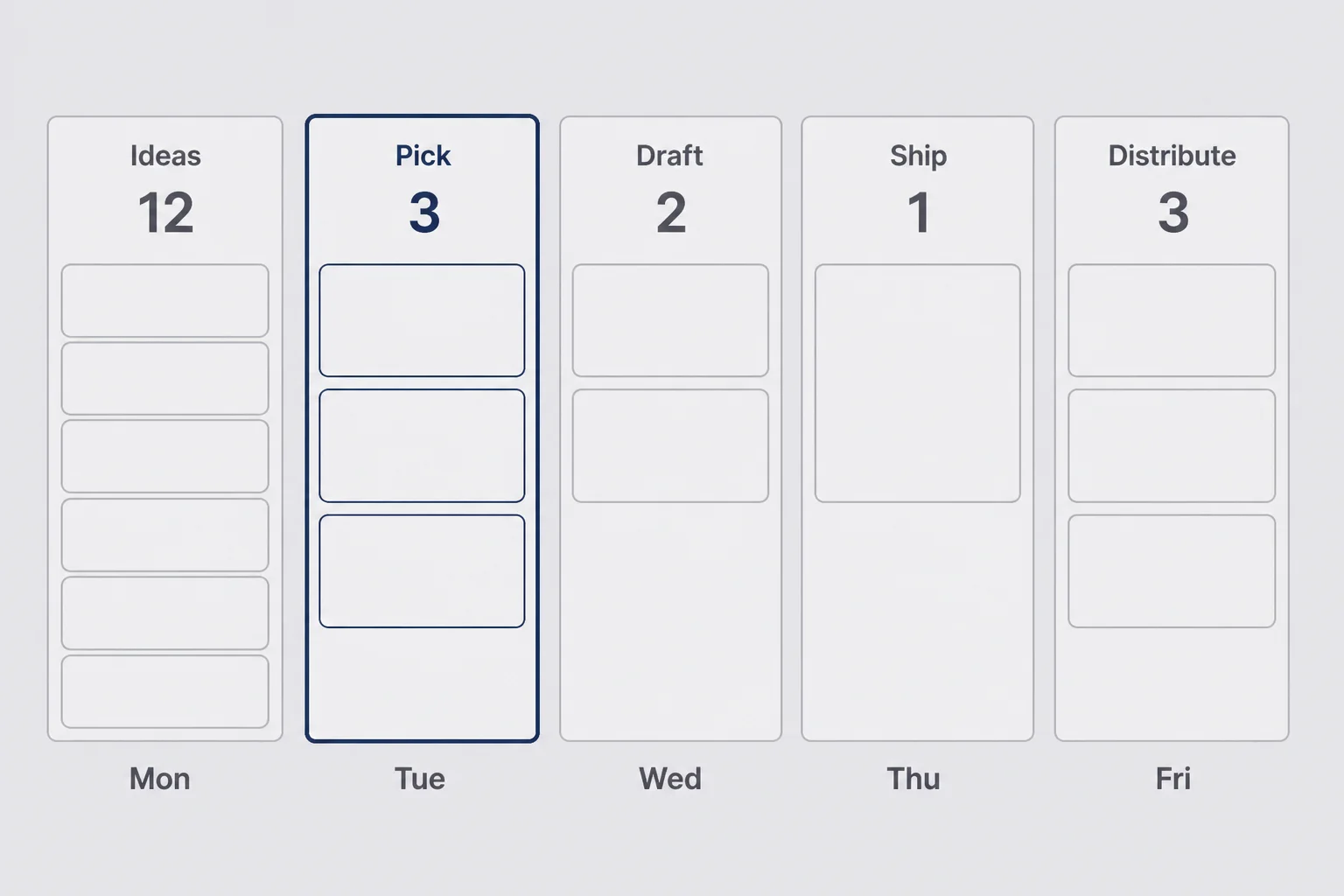
The weekly board is one screen. Columns: Ideas (count from bank), Pick (three max), Draft, Ship, Distribute. You do not need a project management suite. You need a board you glance at before coffee and know what Tuesday owns.
Pick three on Monday morning. Not seven. Not "whatever is easy." Three forces prioritization. One spine piece (article or long post). One secondary slice (thread, carousel outline, email). One distribution action (republish an old winner, update CTA on a ranking post, comment-first session on X or LinkedIn). If you finish early, you may steal from next week. You may not add a fourth pick until ship column is green.
The monthly calendar still exists if you want it, but it is a log, not a plan. You record what shipped. You do not pre-fill empty future days. Future empty days were the guilt machine. The weekly board is the commitment machine.
Why three picks beat thirty planned slots
Thirty slots optimize for appearance. Three picks optimize for completion. Completion is what Google, strangers, and your email list experience. A founder who ships twelve good pieces in a quarter beats a founder who planned forty and shipped six. Search compounds on shipped URLs. Social compounds on consistent presence. Neither compounds on drafts titled "draft v4 final FINAL."
Three also matches solo founder energy. You have support. You have bugs. You have life. The board should respect that. On a brutal week, one ship and two distribute actions still count. The system flexes. The calendar does not.
Monday pick, Tuesday ship, Thursday edit
Monday: pick three, outline the spine in bullet form, block ninety minutes for draft. Tuesday: ship the spine or the highest-value piece. Wednesday: slice for social or email. Thursday: edit clarity, add CTA, fix headline. Friday: distribute and reply work, not new creative. Weekend: capture to bank, no performance.
Tuesday ship is sacred. Ship means visible to a stranger, not saved in drafts. A Google Doc shared with nobody is not ship. A scheduled post is ship. An email to your list is ship. Drafts that age turn into guilt. Guilt turns into generic posts. Generic posts train mutes.
I treat Distribute as a column with names, not a vibe. Wednesday: LinkedIn long post or comment block. Thursday: X notes plus replies. Friday: email or republish. Names force honesty. "Do social" is how links die in drafts folders.
If you co-build with a technical partner, the board is shared. One person can own ship, one can own distribute. Still three picks total. Splitting into six picks because there are two humans recreates the thirty-slot calendar in teamwork cosplay.
Raw notes to first draft without the AI smell
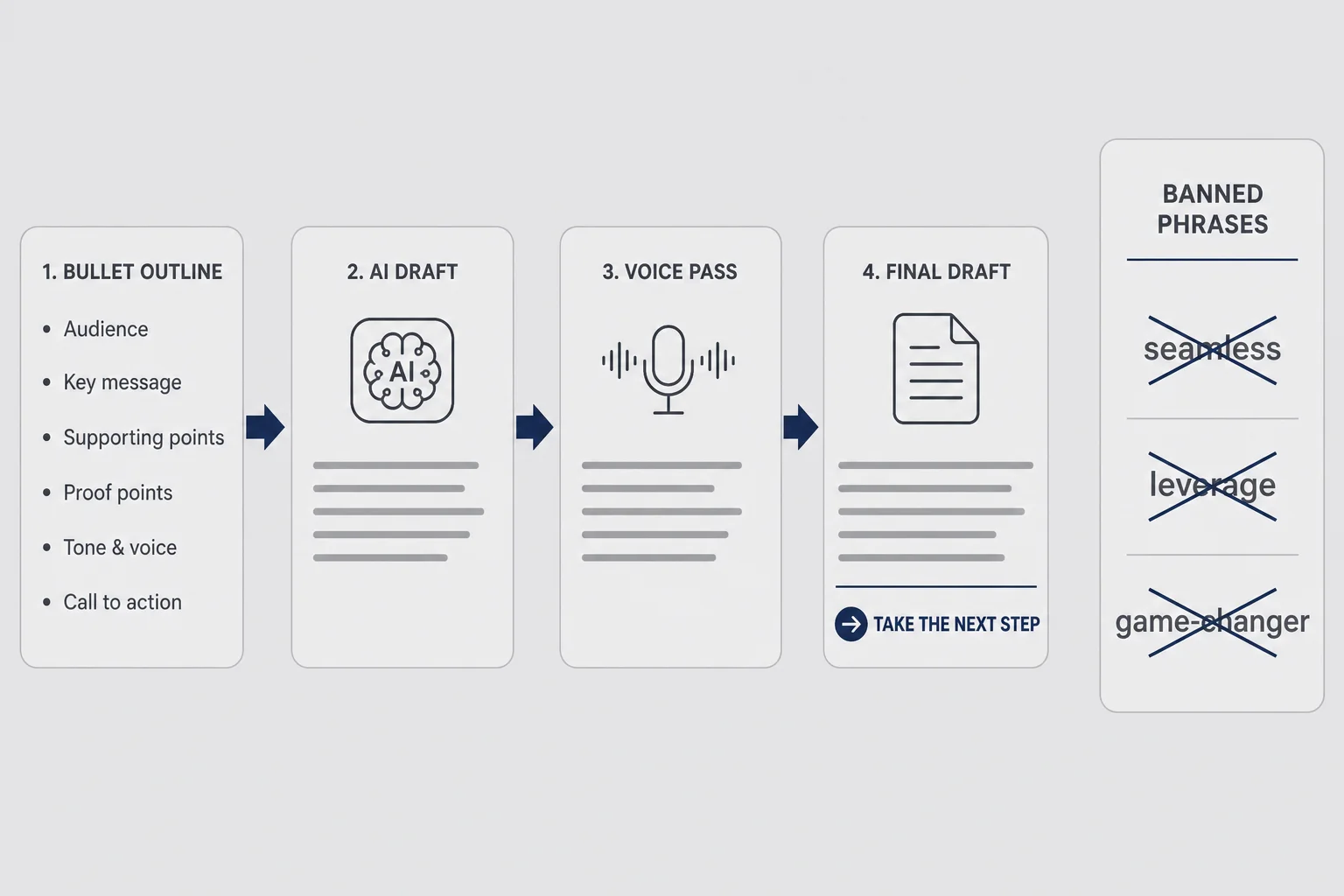
AI is a draft accelerator, not a strategy department. My draft path: bullets from the bank entry, paste into Claude or ChatGPT with explicit constraints (ICP, outcome, no hype words, American English, stop if vague). First output is too smooth. Second pass is mine: delete rule-of-three triads, add the specific Tuesday detail, replace "leverage" with what the button actually does.
The AI smell is uniformity. Every founder's AI draft has the same rhythm: short opener, three bullets, tidy moral. Readers who live on LinkedIn and X notice. Your draft pass should break symmetry on purpose. One long paragraph. One sentence section. A number that is ugly and real. "Forty users" not "dozens of customers."
Keep a banned phrase list in the doc footer: seamless, robust, game-changer, delve, landscape, unlock. Run a find before ship. I sound pedantic. I also sound human. Pedantic is cheaper than losing trust.
Outline before generate. Bullets are: who, pain, wrong alternative, what you tried, what worked, CTA. If bullets are weak, do not prompt AI. Call a customer. The model will happily write five hundred words of confident nothing.
Bullets first, generate second, voice pass last
Bullets are the contract. Generate fills paragraphs. Voice pass removes lies and theater. Voice pass is where you add "I once rewrote a headline six times" or "say you send fifty cold emails." Illustrative texture, not fake metrics. The reader should feel a person who counted something, not a model that rounded.
Read aloud once. If you stumble, shorten. If you stumble on jargon, replace with what the user sees. "Refactored middleware" becomes "checkout stopped failing on Safari."
The banned phrase strip before you ship
Add your own bans from mistakes. I ban "building in public" as a headline crutch unless the post is literally about that choice. I ban "excited to announce" in any spine piece. Announcements are not teaching. Teaching is what earns search and saves.
CTA line is last and explicit. "Try the export on your messiest Shopify store" beats "learn more." One link. One action. Match the spine's promise.
SEO articles, social notes, and email from one spine
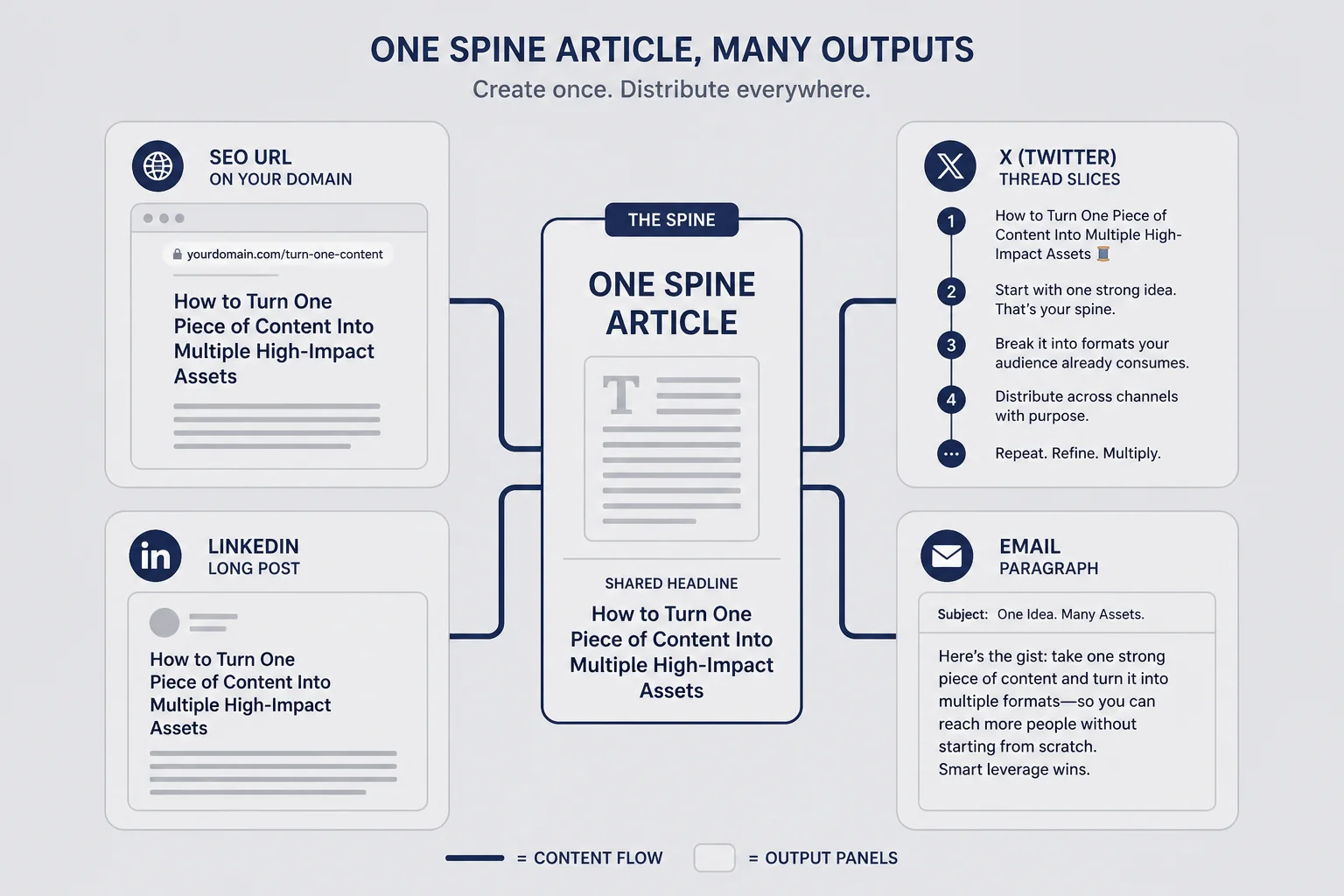
One spine is one answered question with proof. Article on your domain for search equity. Long LinkedIn post with the same hook and a personal opener. Three X notes: hook, example, CTA. Email paragraph for people who already opted in, with a deeper link. Same headline logic. Different lengths. Not different ideas.
SEO piece follows micro-SaaS SEO rules: one keyword, honest answer, internal links to product pages. Social pieces follow channel playbooks: Twitter reply-first habits, LinkedIn profile-as-landing-page. Email is the spine without the SEO scaffolding, plus a direct ask.
Repurposing is not lazy. It is respect for reader attention. Your ICP is not reading every channel. The ops lead who Googles on Tuesday is not the same person who scrolls X at 11 p.m. Same truth, different room. Lazy is posting the URL with "new blog post" and zero context. Adaptation is rewriting the hook for the room.
Example spine week for a Shopify export tool. Monday pick: "manual Monday exports versus automated mapping." Tuesday ship: two-thousand-word article on your domain targeting export shopify orders without zapier. Wednesday: LinkedIn post opens with the agency owner who still copies CSV into slides; CTA is Featured trial link. Thursday: three X posts — hook about Friday deck rebuilds, screenshot of messy sheet, soft trial mention. Friday: email to two hundred waitlist people with one paragraph and article link. Same story. Five surfaces. One outline doc.
Email is the most neglected slice. Founders post in public and forget the list that already opted in. Those people raised a hand. Send them the spine with a subject line that matches the support language. "Still rebuilding the Friday client deck?" beats "Newsletter #47."
Long form on your domain, short form in the feed
Domain long form earns search and sends authority to your signup flow. Feed short form earns conversations and profile visits. Both need the same outcome headline. "Export Shopify orders without rebuilding Zapier" works in both. "We launched v2" works in neither.
When the spine is social-only because the insight is timely but not searchable, still capture it in the bank and consider a lighter SEO page later. Timely wins fade. Search wins sleep.
Republishing winners without sounding like a bot
Winners deserve second distribution. Update the intro, refresh screenshots, add a paragraph from new support themes, change the date in the body if material changed. Do not spam the same link weekly. Schedule a quarterly republish for posts that rank on page two. Add internal links from newer posts. SEO is a library, not a launch day.
Distribution is step two, not step seven
Most founders write, publish, and hope. Hope is not a step. Distribution is: post the link where your ICP already argues, reply to five threads with the spine's insight without linking first, send the email segment, add the URL to onboarding for users who hit the problem. Same day or next day. Not "when I have time."
I schedule distribution in the weekly board's Distribute column alongside ship. If ship is Tuesday, distribute is Wednesday through Friday. Link posts are the smallest part. Replies are the bulk. On X, borrow attention in threads, then let profile and pinned post convert. On LinkedIn, comment with a useful second thought, then let the About section and Featured link convert. The spine gives you something useful to say in replies without pitching.
Cold link drops train ignores. "Here's my post" in a stranger's thread is a pitch. "We saw the same Friday export bug last month; mapping custom fields is where most teams break" is a contribution. The second might earn a profile click. The first earns a mute.
Distribution also includes your own house. Link new spine pieces from older articles that rank. Add the spine to onboarding for users who hit the related error. Mention the article in support replies when it genuinely helps, with one line and a URL, not a lecture. That is distribution without a post. It is also how solo founders multiply effort without multiplying hours.
Partners and micro-communities fit here too. Not "please share my launch." Offer a useful excerpt another newsletter can paste with attribution. One honest guest post on a niche blog beats five self-promotional comments. The spine makes guest pitches fast because the outline already exists.
Ship and distribute in the same week
If you ship without distribute, you built a private library. If you distribute without ship, you are networking without assets. Pair them. The board's green check means both happened.
Track one UTM or tagged link per spine piece. Know if Wednesday's LinkedIn post drove more trials than Thursday's X thread. Not for vanity. For next week's pick.
Batch distribute tasks if context switching hurts you. Same spine doc open, three tabs: LinkedIn composer, X, email tool. Write slices in one sitting after Tuesday ship. Thirty minutes of slicing beats three separate evenings of dread. The spine doc should have a section at the bottom labeled slices filled in before you close Tuesday.
When a slice performs, bank why. "Hook about Friday decks" becomes a tag. Next month you might pick a related spine because the tag cluster is loud. Performance feeds the bank backward. Most founders only feed forward from support. Both directions work.
Comment-first sessions that borrow attention
Block thirty minutes. Search your keyword or hang in three communities where buyers talk. Leave five useful comments. One may ask a follow-up. That follow-up is warmer than any cold DM. Your spine is cheat sheet for substance. Do not paste links unless asked.
The Tuesday ship habit
Tuesday ship sounds arbitrary. It is arbitrary on purpose. Arbitrary beats "when inspiration strikes." My Tuesday block is ninety minutes, phone on another room, same coffee mug. Outcome: one piece live. If life explodes, Wednesday is backup. Friday is last resort. Not next Tuesday. Sliding ship trains the guilt calendar again.
Protect the block like a customer call. Founders protect sales calls. They do not protect their own distribution. Both are revenue. Tuesday morning your buyers are starting their week. A useful post or article meets them when they have problems, not when you have guilt.
Small ship counts. A tightened email to fifty waitlist people counts if it teaches. A revised landing section counts if it replaces feature soup with outcome copy. Not every Tuesday is a three-thousand-word article. Every Tuesday is something a stranger could find or receive without asking you personally.
The habit has a physical trick that sounds silly and works. I leave one sticky on the keyboard that says SHIP for Tuesday morning only. Other days it lives in the drawer. The sticky is not magic. It is a interrupt between opening Slack and opening Notion. Slack is where inspiration traps live. Notion is where drafts go to age. Ship is a third door.
When I miss Tuesday, I do not "make up" with a rushed Friday post that nobody needed. I ship the smallest possible piece: one email, one landing tweak, one reply thread summarized as a note. Then I protect next Tuesday harder. Makeup sprints recreate the calendar guilt. Small recovery preserves the habit.
Protecting ninety minutes like a sales call
Put it in the calendar as SHIP, not "content." Language matters. Content sounds optional. Ship sounds contractual.
If you miss two Tuesdays in a row, shrink the pick to one spine and one distribute action until the habit returns. Systems fail when recovery is too ambitious.
What counts as ship versus what counts as planning
Planning is bullets and board moves. Ship is public. Planning is necessary. Planning is not ship. Do not confuse a filled outline with progress. Progress is a URL, a sent email, a live post.
What to measure when you are not a media company
Media companies measure impressions and subscribers. Solo founders measure ICP curiosity and trials. Profile visits from target titles. DMs that ask about the problem. Signups tagged from content URLs. Search Console clicks on problem queries. Email replies that are not unsubscribe notices.
Vanity metrics still show up. Impressions are weather. Useful when rising with the right followers, misleading alone. Likes from founders are applause, not pipeline. Track them if you want mood. Do not optimize for them.
Review monthly, not hourly. One spreadsheet row per spine piece: channel, ship date, clicks, trials, one ICP question it produced. Kill formats that never produce questions. Double formats that produce questions but weak CTAs fix CTAs, not topics.
Say your spine article on Shopify exports gets forty clicks and two trials in month one. Your LinkedIn slice gets six hundred impressions and one DM asking about custom fields. That is a win worth repeating with a harder CTA on LinkedIn, not a reason to abandon SEO. The system is comparative inside your own rows, not competitive with influencer metrics.
Plausible or GA on the blog, native analytics on each social platform, Search Console for queries. You do not need a data warehouse. You need five numbers you actually open on the first Monday of the month.
ICP questions versus founder applause
Ask: did a buyer-type person ask a follow-up? Title matches your list. Company size matches. Question is about the problem, not about your stack. That is signal.
Founder applause is still data. It tells you the writing is clear. It does not tell you the market is right.
The monthly one-row review
One row per ship. No dashboard tourism. If the row is empty for a month, the system failed, not the algorithm. Empty row means pick was wrong, ship did not happen, or distribute did not happen. Fix the board, not the tools.
When to skip content and talk to users instead
Content is wrong when you cannot write one sentence about who buys. Wrong when onboarding is broken and posts would send traffic to a leaky bucket. Wrong when your bank is empty because you have not talked to humans in three weeks. Wrong when every post reaches founders and zero reach buyers.
In those weeks, replace ship block with five user conversations, onboarding fixes, or positioning work on the landing page. The idea bank still captures. The board still picks next week. You are not abandoning the system. You are feeding it honestly.
Skipping content is not failure. Shipping content that avoids the real problem is failure. I have written beautiful email sequences for products with twelve signups. The sequence was not the bottleneck. The audience was.
Return to ship when you can name the buyer, the pain, and the next step a reader should take without guessing.
Max sometimes asks whether technical founders should write or delegate. Delegate when you have revenue to pay a sharp freelancer who can run your voice pass from bullets. Until then, your weird honest draft beats polished generic copy because the specifics are yours. The system makes delegation easier later because the bank and spine are already structured input.
Imani's world of AI-native building has the same trap: ship fast, post fast, wonder why signups lag. Agents do not replace the bank. They fill drafts faster once the pick is sharp. If your agent output sounds like everyone else, your pick was vague, not your model.
Empty bank weeks
Empty bank means go to customers, not go to Canva. Run five short calls. Read twenty support tickets. Post one question in a community where buyers hang out. Bank fills in forty-eight hours when you listen.
Founder audience drift
If applause ratio is wrong for six weeks, pause public posting to founders. Rewrite positioning. Test headline on the landing page. Run three cold emails with the new sentence. Content resumes when the sentence survives contact with strangers who are not indie hackers.
Questions I get about founder content systems
How much content should a solo founder publish per week?
Three useful pieces per week is enough for most micro-SaaS founders when distribution is included. That might be one SEO article every two weeks, two social posts, and repurposing the same spine into email. Daily posting burns you out and trains vanity metrics. Pick three slots on a weekly board and ship them before you add a fourth.
Should I write SEO articles or social posts first?
Write the spine that answers a buyer question first, usually an SEO article or a long LinkedIn note. Social posts and email are slices of that spine, not separate creative projects. If you only have thirty minutes, post a useful reply on X or LinkedIn instead of half-writing a blog post you will abandon.
Can AI run my entire content system?
AI can draft from your notes and subject lines if you supply the idea, the ICP, and the outcome. It cannot pick your ICP, notice support themes, or decide what to kill. Use AI after the idea bank and weekly pick, not before. Unedited AI drafts sound like every other founder thread. Your system should produce your voice, not template voice.
When is content the wrong move for a solo founder?
When you have zero paying users and no clear buyer sentence. When your last ten posts got praise from other founders but no ICP curiosity. When support tickets are piling up and you are writing instead of fixing onboarding. Content amplifies a real offer. It does not replace validation calls, pricing tests, or shipping fixes buyers asked for.
How do I connect content to signups?
Every piece needs one next step: trial link, relevant landing page, or reply path. Tag links in analytics. Track profile visits, DMs, and signups from content URLs separately from vanity impressions. If a post teaches something true and nobody clicks, fix the CTA or the audience match before you write volume.
The calendar was lying. The board tells the truth.
I still do not trust inspiration. I trust Tuesday. I trust the bank entry that says "third ticket about Friday exports this month." I trust three picks because thirty slots lied to me for years.
You do not need a content team. You need a capture habit, a weekly board, one spine, and distribution the same week you ship. Read the channel playbooks when you need tactic depth. Run this system when you need to stop losing Sundays to empty calendars.
If your bank is empty, close the doc and call a customer. If your bank is full and nothing ships, fix Tuesday, not your voice. Distribution is still a skill. The system makes the skill repeatable.
A product nobody hears about is still just an expensive hobby. The board is how you hear yourself think before the market has to guess.
Start small if the system feels heavy. Week one: only the bank and one Tuesday ship. Week two: add the pick column with three max. Week three: add distribute. You are allowed to ramp. You are not allowed to buy a thirty-slot calendar and pretend you ramped.
The founders who stick with this for ninety days stop asking what to post. They ask which pick moves trials. That question is healthier. It ties content to revenue without turning you into a performer. Keep the board visible. Keep Tuesday loud. Keep the bank honest. The channels will fight for your attention every morning. The board is how you fight back.




Comments