Apple Search Ads Are a Microscope, Not a Megaphone
How to run Apple Search Ads as a solo iOS founder: when ASA beats organic, campaign structure, keyword tiers, daily caps, and metrics gates before you scale spend.
 By Iryna26 min read
Listen to this article
AI-generated podcast-style overview of this article (not a word-for-word narration).
I opened Apple Search Ads on a Tuesday afternoon with the same energy I used to open App Store Connect the night before a soft launch. Heart rate up. Certainty low. The interface looked reasonable — campaigns, ad groups, keywords, bids — like a grown-up product. Then I imagined spending fifty dollars a day to teach strangers that my screenshot upload flow still felt creepy. I closed the tab. That was the right instinct for the wrong reason.
Closing ASA forever would have been lazy. Opening it before my listing could convert would have been expensive. Apple search ads solo founder work sits in that narrow hallway: you are not Reese running Meta campaigns with landing-page variants and a spreadsheet cult. You are one person who maybe has forty organic installs in New Zealand and a paywall that finally works on production receipts. ASA is how you buy sharper intent on the store you already live on — not how you skip App Store optimization, not how you avoid a soft launch ramp, and not how you pretend subscription pricing does not matter once traffic arrives.
I run Finish Him Replies, a consumer app with an emotional first session and a privacy-sensitive upload. Paid search for me is not "growth hacking." It is a microscope pointed at whether the right person finds my listing, understands it in two seconds, and trusts me enough to try premium. If that chain breaks, ASA becomes a vanity hose. If it holds, ASA is the cheapest room on the App Store where intent already exists.
Apple search ads solo founder: paid search is a microscope, not a megaphone
The megaphone fantasy sounds like this: turn on Apple Search Ads, downloads spike, you feel like a real app on the chart, Product Hunt can wait. The microscope reality is quieter. You bid on a handful of searches. You watch whether installers open the app twice. You compare cost per install to cost per trial start. You pause keywords that attract curious people who never wanted what you built.
ASA is not Facebook. You are not designing cold audiences from interests and lookalikes. Apple already grouped your audience: they typed something into App Store search. That is high intent compared to a scroll feed — but intent is not the same as fit. Someone searching "dating tips" might want a podcast, a coach, or a game. Someone searching "reply ideas for texts" might want exactly my app or might want a listicle they will never pay for. Your listing and your first session decide which one you get.
For a solo founder, that specificity is a feature and a trap. The feature: you can run meaningful experiments with fifteen dollars a day and a notepad. The trap: small numbers lie loudly if you refresh the dashboard every hour. ASA rewards patience and gates, the same discipline as widening countries during soft launch. You are not buying reach. You are buying labeled experiments on the store's own search shelf.
I think of ASA in three layers. Layer one is defense: own your brand name cheaply so a competitor does not appear above you when someone types your exact title. Layer two is offense on intent: phrases that describe the embarrassing moment your app solves, bid modestly, watch downstream conversion. Layer three is discovery: wider terms, low bids, fast pauses. Most indie apps should live in layer one and two for months. Layer three is where budgets catch fire.
ASA also interacts with privacy psychology in consumer apps. A paid install does not trust you more than an organic one. If your first screen asks for photo access before value, ASA traffic will bounce harder because paid users are not your friends doing you a favor. Paid traffic is strangers with higher expectations because Apple put you at the top of their search. Product work still leads. ASA follows.
Install spray
Raising daily caps because installs went up — without trial starts, retention, or support themes improving — is paying to amplify confusion. CPI is a vanity cousin of download spikes during soft launch.
When Apple Search Ads actually make sense for indie apps
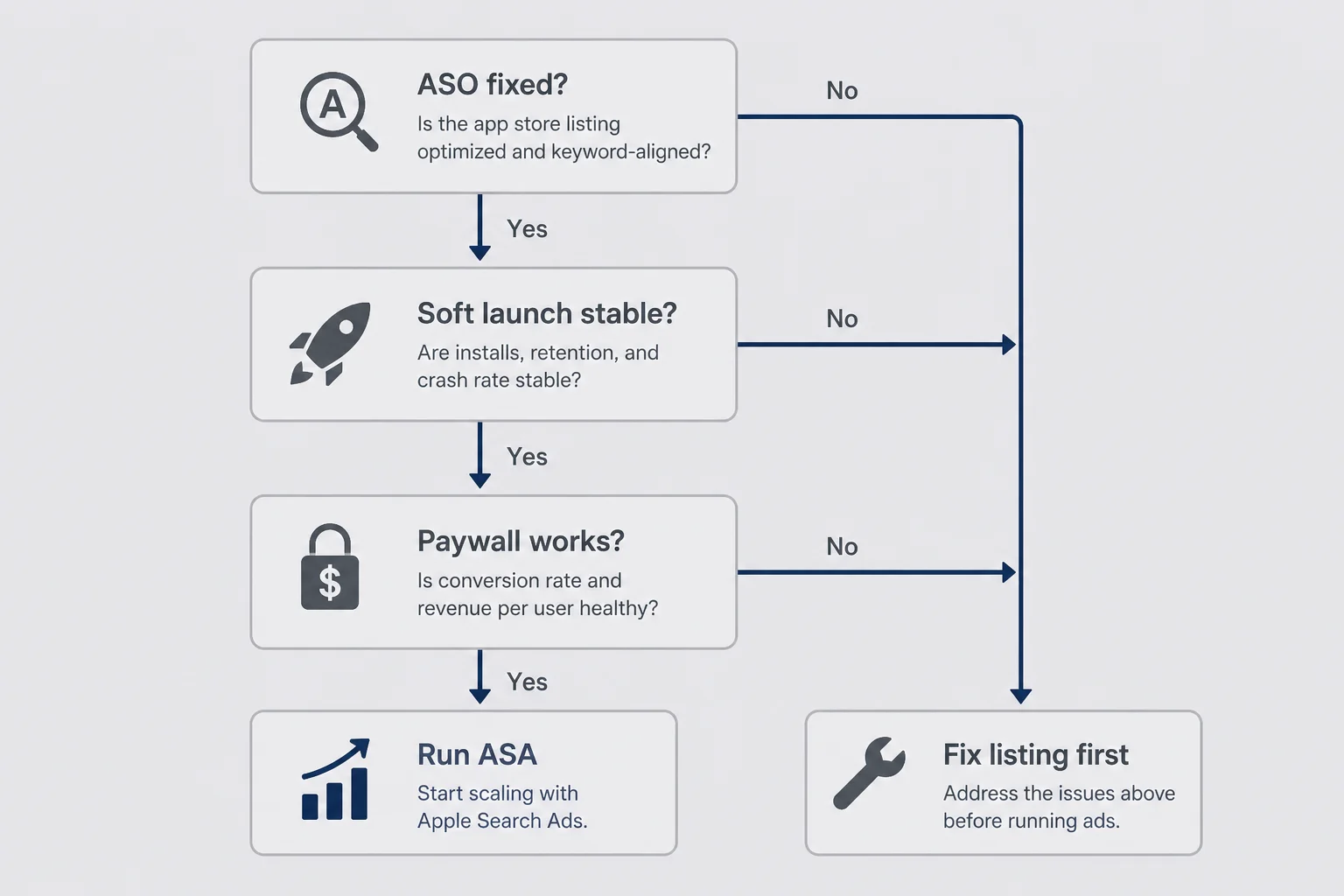
ASA makes sense when the store page is honest and your core loop survives cold strangers — not when you need a miracle because organic is zero and you refuse to fix the listing.
The honest checklist is boring. Your app is live in at least one country you can support. Crash-free sessions are stable enough that you are not paying to reproduce crashes on new devices. Your screenshots show the outcome, not a feature laundry list. Your paywall appears after value, not before permission scares someone off. You have seen at least a trickle of organic search impressions in App Store Connect analytics, even if conversion is weak. Weak conversion with real impressions is an ASA opportunity because you can test whether paid placement on specific keywords beats your organic rank.
ASA is wrong when the app is still a plumbing project. If you are fixing StoreKit restore daily, ASA is a distraction. If you are rewriting onboarding every build, ASA resets learning before you know what fixed anything. If your privacy copy does not match behavior, ASA buys you angry reviews faster. If you have not soft launched in a small geography, ASA worldwide is the same blast-radius mistake as checking every country on day one — except you pay per click for it.
Consumer apps with subscriptions have an extra gate. ASA traffic that installs but never sees a coherent price story is money spent teaching people your weekly plan looks predatory. Fix annual versus weekly presentation in a small market first. Then ASA tells you whether high-intent searchers agree with your pricing frame, not whether random installers hate numbers.
ASA also makes sense when you have a clear search phrase you already own organically on page two or three. Apple Search Ads can put you at the top for that phrase while you keep improving organic rank through ASO. It is rent on shelf space, not a substitute for shelf quality. When organic climbs, you can lower bids or pause offense keywords and keep brand defense cheap.
Who should skip ASA entirely? Tiny utilities with almost no search volume, apps distributed only to enterprise customers outside the store, founders who still have not validated that strangers complete the core loop. Skipping ASA is not failure. It is scope control.
ASA versus Meta or TikTok for indie iOS
Reese can explain paid social better than I can. My short version: social ads send people to a listing they did not search for. ASA meets people who already typed a problem into Apple's search box. For emotional consumer apps, social can work when your creative is a video that demonstrates relief in thirty seconds. ASA works when your listing already demonstrates relief in two screenshots and your first session delivers.
Many solo founders run ASA first because the interface is inside Apple's world and the traffic is store-native. That is fine. Do not run ASA because you are afraid of making a video ad. Run ASA because search intent matches your app and your listing is ready.
What has to be true before you turn on spend
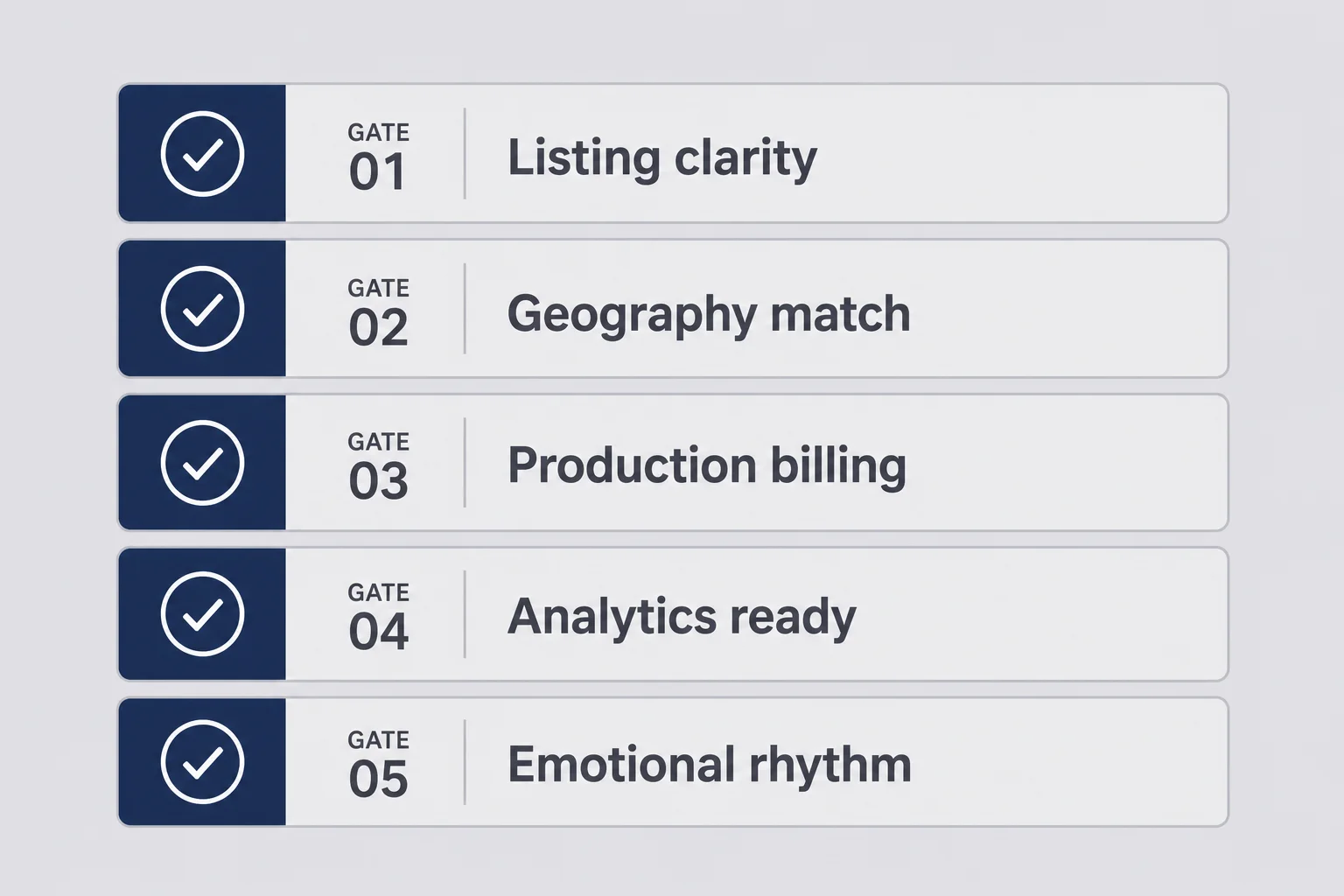
Before I spent a dollar on ASA, I wrote a half-page gate list on paper. Not because Apple requires it. Because I knew I would rationalize bad numbers if I skipped steps.
Gate one was listing clarity. I read my subtitle out loud to someone who does not know the app. If they guessed a different product, ASA would buy the wrong clicks. I rewrote the first screenshot caption three times until it described the moment of relief — paste-ready replies, not "AI-powered conversation assistant." Feature language attracts feature shoppers. Moment language attracts people with a screenshot in their Photos app and a stalled chat.
Gate two was geography alignment. My app was live in a soft-launch country set, not worldwide. ASA country targeting had to match availability. Paying for US installs when the app was not live in the US is a special kind of self-harm. Match campaigns to phased rollout reality.
Gate three was production money paths. Sandbox purchases in TestFlight do not prove your paywall on ASA traffic. I needed one real subscription in a live country, restore on a second device, and a refund policy I could point to in support email. ASA multiplies strangers; strangers multiply edge cases.
Gate four was analytics sanity. I could see App Store Connect impressions and product page views. I could see basic install counts. I did not need a fancy MMP on day one, but I needed a spreadsheet column for "trial started within 24 hours" that I filled manually from whatever analytics I had. If you cannot measure downstream, ASA is a slot machine.
Gate five was emotional readiness. ASA will show you that some keywords attract people who install once and vanish. That is not personal. It is data. If you refresh cost per install like App Store Connect reviews, you will pause winners too early and scale losers too late. Pick a twice-weekly check rhythm before you enable billing.
The ASO floor you cannot skip
App Store optimization is not a parallel project. It is the floor ASA stands on. Keywords in your listing metadata should align with ASA keyword tiers — not copy-pasted blindly, but strategically consistent. If ASA data shows a phrase converts, consider weaving it into subtitle or keyword field where Apple allows. If ASA shows a phrase attracts installs that bounce in ten seconds, do not chase it in metadata just because CPI looked cheap.
Screenshots are ad creative Apple does not let you customize per keyword. Everyone sees the same product page. That is why ASA before screenshot fixes is backwards. You are paying for traffic to a static sales page you already know is weak.
Setting up Apple Search Ads without a growth team
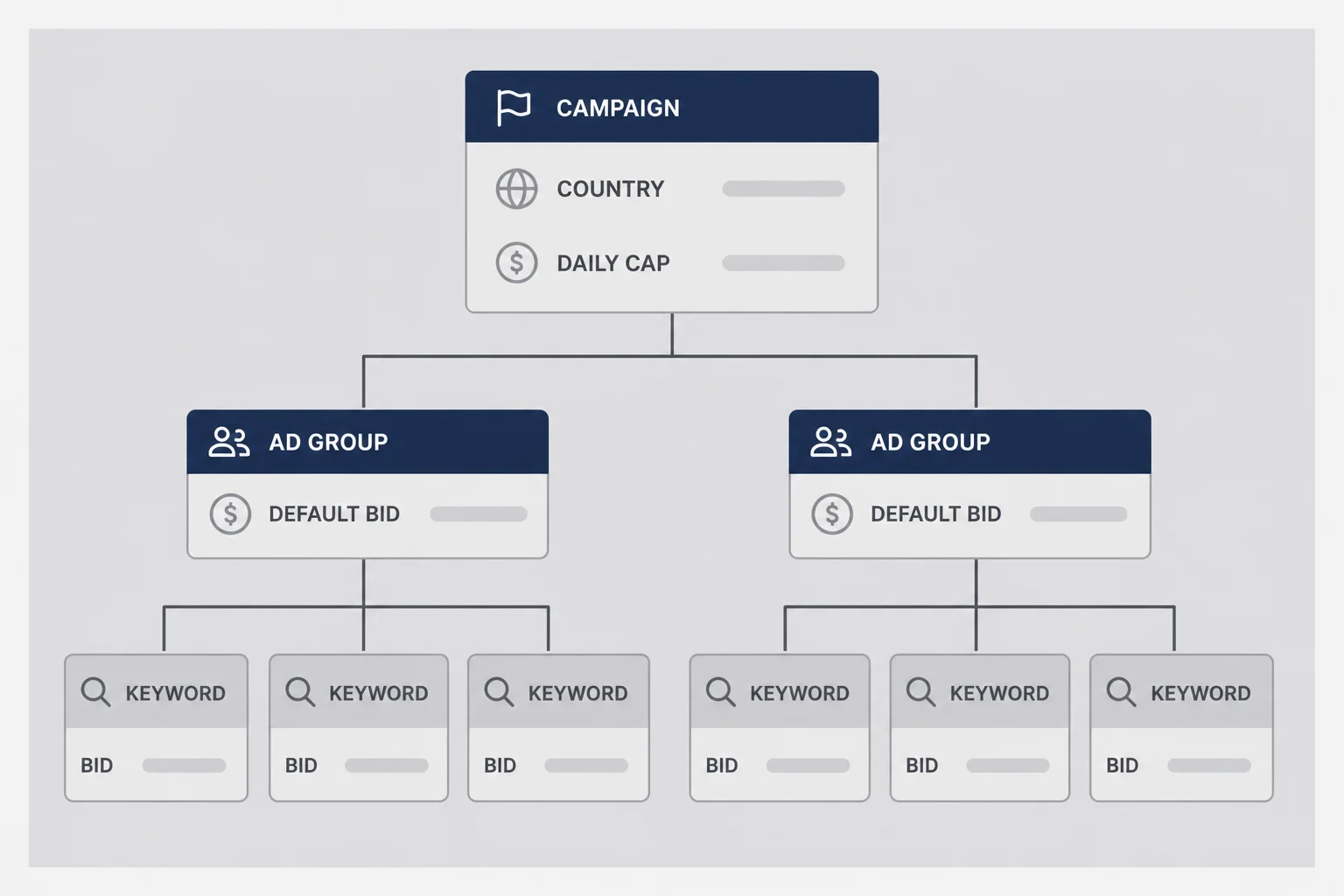
Apple Search Ads lives in a separate console from App Store Connect, linked to your app record. The hierarchy is campaign, ad group, keywords, and bids — familiar if you have seen Google Ads, simpler than Meta's maze. Solo founders should keep the hierarchy shallow. One app, one or two campaigns, a handful of ad groups, not forty nested experiments you cannot maintain.
Start in Search Results — the classic text ad on search, not Search Tab placements on the home screen unless you have budget to burn on discovery. Search Results matches intent keywords. Search Tab is billboard rent. Indie apps usually learn faster on Results.
Campaign level sets country targeting and daily budget cap. Ad group level sets default bid, audience settings where applicable, and keyword buckets. Keyword level sets match type and bid overrides. Creative is mostly your App Store listing — Apple pulls screenshots and title from the live product page. You do not upload separate ad images for basic Search Results campaigns.
Payment is a credit line or card on the ASA account. Set billing alerts. Apple will spend up to your daily cap on active keywords. "I forgot ASA was on" is a real founder story. I set a calendar reminder every Monday: "ASA alive? gates pass?"
Link the right app. Triple-check bundle ID. Promoting the wrong app is rare but spectacular. If you have multiple apps someday, name campaigns with the app name prefix so you do not pause the wrong thing half asleep.
Discovery campaigns versus exact campaigns are a conceptual split many founders use even inside one interface. Discovery lets Apple suggest searches related to your app — useful for keyword ideas, dangerous as your only campaign because broad matching spends fast. Exact and search match campaigns on named keywords give you control. Start controlled. Open discovery later with low caps if you want mining ideas.
Search Match and why I keep it on a leash
Search Match lets Apple match your ad to searches it thinks fit your app. For a solo founder, that is sometimes how you learn a phrase you never considered. It is also how you spend twenty dollars on "free games" adjacent junk. If you use Search Match, isolate it in its own ad group with a low daily cap and review search term reports weekly. Pause anything that smells wrong within forty-eight hours, not at month end.
Billing, invoices, and tax paperwork
Apple Search Ads invoices separately from App Store Connect payouts. Your ASA credit card charge is an expense line, not a mystery fee inside developer revenue. Track it monthly if you are serious about bootstrap accounting. I export ASA billing summaries when I do quarterly review — not because ASA is huge money, but because I want one spreadsheet that shows OpenAI, Apple Developer, ASA, and hosting in one column called "app tuition."
If ASA spend is zero for a month because you paused, note why in that spreadsheet. Future you will forget whether pause was strategy or forgetfulness.
Campaign structure when you are the only operator
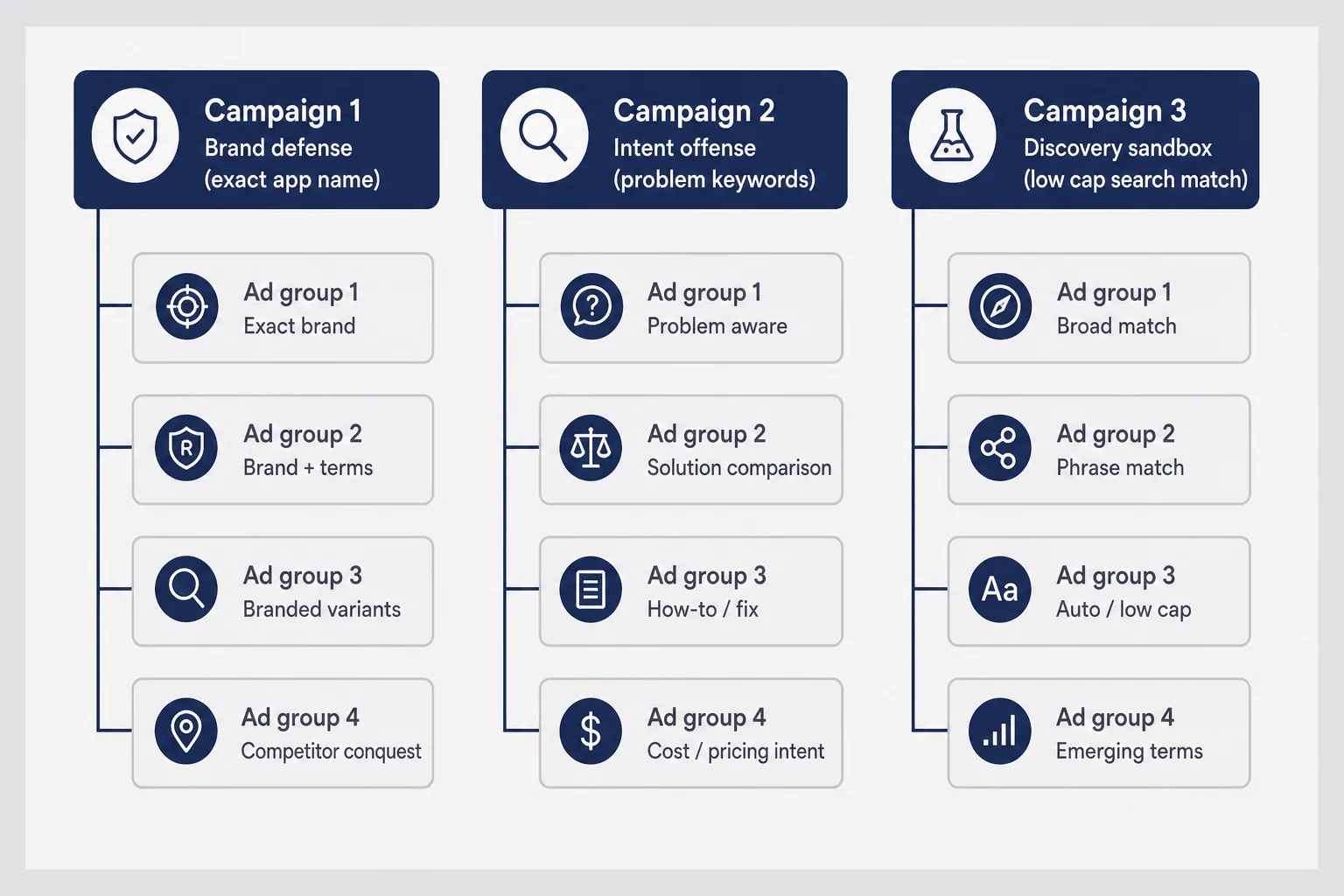
My living campaign structure for a single consumer app is embarrassingly simple. Campaign A: brand defense. Campaign B: intent offense. Optional Campaign C: discovery sandbox with a five-dollar cap. That is it. I do not build seventeen ad groups because a blog post said granularity wins. Granularity wins when someone reads the reports.
Brand defense is exact match on my app name and close misspellings. Bid enough to stay top of search for my own name — often modest because competitors may not bid on you until you are visible. This campaign is insurance. Cheap clicks from people who already decided to find you.
Intent offense is exact and broad match on problem phrases — "text reply helper," "comeback comebacks app," phrases that mirror my screenshot story. Default bids start conservative. I raise bids on keywords with trial starts, not keywords with installs alone. Each ad group clusters similar intent so I can pause a cluster without nuking the whole campaign.
Discovery sandbox uses Search Match or a small set of broad keywords with rock-bottom caps. Purpose is keyword research, not scale. When a search term report shows a phrase with three installs and two trial starts, I promote that phrase into intent offense as an exact keyword. When a phrase shows twelve installs and zero opens day two, I negative-match it if the interface allows or pause the ad group.
Day parting, demographic splits, and audience refinements exist. I ignore most of them early. Solo ASA is not where you simulate a growth team. It is where you learn whether search intent converts for your listing. Complexity is a tax on attention.
Negative keywords and search term reports
Search term reports show what people actually typed before they saw your ad. That is gold for solo founders who do not have a keyword research department. Weekly ritual: export or screenshot the report, highlight terms with spend and no downstream signal, add negatives or pause bids. Terms with good signal get promoted to exact keywords with their own bids.
Negative keywords prevent your ad from showing on searches you know are wrong — "free," "game," competitor names you do not want to fight, category words that attract bargain hunters. Consumer subscription apps often negative early: "free," "mod apk," "hack," whatever your category's junk traffic looks like.
Keywords, match types, and bids that won't bankrupt you
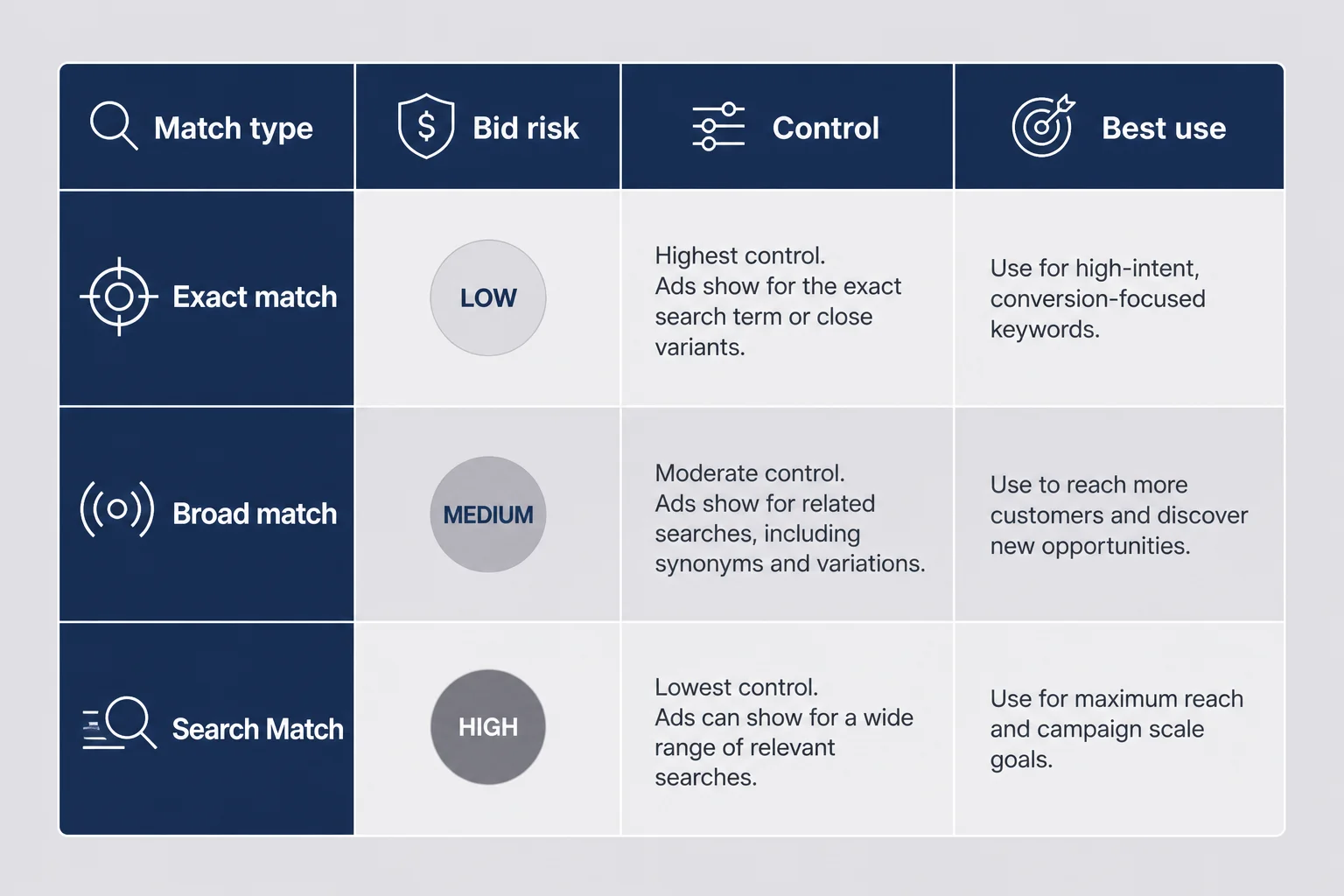
Keywords are where ASA feels like poker and math at the same time. Match types change how loose Apple interprets your bid.
Exact match targets the specific phrase or close variants Apple considers equivalent. Use exact for brand and for proven intent phrases once you have data. Broad match lets Apple expand to related searches. Broader reach, faster spend, messier signal. Search Match is the loosest — Apple decides. Bids should reflect looseness. Exact brand name: low bid often enough. Broad problem phrase: start low, raise only with evidence. Search Match sandbox: lowest bid that gets any data.
I do not chase CPC trivia. I watch cost per install and cost per trial start relative to gates I set before spending. Say my weekly subscription is four ninety-nine and I expect one in ten installers to start a trial. Rough math says I can tolerate higher CPI than a free app with ad monetization. Your subscription pricing sets the ceiling on acquisition spend — even rough napkin math beats flying blind.
Bid adjustments happen weekly, not hourly. Raise bids ten to fifteen percent on keywords that beat your gate two weeks running. Lower or pause keywords that miss two weeks. Sudden bid doubles chase vanity placement. ASA is not an auction you win for ego. Top spot is only good if the person below would have been wrong for you anyway.
Keyword research sources for indie apps: your own ASO keyword field and subtitle, App Store Connect search analytics, competitor names you are not bidding on offensively, support email verbs users use ("I needed help replying," "couldn't think of a comeback"), and ASA search term reports themselves. I keep a running list in Notes titled "phrases real humans used" separate from "phrases SEO blogs suggested."
Competitor keywords and category terms
Bidding on competitor app names is a strategy big apps use. Indie founders should be careful. You can pay a premium to appear when someone searches a rival, but that person already wanted the rival. Your listing must win a comparison in one glance. If your app is a niche reply helper, appearing above a giant dating app might get installs that churn immediately.
Category terms — "dating app," "productivity," "AI writer" — are expensive and vague. They test whether ASA can work at scale for brands, not whether a solo founder should start there. I touch category terms only in the discovery sandbox with bids so low they almost never win. If they win often, your bid is too high for your budget.
Budgets and daily caps for one nervous system
Daily cap is the most important number in ASA for a solo founder. It is the ceiling on how much damage one forgetful week can do. I started at fifteen dollars a day total across campaigns, not per campaign. Some founders start at ten. Some at twenty-five if they have savings earmarked for learning. The right number is one you would not panic about if it spent fully every day for seven days straight.
Do not set campaign budgets that sum higher than your monthly ASA budget goal. If you want three hundred dollars a month of learning, daily cap near ten dollars total keeps you honest. ASA can spend daily caps on active hours — understand that "fifteen dollars a day" is not "fifteen dollars every day guaranteed" but "up to fifteen."
Raise caps only after a gate passes twice. My gate was trial start rate stable at or above my organic baseline for two weeks on intent keywords. Yours might be different if you are free with ads or one-time purchase. Write the gate before money flows.
Lifetime budget caps exist in some setups; use them if you are terrified of runaway spend. I prefer daily caps plus Monday reviews because lifetime caps can exhaust mid-month and leave you blind during a fix week.
ASA is not venture scale. It is tuition. Tuition should be priced like tuition — predictable, bounded, reviewable on a calendar.
Weekly ASA review ritual for one person
I blocked thirty minutes every Monday before I checked ASA, not as a reward after coffee. The ritual is the same four questions: Did any keyword spend more than a third of the weekly budget without trial signal? Did any search term report entry look obviously wrong? Did organic conversion change enough that ASA bids need lowering? Did product or listing change that makes last week's CPI meaningless?
I write answers in the same Notes file as my keyword list. One sentence per question. If all four answers are "no change," I do not touch bids that week. Boredom is a feature. Solo founders who tweak ASA daily are often tweaking anxiety, not performance.
Tuesday through Sunday I allow myself one glance at total spend — not keyword-level panic. If spend hits the daily cap every day and gates pass, I raise the cap five dollars on Monday, not on a Wednesday night spike. If spend barely moves, I check whether keywords are too low bid to win auctions or whether search volume in my countries is simply thin. Thin volume is normal for niche consumer apps. ASA might still be correct at five dollars a week of learning.
Seasonality and launch timing
ASA costs move with seasonality and competitor activity. December feels different from January for consumer apps. Dating-adjacent apps spike around holidays and weekends in ways that confuse week-over-week comparison. I compare ASA weeks to the same calendar context when possible, not just the prior seven days.
If you launch ASA the same week you ship a major onboarding rewrite, you will not know what moved. Freeze ASA during listing experiments when you can. A quiet ASA week during a screenshot swap is cheaper than misattributing a conversion lift to keywords when the first image changed.
What ASA will not pay for
ASA will not replace product development. It will not fix crashes. It will not write your privacy label. It will not make a weekly subscription look fair next to annual. It will not convince someone to trust you with a screenshot if your upload screen feels sketchy. Budget for ASA separately from Apple Developer Program fees, App Store Connect tools, and your OpenAI bill if you use APIs. Stack them in a spreadsheet so "growth" is not a mystery envelope.
When founders ask whether ASA is "worth it" in the abstract, I ask what they expect ASA to do that product work has not done yet. If the answer is "get users," ASA is the wrong tool. If the answer is "tell me whether this search phrase converts once the app is ready," ASA is exactly the right microscope.
Metrics that matter when you cannot hire an analyst
Downloads from ASA are the first number Apple shows you. Treat them like soft-launch download spikes — interesting, incomplete. The numbers I track on a simple sheet: impressions, taps, installs, CPI, day-one opens, trial starts within twenty-four hours if applicable, day-seven retention if sample size allows, and support email themes from paid users.
Cost per install is a gate input, not a victory. If CPI is two dollars and nobody opens the app day two, you bought two-dollar ghosts. Cost per trial start is slower to measure but closer to truth for subscription apps. Cost per subscriber is the adult metric once trials convert.
Compare ASA cohorts to organic cohorts loosely, not as a rigorous science experiment with tiny samples. If organic installers retain better, your listing might be fine and your keyword targeting might be loose. If ASA installers retain similarly but cost more, ASA might still be worth it for speed of learning in a soft-launch country.
Apple Search Ads attribution and App Store Connect analytics do not always line up perfectly with third-party tools. I do not fight reconciliation daily. I look for directional agreement week over week. If ASA says forty installs and Connect says thirty-five, I note variance and move on. If ASA says forty and Connect says six, I debug tracking before I raise bids.
Review velocity matters for consumer apps. ASA can accelerate reviews — good and bad. Watch star average and review text when ASA is on. A spike in "scam" or "doesn't work" with ASA on usually means product or listing mismatch, not "haters."
Qualitative notes beat perfect attribution at micro scale. When someone emails "I searched for X and your app did Y," tag it ASA-relevant. Five notes may explain a keyword faster than a dashboard.
When to kill a keyword versus when to wait
Kill fast when spend is high and trial starts are zero across two weeks with at least thirty installs — sample size small, but direction matters. Wait when spend is low and installs are trickling — some keywords need time. Kill when support emails cluster on a keyword theme — "I thought this was a game." Wait when CPI is high but trial rate beats organic — you might optimize listing later and keep the keyword.
Your App Store listing is the ad creative
Every ASA click lands on the same product page. You cannot A/B test a separate landing page per keyword without Apple's product page optimization tools — and those need traffic volume many solo apps lack early. Your screenshots, title, subtitle, and first two lines of description are the ad.
That is why ASA and ASO are one system. When ASA search term reports show a phrase converting, ask whether your first screenshot mentions that job. When a phrase fails, ask whether your listing accidentally promises something else. I changed my second screenshot order after ASA showed high install volume on "screenshot reply" themed searches but low trial starts — the screenshot that showed upload was third, not second. Reordering cost nothing except ego.
Subtitle length is precious. Use it for outcome, not buzzwords. "Three paste-ready replies from a screenshot" beats "AI-powered communication enhancement." ASA amplifies whichever promise Apple shows.
Ratings and reviews affect conversion on paid traffic same as organic. If ASA is on while you are in soft launch with a fragile build, you are paying to collect public feedback faster. That can be good. It can also be expensive one-stars. Align ASA spend with soft launch gates the same way you align country widening.
Localization: if ASA runs in countries where your listing is English-only, expect mixed results. Either localize listing for that country or limit ASA to English markets you support honestly.
Product page optimization and ASA together
Apple's product page optimization tests let you compare screenshot sets when you have enough traffic. ASA can feed traffic into those tests faster than organic alone in a soft-launch country — but only if you have a hypothesis. "Maybe screenshots matter" is not a hypothesis. "Second screenshot showing upload flow will raise trial starts from search traffic" is.
I ran ASA modestly while testing screenshot order because I needed installs faster than organic search provided in New Zealand. The test still needed hundreds of product page views before Apple reported confidence. ASA shortened calendar time, not statistical magic. If your daily installs are four, product page optimization plus ASA still moves slowly. Plan patience.
When a screenshot variant wins, lower ASA offense bids temporarily and watch organic conversion in Connect. Sometimes paid traffic was training the listing, and organic catches up without rent. Sometimes paid was the only shelf space you had. Either outcome is useful to know before you scale spend nationally.
Ratings velocity under paid traffic
Paid installs can accelerate reviews — the blessing and curse of consumer apps. I read every ASA-era review the morning after a bid increase. Patterns matter more than stars. "Confusing" clusters mean listing or onboarding. "Scam" clusters mean trust or billing. "Love it but pricey" clusters mean pricing presentation, not keyword choice.
Do not argue with reviewers in public unless you fixed the bug they named. ASA founders sometimes reply defensively because they paid for the install. Strangers do not care about your CPI. They care whether the app did what the screenshot promised.
Mistakes I would not repeat on Apple Search Ads
Turning ASA on before soft launch proved production billing. I would not repeat that. Sandbox lies.
Running Search Match as the only campaign with a thirty-dollar daily cap. I would not repeat that. Broad spend without negatives is a bonfire.
Judging success by install charts alone. Vanity metrics migrate from Connect to ASA if you let them.
Raising bids because a keyword "felt important" in a keyword research tool. Tools do not pay subscriptions.
Ignoring brand defense because "nobody knows my app yet." Someone will type your name after a TikTok comment someday. Cheap brand bids are insurance.
Running ASA worldwide while the app is live in three countries. Geography mismatch wastes money and confuses analytics.
Pausing ASA during a listing experiment, then restarting without resetting expectations. New screenshots change conversion; old CPI memories mislead.
Forgetting ASA was on while rebuilding onboarding. You will attribute chaos incorrectly.
Comparing ASA to Reese's Meta playbook and feeling behind. Different channels, different jobs.
Believing ASA is required to be a real founder. Organic, word of mouth, and one good Reddit comment still launch apps.
The shame of pausing
I paused ASA for two weeks after a paywall copy fix because I did not want to pay for traffic into old words. Pausing felt like admitting failure. It was quality control. Solo founders confuse spend with momentum. Sometimes momentum is a quiet build upload and ASA off until the gate passes again.
Questions about Apple Search Ads for indie iOS apps
Should a solo founder use Apple Search Ads for a new iOS app?
Only after your listing converts strangers and your first session is stable. Apple Search Ads amplify intent on the App Store — they do not fix a confusing screenshot or a paywall nobody understands. If organic search in one soft-launch country already produces some installs with weak marketing, ASA can sharpen that signal. If nobody installs organically, fix App Store optimization and onboarding first.
How much should I spend on Apple Search Ads as an indie?
Start with a daily cap you would not miss if it vanished — often ten to twenty dollars for a first consumer app. Run one campaign with a handful of keywords for two weeks before you raise anything. Your goal is learning cost per trial start or per retained user, not maximum installs. Scale only when a keyword tier beats your gate consistently.
What keywords should I bid on in Apple Search Ads?
Tier one is your exact app name and close variants so competitors do not steal brand searches cheaply. Tier two is high-intent problem phrases that match what your listing already promises — not generic category words. Tier three is discovery terms you test with low bids and pause fast if cost per install spikes without trial starts. Avoid broad vanity keywords that attract the wrong stranger.
Do Apple Search Ads help App Store optimization?
They are related but not the same job. ASO is how your listing earns organic impressions and converts them. ASA buys placement on specific searches. Good ASA data can tell you which phrases attract installers who actually open the app. Bad ASA can hide a broken listing by sending paid traffic into the same drop-off. Fix the store page first; then ASA amplifies.
When should I pause Apple Search Ads?
Pause when cost per install rises above your gate without trial or subscription movement, when you are mid-fix on a crash or paywall bug, or when you do not have enough listing clarity to know why people bounce. Also pause losers weekly — keywords that spent your cap with no downstream signal. ASA is optional forever if organic and word of mouth cover your growth.
Can I run Apple Search Ads before worldwide launch?
Yes, and that is often smarter. ASA in one or a few countries matches a soft launch geography. You learn whether paid intent converts in a pond before you widen organic blast radius. Match your ASA country targeting to where your app is actually live and where you can read support email in the user's language.
Paid search amplifies what already works
I still want ASA to be a megaphone sometimes. Turn it on, watch numbers climb, feel like the App Store noticed me. Numbers climbing without trial starts is the same hollow rush as a worldwide launch checkbox — loud, public, easy to misread.
ASA is a microscope. It magnifies your listing, your first session, and your price story. If those are blurry, magnification hurts. If they are sharp, ASA is one of the few places on mobile where someone already typed their problem into a search box and waited for an answer.
Fix the store page. Soft launch until strangers survive cold install. Price honestly. Then rent intent on keywords you can defend with data — brand cheap, offense modest, discovery on a leash. Cap daily spend like tuition. Pause losers weekly. Scale only when trial starts say you earned it.
Your first app does not need a billboard on every search in America. It needs one clear phrase, one honest screenshot, and the courage to pay five dollars a day to learn whether strangers agree. ASA is not magic. It is search with a receipt.
Comments