The Ads Button Stays Gray Until the Math Works
How solo founders should read SaaS unit economics before turning on paid ads: LTV:CAC, payback period, contribution margin, and the gate checklist that keeps you from buying vanity growth.
 By Max28 min read
Listen to this article
22:16AI-generated podcast-style overview of this article (not a word-for-word narration).
The Meta Ads manager was open on my second monitor. Budget field blinking. I had $500 from a decent month and the itchy feeling that spending it would finally make the graph go up and to the right.
I did not click Create Campaign.
Not because I am disciplined. Because I had run the numbers the night before on a legal pad like a person from 1998, and the pad said no. My average customer was paying $39 a month. Churn was ugly but improving. I could tell a story about lifetime value that sounded respectable in a Twitter thread. Fully loaded CAC from a small test two months earlier was $140 and change, and half those trials never activated the one feature that predicted payment.
Saas unit economics paid ads solo founder is not a phrase anyone says out loud at dinner. It is the boring homework that keeps you from lighting cash on fire because a podcast said "scale what works." Paid ads work. For some products. At some prices. With some retention curves. After some other things are true. The rest is grief with better charts.
I write for builders who ship alone. You probably already have a price on the page, maybe Stripe wired, maybe a trial running. This post is what I check before I treat ads like a growth lever instead of a tax on impatience. Some numbers below are round examples to show the logic. I will say when they are hypothetical.
Revenue is validation. Ad spend is not. A spike in trials that never pay is not traction. It is rent paid to Mark Zuckerberg for the privilege of feeling busy.
SaaS unit economics paid ads solo founder: the Tuesday I almost bought growth
A founder I know launched Google Search ads the same week he changed onboarding. Trials doubled. Paid conversions flatlined. He concluded ads do not work for his niche. I asked what changed besides the budget line. Silence. Then: "Well, we moved the import step."
That is the pattern. Ads get blamed when the product moved under the microscope. They also get credit when organic word of mouth was doing the heavy lifting and the campaign was retargeting people who already bookmarked the site.
Paid acquisition is a amplifier. Solo founders do not have a finance team to smooth a six-month payback period with other people's money. You have a checking account, a Stripe balance, and maybe an annual plan that tricks you into thinking you have more runway than you do.
My rule is unglamorous. The ads button stays gray until unit economics say yes. Not "maybe." Not "we will fix churn later." Yes, with conservative inputs and a number you would still defend if a stranger on the internet asked you to show your work.
That does not mean never run ads. I have profitable campaigns on boring tools. It means the sequence matters. Pricing, retention, activation, billing truth, then distribution you pay for. Skip a step and you are not investing. You are donating.
The uncomfortable part is how good ads feel before the math is ready. CTR ticks up. Trials trickle in. Someone in a Slack channel says "just scale it." Scaling a negative margin is how solo founders turn a $500 experiment into a $5,000 problem without noticing until the statement closes. I am not anti-ads. I am anti-surprise. Surprise is what happens when you treat MRR like cash and trials like customers.
If you are reading this because Google or Meta sent you a coupon, ignore the coupon until the gate passes. Platforms subsidize your first burn because they know many founders will keep burning after the subsidy ends. That is not conspiracy. That is business. Your job is to be the boring exception who only scales when Stripe and the legal pad agree.
LTV and CAC: the ratio everyone quotes and few people calculate honestly
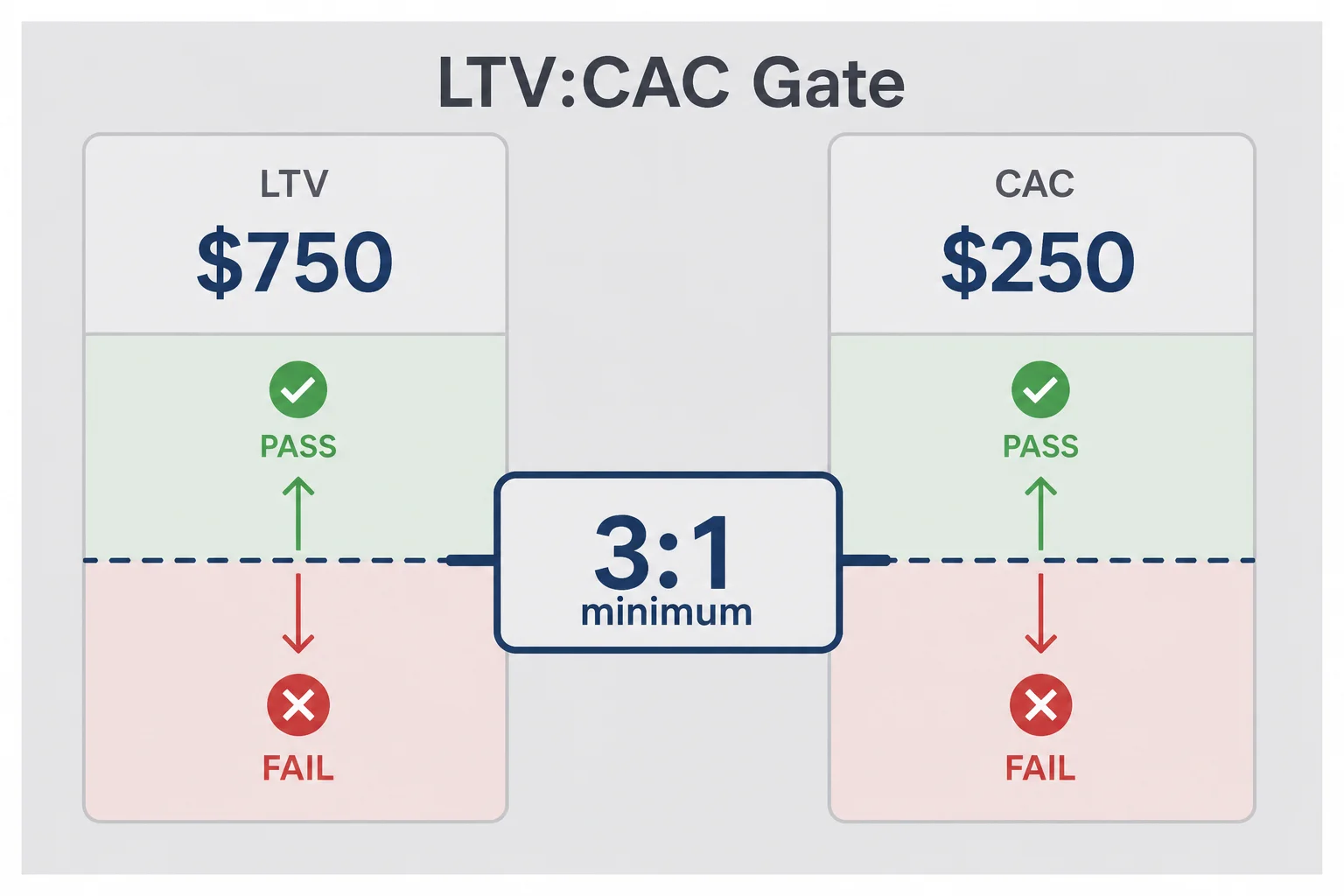
LTV:CAC is the bumper sticker of SaaS unit economics. Investors want 3:1 or better. Solo founders should want that too, with one difference: you cannot raise a round to cover a bad ratio while you "figure out retention."
LTV is not "monthly price times forever." LTV is what a customer actually pays you before they leave, on average, minus refunds and discounts, in the time horizon you can reasonably model. For a micro-SaaS with thirty to eighty customers, honest modeling often looks like average monthly revenue per customer divided by monthly churn rate. If ARPU is $45 and churn is 6% a month, a simple LTV estimate is $45 divided by 0.06, which is $750. That is already optimistic if churn is improving because you fixed onboarding last month. Use the uglier trailing average.
CAC is what you spend to get one paying customer, not one trial, not one click. Include ad spend, creative tools, landing page tests, and the hours you would pay a contractor to do if you were not doing it yourself. Solo founders often forget the labor tax. Your time has a price even if you do not invoice it.
Divide LTV by CAC. Above 3:1, ads might be a machine. Between 2:1 and 3:1, tread carefully. Below 2:1, you are buying revenue at a loss and hoping churn cooperates. Hope is not a strategy. It is how you end up with 400 trials and twelve payments, then a blog post about how ads are dead.
I once modeled LTV using "if nobody churned." Cute. Real LTV used the last ninety days of cancellations. The ratio dropped from 4.2:1 to 2.1:1. Still not tragic. Not green-light scale either.
Conservative inputs feel pessimistic until they save you from scaling a leak. When in doubt, shave LTV by twenty percent and add twenty percent to CAC. If the ratio still works, proceed. If it does not, you just bought clarity for the price of a spreadsheet row.
Why solo founders lie to themselves here
The lies are always the same flavor. "Enterprise will pay more later." "Churn will drop when we ship the dashboard." "CAC will fall when we find the winning creative." Maybe. Ads today are priced on today’s math.
Another lie: counting trials as customers. A trial is inventory. It is not LTV until money moves. Your ad platform will happily optimize for cheap trials. Stripe tells the truth.
Segment LTV when you can. Organic customers who found you from a blog post often stay longer than cold ad traffic. Blending them flatters ads. If you only have twenty customers total, segmentation is noisy. Still note the direction. When ad cohorts churn twice as fast, your paid LTV is half the blended number and your CAC tolerance should shrink immediately.
I also separate refunds from churn in my head. A refunded annual customer is not "churn at month twelve." They are a negative LTV event in week two. Ads that attract refund-heavy buyers are worse than ads that attract slow activators. Both hurt. Refunds hurt faster.
If your pricing is $19 a month because it felt safe, LTV collapses even when CAC looks fine on paper. A $19 customer who stays five months is $95 gross. At $120 CAC you are underwater before hosting and support. Price is not separate from unit economics. It is the numerator.
Work the ratio backward when planning spend. Pick a CAC ceiling from a small test or industry guess. Multiply by three. That is the minimum gross LTV you need. Divide by ARPU to get implied months retained. If implied months retained is higher than your actual trailing retention, ads are not a scaling problem yet. Retention or price is.
I keep a one-line note in my project doc: "CAC ceiling $X at Y months retained." When retention improves, the ceiling rises without any change to creative. That is the cheapest growth hack that actually exists, and it has nothing to do with audiences.
Payback period: the number your bank account actually cares about
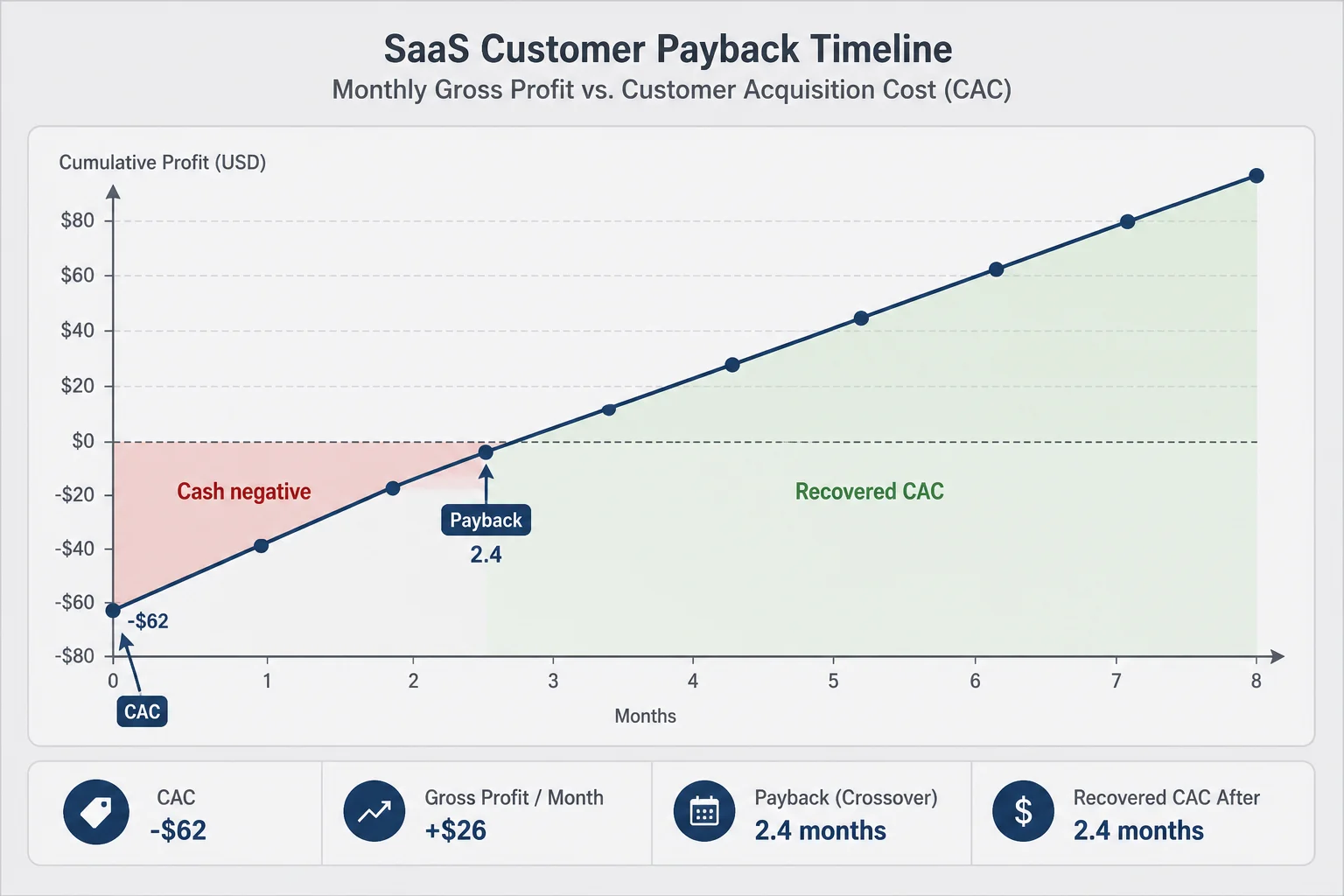
Ratio talk is abstract. Payback period is whether you can make payroll.
Payback answers a simple question. How many months until this customer’s contribution margin repays what you spent to acquire them?
Formula: CAC divided by monthly contribution margin per customer.
Contribution margin is not MRR. It is revenue minus variable costs tied to serving one more customer: payment processing, usage-based API bills, email sends that scale with users, support load you can attribute. Fixed costs like your base hosting or your own salary do not belong in this per-customer margin for payback math, though they belong in "can I afford to run this business at all."
Example. You spend $160 in ads and tooling to win a customer on a $49 plan. Stripe and variable infra eat $7. Support time, priced honestly at $8 a month equivalent at your current scale. Contribution margin is about $34. Payback is $160 divided by $34, roughly 4.7 months.
Under six months, I will scale cautiously. Six to nine months, only if churn is stable and cash is not tight. Above nine months, you are running a bank that lends money to future you and charges interest in the form of anxiety.
Solo founders feel payback in the checking account before it shows up in a cohort chart. You spend $2,000 on ads in March. April revenue looks fine because trials convert on a lag. May hits and you are buying groceries from the same account that funded acquisition. That is not failure. That is cash timing. Ads move cash out now and revenue in later. If later is too late, you do not have a marketing problem. You have a treasury problem.
Cash lag and trial delay
Trials stretch payback before they stretch LTV. You pay for the click on day zero. Card charges on day fourteen if you are lucky. Refunds cluster around day twenty-one when someone realizes they never finished setup.
Model payback from first dollar collected, not from signup. If your free trial is fourteen days and conversion is 15%, your effective CAC per paying customer is roughly six times higher than cost per trial. The ads dashboard will not do that math for you.
I keep a row on the same legal pad: "months until cash positive on this cohort." Not MRR added. Cash in minus cash out for the acquisition month and the following months. Boring. Accurate.
Founders sometimes ask if payback should include the cost of building the landing page or the first month of an agency retainer. Yes, if you would not have spent it without ads. No, if it is a one-time asset you reuse across channels. When in doubt, include it. Conservative payback has never embarrassed me. Optimistic payback has.
If your product has a long setup before first value, payback clocks start late. A B2B tool that needs a week of data import before the dashboard lights up will show terrible early cohorts even when month-four retention is fine. Model payback from activation, not from signup, same as trials. Otherwise you kill a campaign that was teaching you something true on a slower timeline.
Annual billing changes the picture, which is why I treat annual plans as a cash instrument, not proof of love. A customer who prepays $490 can make March look heroic while contribution margin still drips in monthly if you recognize revenue honestly. Payback can look instant on cash while operational payback on effort is unchanged.
Picture two founders with the same CAC and the same ARPU. Founder A has six months of expenses in the bank. Founder B has six weeks. Identical math, different decision. Payback period is not only a formula. It is a formula read against your nerves and your rent due date. I will accept a longer payback with cash in the bank and stable churn. I will not accept it when one slow month means pausing development to drive Uber.
Seasonality punches solo founders in the face. B2B trials die in late December and mid-August. If your payback model assumes twelve smooth months, November ad spend can look broken when the truth is everyone is on vacation. Compare cohorts year over year before you panic, and keep December budgets smaller unless your buyer is a retailer who lives for Q4.
Contribution margin: the gate nobody posts about on LinkedIn
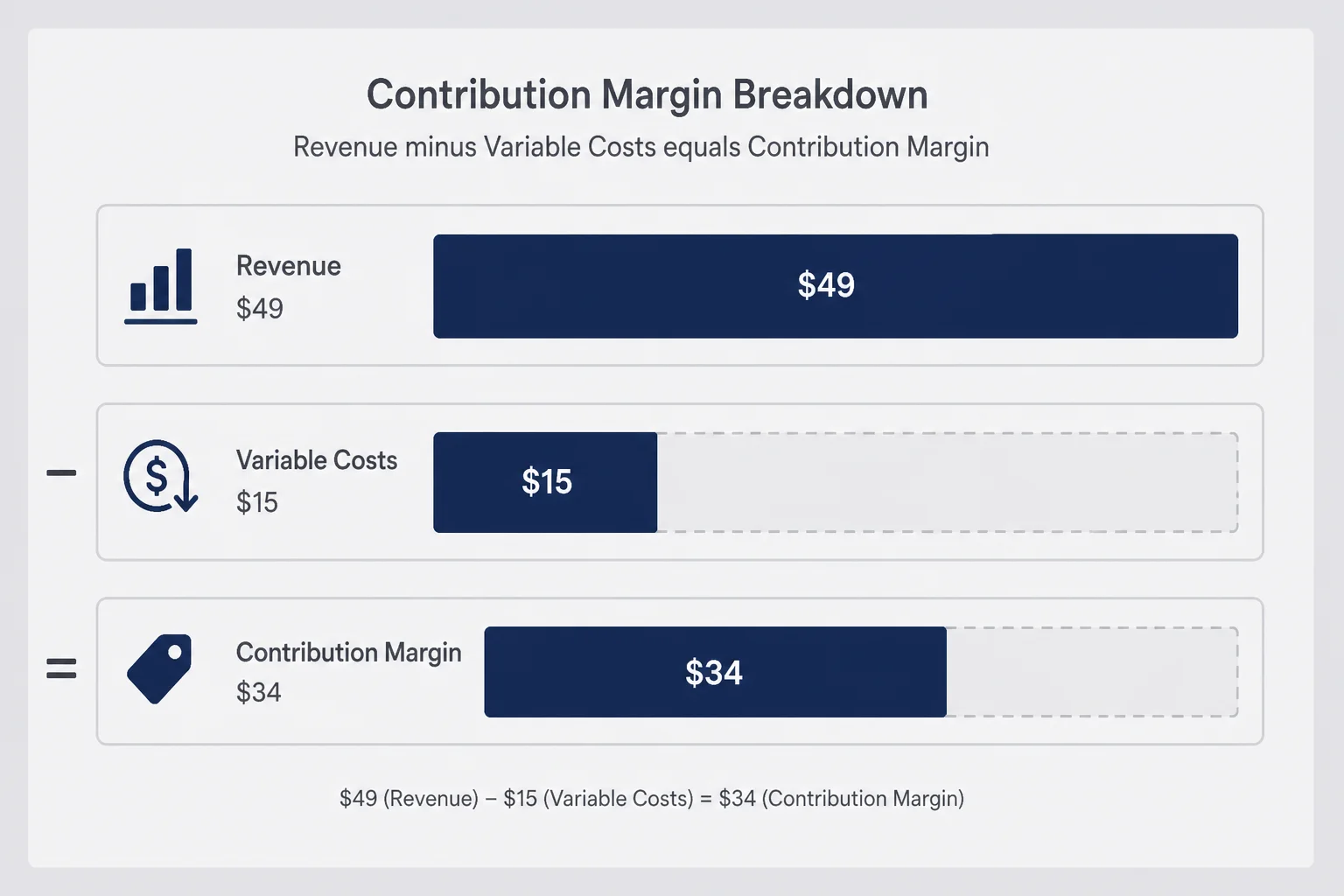
People argue about CAC on Twitter. They rarely post their contribution margin per customer because it is embarrassing how thin it gets at low prices.
Contribution margin is the money left after variable costs to cover fixed costs and profit. For ads math, it is the monthly number that pays back CAC.
At $29 a month with $6 in processing and variable infra, you might net $23. Support-heavy products net less. AI-heavy products net less unless you pass usage through. A solo founder answering forty emails a week from $12 customers does not have a $12 margin problem. They have a $12 price problem wearing a support costume.
Raise price, margin widens, payback shortens, LTV rises. Same CAC suddenly works. That is why I nag people about pricing before I nag them about lookalike audiences.
Variable costs hide in weird places. OpenAI tokens per active user. Image processing per export. SMS reminders. Webhook retries that scale with volume. If one heavy user costs you $40 a month and your plan is "unlimited," your margin is a fiction until you meet that user.
I bucket customers into light, medium, heavy once I have usage data. Ads bring strangers. Strangers include the heavy bucket. Model margin with a pessimistic mix, not the average of your friendly early adopters.
Support is a variable cost whether you like it or not
You will not hire support at month one. You are support. Still price your time. If each new customer adds two tickets a month and each ticket takes twelve minutes, that is twenty-four minutes monthly. At a $60 effective hourly rate, that is $24 before the customer asks for a feature call.
Ignore support in your margin and payback looks fast. Include it and you might discover ads only work above $49 for your current onboarding quality. That is useful. Painful. Useful.
Fixed costs still matter for survival. Rent, tools, your minimum income. They just should not inflate per-customer payback unless you are deciding whether to run ads at all. If contribution margin is positive and payback is acceptable, ads can be rational even when the business overall is not yet paying your full salary. If contribution margin is negative, ads are a machine that ships you customers who lose money on every invoice.
Gross margin percent from a VC deck is not contribution margin for a solo shop. You might show eighty percent gross margin on paper because you forgot that "founder support" is not free. Recalculate with your actual Tuesday, not your pitch deck Tuesday. The second number is the one that decides whether ads are allowed.
When you raise prices, revisit margin before you revisit bids. A $10 ARPU bump might add more to payback speed than a week of keyword tuning. I have seen founders celebrate a twenty percent CAC drop from creative while leaving thirty percent of margin on the table in pricing. The creative win was real. The strategic win was elsewhere.
The unit economics gate: a checklist before you scale spend
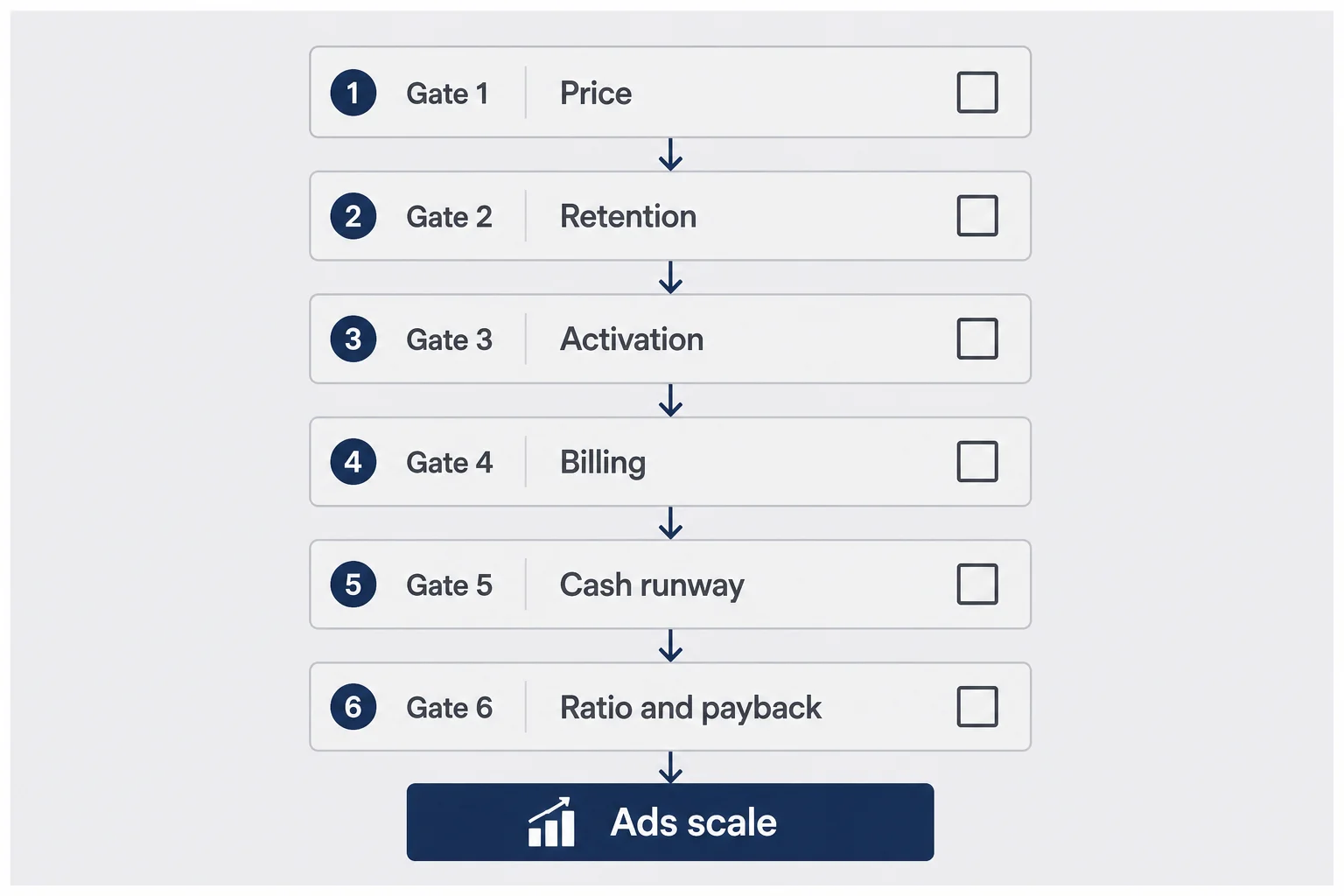
I keep a literal checklist. Not because I love process. Because impulse is expensive.
Gate 1: Price defensible. One plan or a clear default. You can explain the number without apologizing. ARPU is not stuck at a tier that makes support impossible. If you are still A/B testing $19 versus $29 on principle, finish that fight first.
Gate 2: Retention understood. You know monthly churn over the last sixty to ninety days, not lifetime since launch when the product was different. At least twenty customers have renewed more than once, or your sample is noise.
Gate 3: Activation named. You can point to one in-product action that correlates with payment. Not "used the main feature." Something specific. Connected Shopify. Sent first report. Invited a teammate. Ads send traffic to a machine. You should know which lever matters.
Gate 4: Billing truth. Stripe webhooks update entitlements. Trials end the way you think they end. Failed payments are not silently granting access. Your MRR dashboard matches Stripe's paid invoices, not wishful counting.
Gate 5: Cash runway for lag. You can spend one to two months of ad budget without missing rent while trials convert. If the only way ads work is prepaying $5,000 you do not have, fix cash or fix payback before you scale.
Gate 6: Ratio and payback on conservative math. LTV:CAC at or above 3:1 with pessimistic LTV. Payback under six to nine months depending on your nerves and bank balance.
Fail any gate, run a small test if you must learn, but do not call it scaling. Call it tuition.
I failed Gate 3 once on a reporting tool. Ads brought cheap trials. Activation was "connect your data source," which took forty minutes and a CSV template from 2014. CAC looked fine. Paid customers did not. We fixed onboarding, not the bid strategy. CAC rose per trial. Paid CAC fell. Counterintuitive unless you have lived it.
What a small test is allowed to do
A $20-a-day test for two weeks is not scaling. It is buying information. Expect to lose it. Track trial start, activation event, trial-to-paid, and refund rate by campaign, not just CPC.
Kill losers fast. Solo founders romanticize the creative that almost worked. Almost is still a no.
When a test passes the gates on paper but fails in cash, trust cash. Paper LTV is a model. Your account balance is an audit.
Print the checklist. Seriously. Tape it next to the monitor. Impulse is weaker when you have to physically look at "activation named" and admit you cannot name it. Founders laugh at this until the week they almost scale. The paper is cheaper than tuition.
Gate failures are not moral failures. They are sequencing. I failed Gate 4 once because webhooks worked in test mode and silently failed in production for one edge case. Ads were fine. Billing was not. Fix the gate, rerun a small test, move on. The checklist is not a permanent rejection. It is a pause with a reason.
The profitable ads loop once the gate opens
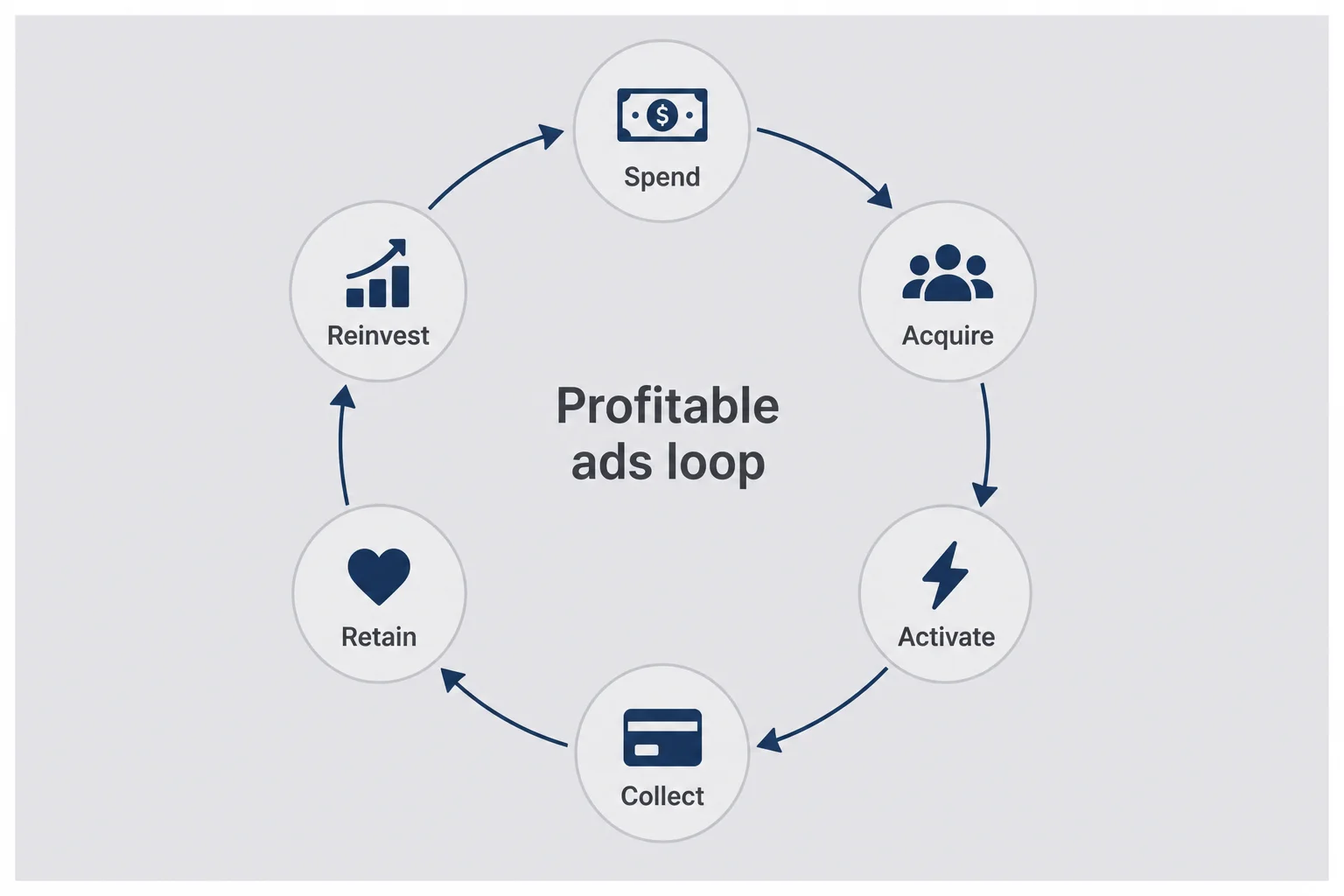
When the math works, ads stop being a gamble and start being a loop. Spend, acquire, activate, collect, retain, reinvest. Boring on purpose.
Spend with a daily cap you can ignore for a week without panic. Acquire trials or direct purchases, depending on funnel. Activate with a landing page that matches the ad promise and a first session that finishes in under ten minutes. Collect via billing you trust. Retain so LTV is real. Reinvest a fraction of contribution margin, not all of it, until payback stabilizes.
The loop breaks in predictable places. Creative fatigue raises CAC. Seasonality hits B2B in August and December. A bug in trial expiry creates ghost revenue. Churn rises when ads bring a less ideal customer segment than organic did.
I watch cohort quality, not just volume. If ad customers churn faster than organic, your LTV assumption for paid traffic needs its own column. Blended LTV lies politely.
Retargeting is the solo founder's friend once traffic exists. Cheaper CAC, warmer intent, smaller creative burden. It is not a substitute for cold acquisition if you need new people, but it is often the first profitable campaign because the gate is lower.
Referrals and content lower blended CAC. Ads raise top-of-funnel when you have something worth pouring into. The loop works best when organic whispers and paid shouts the same promise. Divergent messaging confuses activation metrics and makes you think onboarding broke when positioning did.
Creative is not a substitute for economics
Good creative lifts conversion ten to thirty percent. Bad economics cannot be fixed with a hook. If payback is twelve months at best, a killer video buys you eleven months. Still no.
I spend more time on the post-click experience than on thumb-stopping hooks. Load time. Headline match. One CTA. Trial signup that does not ask for a biography.
When the loop runs, increase budget monthly, not daily. Step changes let you see if CAC drifted before you are $3,000 in. Automated rules help if you set them when calm, not after a bad night.
Document the loop when it works. Write down the campaign structure, landing page, trial rule, and activation metric that produced acceptable payback. Future you will forget and try to reinvent it during a slow week. Ads amnesia is real. You will remember the feeling of growth and forget the checkout page headline that converted.
Pair paid with something you own. Email list, retargeting pixel, content that ranks. The loop survives platform risk better when you are not one policy change away from zero distribution. Unit economics include the cost of rebuilding if the account gets restricted because you used the wrong word in ad copy. It happens. Ask anyone who sells anything adjacent to finance or health.
Pricing is the fastest lever on your ad math
Ads feel like a growth channel. Price is the silent partner that decides whether that channel is legal.
Move ARPU from $29 to $49 without losing more than a third of conversions, and LTV jumps while CAC tolerance jumps with it. Payback shrinks. The same $150 CAC goes from reckless to fine.
I see founders tweak audiences for weeks while leaving $19 on the page because a competitor priced there in 2021. Competitors might be wrong. They might be subsidized. They might be dying slowly. Copying their price copies their margin structure without copying their runway.
Micro-SaaS pricing for solo founders is not a separate topic from paid ads. It is the first dial. Annual discounts, higher tiers, and usage limits that protect margin all change the ad equation before you upload a single creative.
Raise price before you raise budget. Test price on new customers while grandfathering early believers if you must. Measure trial-to-paid and refund rate, not just sticker shock complaints. Complaints from people who were never going to pay are not data. They are noise with avatars.
Discounts and CAC illusions
Coupons inflate conversion and deflate LTV. A fifty percent first-month discount changes payback math. If your ad optimizes for discounted signups, you might win the dashboard and lose the bank account when month two charges full price and churn spikes.
Keep promotional complexity off the first paid acquisition push. One price. One trial rule. One story. Complexity is for later, when you have cohorts to study.
Enterprise someday does not help this month's ads. Sell to the buyer you can reach on Google today. Price for that buyer's pain, not for the logo you hope appears in a case study.
Think about willingness to pay in the ad headline, not only on the pricing page. If your tool saves a shop owner three hours a week, say that in the ad and price at $49 without flinching. Underpricing in the ad creative signals underpricing in the product. Humans are consistent that way.
Price increases for new customers while ads run are allowed if you communicate value, not if you are panic-raising to fix a broken margin. Raise from strength after retention proves out, not from weakness because CAC came in hot. The sequence matters again.
Trials, activation, and the hidden multiplier on CAC
Paid traffic loves trials. Trials love ambiguity. Ambiguity kills unit economics.
Every point of trial-to-paid conversion changes effective CAC. Spend $1,000 for 100 trials, convert 10%, you bought ten customers at $100 CAC before activation failures. Convert 20%, CAC is $50. Same ads. Different product moment.
Micro-SaaS free trial solo founder decisions matter here: length, card upfront, what happens on day zero. Fourteen days with no card might flood trials that never intend to pay. Seven days with a card might starve the top of funnel but feed payback.
I bias toward shorter trials once activation is solid. Long trials delay the truth. Solo founders do not need more time to hope. They need faster no's.
Activation is the bridge. Define it narrowly. Measure it per campaign if volume allows. If Meta traffic activates at 22% and Google at 41%, your blended CAC is lying. Split them.
Onboarding emails, empty states, and the first success screen are ad assets. They do not show up in Ads Manager. They show up in Stripe thirty days later.
When to skip trials in paid funnels
Direct-to-paid can work for simple tools with instant value and low price friction. Trials add steps. Steps add drop-off. If your product delivers value in one session, charging immediately with a money-back guarantee might beat a fourteen-day maze.
Match funnel to product shape. B2B workflow tools often need trials. Small utilities sometimes need a checkout button and courage.
Do not copy a competitor's trial because their landing page looks nice. Copy the economics implied by their retention, which you will not see. Run your own funnel like an engineer, not a tourist.
Run a weekly fifteen-minute funnel review while ads are live. Trials started, activation rate, trial-to-paid, refunds, by source. No new tools required. A spreadsheet and honesty. The review is where you catch the hidden multiplier before it becomes a month of spend. Skip it and you will optimize bids while onboarding rots.
If trial-to-paid is below ten percent for B2B with decent activation, I pause scale and fix the first session. Below five percent, I pause spend entirely. Those thresholds are not universal law. They are my panic buttons. Set yours before you launch, not after you are emotionally invested in the campaign name.
Annual billing, cash, and whether you can afford to buy customers
Ads spend cash now. Annual billing collects cash now. That pairing is seductive and dangerous.
Annual billing discount micro saas plans can fund acquisition if refunds stay rare and the product is stable. Collect $490 in March, spend $400 on ads in April, feel like a genius in May when trials from April convert.
If refunds spike because annual buyers misunderstood the product, you funded ads with borrowed confidence. Annual hides churn until renewal. Monthly tells you faster. I prefer monthly learning until activation is predictable, then annual as a cash lever, not a crutch.
Cash from annual does not change contribution margin per month unless you recognize revenue monthly for decisions. For payback, you can treat annual prepay as accelerating cash recovery if refund policy is strict and support load is manageable.
Do not let annual revenue make CAC look smaller in your head than it is. Divide prepay by expected months retained, not by twelve by default. If average retention is seven months, that is the horizon. Be honest.
Refund policy is part of unit economics
Generous refunds protect brand. They also raise effective CAC. Model refund rate by source if you can. Ad traffic sometimes refunds more because expectations were set by an ad promise you overshot.
Tighten the promise before you tighten refunds. Landing page copy is a billing policy.
Solo founders with thin cash should win organic payback first, then add ads with a ceiling. Winning organic payback means customers from content, referrals, or communities repay acquisition effort in acceptable time without invoice from Meta.
Use annual selectively in ad landing pages. Defaulting to annual on cold traffic can tank conversion if the buyer wanted to try monthly first. Show both paths with clear savings math, same advice as the annual billing post. Let self-serve buyers choose annual after activation, not before they know your name.
If you offer annual only to reduce churn before product-market fit, ads will buy you a year of regret faster than monthly ever could. Cash upfront is not forgiveness for a weak first week.
Stripe, measurement, and not lying to yourself with MRR
Your ad platform and your bank account speak different languages. Stripe billing for micro saas is the translator if you wire it correctly.
Count paying customers from paid invoices, not from checkout.session.completed before trial ends. Tag trials separately from subscriptions in your database. When webhooks fail, you will think ads work while access is free. I have been there. It is not a growth hack. It is a bug.
Track cohorts by acquisition source in Stripe metadata or your app database. utm_source on signup is not vanity. It is how you know Google trials convert better than Instagram reels.
MRR dashboards smooth reality. Cash and paid invoices do not. For ad decisions, I keep a weekly sheet: spend, new paid customers, refunds, net cash from those customers to date. Simple. Hard to fool.
Dunning matters. Failed cards after trial look like churn in product analytics and like almost-revenue in ads reporting. Stripe billing with invoice.payment_failed handled saves unit economics from silent leaks.
Metrics I ignore on purpose
Impressions, CTR, and CPC are diagnostics, not outcomes. I care about cost per activated trial and cost per paid customer. Everything else is prelude.
ROAS on day seven is fiction for subscription businesses with trials. If someone demands ROAS on week one, they are selling courses, not running your payroll.
Blended CAC across channels is for storytelling. Decisions get made per channel once volume exists. Kill a channel on its own payback, not on blended comfort.
When Stripe and Ads Manager disagree, Stripe wins. Always. The other dashboard is an estimate wearing confidence.
Build a simple reconciliation habit. Once a week, export paid invoices from Stripe for customers tagged with an ad source. Compare count and revenue to what the ad platform claims as conversions. Discrepancy is normal. Large persistent discrepancy means your tracking is lying and your unit economics are built on sand.
Store utm_campaign on the user row at signup, not only in analytics. Analytics sessions expire. Database rows survive. When someone pays in week three, you still want to know they came from the March search campaign. That single field has saved me from scaling the wrong winner more than once.
Questions I get about unit economics and paid ads
What LTV:CAC ratio should a solo founder hit before running paid ads?
Aim for at least 3:1 on fully loaded numbers, not wishful LTV from a spreadsheet you built on a Sunday. If your realistic customer pays for five months at $49, that is about $245 gross LTV before churn eats the tail. At 3:1 your CAC ceiling is roughly $80. Many solo founders see $120 to $250 CAC on cold Meta or Google traffic for B2B tools, which is why ads fail before creative does. Fix price, retention, or conversion first.
How long should payback period be for micro-SaaS paid ads?
Under six months is the band I want before scaling spend. Twelve months can work if you have cash reserves and low churn, but solo founders rarely have both. Payback is CAC divided by monthly contribution margin per customer. If you spend $150 to acquire someone who nets you $35 a month after variable costs, payback is about 4.3 months. Above nine months, one bad month of churn or a creative fatigue dip can wipe out a quarter of progress.
When is paid acquisition too early for a solo founder?
Too early when you do not know why people convert, when monthly churn is still a mystery, when your price is a guess, or when fewer than twenty customers have renewed at least once. Ads amplify what already works. They do not fix positioning, onboarding, or a product people politely try once. I also wait until support tickets repeat instead of surprising me every week. Predictable operations matter when you are buying strangers at scale.
How does a free trial change unit economics for paid ads?
A trial turns part of your ad spend into a time delay before revenue. You pay for the click today and maybe collect money in two weeks. Low trial-to-paid conversion is a silent CAC multiplier. If only eight percent of trials convert, your effective CAC is twelve times higher than the dashboard suggests unless you model trial drop-off. Tighten activation and trial length before you blame the ad platform.
Should solo founders start with Meta ads or Google ads?
Google Search when strangers already type the problem into a search box. Meta when you can describe the buyer tightly and show a visual before-and-after. Solo founders with narrow B2B pain and clear keywords often learn faster on Google because intent is higher. Meta can work for visual products and retargeting once you have site traffic. Either way, start with a small daily budget you are willing to lose while you read the unit economics, not while you hunt for a winning hook.
What is a realistic CAC for micro-SaaS paid ads?
For cold traffic to a $29 to $79 B2B tool, $80 to $200 per paying customer is common once you include creative tests and failed trials. Cheaper CAC usually means warmer traffic you already earned through content or referrals, not magic targeting. If your contribution margin is $40 a month, a $180 CAC needs roughly 4.5 months payback before you even think about scale. Compare that to your bank balance honestly.
The boring gate beats the heroic burn
I still want to press the green button sometimes. Growth graphs are emotionally loud. Unit economics are quiet until they are not, usually when the account balance whispers.
Saas unit economics paid ads solo founder work is not sexy. It is a pad, a conservative spreadsheet, a checklist, and the discipline to keep the ads button gray until the math survives pessimism. Price right. Measure retention without flinching. Fix activation before you fix audiences. Wire Stripe so revenue is real. Treat trials and annual plans as levers on the same equation, not side quests.
When the gate opens, ads can be a machine that buys you customers you already know how to keep. Until then, you are not behind. You are solvent.
Run the numbers tonight on paper if spreadsheets make you performative. If the ratio only works with best-case churn, you have your answer. If payback survives ugly assumptions, run a small test and watch Stripe, not the ad dashboard.
The founders who win with paid acquisition are rarely the ones with the best creative. They are the ones who refused to scale a leak because a podcast made urgency sound like virtue. Boring SaaS math beats heroic ad spend every time the checking account is yours alone.
Go fix the numerator before you feed the algorithm.
One last scene, because stories stick better than formulas. A founder I respect finally passed every gate. Ran a $30-a-day test for three weeks. Payback landed near five months on conservative margin. He doubled budget. CAC held. He doubled again. Month three, churn ticked up one point from a segment of ad buyers who expected a feature on the roadmap slide in the ad. Not a bait and switch. A mismatch. He paused scale, fixed the landing page promise, emailed new users about timeline. Churn settled. Budget rose again, slower.
That is what good looks like. Not a hockey stick from day one. A machine you tune while solvent. Unit economics are the tune-up. Ads are just gasoline. Pour gasoline into a leaking engine and you get fire, not distance.
If you are not there yet, you are not behind. You are early. Early is cheaper than wrong.




Comments