Forty-Three Subscribers and a Product Nobody Hears About
How to run a founder newsletter as a solo micro-SaaS builder: grow an owned email list, pair it with cold outreach, and connect it to waitlists and onboarding without sounding like a changelog.
 By Reese26 min read
I opened ConvertKit on a Tuesday and stared at a graph that looked like a flat line with a small bump from my mom. Forty-three subscribers. Three of them were me testing links. One was a former coworker who signed up out of pity. The product worked. Stripe worked. What did not work was the part where strangers kept hearing from me after they left the landing page.
That is the gap a founder newsletter micro saas solo founder setup is supposed to fill. Not fame. Not a personal brand empire. A small owned audience that remembers you exist when you ship the next thing, fix the pricing page, or finally write the onboarding email that does not sound like a terms-of-service PDF.
I have spent more of my career in inboxes than in code editors. Growth at small B2B shops, freelance consulting for indie builders, a couple side projects that paid rent for a month and then went quiet. The pattern repeats: builders treat Twitter like a launch button and email like something you turn on after Product Hunt. Then launch week ends and the graph goes back to flat.
A product nobody hears about is just an expensive hobby. I say that a lot because founders keep proving it. They ship something clean, post twice, and wonder why trial signups look random. Random is what you get when every visitor is a one-night stand from an algorithm you do not control.
This article is for you if you already have a landing page, maybe a handful of customers, and you want a founder email list that compounds instead of resetting every time the feed moves on. I will walk through what owned audience actually means at micro-SaaS scale, how newsletter growth solo founder tactics differ from influencer playbooks, why ConvertKit micro saas setups beat overbuilt stacks, how newsletter vs cold email split the same inbox, and where your list connects to waitlists and onboarding. If you need the content rhythm that feeds the newsletter, read the founder content creation system for solo founders first. If you are still pre-launch, pair this with waitlist micro saas solo founder so capture and nurture stay connected.
Founder newsletter micro saas solo founder: the job you are hiring email to do
Your newsletter is not marketing fluff sitting beside the product. It is distribution you own. Social platforms lend you attention. Email stores permission. That difference matters when you have no ad budget, no SDR, and no co-founder who loves posting.
When I say founder newsletter, I mean a recurring email from a person building a specific product for a specific buyer. Not a corporate blog digest. Not a weekly roundup of seventeen links you did not read. A letter where someone who understands the problem shares what they learned while trying to solve it, with the product visible but not screaming in every paragraph.
The job breaks into three moves that sound boring and are actually the whole game.
First, stay in memory. People forget tools exist. They forget landing pages they bookmarked at midnight. A short email on a predictable cadence is a polite tap on the shoulder. You are not begging for attention. You are honoring the fact that they asked to hear from you.
Second, teach before you sell. Micro-SaaS buyers at SMB scale do not buy because you added a feature. They buy because they trust you understand their Tuesday. Newsletters earn that trust faster than changelogs when the list is still tiny.
Third, bridge to action when the product is ready. Launches, betas, pricing changes, and honest "this did not work" posts all land differently when they hit people who have read you for a month. That is the micro saas owned audience advantage: warm reach without paying rent to an algorithm.
If you skip the newsletter and rely on launch spikes, you are always restarting. I have seen founders get five hundred landing page visits from a good post and convert two trials because nobody came back. Owned email fixes the comeback problem. It does not fix a bad offer. You still need clarity on who pays and why.
The voice problem most technical founders hide from
Developers often tell me they have nothing to say in a newsletter. What they mean is they do not want to perform online. Good. Performance is the wrong bar. Documentation of useful thinking is enough. You fixed a bug that exposed a misunderstanding about how agencies report hours? That is an email. You rejected a feature request because it served an edge case? That is an email too, if you explain the trade-off without being defensive.
You do not need jokes. You do not need a hot take about AI replacing jobs. You need to sound like the person who actually answers support mail. Readers can smell when a newsletter is outsourced or assembled from templates. Write it yourself, even if it takes ninety minutes and feels awkward the first four times.
Subject lines that sound like you, not like Mailchimp circa 2014
I keep a swipe file of subject lines I actually opened as a buyer, not as a marketer. They are boring in the best way. "The invoice email I stopped sending." "Why our trial ends at day seven now." "A spreadsheet lie I see every month." Notice none of them say "Unlock growth" or "Your weekly digest." Specificity earns the open. Mystery without context feels like clickbait from a stranger.
Test one variable at a time when you are small. Subject line OR preview text OR send time. Not all three on the same send. You will not have statistical significance with four hundred subs. You will have directional hints if open rates jump or crater.
Preview text matters on mobile more than founders think. Do not repeat the subject. Extend it with the human detail. "Plus the one question I ask before every pricing change" gives a reason to tap.
Why this fits the grow stage, not the idea stage
Newsletters shine after you have something to point to, even if it is rough. Before that, conversations and validation beat list building. Once you can describe an outcome without lying, email becomes the spine that connects content, waitlist, and product updates.
You are in the grow funnel when strangers can sign up, use the product, and leave without you noticing. That is when distribution skill matters as much as the next feature. The newsletter is how a solo founder markets without pretending to be a media company.
What a micro saas owned audience actually means at twelve customers
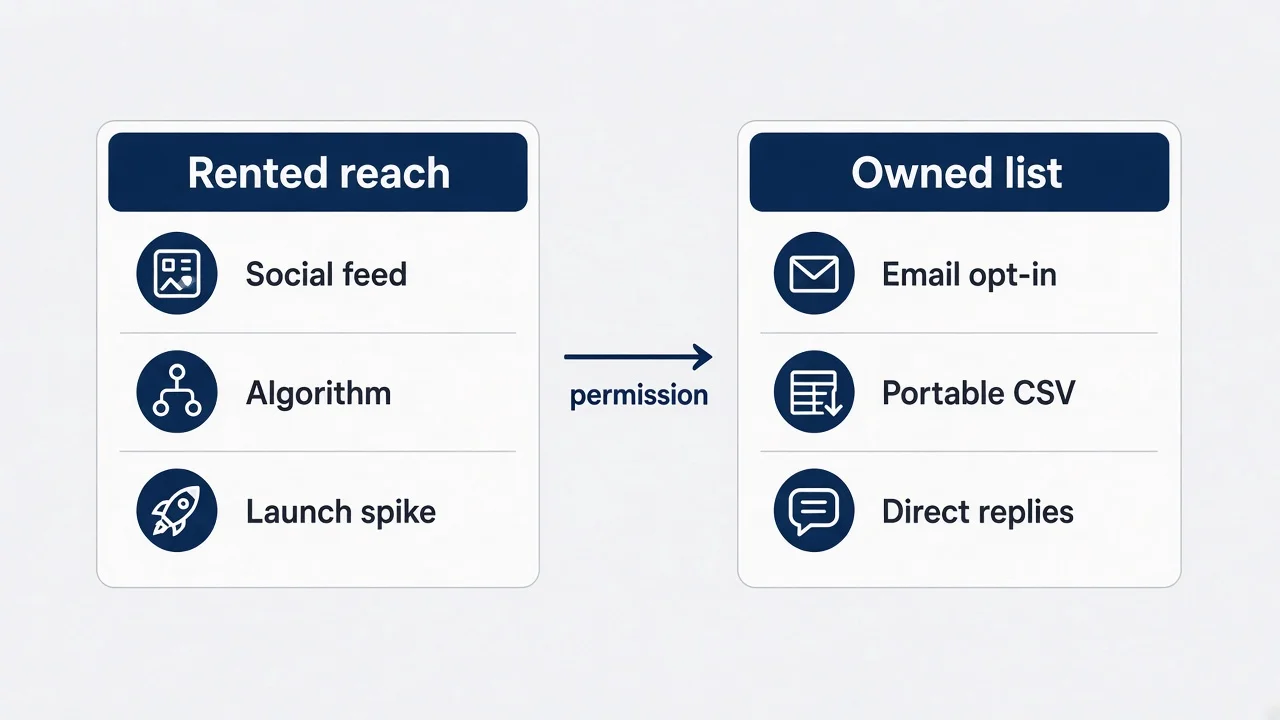
Owned audience is one of those phrases that sounds like a podcast title until you need it. Here is the plain version. If the platform changes the rules tomorrow, can you still reach the people who cared about your product yesterday? With email, the answer is mostly yes, as long as you exported the list and did not spam them into oblivion. With a social following, the answer is "sort of," which is code for no.
At twelve paying customers, your owned audience might be eighty subscribers and four people who reply every time. That is not embarrassing. That is a lab. Those four replies tell you which subject lines sound human, which problems repeat, and which feature requests are actually one person with a loud keyboard.
Rented reach still matters. I am not telling you to delete your account and live in a cave. Posts find strangers. Newsletters deepen strangers into readers. The mistake is optimizing only for the spike. Spikes feel like progress because numbers move. Email feels slow until someone replies "this is exactly my invoicing nightmare" and you realize you found a buyer segment without running ads.
Think of ownership as portability plus permission. Portability means you can move from ConvertKit to Loops without begging a platform. Permission means they opted in for your voice, not for a coupon that expired in 2019. Both beat follower counts that never see your launch thread because the algorithm had other plans.
I had a client who bragged about twelve thousand LinkedIn followers and could not fill a fifteen-seat webinar for his niche compliance tool. Different product, same lesson: borrowed reach measures attention, not purchase intent. Your founder email list is smaller and uglier on a dashboard. It is also the place where someone can hit reply and describe a budget line item.
I track owned audience with simple counters: active subscribers, open rate trend, reply rate, and how many trials or sales mention "your email" in the signup survey. Vanity is total subscribers if half are dead addresses from a giveaway you regret.
The list is an asset, not a scoreboard
Founders treat subscriber count like waitlist count. They screenshot it. They do not talk to it. An asset generates future actions: replies, forwards, beta testers, people who tolerate a broken onboarding flow because they trust you will fix it.
Protect the asset. Clean bounces. Remove people who have not opened in six months if your provider makes that easy. Write like a person, not a marketing automation textbook. One honest email beats four templated "value bombs" with no value in them.
Where SEO and the list meet without duplicate work
Search brings strangers who do not trust you yet. The newsletter converts strangers into people who recognize your name on a landing page later. Write the post for the keyword. Write the email for the person who already raised their hand. Same research, different packaging.
When a post ranks, add a single inline mention of the list mid-article, not only at the bottom. One sentence about getting more examples like this in their inbox. That placement catches skimmers who never scroll to footers.
Internal links from posts to posts still matter for SEO. The list is not a replacement for site structure. It is the retention layer on top of discovery. You want both nets in the water.
Newsletter growth solo founder when nobody knows your name yet
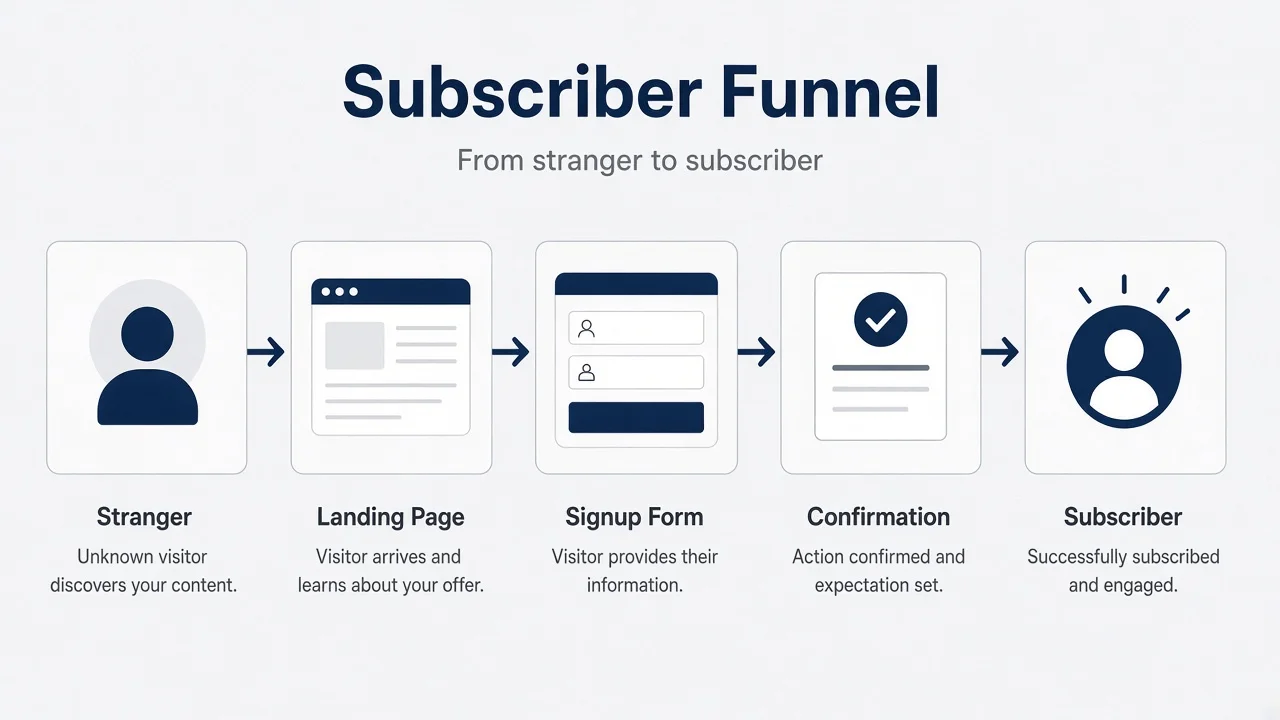
Newsletter growth solo founder paths look unglamorous because they are. You are not going to jump from zero to ten thousand subs unless you already have an audience somewhere else. Good. Small lists with the right people beat large lists that never open.
Start with a clear promise on one page. One sentence about who this is for. One sentence about what they get each week or each month. One field. Maybe a second field if you need a first name for human greetings. Every extra question is friction you must earn.
Lead with the problem you solve in public. Write posts that answer one narrow question your buyer actually types into Google. Link to the signup at the bottom like a footnote, not like a pop-up ambush. The founder content creation system is built for that rhythm: pick three topics, ship one, distribute once, repeat.
Borrow audiences carefully. Guest posts in newsletters that share your niche. Thoughtful replies in communities where buyers hang out, with your profile linking to the signup page. Interviews on small podcasts where the host actually serves your ICP. Each of these is slower than a viral thread and more durable than a spike.
Swap favors with peers at your scale. Not "newsletter exchange" schemes that smell like spam. Genuine cross-mentions when your products serve adjacent problems. A bookkeeping tool founder and an invoicing tool founder can share lists without competing if they are honest about overlap.
Run tiny experiments and write them up. "I changed the signup headline and conversions doubled" is interesting to the fifty people who care about invoicing pain. That post becomes signup fuel. Documentary beats declaration.
If growth stalls, the problem is usually positioning, not tactics. I once rewrote six subject lines for a founder who had not decided whether he sold to agencies or freelancers. The subject lines were never the problem. Fix who the letter is for, then fix the signup sentence.
Run a single landing page test per month if traffic allows. Change the headline on the signup form, not the whole site. Measure signup rate per hundred visitors from the same source. Founders obsess over email subject lines while the signup promise still says "join my journey," which nobody understands.
Pair SEO posts with the list when the keyword intent matches buyers. A post titled around a painful workflow should end with a signup that promises more workflow fixes, not "general updates." Alignment sounds obvious. Most signup pages ignore it.
Reply rate beats subscriber rate early
When you are under two hundred subs, count replies. An email that gets five thoughtful responses taught you more than fifty silent opens. Ask one question at the end. Not a survey link. A real question. "What did you try last month that failed?" works better than "How did we do?"
Replies also train spam filters and providers that humans want your mail. That sounds technical. It is really about writing like you want an answer back.
ConvertKit micro saas stack without paying for enterprise features
ConvertKit micro saas is the default I recommend when a solo founder asks me what to use. Not because it is perfect. Because it is understandable on a Sunday when you are tired and the product broke in prod and you still owe subscribers an email.
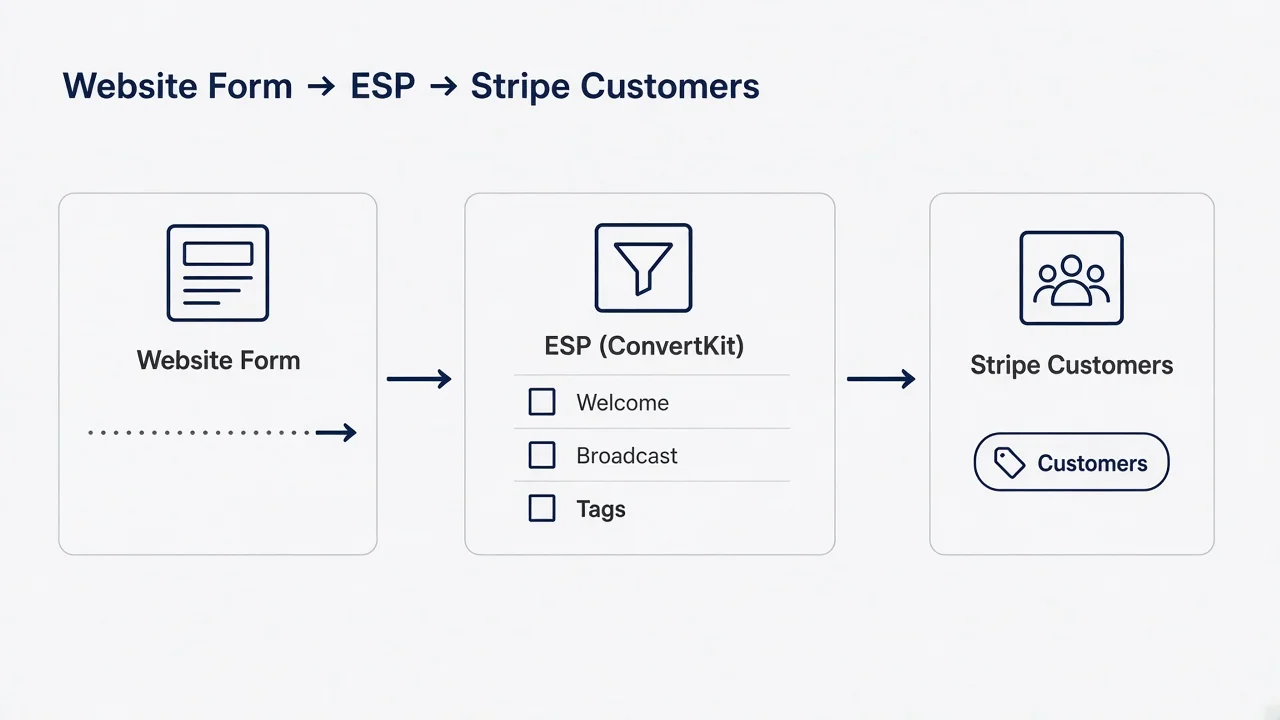
You need four pieces: capture, confirmation, broadcast, and automation light enough that you will actually maintain it. Capture is a form on your site or a dedicated page. Confirmation is the double opt-in email that sets expectations. Broadcast is the weekly or biweekly letter. Automation is maybe three emails, not thirty.
Tags beat complex funnels at your scale. Tag people who came from the waitlist. Tag people who clicked pricing in an email. Tag beta users. When you send, filter or segment if you must, but do not build a Rube Goldberg machine you forget to update.
Loops is the other honest option if your taste runs more developer-minimal. Same idea. Form in, emails out, tags if needed. Pick one and stop shopping. Shopping is procrastination wearing a stack comparison hat.
Integrate with how you already publish. Framer and Webflow both connect cleanly. If your site is Next.js, embed the form or use their API. The founder email list lives in the ESP, not trapped in a page builder you will abandon.
Pricing at micro-SaaS scale usually starts free until you hit a few thousand subs or need automations that matter. Pay when the tool saves you more time than it costs. Do not pay for CRM features you will never configure.
Export monthly. Seriously. Put a calendar reminder. Owned audience means you can leave. Providers are good until they are not. Your business should survive a migration.
If you are non-technical, you can still wire this without Max-level code. Framer forms, Webflow embeds, and ConvertKit landing pages get you live in an afternoon. If your app is custom, ask your builder for a form endpoint once and stop debating ESP APIs forever. The stack is not the bottleneck. The letter is.
When you do connect Stripe, tag purchasers automatically if your provider supports it. Manual tags work until you forget after a late-night sale. One missed tag is fine. Fifty missed tags mean you pitch beginners to people who already pay you.
What not to bolt on yet
Skip referral contests until you have content worth sharing. Skip complex scoring until you have enough data to score. Skip twelve-branch automations until you have sent twelve broadcasts manually and know what people respond to.
Your ConvertKit micro saas setup should look almost boring on the inside. One welcome sequence. One newsletter template. One tag for customers synced from Stripe if you can manage it. Boring is maintainable. Maintainable is what solo founders need.
Newsletter vs cold email: same inbox, opposite temperature
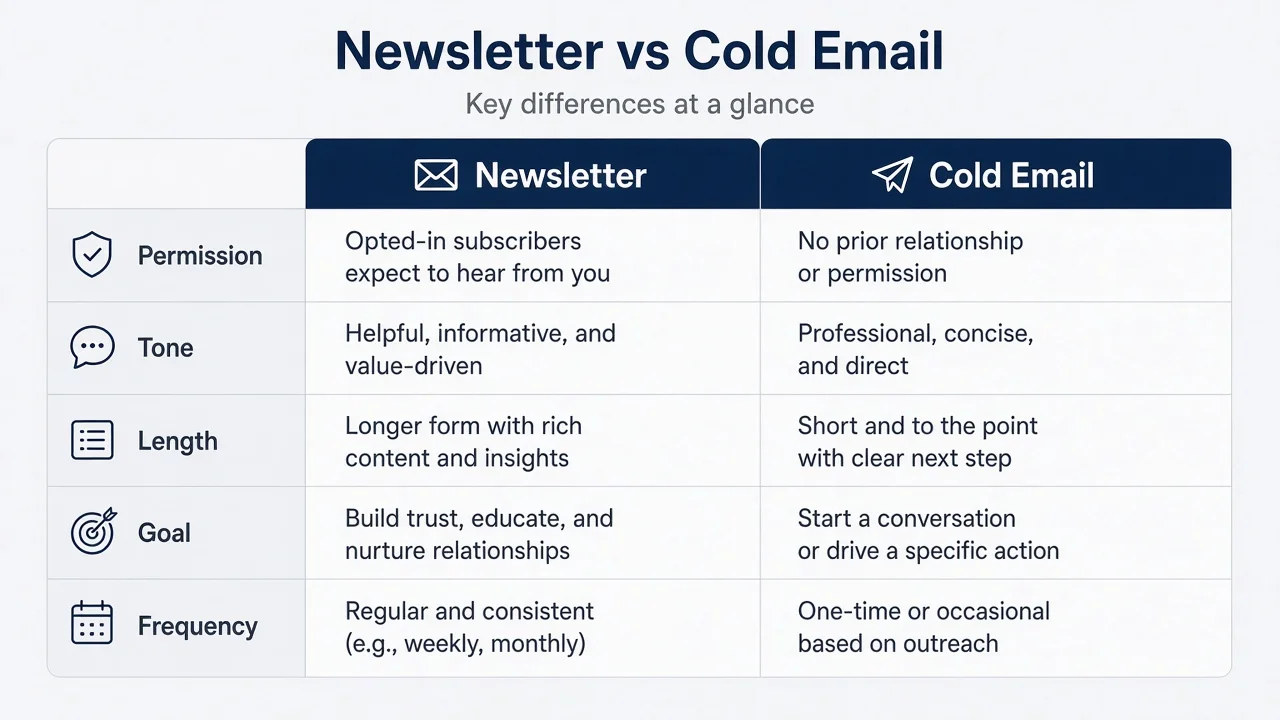
Newsletter vs cold email confuses people because both land in Gmail. They are not the same channel. Newsletters are pull. Cold email is push. One started with yes. The other started with "who is this?"
Newsletters assume ongoing permission. You write for people who opted in. You can be longer. You can tell stories. You can mention the product every third email instead of every paragraph. Cold email assumes you must earn the next sentence. You are interrupting. You need one sharp reason to reply, not a lifestyle essay.
I use cold email when I have a specific list of companies or roles and a hypothesis about pain. I use the newsletter when I want compounding trust with people who might buy someday, or who bought and should not forget me. Cold email can produce a customer Tuesday. A newsletter produces the customer who does not churn because they feel like they know you.
Same inbox, different contracts. Break the contract and you pay. Spam the newsletter list with daily pitches and opens crater. Send a cold email that reads like a newsletter and you get marked as spam. Match format to permission.
Founders sometimes try to cold-email their newsletter topics. It fails because the tone is wrong. Strangers do not care about your "five lessons from building in public" unless lesson one solves a problem they have today. Save the arc for subscribers.
When a cold email conversation goes well, invite them to the newsletter as a soft second step. Not as a trick. As a way to stay useful if they are not ready to buy. The newsletter warms future pipeline. Cold email fills near-term pipeline. You need both at different weeks, not blended into one voice.
Illustrate with round numbers. Say you send fifty cold emails and get three replies. One becomes a customer at twenty-nine dollars a month. That is not scale. It is proof the message landed somewhere. Your newsletter is the slow companion to that spike: the person who did not reply to cold mail might subscribe after reading three issues and buy in month two. Different timing, same inbox ecosystem.
Cold email lists decay fast if you do not follow up well. Newsletter lists decay slow if you go silent. Choose your decay rate on purpose.
A simple rule I use
If they did not opt in, keep it under one screen and ask one thing. If they opted in, teach something real and mention the product when it fits naturally. That rule has saved me from a lot of copy that sounded smart in a doc and rude in an inbox.
The first twelve issues that earn the right to mention your product
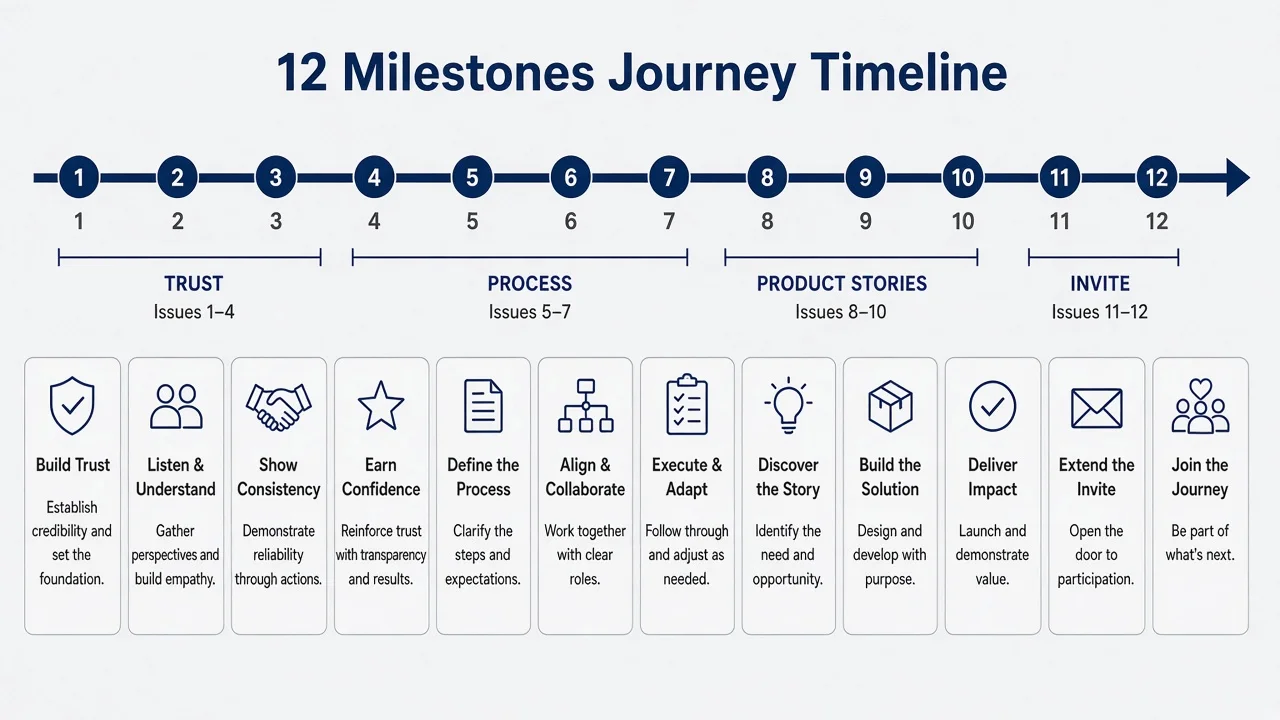
The first twelve issues set the contract. Subscribers decide whether you are a person or a funnel wearing a human mask. I aim for a mix: problem stories, small frameworks, honest failures, one customer-shaped win without fake metrics, and occasional product context when it clarifies the lesson.
Issue one should confirm expectations you already promised on the signup page. Who you are, what you build, how often you email, how to reply. No hard pitch. They just raised their hand.
Issues two through four go deep on the problem space. Show you understand the Tuesday they have. Use specifics from your ICP. If you sell reporting for agencies, talk about the client call where the spreadsheet lied. If you sell scheduling for clinics, talk about no-shows, not "optimization."
Issues five through seven can introduce how you think about solutions without a demo link every time. Process beats features. "Here is how I decide what to build next" beats "here are our integrations."
Issues eight through ten are fair game for soft product stories. What shipped, what broke, what you learned from three beta users described in composite form. Be honest about rough edges. Trust grows when you admit limits.
Issues eleven and twelve can include a direct invite: trial, beta, office hours, reply if you want help. By then, readers know if you are for them. The pitch lands because you earned it.
Skip the temptation to republish your changelog every week. Nobody subscribed for release notes unless they are already power users. Changelog belongs in-app or in a separate opt-in for customers.
Write one issue ahead when you can. Life happens. Product fires happen. A buffer keeps cadence from dying when GitHub issues eat your Friday.
Theme issues loosely if it helps you plan. Month one might be "pricing mistakes I see." Month two might be "onboarding traps." Themes are not cages. They are guardrails when you stare at a blank doc on Sunday night.
Invite replies with specificity. "Hit reply if you are stuck on X" beats "let me know your thoughts." Specific prompts get specific stories you can reuse ethically in landing copy.
Cadence over intensity
Weekly is ideal if you can sustain quality. Biweekly is fine if your writing is dense and your product moves slower. Monthly is risky for memory unless each issue is unmistakably worth the wait. Pick a schedule you can keep for six months. Consistency trains opens. Bursts train ignores.
Turning waitlist signups into readers who reply
Your waitlist and your newsletter should not feel like two strangers who never met. The waitlist is high intent at capture. The newsletter is sustained intent over time. Bridge them.
When someone joins the waitlist, they get waitlist-specific mail: progress, launch timing, founding offer. That sequence lives in the same ESP with a tag. When they have not converted after launch, invite them to the founder newsletter as ongoing value, not as a second waitlist.
If you are pre-launch, the newsletter can document the build in public without fake urgency. "Here is what I learned wiring Stripe" serves readers and waitlist people alike. The waitlist micro saas solo founder playbook covers capture and launch bursts. This section is the glue: do not let names sit cold between those bursts.
Ask waitlist joiners one question on signup. Use answers in the newsletter anonymously. People recognize their own pain when you describe it well. That recognition produces replies.
Share behind-the-scenes numbers when they teach something. Not "we grew forty percent" without context. Instead, "we doubled signups after rewriting the hero for agencies only" teaches a reader something they can try. Transparency is marketing when it comes with a lesson attached.
If someone unsubscribes from the waitlist sequence but stays on the newsletter, respect that. They might not want launch mail but still want your thinking. Tags exist so people control temperature.
When launch day hits, send the launch email to both tags if overlap exists, but segment so people do not get duplicate subject lines minutes apart. Nothing says amateur like two identical emails because tags were messy.
After launch, move buyers to customer onboarding in product email, not the founder newsletter. Mixing transactional onboarding with essays confuses expectations. The handoff matters.
Where founder email hands off to product onboarding
Founder email is the front porch. Product onboarding is the front door. Confuse them and people unsubscribe from the wrong thing when checkout frustrates them.
Keep the founder newsletter focused on problem space, lessons, and occasional product narrative. Keep lifecycle mail focused on activation: first project, first invite, first export, whatever equals success in your app. That split is why I send people to micro saas onboarding email sequence when they ask about trials that go quiet after signup.
Use the same voice, different job. Onboarding emails can be shorter and more directive. Newsletters can breathe. If onboarding sounds like a blog post, users miss the next step. If the newsletter sounds like a checklist, readers feel managed.
Link from newsletter to docs and templates when relevant. Do not link every issue to pricing. One clear CTA per email is enough. Multiple CTAs feel like panic.
When someone becomes a customer, celebrate in onboarding, not in a public newsletter unless they opt in to a case study. Respect privacy. Trust is fragile.
Reactivation belongs in product email first. If a paying user goes quiet, onboarding or lifecycle mail should nudge them back to the habit that made them buy. The founder newsletter can support with content about advanced use cases, but do not confuse "reader" with "active user." Different metrics, different fixes.
Tag customers in your ESP and exclude them from beginner-focused acquisition content if it would annoy them. They might still want the founder letter. They do not need "what is micro-SaaS" issue forty-two.
Metrics worth tracking when your list is still small
Subscriber count is the metric you show your friend. It is not the metric you run the business on. Watch opens as a trend, not a grade. Providers measure differently. A slow drift down might mean subject lines got generic or frequency changed without notice.
Click rate matters when you include links to posts, templates, or trials. If nobody clicks, either the content is not compelling or the link placement feels salesy. Fix the content first.
Reply rate is the solo founder superpower. Count replies per issue. Save good ones (with permission) as voice-of-customer notes for landing page copy.
Conversion attribution stays messy at small scale. Ask on signup or in a one-question survey: "How did you hear about us?" Email will show up if it mattered. Do not pretend last-click analytics will tell the whole story with forty trials.
List health: bounces, spam complaints, unsubscribes after specific emails. A spike after a pitch email tells you the pitch was wrong for the list, not that email failed.
Unsubscribes are data. If ten people leave after an issue about pricing, maybe the list skewed toward freebie seekers. If one person leaves after a personal story, that is noise. Read the pattern across issues, not the sting of one departure.
Deliverability basics still apply at small scale. Use a real domain for sending, not a free Gmail address. Set up SPF and DKIM even if DNS makes you groan. One afternoon of DNS saves weeks of mail hitting spam when you finally have something worth saying.
Compare cohorts loosely. People who joined from search content versus community referral often behave differently. You do not need a data team. You need a notebook.
Mistakes that turn your newsletter into a changelog nobody asked for
The fastest way to kill a founder email list is to treat it like a product Twitter account in HTML form. Shipping notes have a place. That place is not every subject line.
Another mistake is apologizing for not emailing for three months and then pitching hard. The apology email is itself an interruption. Come back with something useful, acknowledge the gap in one line, move on.
Founders also copy venture-backed newsletter formats: long curated link sections, corporate tone, zero opinion. Solo readers subscribed to you because you are a person building a thing. Be that person.
Do not buy lists. Do not scrape. Do not import conference attendees without clear consent. Short-term numbers create long-term deliverability hell.
Avoid endless "we're almost ready" waitlist energy in a newsletter meant for teaching. Urgency without substance trains people to ignore you.
Repurpose carefully. A newsletter issue can become a blog post for SEO, but the blog should not be the only people ever see. Some readers live in email and never visit your site. Meet them where they opted in. The founder content creation system treats site and list as one loop, not two competing projects.
If every issue ends with "by the way, buy my product," readers learn to stop before the footer. Rotate CTAs. Sometimes the CTA is "reply with your situation." That input is marketing research disguised as conversation.
Questions I get about founder newsletters
Do I need a newsletter if I only have a handful of customers?
Yes, if you plan to keep selling after this week. A tiny list of the right readers beats a large silent one. Twelve customers can still mean eighty subscribers who care about the problem. The newsletter keeps you in memory while you fix the product and find the next buyer. Skip it only if you are still validating whether anyone wants the outcome at all.
How often should a solo founder send a newsletter?
Pick a cadence you can hold for six months. Weekly works if you can write one useful email without recycling fluff. Biweekly is fine for dense, practical letters. Monthly is hard because people forget you. Consistency matters more than frequency theater. Missing a month happens; disappearing for a quarter then pitching hard does more damage.
ConvertKit or Loops for a micro-SaaS newsletter?
Either is fine. ConvertKit is familiar to non-developers and handles forms, tags, and simple automations well. Loops feels minimal if you prefer a lighter UI. Do not spend a month comparing. You need capture, confirmation, broadcasts, and a few tags. Pay when volume or automation saves real time.
Should I use the same emails for my newsletter and cold outreach?
No. Newsletters serve people who opted in. Cold email interrupts strangers who did not. Mixing the tone gets you ignored or marked as spam. Use cold outreach for targeted near-term conversations. Use the newsletter to compound trust with people who might buy later or who already bought and should not forget you.
What is the difference between a waitlist and a founder newsletter?
A waitlist is a launch-focused capture with higher intent at signup. A newsletter is ongoing teaching and relationship. They should connect through tags and expectations, not duplicate blasts. Waitlist mail covers progress and launch offers. The newsletter covers the problem space after the launch dust settles.
When should I mention my product in the newsletter?
After you have taught something real in the first handful of issues. Mention the product when it clarifies the lesson, not as a footer on every email. By issue twelve, a direct trial or beta invite is fair because readers know your voice. Changelog-only emails train people to stop opening.
Send the next issue before you ship the next feature
I still have side projects where the product outran the list. Code shipped. Docs shipped. Nobody was home to hear about it. The fix was never another feature flag. It was sitting down on a Wednesday and writing to the eighty people who asked to be kept in the loop.
A founder newsletter micro saas solo founder strategy is not glamorous. It will not get you on a stage. It will get you the quiet advantage of strangers who recognize your name when they need a tool like yours. That recognition is worth more than a spike of traffic from people who scroll past in two seconds.
Start small. Write like you talk. Ask one question. Mention the product when it helps explain the lesson. Export the list. Bridge waitlist capture to ongoing letters. Hand off to onboarding when someone pays. The rest is consistency, which is the part founders underestimate because it sounds too simple to work.
The inbox is crowded. Your job is not to shout louder. It is to be worth opening when everything else is noise. Send the next issue. Then go fix the bug your subscriber just told you about in a reply. That loop is the whole business at your scale.
If you are waiting for enough subscribers to feel legitimate, you will wait forever. Legitimacy is a reply that teaches you something. Send to the list you have. Improve the next issue by one obvious notch. Ownership compounds quietly while you are busy pretending the product sells itself.
One last nudge because I needed it once: block ninety minutes on your calendar like it is a customer call. Title the event "issue draft," not "marketing." Protect the slot from feature creep. The product will always feel more urgent than email until email starts sending you customers. Then the order flips and you wonder why you waited.




Comments