Indie Hackers and the Rooms Reddit Forgot
A solo founder guide to community launches beyond Product Hunt: Indie Hackers, Hacker News, niche Slack groups, and how to show up without sounding like an ad.
 By Reese31 min read
Listen to this article
21:47AI-generated podcast-style overview of this article (not a word-for-word narration).
I posted my launch on Indie Hackers at 7:14 a.m. on a Thursday because I had read somewhere that mornings perform better. The title was careful. The revenue screenshot was real but small. I hit publish, made coffee, and refreshed the page like the comments would arrive on a schedule. They did not. Three people said congrats. One person asked a sharp question about churn I had not prepared for. Nobody clicked through to Stripe that day.
That was not a disaster. It was a Tuesday-sized lesson wearing a Thursday outfit.
Two weeks later I answered a thread in a niche Slack group for agency operators. No launch post. No banner. Just a reply to someone venting about client reporting, with a Loom link because they asked how I handled exports. Four DMs followed. One became a customer at $49 a month. The IH post still sits on my profile like a polite museum piece. The Slack reply is the one I think about when founders ask me where to launch.
If you are trying to figure out how indie hackers launch micro saas products without treating every platform like a slot machine, you are in the right mental neighborhood. Product Hunt and Reddit get most of the slideshow advice. Indie Hackers, Hacker News, and the small forums hiding behind invite links deserve the same seriousness, with different rules in each room. I am not a developer. I do not ship production code. I have spent years watching technically solid products stall because the founder posted once in the wrong place, with the wrong posture, on the wrong Tuesday.
This is the map I wish someone had handed me before I confused activity with distribution. Warm outreach still comes first. Max wrote the broader how to launch a micro-SaaS piece that keeps you from performing for strangers before you email the people who already raised their hands. My job here is the community layer: where to show up, how long to lurk, what to measure, and how to connect a thread to a landing page that does not waste the click.
Some scenes below are composites. The pattern is not.
I am going to talk about numbers because vague launch advice wasted years of my early freelance clients' time. Not flex numbers. Example math. Say you post on Indie Hackers and get eighty thoughtful views, twelve landing page visits, three trials, and one customer at $39 a month. That is not a billboard campaign. It is proof the message landed somewhere. Say your Show HN post sends four hundred visitors, your server stays up, and nobody converts because the product needs a forty-minute import ritual. That is also data. Both outcomes are normal for solo founders. The skill is reading them without drama.
Indie hackers launch micro saas: what community launch actually means
When I say indie hackers launch micro saas through community, I do not mean collecting upvotes like baseball cards. I mean choosing rooms where your buyer already talks about the problem, earning enough trust that a product mention feels like a useful answer, and treating each platform as a conversation with strangers who owe you nothing.
Community launch is distribution work. It is closer to sales without a calendar link than it is to content marketing. You are not publishing for algorithms alone, though search and archives matter later. You are showing up where people argue about workflows, compare tools, and admit what broke last quarter. Your product enters as a possible fix, not as the main character of the thread.
That posture sounds obvious until you are staring at a blank post form at midnight. The temptation is to write a miniature landing page with a hero image and a call to action that says Start free trial. Communities smell that instantly. The founders who convert treat the post as the first support ticket from a room full of skeptics.
Launch is a sequence, not a firework
A community launch is not one spike on a graph. It is a sequence: lurk, contribute, publish, reply, follow up by email, fix onboarding, return to the same room next month with a real update. The indie hackers product launch fantasy is a single heroic post that fills Stripe. The reality I have seen over and over is quieter. A post that lands okay. A comment thread that teaches you positioning. Two trials. One paying customer who found you because you answered a follow-up question on day three.
That sequence still counts as launch. Bootstrapper launch does not require confetti. It requires strangers who understand the offer well enough to pay without a demo call, or at least well enough to book one.
The rooms that count for solo founders
For most micro-SaaS products, the community map has four layers. Indie Hackers and similar founder forums where build-in-public culture lives. Hacker News when your product has technical depth or a contrarian take worth arguing about. Niche forums, Slack groups, and Discords where vertical buyers already complain in public or semi-public. Reddit and Product Hunt as the loud public square, useful but dangerous if you treat them as the whole strategy.
I have already written about Reddit marketing and Max covered Product Hunt with more patience than I have on launch day. This article sits beside those, not above them. The mistake is assuming one platform is the indie hacker launch. The skill is picking the right room for your buyer and your product shape.
The loop in that diagram is the part people skip. They post, refresh, declare the channel dead, and never return. Communities compound for founders who behave like members.
What community launch is not
It is not posting the same announcement in six places on the same afternoon. Cross-posting feels efficient. It usually produces six thin threads with no follow-up energy. It is not hiring a VA to drop links while you sleep. Communities pattern-match outsourced promotion fast. It is not arguing with mods about rules you did not read. Rules are not suggestions because you have a launch deadline.
It is also not a substitute for a product that solves a real job. Community distribution finds people faster. It does not invent demand where none exists. If interviews were lukewarm and the waitlist stalled, a Hacker News spike will not fix positioning. It will broadcast the confusion to a larger audience.
I treat community launch as one leg of a stool. Warm outreach is another. Landing page conversion is another. Onboarding that produces a win in the first session is another. Remove any leg and the stool wobbles no matter how good your IH title is.
Why Product Hunt and Reddit are not your whole launch map
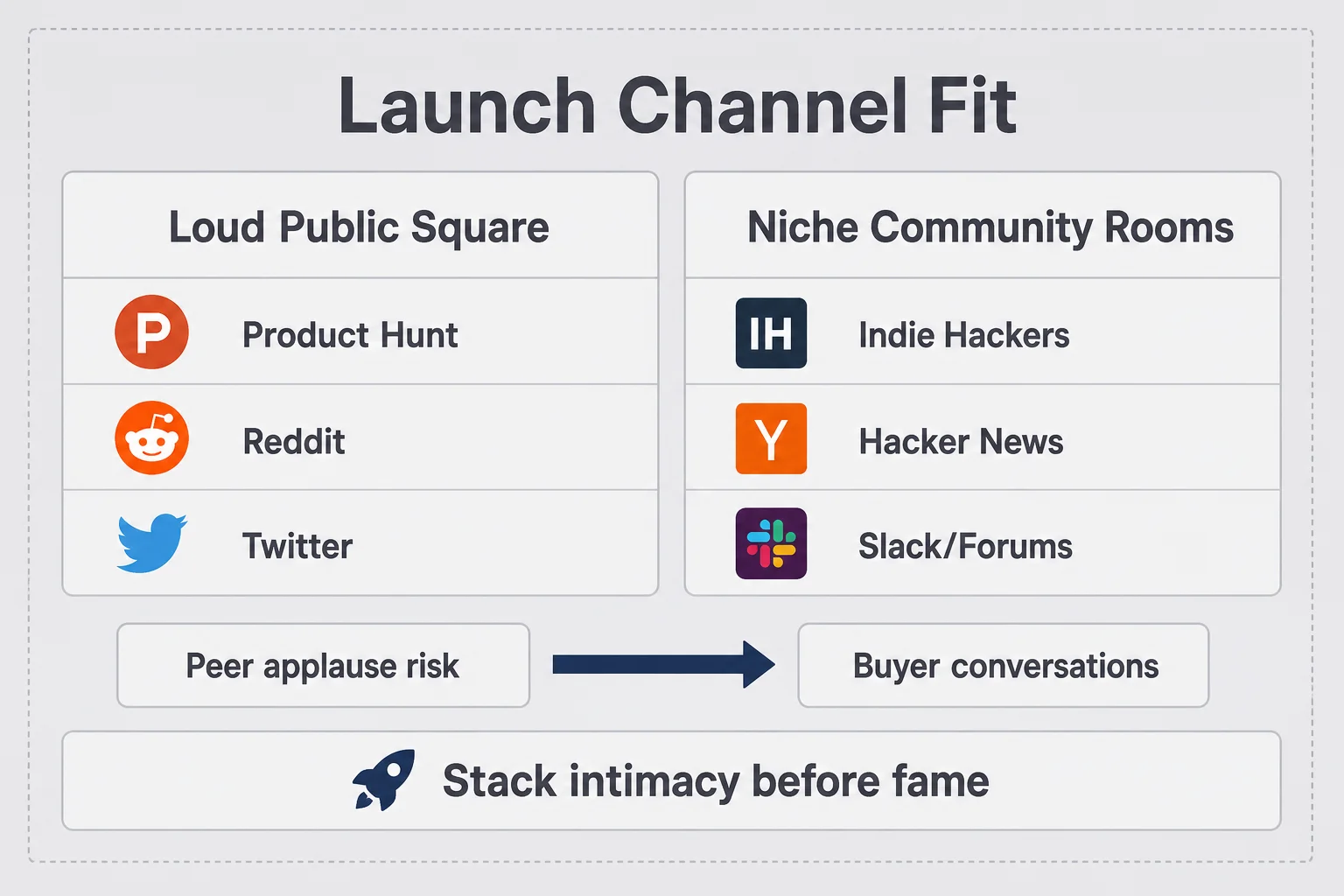
Product Hunt is a stressful Tuesday with a badge attached. Reddit is a city of rooms with different bouncers. Both can send traffic. Both can teach you language. Neither replaces knowing where your buyer already gathers when they are not performing for an audience.
I see the same launch map on founder Twitter every quarter. Ship product. Product Hunt on Tuesday. Reddit launch post on Wednesday. Tweet thread on Thursday. Collapse on Friday when Stripe looks unchanged. The map is not wrong because those platforms are useless. It is wrong because it treats distribution like a checklist of famous logos instead of a fit problem.
Your buyer might never open Product Hunt. They might lurk in a Slack for e-commerce operators, or read Hacker News comments without posting, or scroll Indie Hackers at lunch for moral support and competitor ideas. If you only launch where indie Twitter can see you, you might be performing for peers while your customer waits in a quieter room.
The peer applause trap
Builder audiences are generous with congratulations and stingy with credit cards. I have watched founders collect hundreds of upvotes from other founders and wonder why none of the signups matched their ICP. Peer applause feels like traction. Revenue disagrees.
That does not mean ignore Product Hunt or Reddit. It means do not let them consume the whole launch calendar before you test a niche community launch saas motion where actual buyers talk. A waitlist email to thirty warm contacts will often outperform a public splash aimed at the wrong crowd. Public platforms amplify what is already working. They also amplify confusion if your positioning is still mid-edit.
Stack channels with intent
Think of launch channels in order of intimacy, not fame. Warm email and interview contacts first. One community where you have been useful for weeks. Then the louder public options if they fit. Solo founder community marketing fails when you reverse the order and shout before you listen.
I budget time the way I budget money when I had almost none of it. Product Hunt prep might be ten hours across two weeks if the buyer fits. Reddit participation might be thirty minutes a day for a month. Indie Hackers might be one careful post plus daily comment replies for a week. A niche Slack might be five thoughtful messages a week forever. The total is less than a part-time job if you pick one primary room instead of five shallow ones.
The calendar mistake I see every quarter
Founders block launch week on the calendar like a wedding. Monday: finalize gallery. Tuesday: Product Hunt. Wednesday: cross-post to Reddit and IH. Thursday: Hacker News Show HN. Friday: collapse and refresh analytics. Nobody blocked Tuesday through Friday of the following week for comment replies, bug fixes, and personal emails to trial users who went quiet.
Community launch is front-loaded in prep and back-loaded in follow-up. The post is the middle, not the climax. If your calendar ends on launch day, you are planning for applause, not customers.
I also see founders treat Indie Hackers and Hacker News as interchangeable because both skew technical. They are not the same room. IH tolerates founder vulnerability and revenue transparency. HN tolerates technical depth and punishes vague marketing. A post that works on IH verbatim often dies on HN because the tone is wrong. Rewrite for the room. Do not copy-paste your distribution stack like it is one press release.
Fame order is not fit order
The platform with the biggest logo is rarely the platform with your buyer. Fit beats fame every time.
When Indie Hackers fits a micro-SaaS (and when it does not)
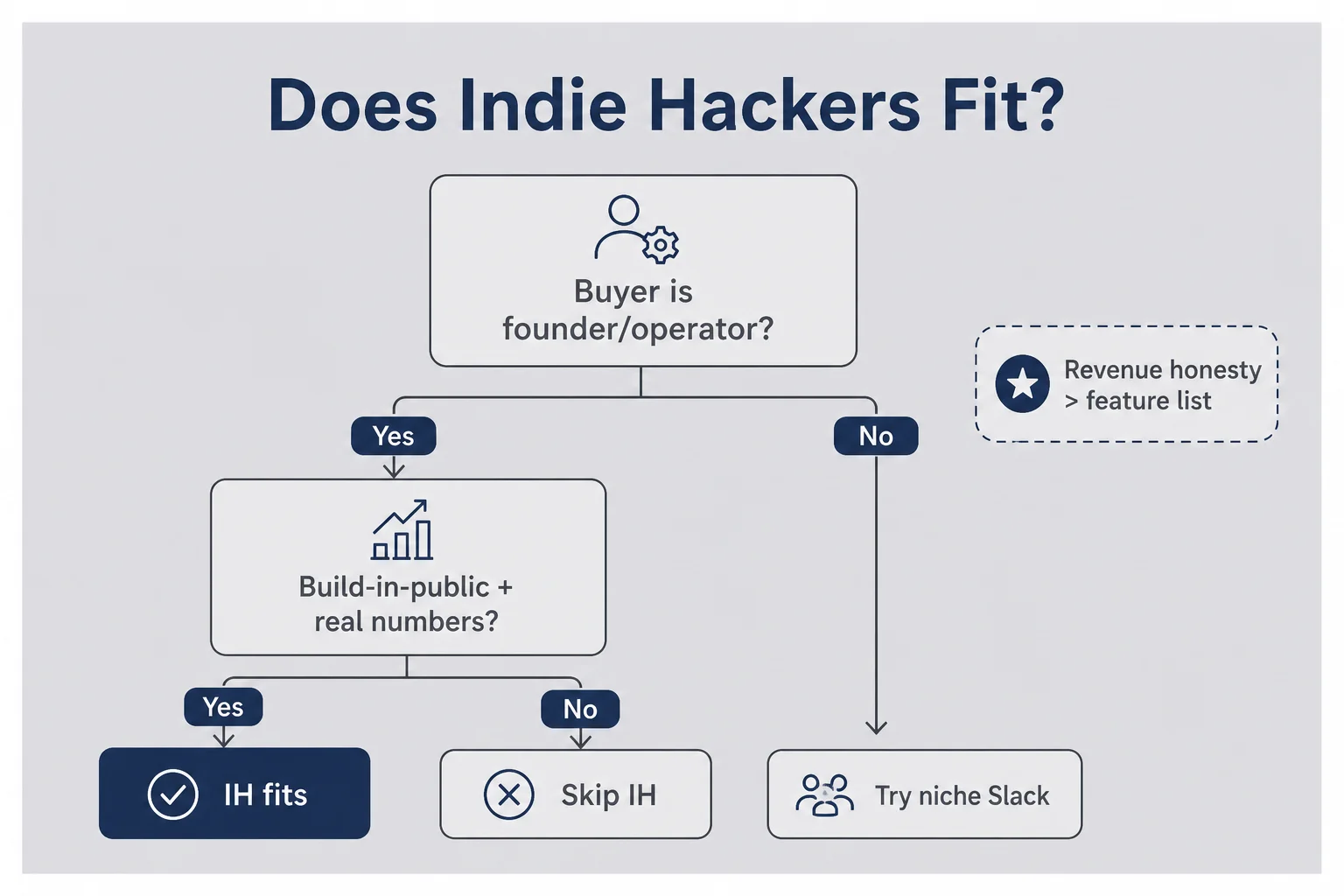
Indie Hackers is home turf for founders who like revenue screenshots, honest failure posts, and build-in-public updates. That culture is a gift when your product serves founders, indie operators, marketers, or anyone who self-identifies as building a small internet business. It is a mismatch when your buyer is a dental office manager, a warehouse supervisor, or any professional who has never typed MRR into a spreadsheet for fun.
I launched a client onboarding helper on IH in 2024. The product was fine for small agencies. The post did fine too. Comments were thoughtful. Trials trickled in. Not because IH is magic. Because the buyer and the room overlapped. The same product would have died in a generic startup subreddit aimed at developers who do not run client reports.
Good fit signals on Indie Hackers
You see recurring threads about the job your product does. People share numbers without being asked. Founders ask for tool recommendations with budget context. Build-in-public posts get genuine questions instead of drive-by links. You can explain the product in one sentence a stranger would repeat at coffee.
IH also fits when you want peer feedback on pricing, onboarding, or positioning before you scale cold traffic. The comments can be blunt. That is the point. A solo founder without a marketing team needs rooms that tell the truth.
When to skip or deprioritize IH
Skip IH as a primary launch room when your customer never visits. Deprioritize it when your product needs a twenty-minute setup before value appears. IH readers will try a lot. They will not all finish a complex onboarding flow out of charity.
Also deprioritize when you have nothing to say beyond I built a thing. IH rewards story. Problem, constraint, what you tried, what broke, what you charge, what you learned. A thin post with a logo and a discount code reads like an ad wearing a hoodie.
I still post on IH when the update is real. Churn fix with numbers. Pricing change with reasoning. A feature born from a support ticket pattern. Launch day is one post. The channel is the ongoing relationship.
The indie hackers product launch post types that work
Build-in-public milestones work when the milestone is specific. Hit $1k MRR is less useful than Raised price from $29 to $49 and churn did not move because here is the email I sent. Failure posts work when you name what you would do differently, not when you fish for sympathy. Tool comparison posts work when you disclose bias and compare on jobs, not feature checklists.
What rarely works: thin affiliate energy, vague AI wrapper announcements with no constraint named, and posts that read like they were written to impress investors who are not in the room. IH readers are founders. Many of them have been burned by tools that overpromised. Meet them at the job level.
If you are pre-revenue, say so. Some of my best IH conversations started with I have twelve beta users and I am trying to decide whether annual billing is insane. Honesty invites help. Performance invites silence.
Hacker News is not a lottery ticket
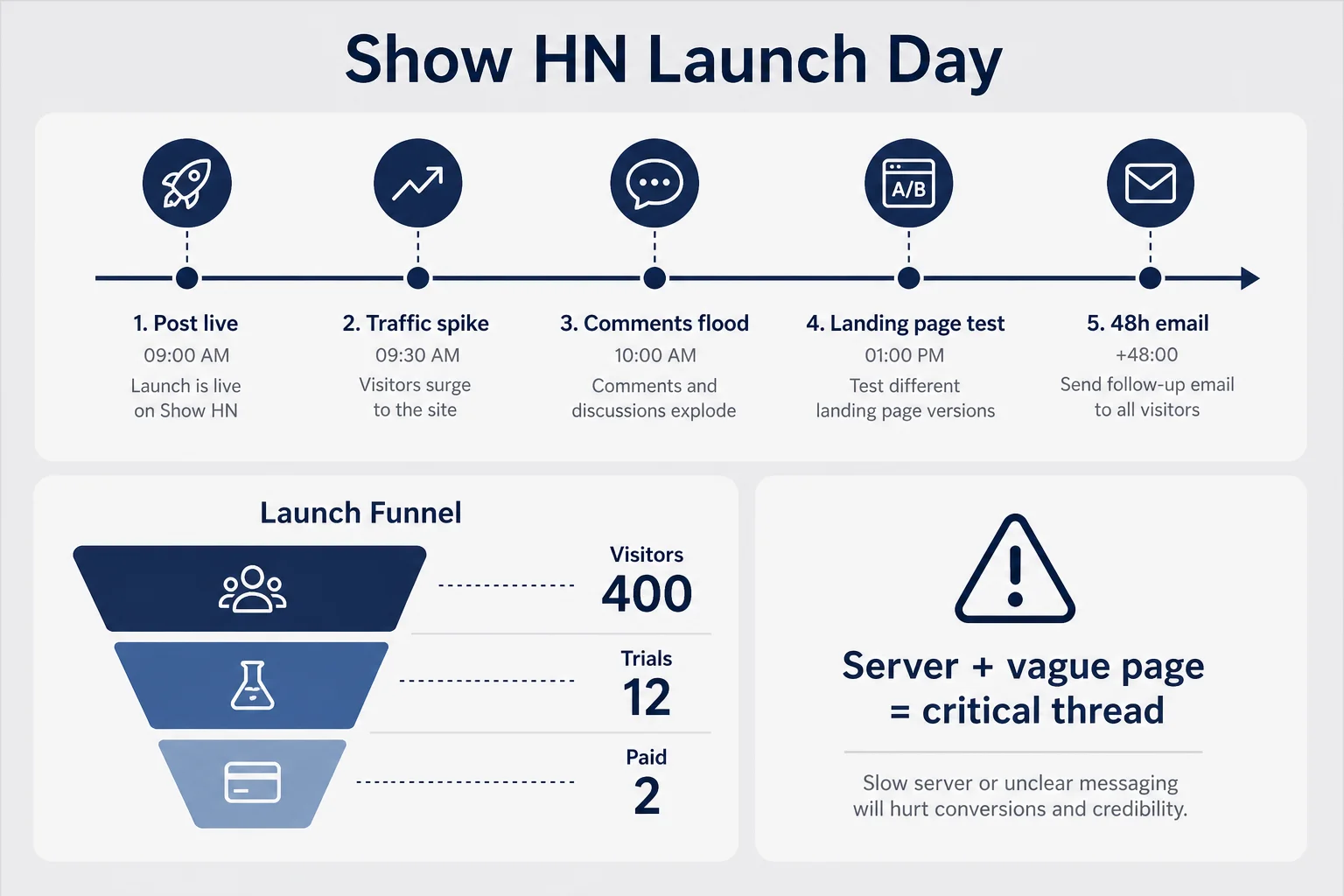
Hacker News is not a button you press for free traffic. It is a courtroom where technical readers cross-examine your product, your claims, and sometimes your entire business model before lunch.
I have seen HN send thousands of visitors in an hour. I have also seen threads turn into autopsies of landing page copy, privacy policies, and whether the founder understands their own stack. Both outcomes are possible on the same Tuesday. The variable is rarely luck. It is fit, preparation, and whether you stay in the comments like someone who respects the room.
What HN actually rewards
HN rewards substance over polish. A Show HN post that explains a real technical constraint, a clever workaround, or an honest niche problem can do well even with an ugly page. A post that sounds like venture marketing dies fast. Readers click, judge in seconds, and comment with precision that would make a lawyer nervous.
Your product does not need to be open source. It does need to be legible to a smart generalist. If you cannot explain what happens to user data, why your pricing is not a trap, and what breaks at scale, the thread will find those gaps for you.
The infrastructure homework nobody posts about
Before you chase a hacker news launch micro saas moment, do boring work. Can your server handle a spike on a $20 DigitalOcean droplet or whatever you are running? Does the landing page load in under three seconds on mobile? Is signup friction minimal? Do you have a founder account ready to reply for six hours?
I watched a founder's Show HN thread climb while his site returned 502 errors. By the time he fixed hosting, the conversation had moved on to whether he was competent. Harsh. Predictable. The platform did not owe him a second chance.
Titles, timing, and temperament
Titles matter on HN more than most founders want to admit. Lead with the problem or the interesting mechanism, not your brand name alone. Tuesday through Thursday mornings Pacific are common launch windows. Not because the algorithm demands it. Because that is when a critical mass of readers is online and moderators are awake.
Temperament matters more. If criticism makes you defensive in public, wait. HN comments are not personal attacks. They are often impersonal attacks that still sting. The founders who benefit reply with specifics. We store exports for thirty days then delete. Here is the pricing math for a ten-person team. Fair point on the docs gap, shipping tonight.
If you cannot defend the product calmly, you are not ready for HN. You might be ready for a warmer room first.
Show HN versus a comment mention
Not every HN moment needs a Show HN post. Sometimes the better move is a useful comment in a related thread with no link, building karma and name recognition, then posting weeks later when you have a crisp story. Show HN is a high-variance move. A single great comment is a low-variance deposit in a bank that pays slowly.
When you do post Show HN, put the URL in the post field, write the substance in the text field, and stay online. The first ninety minutes set the tone. Founders who announce and disappear confirm the suspicion that they wanted traffic, not feedback. Reply with short paragraphs. Link to docs when asked. Admit tradeoffs. If someone points out a competitor, explain who you are for without trash-talking.
I keep a doc of tough HN questions from past launches. Data retention. Why not use open source X. How is this different from Y. Pricing versus self-hosting. Rehearse answers before you post, not while the thread is moving.
The small forums that outperformed my big launch days
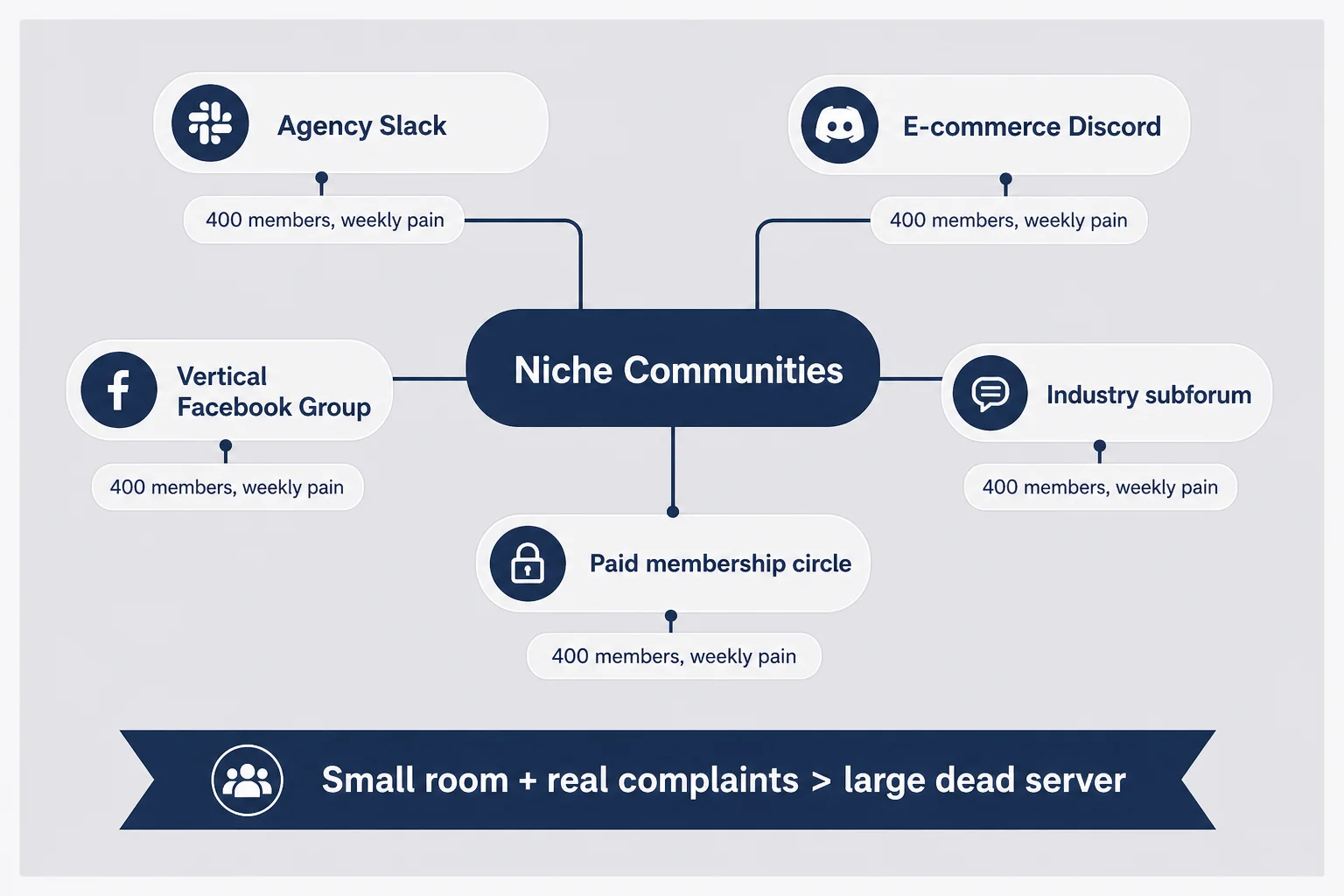
The biggest launch days of my career were not the biggest traffic days. They were the days a niche community sent the right ten people to a page that converted.
I am thinking of a Facebook group for independent bookkeepers that is not sexy on a pitch deck. A Slack workspace for Shopify operators that requires an application. A Discourse forum attached to a vertical newsletter with four thousand subscribers. None of these show up on the indie hacker greatest hits reel. All of them produced customers who stayed longer than Product Hunt curiosity traffic.
Niche community launch saas motion looks unglamorous on purpose. You do not get a badge. You get DMs from people who already trust the room.
How I find the small rooms
Start with customer interviews, not platform trends. Ask where people complained about the problem before they found any tool. Search those exact phrases on Google with forum, Slack, Discord, community attached. Look at what tools your early users mention in support tickets. Check who links to competitors in obscure threads.
I keep a simple spreadsheet. Community name, platform, approximate size, rules about promotion, last time I saw a pain thread, my participation status. I do not join twenty at once. I join one, lurk, comment twice, wait a week, comment again. If the language in the room matches my landing page headlines, I stay. If the room is mostly people selling to each other, I leave.
Why small beats loud for solo founders
Small forums have memory. People notice if you show up only to pitch. They also notice if you help for a month then mention a product that solves yesterday's thread. That memory becomes trust. Trust converts better than raw impressions for products in the $19 to $99 a month range aimed at specific jobs.
Big platforms reset every day. A front-page moment disappears by dinner. A helpful reply in a four-hundred-person Slack gets pinned by a mod and referenced months later when someone new asks the same question. Compounding is the whole game for bootstrappers without ad budgets.
| Room type | Best for | Watch out for |
|---|---|---|
| Indie Hackers | Founder buyers, build-in-public updates | Peer applause without revenue |
| Hacker News | Technical products, contrarian takes | Hostile comments if you ghost the thread |
| Niche Slack / forum | Vertical buyers with specific pain | Slow growth if you spam links early |
| Product Hunt | Tech-curious browsers, backlinks | Vanity spike without conversion |
| Public pain threads, language mining | Mod removals, wrong-subreddit noise |
That table is not a ranking. It is a fit checklist. Pick the row that matches your buyer before you optimize the post.
Slack and Discord etiquette that actually matters
Read the pinned rules before you type. Introduce yourself in the intro channel if there is one, without pitching. Answer two questions before you share anything you built. Use DMs only when someone asks for a link or a demo. Public pitch drops in general channels get you muted fast.
Some groups allow a monthly self-promo thread. Treat it like a farmer's market stall, not a megaphone. Show up when the thread opens. Explain the problem in the group's dialect. Offer a founder discount only if you will honor it calmly for six months.
I lost access to a valuable operator Slack once because I got excited and posted a Loom in the wrong channel. The mod was fair. I was careless. One careless post can cost you a year of compounding presence. Slow down. The product will still exist next week.
The lurk-before-you-pitch rule nobody wants to hear
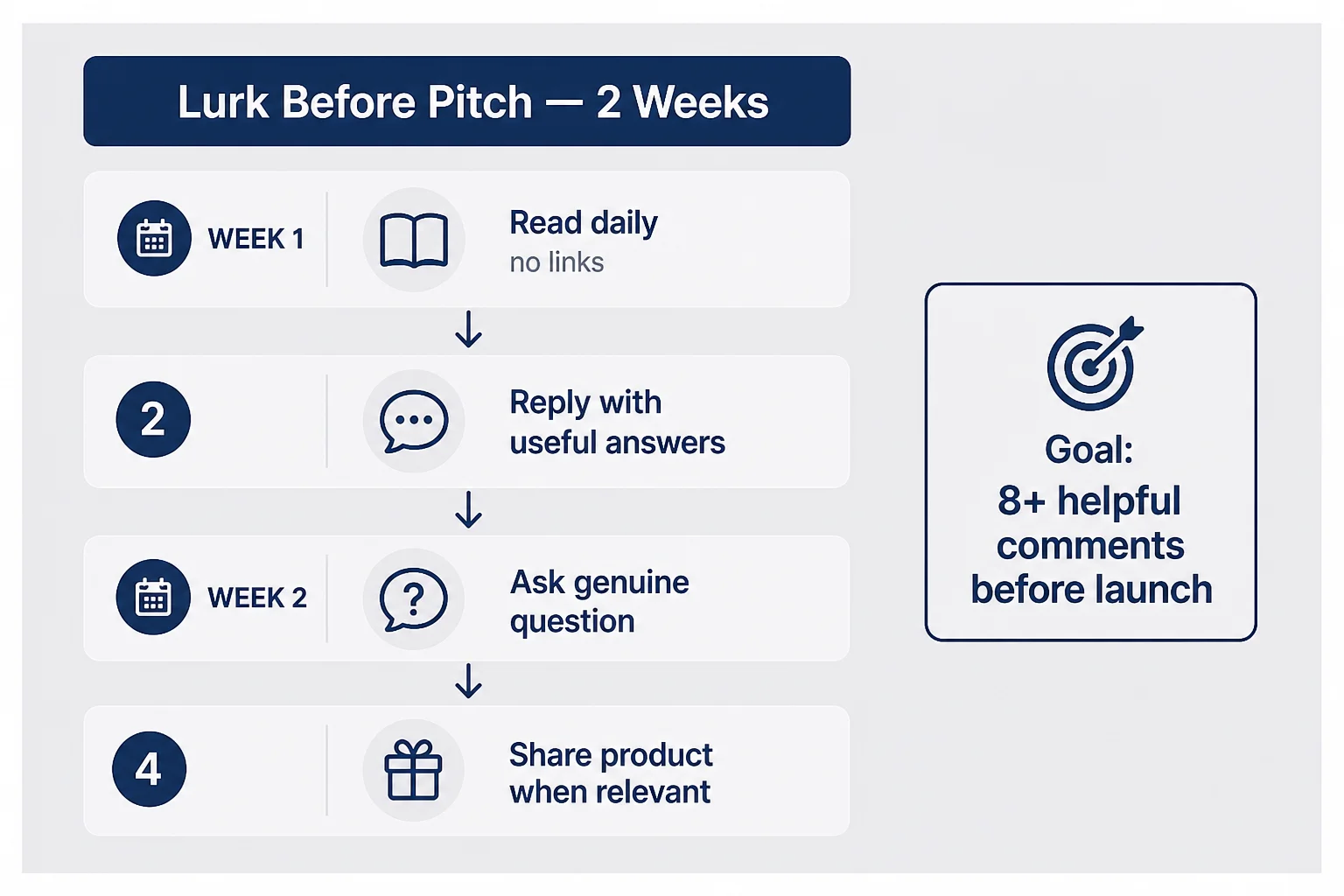
Nobody wants to hear that launch is delayed by two weeks of lurking. You shipped the thing. You want the internet to notice today. I get it. I have refreshed Stripe on hour one too.
The lurk-before-you-pitch rule is not punishment. It is market research with social consequences. You learn how people phrase pain. You learn which jokes land and which topics are tired. You learn who the mods are and what gets deleted. You also stop looking like a tourist.
What lurking actually looks like
Lurking is not silence. It is participation without a link. Answer a question you know. Share a spreadsheet template. Admit a failure from your own freelance years. Upvote or react thoughtfully. Save threads that repeat the same complaint weekly.
Two weeks is a useful minimum in most communities. Not because someone wrote it in a gospel. Because shorter windows usually mean your product mention arrives before your name means anything. On IH, you might comment on three build-in-public posts before you publish yours. On HN, you might add ten useful replies in threads adjacent to your problem space. In a niche Slack, you might answer five questions without mentioning you sell software.
The exception that proves the rule
Sometimes you already earned the room. You were active for months before you shipped. You helped the mod fix a doc. You are a known agency operator in a group of agency operators. In that case, launch day is not day one of community marketing. It is day one of talking about your product openly.
If that is not you, do not pretend. Founders love to claim they are embedded in a community because they joined the Discord last Tuesday. Members can tell.
The shortcut tax
Every skipped lurk week shows up later as a removed post, a cold thread, or a landing page bounce from people who did not trust the source.
How I write a community post that does not smell like an ad
The smell test is simple. If you delete the product name and the post still helps someone, keep it. If the post only exists to justify a link, rewrite.
I write community posts the way I write emails to someone who did not ask to hear from me. Lead with their problem. Name the constraint. Show your work. Mention the product as one option, not the hero. Disclose that you built it early, not buried at the bottom like a legal footnote.
Open with the reader's Tuesday, not your roadmap
Bad open: I am excited to announce the launch of CloudReportify, a revolutionary reporting solution.
Better open: If you rebuild the same client report every Friday because your agency tool exports garbage, I built a small fix and I am curious what I missed.
The second version is still promotional. It is also recognizable. People see their week inside it.
Specifics beat adjectives
Replace seamless onboarding with onboarding takes four clicks and imports CSV from Harvest. Replace powerful analytics with shows margin per client, not just revenue. Replace affordable pricing with $49 a month for up to twenty clients because that is what I wished existed when I freelanced.
Specifics invite questions. Adjectives invite skepticism.
Disclosure without apology
I am the founder. I built this because I got tired of X. That is enough. You do not need a paragraph of self-flagellation. You do need honesty. Communities punish stealth marketing harder than disclosed promotion.
One ask, clearly stated
End with one ask. Try the trial and tell me what breaks. Roast my pricing. Ask me anything about churn. Multiple CTAs read like a landing page pasted into a forum. One CTA reads like a human request.
I draft posts in a plain text file first. Read aloud. If I sound like a press release, I cut adjectives until I sound like me after coffee. AI outlines can help. The final voice has to be yours. Rooms that tolerate founders still punish generic polish.
Comments are part of the post
The post is not finished when you hit publish. It is finished when you stop replying. On IH, I aim to respond to every comment for seventy-two hours, even the ones that sting. On HN, speed matters more than length. On Slack, a thoughtful thread might revive three days later when someone new joins.
When someone criticizes pricing, I explain the math. When someone says they tried and bounced, I ask where. When someone compares me to a free alternative, I name who should use the free alternative instead of me. That posture turns critics into collaborators sometimes. Even when it does not, future readers see you can think in public.
Save phrases from comments
When three strangers describe your product the same way in comments, steal their words for your landing page headline. They are giving you free positioning research.
The indie hackers launch post structure I steal every time
I do not believe in magic templates. I do believe in repeatable bones. This is the indie hackers launch post structure I return to when I want comments instead of crickets.
Hook in the title. Problem-forward, not brand-forward. How I stopped rebuilding Friday client reports is better than Introducing ReportMini.
First paragraph: the pain in present tense. Put the reader in the job. Mention frequency, cost, or embarrassment if true. No feature list yet.
Second paragraph: what you tried before building. Spreadsheets, Zapier, a expensive tool with one missing export. This builds credibility. You are not a tourist who saw a market map. You lived in the problem.
Third paragraph: what the product does in one tight paragraph. Concrete limits welcome. Handles CSV from X, sends PDF by Monday morning, does not replace your CRM.
Fourth paragraph: honest numbers. Revenue if you have it. Users if early. Pricing plainly stated. IH respects transparency. Fake traction gets you roasted gently and then ignored.
Fifth paragraph: the ask. Specific question. What would make you switch? What scares you about trusting a new tool with client data? Questions pull comments. Announcements pull likes.
Link once. Do not pepper URLs. One landing page, UTM tagged, matched to the post intent.
On Hacker News, tighten further. Less story, more mechanism. On niche Slack, sometimes skip the long post entirely and answer a live thread with a Loom when invited.
I keep a folder of posts that worked, not because I copy words, but because I study rhythm. Where the founder disclosed. Where they admitted uncertainty. Where they replied in comments two days later with a shipped fix. That follow-up reply is part of the structure even if it is not in the draft.
A sample week after an IH launch
Day zero: publish in the morning, block three hours for replies, fix any broken link or typo immediately. Day one: email new trials personally, note objections in a doc. Day two: ship one small fix mentioned in comments if possible, comment on the thread with the update. Day three: write a short follow-up post only if something material changed. Days four through seven: return to lurking and helping in the same community without pitching again.
That rhythm keeps you visible without becoming the person who only talks about their product. It also gives you something real to say if you post an update next month.
What to measure after you hit publish (and what to ignore)
Community launch measurement is where founders either learn or lie to themselves. The lie sounds like we had a great launch because the post did numbers. The learning sounds like we had ten trials, two paid, and one comment that forced a pricing rewrite.
Track what ties to revenue
Use UTM parameters on every community link. Indie Hackers post gets utm_source=indiehackers and utm_medium=community. HN gets hackernews. Slack gets the group slug if mods allow links. In Plausible or Google Analytics, watch landing page sessions, signup starts, and trial activations for seven days, not just day one.
In Stripe or your billing tool, tag customers informally in a spreadsheet if you cannot tag in product yet. Source thread, date, plan, still active after thirty days. Thirty-day retention from a community beats day-one traffic every time.
Track reply depth. Posts with twenty comments where you answered fifteen teach you more than posts with two hundred upvotes and three generic nice job replies. On IH and HN, follow-up questions about pricing, security, or switching costs are buying signals dressed as skepticism.
Ignore or deprioritize vanity
Upvotes alone. View counts without conversion context. Twitter screenshots of your ranking. Compliments from other founders who will never pay. These are mood metrics. Fine for morale. Dangerous as strategy.
I log vanity metrics in a separate line in my weekly notes so they do not contaminate decisions. Yes, the post hit page two on HN. No, that did not pay rent. What paid rent was the agency owner who emailed from the IH thread on Saturday asking if exports work with QuickBooks.
The forty-eight-hour follow-up window
Measure whether you did the unglamorous work after publish. Did every comment get a reply within forty-eight hours? Did trials get a personal email? Did you fix the doc gap someone mentioned before the thread went cold? Community launch success is often decided in the follow-up lane, not in the title.
If numbers are soft after a week, diagnose before declaring the channel dead. Wrong room. Weak offer. Landing page mismatch. Product setup too long. Positioning that sounds right to founders and wrong to buyers. Each diagnosis points to a different fix. None of them are post again louder.
A simple scorecard I use
After seven days I write four numbers on a sticky note: community sessions to landing page, signup rate, trial activation rate, paid conversions with source tagged. I add one sentence of qualitative color. Best comment was about security. Mod removed cross-post. Someone asked for annual billing.
If paid conversions are zero but signup rate is healthy, the problem is probably activation or pricing, not the community. If sessions are high and signup rate is trash, the landing page or offer mismatch is screaming. If everything is low, wrong room or weak hook. The scorecard stops me from rage-quitting a channel because IH felt quiet when the real issue was onboarding.
Tie your community launch to email and a landing page that converts
A community post without a conversion path is a performance. You entertained a room. You did not build a business. The tie between thread, page, and inbox is where solo founders win or leak trials.
Send community traffic to a focused landing page, not a homepage with six paths. Match the headline to the post language. If the IH thread talks about Friday reporting hell, the page hero should mention Friday reporting, not your vague platform for modern agencies. Consistency is not cute. It is conversion hygiene.
Your waitlist and launch email list should know the post is coming if you have one. Not to brigade upvotes. To welcome people who click with a short personal note if they trial. Warm follow-up beats automated onboarding when the volume is still small enough to be human.
Email in the first week after publish
Within forty-eight hours, email everyone who signed up from the thread. Plain text. Reference the community if true. Saw you joined from Indie Hackers. Happy to answer questions about exports. One specific offer of help. No marketing banner.
If you use ConvertKit or Loops, keep the sequence short. Three emails over ten days for launch traffic, not thirteen emails pretending you are a lifecycle team of six. Email one: welcome plus one tip. Email two: story behind the feature commenters asked about. Email three: direct ask for a reply if they have not activated.
Landing page checks before you post
Read Max and my landing page guidance if you have not. For community launch week, run a brutal checklist. Eight-second comprehension test. One primary CTA. Pricing visible without scroll on desktop. Mobile signup works thumb-first. Social proof if you have it, honest early-stage copy if you do not.
Add a line near the signup that acknowledges community visitors when relevant. Founding member pricing through August if that is true. Even without a discount, clarity wins. This page is the product story for people who never met you.
Community traffic is curious, skeptical, and impatient. The landing page has one job: confirm the post was not exaggerating. Everything else is decoration.
Positioning has to match the room
If your IH post talks to agency founders and your landing page talks to generic small businesses, you will feel like the channel failed when messaging failed. Same product, two stories. Pick one for launch week. You can broaden later. Launch week is not the time to be everything.
I reread my positioning notes before every community post. One sentence for who it is for. One sentence for who it is not for. One sentence for the outcome. If I cannot write those three without hedging, I am not ready to post publicly. I am ready for more interviews.
The landing page guide on this site goes deeper on structure and the eight-second test. Community launch adds one constraint: the visitor arrives with context from a skeptical human conversation, not a cold ad. Your page should feel like the natural next paragraph of that conversation.
Questions solo founders ask about indie community launches
Is Indie Hackers still worth it for launching a micro-SaaS in 2026?
Yes if your buyer is a founder, operator, or indie-adjacent professional who reads build-in-public posts and cares about revenue honesty. No if your customer never visits IH and you only want a link drop. IH rewards context and numbers. A thin launch post with no prior comments usually dies quietly. Treat it as one room in a launch plan, not the whole plan.
How long should I lurk before posting about my product?
Two weeks of real reading and commenting in one community is a useful minimum for most solo founders. You do not need celebrity status. You need enough familiarity that your post reads like a continuation, not a billboard. On Hacker News, even one week of thoughtful comments in relevant threads can be enough if the post itself is substantive.
Should I launch on Indie Hackers and Hacker News the same week?
Usually no. Stack them with breathing room so you can reply to comments without splitting attention. IH tolerates a longer founder thread. HN punishes anything that feels like marketing if you cannot defend the product in technical comments. Pick one primary public room for the week, fix what breaks, then add the second.
What makes a Hacker News launch post fail?
Titles that sound like ads, products that need a sales call to understand, founders who disappear from the comments, and pages that buckle under traffic. HN readers click fast and judge faster. If your landing page is vague or your server falls over, the thread turns into criticism instead of curiosity.
How do I find niche forums or Slack groups that actually convert?
Search the exact phrases from customer interviews, not generic startup keywords. Ask early users where they already hang out. Join one group, participate for a month, and track whether conversations match your buyer. A Slack with four hundred members and weekly pain threads beats a ten-thousand-member Discord where nobody buys.
What should I measure after a community launch post?
Track signups and trials with UTM-tagged links, reply depth in the thread, and whether strangers ask pricing questions. Ignore vanity counts unless they correlate with revenue. Ten thoughtful comments and two paid trials beat five hundred upvotes and zero conversions. Follow up with email within forty-eight hours while curiosity is warm.
The room you return to beats the room you debut in
I still think about that Thursday IH post that underwhelmed me. It was not wasted. It taught me to answer churn questions in public. It gave me one comment I pasted above my desk for a month. But the customer who mattered that month did not find me because I performed launch theater. She found me because I was useful in a smaller room on a random Tuesday.
That is the uncomfortable part nobody puts on a slide. Distribution is repetitive. It is often boring. It rewards founders who can tolerate being helpful without immediate credit. You will write posts that die quietly. You will answer threads that go nowhere. You will watch someone else's Show HN rocket while you fix a doc link. None of that means you are failing. It might mean you are building the kind of presence that still sends a paying customer in October from a reply you wrote in August.
Pick one community that fits your buyer. Lurk until your comments sound native. Publish once with honesty and specifics. Measure trials, not applause. Tie the click to a page that matches the promise. Follow up like a human while the thread is still warm. Then come back next month with a real update, not a relaunch disguised as news.
A product nobody hears about is still just an expensive hobby. The indie hacker launch map is wider than the platforms on the poster. Walk the whole map slowly enough to learn which room is yours.




Comments