Your Customer Mentioned a Colleague. You Did Nothing.
How to run a micro-SaaS referral program as a solo founder without viral gimmicks: simple rewards, honest timing, and copy that turns happy users into your cheapest acquisition channel.
 By Reese24 min read
Listen to this article
17:00AI-generated podcast-style overview of this article (not a word-for-word narration).
A customer emailed me last fall with a sentence I still think about. "My bookkeeper asked what I use for client reporting. I told her about you but I do not think I have a link." She had been paying $39 a month for four months. She liked the product. She had already done the hard part, which is recommending it to someone with the same problem. I had no referral program, no link, no credit for her, and no easy way for the bookkeeper to start a trial without hunting through a generic homepage.
I fixed the link that week. Hand-typed a Stripe coupon. Emailed her back. The bookkeeper never signed up. Not because the offer was wrong. Because I sent a paragraph of instructions instead of one button. She was busy. Her friend had already done the social work. I added friction at the finish line. That is the lesson I keep relearning: referrals are not about generosity alone. They are about making the handoff stupidly easy for both sides.
That is the gap a referral program for solo micro-SaaS founders is supposed to close. Not viral loops. Not leaderboard theater. Not "invite ten friends to unlock premium." Just a clean path for happy customers to send someone like them, and a small thank-you when that person actually pays.
I have run growth for small B2B SaaS since 2014. I have watched founders bolt on referral software before they had ten customers, then wonder why the dashboard shows forty invites and zero revenue. I have also watched a boring "give a month, get a month" offer become thirty percent of new signups once the product was worth talking about. The difference is almost never the widget. It is timing, offer clarity, and whether anyone would refer you without being paid.
Referrals sit in the grow stage of the funnel, but they only work if launch and retention did their jobs. If you are still collecting waitlist emails, read the waitlist guide for solo founders first. If nobody converts after signup, fix customer onboarding before you ask for invites. This post assumes you have something people would mention in a Slack channel when a colleague complains about the old way.
The math is simple enough to do on a napkin. Say you have forty paying customers at $49 a month. One of them sends a colleague who also pays. You gave both a free month ($98 forgone) to acquire $49 in new MRR that might stick for a year. That is cheaper than most paid channels if the customer stays. Referrals fail when you treat the free month as marketing spend before you know your retention curve. They work when you treat it as a thank-you for an introduction you would have struggled to buy elsewhere.
I am not going to pretend every micro-SaaS should prioritize referrals over cold email or Reddit marketing. For the wider channel map, see marketing for solo founders. Channels stack. Referrals are slow and lumpy. They spike when you ship something people want to talk about. They flatline when the product is fine but not remarkable. That is normal. The goal is to remove friction from a behavior that already happens, not to invent viral growth from a lukewarm dashboard.
Micro saas referral program solo founder: the customer referral loop you are building
A referral program is not a growth hack. It is infrastructure for word of mouth you were probably already getting in messy form. Someone tells a friend. The friend Googles your name wrong. The friend signs up on a generic landing page. You never know the introduction happened. The original customer gets no credit. The loop dies after one hop.
What you are building, as a solo founder, is three pieces wired together.
First, a trackable link or code tied to the referrer so you know who sent whom. Second, a reward rule that fires when the referred person becomes a paying customer, not when they create an account. Third, a moment to ask that does not feel like a desperate banner on every screen.
That is it. Everything else is optimization after you see whether anyone clicks.
I think of referrals as the cheapest paid channel you will ever have, with a catch. The catch is you cannot buy them before the product earns them. A referral program amplifies satisfaction. It does not create satisfaction. If your churn is high because onboarding is confusing, referrals will bring in more people who churn for the same reasons.
The solo-founder version should be embarrassingly simple at launch. One reward. One email template. One place in the product where a happy user might copy a link. You can add tiers, leaderboards, and A/B tests later if the channel justifies the attention. Most micro-SaaS products never need that complexity.
Think about the last tool you recommended to a friend without being paid. You probably did it because it solved a problem they were venting about in the same conversation. You did not open a referral dashboard. You dropped a name or a URL from memory. Your program exists to catch those moments when memory fails or when a small incentive makes the extra ten seconds of effort worth it for busy people.
Some founders worry that paying for referrals cheapens authentic word of mouth. I get it. If the product is bad, no reward fixes that. If the product is good, a free month is a thank-you, not a bribe. The customers who would never refer you without payment were never your evangelists anyway. The ones who already recommend you will appreciate the credit. Everyone else stays silent, which is also fine.
Referrals versus affiliate programs
Founders confuse these constantly. A referral program is for existing customers who use the product and know one or two people with the same job. An affiliate program is for creators, bloggers, and strangers who promote for commission. Referrals are warm. Affiliates are often cold.
As a solo founder, start with customers. Affiliates add support load, fraud risk, and SEO clutter you may not want at $2k MRR. If a customer also runs a newsletter in your niche, great. Treat them as a happy user first. Formal affiliate tiers can wait until you have ops bandwidth.
What "referral loop" means without the buzzword
A loop means referred customers can refer someone else, and the reward still makes sense economically. You do not need infinite viral math. You need one hop that repeats often enough to matter. Say one in eight paying customers sends one friend who also pays within ninety days. That is a loop. It is slow. It is also nearly free acquisition compared to ads.
The economics solo founders forget to model
Before you pick a reward, sketch the unit economics. If your average customer stays eight months at $39, one free month costs you $39 in forgone revenue but might save you $150 in ads or ten hours of outreach. If average retention is six weeks, paying for referrals is burning cash on leaky buckets. I check retention before I check referral software.
Also model fraud and edge cases. Same company, three employees, three referral codes. Family plans. Annual prepay with a monthly credit awkwardness. You do not need perfect policy on day one. You need awareness that "free month" sounds simple until accounting asks questions.
Why most solo founders build referral loops too early
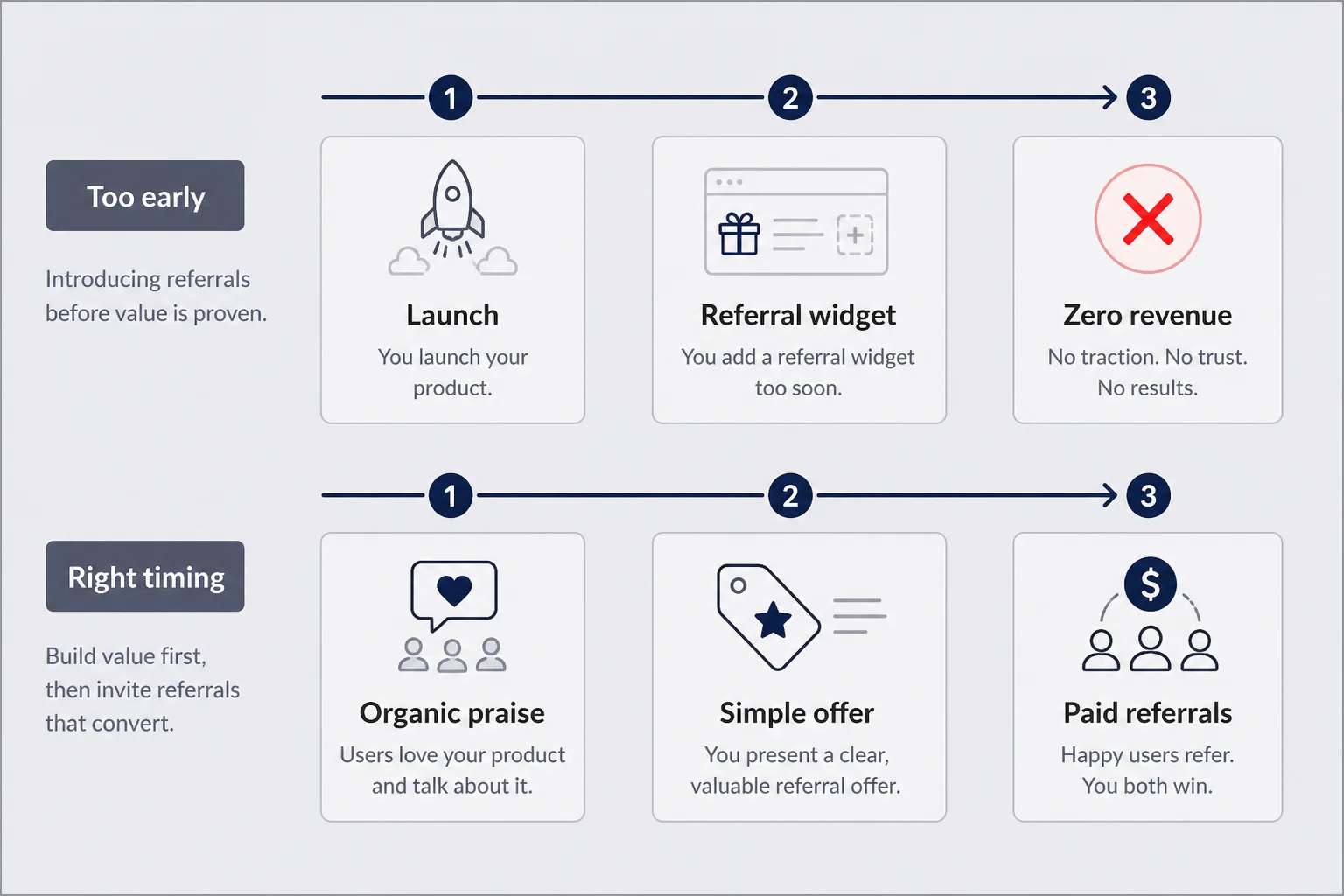
The most common mistake is treating a referral program like a launch tactic. You ship the product, add a "Invite friends" button on the dashboard, and wait for hockey stick growth. Nothing happens because nobody loves the product yet. They have no one to invite and no reason to stake their reputation on your half-finished export flow.
I did this on a side project in 2023. Built a referral page with tiered rewards before I had twenty paying users. Total referred signups in three months: eleven. Total referred revenue: zero. The invites came from founders like me testing the feature, not from customers with a real workflow win. I was optimizing distribution for an audience that did not exist.
Early referral programs also fail when the reward is unclear. "Earn rewards" is not an offer. "You both get one free month when they subscribe" is. Solo founders have limited cognitive budget. If your customer has to read a FAQ to understand what they get, they will close the tab and go back to work.
Another failure mode: paying for signups instead of conversions. Credit for creating an account attracts freebie hunters. Tie rewards to paid plans, with a clear delay if you offer trials. You are not running a list-building contest. You are sharing margin with people who brought you revenue.
I audited a founder's referral page last year. Beautiful design. Confusing rules. The headline promised "unlimited rewards" but the fine print capped credits at three per year. Two customers asked support about it in the same week. Both stopped referring. Clarity beats generosity when the alternative is suspicion.
The vanity metrics that feel like traction
Dashboards love showing "invites sent." Invites sent without paid conversions is a party trick. I would rather see three referred paying customers than three hundred invite clicks from people who never intended to buy. Track referred MRR, not referred registrations.
If your referral tool shows big numbers and your Stripe does not, believe Stripe.
Copying Dropbox when you sell to dentists
Consumer apps trained us that referrals mean leaderboards and exponential growth. B2B micro-SaaS rarely works that way. Your buyer might know four people with the same problem, not four hundred. A dentist who loves your patient reminder tool might refer one other practice in their study club. That single referral is a win. Designing for viral coefficients when your TAM is three thousand practices nationwide is cosplay.
I see founders import tactics from products with network effects when their tool has none. Project management for freelancers does not become more valuable because your friend also uses it, unless you built sharing into the core workflow. Be honest about whether you have true virality or just satisfied customers who occasionally mention you. The second case still deserves a program. It just will not look like Dropbox.
What to do instead of a referral program at month one
Month one priorities: talk to users, fix onboarding, get ten people to pay without incentives. Ask in customer calls: "How did you hear about us?" and "Who else has this problem?" If the answer is always "nobody referred me," referrals are not your bottleneck. Positioning or distribution is.
When someone does say a friend told them, ask how that conversation went. What did they say? What did the friend ask? That language becomes your referral copy later. You are interviewing for the message before you build the machinery.
When a referral program fits a micro-SaaS (and when it does not)
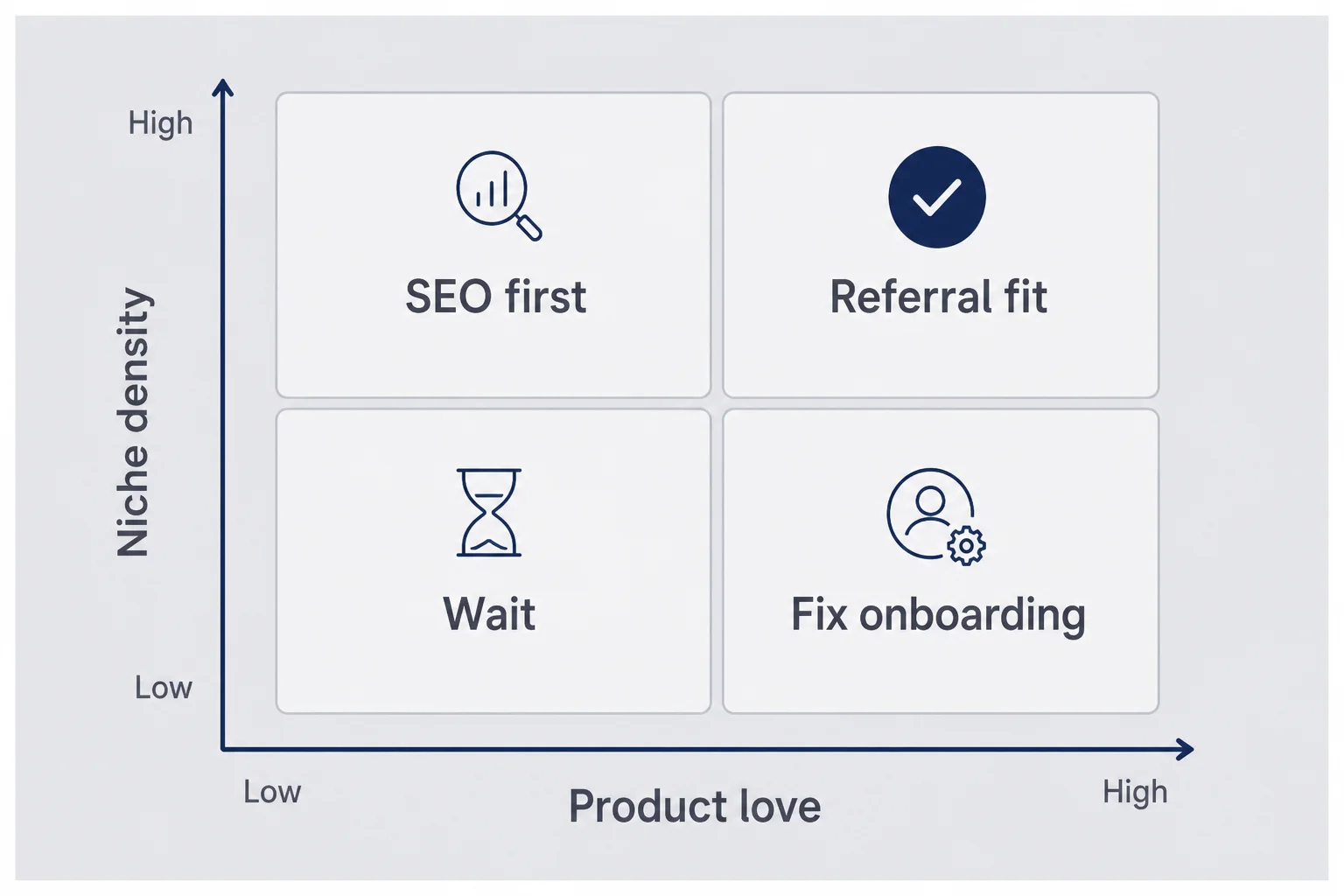
A referral program fits when customers naturally cluster in teams, communities, or professions where they talk shop. Accountants refer accountants. Shop owners know other shop owners. Indie hackers mention tools in Discord threads when someone asks for a recommendation. The product does not have to be collaborative. The buyers just have to know each other.
It fits when your pricing leaves room for a month of credit without panic. If you are at $9 a month with thin margins and no annual plans, double-sided free months might hurt. If you are at $29 to $79 for a B2B workflow tool, one month of credit per side is often cheaper than one month of Google Ads with no guarantee.
It fits when you can identify a win moment in the product. Something completed. A report exported. A first successful automation. Ask there, not on the empty dashboard.
It does not fit when you are still pivoting every month. Referral links spread old positioning. Wait until the promise stabilizes.
It does not fit when your buyers are isolated consumers with no professional overlap. A meditation app might grow through shares, but that is a different playbook than B2B micro-SaaS.
It does not fit when support cannot handle a spike of low-intent signups from incentive seekers. If your onboarding is manual and you are already drowning, fix that first.
Honest caveat: some excellent micro-SaaS businesses grow almost entirely through content and search. Micro-SaaS SEO for solo founders might be a better next channel if your buyers start with Google, not colleagues. Referrals and SEO can coexist. Pick the one your customers already do in real life.
Verticals where referrals tend to work
Agencies and freelancers who subcontract work refer tools to peers constantly. Shopify app merchants talk in Facebook groups. Accountants, bookkeepers, and ops managers swap stack recommendations when someone new joins the team. Dev tools spread through Twitter and GitHub, which is a weird hybrid of public referral and content. If your ICP has a group chat, referrals have a chance.
Verticals where referrals are harder
Enterprise-ish buyers with procurement gates. Tools where the buyer is not the user and the user cannot invite anyone. Highly regulated data where sharing a link feels risky. Single-player utilities with no natural "colleague" overlap. You can still ask for testimonials and case studies. That is not the same as a referral loop.
Pair referrals with positioning clarity
A vague product is hard to refer. "It is like Notion but for X" helps nobody explain it at coffee. If you did the positioning worksheet, your referral page should use the same one-sentence outcome. The referrer should not have to invent language. Give them a sentence they can paste: "This is what I use to stop manually copying Stripe payouts into a spreadsheet every Friday."
Double sided referral reward saas: one-sided versus double-sided credits
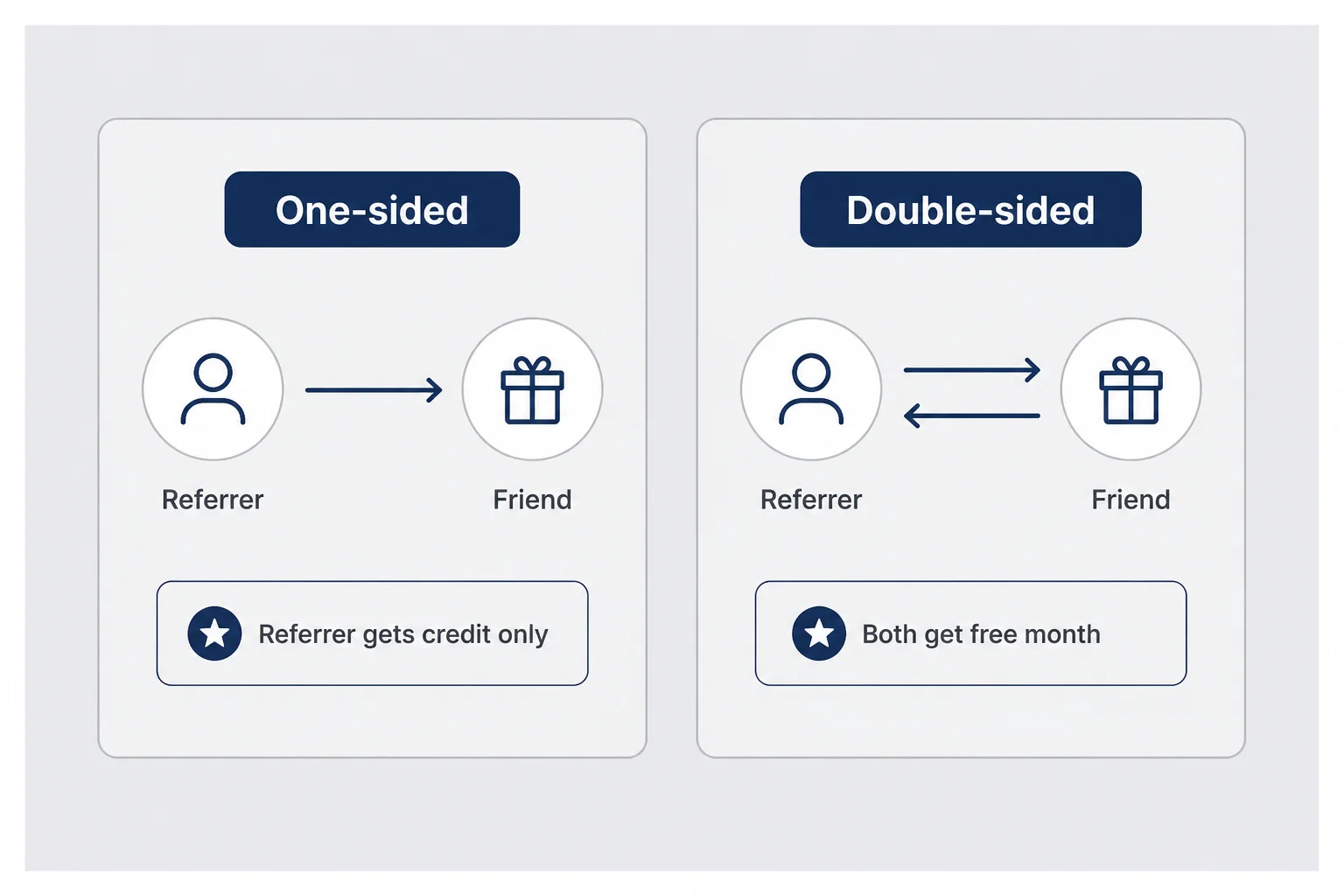
Double-sided means referrer and friend both get something when the friend pays. "Give a month, get a month" is the classic. It works because the referrer does not feel greedy. They are handing their colleague a discount, not pitching a pyramid.
One-sided means only the referrer gets credit, or only the friend gets a discount. "Refer someone and get $50 account credit" puts all the benefit on the sender. That can work when referrers are motivated by their own bill, but it can feel slimy to the friend if there is no welcome offer.
I default to double-sided for solo-founder B2B tools because the psychology is cleaner. The email sounds like "here is a link that gives you a free month" instead of "please use my link so I get paid."
Keep the reward proportional. One month free beats vague "points." Fixed credit beats percentage discounts that require a calculator. If you run annual plans, decide whether the reward applies to the first invoice only. Grandfathering confusion kills trust.
Cash payouts versus account credit
Cash sounds generous. It also creates tax questions, PayPal fees, and fraud. Account credit keeps people in your product and is instant to administer. Save cash rewards for formal affiliate relationships, not for your tenth customer referring their coworker.
If you use Stripe, promotion codes and customer balance credits are usually enough until you outgrow them.
Testing reward size without overthinking
Pick a reward you can afford to give ten times. Run it for thirty days. If uptake is zero, the problem is probably not "we needed $75 instead of $50." It is timing, awareness, or product love. I have seen founders bump rewards twice before realizing customers never saw the program. Visibility beats generosity early on.
Annual customers need explicit rules. "One month credit" on a yearly plan might mean prorating confusion. Write the rule in plain English on the referral page before someone asks in support.
SaaS referral program bootstrapping: the minimum viable loop you can ship this weekend
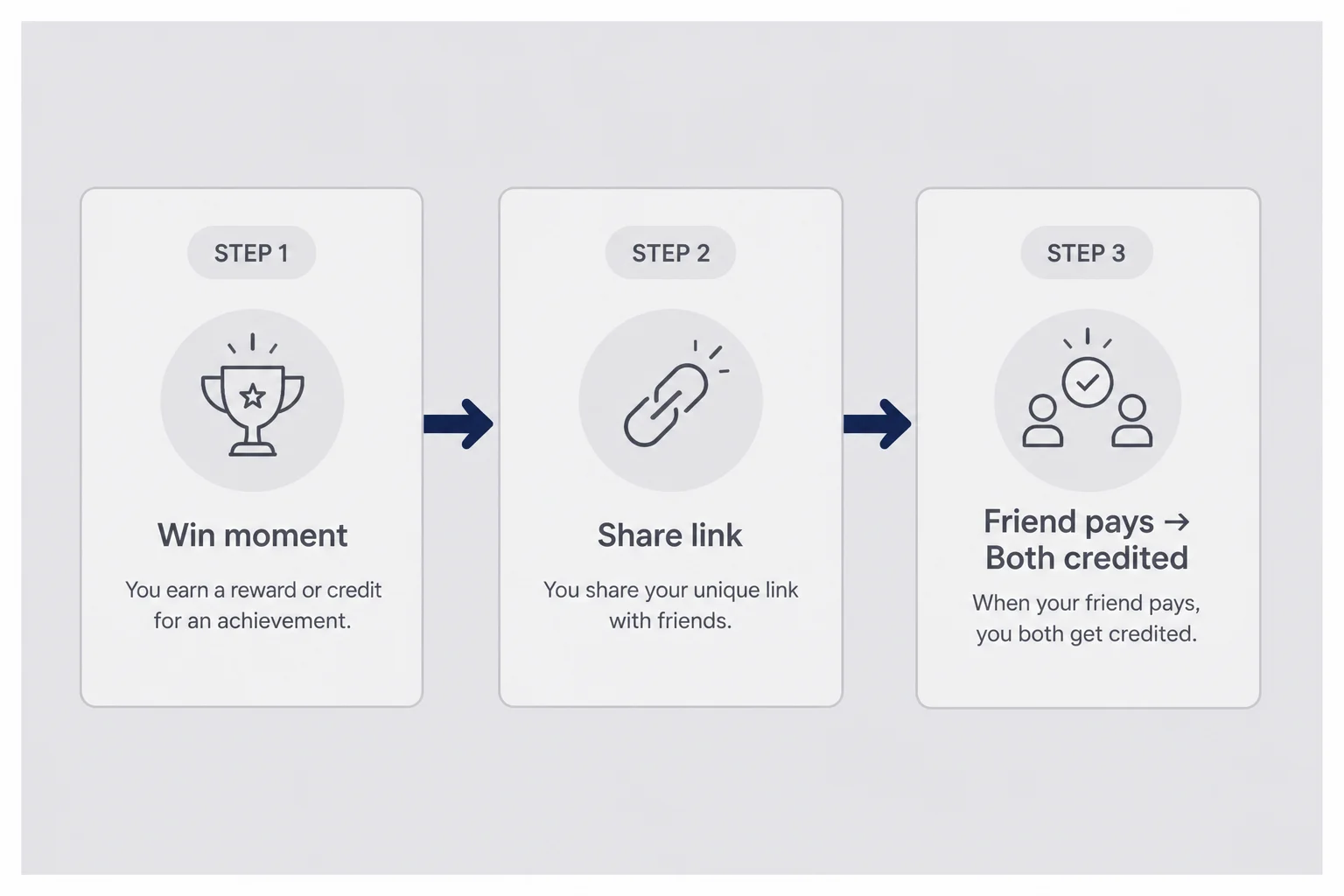
You do not need a referral platform on day one. You need a repeatable manual process that you can automate after it works.
Step one: Pick the reward. Write it in one sentence both sides understand.
Step two: Generate unique links or codes. Rewardful and FirstPromoter integrate with Stripe. If you are allergic to another subscription, start with one shared promo code for a pilot cohort of ten happy users and track manually in a spreadsheet. Imperfect tracking beats six weeks of integration procrastination.
Step three: Email ten customers who you know had a win. Personal subject line. No HTML newsletter template. "You mentioned sharing this. Here is a link that gives your colleague a free month and credits you when they subscribe."
Step four: Add one in-app surface after the win moment. Settings page is fine. A modal on first success is better. Copy is two lines and a copy button.
Step five: Review results after thirty days. How many links copied? How many trials? How many paid? If zero, talk to three customers before you redesign the widget.
That is the whole MVP. You can read how to launch a micro-SaaS for the wider launch context. Referrals are a grow lever, not a substitute for having something worth launching.
Tools that do not require a developer
Rewardful and FirstPromoter are popular for Stripe-backed SaaS. Some email tools have basic referral features. Cello and PartnerStack lean bigger than most solo founders need on day one.
If Max is your co-founder on code, a custom /r/[code] route plus a database column works. If you are not technical, do not block the program on custom code. Manual tracking with honor-system credits for your first five referrals is still a program.
A real weekend launch checklist
Friday afternoon: write the reward sentence and referral landing blurb. Generate codes or sign up for a tool trial. Saturday: email ten customers with personal notes. Sunday: add a settings card with copy link. Monday: watch Stripe and support inbox. That is a launch. No Product Hunt post required.
Use your existing email tool for the announcement. ConvertKit, Loops, whatever you already pay for. Do not buy a referral suite before you have sent the first ten manual emails. Software is for scale. Conviction comes from conversations.
Landing page for referred friends
Referred traffic is warm but not hot. They trust their friend more than they trust you. A dedicated /invite or ?via= landing page should repeat the outcome headline, show the discount clearly, and shorten signup. Sending friends to your homepage with a buried promo code is how you waste introductions.
Match the page to landing page basics for solo founders: one promise, one CTA, social proof if you have it. The friend's name does not need to be on the page. The offer does.
Invite friends as a solo founder without sounding desperate
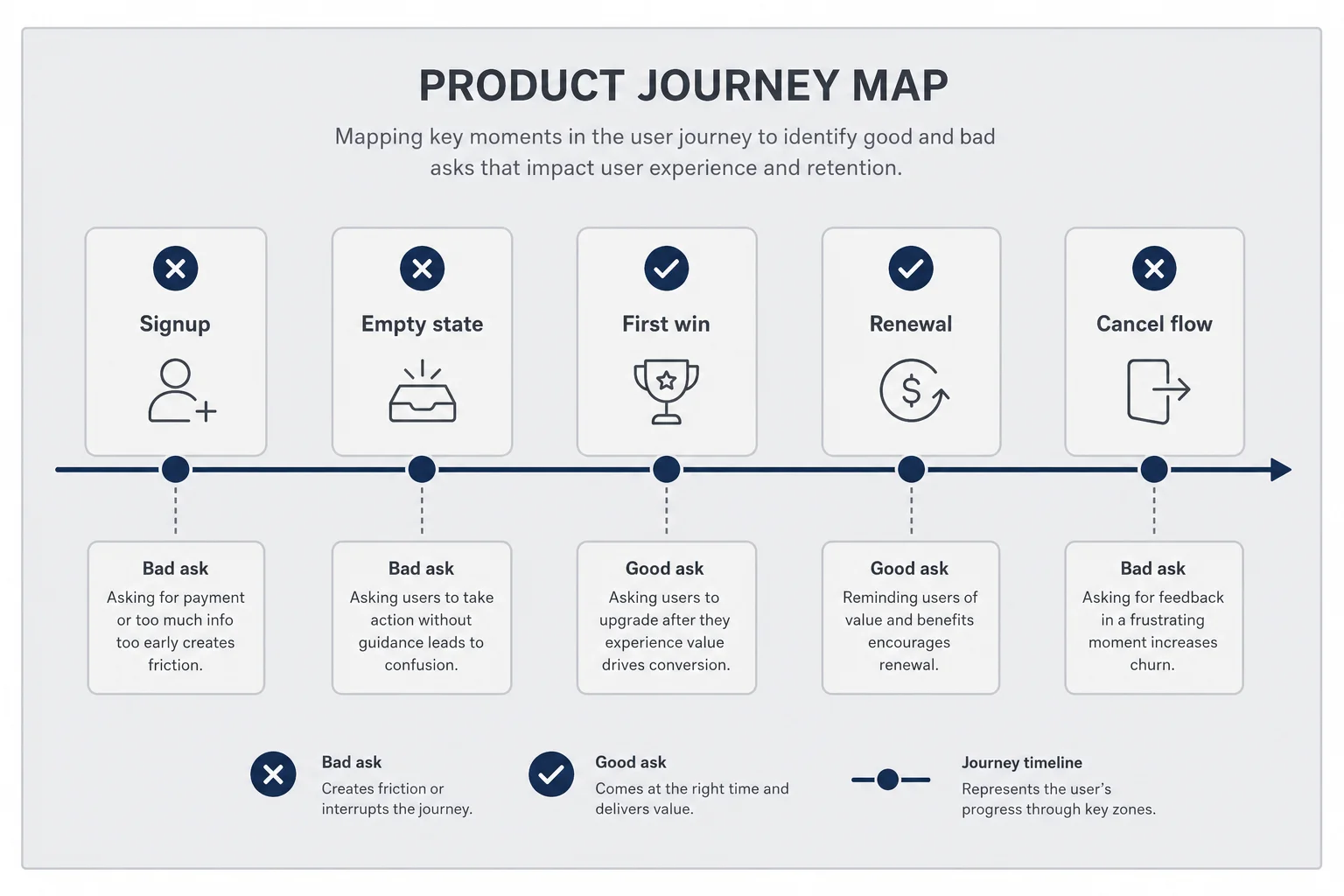
Timing is the whole game. The ask belongs after value, not before it.
Good moments: first successful outcome, renewal confirmation, positive support reply, NPS score of nine or ten, customer says "this saved me hours" in an email.
Bad moments: signup screen, empty state, failed payment, cancellation flow, day-one onboarding checklist.
I like one email sent manually from the founder account when you notice a win in support or usage data. "Saw you ran your first batch report. If anyone on your team has the same headache, here is a link." That beats an automated "Refer now!" banner that follows users like a guilt trip.
In-app placement should be quiet and persistent. A card in billing settings works. A full-screen takeover does not.
Community channels matter too. If you run a small Slack or Discord for customers, pin the referral terms once. Do not spam weekly.
What to say when they refer someone who does not convert
Thank the referrer anyway. "Thanks for sending Jordan. They are still on trial. I will make sure they get a fair shot." Silence teaches people their introductions do not matter.
If the friend churns fast, that is a product signal, not a referral failure. Fix onboarding before you tweak the reward size.
Email templates that sound like you, not a growth robot
Here is a structure I use. Subject: "Link if a colleague has the same headache." Body: one sentence of context ("You mentioned you run reports for clients every month."), one sentence of offer ("This link gives them a free month and credits your account when they subscribe."), the link, one sentence permission ("No pressure if it is not relevant."). Sign with your first name. That is the whole email.
Do not BCC ten customers with the same mail merge and pretend it is personal. Send ten individual emails. At this scale, batching is false efficiency.
In-app patterns that work at small scale
A small card below the success state: "Know someone else who hates manual exports? Share a free month." Copy button. Link to terms. Done.
Avoid gamification badges unless your audience is literally gamers. "You are three invites away from Super Ambassador" makes accountants cringe.
Tracking referrals without a growth team
You need four numbers, not forty.
Links or codes active — how many customers actually have a referral asset.
Referred signups — trials or accounts created with attribution.
Referred paid customers — the only number that pays your rent.
Referred MRR — what those customers contribute monthly.
Calculate referral rate as referred paid customers divided by total new paid customers in the same period. Do not use invite clicks in the denominator.
Stripe metadata, promotion codes, and UTM parameters on referral URLs are enough for most solo founders. Put ?ref= on the signup link and store it in the user record on account creation. If you lose attribution sometimes, fix it when volume justifies engineering time. At five referrals a month, a spreadsheet with customer names is fine.
Watch for self-referrals and duplicate accounts. Same credit card, same company domain, obvious gaming. A simple manual review on payout is enough at small scale.
When to automate payout
Automate when you are crediting more than ten successful referrals a month or when manual Stripe adjustments eat your Tuesdays. Before that, automation is procrastination dressed as product work.
Building a simple referral dashboard in a spreadsheet
Columns I track: referrer name, referral link or code, date sent, referred signup date, trial start, paid conversion date, MRR added, reward credited date, notes. Ugly but legible. Review monthly. If a referrer sends three people who all churn in week two, I call them and ask what went wrong. That is customer research wearing a growth hat.
Connect Stripe exports if you want. Plausible or GA for link clicks is optional. Clicks without signup data are a half answer. Signup without payment data is the same vanity trap as invite counts.
Cohort thinking for referred customers
Referred users often retain better than cold traffic when the referral was genuine. They arrived with context. Track retention separately for ninety days. If referred customers churn faster, your product might be fine for evangelists but confusing for newcomers. Tighten onboarding for referred signups specifically. A welcome email that says "Alex thought this might help with X" beats a generic drip.
Referral copy that does not read like a pyramid scheme
Customers will not forward corporate-speak. Write the message they would send in Slack, then shorten it.
Bad: "Join our exclusive referral ecosystem and unlock premium rewards."
Good: "I use this for client reports. This link gives you a free month if you try it."
The in-app copy should answer three questions in plain language. What does my friend get? What do I get? When do we get it?
Put the friend benefit first. It makes the referrer feel helpful instead of salesy.
Subject lines for the founder email: "Link if your colleague has the same problem" beats "Earn rewards today."
If you use social share buttons, pre-fill text that sounds human. Do not force Twitter posts that read like ad copy. Most B2B referrals happen in private messages anyway. Optimize for copy-link, not public broadcast.
Legal and policy basics
You do not need a twenty-page terms doc on day one. You do need clear rules posted somewhere: reward triggers on paid conversion, one reward per new customer, you can change or end the program, no spamming. If you operate in regulated industries, skim what your customers' employers allow. When in doubt, a short paragraph on the referral page beats silence.
Examples of copy I would actually send
Slack message version: "We use LedgerLoop for payout reconciliation. Free month here if you want to try: [link]."
In-app microcopy: "Give a colleague a free month. You get one too when they subscribe."
Footer of a success email: "If someone on your team still does this manually, they can start here: [link]."
Notice none of these say "referral program," "ambassador," or "unlock rewards." They describe a favor with a fair trade attached.
Measuring whether your referral program is working
Most founders declare failure at day fourteen. Referrals move slower than ads. Give a new program sixty to ninety days if you actually promoted it to happy users.
Green flags: referred signups convert to paid at or above your site average, referrers send a second person without prompting, support tickets from referred users are about usage not confusion about the discount.
Yellow flags: lots of link copies, no signups. Offer or landing page problem. Signups, no payment. Positioning or trial problem. Payments, fast churn. Onboarding problem.
Red flags: incentive fraud, support complaints about spammy referrers, referrers who only signed up to farm credits themselves. Pause and tighten rules.
Compare referred CAC to one other channel you run. If cold email costs you six hours per customer and referrals cost one month of MRR, referrals win when retention holds. If you do not run any other channel, referrals are still worth building because they compound with product quality.
I once ran a referral pilot for a client whose product helped agencies report ad spend. We emailed twelve customers who had left five-star support ratings. Four replied. Two sent links. One conversion in thirty days. That sounds tiny until you realize their paid ads had produced zero conversions in the same month. We kept the program, tightened the landing page, and hit six referred customers in quarter two. Slow channels need patience and honest measurement, not abandonment at week three.
When referrals work, resist the urge to rebuild everything. Add a reminder email at renewal. Test one copy tweak. Ship a second win moment prompt. Incremental beats replatforming.
Say you end quarter one with six referred paying customers out of thirty new logos. That is twenty percent from a channel you barely maintained. You do not need to hire a growth person. You need to email your top three referrers and ask what would make the next introduction easier. Sometimes the answer is embarrassing: "I did not know you had a link." Fix visibility before you fix economics.
Questions founders actually ask about referral programs
When should a solo founder launch a referral program?
After you have paying customers who would recommend you without a bribe. If nobody has renewed or referred you organically, a referral widget will not fix product-market fit. I usually wait until at least ten people paid and two mentioned a colleague unprompted. Then you are codifying behavior that already exists, not inventing it.
What reward works best for a micro-SaaS referral program?
Account credit beats cash for most bootstrapped tools. A month free for both sides is easy to explain and does not require PayPal payouts. Keep the reward tied to a paid conversion, not a signup. Paying for empty accounts trains the wrong behavior and attracts people who never intended to use the product.
Do I need custom code for referrals?
Not at first. Stripe promotion codes, Rewardful, FirstPromoter, or even a manual spreadsheet plus a unique link per customer can work until volume justifies automation. I have seen founders ship a referral program in an afternoon with a shared promo code and a personal email to ten happy users. Fancy infrastructure comes after you know anyone clicks.
Should referrals be double-sided or one-sided?
Double-sided usually converts better because the referrer does not feel like they are selling. Both people get something when the friend pays. One-sided can work in tight B2B niches where the referrer cares about reputation more than credit. Test one offer for a month before you redesign the whole flow.
How do I ask for referrals without annoying customers?
Ask after a win, not after onboarding. Someone who just exported their first clean report or closed their first invoice with your tool is warm. Someone on day two who has not finished setup is not. One short in-app note or email beats a permanent banner begging for invites.
What is a good referral rate for a solo micro-SaaS?
There is no universal benchmark. Five to fifteen percent of new paid customers from referrals is strong for a young product. Zero for six months might mean you asked too early or the product is not remarkable enough to mention. Track referred signups and referred revenue separately. Vanity invite counts lie.
You do not need viral mechanics. You need one friend who had the same problem.
That customer who told her bookkeeper about the product was not waiting for a leaderboard. She was being helpful in a conversation that already happened. Your job is to make the next hundred conversations one click easier, and to say thank you when money follows.
Start small. Ten happy users. One clear offer. One win moment. Measure paid referrals, not vanity invites. If the loop works, double down. If it does not, talk to customers before you buy fancier software.
I still think about that bookkeeper who never signed up. The product was good enough to mention. The referrer was willing. I failed on the handoff. Do not repeat my mistake. Build the link before you need it. Write the reward in one sentence a tired professional can forward without reading a FAQ. Then get back to making something worth mentioning in the first place.
A product nobody hears about is just an expensive hobby. A product people mention in passing, but you never reward or track, is leaving the cheapest growth on the table. Fix the link. Fix the timing. Then see if word of mouth was there all along, waiting for you to stop being busy with buttons nobody clicked.




Comments